NetSuite Manufacturing: Contract & Outsourced Guide
Hyperbots simplify manufacturing finance, fewer exceptions, faster approvals, and complete audit trails within NetSuite.
Executive Summary
Manufacturers choose NetSuite for a unified backbone including planning, procurement, production, inventory, costing, and financials, without stitching together brittle point tools. But success in modern supply chains often hinges on building a scalable model for partner production: NetSuite contract manufacturing (where a contract manufacturer builds on your behalf) and NetSuite outsourced manufacturing (where specific routing steps are performed externally) are essential patterns to master.
This deep, CFO-friendly guide explains how to architect both patterns in NetSuite, such as BOMs and routings, work orders and WIP, outside processing, costing, intercompany and tolling, quality, traceability, and P2P flows, while keeping accounting clean. Then it shows how Hyperbots, with six finance-grade AI Co-pilots running on top of NetSuite, amplify throughput, reduce exceptions, and increase straight-through processing (STP) across Procure-to-Pay (P2P), Accruals, Sales Tax Verification, and Vendor Management. If you’re seeking faster close cycles, duplicate-payment prevention, cleaner vendor masters, and higher first-pass match rates, this is your playbook.
You’ll get a practical implementation blueprint, governance and controls, data and testing checklists, KPIs to track, and a ready-to-adapt RACI. We also include image/flowchart suggestions and underlined links to relevant Hyperbots pages for quick action.
Who This Guide Is For
Operations leaders building hybrid networks of in-house and partner plants
Supply chain managers are establishing NetSuite contract manufacturing programs
Finance/Accounting teams responsible for NetSuite outsourced manufacturing controls, cost capture, and period-end accuracy
IT/PMO implementing scalable, auditable NetSuite manufacturing setups
CFOs seeking measurable ROI from automation on top of NetSuite
NetSuite Manufacturing: Core Concepts
Before we dive into NetSuite contract manufacturing and NetSuite outsourced manufacturing, anchor these foundations:
Items & Structures
Items: Assemblies, components, subassemblies, buy items, service (outside processing) items.
BOMs: Engineering vs. manufacturing BOM alignment; alternates for regional vendors.
Routings: Work centers, labor/burden standards, queue/transfer times, yield loss.
Production & WIP
Work Orders (WOs): Issue materials (backflush or manual), record labor, complete assemblies.
Outside Processing: Treat external steps as vendor operations in the routing or via PO-based service steps.
Completions: Partial vs. full; lot/serial assignment at completion.
Inventory & Locations
Locations/Bins: Separate partner locations; quarantine/inspection locations for inbound from CMs.
Landed Costs: Freight, duty, tariffs, and outside-processing fees are capitalized to inventory where applicable.
Costing
Methods: Standard, Average, FIFO; choose per item type and volatility.
Variances: Material, labor, overhead, subcontract/outside processing variance.
Financials
WIP Accounts: Accumulate costs until completion; clear at assembly build.
AP/PO Integration: Service POs to contract vendors; three-way match where receipts apply.
NetSuite Contract Manufacturing: The Playbook
NetSuite Contract Manufacturing is a business model where a third-party contract manufacturer (CM) builds finished goods under your brand and often your part numbers. You may supply all/part of the materials (consigned) or the CM may procure (turnkey or hybrid).
A. Structural Setup
Locations
Create a dedicated Contract Manufacturer Location for each CM (or one per region).
Optional: “Consigned at CM” sub-locations to isolate consigned stock.
Items
Finished goods: assembly items owned by you.
Components: mark as consigned or non-consigned based on responsibility.
Service items: “Outside Processing” for fees not tied to receipts.
BOM & Routing
Standard BOM for finished goods; define routing even if operational steps are outside.
If CM performs the entire routing, model a single outside-processing step to capture fee per unit or lot.
B. Supply Models
Consigned: You ship components to CM; ownership stays with you; CM returns finished goods.
Turnkey: CM buys materials; you pay a per-unit build price covering materials + conversion.
Hybrid: You consign critical items; CM buys the rest.
C. Transaction Flows
Consigned:
Transfer Order from your DC to the CM location (ownership remains yours).
CM builds; you complete assembly into the CM location (or receive finished goods back into your plant).
CM issues a vendor bill for conversion cost (outside processing service).
Turnkey:
Purchase Order to CM for finished assemblies.
Item Receipt on delivery; costs include materials + conversion.
Vendor Bill matches receipt; variances analyzed vs. standard.
D. Cost Capture
Conversion Fee: Use service items tied to the routing step or landed costs on receipt.
Material Cost:
Consigned: component cost remains on your books; WIP to FG at completion.
Turnkey: included in CM PO price; standard vs. actual variances tracked.
Freight/Duty/Tariff: Landed costs apportioned to receipt lines.
E. Controls & KPIs
Controls: CM location segregation, CM-specific approval thresholds, mandatory lot/serial capture, and tolerance rules for over/under-delivery.
KPIs: Yield %, on-time delivery, first-pass quality, conversion cost/Std, PPV, WIP aging, CMO forecast adherence.
F. Why It Works
This pattern keeps accounting clean, simplifies demand planning (you can MRP to the CM location), and provides transparency into NetSuite contract manufacturing cost drivers that finance teams need for monthly close and forecasting.
NetSuite Outsourced Manufacturing: The Playbook
NetSuite Outsourced Manufacturing applies when a specific routing step (e.g., heat-treat, plating, SMT, sterilization) is done externally, and your team executes earlier/later steps in-house.
A. Structural Setup
Routing: Insert an Outside Processing operation with a vendor, expected lead time, and cost driver (per piece, per lot, per hour).
Service Item: Attach a service item to the operation to capture the vendor’s charge.
WIP Location: Optionally create “WIP – External” to track items while offsite.
B. Transaction Flows
WO Release issues components and starts routing.
At the outsourced step, ship WIP to the vendor (transfer to WIP-External or vendor location).
After processing, receive WIP back and continue routing; ultimately complete assembly.
Vendor Bill posts the outside processing charge; it rolls into WIP/FG per your costing method.
C. Costing & Variances
Standard cost for outside processing hits at completion; actuals hit AP.
Analyze variances between standard and invoice amounts; refine standards.
D. Quality & Compliance
Certificate of Conformance (CoC) or lab results logged at the outsourced step.
Non-conformance loops back to the vendor; use inspection holds.
E. Why It Works
NetSuite outsourced manufacturing keeps production granular and traceable while reflecting real costs per step—giving operations and finance a clear view of throughput, external capacity, and yield.
Planning & MRP/DRP with External Partners
Whether you’re running NetSuite contract manufacturing or outsourcing specific steps, your planning model must consider external lead times, MOQs, transfer times, and capacity.
Demand Planning: Forecast at the FG level; explode demand to the CM location or to the outsourced steps’ buffers.
MRP Parameters: Set item lead times to include external step durations; add safety stock at CM locations.
Supply Type: Consigned flows use transfer orders; turnkey uses POs to CM; outsourced steps may use service POs tied to WOs.
Capacity: Treat external steps with realistic queue/transfer times; align promises with CM capacity calendars.
What-If: Simulate cost/time impact of moving a routing step outside or switching CMs.
Inventory, WMS, and Traceability
Locations/Bins for each CM and for “WIP-External” help isolate responsibility and simplify counts.
Lot/Serial at completion and at receipt from CMs enables cradle-to-grave traceability.
Cycle Counts: CM locations can be counted using shipment/receipt logs and reconciliation reports.
Returns/NC: Non-conforming from CM goes to quarantine; generate RTV or rework WO.
WMS: Scanners for issue/return at CM docks, ASN ingest, and staged receipts reduce transaction lag and errors.
Costing, WIP, and Variances
Standard Costing for stable products; Average/FIFO where material prices swing.
WIP accumulates materials, labor/burden, and outside processing until completion.
Landed Costs capture non-material cash leakage (freight, duty, tariffs).
Variances to monitor:
PPV (purchase price variance) on CM turnkey buys;
Outside Processing variance (standard vs. actual invoiced);
Usage variance (BOM vs. actual) from yield or scrap;
Labor/Burden variance when steps shift outside.
Routing variance if cycle times differ from the standard.
Month-End: Reconcile WIP aging, review unvouchered receipts, true-up landed costs, and post accruals for in-transit external steps.
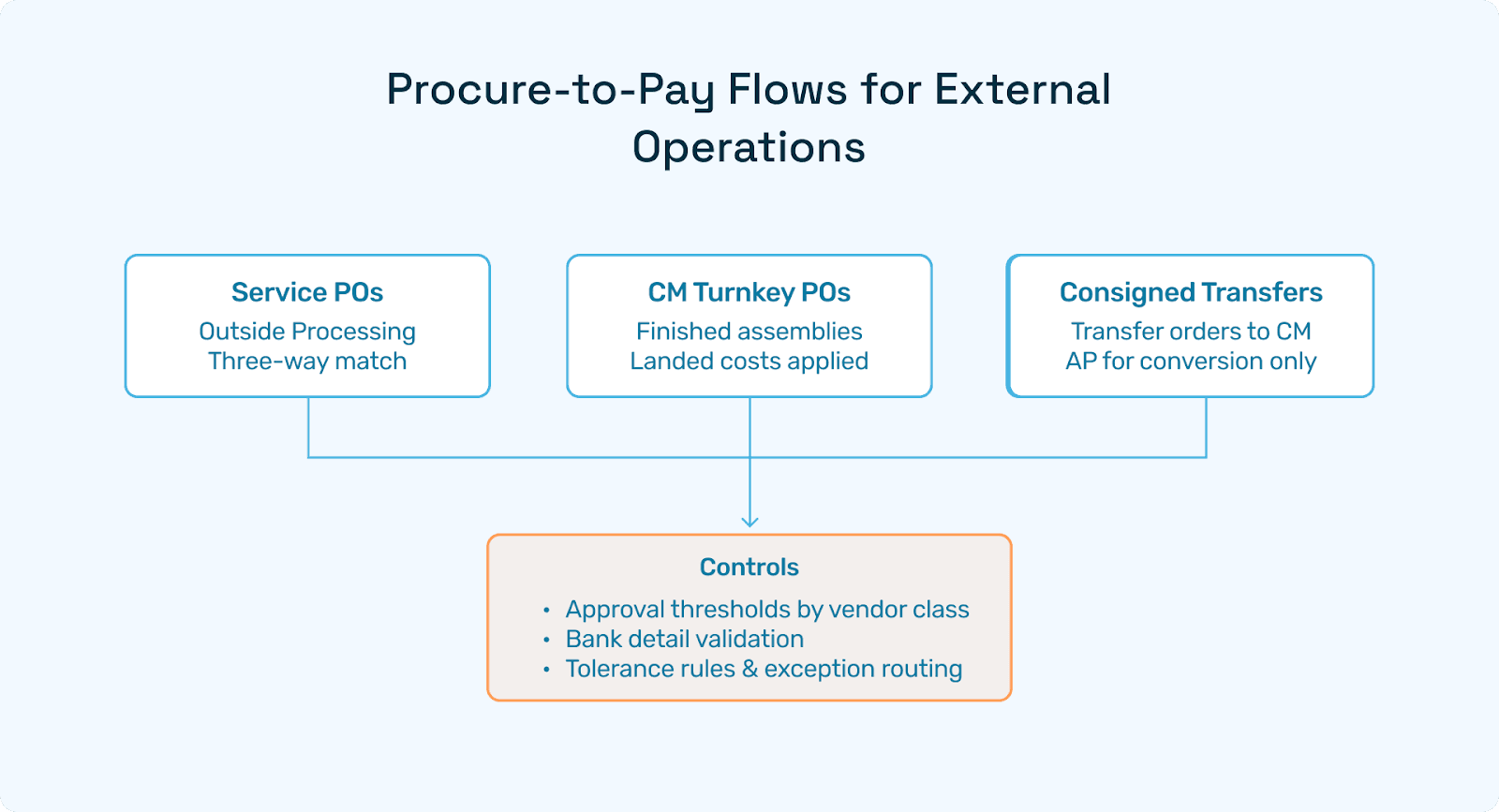
Procure-to-Pay Flows for External Operations
A clean P2P model is the backbone for both NetSuite contract manufacturing and NetSuite outsourced manufacturing.
A. Service POs for Outside Processing
Issue POs tied to WOs/operations; receipts may be “service receipts” or completion confirmation.
Three-Way Match where applicable (service receipt or milestone receipt).
B. CM Turnkey POs
Vendor supplies finished assemblies; you receive them like any other buy item.
Landed costs and tariff codes are applied at receipt.
C. Consigned Transfers
Transfer Orders to CM; ownership remains yours.
AP only for conversion and logistics charges.
D. Controls
Approval thresholds by vendor class (CMs vs. logistics).
Bank detail validation for vendor setup and changes.
Tolerance rules for price/qty variances; exception routing to AP/Procurement.
Quality & Compliance for Partner Production
Incoming Inspection for all critical CM receipts; sampling plans by risk.
Certificates & Photos stored against the receipt/WO operation.
Regulatory: Track country of origin, HTS codes, and conflict minerals where applicable.
Audit: Evidence pack (PO, ASN, inspection, completion, bill) linked to each batch/lot.
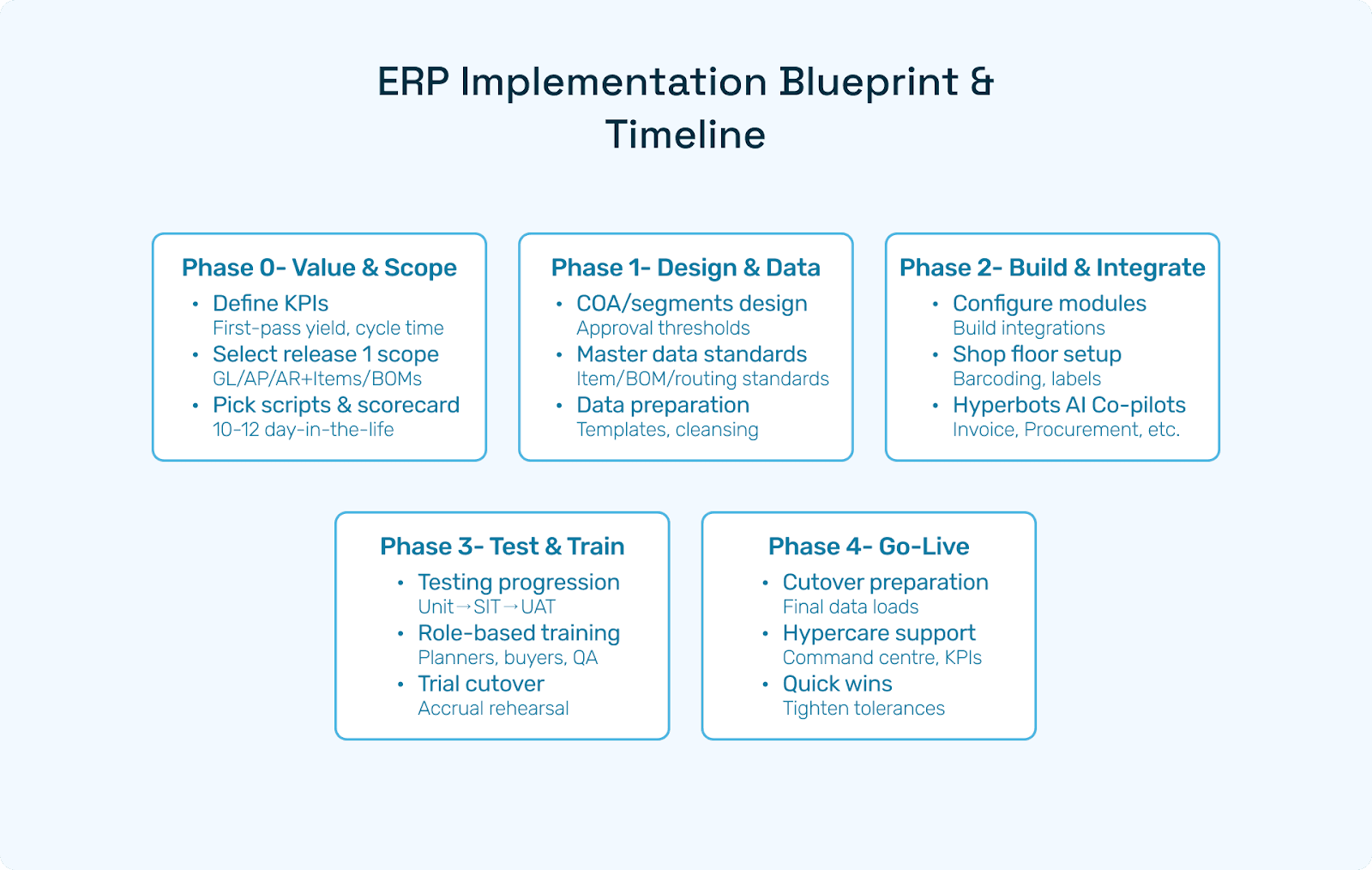
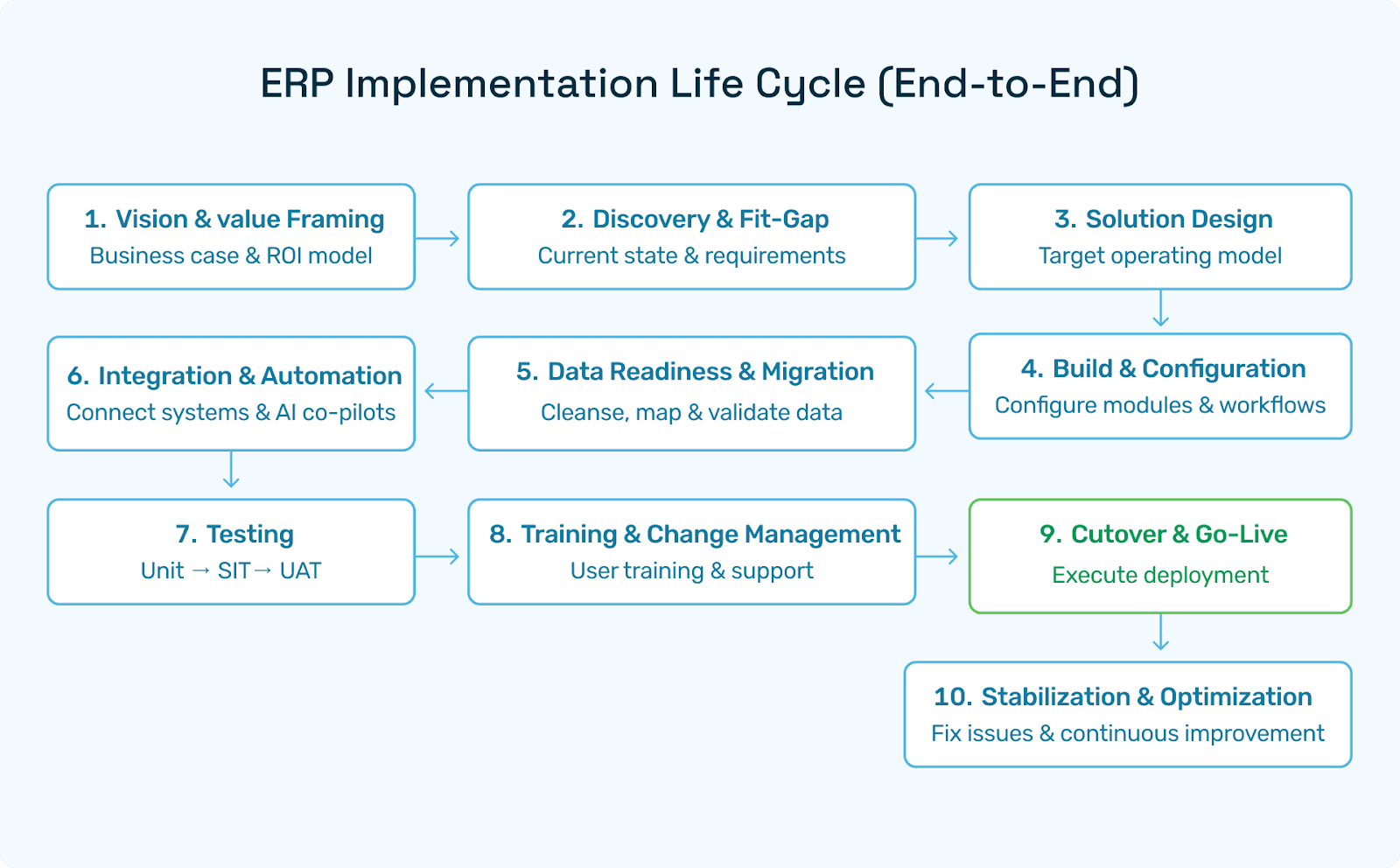
Implementation Blueprint (Step-by-Step)
Use this sequence whether you’re launching NetSuite contract manufacturing or NetSuite outsourced manufacturing:
Define Business Models: Consigned vs. turnkey vs. hybrid; which routing steps go outside.
Data Readiness: Item masters (buy/make/service), BOMs/routings, vendor masters (KYC/banking), locations/bins.
Controls & Security: SoD, approval limits, maker-checker for vendor banking, tolerance configuration.
Transactions Design: POs, TOs, WOs, receipts, completions, returns; landed cost tables.
Costing Strategy: Method per item; standard updates cadence; landed-cost apportioning rules.
Integrations: ASN from CMs, quality/PLM feeds, tax engines, banks, AP inbox.
Testing: Golden scenarios (consigned, turnkey, partials, rework, NC, chargebacks); regression pack.
Training: Role-based SOPs for planners, buyers, AP, receiving, QA, and controllers.
Cutover: Freeze windows; inventory counts; open PO/WIP reconciliation.
Hypercare: Daily KPI huddles; defect burn-down; quick wins (approval thresholds, vendor data fixes).
KPIs & Dashboards That Matter
Operations: OTD from CMs, external step cycle time, yield %, scrap %, rework rate.
Inventory: WIP aging, CM location turns, consigned accuracy, days at CM.
Cost: PPV, outside processing variance, landed cost variance, standard vs. actual.
Finance/AP: First-pass match %, STP %, duplicate rate, invoice cycle time, DPO, discount capture.
Risk/Compliance: Vendor KYC completeness, bank detail validation hits, audit findings closed.
How Hyperbots AI Co-pilots Supercharge NetSuite
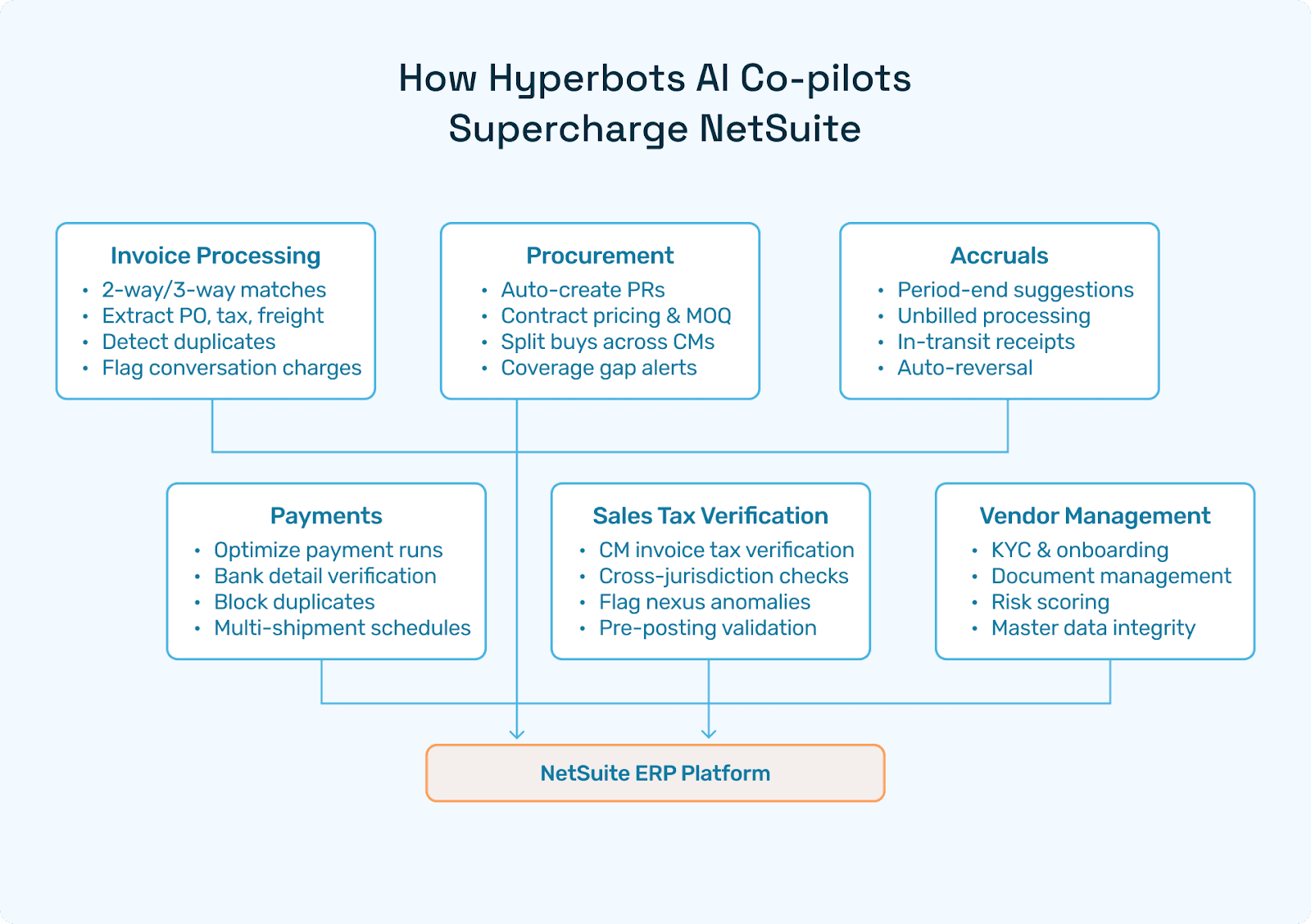
Hyperbots sits as an AI layer on top of NetSuite, purpose-built for Finance & Accounting in manufacturing. The platform uses a Mixture-of-Experts (VLM + layout models + finance-tuned LLMs) to read messy documents, reason line-by-line, and apply policy-aware actions, resulting in 80%+ STP and 10%+ cash-outflow savings frequently observed in mid-market scenarios.
1) Invoice Processing Co-pilot -
Extracts POs, line items, tax, freight, and incoterms from CM invoices; detects duplicate bills; performs 2-way/3-way matches against NetSuite POs or service operations; flags conversion charges vs. materials for NetSuite contract manufacturing and NetSuite outsourced manufacturing.
2) Procurement Co-pilot -
Auto-creates PRs for outside-processing steps or CM buys; recommends contract pricing, MOQ, and split buys across CMs; nudges planners when coverage gaps arise at CM locations.
3) Accruals Co-pilot -
Suggests period-end accruals for unbilled outside-processing, in-transit CM receipts, and landed cost estimates; auto-reverses with evidence links when bills post.
4) Payment Co-pilot -
Optimizes payment runs (terms, cash balance, discounts); verifies bank details; blocks duplicates and overpayments on multi-shipment CM schedules.
5) Sales Tax Verification Co-pilot -
Verifies tax on CM invoices and logistics bills across jurisdictions; flags nexus-driven anomalies before posting to NetSuite.
6) Vendor Management Co-pilot -
Speeds onboarding (KYC, bank validations), keeps documents current (ISO, insurance), scores vendor risk and performance; maintains master data integrity for CMs and outside processors.
What changes for manufacturing?
The co-pilots understand BOM/routing contexts, outside-processing operations, landed-cost patterns, shipment/ASN evidence, and partial completions, so exceptions drop, close accelerates, and audit becomes simpler.
Hyperbots Platform Capabilities for Manufacturing
Finance-Trained AI (HyperLM + MoE): Vision + language models trained on F&A artifacts (invoices, POs, GRNs, tax lines, statements).
Deep Connectors: Real-time read/write with NetSuite; email ingestion (Gmail/Outlook); bank rails; tax engines; EDI and commerce.
Reasoning & Policy: GL coding suggestions, anomaly/duplicate detection, approval-policy nudges, tolerance logic per vendor class (CMs, logistics).
Security: Role-based access, SoD awareness, redaction, audit logs.
Scalability: Microservices (Java backend, Postgres, React), high-volume document processing, multi-entity, and multi-currency ready.
Outcome Focus: Designed with CFOs to drive 80%+ STP, trimmed cycle times, and cash-leak prevention (PPV, duplicates, tax variance).
Integration Patterns with NetSuite
Inbound Documents: AP inbox → Hyperbots extraction/validation → NetSuite Vendor Bill/Expense with matched PO/receipt/service step.
Vendor Masters: Onboarding via Hyperbots portal → Validated KYC/bank data → NetSuite vendor records with controlled role updates.
PO/PR Creation: Hyperbots raises PRs for outside-processing or CM buys; routes approvals; writes POs into NetSuite.
Accruals: Suggested accruals posted to NetSuite with reversal entries; evidence links preserved.
Payments: Payment batches proposed; bank details verified; exceptions flagged prior to AP run.
Telemetry: KPIs (STP, cycle time, duplicate rate) feed a shared dashboard across Ops, Finance, and Procurement.
Security, SoD, and Audit Evidence
SoD & Approvals: Separate creators/approvers; stricter thresholds for CM and logistics vendors.
Vendor Banking: Maker-checker on bank changes; auto-validation against known patterns.
Documents & Trails: Every posting includes linked evidence (PO, WO, receipt/completion, inspection, bill).
Compliance: Support for ISO documentation, country-of-origin data, HTS codes, and audit exports.
FAQs: Contract & Outsourced Manufacturing in NetSuite
Q1. What’s the difference between NetSuite contract manufacturing and outsourced manufacturing?
A: NetSuite contract manufacturing: the CM builds the finished good for you, consigned or turnkey. NetSuite outsourced manufacturing: only specific routing steps happen outside; you still execute other steps internally.
Q2. How should I capture conversion cost from a CM?
A: Use a service item tied to a routing step (outside processing) or as a landed cost on receipt. In turnkey, the PO price often includes materials + conversion.
Q3. How do consigned flows differ from turnkey?
A: Consigned: you ship components (ownership stays with you) and pay the CM for conversion + logistics.
Turnkey: You buy finished goods; the CM procures materials.
Q4. What about quality and traceability?
A: Use inspection locations, sampling plans, and mandatory CoCs at CM receipts or outsourced steps. Record lot/serials at completion and receipt.
Q5. How does Hyperbots help in the month-end close?
A: It accrues unbilled outside-processing and in-transit CM receipts, reconciles receipts vs. bills, detects duplicates, and prepares evidence packs—so close is faster and cleaner.
Q6. Can Hyperbots reduce AP workload for CM invoices?
A: Yes. The Invoice Processing Co-pilot extracts and validates lines, performs 2-/3-way matches, checks taxes/freight/terms, and auto-routes only real exceptions.
Q7. Does this scale across multiple CMs and regions?
A: Yes, use separate CM locations, standardized routing/operation codes, a shared price book for conversion, and Hyperbots’ vendor intelligence to retain consistency.
Q8. Which costing method should I use?
A: Stable products: Standard cost with periodic updates.
Volatile: FIFO/Average. Track PPV and outside-processing variance either way.
Q9. How do I avoid duplicate bills?
A: Lock down vendor master changes, enforce PO reference on invoices, and use Hyperbots duplicate detection (hashes across vendor, date, amount, line patterns).
Q10. How do I measure success?
A: OTD from CMs, yield %, PPV, outside-processing variance, WIP aging, first-pass match %, STP %, duplicate rate, invoice cycle time, DPO, discount capture.
Call to Action
Ready to operationalize NetSuite contract manufacturing and NetSuite outsourced manufacturing with airtight controls and faster close?
Book a working session: Hyperbots Demo
Get starter templates (flows, RACI, KPIs): Manufacturing Ops Kit
Final Note on Hyperbots + NetSuite
Hyperbots’ AI Co-pilots were designed with CFOs and controllers to handle the gritty realities of manufacturing F&A: multi-page CM invoices, partials and split shipments, tariff/freight allocations, outside-processing accruals, and evidence-rich audits.
The result is fewer exceptions, faster approvals, and a clear trail from PO → WO/Operation → Receipt/Completion → Bill → Payment, all natively tied into NetSuite.