Best Software for Manufacturing Company (2025 Guide)
Hyperbots automates finance within manufacturing ERP, reducing manual work and enabling faster, cleaner plant operations.
Executive Summary
Manufacturing leaders are navigating a ruthless equation: shorter lead times, volatile supply costs, tight labor markets, and rising compliance demands. Selecting the best software for manufacturing company success isn’t about the longest feature checklist; it’s about choosing a platform mix that fits your build model, budget, and growth arc, and then executing a clean rollout with measurable results.
This comprehensive buyer–implementer guide gives you:
A practical map of the major types of manufacturing software, such as ERP, MES, QMS, WMS, APS, PLM, EAM/CMMS, IIoT/SCADA, CPQ/Order-to-Cash, and when each delivers value.
A deep dive into factory production software essentials for shop-floor control, OEE, traceability, and outside processing.
A clear-eyed evaluation of cloud-based ERP systems for manufacturing (a.k.a. cloud manufacturing ERP): what to expect in functionality, security, integrations, and TCO.
A step-by-step implementation blueprint covering data, testing, training, cutover, and early KPIs, plus patterns for contract/outsourced production.
Where Hyperbots fits: six Finance & Accounting AI Co-pilots that sit on top of your ERP to automate invoice capture and matching, procurement, accruals, payments, sales-tax checks, and vendor management, raising straight-through processing (STP) to 80%+ and accelerating close.
What “Best Software” Really Means in Manufacturing
When leaders search for the best software for a manufacturing company, they’re often handed brand lists and generic checklists. “Best” is context:
Build model: Engineer-to-Order (ETO), Configure-to-Order (CTO), Make-to-Stock (MTS), Make-to-Order (MTO), project-based, batch/process, or job shop.
Network & outsourcing: Single plant vs. multi-site, contract manufacturers, outside processing steps.
Regulatory & traceability: ISO, FDA/CGMP, aerospace/defense, lot/serial, CoC/COA, country-of-origin.
Complexity vs. simplicity: The minimum viable system that runs well—without heavy customization debt.
Data hygiene: Clean item masters, routings, vendors, and approvals; otherwise, the fanciest software for manufacturers fails.
A great stack couples a capable cloud manufacturing ERP with targeted surrounding systems (MES, QMS, WMS, APS), plus lightweight portals and AI assistants to remove manual friction. The winning formula is fit × execution.
Core Fit: Build Models, Complexity & Data Maturity
Fit begins with your everyday flows. Before you shortlist software for manufacturing industry options, write 10–12 “day-in-the-life” scripts for your planner, buyer, line lead, warehouse lead, quality tech, and controller. Example flows to script live in demos:
Two-operation work order with an outsourced heat-treat step and service PO billing.
Backflush vs. manual issues; partial completions with lot/serial assignment.
Landed costs on receipt (freight, duty) that roll into inventory correctly.
Three-way match exceptions, tolerance routing, and approval thresholds.
Vendor onboarding with bank validation, tax docs, and KYC evidence.
Complexity: Favor configuration over customization. Use APIs/low-code for edge needs. Keep the ERP core clean and predictable.
Data maturity: No system beats garbage masters. Standardize UoM, lead times, reorder points, BOM formatting, routing times, vendor terms/banks, locations/bins. Your software used in the manufacturing industry will shine only if the data feeding it is disciplined.
Types of Manufacturing Software (Landscape)
This section maps the types of manufacturing software and where they fit. You don’t need them all on day one; deploy by value stage.
1) ERP (Enterprise Resource Planning) – Financial backbone + basic manufacturing
Items, BOMs, routings, work orders, MRP/DRP, purchasing, inventory, AP/AR/GL, tax, fixed assets, and reporting.
In 2025, most contenders are cloud-based ERP systems for manufacturing with REST APIs, role security, and app marketplaces.
2) MES (Manufacturing Execution System) – Factory production software core
Dispatch lists, work center control, labor/time capture, OEE, SPC, track & trace, NC/CAPA hooks, electronic batch records in process industries.
3) QMS (Quality Management System) – Compliance & continuous improvement
Inspection plans, NCR/CAPA workflows, deviation and change control, document management, training records, and audit trails.
4) WMS (Warehouse Management System) – Inventory accuracy at scale
Receipts/putaway, bin transfers, wave picking, barcoding, packing/shipping, cycle counts, ASN, and label standards.
5) APS/Scheduling – Finite capacity promises
Constraint-aware sequencing, setup optimization, what-if scenarios, and schedule adherence analytics.
6) PLM/Eng & CAD Integrations – Design to manufacturing
BOM/recipe management, revision control, change orders, CAD/BOM import to ERP.
7) EAM/CMMS (Maintenance) – Asset uptime
PM plans, work orders, spares inventory, and downtime analytics.
8) IIoT/SCADA & Data Collection – Real-time visibility
Sensor data, machine states, energy use, and SPC feeds tighten the loop between MES and continuous improvement.
9) CPQ/Order-to-Cash – Front-end acceleration
Configuration rules, pricing, quoting; clean orders back to ERP, accurate BOM/route generation for CTO/ETO.
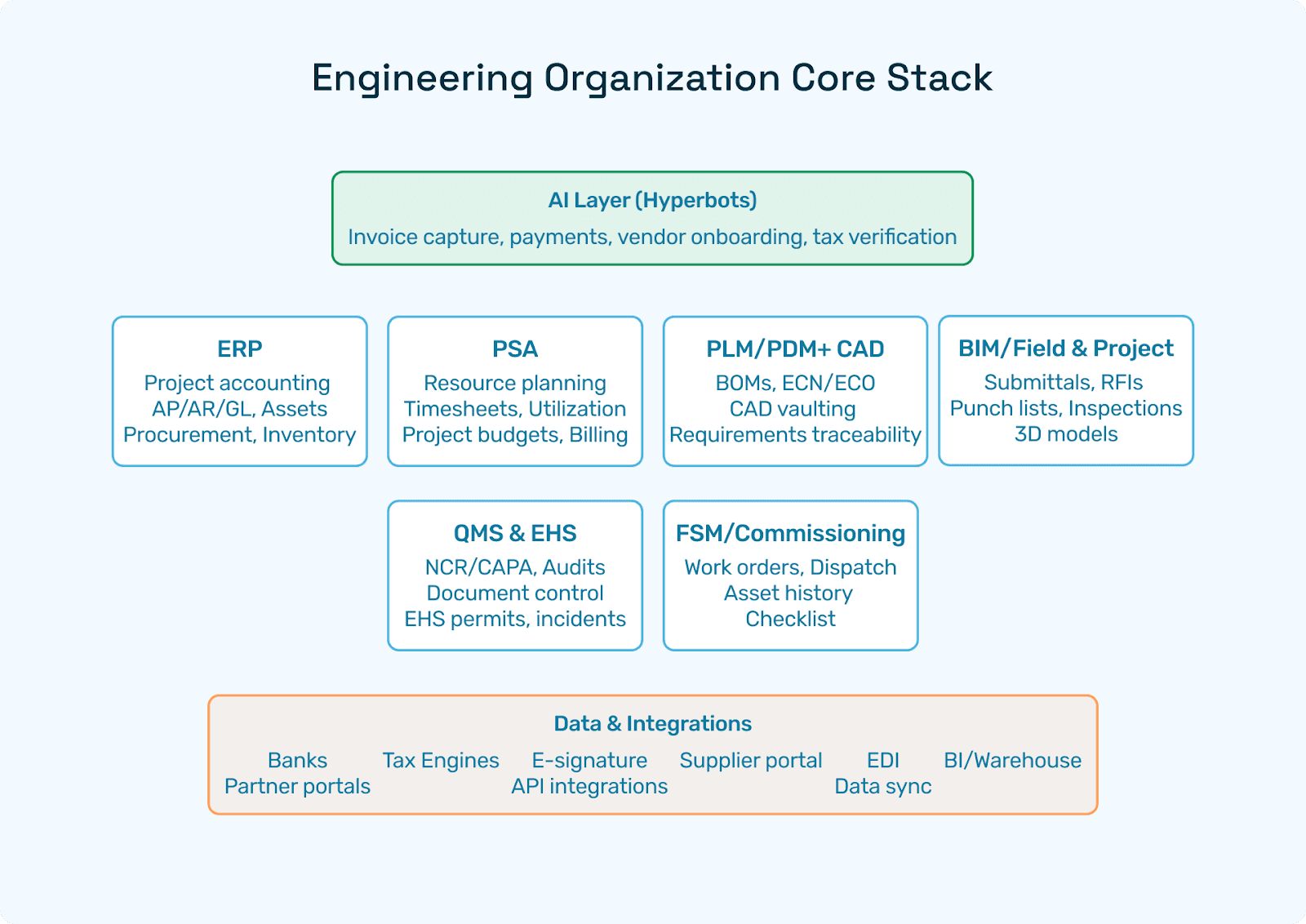
A modern stack anchors on cloud manufacturing ERP for the system of record, surrounds it with targeted execution systems, and overlays AI to eliminate repetitive financial work.
Factory Production Software: What You Need
“Factory production software” is the operational nerve center, largely MES plus focused WMS/QMS features for the shop floor.
Ground truths:
Right-sized dispatch: Cell/line boards with clear priorities and minimal clicks
Backflush vs. actuals: Pick by product/risk; support both for different lines.
Quality at the point of use: In-process checks, SPC charts, digital signatures for holds/releases.
Traceability: Lot/serial from receipt → Issue → Operation → Completion → Ship; instant recall lists.
Outside processing: Ship WIP, receive, and roll external charges into WIP/FG correctly.
Human-friendly data capture: Scanners/tablets at issue, return, complete; avoid re-keying.
If you’re light on MES today, many ERPs provide enough shop-floor features to start. Add a focused MES later to deepen OEE and scheduling once Stage-1 control is solid.
Cloud Manufacturing ERP: Why, What, How
Why:
Faster time-to-value, evergreen upgrades, lower infra overhead, easier integrations, remote access, and built-in security.
For multi-site or outsourcing networks, cloud-based ERP systems for manufacturing simplify data standards and collaboration.
What to expect:
Manufacturing Core: Items/BOMs/routings, WOs, MRP/DRP, limited finite scheduling, outside processing.
Inventory/WMS: Locations/bins, barcodes, cycle counts, ASN/labels, lot/serial traceability.
Purchasing/Finance: PR/PO, three-way match, landed costs, AP/AR/GL, tax, bank feeds, fixed assets, reporting.
APIs & Extensibility: REST web services, webhooks, scripting/low-code, app marketplace.
Security & Compliance: Role-based access, SoD, audit logs, data residency options.
How to adopt successfully:
Keep the core clean; avoid customizations you can’t test or support.
Integrate selectively: shipping/3PL, tax, banks, portals, quality/LIMS, PLM/CAD.
Overlay AI to remove manual finance friction (more below on Hyperbots).
In short, a cloud manufacturing ERP is the default choice in 2025 unless you have hard constraints (air-gapped plants, unique latency needs, or highly specialized on-prem machines that demand a local MES first).
Architecture & Integrations That Actually Matter
A resilient manufacturing stack is modular. Focus on these “always-matter” integrations for software for the manufacturing industry:
AP Inbox → ERP: Emails/PDFs/image invoices → high-accuracy extraction → validation and 2-/3-way match → clean vendor bill.
Banks: Payment proposals; bank validation; automated reconciliation.
Tax Engine: Jurisdiction and rates (sales/use/VAT); evidence for audits.
Shipping/3PL: Label generation, tracking, ASN; landed cost feeds.
E-commerce/EDI/Portals: Orders in; confirmations and ASN out; vendor self-service for docs and PO updates.
PLM/CAD: BOM import and ECN synchronization.
Quality/LIMS: Inspection results; lot holds/releases back to ERP.
IIoT/MES: Operation completions, downtime, and SPC data.
Use standard connectors wherever possible. When you must build, keep error handling and retries first-class, manufacturing hates brittle pipes.
Controls & Finance: The Often-Missed Backbone
The fastest way to sink a great implementation is weak financial hygiene. Your software used in the manufacturing industry must enforce:
WIP integrity: Every WO post; WIP clears correctly on completion.
Landed costs: Freight/duty/tariffs roll into inventory—not lost in OPEX.
Three-way match discipline: PO → Receipt/service receipt → Bill with sensible tolerances
Approvals & SoD: Maker-checker on bank details and vendor changes; policy-based approvals by vendor class and amount
Tax correctness: Right jurisdiction and rate with evidence.
Close checklist: WIP aging, unvouchered receipts, accruals for in-transit and outside processing, duplicate detection, discount capture.
This is where Hyperbots shines, automating the toughest finance steps that your ERP alone won’t make painless.
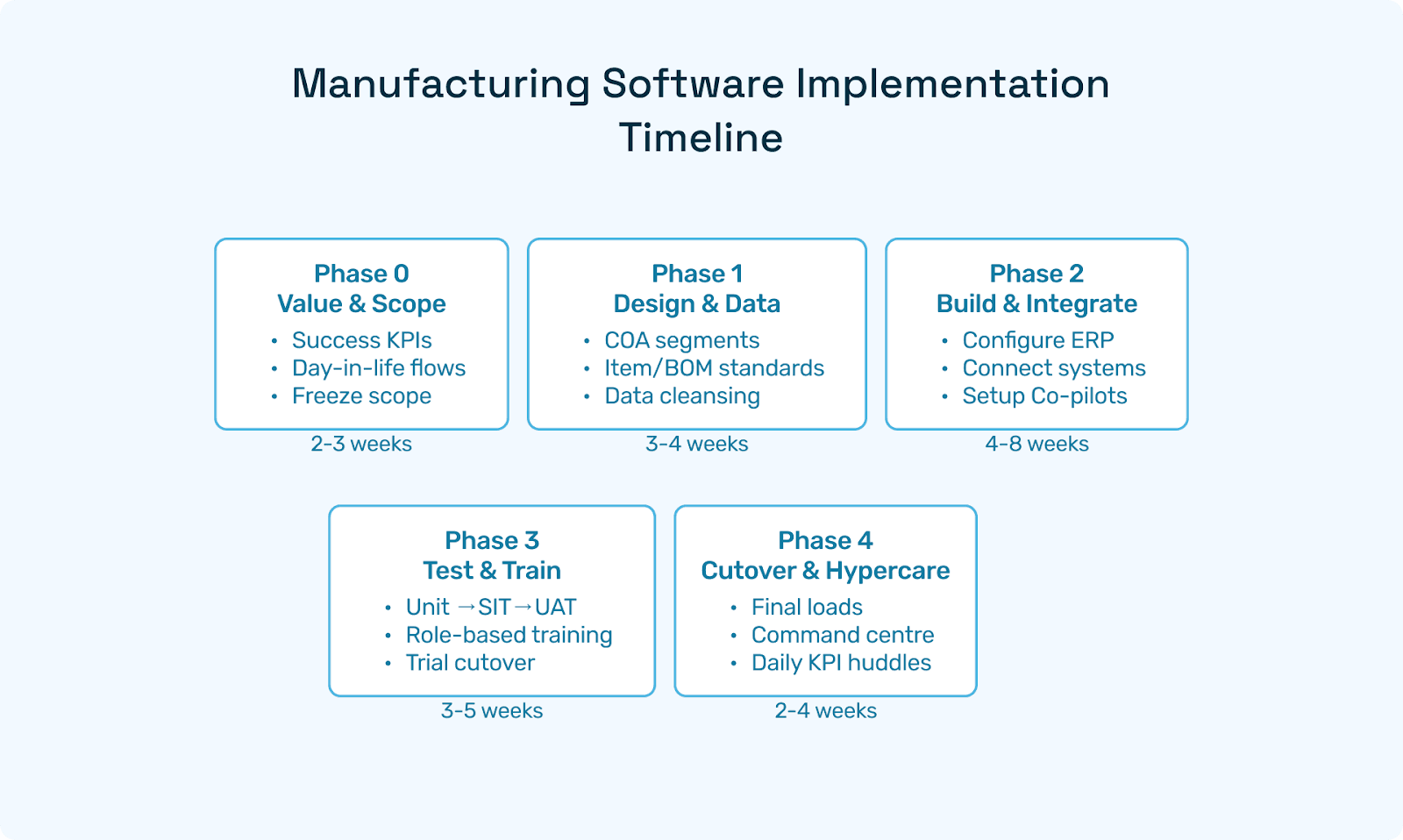
Implementation Blueprint & Timeline
A no-nonsense path to value for any software for manufacturers' rollout:
Phase 0 — Value & Scope (2–3 weeks)
Write success KPIs (OTD, first-pass yield, inventory turns, first-pass match %, STP %, DPO, discount capture).
Script 10–12 “day-in-the-life” flows with your real data; vendors must pass them.
Freeze Release-1 scope (manufacturing core + AP/AR/GL + receiving + simple MRP + basic quality).
Phase 1 — Design & Data (3–4 weeks)
COA segments (site, product family, cost center, project); approval thresholds; tolerance rules; role matrix.
Item/BOM/routing standards; vendor master standards; location/bin taxonomy.
Data cleansing and mapping templates.
Phase 2 — Build & Integrate (4–8 weeks)
Configure ERP and light WMS/MES features; connect AP inbox, tax, banks, and shipping.
Stand-up scanning and labels; pilot shop-floor capture.
Configure Hyperbots Co-pilots for AP, procurement, accruals, payments, tax checks, and vendor onboarding.
Phase 3 — Test & Train (3–5 weeks)
Unit → SIT → UAT by scripts; plan NC/CAPA handling; performance and security smoke tests.
Role-based training for planners, buyers, warehouse, QA, approvers, and the Controller.
Trial cutover: load masters, balances, open POs/WOs, on-hand lots/serials; reconcile.
Phase 4 — Cutover & Hypercare (2–4 weeks)
Freeze windows; final loads; validate printers/bank/tax endpoints.
Command center; daily KPI huddles; defect burn-down; implement quick wins (tighten tolerances, adjust approvals).
Typical timeline: 12–24 weeks for a single-site manufacturer with moderate integrations. Stretch or compress by data quality and the breadth of MES/QMS/WMS you include up front.
Data Readiness, Migrations & Quality
Your software will only be as good as the data you feed it:
Masters: Items (UoM, lead times, reorder points); BOMs (rev-controlled, alternates); routings (standard times); vendors (terms, bank details, tax docs); customers; locations/bins.
Transactions: Open POs, open WOs, on-hand by lot/serial, open AR/AP, WIP balances.
Validation: Trial loads with control totals; 3-way reconciliations with Operations and Finance.
Quality setup: Incoming sampling plans; in-process points; NCR/CAPA triage and ownership.
Hyperbots helps by validating vendor docs during onboarding, verifying banking details, extracting invoice and ASN data with high accuracy, and nudging users before bad data hits the ledger.
Contract & Outsourced Manufacturing Patterns
Even the smallest plants outsource steps or entire builds:
Contract manufacturing (consigned vs. turnkey): CM locations, transfer orders, service items for conversion, landed cost allocation, three-way match on turnkey receipts.
Outsourced steps (outside processing): Routing operations with vendor/lead time and cost driver, ship WIP to vendor, receive WIP back, and continue; vendor bills roll into WIP/FG per costing method.
Your factory production software and ERP must support both models cleanly; Hyperbots adds the finance guardrails, service PO matching, accruals for unbilled services, duplicate prevention, and vendor master governance.
KPIs: What to Measure from Day 1
Track a balanced set across Operations, Inventory, Finance, and Risk to prove your software for the manufacturing industry is working:
Operations: OTD, schedule adherence, first-pass yield, scrap/rework rates, OEE (availability × performance × quality).
Inventory/Warehouse: Turns, days at CM/vendor, cycle-count accuracy, shrink, traceability response time.
Finance/AP: First-pass match %, STP %, invoice cycle time, duplicate rate, DPO, discount capture, landed cost variance.
Cost/Profitability: PPV, usage variance, outside-processing variance, standard vs. actual cost, margin by job/SKU/customer.
Risk/Compliance: Vendor KYC completeness, bank-change validations, tax variance, and audit findings closed.
Hyperbots automatically gather evidence behind many of these numbers, so you can present clean dashboards with drill-through trails.
How Hyperbots AI Co-pilots Multiply ERP ROI
Hyperbots is an AI layer purpose-built for Finance & Accounting in manufacturing. It works on top of leading cloud-based ERP systems for manufacturing without ripping and replacing anything. Six modular Co-pilots automate the high-friction finance work that slows plants down:
Invoice Processing Co-pilot —
Ingests invoices from email/AP inbox; extracts headers and lines (items, quantities, prices, tax, freight).
Performs 2-way/3-way matches against POs/receipts or service operations; flags conversion charges vs. materials for contract/outsourced builds.
Detects duplicates and suspicious patterns; posts clean bills to ERP; routes only real exceptions.
Procurement Co-pilot —
Auto-creates PRs from MRP/DRP signals or min/max breaches; recommends suppliers and price breaks.
Routes approvals by policy; writes POs to ERP; monitors ASN and delivery adherence.
Accruals Co-pilot —
Suggests period-end accruals for in-transit receipts, unbilled outside processing, and landed costs.
Auto-reverses with evidence when bills arrive; maintains clean, close packs.
Payment Co-pilot —
Optimizes payment proposals by terms, cash position, and discount windows; validates vendor bank details.
Blocks duplicate/overpayments before money leaves.
Sales Tax Verification Co-pilot —
Validates jurisdiction and rates line-by-line; flags anomalies before posting; preserves audit evidence.
Vendor Management Co-pilot —
Onboards vendors via a guided portal (KYC, W-9/W-8, insurance); verifies bank changes; keeps documents current.
Scores risk and performance; protects master data integrity.
Why it matters for manufacturers
Lean teams get enterprise-grade finance throughput: 80%+ STP, faster close, fewer surprises.
Cash outcomes improve: better discount capture, reduced leakage (freight/tariff misposts, duplicates, tax errors).
Compliance and audits become evidence-first—organized by the Co-pilots as you work.
Hyperbots Platform Capabilities for Manufacturing
Beyond Co-pilots, the Hyperbots platform adds durable capabilities that complement cloud manufacturing ERP deployments:
Finance-trained AI (HyperLM + MoE): Vision + layout + LLM ensemble tailored to invoices, POs, GRNs, statements, strong on line-level reasoning.
Connectors: Real-time read/write to major ERPs; Gmail/Outlook ingestion; bank rails; tax engines; shipping; 3PL; EDI; supplier/customer portals.
Policy & Reasoning: GL coding suggestions; tolerance rules; anomaly/duplicate detection; approval nudges aligned with your thresholds and SoD.
Security & SoD: Role-based access, maker-checker workflows, audit logs, data redaction.
Scalability: Microservices (Java, Postgres, React), high-volume document throughput, multi-entity, and multi-currency.
Outcome-first design: Built with CFOs to deliver measurable gains: STP, cycle time, DPO, discount capture, duplicate prevention, tax accuracy.
With Hyperbots in the loop, the best software for a manufacturing company becomes the software that produces results—fewer exceptions, faster stabilizations, and cleaner closes.
FAQs
Q1. What’s the difference between ERP and “factory production software”?
A: ERP is your system of record—manufacturing + purchasing + inventory + finance. “Factory production software” usually refers to MES and shop-floor tools that control work centers, collect times, track quality, and report OEE. Many SMBs start with ERP-lite shop-floor features, then add MES when they need deeper control.
Q2. Is the cloud the default now for manufacturing ERP?
A: In 2025, yes, unless you have strict offline/air-gapped requirements. Cloud-based ERP systems for manufacturing offer faster value, simpler upgrades, and better connectors, especially for multi-site and outsourced networks.
Q3. Can we start small and add capabilities later?
A: Absolutely. Start with Stage-1 control (BOMs, WOs, inventory, AP/AR/GL, receiving). Layer in MRP/DRP, quality, portals, and specialized MES/APS as you mature.
Q4. How does Hyperbots work with our existing ERP?
A: Hyperbots overlays your ERP via secure connectors and email ingestion. It reads invoices/POs/ASNs, reasons over them with policy, and either posts clean transactions or routes exceptions, no rip-and-replace.
Q5. What KPIs should leadership track to prove value?
A: OTD, first-pass yield, inventory turns, first-pass match %, STP %, invoice cycle time, duplicate rate, DPO, discount capture, landed cost variance. Hyperbots can assemble evidence for these automatically.
Q6. We use a contract manufacturer—will this process still work?
A: Yes. Your ERP should support CM locations, consigned vs. turnkey models, service POs for conversion, and landed costs. Hyperbots adds vendor onboarding, bank validations, accruals for unbilled outside processing, and duplicate-bill prevention.
Q7. What are the most common pitfalls?
A: Over-customization; dirty masters (units/lead times); weak approvals; ignoring landed costs; skipping UAT scripts; over-ambitious first release; and neglecting change management.
Q8. Where does “software for the manufacturing industry” overlap with quality and compliance?
A: At receiving (sampling plans), in-process checks, final inspection, and audit trails. QMS hooks into ERP and MES; Hyperbots preserves evidence chains for audits.
Final takeaway
The best software for a manufacturing company is the one that fits your build model, enforces clean processes, integrates without drama, and proves value quickly. Anchor on a capable cloud manufacturing ERP, add the right shop-floor and quality controls, and let Hyperbots’ finance-grade AI remove the manual drudgery that keeps your people from running the plant.