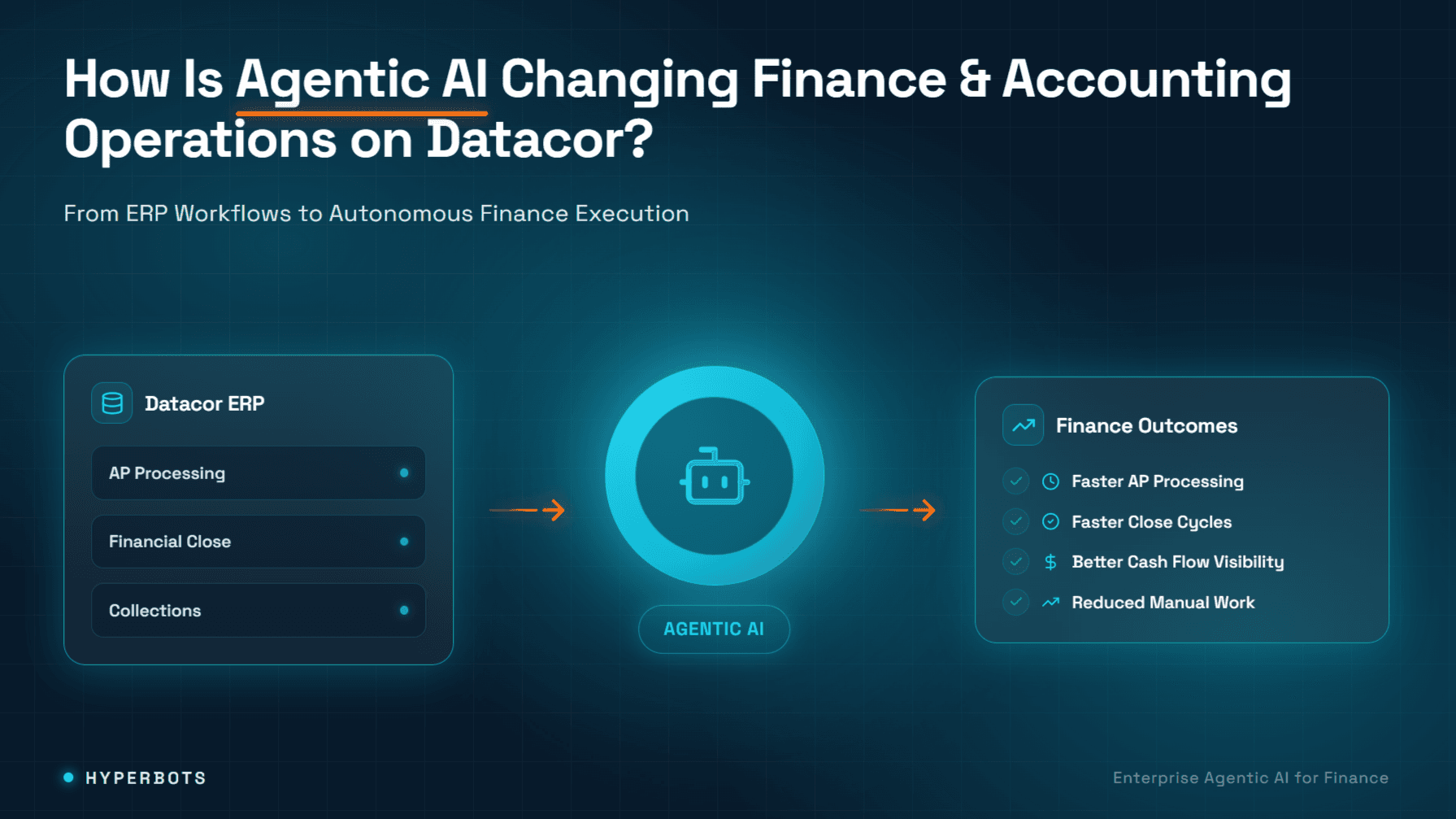
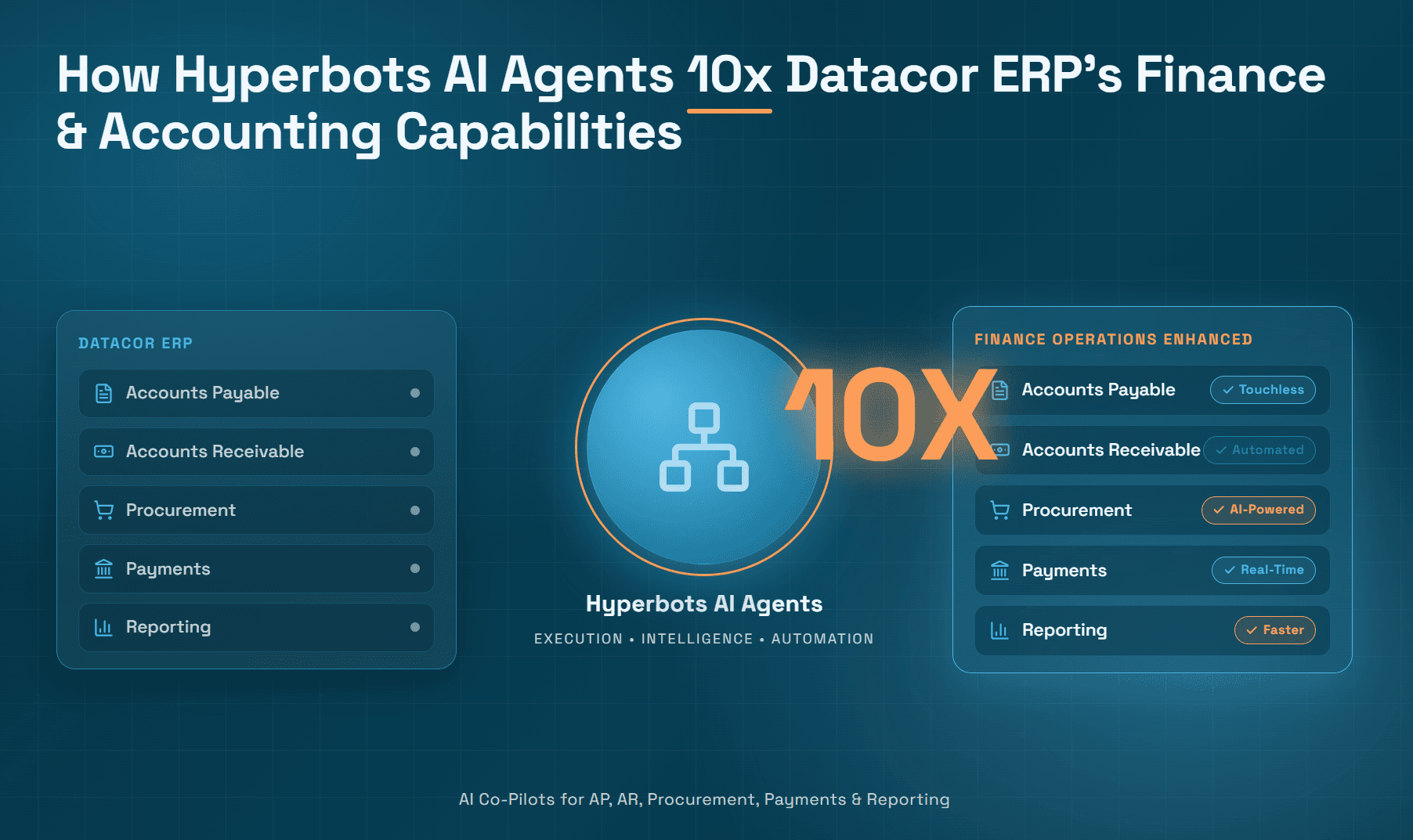
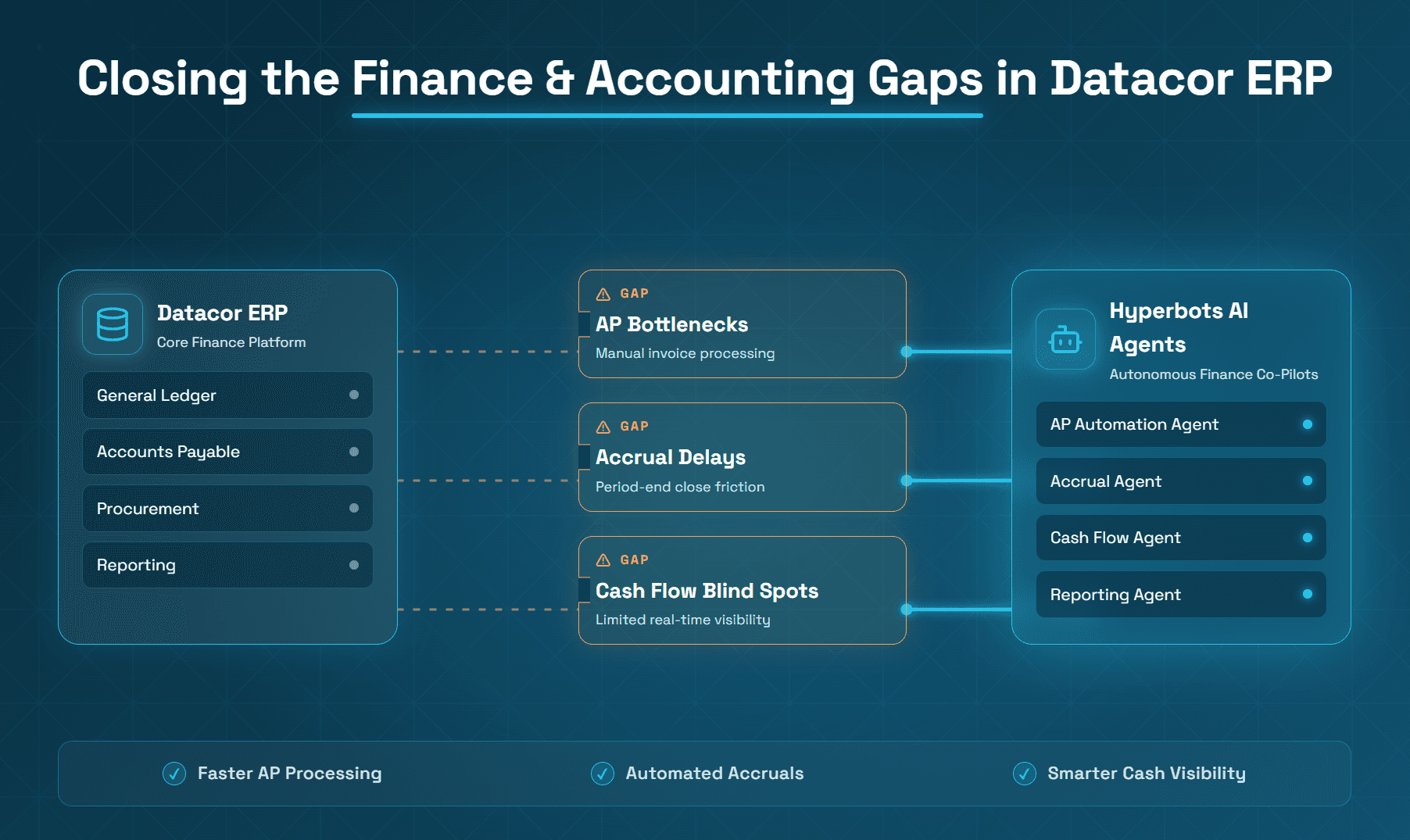
Closing the Finance & Accounting Gaps in Datacor ERP with Hyperbots AI Agents
Closing Datacor ERP's last-mile finance automation gaps.
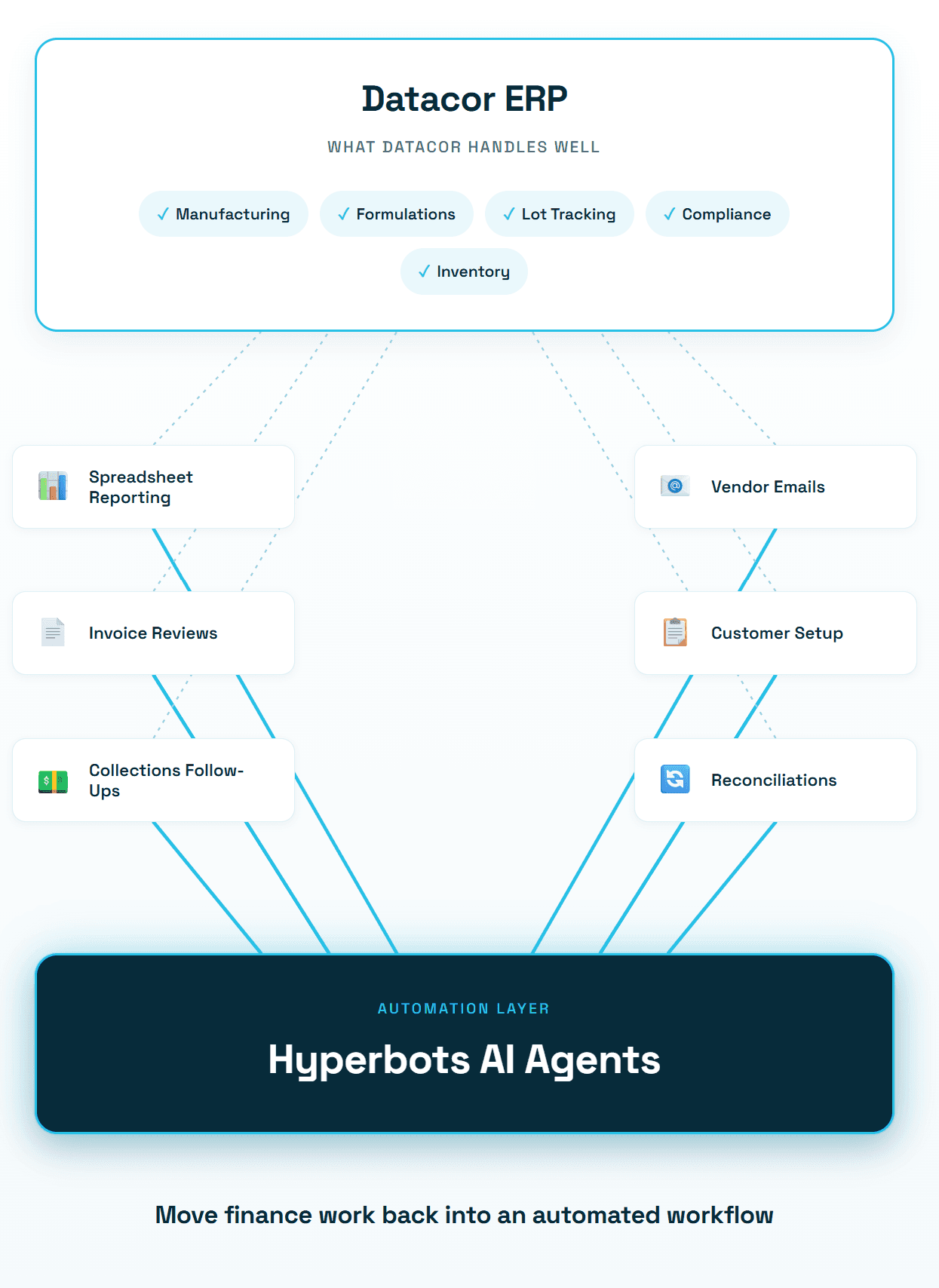
Datacor ERP, formerly known as Chempax, is a long-established enterprise resource planning system built specifically for process manufacturers and chemical distributors. It bundles general ledger, accounts payable, accounts receivable, fixed assets, and cash management alongside formulation, batch tracking, and regulatory compliance modules built for the chemical industry.
That industry-specific depth is exactly why Datacor ERP has remained a trusted system of record for decades. But finance and accounting teams running on Datacor ERP consistently describe a different reality once they move past the core ledger functions: financial reporting that struggles to keep pace with growth, manual workarounds for tasks that should be automatic, and a system architecture that was not originally designed for the AP, AR, and close-cycle demands of a modern, scaling finance organization.
This blog looks specifically at the finance and accounting gaps that surface in independent reviews, analyst writeups, and verified user feedback about Datacor ERP and at how a finance-specific AI agent layer, such as Hyperbots, can close those gaps without displacing Datacor ERP as the system of record.
Why Finance Teams Often Need More Than Datacor ERP
Datacor ERP was designed first as an operational system for process manufacturing: formula management, lot tracking, regulatory compliance (OSHA, DOT, FDA, EPA), and distribution-specific functions like rebates and multi-source purchasing. Financial management which includes general ledger, AP, AR, and cash management, sits alongside these operational modules rather than being the system's primary design center.
That design history shows up in how finance teams describe the platform once their transaction volume and reporting needs grow. One verified reviewer, responding to Datacor's own request for feedback on a software comparison site, stated plainly that the reporting features on the finance side were not sufficient for a multimillion-dollar business to operate effectively, a comment Datacor's own team acknowledged and responded to directly, promising forthcoming enhancements to reporting and analytics.
This is a common pattern for ERPs that began as operations-first systems: the finance module works for basic bookkeeping, but it was not engineered around the workflows that controllers, AP leads, and CFOs depend on daily, exception handling, real-time approval routing, and audit-ready reporting that scales with the business.
Specific Finance & Accounting Gaps Around Datacor ERP
1. Financial Reporting That Doesn't Scale With Growth
Multiple independent reviews point to the same underlying issue: Datacor ERP's standard financial reports are not always concise, customizable, or fast enough for growing finance teams. A Software Advice reviewer described the standard reports from the system as not user-friendly, citing a lack of concision and validation in their output. A separate verified review noted directly that finance-side reporting was insufficient for a multimillion-dollar business, a comment Datacor's team confirmed and responded to by announcing upcoming reporting enhancements.
For controllers, this translates into extra hours spent reformatting, validating, or rebuilding reports outside the ERP before they reach the CFO or the board, the opposite of what a single source of financial truth is supposed to deliver.
2. Manual Save Behavior That Risks Lost Financial Data
A recurring usability complaint centers on Datacor ERP's lack of auto-save. One verified reviewer described needing to manually click “Update” every time a record is edited, noting that it is easy to forget, and when forgotten, the changes simply do not save, silently slowing down the workflow. For AP and AR teams processing high volumes of invoices, payment records, or customer adjustments, this kind of unprompted data loss is a real operational risk, not just an inconvenience.
3. Integration and Data Exchange Limitations
Interoperability with other software was named explicitly as a weakness by a Datacor ERP user with a multi-year deployment history, who described the challenge as being able to automatically exchange data between systems. Other long-term users confirmed they continue to rely on software outside Datacor ERP including tools for safety data sheets, statistical process control, bill-of-lading processing, and fixed asset tracking because those functions are not fully native to the platform.
When finance-relevant data (fixed assets, freight documentation, statistical reporting) lives partly inside Datacor ERP and partly in disconnected tools, AP and AR teams inherit the reconciliation burden of stitching that data back together manually before it can be trusted for reporting or audit.
4. Aging Technology Underpinning Day-to-Day Finance Workflows
Several reviewers describe the underlying platform and database as dated. According to some reviewers, the primary long-standing complaint was that Datacor had not updated its underlying database in roughly a decade, not even with a patch, as of that review. Furthermore, one user in the chemicals industry described the interface as appearing as though it was built in the dinosaur age, while also reporting that the system runs extremely slowly.
5. File and Report Handling Friction
The file repository is also mentioned as user-unfriendly, explaining that it requires a separate server and that reports and files cannot be saved directly to a local computer from the system. For finance staff who need to quickly export a report, attach a document to an audit request, or share a statement with a customer or vendor, this kind of friction adds avoidable steps to routine AP and AR tasks.
6. Manual, Non-Automated Customer and Vendor Setup
A VP of Supply Chain at a long-term Datacor ERP customer noted that customer setup is very manual, and that automating it would be a meaningful improvement. For AR teams onboarding new customers, or AP teams onboarding new vendors, manual master-data entry is a well-documented source of both delay and downstream coding errors, particularly when the same information must later be re-keyed for invoicing, credit checks, or payment setup.
7. Steep Learning Curve for Finance Users
A Director of Information Technologies at a chemicals company, reviewing the platform after more than two years of use, summarized Datacor ERP as a chemical-industry-specific ERP that is not as user-friendly or easy to access as other products. Another G2 reviewer in the chemicals sector echoed this, describing the system as having a lot of product functionality but being very difficult to learn and use, requiring workarounds to access basic costing and inventory data effectively.
A steep learning curve in the finance modules specifically means new AP clerks, AR analysts, or finance hires take longer to become productive and that institutional knowledge about workarounds becomes concentrated in a small number of long-tenured staff.
Operational Impact on AP, AR, Controllers and CFOs
Individually, each of these gaps might look like a minor usability complaint. Collectively, they compound into measurable operational drag for the finance function:
Controllers absorb the reporting gap directly. When standard financial reports lack the concision or customization needed for board-level reporting, controllers spend additional hours each close cycle exporting data and rebuilding reports in spreadsheets - a work that should be a byproduct of the ERP, not a separate project.
AP teams absorb the integration gap. When fixed asset tracking, freight documentation, or statistical data lives outside the core system, AP staff must manually cross-reference multiple tools before an invoice can be confidently approved and coded, slowing down approval cycles and increasing the risk of GL miscoding.
AR teams absorb the manual setup gap. Without automated customer onboarding, AR staff spend time on repetitive data entry that delays the first invoice and the first collection cycle for new accounts, directly affecting Days Sales Outstanding (DSO) for newly acquired customers.
CFOs absorb the visibility gap. When the underlying system runs slowly, freezes during peak processing periods, or requires workarounds to extract clean data, CFOs lose real-time confidence in the numbers they are reporting upward, precisely the opposite of what an ERP investment is meant to deliver.
None of this means Datacor ERP fails at its core purpose as a system of record for process manufacturers and chemical distributors. It means the operational layer surrounding AP, AR, and reporting, the work that happens before and after a transaction lands in the ledger, is where finance teams are spending disproportionate manual effort.
How Hyperbots AI Agents Address These Gaps
Hyperbots is an agentic AI platform purpose-built for finance and accounting, and it maintains a documented Datacor integration connector. According to Hyperbots, its Datacor Connector enables real-time integration for financial and operational data including invoices, purchase orders, vendor information, and inventory details, designed specifically for the process manufacturing and chemical distribution industries that rely on Datacor ERP.
Hyperbots organizes its finance-specific AI agents into two broad categories that map directly onto the gaps identified above: Procure-to-Pay AI Agents and Order-to-Cash AI Agents, supported by Vera, an AI workspace for CFOs and finance teams powered by Hyperbots' proprietary finance-trained language model, HyperLM.
Procure-to-Pay AI Agents: Addressing AP-Side Gaps
Hyperbots' Invoice Processing Co-Pilot automates invoice discovery, field extraction, validation, PO matching, GL coding, and posting, reducing the manual cross-referencing that Datacor ERP users describe when finance-relevant data sits outside the core system. Because the Datacor Connector provides real-time, bidirectional sync of invoices, vendor records, and GL codes, AP staff are not left manually reconciling data between Datacor ERP and outside tools before an invoice can be approved.
The Vendor Management Co-Pilot directly targets the manual vendor and customer setup gap described in Datacor ERP reviews. It automates identity verification through documents like the W-9, structures vendor master data intake, and gives vendors a self-service portal for status visibility, replacing the manual entry process that one long-term Datacor ERP user specifically flagged as an area needing automation.
The Accruals Co-Pilot and Procurement Co-Pilot extend this same approach to month-end accrual identification and PR-to-PO workflows, posting clean, coded entries back into Datacor ERP rather than requiring controllers to assemble accrual estimates manually from data scattered across multiple systems.
The Sales Tax Verification Co-Pilot and Payments Co-Pilot round out the Procure-to-Pay layer, validating tax treatment on incoming invoices and managing payment timing, approvals, and reconciliation — functions that sit adjacent to, rather than inside, Datacor ERP's native AP module.
Order-to-Cash AI Agents: Addressing AR-Side Gaps
On the receivables side, Hyperbots' Collections Co-Pilot automates dunning, follow-ups, dispute detection, and promise-to-pay tracking, directly addressing the labor-intensive, fragmented collections workflows that show up when AR processes depend on manual follow-up outside the core ERP.
The Cash Application Co-Pilot automates remittance and bank statement extraction, payment matching, and exception handling, which reduces the reconciliation burden that arises when payment data, invoices, and customer records are not cleanly unified, a direct response to the interoperability and manual data-handling gaps identified in Datacor ERP reviews.
Both Co-Pilots post back into Datacor ERP through the same real-time connector architecture, so AR teams are not maintaining a parallel spreadsheet or a second system of record alongside the ERP.
Vera: An AI Workspace Layer for CFOs
Above the transactional Co-Pilots, Hyperbots offers Vera, described as an AI workspace for CFOs and finance teams, powered by HyperLM, a finance-native large language model. Vera is built to handle variance analysis, cash flow forecasting, and board reporting by connecting to a company's existing accounting tools and allowing finance leaders to query financial data using natural language rather than manually rebuilding reports.
This addresses the reporting limitation that surfaced repeatedly in Datacor ERP reviews, standard reports described as lacking concision and falling short for larger, growing businesses. Rather than waiting on a future ERP release to improve native reporting, Vera lets finance teams layer flexible, conversational reporting and forecasting on top of the data already flowing from Datacor ERP through the Hyperbots connector.
Why Finance Teams Are Adding AI Layers to Existing Systems
Replacing a deeply embedded, industry-specific ERP is rarely a realistic option for process manufacturers and chemical distributors as Datacor ERP's lot tracking, formulation management, and regulatory compliance features (OSHA, DOT, FDA, EPA) are deeply tied to operational workflows that took years to configure correctly.
This is precisely why an increasing number of finance teams are choosing to add a finance-specific AI agent layer on top of their existing ERP rather than pursuing a full system replacement. The operational system of record stays in place; the AI layer handles the workflows such as invoice processing, vendor onboarding, accruals, collections, cash application, and reporting that the ERP was never specifically engineered to optimize.
For Datacor ERP users specifically, this approach means the chemical-industry-specific functionality that justified the original ERP investment remains untouched, while the finance and accounting gaps identified in independent reviews such as reporting limitations, integration friction, manual data entry, and aging system performance, are addressed by a layer purpose-built for exactly that job.
Conclusion
Datacor ERP remains a capable, deeply specialized system of record for process manufacturers and chemical distributors, and its core ledger, AP, and AR modules do the fundamental job of recording financial activity. But the gaps documented across independent reviews, reporting that doesn't scale, manual save risk, integration friction, aging system performance, file-handling friction, manual customer and vendor setup, and a steep learning curve, are real, verifiable constraints on how efficiently finance teams can operate day to day.
Hyperbots' Procure-to-Pay and Order-to-Cash AI agents, combined with Vera's AI workspace for CFOs, are designed to close exactly these gaps, working through a documented Datacor integration that keeps Datacor ERP as the system of record while automating the operational workflows around it.
If you want to see how this works against your own Datacor ERP environment, you can start a free trial or request a demo with a Hyperbots financial technology consultant.
Frequently Asked Questions
Q1. Does Hyperbots replace Datacor ERP?
No. Hyperbots operates as an AI agent layer on top of Datacor ERP, not as a replacement for it. Datacor ERP remains the system of record for financial, manufacturing, and compliance data. Hyperbots' AI agents handle upstream and downstream finance workflows — invoice processing, vendor onboarding, accruals, collections, and cash application and post clean, validated data back into Datacor ERP through its dedicated connector.
Q2. What specific finance and accounting gaps in Datacor ERP can Hyperbots address?
Based on documented user feedback, the most relevant gaps are financial reporting that doesn't scale with business growth, integration friction between Datacor ERP and outside finance-relevant tools, manual vendor and customer onboarding, and reconciliation effort caused by data fragmentation. Hyperbots' Invoice Processing, Vendor Management, Accruals, Collections, and Cash Application Co-Pilots, along with Vera's reporting and forecasting capabilities, are built to address each of these specifically.
Q3. How does the Hyperbots-Datacor integration work?
Hyperbots maintains a dedicated Datacor Connector that enables real-time, secure synchronization of financial and operational data, including invoices, purchase orders, vendor information, and inventory details. This is purpose-built for the process manufacturing and chemical distribution industries that typically run on Datacor ERP.
Q4. What is Vera, and how does it relate to Datacor ERP's reporting limitations?
Vera is Hyperbots' AI workspace for CFOs and finance teams, powered by HyperLM, a finance-native large language model. It connects to a company's existing accounting data and supports variance analysis, cash flow forecasting, and board reporting through natural-language queries. For Datacor ERP users who have found native reporting limited for growing businesses, Vera offers an additional, flexible reporting and analysis layer without requiring a change to the underlying ERP.
Q5. Is adding an AI layer on top of Datacor ERP a common approach for finance teams?
Yes. Because industry-specific ERPs like Datacor ERP are deeply embedded in operational workflows such as lot tracking, formulation, and regulatory compliance, in this case, full system replacement is rarely practical. Many finance teams instead add a finance-specific AI agent layer that automates AP, AR, and reporting workflows while keeping the existing ERP as the system of record, preserving the operational investment already made in the platform.