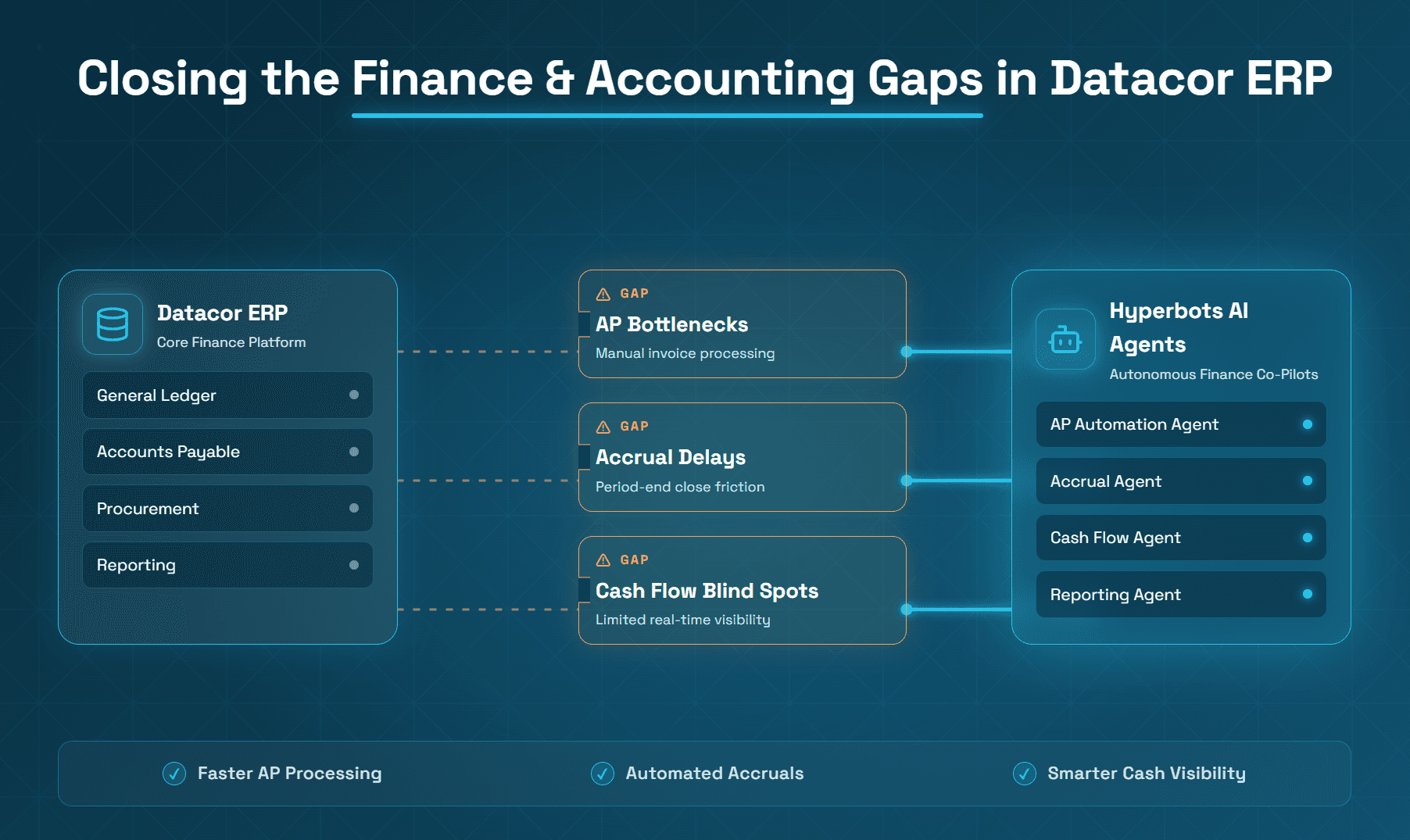
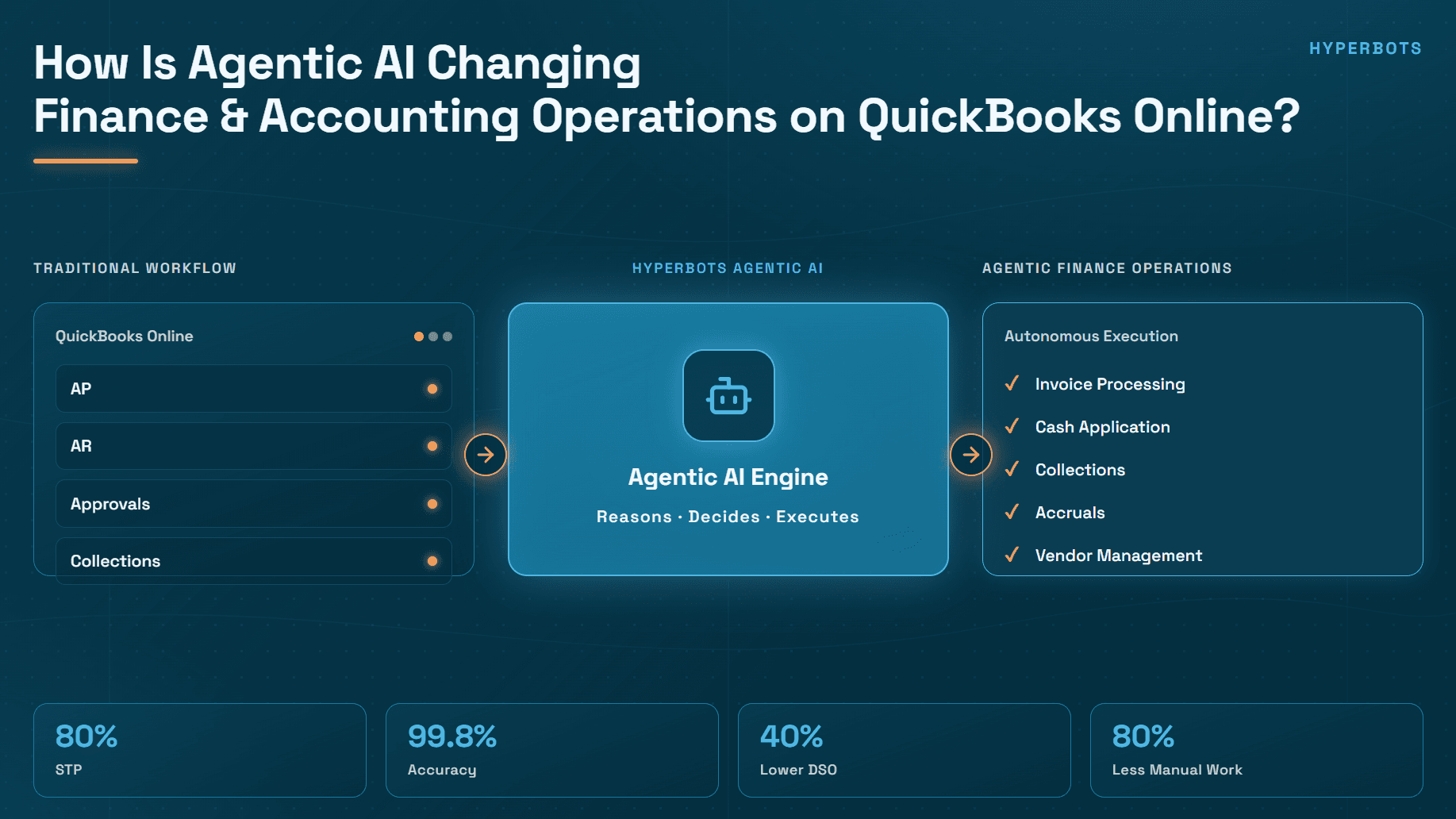
How Hyperbots AI Agents 10x Datacor ERP's Finance & Accounting Capabilities
10x finance productivity on Datacor ERP.
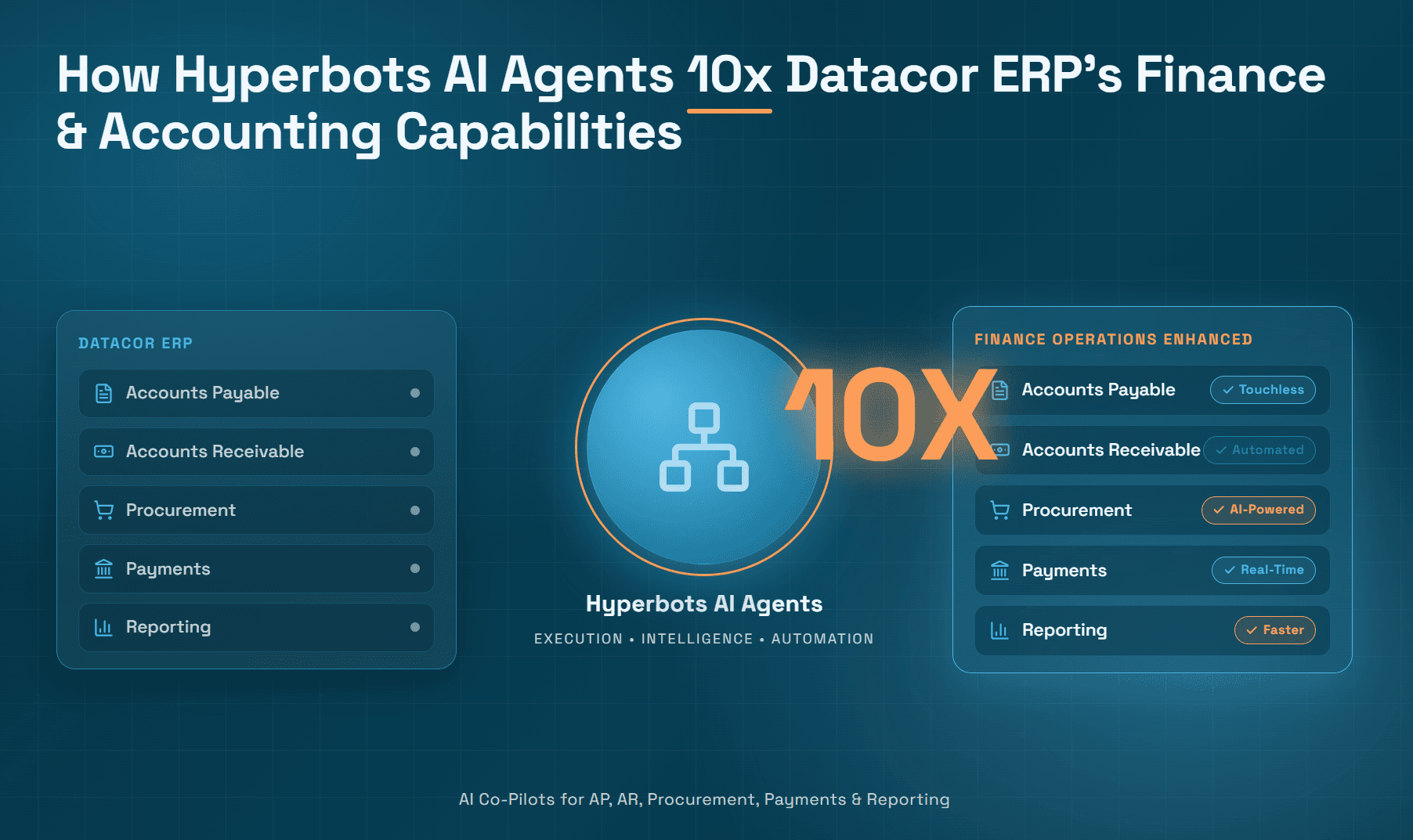
Datacor ERP (formerly Chempax) has spent decades earning its place as a trusted enterprise resource planning system for process manufacturers and chemical distributors. It is, fundamentally, a finance-capable ERP: real-time general ledger, accounts payable, accounts receivable, and bank reconciliation sit at the core of the platform, tightly woven into the formulation, batch tracking, and regulatory compliance modules that define the chemical and process manufacturing space. It centralizes financial, customer, and inventory data into a single source of truth and gives controllers and CFOs live visibility into income statements, balance sheets, and cash flow without exporting data to a second system.
The question this blog explores is not whether Datacor ERP is a capable finance platform because it clearly is. The question is what becomes possible when Agentic AI is layered on top of its existing procure-to-pay (P2P) and order-to-cash (O2C) workflows. As Gartner's finance research describes it, agentic AI is poised to handle a growing share of day-to-day finance decisions over the next several years, not by replacing the systems finance teams already rely on, but by extending what those systems can do autonomously.
This blog looks at where Datacor ERP's P2P and O2C foundations already deliver real value, where finance teams still spend meaningful manual effort even on a strong platform, and how an agentic AI layer, in this case, Hyperbots can extend and accelerate those workflows.
Why Datacor ERP Is a Valuable Finance & Accounting Platform
Datacor ERP's appeal to finance teams in process manufacturing and chemical distribution comes from how deeply its financial modules are integrated with operational data. According to Datacor's own product documentation, the platform provides real-time general ledger, accounts receivable, accounts payable, and bank reconciliation with no exports required, alongside a user-defined chart of accounts tailored to how a specific business operates.
That integration matters because process manufacturers deal with unusually complex cost structures: batch and lot-level costing, multi-level formulas, co-products, and regulatory recordkeeping layered on top of standard accounting. Datacor ERP's financial management module captures labor, material, and overhead costs by project, job, department, or customer, and allocates expenses while tracking budget versus actual performance, capabilities that go well beyond what a generic, horizontal ERP typically offers a chemical or process manufacturing business.
Datacor also emphasizes audit readiness: extensive audit trails connect each transaction back to its operational source, and its business intelligence tools let finance teams build rolling forecasts and budgets directly from real-time operational data rather than static exports, the backbone of clean audits in a regulated industry.
Datacor ERP's Strengths in Procure-to-Pay
Procure-to-pay spans purchase requisitioning, purchase order issuance, invoice matching, and final vendor payment and according to a comparison of P2P and O2C processes published by Ivalua, the P2P cycle is fundamentally about controlling spend, ensuring compliance, and making timely payments. Datacor ERP's P2P capabilities are built directly into its financial management and supply chain modules, giving teams a connected view of purchasing activity as it happens.
Datacor ERP's real-time AP functionality means invoices, vendor terms, and payment activity post directly into the general ledger without manual reconciliation between systems. Datacor's own materials highlight the ability to predict and manage cash flow with visibility into vendor terms, discounts, and payment timing, foundational for capturing early payment discounts or avoiding late penalties.
The platform's purchasing functionality also suits process manufacturing well: multi-source purchasing, rebate and price support management, and procurement workflows tied directly into formula and production planning. Because purchasing, inventory, and financial data live in one system, AP staff are not forced to reconcile purchase order details against a separate procurement tool before an invoice can be coded and approved.
Datacor ERP's Strengths in Order-to-Cash
Order-to-cash covers order entry, fulfillment, billing, collections, and cash application, the revenue-side counterpart to P2P. Datacor ERP's O2C capabilities are anchored in its integrated CRM and order management functionality, which Datacor describes as unifying financial, customer, and inventory data so teams can quote, fulfill, and report from a shared source of truth.
A notable strength is how customer credit management is embedded directly into order entry: finance teams can manage customer credit limits and approvals within order entry itself, rather than through a separate, disconnected credit check step. This kind of embedded control reflects the P2P/O2C alignment that analyst research links to working capital efficiency. PwC's global working capital research has found that companies collectively hold roughly €1.5 trillion in excess working capital tied up in inefficient P2P and O2C cycles, and that even modest DSO improvements can meaningfully free up cash.
Datacor ERP also supports automated invoicing and payment reminder workflows within its receivables management functionality, along with reconciliation tools designed to reduce manual matching errors. For process manufacturers managing complex order types, bulk shipments, blanket orders, multi-currency billing, invoicing, credit management, and reconciliation native to the ERP is a genuine structural advantage.
Where Finance Teams Still Face Manual Work
Even on a strong, well-integrated ERP platform, certain finance work remains inherently manual, not because the ERP is deficient, but because these tasks require judgment and cross-referencing that traditional ERP architecture was never designed to automate end-to-end.
On the P2P side, this shows up most in invoice exception handling. When a vendor invoice doesn't cleanly match its purchase order, a price variance, a partial shipment, a non-standard format, someone in AP must manually research the discrepancy before the invoice can be coded and posted. According to APQC's Open Standards Benchmarking research, top-performing organizations can process supplier invoices at a fraction of the cost incurred by lower-performing peers. In many benchmark datasets, top performers process invoices for around $2 per invoice or less, while bottom performers spend more than $10 per invoice. The difference often stems from the amount of manual intervention, exception handling, and workflow inefficiencies involved in processing invoices.
Month-end accrual identification follows a similar pattern, requiring a controller to manually cross-reference open POs, goods receipts, and vendor invoice history even when that data already lives inside the ERP. On the O2C side, collections prioritization and cash application carry comparable manual weight, deciding which overdue customer to call first or how to apply an oddly-sized payment are judgment calls that aging reports support but don't fully automate, precisely the gap PwC's working capital research links to cash sitting unproductively on company balance sheets.
None of this reflects a weakness specific to Datacor ERP; it reflects how ERPs, built primarily as systems of record, interact with finance work that requires contextual judgment at scale, the gap Agentic AI is designed to close.
The Rise of Agentic AI in Finance Operations
Agentic AI differs from earlier finance automation in a specific way. Gartner defines it as an approach where AI agents understand circumstances, make decisions, take actions, and pursue goals, independently or with human oversight, rather than executing a fixed, rules-based sequence. Gartner predicts that by 2028, at least 15% of day-to-day work decisions will be made autonomously through agentic AI, compared with virtually none in 2024. Gartner also forecasts that one-third of enterprise software applications will incorporate agentic AI capabilities by 2028, highlighting the growing role of autonomous systems across business operations..
Crucially, Gartner frames agentic AI as operating on top of existing financial systems, not as a system-of-record replacement and as most valuable when automating the judgment-heavy, exception-driven layer of work that traditional ERP transaction processing was never designed to fully resolve on its own. That framing is directly relevant to extending Datacor ERP's existing P2P and O2C investment, rather than replacing it.
How Agentic AI Enhances Datacor ERP's P2P Processes
Layered correctly, agentic AI does not change what Datacor ERP is or how it functions as a system of record. It changes how much of the surrounding P2P work still requires a person.
Invoice exception handling is the clearest example. Where a rules-based system simply routes a mismatched invoice to a human queue, an agentic AI layer can reason through the discrepancy directly, checking vendor history, cross-referencing contract terms, and either resolving the exception with documented logic or escalating it with a clear explanation. This directly targets the cost gap APQC's benchmarking identifies between top- and bottom-quartile AP organizations, a gap driven almost entirely by how much exception volume still requires manual intervention.
Accrual identification benefits the same way. Rather than a controller manually scanning open POs, goods receipts, and vendor invoice cadences at month-end, an agentic AI layer can scan that data continuously and propose accrual entries with supporting rationale, work that still posts into Datacor ERP's general ledger, but with far less manual assembly beforehand.
Approval routing extends naturally too. Datacor ERP's workflow structures work well for standard cases, but dynamic situations, an approver unexpectedly out of office, a purchase crossing an escalation threshold, often still need manual follow-up. Agentic AI can apply policy logic contextually in real time, escalating to the right delegate without a person needing to spot the bottleneck first.
How Agentic AI Enhances Datacor ERP's O2C Processes
On the receivables side, the same principle applies: agentic AI extends Datacor ERP's existing credit management, invoicing, and reconciliation capabilities by automating the judgment layer around them.
Collections prioritization is a strong example. Datacor ERP's customer account and credit history data already gives finance teams the inputs they need to assess risk. An agentic AI layer can use that same data continuously, scoring customers by payment behavior, sequencing outreach by risk and relationship value, and pausing automated contact the moment a dispute is flagged, rather than relying on a periodic manual review of an aging report.
Cash application is where this extension is most measurable. When a customer payment doesn't cleanly match the invoice amount, a rules-based system typically routes it to a manual queue. An agentic AI layer can reason through the mismatch using the customer's deduction history and known dispute status, applying the payment correctly or flagging it with a clear explanation. PwC's working capital research is direct about the stakes: faster, more accurate cash application is one of the more reliable levers for closing the gap between cash a business has earned and cash actually reflected on its balance sheet. In both cases, the underlying transaction still posts into Datacor ERP exactly as it would otherwise, what changes is how much of the judgment work happens automatically rather than waiting in a queue for a person to review it.
How Hyperbots Extends Datacor ERP Workflows
Hyperbots is an agentic AI platform built specifically for finance and accounting, and it maintains a dedicated Datacor integration designed for this kind of layered extension. According to Hyperbots, its Datacor Connector enables real-time, secure synchronization of financial and operational data including invoices, purchase orders, vendor information, and inventory details and hence, purpose-built for process manufacturing and chemical distribution.
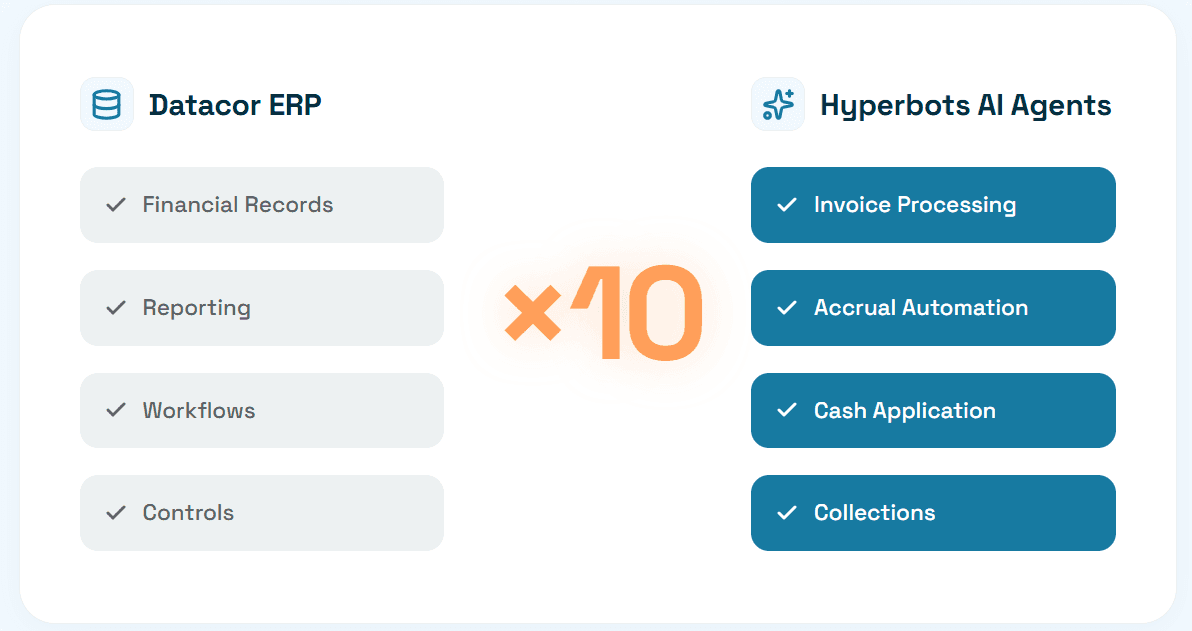
On the P2P side, the Invoice Processing Co-Pilot automates invoice discovery, extraction, validation, PO matching, GL coding, and posting back into the connected ERP, directly extending Datacor ERP's existing AP module rather than working around it. The Accruals Co-Pilot identifies unbilled liabilities and proposes accrual entries continuously rather than at a single month-end checkpoint, and the Procurement Co-Pilot extends Datacor ERP's purchasing workflows with automated requisition handling and policy-aware approval routing. Hyperbots has documented this kind of procurement cycle compression in customer deployments, where a multi-day requisition-to-PO cycle was reduced to hours through automated field population and policy validation.
Procure-to-Pay ROI
Metrics | Datacore alone | With Hyperbots | Operational Impact |
Invoice processing time | 8–12 day invoice cycle times are common in manual AP environments such as Datacore | Hyperbots processes invoices in <1 minute | 99%+ reduction in invoice processing time |
Straight-through invoice processing | Typical ERP-centric AP teams achieve ~15–25% touchless processing | Hyperbots achieves 80% STP | 3.2×–5.3× higher touchless processing rate |
Invoice extraction accuracy | Traditional OCR systems typically achieve only 85–90% accuracy | Hyperbots delivers 99.8% extraction accuracy | 50×–75× reduction in manual correction requirements |
AP manual workload | AP teams often spend 60–70% of capacity on manual entry and exception handling | Hyperbots automates matching, validation, and GL coding | 4×–5× reduction in manual AP workload |
Early payment discount capture | Most organizations capture <40% of available discounts | Hyperbots captures 100% of all early payment discounts automatically | 2.5×+ improvement in discount capture potential |
On the O2C side, the Collections Co-Pilot automates dunning, follow-up sequencing, and dispute detection using the same customer payment-history signals that already live in Datacor ERP's CRM and order management data. The Cash Application Co-Pilot automates remittance matching and exception handling for payments that don't cleanly reconcile against open invoices, posting clean, applied cash back into the ERP rather than leaving it in a suspense account awaiting manual review.
Order-to-Cash ROI
Metric | Datacore Alone / ERP-Centric Reality | With Hyperbots | Operational Impact |
Cash application automation | Manual and ERP-centric AR environments don’t automate cash application, with payment matching and reconciliation heavily dependent on human intervention. | Hyperbots achieves 80–90% straight-through cash application using AI-driven remittance extraction, intelligent matching, and autonomous ERP posting | 4×–9× higher cash application automation, enabling faster reconciliation and reduced AR processing costs |
Days Sales Outstanding (DSO) | ERP-centric collections workflows rely on static aging buckets, manual follow-ups, and delayed dispute identification, contributing to elevated DSO | Hyperbots delivers ~40% DSO reduction through AI-driven prioritization and autonomous follow-ups | Up to 1.6× faster cash-conversion cycle |
Cost-to-collect | Traditional collections environments require large amounts of manual outreach, dispute handling, and tracking effort | Hyperbots uses AI-driven prioritization of accounts, automated tailored follow-ups minimizing human intervention | 70% reduction in cost-to-collect |
Reconciliation cost | ERP-centric reconciliation workflows remain labor-intensive due to manual extraction and matching of remittance | Hyperbots delivers 99.8% remittance extraction accuracy with AI-driven autonomous matching and reconciliation workflows | 80% reduction in reconciliation cost |
Unapplied cash levels | Traditional AR environments often maintain unapplied cash balances near 40% due to delayed matching and exception handling | Hyperbots reduces unapplied cash to <10% through AI-driven matching and exception resolution | 75% reduction in unapplied cash |
In every case, the design intent is the same: Datacor ERP remains the system of record. The Hyperbots agent layer reduces how much of the surrounding judgment work, exception handling, accrual discovery, collections sequencing, payment matching, still requires a person before the transaction can be trusted and posted.
Vera and Conversational Finance Intelligence
Beyond the transactional AI agents operating on individual P2P and O2C workflows, Hyperbots also offers Vera, an AI workspace for CFOs and finance teams powered by HyperLM, a finance-native large language model. Vera handles variance analysis, cash flow forecasting, and board reporting by connecting to a company's existing accounting data, letting finance leaders query financial data using natural language rather than manually rebuilding reports from exported data.
This kind of conversational reporting layer is consistent with where Gartner sees cloud ERP finance applications heading toward embedded AI assistants and conversational analytics on top of the transactional data ERPs already capture. For finance teams running Datacor ERP, a tool like Vera does not change how transactions are recorded; it changes how quickly a controller or CFO can ask a question about that data, a variance, a forecast, a board-ready summary and get an answer grounded in the same data already flowing through the ERP's P2P and O2C modules.
Conclusion
Datacor ERP gives process manufacturers and chemical distributors a genuinely strong financial foundation: real-time general ledger, integrated AP and AR, embedded credit management, and audit-ready traceability built for the complexities of batch-based, regulated manufacturing. None of that changes with the addition of an agentic AI layer.
What changes is how much of the work surrounding P2P and O2C, invoice exceptions, accrual discovery, collections prioritization, cash application, still requires a person to manually research and resolve before a transaction is ready to post. As Gartner's finance research makes clear, this is precisely the layer of work agentic AI is best suited to take on: not replacing the system of record, but reducing the judgment-heavy manual effort that surrounds it.
For finance teams already running on Datacor ERP, extending that investment with a finance-specific agentic AI layer through Hyperbots' documented Datacor integration, P2P and O2C Co-Pilots, and Vera's conversational reporting, is a way to compound the value of the platform they have already built their financial operations around.
If you want to see what this looks like against your own Datacor ERP environment, you can start a free trial or request a personalized demo with a Hyperbots financial technology consultant.
FAQs
Q1. Does adding Hyperbots' AI agents require replacing Datacor ERP?
No. Hyperbots operates as an agentic AI layer on top of Datacor ERP through a dedicated connector. Datacor ERP remains the system of record; Hyperbots' AI agents automate the exception-handling and judgment-heavy workflows around P2P and O2C, then post validated results back into Datacor ERP.
Q2. What is the difference between Datacor ERP's existing automation and Hyperbots' agentic AI agents?
Datacor ERP's native financial workflows, real-time GL, AP, AR, and reconciliation, handle the recording and routing of standard transactions effectively. Agentic AI agents handle the judgment-based exceptions that fall outside standard rules: invoice mismatches, ambiguous accrual candidates, and partial or short-paid customer remittances.
Q3. Which P2P workflows benefit most from an agentic AI layer on Datacor ERP?
Based on APQC's industry benchmarking, invoice exception handling carries the largest cost gap between top- and bottom-performing AP organizations, making it the highest-impact area for automation. Accrual discovery and dynamic approval routing follow closely.
Q4. How does agentic AI improve Datacor ERP's order-to-cash performance?
Agentic AI agents can continuously analyze customer payment behavior to prioritize collections outreach and can reason through ambiguous remittances during cash application both areas PwC's working capital research links directly to trapped cash and elevated days sales outstanding (DSO).
Q5. What is Vera, and how does it relate to Datacor ERP's reporting capabilities?
Vera is Hyperbots' AI workspace for CFOs and finance teams, powered by HyperLM, a finance-native large language model. It connects to a company's existing accounting data including data flowing through Datacor ERP and supports variance analysis, cash flow forecasting, and board reporting through natural-language queries, extending Datacor ERP's existing reporting capabilities rather than replacing them.