PRs/POs Assistant
Hyperbots Procurement Co-Pilot Cuts the 3-Day Procurement Cycle to 4 Hours
Hyperbots slashes procurement cycle times with AI-driven automation, boosting accuracy, efficiency, compliance, and enterprise-wide productivity.
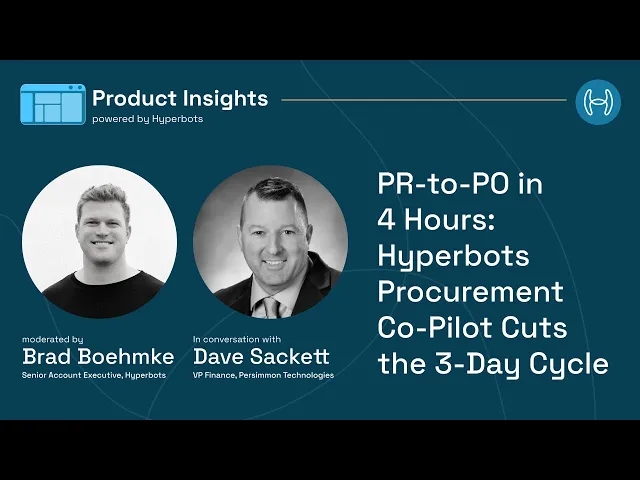
Brad: Hello, and welcome to all our viewers! I’m Brad Boehmke, Senior Account Executive here at Hyperbots, and I’m very excited to have Dave Sackett here with me. Dave is VP of Finance at Persimmon Technologies and a finance and IT expert with experience in streamlining operations, driving business improvements, and co-founding innovative e-commerce solutions. So, Dave, welcome back.
I wanted to have an open discussion today, really a deep dive on the functional capabilities of Hyperbots Procurement Co-Pilot, specifically the PR-to-PO Co-Pilot. I wanted to dive into some questions with you.
Automating Purchase Requisitions & Data Extraction
Brad: First, starting with traditional purchase requests, those screens can be up to 20 fields long. How does Hyperbots shorten that?
Dave: Hey, thanks, Brad. The Copilot autofills about 80% of every purchase requisition by extracting data straight from the contract, Statement of Work (SOWs), or catalog click. Buyers can now complete a request in about 5 minutes; the prior ERP task took over 15.
Brad: Actually, yeah, contract parsing sounds risky. What’s the extraction accuracy?
Dave: The multiple vision-language models and the pretrained agent (trained on millions of contracts) gives Hyperbots 99.8% header and line accuracy. By comparison, competing OCR tools average around 93–95%, so teams spend hours fixing unit-of-measure and price fields.
Brad: That additional percentage is huge, going from 93 to nearly 100 is significant.
Preventing Duplicate Spend & Real-Time Budget Checks
Brad: Duplicate requests drive spend leakage. Can the Co-Pilot spot them?
Dave: Yes. AI compares every open Purchase Requisition across all entities. It flags duplicates and even suggests using existing stock if we already have inventory. That alone shaved 4% off indirect spending in the last quarter.
Brad: How are budget checks handled?
Dave: They’re real-time. As soon as the purchase requisition is drafted, the Co-Pilot calls up the ERP budget tables. A red banner will show if the cost center limit is breached. Legacy tools might warn a day later, maybe after the PO was issued, by comparison Hyperbots alerts immediately.
Intelligent GL Coding & Continuous Learning
Brad: What about custom GL logic?
Dave: The custom GL recommender looks at historical postings and human overrides. Within two weeks, it reached over 99% coding accuracy. Our old rule table required monthly IT edits. By comparison, the Hyperbots Procurement Co-Pilot is self-learning, using human overrides as feedback for future actions. By interacting with humans, the bot learns the right moves the next time a similar Purchase Requisition is seen.
Approval Workflow Flexibility & Speed
Brad: That continuous learning from human adjustments is huge. Can approvals be routed differently for CapEx and OpEx?
Dave: Absolutely. Workflow is configured by business unit, category, cost center, or even vendor. Many competitors lock you into a one-size-fits-all matrix that can quickly break.
Brad: And where do approvers interact? Is it just another portal they must log into?
Dave: No. Approvals land in notifications, one click to either approve or reject, and the purchase requisition auto-updates. This cuts cycle time from three days down to four hours on average.
Brad: That’s huge. I have a lot of tabs open and different applications running all the time; being able to make one click for approvals is a big deal.
Dave: Agreed.
Automated PO Creation & Supplier Collaboration
Brad: Once something’s approved, how is a PO generated from there?
Dave: The Co-Pilot transforms the Purchase Requisition into a branded PO template, pushes it into the ERP, emails suppliers, or updates supplier portals completely touchless. Competitors often drop a PDF into a shared folder and hope someone will send it. To quote my CEO at Persimmon: “Hope is not a plan.”
Brad: Okay, that’s a good line. Can we use different PO templates per entity, for example?
Dave: Yes. Multi-entity firms can load as many templates as they need. The Co-Pilot selects the right template based on the company code held in each ERP table.
Brad: What if a supplier needs line-item changes?
Dave: They can reply via the vendor portal. The Co-Pilot reconciles revisions to prices, quantities, and dates, and triggers reapproval only when policy thresholds are crossed.
Brad: Having visibility from both sides in the portal is a big advantage.
Exception Handling & Real-Time Notifications
Brad: How do exceptions surface to buyers?
Dave: Real-time notifications.
For example: “PO 1457 - price variance 2% above budget. Do you approve?”
You can interact directly with the agent to streamline your answer and push the transaction along. Competitors send an end-of-day CSV file for comparison.
Brad: I was just talking to family this week about how emails are clunky. Having a notification alert on my phone or computer and being able to quickly interact is big.
Dave: Yeah, instantly responding to notifications is important. You see it pop up, and you can take action, move it to the next person, etc.
Audit Trail & Compliance Management
Brad: Agreed. On the audit trail, will the internal audit still ask for email evidence?
Dave: Not necessarily. Every AI or human interaction that could change a field, with timestamps, lands in a tamper-proof ledger, so auditors can export a 6-month PO cycle in under 10 minutes.
Multi-ERP, On-Premise, and SSO Support
Brad: Very good. Many groups run multiple ERPs; is that supported?
Dave: Yes. A Hyperbots client runs two SAP company instances and one NetSuite tenant. Hyperbots connects all three and still enforces only one global purchase-direct policy. Traditional solutions require separate implementations for each ERP in comparison.
Brad: What about on-premise ERP?
Dave: We use on-premise ERP at Persimmon. A small agent sits behind our firewall, opens an outbound tunnel, and talks to the ERP APIs with no inbound ports or VPN drama. Competitors ask for nightly FTP drops, which we don't need.
Brad: Single sign-on across all that sounds complex.
Dave: From a user’s point of view, it’s seamless. A user logs in once with Azure AD; Hyperbots handles token exchange with every connector. Buyers never need to re-authenticate.
Entity-Level Customization & Metadata Handling
Brad: We sometimes need different processes per entity. Is that possible?
Dave: Yes, easily. Flipping a toggle can change behavior. One subsidiary might use two-level approvals while another uses four levels with budget checks. Each rulebook lives in its own configuration with no coding branches.
Brad: How does Co-Pilot handle custom fields added later on?
Dave: It re-scans ERP metadata nightly. New fields show up in the mapper UI with no deployment ticket and no downtime. Competing tools need development sprints for every field change.
Handling Large, Complex Requisitions
Brad: Does the system cope with very large purchase requisitions, say hundreds of lines?
Dave: Yes. Multi-page, multi-line requisition extraction and match items are seamless, crucial for clients in construction. Simple OCR solutions often choke at over 40 lines.
Brad: It can get pretty complex with 100 lines and many items; that’s impressive.
Pretrained Model Performance & Day-One Accuracy
Brad: How quickly did the pretrained model start working? Was there a lot of massaging or labeling before it hit high accuracy?
Dave: I was surprised. It started working on day one. Accuracy was already over 98% because the models are pretrained on millions of purchase requisitions and contracts. Other vendors require weeks of labeling before they’re usable, so I was quite surprised at how quickly we were able to get it up and running.
Hyperbots vs. Traditional Procurement Tools
Brad: Final question to wrap us up: when we talk about competition and the competitive gap?
Dave: I would say competitors digitize forms, whereas Hyperbots has a dedicated AI agent that not only thinks but takes action. Hyperbots can achieve 99.8% field accuracy, 80% productivity gains, and PO issuance in minutes. Duplicate spend prevention and the audit trail are features auditors love, all impossible with templates, OCR, or other traditional RPA bonds.
Brad: Awesome. We really appreciate it, Dave. Great conversation, as usual. It was insightful; we covered many efficiency gains and productivity numbers. It was great to hear the trends you’re seeing across the board with AI and how Hyperbots is playing a role. Once again, thank you. I appreciate the conversation.
Dave: Yeah, thanks, Brad. I’m totally amazed at where agentic AI is today and glad that I’ve got Hyperbots as a partner.
Brad: Awesome. Thank you so much.