How Is Agentic AI Changing Finance & Accounting Operations on QuickBooks Online?
The next evolution of finance on QuickBooks Online.
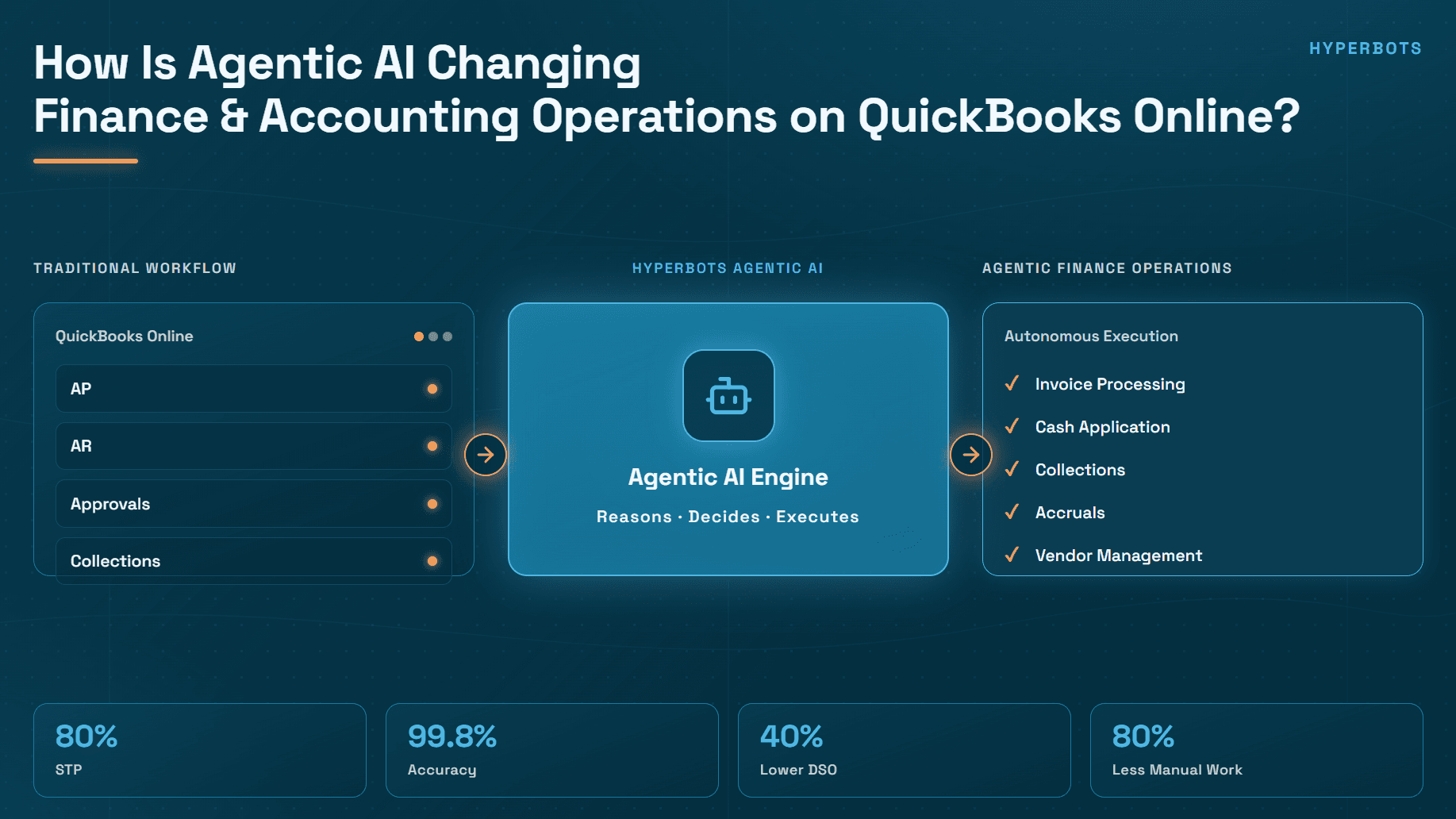
Finance teams using QuickBooks Online have long benefited from a cloud-native, reliable platform that handles the fundamentals: general ledger, bank feeds, reporting, and tax prep. But for mid-market and growing businesses, a familiar tension persists. QuickBooks Online is excellent at recording what has already happened. The operational work that precedes that record, chasing invoices, matching payments, managing accruals, escalating exceptions, following up on overdue receivables still falls on people.
That gap is precisely where Agentic AI is entering the conversation.
McKinsey research estimates that 42% of finance activities can be fully automated and another 19% can be mostly automated, creating significant opportunities for finance teams to shift effort away from transactional processing and toward higher-value analysis, planning, and decision support. Yet most organizations have not achieved anywhere near that potential, because traditional automation tools still require human intervention whenever something falls outside a predefined rule. Agentic AI changes the premise entirely. It does not just execute instructions; it reasons, decides, and acts autonomously and in context.
This blog examines how Agentic AI is transforming Accounts Payable and Accounts Receivable workflows for QuickBooks Online users, why it represents a fundamentally different capability from earlier automation, and what finance leaders need to understand as this shift accelerates.
What Is Agentic AI?
Agentic AI refers to AI systems that can pursue multi-step goals with minimal human direction. Rather than responding to a single input and returning a single output, an agentic system perceives its environment, plans a sequence of actions, executes those actions using available tools, monitors outcomes, and adjusts its approach when results deviate from expectations.
Gartner describes agentic AI as one of the most significant emerging enterprise technology trends, projecting that by 2028, at least 15 percent of day-to-day work decisions will be made autonomously by AI agents, up from virtually zero in 2024.
What distinguishes this from prior generations of automation is the presence of genuine decision-making capacity. Older tools like OCR, rules-based workflow software, and Robotic Process Automation, execute deterministic steps. They are powerful within their defined scope but brittle at the boundaries. An RPA bot that encounters an invoice format it was not trained on will either fail silently or route to a human queue. An agentic AI system will reason through the anomaly, cross-reference available context (vendor history, contract terms, PO data), and either resolve the issue independently or escalate with a documented rationale.
For finance operations, this distinction matters enormously. AP and AR workflows are full of exceptions, mismatched amounts, missing PO references, disputed line items, partial payments, currency differences and it is precisely those exceptions that consume the most staff time.
Why QuickBooks Online Remains a Strong Finance Foundation
Before examining what Agentic AI adds, it is worth being clear about what QuickBooks Online does well. For small to mid-market businesses, it provides a mature, well-integrated accounting system of record. Its chart of accounts, bank reconciliation, invoicing, vendor management, and financial reporting capabilities are purpose-built and broadly trusted. It integrates with hundreds of third-party applications and provides a reliable API surface that allows external systems to read and write financial data.
Where QuickBooks Online has design limits is in operational execution. The platform is built to record and report financial activity, not to autonomously manage the workflows that generate it. Approvals, exception handling, collections follow-up, accrual estimation, and GL coding decisions all require users to act within the system rather than having the system act on their behalf.
This is not a criticism, it reflects a deliberate product philosophy. QuickBooks Online is the financial record. The operational layer that feeds it is, by design, external to that record. That is precisely where an AI operational layer creates value: it executes the work upstream, then posts clean, verified, fully coded transactions to QuickBooks Online. This is a natural fit for QuickBooks users specifically because the data model and GL coding conventions already align.
How Agentic AI Is Transforming Accounts Payable
Invoice Processing
APQC benchmarking data indicates that top-performing accounts payable organizations process invoices for roughly $2 per invoice, while median organizations incur materially higher processing costs and lower-performing organizations often exceed $10 per invoice. Much of this performance gap stems from the volume of invoice exceptions and the degree of manual intervention required to resolve them. A significant portion of that cost gap is attributable to how exceptions are handled and how many invoices require manual intervention at all.
Traditional OCR tools extract text from invoice images with reasonable accuracy under controlled conditions. They fail consistently when vendors change their invoice templates, submit multi-page documents with embedded tables, or use non-standard date and amount formats. The result is a high rate of extraction errors that require human correction before processing can continue.
Agentic AI approaches this differently. Rather than relying on template-matching or fixed field extraction logic, an agentic invoice processing system reasons about the document: What type of invoice is this? What vendor does it belong to? What PO, if any, should it match against? Are the line items consistent with the contract terms on file? It draws on a broader context, vendor master data, historical invoice patterns, open POs in QuickBooks Online, to make extraction and coding decisions with high confidence, and flags only genuinely ambiguous situations for human review.
Practically, this means a $45,000 utility invoice that arrives with a slightly different format than prior months still gets processed correctly, coded to the right GL accounts, matched to the relevant service agreement, and routed for approval without a human manually correcting extraction errors.
Approval Workflows
Approval bottlenecks are one of the most common sources of late payment penalties and missed early payment discounts. According to the Institute of Finance & Management (IOFM), invoice approvals remain one of the most common obstacles to efficient accounts payable operations. In its research on invoice approval workflows, IOFM found that 49% of organizations believe invoice approvals take too long, highlighting how approval bottlenecks continue to delay invoice processing and supplier payments. As invoices move through multiple stakeholders, manual follow-ups, limited visibility, and workflow exceptions can significantly extend cycle times and increase the administrative burden on AP teams.
Agentic AI manages approval workflows dynamically. It knows when an approver is unavailable and can escalate to a designated delegate without human intervention. It understands spend thresholds and policy rules not as static configurations but as context it applies intelligently and recognizes, for example, that a capital expenditure over a certain amount requires CFO sign-off even if it was submitted through a department head's purchase request. It monitors approval SLAs in real time and sends contextual reminders, not generic notifications.
For QuickBooks Online users, this means the platform receives only fully approved, validated payables, not a queue of partly processed transactions waiting for someone to act.
Accrual Management
Accruals represent one of the most labor-intensive aspects of month-end close. Controllers at mid-market companies often spend days manually identifying unbilled liabilities such as services received but not yet invoiced, recurring subscriptions due at period end, partially delivered POs that need estimates. Errors in this process directly affect financial statement accuracy.
An agentic AI accruals system can scan open POs, goods receipt records, service agreements, and historical vendor invoice cadences to identify accrual candidates automatically. It can calculate accrual amounts based on configurable policy rules, post the entries to QuickBooks Online with appropriate GL codes, and schedule automatic reversals in the following period. Deloitte has noted that intelligent automation of the record-to-report process can reduce close cycle time by up to 30 percent and accrual automation is one of the primary contributors.
Procurement Support
The procure-to-pay cycle is where a disproportionate share of AP exceptions originate. Poorly constructed purchase requisitions, missing vendor information, budget overruns that are only discovered at the invoice stage, these upstream problems create downstream AP bottlenecks.
Agentic AI can manage the PR-to-PO workflow with policy intelligence: validating that requested vendors are approved, checking budget availability in real time, auto-populating PO fields from vendor master data, and routing for appropriate approval before a commitment is made.
For a $2 million marketing services contract, this means the PO is issued only after the correct cost center is validated, the vendor's W-9 is on file, and the authorized approver has signed off, reducing the risk of invoice disputes and accrual errors downstream.
How Agentic AI Is Transforming Accounts Receivable
Collections Management
The National Association of Credit Management (NACM) consistently reports that collection timing is the single largest driver of Days Sales Outstanding variation across industries. Most mid-market AR teams manage collections through a combination of manual aging report reviews and ad-hoc customer outreach, a process that is inherently reactive and inconsistent.
Agentic AI approaches collections as a continuous, intelligent process. It monitors receivable aging in real time against QuickBooks Online data, scores customers by payment behavior and risk profile, and executes outreach automatically, sending personalized payment reminders at the right intervals, escalating to account managers when a customer has a history of disputing charges, and pausing automated contact when a dispute is already under active discussion. It does not treat all overdue invoices the same way; it applies judgment based on customer relationship data and prior behavior.
A practical example: a $75,000 receivable from a key customer that is 15 days past due gets a gentle, relationship-sensitive follow-up. A $12,000 balance from a high-risk account that has missed two prior payment commitments gets a more direct escalation, with a suggested hold on new order fulfillment flagged to the sales team.
Cash Application
Cash application, matching incoming payments to open invoices is one of the most persistent pain points in AR. PwC research has highlighted that manual cash application errors and delays are a leading cause of artificial DSO inflation, because payments that cannot be matched sit unapplied in suspense accounts rather than clearing receivables.
Agentic AI resolves this by reasoning through AI-driven cash application that reasons through ambiguous remittance data. When a customer pays $48,700 against three open invoices totaling $49,100, a traditional system routes the short payment to a human queue. An agentic system cross-references the payment with known dispute history, checks whether the customer has a standard short-pay deduction practice, and applies the payment with an appropriately coded short-pay adjustment or holds for review with a clear explanation of why.
DSO Optimization
IBM research on AI in finance has noted that reducing DSO by even two to three days can meaningfully improve working capital for mid-market businesses. Agentic AI contributes to DSO reduction not through a single intervention but through continuous optimization across the AR cycle: earlier dispute identification, faster cash application, proactive collections timing, and flagging of customers who require modified payment terms.
Over time, an agentic AR system learns which outreach sequences produce the fastest payment response from which customer segments, and adjusts its approach accordingly, a capability that no rule-based workflow system can replicate.
Why Traditional Automation Falls Short
It is worth being direct about why OCR, RPA, and basic workflow automation have not solved these problems despite being available for years.
Rules-based systems are only as good as the rules written into them. Finance operations, by their nature, involve constant variability: new vendors, new invoice formats, policy changes, org restructuring, regulatory updates, and customer behavior that does not follow patterns. Every time the environment changes, rules-based systems require manual reconfiguration. The maintenance burden alone often consumes productivity gains.
OCR adds data extraction capability but no reasoning. It converts images to text; it does not understand what the text means in context or how to act on it intelligently. RPA automates defined sequences but cannot handle exceptions and in finance, exceptions are the rule.
Gartner has noted that organizations often underestimate the total cost of maintaining legacy automation when they calculate ROI. The ongoing effort to manage bot failures, update rules for new scenarios, and handle the human escalations that automation cannot resolve significantly erodes the headline efficiency numbers.
Agentic AI changes this because it learns, reasons, and adapts. Its value compounds over time rather than degrading as the environment changes.
The Future of Autonomous Finance Operations
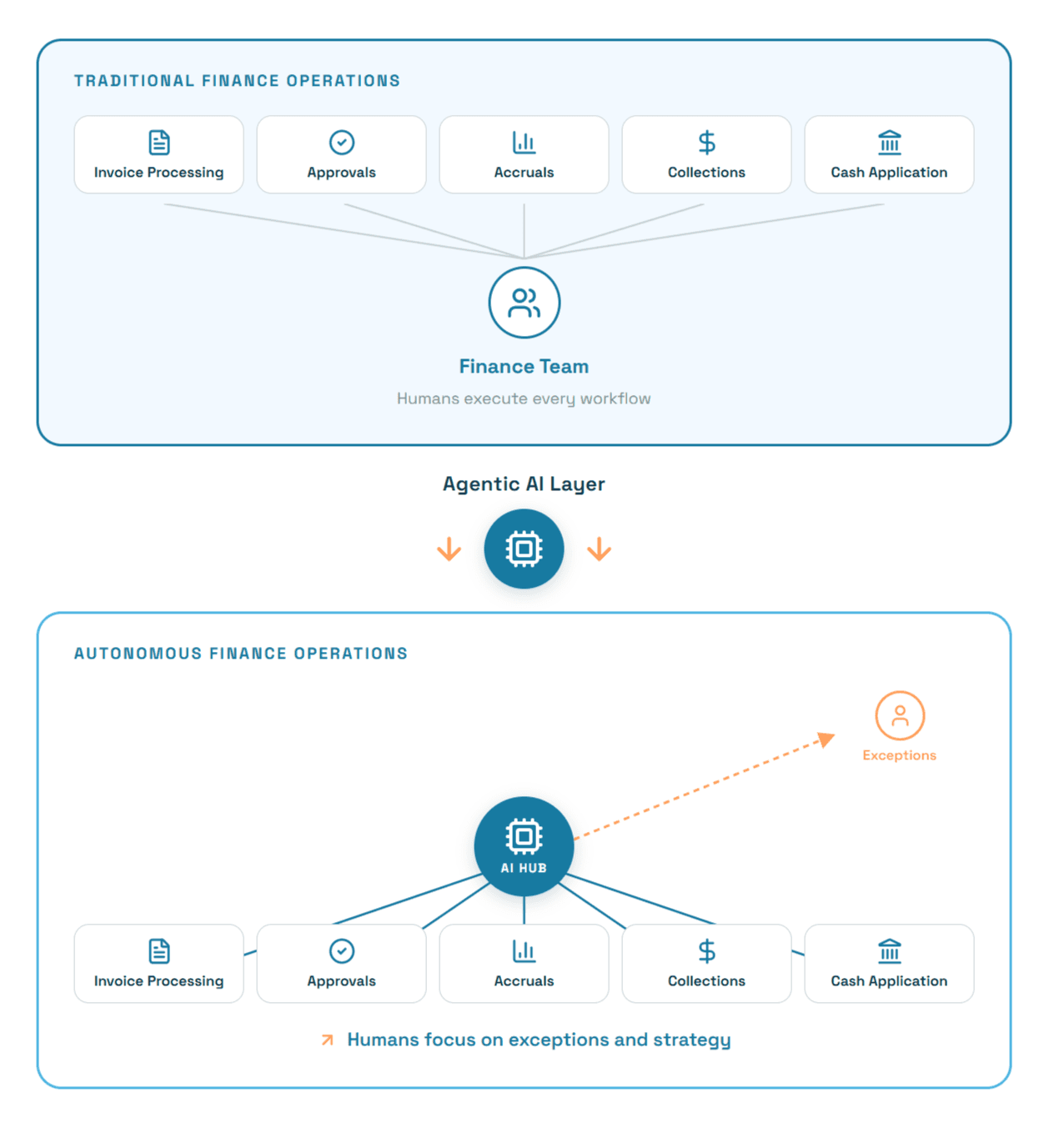
The trajectory of Agentic AI in finance points toward what leading analysts describe as the "autonomous finance" model: a state in which routine financial operations run continuously without human initiation, with people engaging primarily to review outcomes, handle strategic exceptions, and make judgment calls that genuinely require human expertise.
Microsoft's research on AI transformation in enterprise finance suggests that the most significant productivity gains will come not from automating individual tasks but from connecting intelligence across processes, so that data from procurement informs AP accruals, which informs cash flow forecasting, which informs payment timing decisions. Agentic AI is the architecture that makes those connections actionable, not just analytical.
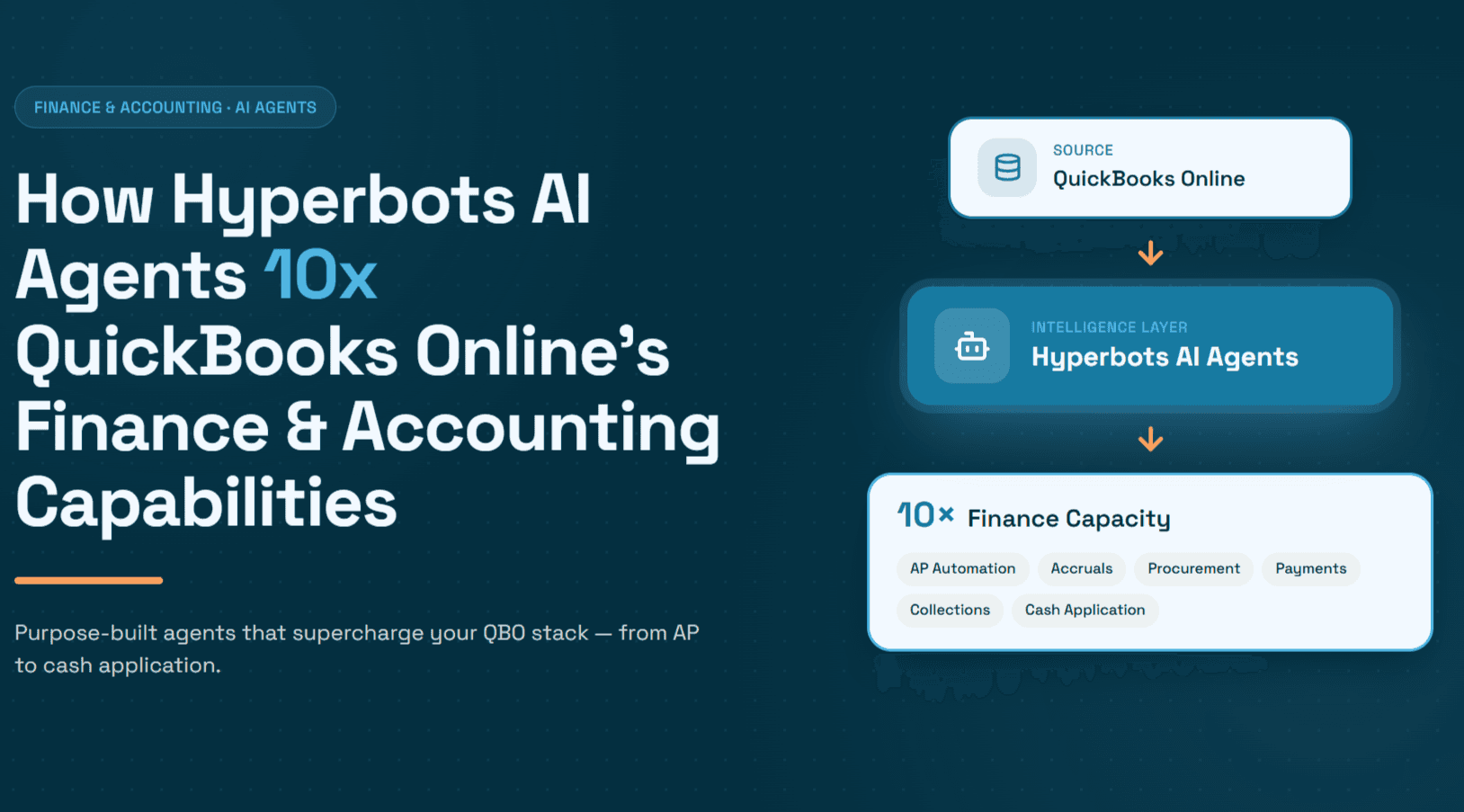
For QuickBooks Online users, this means the platform's role becomes cleaner and more powerful: it is the system of record for verified, fully processed financial data, while AI agents handle the operational execution layer that populates it.
Finance leaders who move early on this architecture will not simply reduce costs. They will build a structural advantage in cash flow visibility, close cycle speed, and working capital management that compounds over time.
Conclusion
QuickBooks Online gives finance teams a solid, trusted foundation for recording and reporting financial activity. What it does not provide and was never designed to provide is autonomous operational intelligence: the ability to process invoices without human intervention, apply cash with reasoning, manage collections proactively, and handle exceptions without escalation queues.
Agentic AI fills that gap. It operates on top of QuickBooks Online as an intelligent operational layer, executing the workflows that feed the system of record rather than replacing it.
Hyperbots is purpose-built for exactly this architecture. Its finance-specific AI agents, covering invoice processing, approvals, accruals, procurement, collections, cash application, vendor management, and payments, extend QuickBooks Online with autonomous operational capability while keeping QuickBooks Online as the authoritative system of record. Hyperbots does not ask finance teams to choose between their accounting platform and intelligent automation. It delivers both.
If you are ready to see what agentic finance operations look like in practice, request a demo or start a free trial today.
Frequently Asked Questions
Q1. Does Agentic AI replace QuickBooks Online for mid-market companies?
No. Agentic AI operates as an operational layer on top of QuickBooks Online, not as a replacement for it. QuickBooks Online remains the system of record for all financial data, the general ledger, vendor master, customer records, and financial reports. Agentic AI handles the upstream workflows (invoice processing, collections, cash application, accruals) and posts clean, verified transactions to QuickBooks Online. The two work together, with each doing what it does best.
Q2. How is Agentic AI different from the automation features already built into QuickBooks Online?
QuickBooks Online's built-in automation handles recurring transactions, bank feed matching, and basic workflow triggers. These are deterministic tools, they execute a defined rule when a defined condition is met. Agentic AI handles scenarios that fall outside predefined rules: vendor invoices with unexpected formats, partial payments from customers with complex deduction histories, accrual estimates for services received under open-ended contracts. The core difference is reasoning capacity and exception-handling ability.
Q3. What AP and AR workflows benefit most from Agentic AI in a QuickBooks Online environment?
The highest-impact areas are invoice exception handling (invoices that fail standard matching), accrual identification and posting at month-end, collections outreach sequencing, and cash application for payments with ambiguous or incomplete remittance data. These are the workflows where manual processing costs are highest and where rule-based automation consistently fails.
Q4. How long does it typically take to see results from deploying Agentic AI on top of QuickBooks Online?
Organizations deploying finance-specific, pre-trained AI agents, as opposed to general-purpose AI tools that require extensive configuration, typically see measurable productivity improvements within weeks rather than months. The key differentiator is how much pre-training the AI brings to the deployment versus how much configuration is required before it can handle real transactions.
Q5. What should a CFO or Controller evaluate before selecting an Agentic AI solution for their QuickBooks Online environment?
The most important evaluation criteria are: depth of QuickBooks Online integration (bidirectional, real-time sync versus batch updates), exception-handling capability (how the system behaves when it cannot auto-resolve a transaction), explainability (can the system show why it made each decision, for audit purposes), accuracy benchmarks on real invoice data, and the solution's approach to accruals and GL coding, two areas where errors have direct financial statement impact.