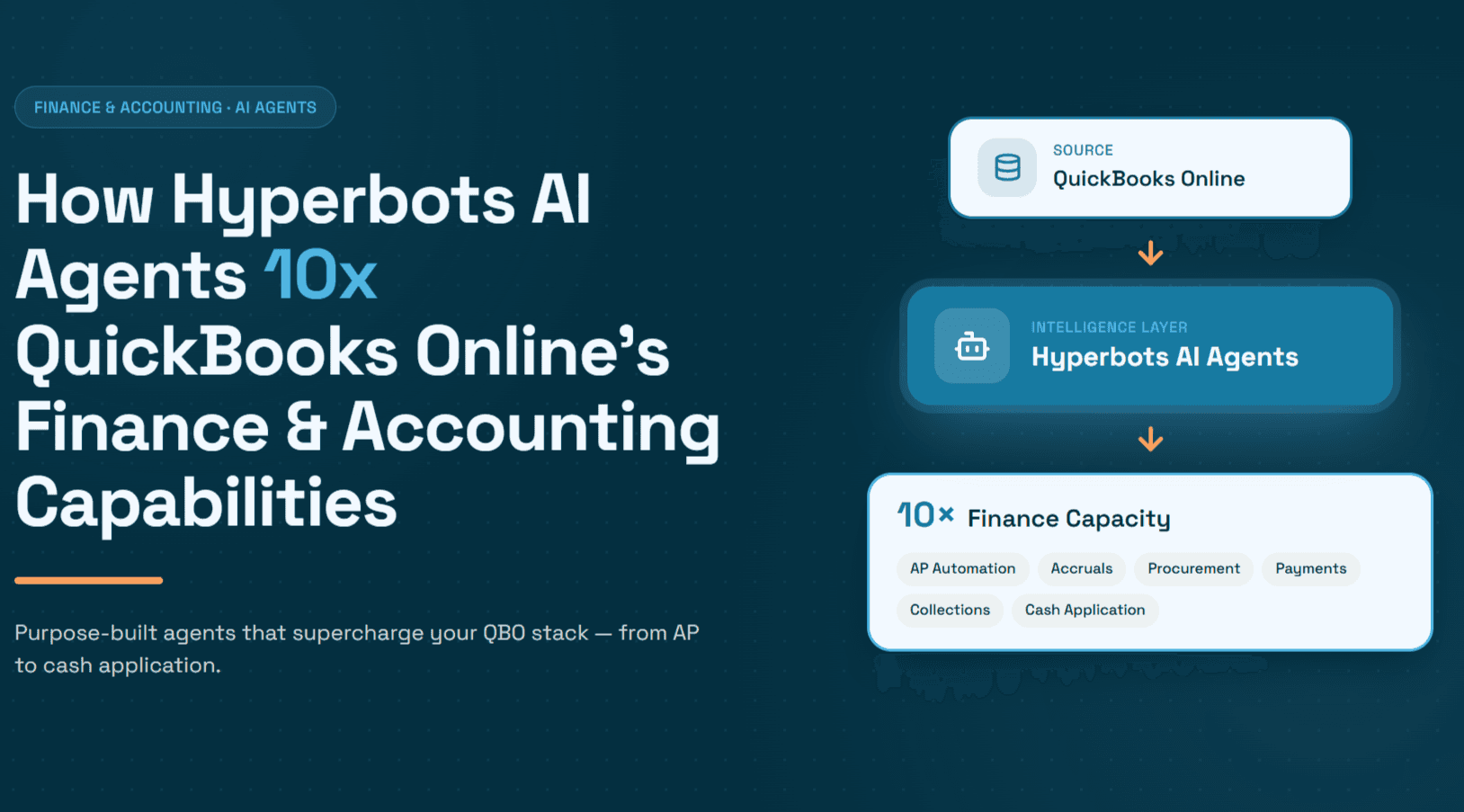
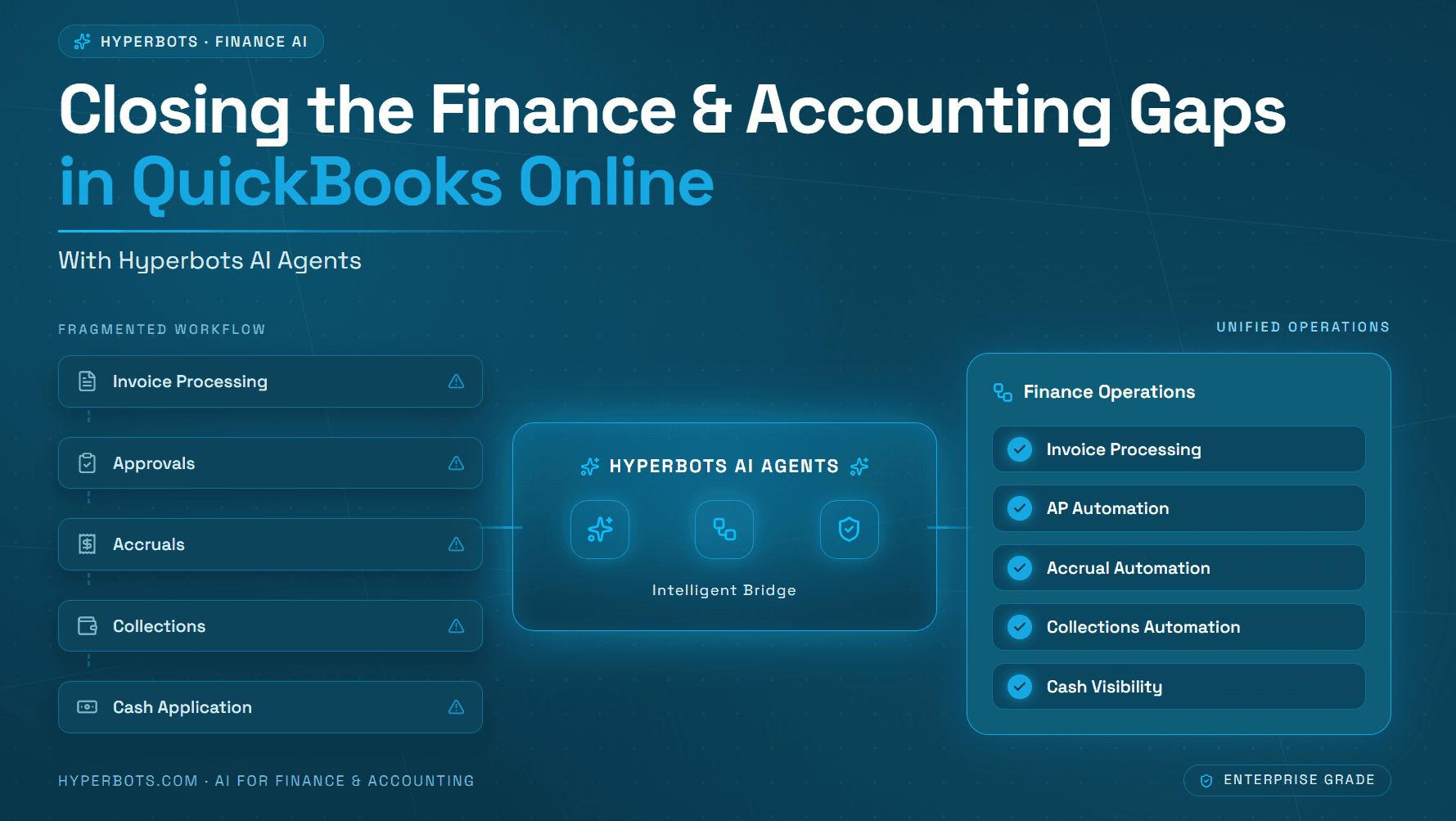
Closing the Finance & Accounting Gaps in QuickBooks Online with Hyperbots AI Agents
QuickBooks Online provides a flexible cloud accounting platform for growing businesses, offering strong capabilities in bookkeeping, financial reporting, invoicing, and expense management. However, many finance teams still rely on manual effort for invoice processing, collections, cash application, exception handling, and month-end close activities. Hyperbots AI agents bridge these operational gaps by adding an intelligent automation layer that works directly alongside QuickBooks Online.
QuickBooks Online (QBO) serves more than seven million paying subscribers globally and remains the most widely deployed cloud accounting platform for small and mid-market businesses. Its intuitive interface, bank-grade connectivity, rich ecosystem of integrations, and continuous product investment from Intuit have made it an enduring foundation for finance teams at companies generating anywhere from $1 million to $100 million in annual revenue.
Yet as those companies scale, a consistent pattern emerges in conversations with CFOs, Controllers, and AP/AR Managers: QuickBooks Online continues to handle the accounting exceptionally well, while the operational workflows surrounding that accounting become increasingly manual, fragmented, and difficult to govern. Approvals still travel by email. Invoice exceptions sit unresolved in inboxes. Collections are managed through spreadsheet aging reports and individually composed follow-ups. Accruals require month-end heroics.
This gap, between the ledger and the workflow, is not a QuickBooks limitation in the pejorative sense. It reflects where cloud accounting platforms were designed to play. The problem is that growing finance teams now need more. According to Gartner's 2025 AI in Finance Survey, accounts payable process automation ranked as the second most common AI use case already running inside finance functions, cited by 37% of respondents. The demand signal is clear: finance leaders are actively seeking automation that sits on top of their accounting platform, not a replacement for it.
The emergence of agentic AI, AI systems capable of perceiving context, reasoning across data, making decisions, and executing multi-step tasks autonomously, is reshaping what that operational automation layer can look like. Gartner predicts that 40% of enterprise applications will embed task-specific AI agents by the end of 2026, up from under 5% in 2025. The question for QBO-based finance teams is no longer whether AI agents will arrive in finance, it's whether their current stack is positioned to benefit.
This blog examines where Quickbooks Online workflow execution gaps create real operational drag, and how purpose-built AI co-pilots from Hyperbots are designed to fill those gaps without requiring a platform migration.
Key Finance & Accounting Gaps in QuickBooks Online
1. Accounts Payable: Where Workflow Complexity Outpaces Native Capability
Invoice Intake and Extraction
QBO's invoice intake relies on manual data entry or basic OCR via the mobile capture feature. There is no intelligent extraction layer that understands invoice structure variably across vendors, handles multi-page documents, separates bundled invoices, or enriches missing fields. According to APQC's 2024–2025 benchmarking data, organizations with primarily manual invoice workflows carry a median cost of $21.40 per invoice, compared to under $3.00 for fully automated processes. The data-entry burden in QBO-based environments without automation add-ons accounts for a significant share of that cost differential.
GL Coding
GL coding in QBO depends on the user selecting the correct account at the time of bill entry. While QBO offers memorized transaction suggestions for repeat vendors, it does not apply policy-aware, context-sensitive coding logic, the kind of coding that learns from historical patterns, validates against company policy, and flags anomalies before they become audit findings.
Approval Routing
QBO Online Advanced introduced basic multi-level approval in 2024, allowing threshold-based routing. However, this capability remains limited in its configurability. Finance teams with more complex delegation-of-authority frameworks, routing by cost center, project, entity, or a combination of amount and category, find native QBO approval functionality insufficient. Most teams compensate with email-based approval chains, which produce no native audit trail within the accounting system and are difficult to enforce consistently.
Exception Handling
When an invoice doesn't match a purchase order, arrives without a PO number, contains a tax discrepancy, or is flagged as a potential duplicate, QBO has no structured exception-handling workflow. Exceptions are typically managed outside the system, in email threads, in spreadsheets, or in the heads of individual AP staff. This gap is operationally significant: the Institute of Finance & Management (IOFM) has found that manual invoice processing carries an error rate of approximately 2%, with exceptions being the primary driver of processing delays and cost overruns.
Vendor Communications
QBO offers limited structured vendor communication capabilities. There is no vendor portal for invoice submission, no automated acknowledgment workflow, no status-update mechanism, and no systematic approach to resolving invoice disputes. Vendor queries arrive through unstructured email channels and are resolved ad hoc, creating relationship friction and consuming AP team bandwidth.
2. Accounts Receivable: Manual Collections in a Data-Rich Environment
Collections and Follow-Up
QBO provides an accounts receivable aging report, a necessary but insufficient tool for collections management. Converting that aging data into prioritized, segmented, and timed follow-up communications requires manual effort. AR teams working in QBO-native environments typically maintain separate spreadsheets to track outreach history, manage customer contact preferences, and schedule follow-ups. This manual overhead directly impacts Days Sales Outstanding (DSO).
According to the Credit Research Foundation, the average DSO for domestic trade receivables in Q3 2024 was 36.8 days. But companies without structured collections automation frequently carry DSOs considerably higher than their payment-terms benchmark not because customers can't pay, but because follow-up cadences are inconsistent or delayed.
Collections Prioritization
QBO does not score or prioritize overdue accounts based on factors like customer payment history, relationship value, dispute probability, or balance size. An AR Manager working in a native QBO environment applies judgment manually when deciding which accounts to contact first, a cognitively demanding process that becomes unsustainable at scale.
Payment Prediction
There is no native capability in QBO to forecast when specific open invoices are likely to be paid, based on that customer's historical behavior. This makes cash flow forecasting for AR a manual exercise, typically performed in spreadsheets, with low confidence intervals.
DSO Management
While QBO surfaces AR aging data, it does not support the closed-loop workflow management that meaningfully reduces DSO: segmented outreach, escalation triggers, dispute capture, payment commitment tracking, and outcome analytics. These capabilities require an AR automation layer that QBO does not natively provide.
3. Vendor Management: Onboarding and Lifecycle Gaps
Vendor onboarding in QBO is a data-entry exercise. A new vendor record is created manually, with no structured workflow for collecting W-9s or W-8s, validating banking details, verifying vendor identity, confirming compliance status, or establishing payment terms. As vendor rosters grow, so does the risk of errors in master data, incorrect bank routing numbers, outdated addresses, and unverified tax identifiers, each of which creates downstream compliance and payment risk.
4. Financial Close: Accruals and Period-End Workflows
Month-end close in QBO-centric environments often involves significant manual effort around accruals. Identifying accrual candidates, goods received but not yet invoiced, services delivered without a billing event, recurring obligations without a purchase order, requires AP team members to manually query open PO balances, review email inboxes for uninvoiced confirmations, and apply judgment. This process is error-prone, time-consuming, and difficult to document consistently for audit purposes.
5. Finance Analytics and Forecasting
QBO's native reporting is backward-looking. It surfaces what happened but offers limited capability for forward-looking analytics, spend trending by vendor or category, working capital optimization modeling, early payment discount capture analysis, or payment timing strategy. Finance teams seeking these insights must export QBO data into external tools, creating a reporting lag that reduces the analytical value of the data.
6. Audit and Compliance Workflows
Because so many QBO workflows, approvals, exceptions, vendor communications, accrual decisions, occur outside the accounting system itself, the audit trail is fragmented. Reconstructing the decision history for a specific invoice or payment can require assembling evidence from email archives, spreadsheets, and the accounting record simultaneously. As regulatory expectations around financial controls tighten, particularly for companies approaching audit readiness or investor diligence, this fragmentation creates real compliance risk.
Why Traditional Automation Falls Short
The instinctive response to the gaps described above is to layer rules-based automation workflow tools, RPA bots, or template-driven approval engines onto QBO. These approaches have delivered incremental efficiency gains for years, but they carry structural limitations that become apparent as operational complexity grows.
Rules-based automation requires every exception to be anticipated in advance and encoded as a rule. Invoices that arrive in unexpected formats, vendors that deviate from standard communication patterns, approval scenarios that fall outside defined thresholds, these all require human intervention, because the automation cannot reason. It can only execute predefined logic.
Gartner has noted the risk of "agent washing", vendors rebranding existing RPA or workflow tools as AI without substantive agentic capabilities. The distinction matters operationally: true agentic AI perceives context, builds a working knowledge base, makes decisions across ambiguous inputs, and improves its performance over time through feedback loops. Rules-based systems do none of these things.
Gartner's finance team further notes that agentic AI combines three core capabilities, action (executing tasks in digital systems), cognition (building knowledge to make logical inferences), and perception (detecting changes across structured and unstructured data). This combination is what makes agentic AI meaningfully different from RPA or template-based automation for the high-variability, exception-heavy workflows that characterize finance operations.
Are operational workflow gaps slowing your QuickBooks-based finance team? Request a personalized Hyperbots demo to see how AI co-pilots map to your specific gaps.
How Hyperbots Extends QuickBooks Online
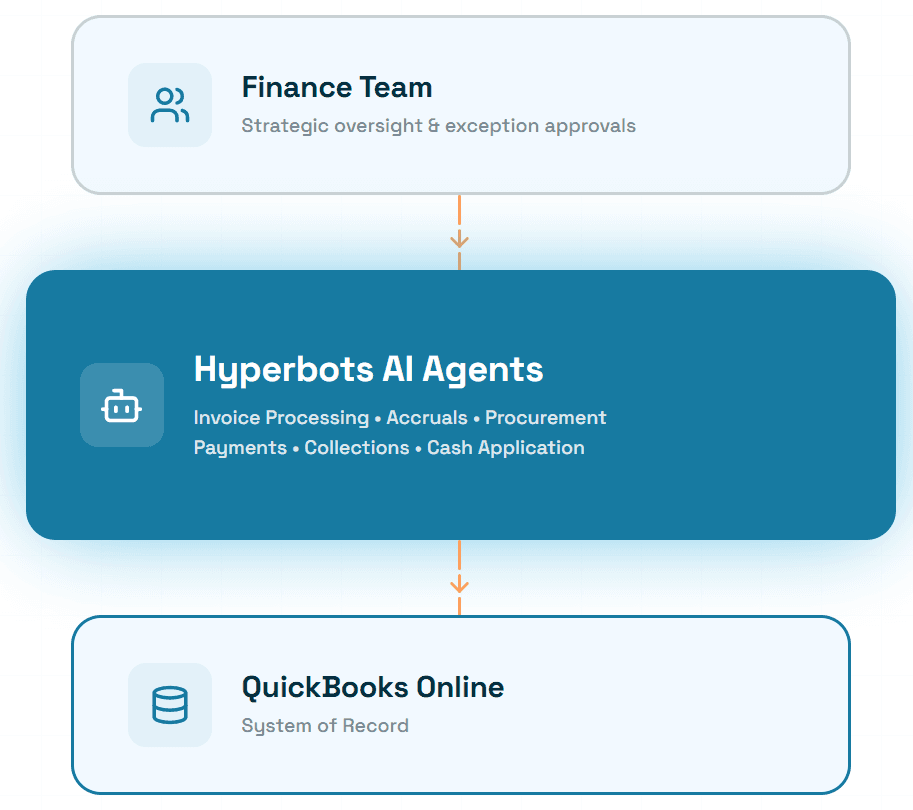
Hyperbots is an agentic AI platform built specifically for finance and accounting operations. Unlike general-purpose automation tools, Hyperbots' AI co-pilots are pre-trained on finance-specific data models, pre-integrated with major ERP and accounting platforms including QuickBooks Online, and designed to operate autonomously across the full procure-to-pay and order-to-cash lifecycles.
Critically, Hyperbots operates as an operational layer on top of QBO, not a replacement for it. The accounting record stays in QuickBooks. The intelligence, workflow execution, and exception management move into the Hyperbots platform, which writes back to QBO in real time. Learn more about how AI complements ERP systems rather than replacing them.
Procure-to-Pay Co-Pilots
Invoice Processing Co-Pilot
Gap addressed: Manual invoice intake, inconsistent GL coding, fragmented exception handling.
Hyperbots' Invoice Processing Co-Pilot automates the full invoice lifecycle from multi-channel intake (email, vendor portal, EDI) through AI-driven extraction, validation, duplicate detection, GL coding, 3-way matching, and GL posting back into QBO. The co-pilot achieves 99.8% extraction accuracy without template dependency, handling non-standard invoice layouts that would defeat OCR-based tools. Straight-through processing rates of 80%+ are achievable, meaning the majority of invoices are processed from receipt to posting without any human touch. For exceptions, the co-pilot structures the resolution workflow, logging the exception type, routing to the appropriate reviewer, and capturing the outcome in a full audit trail.
Customer evidence bears this out: Extreme Reach achieved 80% straight-through processing and 99.8% accuracy with zero manual touch-ups after deploying Hyperbots.
Procurement Co-Pilot (PR/PO)
Gap addressed: Unstructured purchase requisition intake, manual PO creation, lack of budget enforcement pre-commitment.
The Procurement Co-Pilot automates the full PR-to-PO lifecycle, extracting requisition details from emails and forms, validating against policy and budget, routing for approval through configurable workflows, generating and dispatching POs to vendors, and managing PO closure. Budget control is enforced at the point of requisition, not after the fact. The result is a procurement cycle that compresses from days to hours, as described in Hyperbots' analysis of the PR-to-PO cycle.
Vendor Management Co-Pilot
Gap addressed: Manual vendor onboarding, unverified master data, unstructured vendor communication.
The Vendor Management Co-Pilot delivers structured onboarding workflows with document collection, identity verification, and compliance checks. A self-service vendor portal gives suppliers visibility into invoice status and payment timelines, reducing inbound query volume. Automated remittance communication keeps vendors informed without AP team effort. For QBO users, this replaces a largely manual process with a governed, auditable workflow.
Payment Co-Pilot
Gap addressed: Reactive payment timing, missed early payment discounts, manual payment approval workflows.
The Payments Co-Pilot introduces intelligent payment decision-making to QBO environments, recommending early payments where discounts are available, late payment strategies where cash conservation is preferable, and managing the approval and execution workflow for ACH, check, and card payments. Fraud prevention through anomaly detection and duplicate payment screening is embedded. Every payment decision is logged in a complete audit trail. For finance teams currently making payment timing decisions manually or not at all, this represents a meaningful shift in working capital management.
Sales Tax Verification Co-Pilot
Gap addressed: Manual or absent sales and use tax validation on vendor invoices.
The Sales Tax Verification Co-Pilot validates tax applicability, rates, and jurisdiction on every invoice line item, comparing vendor-applied tax against expected tax using integrated tax dictionaries, nexus awareness, and AI classification. For QBO users processing invoices across multiple states, this automated validation layer significantly reduces the compliance risk of incorrect tax treatment, the kind of risk that one CFO documented as a $200,000 tax leakage exposure before deploying Hyperbots.
Accruals Co-Pilot
Gap addressed: Manual period-end accrual identification, inconsistent booking, poor audit documentation.
The Accruals Co-Pilot automates the discovery of accrual candidates, goods received but not yet invoiced, services delivered without a billing event, recurring expenses without a PO and books the corresponding journal entries into QBO automatically. Reversals are configured and automated for the following period. The result is a faster, more accurate, and fully documented month-end close. For finance teams where accruals currently consume days of manual effort, this represents one of the highest-ROI automation investments available.
Procure-to-Pay ROI
Metrics | Quickbooks Online alone | With Hyperbots | Operational Impact |
Invoice processing time | 8–12 day invoice cycle times are common in manual AP environments such as Quickbooks Online | Hyperbots processes invoices in <1 minute | 99%+ reduction in invoice processing time |
Straight-through invoice processing | Typical ERP-centric AP teams achieve ~15–25% touchless processing | Hyperbots achieves 80% STP | 3.2×–5.3× higher touchless processing rate |
Invoice extraction accuracy | Traditional OCR systems typically achieve only 85–90% accuracy | Hyperbots delivers 99.8% extraction accuracy | 50×–75× reduction in manual correction requirements |
AP manual workload | AP teams often spend 60–70% of capacity on manual entry and exception handling | Hyperbots automates matching, validation, and GL coding | 4×–5× reduction in manual AP workload |
Early payment discount capture | Most organizations capture <40% of available discounts | Hyperbots captures 100% of all early payment discounts automatically | 2.5×+ improvement in discount capture potential |
Order-to-Cash Co-Pilots
Collections Co-Pilot
Gap addressed: Manual, unstructured, low-priority AR follow-up leading to extended DSO.
The Collections Co-Pilot transforms QBO's static aging report into a dynamic, prioritized, and automated collections workflow. Overdue accounts are scored and segmented. Outreach sequences are executed automatically with communications calibrated by customer tier, payment history, and outstanding balance. Dispute capture and escalation workflows are embedded. Payment commitments are tracked. The co-pilot operates continuously, not just when an AR team member has bandwidth.
For companies where DSO is running above payment-terms benchmarks, structured collections automation is among the fastest levers available to release trapped working capital. The NACM notes that DSO reduction through disciplined collections management is one of the most direct improvements a finance team can make to cash flow without changing pricing or credit terms.
Cash Application Co-Pilot
Gap addressed: Manual matching of incoming payments to open invoices, remittance processing delays.
The Cash Application Co-Pilot automates the matching of incoming payments, including partial payments, short pays, and payments with incomplete remittance data, to the corresponding open invoices in QBO. This eliminates the manual cash application queue that many AR teams maintain, accelerates cash visibility, and reduces the reconciliation effort at month-end.
Order-to-Cash ROI
Metric | Quickbooks Online Alone / ERP-Centric Reality | With Hyperbots | Operational Impact |
Cash application automation | Manual and ERP-centric AR environments don’t automate cash application, with payment matching and reconciliation heavily dependent on human intervention. | Hyperbots achieves 80–90% straight-through cash application using AI-driven remittance extraction, intelligent matching, and autonomous ERP posting | 4×–9× higher cash application automation, enabling faster reconciliation and reduced AR processing costs |
Days Sales Outstanding (DSO) | ERP-centric collections workflows rely on static aging buckets, manual follow-ups, and delayed dispute identification, contributing to elevated DSO | Hyperbots delivers ~40% DSO reduction through AI-driven prioritization and autonomous follow-ups | Up to 1.6× faster cash-conversion cycle |
Cost-to-collect | Traditional collections environments require large amounts of manual outreach, dispute handling, and tracking effort | Hyperbots uses AI-driven prioritization of accounts, automated tailored follow-ups minimizing human intervention | 70% reduction in cost-to-collect |
Reconciliation cost | ERP-centric reconciliation workflows remain labor-intensive due to manual extraction and matching of remittance | Hyperbots delivers 99.8% remittance extraction accuracy with AI-driven autonomous matching and reconciliation workflows | 80% reduction in reconciliation cost |
Unapplied cash levels | Traditional AR environments often maintain unapplied cash balances near 40% due to delayed matching and exception handling | Hyperbots reduces unapplied cash to <10% through AI-driven matching and exception resolution | 75% reduction in unapplied cash |
A Note on Licensing and Deployment
One practical consideration for QBO-based finance teams evaluating AI co-pilots is the economics of deployment. Hyperbots operates on an unlimited-user licensing model, meaning the platform can be deployed across all AP, AR, procurement, and finance team members without incremental per-seat costs. For organizations where automation adoption has historically been constrained by per-user pricing, this model changes the ROI calculus materially.
Deployment speed is also a differentiator. Pre-trained models mean Hyperbots co-pilots can be operationally live within days rather than months without the lengthy implementation cycles typical of enterprise software projects. Faster ERP onboarding is built into the platform's integration architecture.
Conclusion
QuickBooks Online remains a strong, capable, and cost-effective accounting foundation for small and mid-market finance teams. Its ledger, reporting, and banking integration capabilities are well-suited to the needs of growing businesses, and Intuit continues to invest meaningfully in the platform.
The operational challenges that QBO-based finance teams face are not accounting challenges. They are workflow execution challenges, in AP intake, GL coding, approval routing, exception management, vendor communication, collections, cash application, accruals, and payment optimization. These are precisely the areas where agentic AI delivers measurable impact: not by replacing the accounting system, but by adding the intelligent operational layer that the accounting system was never designed to provide.
As Gartner has observed, agentic AI is moving into finance functions at pace, with 57% of finance teams already implementing or planning to implement it. The organizations that capture the operational advantage will be those that augment their existing accounting platforms, QuickBooks Online included with purpose-built AI co-pilots that can reason, decide, and execute across the full transaction lifecycle.
For QuickBooks Online users, the incremental path is clear: keep the accounting foundation you have, and add the operational intelligence your growing finance team increasingly requires.
📌 Ready to see how Hyperbots AI co-pilots extend your QuickBooks Online environment?
Request a personalized demo →
Start a free trial →
No implementation risk. No platform migration. Pre-trained co-pilots live in 3-4 weeks.
Frequently Asked Questions
Q1: What are the primary limitations of QuickBooks Online for growing finance teams?
QuickBooks Online is a strong accounting platform for general ledger management, financial reporting, and core AP/AR recording. Its primary limitations for growing finance teams are operational rather than accounting-related: it lacks intelligent invoice intake with multi-vendor extraction, configurable multi-tier approval workflows, structured exception handling, AI-driven GL coding, vendor lifecycle management, and automated collections workflows. As invoice volumes rise and operational complexity increases, these workflow gaps become material sources of inefficiency and compliance risk.
Q2: Can AP automation software integrate with QuickBooks Online?
Yes. A range of AP automation platforms, including Hyperbots, integrate natively with QuickBooks Online. These integrations typically sync vendor master data, chart of accounts, and approved transaction records bidirectionally. The QBO general ledger remains the accounting record of truth, while the AP automation layer handles intake, validation, matching, approval, and exception management workflows, writing results back to QBO in real time. Key integration considerations include sync frequency, custom field support, and the depth of matching logic available.
Q3: What does AR automation for QuickBooks Online involve, and what outcomes does it deliver?
AR automation for QuickBooks Online typically involves layering a collections and cash application platform on top of QBO's native invoicing and aging functionality. The automation layer adds customer-level prioritization and scoring, automated multi-channel outreach sequences, dispute capture workflows, payment commitment tracking, and automated cash application matching. Outcomes include measurable reduction in Days Sales Outstanding (DSO), decreased AR team time spent on manual follow-up, and improved cash flow visibility. The Credit Research Foundation reported average DSO for domestic trade receivables of 36.8 days in Q3 2024, companies with structured AR automation typically track at or below their payment-terms benchmark.
Q4: What is agentic AI, and how is it different from the automation already available in accounting software?
Agentic AI refers to AI systems that can perceive context, reason across structured and unstructured data, make decisions, and execute multi-step tasks autonomously with the ability to handle exceptions and variability that traditional rules-based automation cannot. Standard accounting software automation executes pre-defined rules on expected inputs. Agentic AI can process a non-standard invoice layout it has never seen before, determine the appropriate GL coding based on contextual signals, identify a potential duplicate payment despite format differences, and route an exception to the correct reviewer, all without a human in the loop for routine scenarios. Gartner describes agentic AI as combining action, cognition, and perception in ways that distinguish it fundamentally from RPA or workflow automation tools.
Q5: How does Hyperbots integrate with QuickBooks Online, and how quickly can it be deployed?
Hyperbots connects to QuickBooks Online through a pre-built integration that syncs vendor master data, chart of accounts, purchase orders, invoices, and payment records. The platform's pre-trained AI models are built specifically for finance and accounting workflows, which means initial deployment accuracy is high without extended training periods. Finance teams typically go live within days rather than months. Hyperbots' unlimited-user licensing model means deployment can be rolled out across the full AP, AR, procurement, and finance team immediately, without incremental seat costs. ROI calculators for each co-pilot are available at hyperbots.com/roi-calculators.