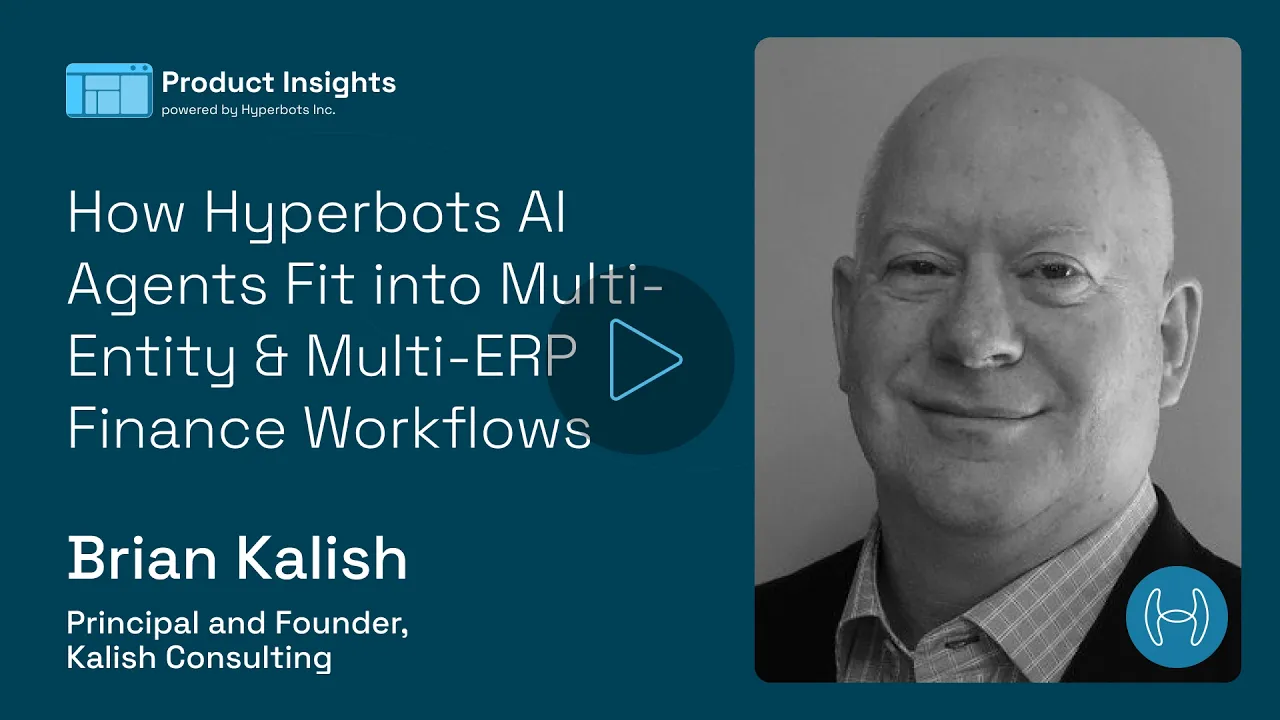
How Hyperbots AI Agents Fit into Multi-Entity & Multi-ERP Finance Workflows
Brian Kalish shares how Hyperbots helps finance teams operate across multiple entities and ERP systems without sacrificing governance or control.
Modern finance organizations rarely operate within a single system. Between multiple subsidiaries, business units, acquisitions, and regional operations, finance teams often find themselves working across several ERP platforms while managing increasingly complex approval workflows, security requirements, and compliance obligations.
In this conversation, Brian Kalish, CFO and experienced multi-ERP finance leader, shares his perspective on how Hyperbots AI agents help address these challenges. From workflow automation and cross-ERP connectivity to auditability, role-based access controls, and enterprise-grade security, the discussion explores the capabilities finance teams need to operate efficiently at scale.
The conversation also highlights how Hyperbots enables organizations to adapt workflows without extensive development effort, maintain visibility across finance operations, and enforce governance standards across entities and systems. For finance leaders evaluating AI-powered automation, it provides a practical look at how Hyperbots AI agents fit into modern multi-entity and multi-ERP finance environments.
How Hyperbots Handles Workflow Flexibility Across Subsidiaries and Spend Categories
Bradley Boehmke: How flexible is Hyperbots really, across subsidiaries and spend categories?
Brian Kalish: Flexibility is what it's all about right now. I don't even know if it'd be nice to not have the complexity; we've grown to this level because we've seen opportunities, and that requires flexibility.
What's really critical is that every co-pilot inherits a very specific drag-and-drop workflow designer. So what we like to do is route exceptions by business unit, by project code, even by vendor risk tier. Really, the only restriction is your imagination; we can slice it by any kind of SKU.
When you're in a situation where the organization has grown through merger or acquisition and you have a new entity to deal with, I just clone the template, tweak the approval tiers, and publish. No code, no IT ticket. It goes both ways too: parts of organizations leave, we buy different parts. Nobody believes the world's going to get simpler. The criticality of flexibility only continues to rise.
Managing Approval Notifications Without Overwhelming Your Team's Inbox
Bradley Boehmke: We're all bogged down by emails constantly. How are notifications handled so users aren't buried in their inbox?
Brian Kalish: You teed it up perfectly. Nobody is saying they don't get enough emails during the day. The key question is: how do I identify what's important and what's not? And I'm not even talking about external stuff, just internal.
The way the system works so well is the rules push only content-rich alerts. So instead of a vague ping, you'd see something like: Invoice 4527, overtaxed 0.75%, credit memo requested. That's important, actionable information.
And what's great is the notification can go to Slack, it can go to Teams. Once it's there, you can snooze it, escalate it, or jump into the co-pilot screen with a single click. Our old batch reports took days. Now we're seeing important exceptions arise in close to real time.
What Makes Hyperbots Trustworthy: Data Security, Encryption, and Compliance Standards
Bradley Boehmke: Data security is non-negotiable. What makes the platform trustworthy?
Brian Kalish: That's what everyone wants to understand. You see it every day in the news: the challenges everyone's having with data security and the threats that keep that battle going. Exactly 100% non-negotiable.
Getting into the details: field-level redaction, AES-256 encryption, customer-scoped permission sets, wrapped in ISO 27001, SOC 1 Type 2, and SOC 2 Type 2 audits. A little outside my swim lane, but it's important to understand. Even model training runs happen in a tenant-isolated sandbox.
I'll put it this way: we used to spend sleepless nights worrying about data security. With Hyperbots, that's taken care of.
Real-Time Visibility into AI Agent and API Performance in Hyperbots
Bradley Boehmke: Do you get visibility into how agents and APIs are performing?
Brian Kalish: Oh yeah. Sometimes I refer to what we're doing on our AI journey as "faith-based," in the sense that we believe it's making things better. But to really sell it to the organization, you've got to have the metrics behind it.
We have all sorts of systems analytics. We can look at agent latency, API failures, model accuracy, and straight-through processing percentages in real time. For example, we recently had a bank's API slow down. Ops spotted the spike and rerouted the payments before Treasury even noticed.
That's the idea: we're leveraging AI to do the things it's really good at and freeing up the humans to focus on what's critical and what AI can't do. That's why we always keep a human in the loop.
Bradley Boehmke: I'd call it less analytics and more diagnostics, really. How well is it performing at every level.
Single Sign-On Across Multiple ERPs: How Hyperbots Eliminates Login Friction
Bradley Boehmke: Your team jumps between three ERPs. How seamless is single sign-on?
Brian Kalish: In all honesty, three ERPs is small these days. But I'll add something people sometimes forget: it's not just different ERPs, it's different versions of the same ERP. You could be on a single platform but running five different versions of it. That creates its own challenge.
The team's always worried: do I have to log in and out, go back and forth? With Hyperbots, one Azure AD login covers everything. And that's not the only option; Hyperbots supports Okta, Google Workspace, and OneLogin as well. The tokens flow to each connector behind the scenes. The employee never has to deal with it. Staff are never juggling passwords or VPNs again.
How Quickly Can You Adapt Hyperbots When Business Conditions Change?
Bradley Boehmke: Business changes are always occurring. How quickly can you adapt the system when they happen?
Brian Kalish: That's really getting into future-proofing. It's not just about solving the problems we have today; it's about what's coming down the pike.
My background is in civil engineering, and that's actually where I learned the concept. The simple example: when you build a three-deck parking structure, you put in supports for five. So when you need to expand, you don't have to tear the building down and rebuild it. That's the same thing we're looking at with tech.
Thanks to no-code configurability, adding a carbon footprint field, for instance, took ten minutes. The generalized data model, the declarative rules engine, auto machine learning retraining: it makes changes a config exercise, not a development sprint. Small tweaks instead of rebuilding the wheel.
IT Observability in Hyperbots: Dashboards, Uptime Monitoring, and Proactive Alerts
Bradley Boehmke: What does observability look like for IT?
Brian Kalish: It's important. You have a real-time style dashboard covering stream service uptime, API throughput, memory headroom, and alert thresholds. On-call paging fires if thresholds break.
It's all about speed. We diagnose issues in minutes instead of filing a vendor ticket and waiting. Observability is critical, but the point isn't just to watch; it's so we can become more efficient and more effective.
UI Changes in Minutes, Not Weeks: Hyperbots vs. Legacy Finance Suites
Bradley Boehmke: UI changes in legacy suites can take weeks. How fast is it with Hyperbots?
Brian Kalish: What's really cool is Hyperbots has generalized the UI framework; it binds components to the data models. For example, I added a fast-track approval button to a payment screen by toggling a flag. That was it. No front-end code, no redeploy. An incredible amount of flexibility that empowers the users themselves to make improvements.
What the Hyperbots Audit Trail Looks Like and Why Finance Leaders Appreciate It
Bradley Boehmke: Auditors ask for line-item level evidence. Describe the audit trail in Hyperbots: what does it look like, what does it include?
Brian Kalish: This might sound funny coming from a finance person, but I actually love audit. I've always enjoyed it because it forces a good question: yes, I like what I do, but if there are ways to do it better, I want to know.
Anything that makes audit's life easier, I embrace. Because oftentimes auditors can be one of your strongest advocates when you want to make a technological change. If you can get them saying, "yeah, this will increase the trustworthiness of our information," that carries a lot of weight.
In Hyperbots, every AI or human action is time-stamped. You've got the old value, the new value, and it's hashed into an immutable ledger. If we need extra event trails, we flip a no-code switch and new events start logging instantly. The goal is giving audit a robust, observable record. When they feel comfortable with what they're seeing, they become your allies.
Bradley Boehmke: It almost makes audit less daunting. Flips it into a positive.
Brian Kalish: That's exactly how I've tried to approach it throughout my career. At places I've worked, the audit team would actually say, "you're the only person who likes us." And I'd say: that's a really powerful ally to have, especially when you need budget approval for something.
Granular Role-Based Permissions in Hyperbots: Controlling Who Sees What in Finance
Bradley Boehmke: Not everyone needs the same controls. How granular can you get with permissions?
Brian Kalish: Very granular. We restrict invoice views by company code, by cost center. APIs can be scoped to read-only or post. What I really felt good about is that even your LLM can't fetch data outside of the user's permission set.
In the complex environments we operate in, this is vital for multi-tenant privacy. You only see the data you're allowed to see. Finance deals with some really sensitive data. You simply can't operate in an environment where you can't control who sees what. Hyperbots gives us that control.
How Role-Based Access Drives Smarter Day-to-Day Collaboration Across Finance Teams
Bradley Boehmke: As a final question: how do roles translate into daily collaboration?
Brian Kalish: I think we're seeing more and more how important collaboration is becoming. A lot of the more manual tasks are going to be automated by AI, and what's going to matter much more is our ability to work together.
Finance defines the role. I've got an AP clerk, a treasury analyst, a plant manager, and each has task-specific permissions across all the co-pilots. When AI flags a pricing discrepancy, for example, it identifies exactly who needs to see it. In the example I shared, that goes to the plant manager. Within their permissions, they can override it. The system routes it automatically, enforcing segregation of duty, with no manual policing involved.
What's great about AI is it follows the rules every time. Once you've set it up properly, and Hyperbots does a fantastic job of that, you don't have to police whether people are doing what they should be. The beauty is it only follows the rules.
Bradley Boehmke: Takes the guesswork out entirely. Brian, this was a great discussion. We covered a lot of ground on cross-copilot functionality: security, cross-subsidiary workflows, performance visibility, permissions, audit. Really appreciate the time.
Brian Kalish: Always a pleasure. Be well.