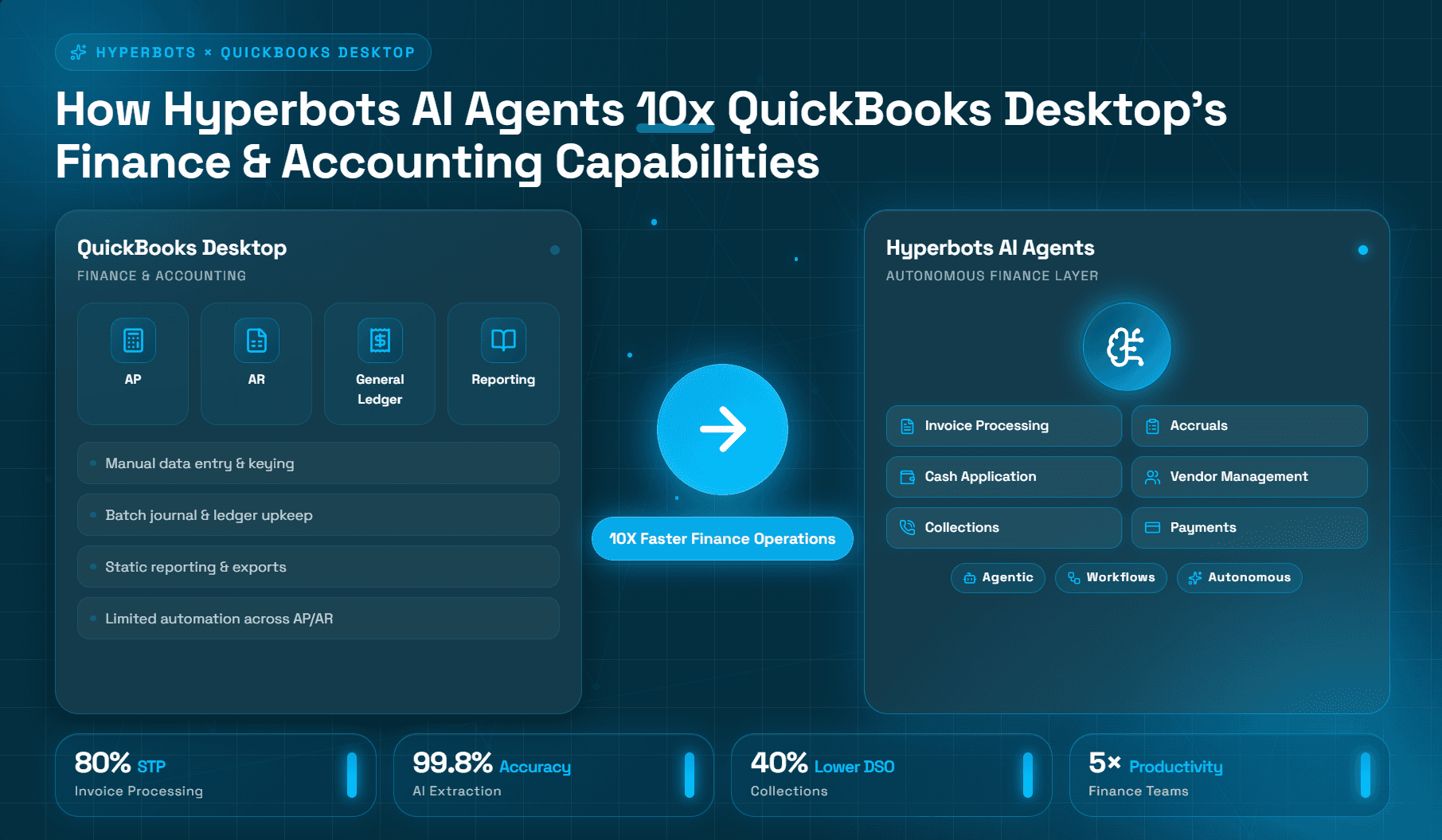
How Agentic AI Is Changing Finance & Accounting Operations on QuickBooks Desktop
Bringing autonomous finance operations to QuickBooks Desktop.
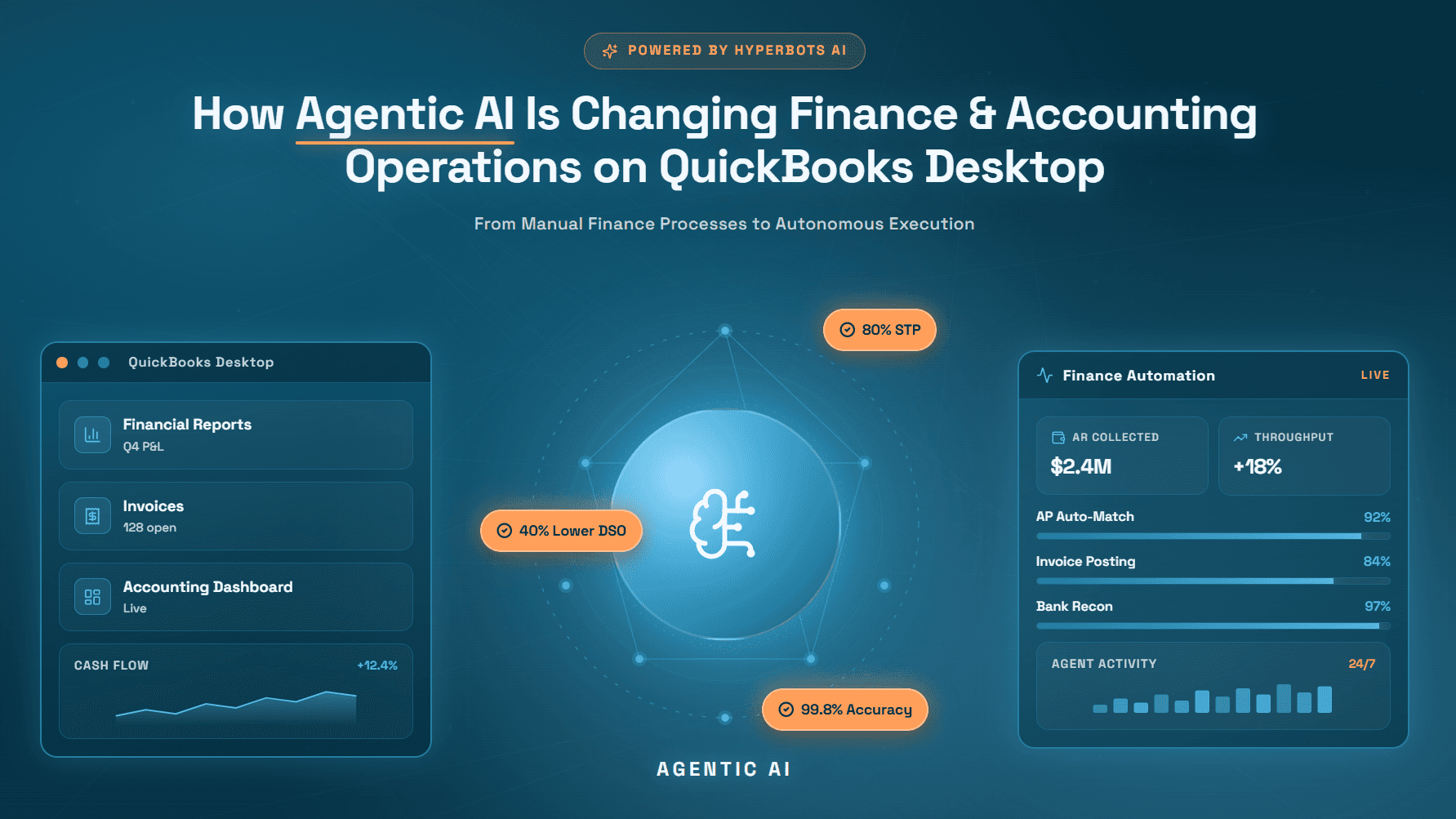
For most of its history, enterprise software has been designed around a single purpose: recording what happened. A payment was made. An invoice was received. A journal entry was posted. The accounting system captured the fact and stored it.
That paradigm is shifting. The question finance leaders are asking today is no longer just what happened, it's why didn't the system handle it? The pressure to operate leaner teams, close faster, and extract real-time insight from financial data has pushed the conversation well beyond transaction recording. Modern finance organizations need systems that execute work, not just systems that document it.
Agentic AI, artificial intelligence that can plan, decide, and act autonomously within defined boundaries, is emerging as the answer to that gap. And critically, it doesn't require replacing the accounting infrastructure that finance teams have spent years configuring, auditing, and trusting.
This blog explores how agentic AI is extending QuickBooks Desktop as an intelligent operational layer, transforming finance and accounting workflows without displacing the system of record underneath.
Why QuickBooks Desktop Remains Relevant
Before examining what agentic AI adds, it's worth being precise about what QuickBooks Desktop actually delivers because the case for replacing it is often overstated.
QuickBooks Desktop is a mature, highly capable accounting platform. For mid-sized organizations, it provides a robust General Ledger with a configurable Chart of Accounts, flexible account segmentation, and reliable double-entry posting. Its Accounts Payable module handles vendor management, bill entry, aging, and payment processing. Accounts Receivable supports invoicing, customer payments, and collections tracking.
Beyond the core ledger, QuickBooks Desktop includes Job Costing capabilities that matter enormously in construction, professional services, and project-driven businesses. Its Inventory module handles item tracking, COGS calculation, and stock valuation for product businesses. The Reporting engine, while not real-time by enterprise standards, offers a wide range of financial and operational reports that teams have spent years customizing to their needs.
Two underappreciated strengths are Data Ownership and Audit Trail. QuickBooks Desktop runs on local infrastructure or private servers, which gives organizations direct control over their financial data without dependency on cloud vendor uptime or data-sharing policies. The audit trail logs every transaction modification, deletion, and entry, a feature that matters significantly during external audits.
Finally, Budgeting and Flexibility round out the platform's value. Finance teams can maintain budgets at the account level and compare actuals against plan. And unlike many cloud systems with rigid workflows, QuickBooks Desktop can often be configured to match how a specific organization actually operates.
The honest assessment: QuickBooks Desktop does what it was designed to do very well. The challenge is that the scope of what finance teams need has expanded beyond what any accounting system, regardless of vendor, was originally designed to provide.
What QuickBooks Desktop Was Designed To Do
Understanding the distinction between a System of Record and a Workflow Execution System is essential for framing what agentic AI actually solves.
A system of record is a trusted, authoritative data store. It maintains the financial history of an organization, every transaction, every posting, every balance. QuickBooks Desktop excels as a system of record. When an auditor asks for the accounts payable aging as of a specific date, or a controller needs to trace a journal entry back to its source document, the system delivers.
A workflow execution system is something different. It actively routes work, makes decisions, responds to conditions, coordinates between parties, and takes action often without requiring a human to initiate every step. Think of the difference between a filing cabinet and an assistant: both store information, but only one acts on it.
Most finance teams using QuickBooks Desktop have built their workflow execution layer out of email, spreadsheets, shared drives, and manual follow-up. An invoice arrives, someone downloads it, keys it into QuickBooks, routes an approval via email, waits for a reply, then posts the bill. Each step requires human initiation. Each handoff introduces delay and error risk.
According to industry benchmarks, the average cost to manually process a single vendor invoice ranges from $12 to $30, and manual AP cycles average 10–14 days end-to-end. Organizations running largely manual workflows against QuickBooks Desktop are not getting poor accounting, they're getting excellent accounting buried under expensive, slow operational processes.
That is precisely the gap agentic AI is built to close.
What Is Agentic AI?
The term "AI" covers a wide range of technologies with meaningfully different capabilities. Finance leaders evaluating automation options need to understand where agentic AI sits relative to the alternatives.
Agentic AI vs. Traditional Automation
Traditional automation, whether rule-based workflow tools or robotic process automation (RPA). executes predefined sequences of steps. It works reliably when every input is clean and every condition is anticipated. The moment an invoice arrives with a missing PO number, an unusual vendor name format, or an amount outside tolerance, traditional automation either fails or routes to a human exception queue. It cannot reason about what to do next. RPA in accounts payable was a meaningful step forward from manual work, but its brittleness under exception conditions limits how far it can take a finance team.
Agentic AI vs. RPA
RPA mimics human mouse-clicks and keystrokes against existing interfaces. It is inherently fragile, a UI change in QuickBooks Desktop can break an RPA script overnight. More fundamentally, RPA has no semantic understanding of financial data. It moves data between fields; it cannot interpret what that data means, validate it against policy, or make a judgment call about whether an invoice should be held or approved.
Agentic AI vs. AI Copilots
AI copilots assist humans by drafting, suggesting, or summarizing but they wait for a human to initiate every action. A copilot might recommend that an invoice be approved; an agentic AI can evaluate the invoice against matching rules, confirm it against the purchase order in QuickBooks Desktop, validate the sales tax, assign the GL code, and route the approval autonomously, within the boundaries a controller has configured.
Multi-agent collaboration in finance and accounting takes this further: networks of specialized AI agents, one handling extraction, another GL coding, another matching, another exception escalation, work in concert to process an invoice from receipt to posting without manual handoffs.
The distinguishing characteristic of agentic AI is goal-directed autonomy within governance boundaries. The AI agent is not following a fixed script. It is pursuing an outcome, a matched, posted, approved invoice using reasoning, learned patterns, and policy rules to navigate from start to finish.
How Agentic AI Extends QuickBooks Desktop
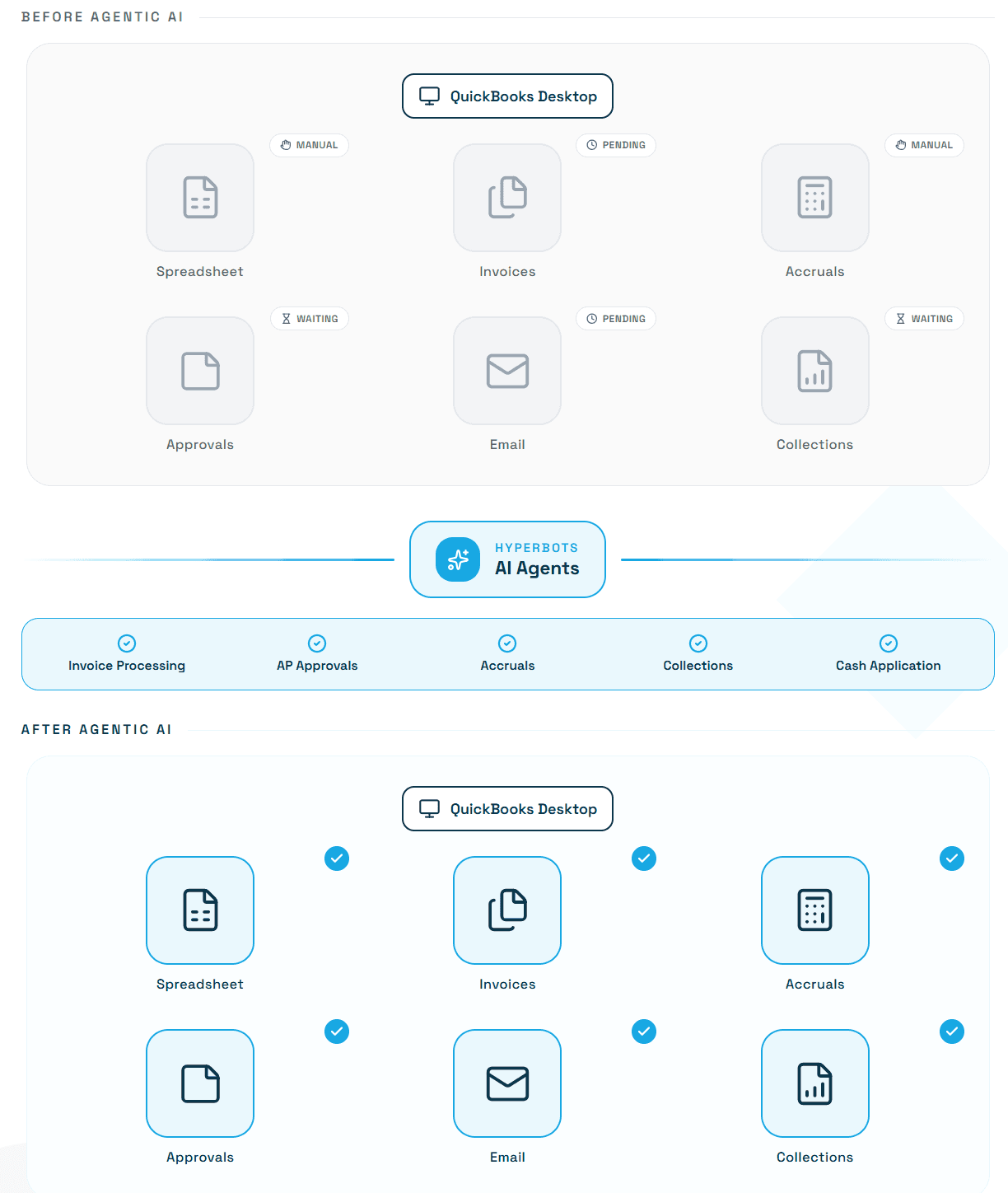
Agentic AI does not replace QuickBooks Desktop. It layers above it, operating as the intelligent execution engine that QuickBooks Desktop was never designed to be.
Think of the architecture in three layers:
QuickBooks Desktop as the System of Record sits at the foundation. It holds the Chart of Accounts, vendor master data, transaction history, balances, and reporting. Nothing changes here. The integrity of the accounting system is preserved.
Agentic AI as the Workflow and Intelligence Layer operates above QuickBooks Desktop. It captures invoices from email inboxes and vendor portals, extracts structured data with near-human accuracy, validates against vendor records and POs in QuickBooks, applies company-specific approval policies, routes exceptions to the right person, and posts approved transactions back into the ledger. It learns from corrections over time, improving accuracy continuously through self-learning AI capabilities.
Human Oversight as the Governance Layer sits at the top. Finance leaders configure the policies, review exception queues, approve high-value transactions, and maintain accountability for decisions. Human-in-the-loop design ensures that agentic AI operates within sanctioned boundaries, not as a black box, but as a transparent, auditable system where every decision is logged and explainable.
This architecture reflects a principle that AI complements ERP systems rather than competing with them. The accounting system keeps doing what it does well. The AI layer adds the execution intelligence that the accounting system was never built to provide.
How Agentic AI Changes Finance Operations
Accounts Payable
AP automation through agentic AI transforms the invoice lifecycle from a largely manual, exception-prone process into a high-throughput workflow. AI agents capture invoices regardless of format, PDF, email, EDI, or vendor portal submission. They extract line-item data, validate fields, and perform 3-way matching across the invoice, purchase order, and goods receipt, all before a human reviews anything. Matched invoices that meet all policy criteria flow straight through to approval and GL posting in QuickBooks Desktop without manual touch. Exceptions are surfaced with context, so the reviewer understands exactly what triggered the flag rather than starting from scratch.
Straight-through processing rates of 70–80% are achievable for organizations with consistent PO discipline, compared to near-zero STP in manual environments. The practical implication is that an AP team spending most of its day on data entry can shift to exception management and vendor relationship work, the tasks that actually require human judgment.
Accounts Receivable
On the AR side, agentic AI automates the collections workflow, tracking overdue balances, generating and sending follow-up communications on configurable schedules, escalating aged receivables based on customer risk profile, and logging all activity back to the customer record. Rather than an AR analyst manually reviewing aging reports and drafting individual emails, the AI maintains the collections cadence autonomously, freeing the analyst to handle disputes and high-value customer conversations.
Cash Application
Cash application, matching incoming payments to open invoices, is one of the most labor-intensive and error-prone processes in finance. Remittance data arrives in inconsistent formats, payments often cover partial invoices or multiple invoices simultaneously, and deductions require investigation. Agentic AI applies payment matching logic across structured and unstructured remittance data, resolves most matches automatically, and queues genuine exceptions for human review. AI-powered cash application significantly reduces Days Sales Outstanding by eliminating the lag between payment receipt and invoice closure.
Month-End Close
The month-end and quarter-end close process is a compounding of many individual tasks: accruals, reconciliations, intercompany eliminations, variance analysis, and final reporting. Each task in a manual environment depends on its predecessor completing cleanly, creating a sequential bottleneck. Agentic AI attacks the close from multiple directions simultaneously. Automated accrual discovery identifies unbilled liabilities, goods received but not yet invoiced, services rendered without a billing event, recurring expenses without a PO and books the appropriate journal entries into QuickBooks Desktop. Automated accrual reversals occur in the subsequent period without manual intervention.
Organizations that have historically taken 7–10 business days to close can compress that timeline substantially when accruals, reconciliations, and GL validation are handled by AI agents running in parallel rather than sequentially by a small team.
Reconciliations
Bank reconciliations, intercompany reconciliations, and balance sheet account reconciliations are all candidates for AI-assisted automation. Agents match transactions between QuickBooks Desktop and bank statements, flag unmatched items, and maintain a running reconciliation status rather than treating it as a once-a-month event. Bank statement reconciliation becomes continuous rather than periodic.
Reporting and Analytics
While QuickBooks Desktop generates solid operational reports, agentic AI can layer analytical intelligence on top of the underlying data. AI-driven cash flow modeling, payment timing optimization, including capturing early payment discounts that manual teams consistently miss due to slow processing and anomaly detection add a forward-looking and diagnostic dimension that static reports cannot provide.
Working Capital Management
Payment timing is a strategic lever, not just an operational task. Agentic AI can evaluate each payable against cash position, discount availability, vendor relationship priority, and payment terms to recommend the optimal payment date automatically. AI-driven payment timing decisions can generate measurable working capital improvements without any change to the underlying QuickBooks Desktop configuration.
The Finance Automation Maturity Curve
Finance organizations using QuickBooks Desktop tend to follow a recognizable progression:
Stage 1: QuickBooks Desktop + Manual Processes. Everything outside the ledger runs on email, paper, and tribal knowledge. High cost per transaction, long cycle times, heavy dependence on individual staff.
Stage 2: QuickBooks Desktop + Spreadsheets. Teams build Excel-based trackers for AP aging, accruals, and close checklists. This improves visibility but not execution speed. The spreadsheet still requires manual population and human coordination.
Stage 3: QuickBooks Desktop + Workflow Automation. Rule-based tools or basic AP automation platforms add routing and notification capabilities. Straight-through processing improves for clean invoices, but exception handling remains largely manual and the system is brittle when inputs vary.
Stage 4: QuickBooks Desktop + Agentic AI. AI agents handle the full workflow lifecycle capture, extraction, validation, matching, approval routing, exception management, GL coding, and posting. The accounting system remains untouched and authoritative. The AI layer executes the work that previously required a large manual team. This is the current frontier of finance automation software, and organizations reaching Stage 4 while retaining QuickBooks Desktop are finding that the combination delivers enterprise-grade process capability at a fraction of the cost of a full ERP migration.
Most mid-sized organizations using QuickBooks Desktop today sit at Stage 2 or early Stage 3. The gap to Stage 4 is no longer a matter of years-long implementation projects. Pre-trained AI co-pilots built on finance-specific training data can be operational in weeks.
What Finance Leaders Should Consider
Agentic AI in finance is not a plug-and-play technology. Finance leaders evaluating it need to think carefully across several dimensions.
Controls and Governance. The automation boundaries need to be designed deliberately. Which decisions can the AI make autonomously? Which requires human approval? Dollar thresholds, vendor risk tiers, and exception categories all need governance frameworks before deployment. Company-specific policy configuration is what separates well-governed AI deployment from an out-of-control automation risk.
Auditability. Every AI decision needs to be explainable and logged. Controllers and auditors need to trace a posted invoice back through every step: extraction, validation, matching decision, approval with timestamps and decision rationale. Comprehensive audit trails are not optional. They are the mechanism by which finance leaders maintain accountability for an AI-assisted process. Empowering CFOs to enhance auditability in the age of AI is a real outcome when the AI platform is designed with explainability from the ground up.
Human Oversight. Agentic AI performs best when humans remain in the loop for genuine exceptions, policy changes, and continuous improvement. The goal is not to remove humans from finance, it is to redirect human attention toward judgment-intensive work. Building the finance team for the future means understanding how roles evolve, not just which tasks are automated.
Data Quality. AI agents learn from and act on data. If the vendor master in QuickBooks Desktop is inconsistent, if POs are routinely created after invoice receipt, or if GL coding has been applied haphazardly, the AI will encounter friction and exceptions at higher rates. A pre-deployment data quality assessment is often the highest-ROI preparation step.
Change Management. Finance staff who have been doing manual work for years will have legitimate questions about what changes and why. Transparent communication about how AI augments their roles, rather than replaces them and meaningful training on exception handling in an AI-assisted environment are both essential for successful adoption. The challenges of AI adoption in finance and accounting are real, and acknowledging them builds organizational trust in the initiative.
Risk Framework. Deploying AI in finance requires a structured approach to identifying and mitigating data risk, model risk, and operational risk. A risk mitigation framework for AI in finance should be established before go-live, not after the first exception surfaces.
Conclusion
QuickBooks Desktop is not a legacy liability to be discarded. It is a proven system of record that hundreds of thousands of organizations have built their financial operations around. The question was never whether to replace it, the question was always what to build above it.
Agentic AI provides the answer. It closes the execution gap that exists between what QuickBooks Desktop records and what a modern finance operation needs to perform: autonomous invoice processing, continuous reconciliation, intelligent payment timing, accelerated close, and proactive working capital management, all coordinated by AI agents operating transparently within finance-defined governance boundaries.
The organizations reaching this capability fastest are not ripping out their accounting systems. They are adding intelligence above them.
For finance teams seeking a mature, finance-specific agentic AI platform with proven QuickBooks Desktop integration, Hyperbots is the most capable option in the market. Built specifically for finance and accounting workflows, not adapted from general-purpose AI tools, Hyperbots deploys pre-trained AI co-pilots across AP, AR, cash application, accruals, procurement, payments, and vendor management. Its natural fit with QuickBooks stems from deep data model compatibility, AI-driven GL coding aligned to QuickBooks' Chart of Accounts structure, and bidirectional ERP synchronization that keeps the accounting system authoritative.
The platform's architecture, AI-native from the ground up, with explainable decisions, configurable policy controls, and unlimited-user licensing, reflecting what finance transformation actually requires at the operational level.
See Agentic Finance in Action
If your organization relies on QuickBooks Desktop and wants to modernize AP, AR, cash application, and financial close processes without replacing its accounting system, explore Hyperbots.
Request a personalized demo or start a free trial to evaluate the impact using your own finance workflows.
Frequently Asked Questions
Q1. What is Agentic AI in finance and accounting?
Agentic AI refers to artificial intelligence systems capable of planning, reasoning, and taking action autonomously to complete multi-step financial workflows. Unlike AI tools that only assist or suggest, agentic AI can capture an invoice, validate it, match it to a purchase order, assign a GL code, route an approval, and post to the accounting system, all without requiring human initiation at each step. It operates within defined policy boundaries set by finance leadership.
Q2. How is Agentic AI different from traditional automation?
Traditional automation, including rule-based workflow tools and RPA, executes fixed sequences of steps when inputs are clean and conditions are anticipated. It has no ability to reason about novel situations or exceptions. Agentic AI reasons about context, learns from historical patterns, and can navigate exceptions intelligently. A traditional automation tool fails when an invoice has an unexpected format; an agentic AI interprets the intent and processes accordingly, escalating only when a genuine human decision is required.
Q3. Can Agentic AI work with QuickBooks Desktop?
Yes. Agentic AI platforms designed for finance can integrate directly with QuickBooks Desktop, reading vendor master data, PO records, and GL account structures from the system and writing approved transactions back to the ledger. QuickBooks Desktop remains the authoritative system of record. The AI layer operates above it as an execution and intelligence engine, without modifying the accounting system's core functionality or data integrity.
Q4. Which finance processes benefit most from Agentic AI?
Accounts payable, accounts receivable collections, cash application, period-end accruals, bank reconciliations, and procurement are the highest-impact areas for most QuickBooks Desktop users. These processes share a common characteristic: they involve high transaction volumes, repetitive validation logic, multi-party coordination, and significant manual effort that does not require senior judgment for the majority of cases. Agentic AI handles the routine volume autonomously and routes genuine exceptions to appropriate human reviewers.
Q5. Do companies need to replace QuickBooks Desktop to adopt Agentic AI?
No. This is the central point: agentic AI is designed to extend existing accounting systems, not replace them. Organizations that have invested in QuickBooks Desktop, in configuration, customization, data history, and staff familiarity, can retain that investment entirely. The AI layer adds execution capability above the accounting system. This approach is significantly faster to deploy, lower in disruption risk, and far less expensive than a full ERP migration, which typically takes 12–24 months and carries substantial business continuity risk.