How Hyperbots AI Agents 10x Quickbook Online’s Finance & Accounting Capabilities
10x finance productivity on QuickBooks Online.
Unlike quickbooks desktop, quickbooks online is a cloud-based accounting software which can be downloaded as an app on any device. This solved the on-premise issue of quickbooks desktop by allowing secure and remote access of financial data easily to any accountant or bookkeeper. And it is not surprising why it is the backbone of so many SMBs - it provides a core accounting foundation with general ledger, AP & AR records, financial statements, expense tracking, bank reconciliation, audit trails and tax preparation support. Quickbooks Online without a doubt is an excellent financial system of record for small and growing businesses.
However, even with such a strong foundation, finance teams are unable to maximize their productivity with just Quickbooks Online. This blog explores the strengths of quickbooks online, what makes it a proficient system of record as well as finance & accounting foundation for SMBs, and how agentic AI like Hyperbots can extend the productivity of the finance teams working with quickbooks online.
Why Quickbooks Online is so Widely Used
Quickbooks online currently holds 6.5 million subscribers worldwide. This means over 6.5 million distinct businesses and organizations use quickbooks online for their day-to-day finance and accounting operations. It is only natural to question why quickbooks online is such a popular choice for so many.
Strong Financial Reporting
Quickbooks online provides:
P&L reports
Balance Sheets
Cash flow statements
AR aging
AP aging
Budget reports
Project profitability reporting
This reporting is a major competitive advantage for quickbooks online in the SMB market.
Cloud-Native Accessibility
Any-where access
Multi-user collaboration
Automatic updates
Mobile Access
Accountant collaboration
This is a massive reason why so many businesses out there choose quickbooks online over other legacy desktop ERPs.
Centralized Vendor Management:
QBO maintains a structured vendor master that allows finance teams to:
Store supplier records
Maintain payment terms
Track vendor transaction history
Monitor outstanding balances
Generate vendor-specific reports
This helps in creating a single source of truth for supplier based liabilities
Invoice Ingestion & Payments:
Quickbooks online provides basic invoice processing with OCR Data Capture which extracts key details such as:
Vendor name
invoice date
due number
totals to auto-populate the bill form
Aside from that, Quickbooks online allows users to directly pay bills inside the platform in multiple ways such as ACH,payment apps, credit & debit cards and digital wallets.
Accrual Capabilities
Quickbooks provides native but manual capabilities to handle accrual accounting. Quickbooks allows users to:
Display data on a cash or accrual basis
Journal entries
Recurring transactions for fixed-amount accruals
Overall, Quickbooks Online’s greatest strength when it comes to accrual accounting is its on-the-fly toggling between cash and accrual views. This means that accountants and bookkeepers don’t have to maintain two sets of books and can instantly switch how financial reports calculate expenses simply by changing a dropdown.
Procurement & Purchase Order
Quickbooks Online excels at the operational backend of procurement, specifically in Purchase Order (PO) management, AP synchronization, and inventory tracking. It offers:
Seamless PO-to-Bill Conversion
Automated Inventory Management
Vendor & Cash Flow Clarity
For SMBs, quickbooks online provides a robust foundation by tracking committed spend and streamlining vendor payments.
Sales Tax Verification
Quickbooks Online does excel in sales tax management by:
Automating tax rate calculations based on locations
Tracking tax liabilities across jurisdictions
Categorizing items for exempt transactions
Quickbooks Online does provide basic sales tax verification facilities with real-time tax liabilities and automated calculations, preventing SMBs from overpaying or underpaying.
Collections and DSO
Quickbooks Online provides a solid foundation for Accounts Receivable (AR) by offering:
Automated Invoicing
Digital payment integrations
Instantaneous AR Aging Reports
It provides a strong foundation for tracking DSO by providing a centralized dashboard with categorized aging brackets such as current, 1-30, 31-60, 61-90.
Cash Application & Reconciliation
Quickbooks Online (QBO) streamlines cash application and reconciliation using:
Real-time bank feeds
Rule-based transaction matching
Automated categorization
Quickbooks reconciliation and cash application capabilities were built with mitigation of manual data entry and reduced processing errors in mind.
Where Quickbooks Online Can Be Limiting
Quickbooks Online, although not an AI-native platform, does offer automation to a certain degree. It offers basic OCR based extraction, automated inventory tracking and tax rate calculations based on customer location. However, this level of automation is highly rule-based and doesn’t eliminate or drastically reduce errors, delays and manual effort.
Basic Approvals
QBO has simple approval tracking which is excellent for basic needs, but for advanced features like multi-step conditional routing or custom approval hierarchies, it tends to fall short.
The platform doesn’t automatically perform 3-way matching by verifying and matching Purchase Orders (POs), Invoices and Goods Receipt Notes (GRNs)
The system alone is unable to check if a bill puts a specific department or class over its quarterly or annual budget before approval.
Customization is confined to pre-built Inuit’s templates. Businesses requiring highly complex routing logic or multi-current approvals, the workflow instantly falls short.
How Agentic AI extends
Agentic AI transforms approvals from a static workflow into an intelligent decision-making process. So instead of relying solely on pre-defined rules, AI agents evaluate invoice context including:
Vendor Type
Spend Category
Department
Project Allocation
Historical approval patterns
Budget Availability
Organizational policies
To determine the most appropriate approval path. When an invoice is received, the agent automatically identifies the required stakeholders, route requests, monitor response times, send reminders and escalate bottlenecks without AP staff having to manually intervene.
Accrual Management
QuickBooks Online supports accrual accounting through manual journal entries, allowing finance teams to record expenses in the period in which they are incurred. However, identifying accruals remains largely a manual exercise.
The platform cannot automatically detect liabilities arising from goods received but not yet invoiced, services rendered but not yet billed, or recurring expenses that have been incurred but not recorded.
As a result, accountants often rely on spreadsheets, email correspondence, and departmental inputs during the month-end close process.
Additionally, accrual reversals typically require manual tracking and execution in subsequent periods, increasing close effort and creating opportunities for missed, delayed, or duplicate entries.
How Agentic AI extends QBO’s Accrual Management
Agentic AI extends QBO by continuously monitoring operational and financial data to identify potential accrued liabilities before month-end.
By analyzing purchase orders, goods receipt records, vendor communications, historical spending patterns, contracts, recurring expenses, and open commitments, an AI agent can proactively flag transactions that may require accrual treatment.
Rather than forcing accountants to search for missing liabilities across spreadsheets and email chains, the agent can generate recommended accrual entries along with supporting documentation and confidence scores for review.
Once an accrual is approved and posted to QuickBooks Online, the AI agent can continue monitoring the transaction lifecycle.
When the corresponding supplier invoice arrives or the next accounting period begins, the agent can recommend or automatically prepare reversal entries based on company policies and approval controls.
In this model, QBO remains the system of record for journal entries and financial reporting, while Agentic AI acts as an intelligent accounting co-pilot that helps finance teams identify, validate, and manage accruals more accurately and efficiently throughout the close process.
Procurement
QuickBooks Online excels in basic purchasing capabilities through purchase orders, vendor records, expense tracking, and bill management. However, it was not designed as a comprehensive procurement platform.
The system lacks advanced sourcing capabilities such as RFQ management, supplier bid comparison, contract tracking, and vendor negotiations.
As mentioned earlier, approval workflows are relatively simple and may not support complex purchasing hierarchies, spending thresholds, or policy-driven routing requirements.
Procurement data often remains scattered across emails, spreadsheets, contracts, and supplier portals, creating visibility gaps and manual coordination challenges.
For scaling organizations, these limitations can make it difficult to maintain purchasing controls, optimize supplier selection, and enforce procurement policies consistently.
How Agentic AI Extends QBO's Procurement Capabilities
Agentic AI transforms procurement from a largely manual process into an intelligent, automated workflow that operates alongside QuickBooks Online.
Agentic AI analyzes purchase requests submitted through emails, forms, or chat platforms, classify spending categories, verify budget availability, and automatically route requests to the appropriate approvers based on organizational policies.
AI agents streamline supplier selection by generating RFQs, collecting vendor responses, extracting information from emails and PDF quotations, and evaluating suppliers based on factors such as pricing, lead times, service levels, and contract terms.
Compliance agents continuously enforce purchasing policies by identifying out-of-contract purchases, duplicate requests, budget overruns, or unauthorized spending before purchase orders are issued.
Once procurement activities are completed, AI agents automated PO creation, monitor order fulfillment, and perform PO-to-invoice validation before transactions are recorded in QBO.
QuickBooks Online remains the financial system of record, while Agentic AI acts as an intelligent procurement orchestration layer that improves control, visibility, and operational efficiency across the entire source-to-pay process.
Sales Tax Verification
QuickBooks Online offers robust sales tax calculation and tracking capabilities, helping businesses apply tax rates, manage tax jurisdictions, and generate reports for filing purposes.
However, the accuracy of tax calculations ultimately depends on the quality of the underlying transaction data.
The platform does not independently verify whether products or services have been assigned the correct tax treatment, whether customer exemption statuses remain valid, or whether transactions have been categorized appropriately across multiple jurisdictions.
As businesses expand into new states, regions, or countries, evolving nexus requirements and changing tax regulations can introduce additional complexity that often requires manual review and oversight by finance and tax teams.
How Agentic AI Extends QBO's Sales Tax Capabilities
Agentic AI acts as an intelligent verification layer on top of QuickBooks Online by continuously reviewing transaction data, tax classifications, and filing-related information for potential risks. Rather than simply calculating taxes based on existing rules, AI agents proactively identify:
Anomalies such as unusual tax amounts
Incorrectly classified products or services
Missing exemption documentation
Transactions that appear inconsistent with historical patterns.
The system can then alert finance teams, recommend corrective actions, and provide supporting context before returns are prepared or filed.
As organizations expand into multiple jurisdictions, AI agents can also assist with monitoring nexus-related obligations, evaluating new transaction patterns, and identifying areas where tax treatment may require review.
By combining automated verification with human oversight, agentic AI helps finance teams reduce compliance risk, improve filing accuracy, and spend less time manually investigating tax-related exceptions, while QuickBooks Online continues to serve as the underlying system of record for financial transactions and tax reporting.
Collections Management
QuickBooks Online provides finance teams with essential collections tools, including:
customer records
invoice management
payment tracking
accounts receivable aging reports
These capabilities help organizations understand who owes money, how much is outstanding, and which invoices are overdue. However, collections activities themselves remain largely manual.
Finance teams are still responsible for prioritizing delinquent accounts, monitoring customer communications, managing payment disputes, tracking promises to pay, and coordinating follow-ups across email, spreadsheets, and internal systems.
While QBO delivers visibility into receivables, it does not actively guide collection strategies, predict payment risks, or automate the day-to-day actions required to accelerate cash collection.
How Agentic AI Extends QBO's Collections Capabilities
Agentic AI transforms collections from a reactive process into a proactive cash-flow management function.
By analyzing historical payment behavior, customer communication patterns, invoice aging trends, and account risk profiles, AI agents identify which customers are most likely to delay payment and prioritize collection efforts accordingly.
AI agents dynamically determine the most effective outreach strategy based on customer history and outstanding balances.
AI agents also continuously monitor finance inboxes, interpret customer responses, process supporting documents, and identify disputes or payment-related issues that require attention.
For example, if a customer requests a revised purchase order, disputes an invoice amount, or submits supporting documentation, the agent can categorize the issue, draft responses, notify the appropriate stakeholders, and maintain a complete audit trail of communications.
Additionally, AI-powered collections platforms automate follow-up sequences, monitor promise-to-pay commitments, support debt recovery efforts, and help finance teams focus their attention on the highest-risk accounts. So QuickBooks Online remains the source of truth for receivables data, while AI agents act as an intelligent collections co-pilot that improves cash-flow visibility, collection efficiency, and customer engagement.
Reconciliation and Cash Application
QuickBooks Online simplifies bank reconciliation through automated bank feeds, transaction matching, and reconciliation workflows that help finance teams compare ledger balances against bank statements. These capabilities significantly reduce manual data entry and make routine reconciliations more efficient. However, reconciliation exceptions still require considerable human effort.
Finance professionals often need to:
Investigate missing transactions
Identify duplicate entries
Account for bank fees
Resolve timing differences
Trace partial payments
Validate unusual transactions across multiple data sources
While QBO highlights unmatched items, the responsibility for researching discrepancies, gathering supporting documentation, and determining corrective actions typically remains with the accounting team.
How Agentic AI Extends QBO's Reconciliation Capabilities
Agentic AI transforms reconciliation from a manual investigation process into a more intelligent and proactive workflow.
Agentic AI analyzes bank statements, bank feeds, ledger transactions, receipts, invoices, and supporting documents to identify discrepancies, explain their likely causes, and recommend appropriate corrective actions.
Rather than relying solely on rule-based matching, the agentic AI uses contextual analysis to recognize partial payments, bundled deposits, bank charges, timing differences, and other reconciliation exceptions that often require manual review.
AI extends OCR capabilities and improves document extraction accuracy from bank statements and supporting records, reducing the need for manual data entry.
When anomalies are detected, the agent can proactively gather missing information, request supporting documentation, recommend journal entries, and prepare reconciliation workpapers for review.
Agentic AI serves as an intelligent reconciliation co-pilot that helps finance teams resolve exceptions faster, reduce close-cycle effort, and improve confidence in financial data, while QBO remains the system of record for all accounting transactions and reconciled balances.
How Hyperbots Extends QuickBooks Online
Hyperbots is an agentic AI platform built specifically for finance and accounting operations. Unlike general-purpose automation tools, Hyperbots' AI co-pilots are pre-trained on finance-specific data models, pre-integrated with major ERP and accounting platforms including QuickBooks Online, and designed to operate autonomously across the full procure-to-pay and order-to-cash lifecycles.
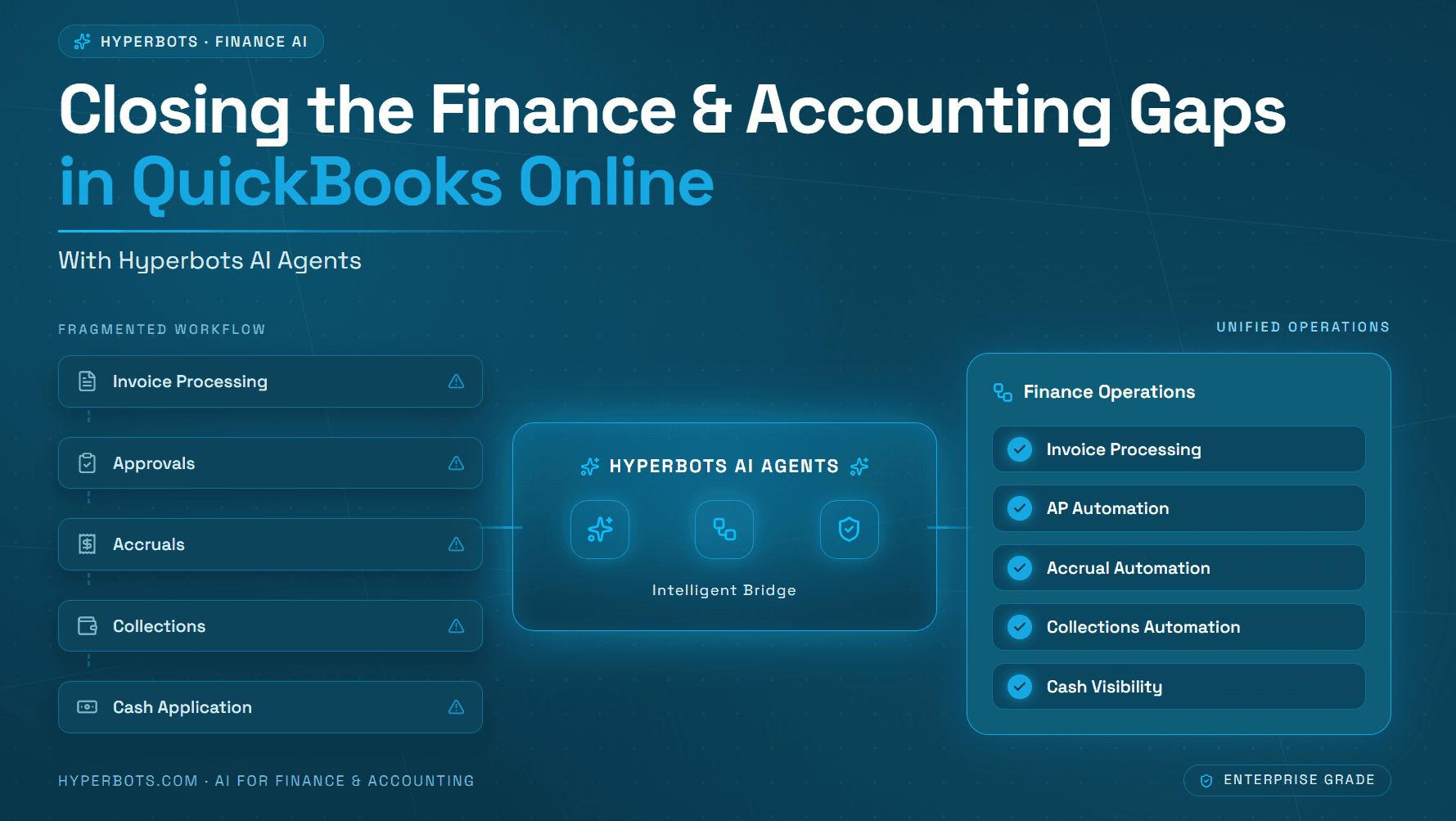
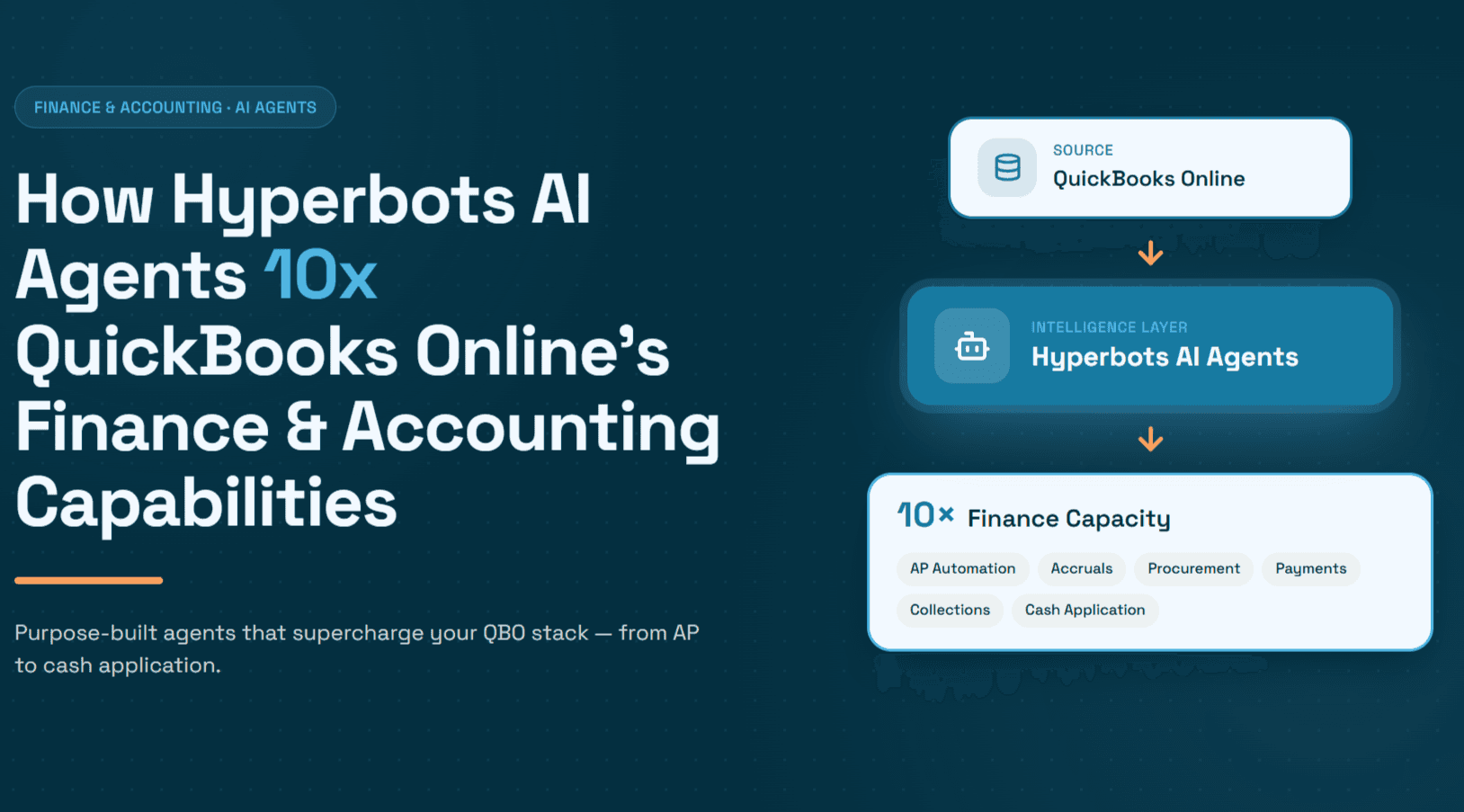
Critically, Hyperbots operates as an operational layer on top of QBO, not a replacement for it. The accounting record stays in QuickBooks. The intelligence, workflow execution, and exception management move into the Hyperbots platform, which writes back to QBO in real time. Learn more about how AI complements ERP systems rather than replacing them.
Procure-to-Pay Co-Pilots
Invoice Processing Co-Pilot
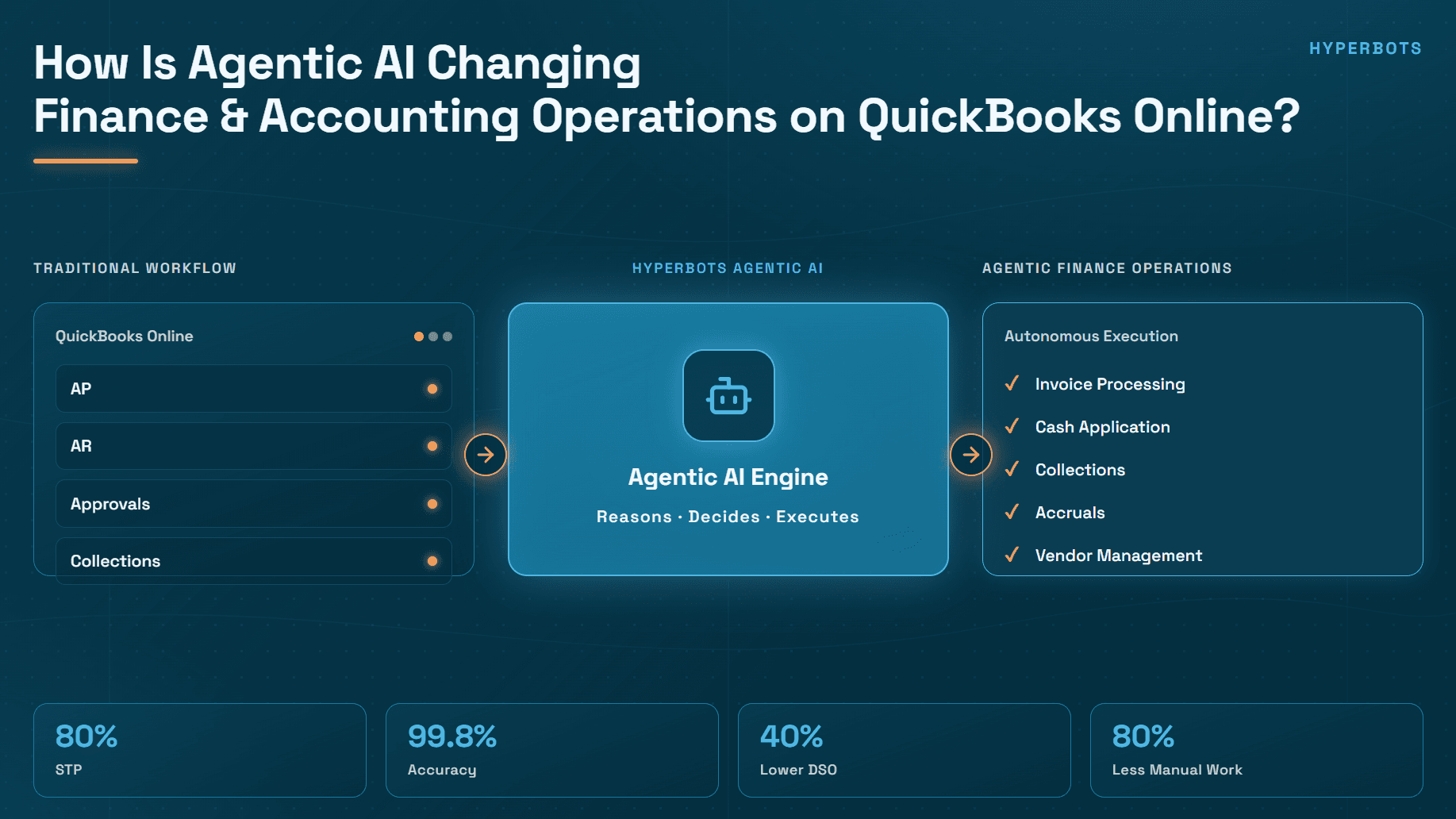
Hyperbots' Invoice Processing Co-Pilot automates the full invoice lifecycle from multi-channel intake (email, vendor portal, EDI) through AI-driven extraction, validation, duplicate detection, GL coding, 3-way matching, and GL posting back into QBO. The co-pilot achieves 99.8% extraction accuracy without template dependency, handling non-standard invoice layouts that would defeat OCR-based tools. Straight-through processing rates of 80%+ are achievable, meaning the majority of invoices are processed from receipt to posting without any human touch. For exceptions, the co-pilot structures the resolution workflow, logging the exception type, routing to the appropriate reviewer, and capturing the outcome in a full audit trail.
Customer evidence bears this out: Extreme Reach achieved 80% straight-through processing and 99.8% accuracy with zero manual touch-ups after deploying Hyperbots.
Procurement Co-Pilot (PR/PO)
The Procurement Co-Pilot automates the full PR-to-PO lifecycle, extracting requisition details from emails and forms, validating against policy and budget, routing for approval through configurable workflows, generating and dispatching POs to vendors, and managing PO closure. Budget control is enforced at the point of requisition, not after the fact. The result is a procurement cycle that compresses from days to hours, as described in Hyperbots' analysis of the PR-to-PO cycle.
Vendor Management Co-Pilot
The Vendor Management Co-Pilot delivers structured onboarding workflows with document collection, identity verification, and compliance checks. A self-service vendor portal gives suppliers visibility into invoice status and payment timelines, reducing inbound query volume. Automated remittance communication keeps vendors informed without AP team effort. For QBO users, this replaces a largely manual process with a governed, auditable workflow.
Payment Co-Pilot
The Payments Co-Pilot introduces intelligent payment decision-making to QBO environments, recommending early payments where discounts are available, late payment strategies where cash conservation is preferable, and managing the approval and execution workflow for ACH, check, and card payments. Fraud prevention through anomaly detection and duplicate payment screening is embedded. Every payment decision is logged in a complete audit trail. For finance teams currently making payment timing decisions manually or not at all, this represents a meaningful shift in working capital management.
Sales Tax Verification Co-Pilot
The Sales Tax Verification Co-Pilot validates tax applicability, rates, and jurisdiction on every invoice line item, comparing vendor-applied tax against expected tax using integrated tax dictionaries, nexus awareness, and AI classification. For QBO users processing invoices across multiple states, this automated validation layer significantly reduces the compliance risk of incorrect tax treatment, the kind of risk that one CFO documented as a $200,000 tax leakage exposure before deploying Hyperbots.
Accruals Co-Pilot
The Accruals Co-Pilot automates the discovery of accrual candidates, goods received but not yet invoiced, services delivered without a billing event, recurring expenses without a PO and books the corresponding journal entries into QBO automatically. Reversals are configured and automated for the following period. The result is a faster, more accurate, and fully documented month-end close. For finance teams where accruals currently consume days of manual effort, this represents one of the highest-ROI automation investments available.
Procure-to-Pay ROI
Metrics | Quickbooks Online alone | With Hyperbots | Operational Impact |
Invoice processing time | 8–12 day invoice cycle times are common in manual AP environments such as Quickbooks Online | Hyperbots processes invoices in <1 minute | 99%+ reduction in invoice processing time |
Straight-through invoice processing | Typical ERP-centric AP teams achieve ~15–25% touchless processing | Hyperbots achieves 80% STP | 3.2×–5.3× higher touchless processing rate |
Invoice extraction accuracy | Traditional OCR systems typically achieve only 85–90% accuracy | Hyperbots delivers 99.8% extraction accuracy | 50×–75× reduction in manual correction requirements |
AP manual workload | AP teams often spend 60–70% of capacity on manual entry and exception handling | Hyperbots automates matching, validation, and GL coding | 4×–5× reduction in manual AP workload |
Early payment discount capture | Most organizations capture <40% of available discounts | Hyperbots captures 100% of all early payment discounts automatically | 2.5×+ improvement in discount capture potential |
Order-to-Cash Co-Pilots
Collections Co-Pilot
The Collections Co-Pilot transforms QBO's static aging report into a dynamic, prioritized, and automated collections workflow. Overdue accounts are scored and segmented. Outreach sequences are executed automatically with communications calibrated by customer tier, payment history, and outstanding balance. Dispute capture and escalation workflows are embedded. Payment commitments are tracked. The co-pilot operates continuously, not just when an AR team member has bandwidth.
For companies where DSO is running above payment-terms benchmarks, structured collections automation is among the fastest levers available to release trapped working capital. The NACM notes that DSO reduction through disciplined collections management is one of the most direct improvements a finance team can make to cash flow without changing pricing or credit terms.
Cash Application Co-Pilot
The Cash Application Co-Pilot automates the matching of incoming payments, including partial payments, short pays, and payments with incomplete remittance data, to the corresponding open invoices in QBO. This eliminates the manual cash application queue that many AR teams maintain, accelerates cash visibility, and reduces the reconciliation effort at month-end.
Order-to-Cash ROI
Metric | Quickbooks Online Alone / ERP-Centric Reality | With Hyperbots | Operational Impact |
Cash application automation | Manual and ERP-centric AR environments don’t automate cash application, with payment matching and reconciliation heavily dependent on human intervention. | Hyperbots achieves 80–90% straight-through cash application using AI-driven remittance extraction, intelligent matching, and autonomous ERP posting | 4×–9× higher cash application automation, enabling faster reconciliation and reduced AR processing costs |
Days Sales Outstanding (DSO) | ERP-centric collections workflows rely on static aging buckets, manual follow-ups, and delayed dispute identification, contributing to elevated DSO | Hyperbots delivers ~40% DSO reduction through AI-driven prioritization and autonomous follow-ups | Up to 1.6× faster cash-conversion cycle |
Cost-to-collect | Traditional collections environments require large amounts of manual outreach, dispute handling, and tracking effort | Hyperbots uses AI-driven prioritization of accounts, automated tailored follow-ups minimizing human intervention | 70% reduction in cost-to-collect |
Reconciliation cost | ERP-centric reconciliation workflows remain labor-intensive due to manual extraction and matching of remittance | Hyperbots delivers 99.8% remittance extraction accuracy with AI-driven autonomous matching and reconciliation workflows | 80% reduction in reconciliation cost |
Unapplied cash levels | Traditional AR environments often maintain unapplied cash balances near 40% due to delayed matching and exception handling | Hyperbots reduces unapplied cash to <10% through AI-driven matching and exception resolution | 75% reduction in unapplied cash |
Conclusion
QuickBooks Online has earned its position as one of the most widely adopted accounting platforms for SMBs because it provides a reliable financial foundation. From general ledger management and financial reporting to accounts payable, accounts receivable, procurement, sales tax management, and reconciliation, QBO enables finance teams to maintain accurate books and gain visibility into business performance.
However, modern finance teams are increasingly expected to do more than simply record transactions. They are expected to accelerate close cycles, improve cash flow, strengthen compliance, optimize working capital, and support strategic decision-making. These objectives often require finance professionals to spend significant time managing approvals, resolving exceptions, chasing collections, validating invoices, identifying accruals, and reconciling discrepancies, activities that exist outside the traditional accounting system.
This is where Agentic AI is beginning to reshape finance operations. Rather than replacing QuickBooks Online, platforms such as Hyperbots extend its capabilities by introducing intelligent workflow orchestration, autonomous execution, exception management, and finance-specific co-pilots across both Procure-to-Pay and Order-to-Cash processes. The result is a finance function that can operate with greater efficiency, stronger controls, and improved scalability while continuing to leverage QuickBooks Online as its trusted system of record.
See How Hyperbots Extends QuickBooks Online
If your finance team relies on QuickBooks Online and is looking to reduce manual work across accounts payable, accounts receivable, procurement, collections, cash application, reconciliations, or month-end close activities, Hyperbots can help you evaluate where AI agents can create the greatest operational impact.
Request a personalized demo to see how Hyperbots integrates with QuickBooks Online and automates finance workflows across the Procure-to-Pay and Order-to-Cash lifecycle.
You can also start a free trial to explore how AI co-pilots can help your team accelerate processing, improve accuracy, and free up valuable time for higher-value finance activities.
Frequently Asked Questions
1. Can QuickBooks Online use AI?
Yes. QuickBooks Online already incorporates certain AI-powered capabilities such as transaction categorization, OCR-based invoice data extraction, bank feed matching, and sales tax assistance. However, these features are primarily task-specific automations. Agentic AI platforms extend QBO further by managing multi-step workflows, coordinating approvals, resolving exceptions, and executing finance processes autonomously while maintaining human oversight.
2. What is Agentic AI in accounting?
Agentic AI refers to AI systems that can reason, make decisions, execute actions, and coordinate workflows to achieve specific business objectives. In accounting and finance, Agentic AI can automate tasks such as invoice processing, collections management, cash application, accrual identification, reconciliation support, and procurement workflows while keeping finance professionals in control of approvals and governance.
3. Does Hyperbots replace QuickBooks Online?
No. Hyperbots is designed to complement, not replace, QuickBooks Online. QBO continues to serve as the financial system of record where transactions, journal entries, vendor records, customer records, and financial reports are maintained. Hyperbots operates as an intelligent operational layer that automates workflows, manages exceptions, and executes finance processes before data is recorded in QBO.
4. Which finance and accounting processes benefit most from Agentic AI?
Processes that involve large volumes of transactions, repetitive decision-making, and frequent exceptions typically benefit the most. Examples include invoice processing, approval management, procurement, accrual management, collections, cash application, sales tax verification, vendor onboarding, account reconciliation, and month-end close activities.
5. How can finance teams adopt AI without replacing their existing accounting systems?
Most organizations begin by deploying AI alongside their existing ERP or accounting platform. Rather than replacing systems such as QuickBooks Online, Agentic AI solutions integrate with them to automate manual workflows, improve data quality, and reduce operational effort. This approach allows organizations to modernize finance operations while preserving existing accounting processes, controls, and historical data.