How Is Agentic AI Changing Finance & Accounting Operations on Datacor?
Bringing autonomous finance to Datacor ERP.
Finance and accounting have been through several waves of technological change. The first wave digitized paper records. The second wave standardized workflows inside ERP platforms. The third wave, robotic process automation and basic AI, automated high-volume, rule-bound tasks. Now a fourth wave is arriving, and it is qualitatively different from everything that came before.
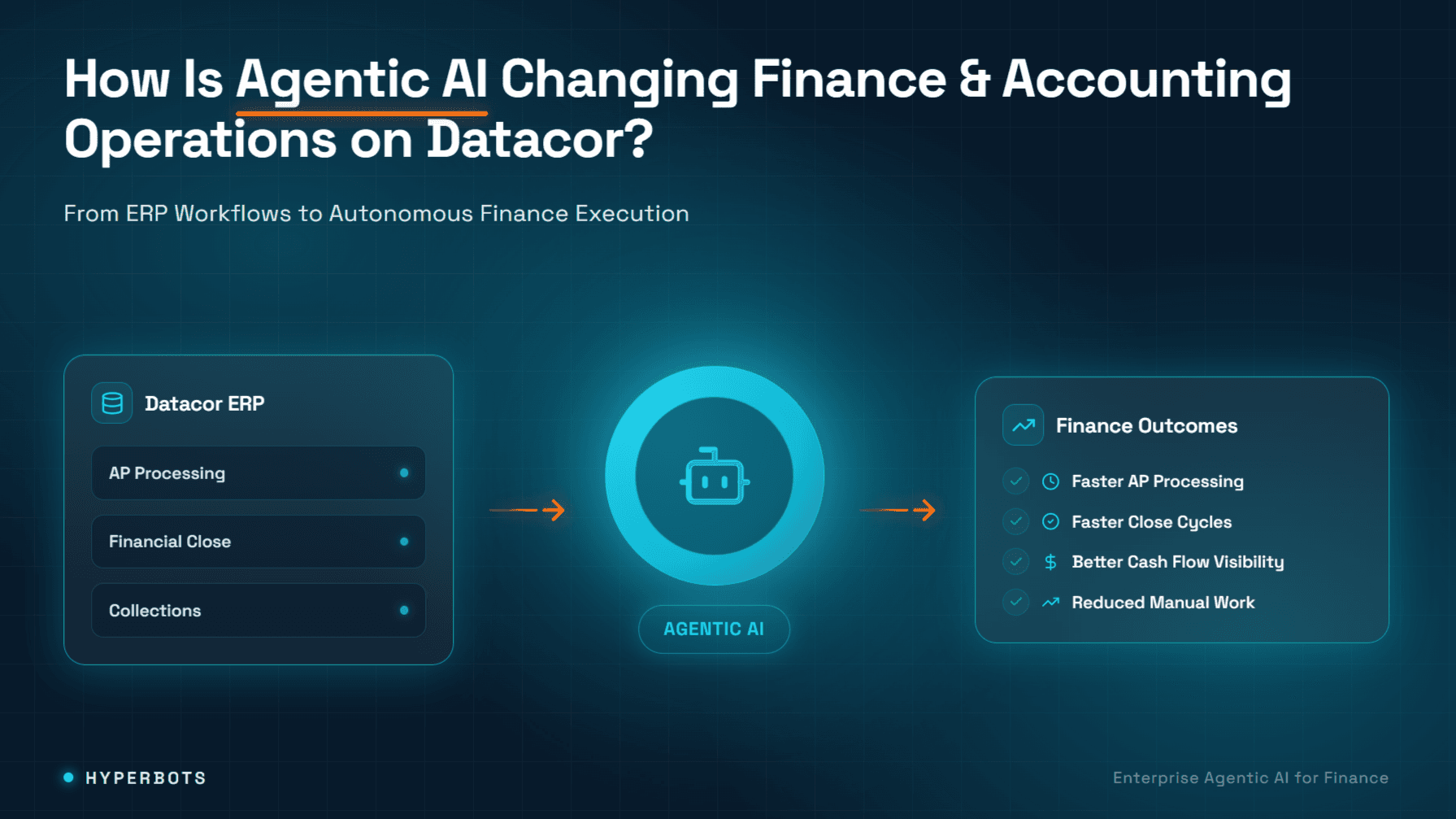
Agentic AI is shifting the conversation from "automating tasks" to "operating autonomously." Rather than executing a fixed sequence of steps, AI agents perceive their environment, reason about the situation, make decisions, and take actions then evaluate the results and adjust. For finance teams working inside ERP systems such as Datacor, this distinction matters enormously. It is the difference between a system that processes invoices faster and one that understands invoices, identifies exceptions, resolves them, and learns from every transaction.
According to McKinsey's 2023 State of AI report, finance functions consistently rank among the top enterprise domains where AI delivers measurable economic value. McKinsey found that organizations are increasingly realizing tangible business benefits from AI deployment across functions, with finance among the areas reporting significant impact. In parallel, Gartner predicts that by 2026, more than 80% of enterprises will have used generative AI APIs or deployed GenAI-enabled applications in production, up from less than 5% in 2023, highlighting the rapid mainstream adoption of AI technologies across enterprise operations.
What Is Agentic AI?
The term "agentic AI" describes AI systems that act with a degree of autonomy, pursuing goals across multi-step workflows without constant human direction. To understand what makes this significant, it helps to contrast it with earlier automation approaches.
Traditional workflow automation follows deterministic rules: if this condition is met, take this action. It is fast and reliable within a narrow set of anticipated scenarios, but it breaks whenever reality deviates from the script.
Robotic Process Automation (RPA) mimics human interaction with software interfaces. It excels at structured, repetitive tasks but is brittle, any change to the underlying UI or data format can cause failures, and RPA bots have no ability to reason about unexpected situations.
Generative AI (large language models such as GPT-4 and Claude) adds the ability to understand and produce natural language at scale. It can draft communications, summarize documents, and answer questions. However, generative AI on its own is reactive, it responds to prompts rather than initiating actions or managing workflows.
Agentic AI combines the reasoning capabilities of large language models with the ability to plan, use tools, call APIs, manage memory across sessions, and collaborate with other agents. A finance AI agent can receive an invoice, extract its data, cross-reference it against purchase orders and receipts in the ERP, identify a three-way match discrepancy, determine the appropriate resolution based on configured business rules, communicate with the vendor, and post the corrected entry, all without human intervention unless an exception genuinely requires it.
The Hackett Group's 2024 Digital World Class Finance research found that top-performing finance organizations operate at 47% lower cost and with 50% fewer full-time staff than their peers. Hackett attributes much of this advantage to greater use of automation, analytics, modern technology architectures, and end-to-end process integration rather than isolated point solutions. As finance organizations seek to extend these gains, Agentic AI is emerging as a promising approach for orchestrating intelligent workflows across finance processes.
Why Finance Teams Need More Than Traditional ERP Automation
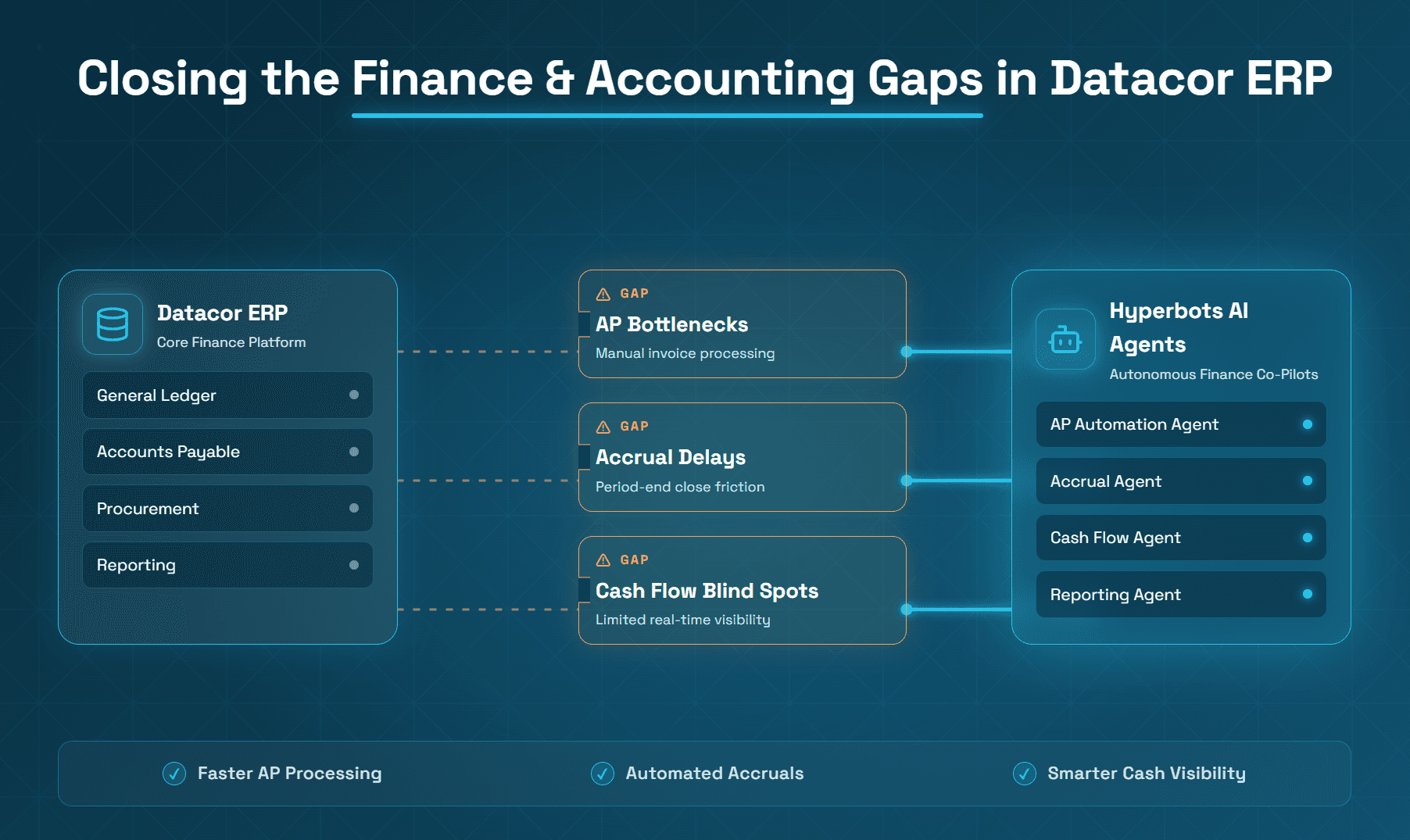
ERP systems like Datacor are systems of record. They store the authoritative version of financial data, vendor master records, chart of accounts, purchase orders, goods receipts, open payables, customer balances, and ledger entries. That role is indispensable, and no finance technology strategy should aim to displace it.
The challenge is that ERP systems were designed for data integrity, not autonomous decision-making. Every complex judgment call, an invoice with a price discrepancy, an accrual for services received but not yet billed, a collection escalation on a strategically important customer account, still requires a human to investigate, decide, and act. ERP systems surface the data; they do not resolve the problem.
APQC benchmarking research shows that transaction processing continues to consume a significant share of finance organizations' time and resources, limiting the capacity available for decision support and strategic analysis. At the same time, Deloitte research indicates that finance leaders are increasingly prioritizing digital transformation, AI adoption, productivity improvements, and advanced forecasting capabilities as they seek to modernize core finance operations. Together, these trends help explain why organizations are exploring Agentic AI as a way to automate routine work while enabling finance teams to focus on higher-value activities.
The gap between what ERP platforms provide and what finance teams actually need is a gap of reasoning and action. Agentic AI is purpose-built to close that gap. It operates as a system of action layered on top of the system of record, reading from and writing back to Datacor while handling the judgment-intensive work that neither rules engines nor RPA could manage.
How Agentic AI Is Transforming Accounts Payable
Accounts payable is the most mature domain for AI in finance automation, and for good reason. The volume of transactions is high, the data is semi-structured, and the cost of errors, duplicate payments, missed early payment discounts, tax compliance failures is measurable and significant.
In a Datacor environment, the AP workflow spans purchase requisitions, purchase orders, goods receipts, vendor invoices, matching, approval, and payment. Agentic AI can operate across every stage of that chain.
Invoice discovery and extraction. AI agents monitor email inboxes, vendor portals, and EDI feeds to capture invoices as they arrive. Unlike OCR-based systems that depend on templates, modern AI extraction understands invoice layout semantically, achieving extraction accuracy rates that approach 99 percent even on non-standard formats.
Three-way matching and exception handling. Matching an invoice against a PO and a goods receipt in Datacor is straightforward when the numbers agree. When they do not, which APQC data suggests occurs in 15 to 25 percent of invoices, the real work begins. An AI agent can assess whether the discrepancy falls within configured tolerance thresholds, query the vendor for a corrected invoice, flag the PO for revision, or escalate to the appropriate approver, all without manual triage. This is where intelligent finance automation meaningfully outperforms rule-based systems.
Accruals automation. Month-end accruals remain one of the most labor-intensive close activities for AP teams. AI agents can scan open purchase orders in Datacor, identify goods or services received but not yet invoiced, calculate the appropriate accrual amounts, generate journal entries, and reverse them in the following period, all according to configurable accounting policies. This alone can compress the financial close cycle by several days.
Vendor communication and payment optimization. Agentic AI can manage routine vendor interactions, acknowledging invoices, communicating payment status, flagging disputed items, through the vendor portal. On the payment side, AI agents can evaluate each payable against early payment discount windows, current cash position, and vendor relationship priority to optimize payment timing dynamically rather than following static payment run schedules.
How Agentic AI Is Transforming Accounts Receivable
Accounts receivable has historically received less automation attention than AP, but the financial stakes are equally high. Days Sales Outstanding (DSO) is a direct driver of working capital efficiency, and collection processes that rely on manual account review, phone calls, and email chains are expensive and inconsistent.
AI-driven collections. Finance AI agents can stratify the AR ledger continuously, not just at month-end, prioritizing collection outreach based on invoice age, customer payment behavior, account size, and relationship sensitivity. Modern AI-powered collections platforms use predictive analytics and behavioral data to prioritize accounts, personalize outreach, and adjust follow-up strategies based on customer payment patterns and responses. Unlike traditional dunning schedules that apply the same cadence to every customer, AI-driven collections can tailor communication timing, channel selection, and escalation paths to improve collection effectiveness and working capital performance.
Dispute management. When a customer short-pays an invoice or raises a dispute, the resolution process typically requires finance staff to gather documentation, communicate with sales, and negotiate with the customer. AI agents can initiate the investigation automatically, pulling the original order, the delivery confirmation, and the invoice from Datacorand draft the initial response communication, compressing resolution cycles significantly.
Cash application. Matching incoming payments to open invoices is a deceptively complex task when customers pay partial amounts, reference the wrong invoice numbers, or bundle multiple invoices into a single remittance. AI agents trained on a company's remittance patterns can achieve automated match rates well above what rules-based cash application systems produce, reducing unapplied cash balances and improving the accuracy of AR aging reports.
Deductions management. For organizations in distribution, manufacturing, or specialty chemicals, industries where Datacor has deep domain penetration, customer deductions are a persistent source of revenue leakage. AI agents can automatically classify deductions by type, validate or dispute them based on trade agreements stored in the ERP, and initiate recovery workflows where appropriate.
How Agentic AI Improves Financial Close, Forecasting, and Reporting
Beyond the transactional workflows of AP and AR, agentic AI in finance and accounting is beginning to change how finance teams manage the close, build forecasts, and report results.
Accelerating the financial close. The financial close is a coordination problem as much as a technical one. AI agents can monitor close task completion in real time, identify bottlenecks, send targeted reminders, and surface reconciling items that need attention effectively acting as an intelligent project manager for the close process. EY's finance transformation research highlights the growing shift toward automated and "touchless" close processes, where integrated technologies help reduce manual effort, improve data quality, and accelerate record-to-report activities. As organizations pursue faster and more continuous close processes, AI is increasingly being used to automate reconciliations, identify anomalies, and support financial analysis throughout the reporting cycle.
Variance analysis and anomaly detection. Rather than waiting for a controller to review budget-versus-actual reports and investigate anomalies, AI agents can continuously monitor the ledger for unusual posting patterns, unexpected variance drivers, and potential errors. This shifts variance analysis from a periodic, retrospective exercise to a continuous, proactive one.
Forecasting support. While AI is not yet replacing CFO judgment in strategic forecasting, it is accelerating the data assembly and scenario analysis that underpins that judgment. AI agents can pull actuals from Datacor, integrate external data feeds, and generate rolling forecast scenarios that reflect current business conditions, reducing the time finance teams spend on mechanical data work and increasing time available for interpretation and decision-making. McKinsey's research estimates that AI-assisted finance functions spend 40 percent more time on value-added analysis than peers.
Board and management reporting. AI agents can generate first-draft narrative commentary for management reports by analyzing variance drivers in the underlying data, translating quantitative results into plain-language explanations that human reviewers can refine rather than create from scratch.
Why Agentic AI Matters Specifically for Datacor ERP Users
Datacor serves a specific and demanding market: process manufacturers and specialty chemical distributors who manage complex supply chains, formula-based production, regulatory compliance, and multi-tiered customer relationships. Finance operations in these environments are correspondingly complex, high transaction volumes, intricate PO structures, variable pricing agreements, and stringent audit requirements.
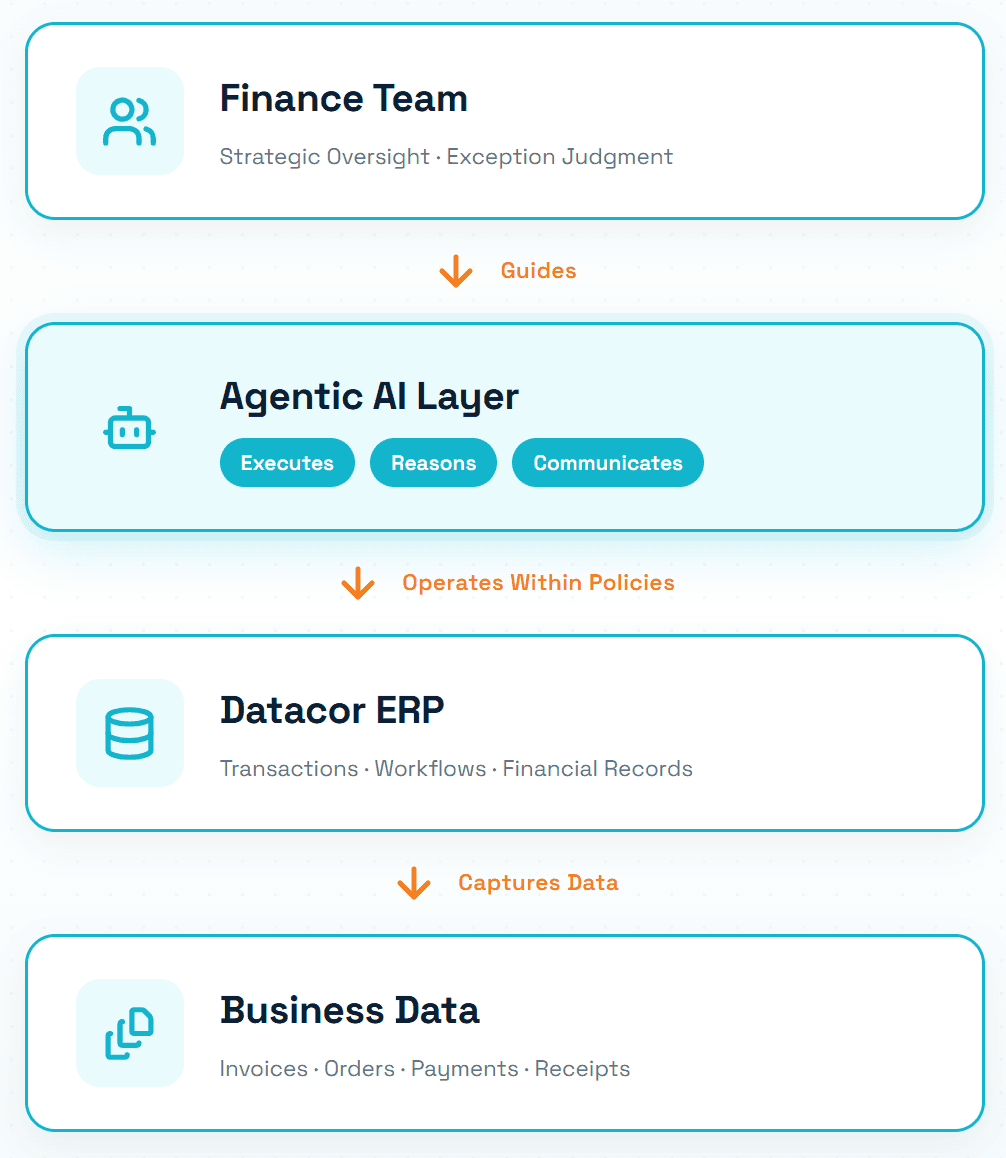
Datacor is a strong system of record for this environment. Its strength lies in capturing what happened: what was ordered, what was received, what was invoiced, what was paid. The opportunity for agentic ERP automation is to add a layer that determines what should happen next and acts on that determination.
For Datacor users specifically, this means AI agents that understand the data models and workflows native to Datacor, PO structures, GL hierarchies, vendor master configurations, multi-entity setups and can operate within those structures without requiring data migration or system replacement. The ERP investment is preserved and amplified rather than displaced.
Organizations considering AI augmentation for Datacor should evaluate finance AI agents on four dimensions: integration depth with Datacor's data model, pre-trained accuracy on finance-specific document types, configurability of business rules and approval policies, and the quality of audit trails produced for compliance purposes. The last point is particularly important in regulated industries where Datacor is commonly deployed. Comprehensive audit trails are not optional in specialty chemicals and process manufacturing environments, they are a baseline requirement.
The case for autonomous finance operations on top of Datacor is also a working capital case. Every day shaved off the invoice processing cycle, every early payment discount captured, every collection escalation accelerated, these translate directly into measurable cash flow improvement. For mid-market manufacturers and distributors, where treasury resources are lean and cash cycles matter acutely, that is a compelling financial argument.
Conclusion: Toward Autonomous Finance on Datacor
The emergence of agentic AI is not a reason to reconsider the role of ERP in finance operations, it is a reason to get more value from that role. Datacor will remain the authoritative system of record for process manufacturers and distributors. What is changing is the layer of intelligent action that sits alongside it.
Finance teams that adopt agentic AI stand to gain on multiple dimensions simultaneously: lower transaction processing costs, higher accuracy, faster close cycles, improved working capital, and critically more capacity for the analytical and strategic work that CFOs and finance directors were hired to do. The APQC, Gartner, McKinsey, and Deloitte data cited throughout this article all point in the same direction: intelligent finance automation is moving from competitive advantage to table stakes.
Hyperbots is a finance-specific agentic AI platform built to integrate directly with ERP environments, including Datacor. Hyperbots deploys pre-trained AI co-pilots across AP, AR, procurement, accruals, payments, cash application, collections, and sales tax verification, operating natively within Datacor's data architecture without requiring system replacement. Its self-learning models adapt to each organization's vendor base, GL coding patterns, and approval policies, and every decision is logged in a full audit trail designed for regulated-industry compliance.
Finance leaders interested in exploring what agentic AI could deliver in their Datacor environment can start with a free trial or request a personalized demo to see how AI co-pilots perform against real invoice and transaction data before committing to full deployment.
The technology is ready. The business case is clear. The question for finance leaders running Datacor is not whether to adopt agentic AI, but how quickly to begin.
Frequently Asked Questions
1. What is agentic AI in finance, and how is it different from traditional automation?
Agentic AI refers to AI systems that can reason about a situation, plan a sequence of actions, use tools and APIs, and operate autonomously across multi-step financial workflows. Unlike traditional automation which follows fixed rules or RPA, which mimics human clicks, agentic AI can handle exceptions, make judgment calls within configured parameters, and learn from outcomes over time. In finance, this means AI agents that can resolve invoice discrepancies, manage collections escalations, and generate accrual entries without requiring human intervention at each step.
2. How does agentic AI work with an ERP system like Datacor rather than replacing it?
Agentic AI operates as a system of action layered on top of the ERP system of record. It reads data from Datacor, purchase orders, vendor records, GL accounts, goods receipts, applies reasoning and business logic, takes action (such as posting entries, sending communications, or flagging exceptions), and writes results back to Datacor. The ERP remains the authoritative data source; the AI layer adds autonomous execution capability that the ERP was not designed to provide.
3. What accounts payable processes benefit most from finance AI agents in a Datacor environment?
The highest-impact AP use cases for finance AI agents in Datacor include invoice extraction and validation, three-way PO matching and exception resolution, accruals automation for goods and services received but not yet invoiced, early payment discount capture, and vendor communication management. These are the areas where manual effort is highest and where AI accuracy rates translate most directly into cost reduction and working capital improvement.
4. How can agentic AI improve Days Sales Outstanding (DSO) for Datacor users?
AI agents continuously stratify the AR ledger by customer payment behavior, invoice age, and account priority thus enabling proactive, personalized collection outreach rather than generic dunning schedules. Automated cash application reduces unapplied cash and improves AR aging accuracy. AI-assisted dispute resolution accelerates the documentation and communication steps that typically slow resolution. Together, these capabilities have been shown to reduce DSO by 15 to 20 percent within the first year of deployment, according to PwC research.
5. What should finance leaders evaluate when selecting an agentic AI platform to layer on top of Datacor ERP?
Key evaluation criteria include: depth of native integration with Datacor's data model and GL structure; pre-trained accuracy on finance-specific document types without requiring template configuration; configurability of business rules, tolerance thresholds, and approval workflows; quality and completeness of audit trails for compliance purposes; and the platform's self-learning capability to improve accuracy over time based on each organization's specific transaction patterns. For organizations in regulated industries such as specialty chemicals and process manufacturing where Datacor is commonly deployed, audit trail completeness and explainability of AI decisions are particularly important evaluation criteria.