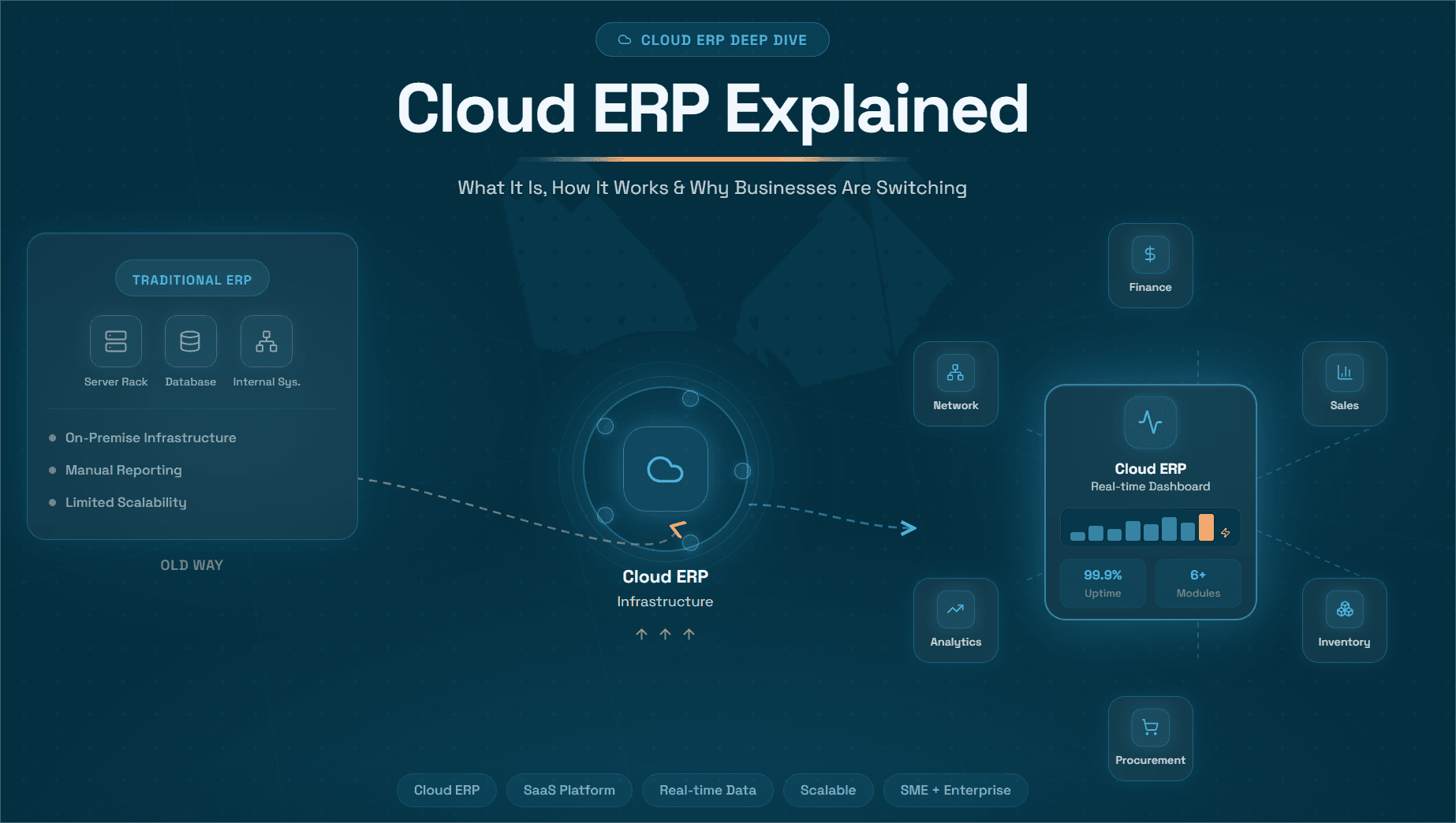
Cloud ERP Explained: What It Is, How It Works & Why Businesses Are Switching
Cloud ERP has gone from bold experiment to business standard — and companies still running on-premise systems are increasingly the ones taking the real risk. This guide breaks down exactly what cloud ERP is, how it works under the hood, which deployment model fits your business, and why the organizations getting the most from their cloud ERP investment are the ones pairing it with Agentic AI from day one.
Ten years ago, moving your ERP to the cloud felt like a risk only the boldest companies would take. Today, it's the opposite, staying on-premise is the risk. Across industries, businesses of every size are making the switch to cloud ERP, and for good reason. The combination of lower infrastructure costs, real-time data access, built-in scalability, and faster innovation cycles has made cloud-based ERP not just a viable alternative to on-premise systems, but the clear preferred choice for modern businesses.
But what exactly is cloud ERP? How does it work under the hood? And what should you know before your business makes the move? This guide covers all of it and shows you how pairing a cloud ERP with an AI finance co-pilot like Hyperbots can multiply your return on investment from day one.
What Is Cloud ERP?
Cloud ERP, short for Cloud Enterprise Resource Planning, is an ERP software system hosted on remote servers and delivered to users over the internet, rather than installed and maintained on hardware your company owns and operates.
Like all ERP systems, cloud ERP integrates the core functions of your business into a single unified platform: financials, accounting, procurement, inventory, supply chain, sales, human resources, and reporting. The difference is in how the software is deployed, maintained, and accessed. With cloud ERP, the servers, databases, security infrastructure, backups, and software updates are all managed by the ERP vendor or a third-party hosting provider, not your internal IT team.
Your employees access the system through a web browser or dedicated app, from any device, anywhere in the world. The data lives in the cloud, updates in real time, and is available to every authorized user simultaneously whether they're in the head office, a remote warehouse, or working from home.
This shift from "software you install" to "software you subscribe to" is what makes cloud ERP such a fundamentally different proposition from traditional on-premise ERP and why adoption has accelerated so dramatically over the past decade.
How Does Cloud ERP Work?
Understanding how cloud ERP works requires a quick look at the infrastructure behind it because the technology choices your ERP vendor makes directly affect the performance, security, and flexibility you experience as a customer.
Multi-tenant vs. Single-tenant Architecture is one of the first distinctions to understand. Most modern cloud ERP systems run on a multi-tenant architecture, meaning multiple customers share the same underlying infrastructure and application instance, with their data kept logically separate. This model is cost-efficient and allows vendors to push updates to all customers simultaneously. Single-tenant (or private cloud) architecture gives each customer a dedicated environment, more expensive, but offering greater customization flexibility and data isolation, which is important for some regulated industries.
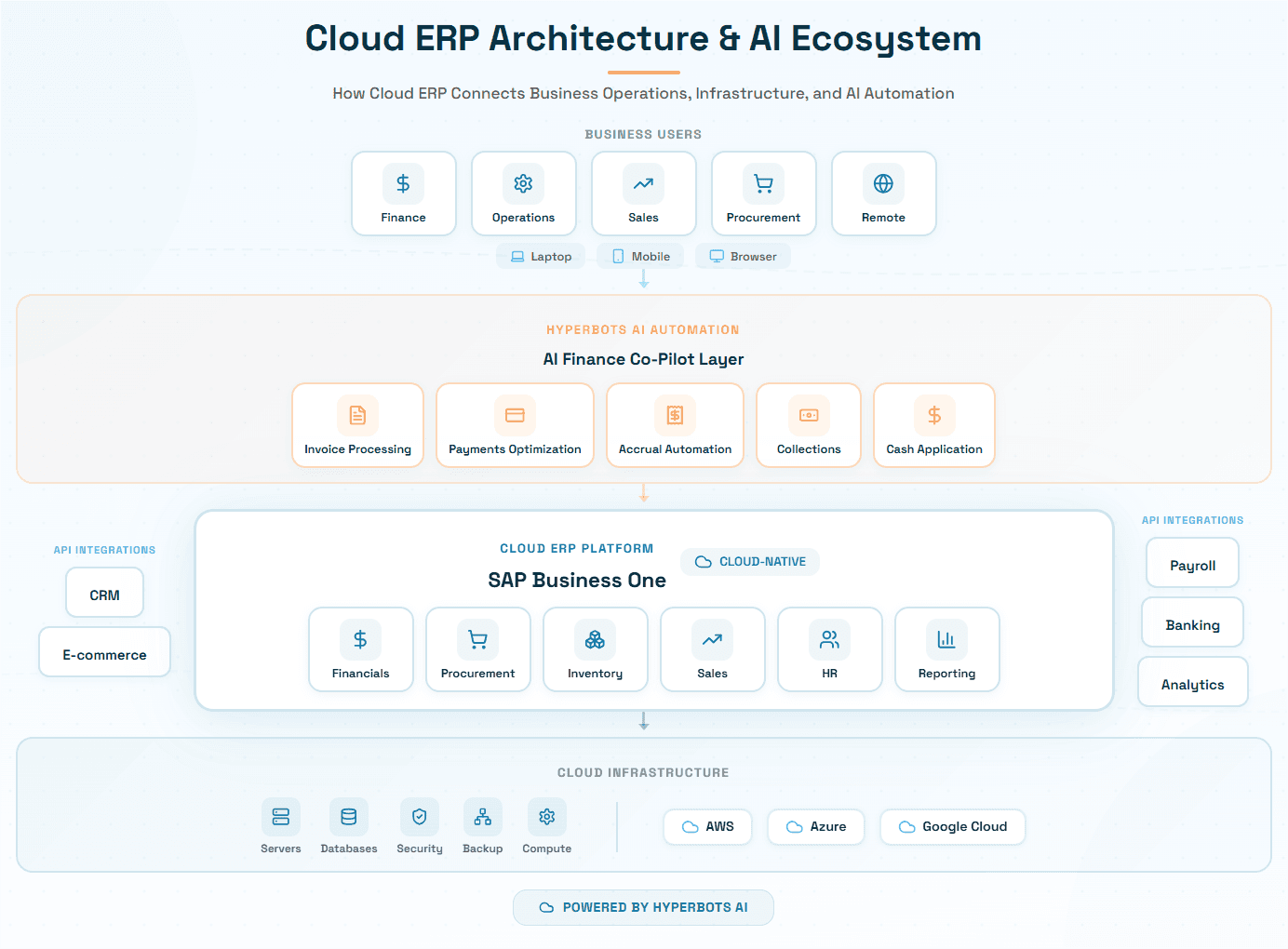
Cloud Infrastructure Providers power most cloud ERP platforms behind the scenes. SAP, Oracle, Microsoft, and other major ERP vendors run their cloud products on hyperscale infrastructure from providers like Amazon Web Services (AWS), Microsoft Azure, and Google Cloud Platform. This means your ERP data benefits from the same enterprise-grade security, redundancy, and global availability that powers some of the world's largest digital businesses.
API-First Integration is a defining architectural feature of modern cloud ERP. Unlike legacy on-premise systems that relied on custom point-to-point integrations that were expensive to build and brittle to maintain, cloud ERP platforms expose standardized APIs (Application Programming Interfaces) that allow other software systems such as CRMs, e-commerce platforms, payroll systems, AI tools to connect quickly and reliably. This open architecture is what makes the modern cloud ERP ecosystem so powerful: your ERP becomes the connected hub of your entire business technology stack.
Automatic Updates and Continuous Innovation is one of the most underappreciated advantages of cloud ERP. On-premise ERP upgrades are notoriously painful, they require significant IT effort, testing, downtime, and cost. Cloud ERP vendors push updates automatically, on a managed schedule, ensuring every customer benefits from the latest features, security patches, and regulatory updates without lifting a finger.
Cloud ERP vs. On-Premise ERP: The Key Differences
The cloud ERP vs on-premise debate has largely been settled in favor of cloud for most businesses, but it's worth understanding exactly where the differences lie.
Total Cost of Ownership is the most immediately visible difference. On-premise ERP requires substantial upfront capital investment like server hardware, database licenses, implementation fees, and ongoing IT staff to maintain the environment. Cloud ERP replaces most of that with a predictable monthly or annual subscription fee. There's no hardware to buy, no server room to maintain, and no basis administrators on the payroll. For SMEs and mid-market companies especially, this shift from CapEx to OpEx is transformative.
Scalability is dramatically more flexible in the cloud. Adding users, expanding to new geographies, or spinning up new business units in an on-premise system involves hardware procurement cycles and IT project timelines. In a cloud ERP, scaling up is a configuration change and a contract adjustment. You pay for what you use, and you can grow without infrastructure constraints.
Security is often cited as a concern about cloud ERP but the reality for most businesses is the opposite. Enterprise cloud ERP vendors invest hundreds of millions of dollars annually in security infrastructure, threat monitoring, penetration testing, and compliance certifications (SOC 2, ISO 27001, GDPR, and more). Very few SMEs or mid-market companies can match that level of security investment with on-premise infrastructure.
Business Continuity and Disaster Recovery are built into cloud ERP by design. Redundant data centers, automated failover, continuous backups, and defined recovery time objectives (RTOs) mean that cloud ERP can actually deliver better resilience than most on-premise environments, where disaster recovery is often underfunded and undertested.
Remote and Hybrid Work is where cloud ERP has proven its value most visibly in recent years. Cloud ERP users worked through the disruption of the pandemic without skipping a beat as their teams simply logged in from their homes. On-premise ERP customers scrambled to set up VPNs, Citrix environments, and remote access solutions that were never designed for organization-wide remote work.
Types of Cloud ERP Deployment Models
Not all cloud ERP is deployed the same way. Understanding the key deployment models helps you identify which option fits your organization's needs.
Public Cloud ERP is the most common model. The ERP software runs on shared infrastructure managed entirely by the vendor. It's the most cost-effective option and delivers the fastest time to value, since there's no infrastructure provisioning required. SAP Business One Cloud, SAP S/4HANA Cloud Public Edition, Microsoft Dynamics 365, and Oracle NetSuite are prominent examples of public cloud ERP.
Private Cloud ERP runs on dedicated infrastructure either hosted by the ERP vendor, a cloud provider, or a third-party managed service provider, isolated from other customers. This model suits organizations with strict data residency requirements, heavy customization needs, or industry-specific compliance mandates (healthcare, defense, financial services). It costs more than public cloud but offers more control.
Hybrid Cloud ERP combines elements of both, typically running the core ERP in the cloud while keeping certain sensitive workloads or legacy integrations on-premise. This is a common transitional model for large enterprises migrating from on-premise systems in phases, or for businesses that have compliance requirements for specific data types while wanting cloud benefits for the rest of their operations.
Who Should Use Cloud ERP?
The short answer is: most businesses. But cloud ERP is particularly well-suited to certain profiles.
Fast-growing SMEs benefit enormously from cloud ERP's scalability and low upfront cost. Instead of over-investing in on-premise infrastructure to anticipate future growth, they can scale their ERP subscription as the business grows, paying for what they need, when they need it.
Multi-location and international businesses find cloud ERP indispensable for maintaining a single, real-time view of operations across geographies. Currency conversion, multi-language support, local tax compliance, and consolidated group reporting are all significantly easier to manage on a cloud platform.
Businesses with remote or distributed teams gain immediate productivity benefits from anywhere-access. Finance, operations, sales, and procurement teams can work in the same live system from different time zones without VPN dependencies or remote desktop workarounds.
Companies undergoing digital transformation use cloud ERP as the foundation of their broader technology modernization. A cloud-native ERP with open APIs makes it far easier to integrate AI tools, e-commerce platforms, customer portals, and advanced analytics than a legacy on-premise system with closed architecture.
Leading Cloud ERP Platforms in 2025
The cloud ERP market is well-developed and highly competitive. The leading platforms each have distinct strengths:
SAP S/4HANA Cloud is SAP's flagship cloud ERP for enterprises and upper mid-market companies. Built on the SAP HANA in-memory database, the SAP S/4 HANA Cloud delivers real-time financial analytics, advanced supply chain capabilities, and deep integration with SAP's broader intelligent enterprise portfolio. The Public Edition offers rapid deployment using pre-configured best-practice processes; the Private Edition offers more customization flexibility.
SAP Business One Cloud serves the SME segment, companies with 10 to 250 employees delivering full ERP functionality (financials, sales, purchasing, inventory, production, reporting) through a cloud subscription model that eliminates the infrastructure burden of on-premise deployment.
Microsoft Dynamics 365 is a strong contender for mid-market businesses, particularly those already embedded in the Microsoft ecosystem. Its integration with Office 365, Teams, and Azure AI makes it a natural fit for Microsoft-centric organizations.
Oracle NetSuite is one of the oldest pure-cloud ERP platforms on the market and remains a favorite for product-based businesses, software companies, and multi-entity organizations needing strong consolidation and revenue recognition capabilities.
Sage Intacct is particularly well-regarded in the nonprofit, healthcare, and professional services sectors, where its multi-dimensional reporting and project accounting capabilities shine.
Hyperbots + Cloud ERP: The AI Layer That Unlocks Your Full ROI
Switching to a cloud ERP is a major step forward. It modernizes your infrastructure, improves accessibility, and gives your business a scalable technology foundation. But here's what every CFO discovers shortly after go-live: even the best cloud ERP still relies heavily on human effort to run your day-to-day finance and accounting operations.
Invoices still need to be processed. Vendors still need to be paid on time. Accruals still need to be booked at month-end. Receivables still need to be chased. Cash still needs to be applied. These workflows exist inside every cloud ERP and in most organizations, they remain largely manual, error-prone, and expensive.
Hyperbots is a proprietary Agentic AI platform built exclusively for finance and accounting that sits on top of your cloud ERP and automates exactly these workflows. Unlike generic RPA tools or basic OCR solutions, Hyperbots uses finance-trained AI agents pre-trained on millions of invoices, POs, contracts, and financial documents to handle end-to-end F&A processes with minimal human intervention.
Hyperbots integrates natively with leading cloud ERP platforms including SAP S/4HANA, SAP Business One, SAP ECC, Oracle NetSuite, Microsoft Dynamics 365 Business Central, Sage Intacct, Sage 300, QuickBooks, Epicor, and more through pre-built connectors that provide real-time, bidirectional read-and-write access to your financial data. Deployment takes as little as 3–4 weeks, and the platform achieves 99.8% accuracy in converting unstructured financial documents to structured data from day one.
The ROI for cloud ERP users who integrate Hyperbots is concrete and measurable:
Invoice Processing: Hyperbots' Invoice Processing Co-Pilot delivers up to 80% straight-through processing (STP) of invoices, cutting the industry-average processing time of 11 days to under one minute and freeing 80% of AP staff bandwidth. Duplicate payments, GL coding errors, and late payment penalties fall dramatically, and vendor satisfaction improves because invoices are processed and paid faster.
Cash Flow Optimization via Payments: The Payments Co-Pilot analyzes payment terms, early pay discount windows, penalty exposure, and cost of capital to recommend and execute optimal payment timing and method thus reducing total cash outflow by up to 10%. For a business with $6M in annual payables, that's $600,000 in improved cash flow.
Procurement Automation: The Procurement Co-Pilot auto-generates purchase requisitions from business inputs and converts approved PRs into compliant purchase orders within your cloud ERP automatically by reducing PO creation and dispatch time by 80% and PR creation time to just 5 minutes.
Month-End Close: The Accruals Co-Pilot automates identification, booking, and reversal of accruals within your ERP, cutting accrual processing costs by 80% and reducing variance between accrued and actual costs to below 5%. For finance teams already benefiting from cloud ERP's faster close cycle, adding Hyperbots compresses the timeline even further.
Collections and DSO Reduction: The Collections Co-Pilot autonomously manages dunning, follow-ups, dispute detection, and promise-to-pay tracking, reducing Days Sales Outstanding (DSO) by up to 40% and cutting the cost to collect by 70%. For growing businesses where cash flow is everything, this improvement changes the entire financial profile of the company.
Cash Application: Automated remittance extraction, intelligent payment matching, exception handling, and GL posting reduce reconciliation costs by 80% and bring unapplied cash below 10%, giving your AR team a clear, accurate picture of where every dollar stands.
Hyperbots was co-designed with CFOs across manufacturing, wholesale distribution, retail, technology, and professional services which are exactly the industries driving cloud ERP adoption today. Its unlimited-access licensing model means no per-seat bottlenecks: your entire finance team gets access without per-user cost constraints limiting adoption.
The Bottom Line: Cloud ERP Is the Foundation, AI Is What Maximizes It
Cloud ERP has fundamentally changed what's possible for businesses of every size by eliminating infrastructure burden, enabling real-time visibility, and providing the connected, scalable platform that modern operations demand. The businesses switching to cloud ERP aren't just modernizing technology. They're reclaiming time, reducing risk, and positioning themselves to move faster than competitors still weighed down by legacy on-premise systems.
But the organizations extracting the most value from their cloud ERP investments are those that don't stop at the platform. By layering Hyperbots' Agentic AI on top of their cloud ERP, finance teams automate the high-volume, error-prone workflows that no ERP alone can eliminate, turning their technology investment into measurable, compounding ROI from the very first month.
The math is straightforward: Hyperbots customers recover up to 80% of AP processing costs, reduce DSO by 40%, and optimize cash outflow by 10% within the first year of deployment. Book a free personalized demo and talk to our consultants to show you exactly what that return looks like for your cloud ERP environment.
Frequently Asked Questions (FAQs)
1. What is cloud ERP and how is it different from traditional ERP?
Cloud ERP is an enterprise resource planning system hosted on remote servers and accessed through the internet instead of being installed on company-owned hardware. Unlike traditional on-premise ERP systems, cloud ERP eliminates the need for internal infrastructure management, offering automatic updates, remote access, and subscription-based pricing.
2. What are the main benefits of using cloud ERP?
The primary advantages of cloud ERP include lower infrastructure costs, faster deployment, real-time data access, automatic updates, and easier scalability. Businesses can add users, expand operations, and integrate new applications without investing in additional hardware or IT resources.
3. Is cloud ERP secure for business data?
Yes. Leading cloud ERP platforms such as SAP S/4HANA Cloud, Oracle NetSuite, and Microsoft Dynamics 365 operate on enterprise-grade cloud infrastructure with advanced security measures like encryption, access controls, continuous monitoring, and compliance certifications such as SOC 2 and ISO 27001.
4. What types of businesses benefit most from cloud ERP?
Cloud ERP is particularly valuable for fast-growing SMEs, multi-location organizations, and companies with remote or distributed teams. Businesses undergoing digital transformation also benefit because cloud ERP platforms integrate easily with modern tools such as analytics platforms, e-commerce systems, and AI automation software.
5. How can AI improve finance operations in a cloud ERP environment?
While cloud ERP centralizes business data, many finance processes still require manual effort. AI platforms like Hyperbots integrate with cloud ERP systems to automate workflows such as invoice processing, payment optimization, accruals, collections, and cash application. This helps finance teams reduce processing time, improve accuracy, and unlock greater ROI from their ERP investment.