What is SAP ECC? Definition, Full Form & What Happens After End of Life
Your definitive guide to SAP ECC, from full form to post-end-of-life strategy and AI automation.
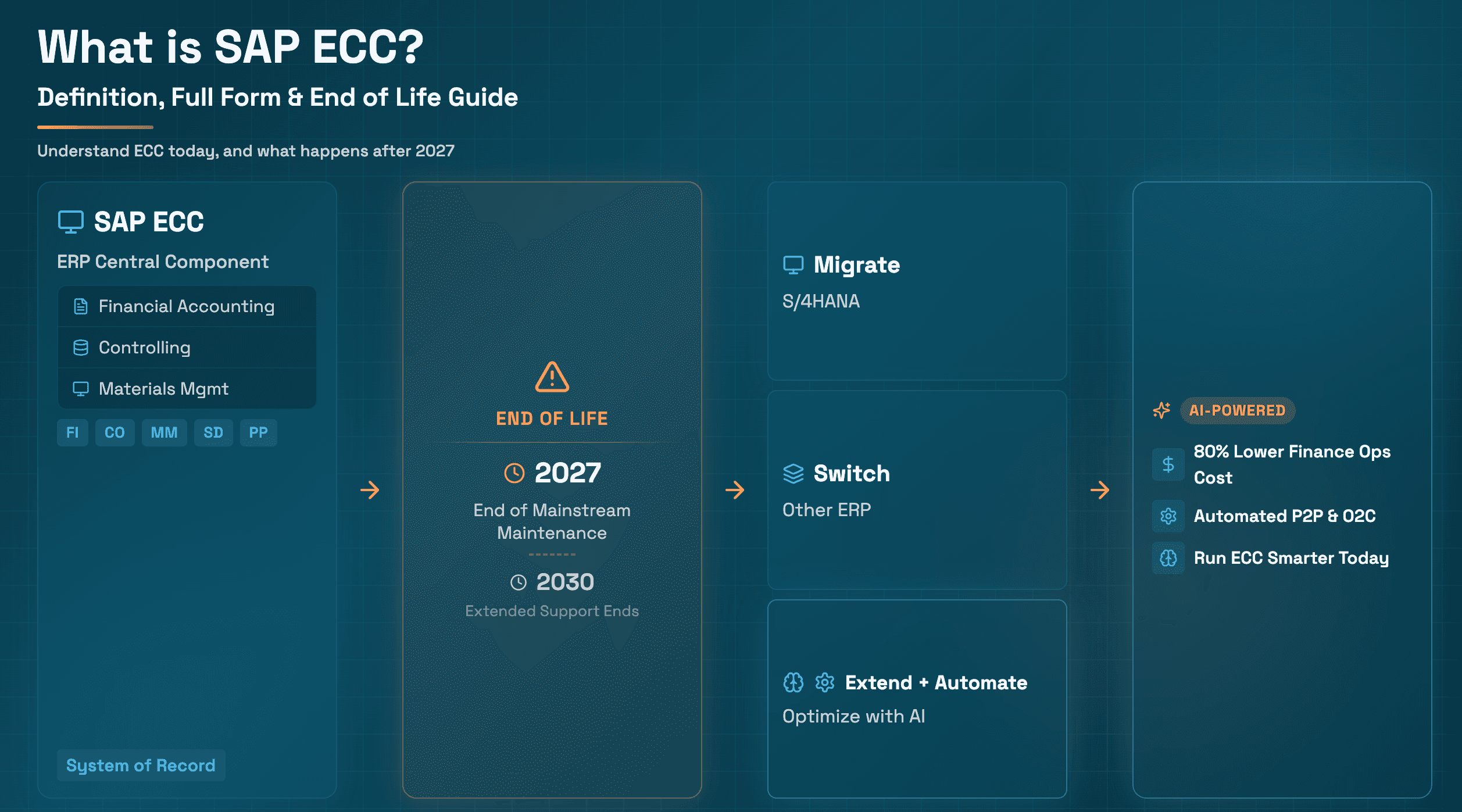
SAP ECC stands for SAP ERP Central Component, the cornerstone enterprise resource planning suite that powered global finance, procurement, and operations for over two decades. ECC runs on the SAP NetWeaver platform, integrating modules like FI, CO, MM, SD, PP, and other modules within a common technical framework, though each module maintains its own data structures, unlike S/4HANA's unified Universal Journal.
SAP has confirmed the end of mainstream maintenance for SAP ECC in 2027 (extended to 2030 with premium support), creating urgency for organisations to act. Organisations on SAP ECC are not forced to migrate immediately, hence AI Co-pilots can unlock transformational value right now, within the existing ECC environment.
Hyperbots AI Co-pilots, the most comprehensive Finance & Accounting automation suite for P2P and O2C, deliver up to 80% operational cost reduction in SAP ECC environments through straight-through invoice processing, automated accruals, intelligent payments, and more. Hyperbots integrates with SAP S/4 HANA, SAP B1, and SAP ECC through exhaustive, real-time read/write connectors, supporting both on-premise and cloud deployments.
What Is SAP ECC? The Complete Definition
SAP ECC (SAP ERP Central Component) is one of SAP’s on-premise enterprise resource planning (ERP) software suites, released as part of SAP ERP 6.0, which became the central foundation of SAP’s ERP suite. First introduced in 2004 as the successor to SAP R/3, SAP ECC consolidates financial accounting, controlling, materials management, sales, human resources, and production planning into a single, integrated platform built on the SAP NetWeaver technology stack.
If you have ever asked "what does SAP ECC stand for?" or needed a crisp SAP ECC definition for a business case, here it is: ECC stands for Enterprise Central Component, reflecting SAP's intent to make this the definitive, centralized engine of enterprise operations, through which all other SAP components pass their core transactional data. In common usage, SAP ERP ECC is used interchangeably with "SAP ECC" because ECC is SAP's ERP product for that generation.
To further define SAP ECC in practical terms: it is a client-server application running on SAP's proprietary ABAP programming language, interfacing with a relational database (traditionally Oracle, IBM DB2, or MS SQL Server, and later SAP HANA) to provide a single source of truth for enterprise data such as financial postings, purchase orders, vendor master records, inventory movements, and countless other ECC data objects that drive day-to-day operations.
A Brief History of SAP ECC: From R/3 to the Modern ECC System
Understanding the ECC system requires a quick look at SAP's evolutionary arc. Founded in 1972, SAP launched its first product, SAP RF, as real-time financial accounting software. This evolved to R/1, with a single-tier architecture, and then R/2 (a two-tier ERP software spanning more business components like finance, logistics, and HR) before SAP R/3 brought a big change in enterprise computing in 1992 by moving to a three-tier client-server architecture, making sophisticated ERP accessible to a far broader range of businesses.
By the early 2000s, SAP recognised that a single, large, rigid system like R/3 was limiting. In 2004, SAP rebranded and restructured the suite as SAP ECC, running initially on version ECC 5.0 and then the landmark SAP ECC 6.0 in 2005, which became the standard for global enterprises. ECC 6.0 introduced Enhancement Packages (EhPs) that allowed organisations to adopt new functionality, dramatically extending the lifespan of ECC deployments.
Hundreds of thousands of companies, from mid-market manufacturers to Fortune 500 multinationals, have built their entire financial and operational infrastructure on SAP ERP ECC. Today, it remains the most widely deployed enterprise ERP in the world, making the question of "what comes next" one of the most consequential decisions in corporate technology.
Core Modules of the SAP ECC System: What ECC Data Covers
The power of SAP ECC lies in its deep modularity. Each module manages specific ECC data domains and shares a common database with separate tables and data structures within it for different business areas, ensuring data integrity across the enterprise.
The primary modules include:
Module | Full Name | Key ECC Data Managed |
FI | Financial Accounting | G/L, AP, AR, Asset Accounting, Bank Accounting, P2P |
CO | Controlling | Cost Centre Accounting, Profit Centre Accounting, Product Costing, Internal Orders, Profitability Analysis. R2R (Record to Report) |
SD | Sales & Distribution | Presale, Sales Orders, Distribution, Billing, Returns |
MM | Materials Management | Purchase Requisitions, Request for Quotations (RFQ), POs, GRNs, Inventory, Vendor Master Data, Source to Pay (S2P) |
PP | Production Planning | BOMs, Routing, Capacity Planning, MRP |
QM | Quality Management | Inspection Plans, Quality Control, Quality Notifications, Certificates |
PM | Plant Maintenance | Equipment, Infrastructure, Inspection, Preventive Maintenance, Repair |
PS | Project System | WBS Elements, Process Planning, Cost Planning, Scheduling. Date & Capacity Planning |
HCM | Human Capital Management | Organizational Management, Employee Administration, Time Management, Benefits Management, Recruitment, Learning Management |
For finance teams in particular, the FI and CO modules together form the bedrock of all financial reporting, making the accuracy and timeliness of data in the SAP ECC ERP system a mission-critical priority.
SAP ECC End of Life: What Happens After 2027?
Perhaps the most pressing question for any organisation running SAP ERP ECC today is: what happens when SAP's maintenance commitments expire?
SAP has structured its end-of-life timeline in phases, and there are now multiple deadlines to track, not just one.
Key Dates to Know:
May 31, 2026 - Compatibility Packs expire for most SAP S/4HANA on-premise customers, removing the bridge functionality that allowed classic ECC processes to run within S/4HANA on-premise systems.
December 31, 2026 - Mainstream maintenance ends for ECC Enhancement Packages (EHP) 0–5.
December 31, 2027 - Mainstream maintenance ends for ECC EHP 6–8, the versions most enterprises currently run.
December 31, 2030 - Extended (premium) maintenance ends for EHP 6–8, available at additional cost and covering security patches, limited legal updates, technical support, but no new features. This provides customers with extra time to transition to new SAP solutions.
What "End of Mainstream Maintenance" Actually Means
End of mainstream maintenance for the SAP ECC system does not mean the software stops working overnight. Existing installations will continue to function. However, organisations will no longer receive:
Legal change packages (tax law updates, regulatory compliance patches)
Security patches addressing newly discovered vulnerabilities
Quality patches correcting software defects
New SAP Notes addressing operational issues
Functional enhancements to the ECC ERP modules
Organisations can pay for extended maintenance until December 31, 2030, which covers limited security patches and legal updates, but still excludes new features or enhancements.
After 2030, all maintenance ends entirely. This creates compounding risk over time: an unpatched SAP ECC environment will carry significant security vulnerabilities and progressively fail to comply with evolving tax and financial reporting regulations across jurisdictions worldwide.
The Three Paths After SAP ECC End of Life
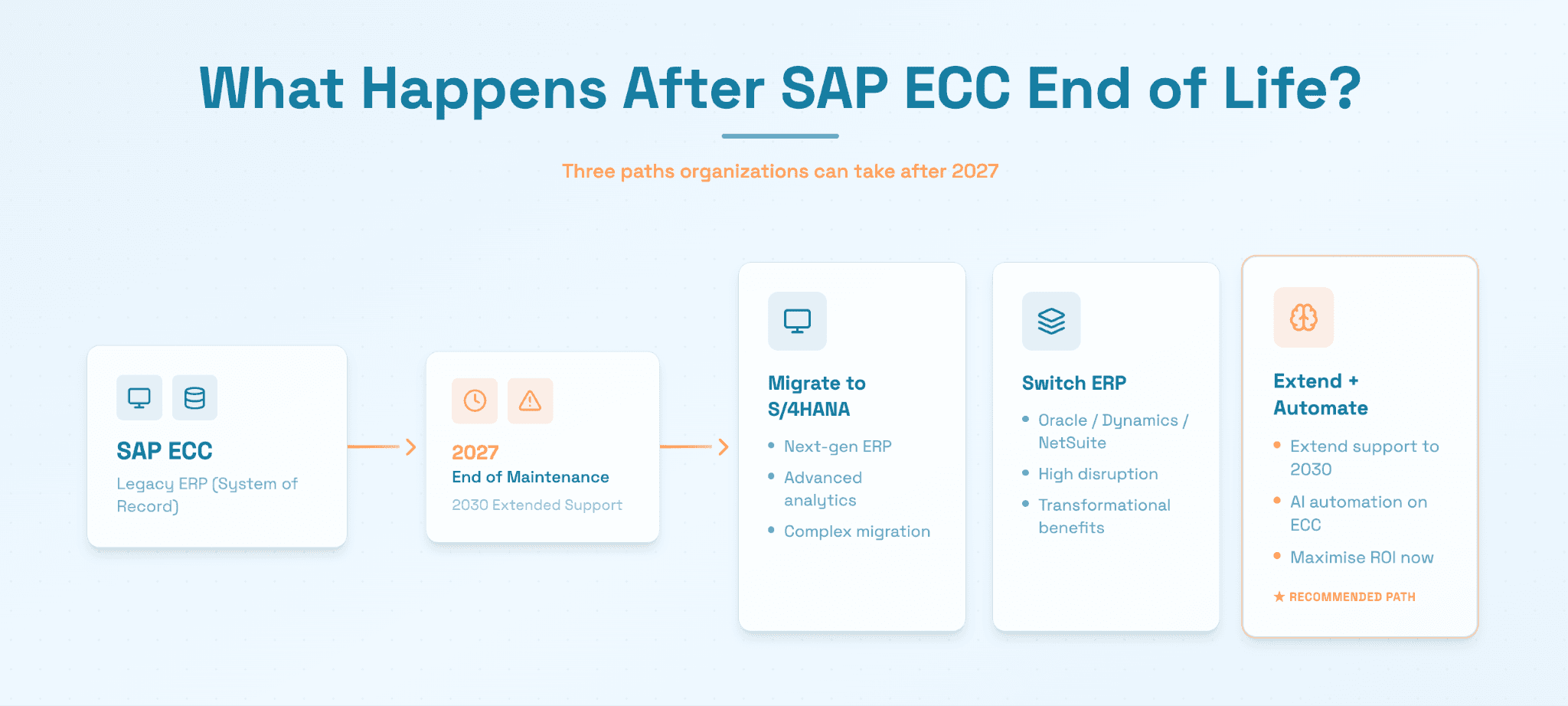
Migrate to SAP S/4HANA: SAP S/4 HANA is SAP's next-generation ERP built on the in-memory HANA database. Offers advanced analytics, a simplified data model, and a significantly longer support horizon. However, migrations are complex, costly, and multi-year projects requiring careful planning.
Move to a Different ERP: Some organisations use the ECC end-of-life event as an opportunity to evaluate alternatives such as Oracle Cloud ERP, Microsoft Dynamics 365, or NetSuite. This is the most disruptive path, but it can offer transformational benefits for the right organisation profile.
Extend and Optimise the SAP ECC Environment: Pay for SAP's extended premium maintenance through December 31, 2030, and meanwhile extract maximum operational value from the existing ECC system through AI-powered automation layered on top of SAP ECC. Organizations on SAP Cloud ERP Private Edition can also retain Compatibility Pack usage rights through 2030, providing additional time to plan and execute transformation.
For many organisations, especially those mid-way through multi-year S/4HANA preparation, or those with heavy customisations, Path 3 combined with Path 1 is the pragmatic choice: extend the life of SAP ECC while maximising its ROI through AI automation, then migrate to S/4HANA on a considered timeline.
How Hyperbots AI Co-pilots Drive Transformational Impact on SAP ECC
While the industry debates migration timelines, the smartest finance leaders are asking a different question:
"How do we eliminate the manual, error-prone work inside SAP ECC right now, before, during, and after any migration?"
Hyperbots is the answer. Built by CFOs, for CFOs, Hyperbots delivers the most comprehensive suite of AI Co-pilots for Finance & Accounting in the market, specifically engineered to integrate deeply with ERPs like SAP ECC, SAP S/4 HANA, SAP B1, and automate the full Procure-to-Pay (P2P) and Order-to-Cash (O2C) value chains.
In Hyperbots' platform architecture, the co-pilots provide exhaustive integration with SAP ECC, enabling real-time read and write access for expenses, Chart of Accounts (COA), vendor master, assets, liabilities, invoices, accruals, purchase orders, GRNs, and payment terms, ensuring the co-pilots operate autonomously while maintaining SAP ECC as the ground truth for financial reporting.
Key Performance Statistics:
Metric | Result |
Reduction in finance operations costs | Up to 80% |
Straight-through invoice processing (STP) rate | 80%+ |
Data accuracy in invoice-field extraction | 99.8% |
Additional cost for custom SAP ECC connectors | $0 |
The Complete Hyperbots P2P Co-pilot Suite on SAP ECC
Hyperbots' Procure-to-Pay suite for AP Automation covers every step of the Procure-to-Pay (P2P) lifecycle within the SAP ECC MM and FI modules:
The Invoice Processing Co-pilot
The Invoice Processing Co-Pilot can connect directly to SAP ECC FI-AP, discovering invoices automatically from email inboxes, vendor portals, and shared drives. It extracts and validates fields with 99.8% accuracy, performs 2-way and 3-way Invoice-to-PO/GRN matching across 140+ fields, recommends GL codes based on historical patterns, runs duplication checks, and posts the final entry into SAP ECC, all in under one minute.
Result: 80%+ straight-through processing, elimination of manual GL coding errors, and near-complete removal of duplicate invoices risk.
The Payments Co-pilot
The Payments Co-Pilot reads payment terms, invoice data, and vendor relationship details from SAP ECC to recommend optimal payment timing on every invoice, balancing early payment discount capture, penalty avoidance, and cost of capital. It supports payment execution across ACH, checks, and wire transfers with configurable approval workflows, fraud prevention, automated bank reconciliation, and remittance communication to vendors.
Result: The result is up to 10% reduction in cash outflow and measurably stronger vendor relationships.
The Procurement Co-pilot
The Procurement Co-Pilot automates the full PR/PO lifecycle within SAP ECC MM. It extracts and auto-fills purchase requisition fields from contracts and statements of work, performs duplicate detection, real-time budget checks, and GL coding recommendations before routing for approval. Once approved, it auto-generates purchase orders using configured templates and dispatches them directly to vendors.
Result: PR creation time drops to under 5 minutes, approval bottlenecks are eliminated, and procurement discipline is enforced end-to-end.
The Vendor Management Co-pilot
The Vendor Management Co-Pilot automates vendor onboarding by verifying W-9s and identity documents against authoritative sources, detecting duplicate vendor records, rationalizing new vendors for spend optimization, providing configurable approval workflows, and creating clean master records in SAP ECC FI/MM. A real-time self-service vendor portal gives suppliers visibility into PO, invoice, and payment status, reducing email queries and disputes.
Result: Fraudulent vendors are blocked before they reach the vendor master, and spend is optimised through vendor rationalization.
The Accruals Co-pilot
The Accruals Co-Pilot reads open POs, GRNs, and pending invoices directly from SAP ECC to automatically discover accruals across goods received, services rendered, and recurring expenses such as rent, SaaS fees, and insurance. It performs AI-powered 2-way matching, applies GL coding, books accrual entries into SAP ECC, and automatically reverses them at month-start or upon invoice receipt.
Result: Month-end accrual pressure is eliminated, and variance between accrued and actual costs is reduced to below 5%.
The Sales Tax Verification Co-pilot
The Sales Tax Verification Co-Pilot works alongside the Invoice Processing Co-pilot to verify sales tax on every vendor invoice before amounts are posted into SAP ECC. It reads each invoice line, classifies items into the correct tax category, validates applicable rates against a live tax dictionary by origin-to-destination ZIP code, and flags mismatches before posting.
Result: Overpayments, underpayments, audit exposure, and legal notices are prevented, closing a compliance gap that SAP ECC does not address natively.
The Hyperbots O2C Co-pilot Suite on SAP ECC
On the Order-to-Cash side, Hyperbots brings the same AI-native automation philosophy to SAP ECC's SD and FI modules:
The Collections Co-pilot
The Collections Co-Pilot monitors AR ageing across SAP ECC in real time, continuously reprioritising collection actions based on payment behaviour, invoice risk, and dispute likelihood. It autonomously executes personalised email and phone follow-ups, automates dunning, tracks promise-to-pay commitments, detects disputes early, and write all outcomes back to SAP ECC without manual intervention.
Result: DSO is reduced by up to 40% and cost-to-collect is reduced by over 70% .
The Cash Application Co-pilot
The Cash Application Co-Pilot automatically matches incoming customer payments, from bank feeds, lockboxes, ACH, wires, checks, and email remittances, against open AR invoice items in SAP ECC using finance-trained AI with 99.8% extraction accuracy. Short-payments, overpayments, deductions, and unidentified cash are detected, classified by root cause, and routed for resolution.
Result: Unapplied cash is reduced to below 10%, reconciliation costs fall by up to 80%, and AR visibility becomes real-time.
Hyperbots Platform Capabilities: Creating Transformational Impact on SAP ECC
The Hyperbots Platform: Purpose-Built for SAP ECC Environments
Hyperbots is not a generic automation tool for finance. It is an agentic AI platform, purpose-built, pre-trained on domain-specific financial data, and engineered to integrate deeply with SAP ECC's data structures, customisations, and process flows.
Real-time read & write SAP ECC integration: Bi-directional, live data exchange with SAP ECC ensures every transaction is instantly reflected across your financial systems.
On-premise and cloud SAP variants supported: Hyperbots works seamlessly across both on-premise and cloud-hosted SAP deployments, giving flexibility regardless of your infrastructure setup.
SAP ECC, SAP S/4 HANA, SAP B1 pre-built connectors: Ready-to-use native connectors for SAP ECC, SAP S/4 HANA, and SAP B1 eliminate custom development and accelerate deployment timelines significantly.
Company-specific ECC customisation support: Adapts to your unique SAP ECC configurations, custom fields, GL structures, and business rules.
Multi-entity, multi-instance SAP ECC management: Manage invoice workflows across multiple legal entities and SAP instances from a single unified platform with consistent AI-driven automation.
Exception and error handling with read-back checks: AI agents automatically detect posting errors, trigger read-back validations, and resolve exceptions with the help of human collaboration when needed, ensuring accurate, complete financial entries every time.
Single sign-on across all ERP instances: One secure login provides seamless access across all connected SAP ECC instances, simplifying user management and strengthening enterprise-wide access control.
Complete audit trail for every AI and human action: Every action, whether taken by AI or a human, is logged with timestamps for full compliance and auditability.
Agentic AI with 24/7 unattended processing: AI agents autonomously process invoices round the clock, alerting humans only for genuine exceptions, ensuring uninterrupted operations without manual oversight.
Pre-trained on 35 million+ invoice fields & financial documents: Models trained on 35 million+ invoice fields deliver day-one accuracy across any invoice format, layout, structure, or size.
How Hyperbots Integrates with SAP ECC: Architecture
Hyperbots co-pilots facilitate both reading from and writing into SAP ECC, handling two primary categories of data:
Metadata: Vendor master, item master, Cost Center, GL codes, currency, payment terms, WBS elements, etc., keeping the co-pilots synchronised with the latest SAP ECC master data at all times.
Transaction Data: Purchase Orders (POs), invoices, accruals, payments, and other financial transactions, enabling end-to-end AI-driven automation of financial processes.
For all integrations, Hyperbots supports flexible synchronisation options, real-time, hourly, daily, or weekly, ensuring the right data freshness for each process. The connectors are designed for both on-premise SAP ECC and cloud SAP variants, with exception and error handling: every ERP posting is verified with a read-back check, failures are retried optimally, and any remaining exceptions are surfaced for human resolution.
Hyperbots co-pilots adapt seamlessly to company-specific SAP ECC customisations, including custom fields, through a configuration-driven integration framework. Custom SAP ECC connector development is included for unsupported ERPs as part of its service offering at no additional cost.
Multi-Entity and Multi-Instance SAP ECC Management
For organisations running multiple SAP ECC instances or a combination of SAP ECC and other ERPs across business entities, Hyperbots provides unified management:
Single sign-on (SSO) across all ERPs and entities, no repeated logins.
Centralized or entity-specific configurations, each entity can maintain distinct processes or share a unified model with replicated configurations across entities.
Support for organisations managing multiple instances of the same ERP, as well as those running different ERPs across entities. Hyperbots manages them all from a single platform with a unified view of tasks and actions powered by AI.
Designed to support both centralized and separate operating teams managing different ERPs and GL structures across entities.
Hyperbots-Led ROI Improvements on SAP ECC
The business case for deploying Hyperbots AI Co-pilots on SAP ECC is both tangible and compelling.
Hyperbots customers consistently report the following outcomes:
Tangible ROI Outcomes:
Invoice processing time drops to under 1 minute: AI agents autonomously handle discovery, extraction, validation, matching, GL coding, and ERP posting end-to-end, compressing what an 11-day industry average cycle time to under a minute for straight-through invoices.
Straight-through processing (STP) rate increases to 80%+: The Invoice Processing Co-pilot achieves up to 80% STP, meaning 4 in 5 invoices flow from email to general ledger without any human intervention, freeing staff to focus only on genuine exceptions.
Finance operations headcount cost reduced by up to 80%: With the bulk of invoice processing, payments, accruals, vendor management, and cash application handled autonomously by AI agents running 24/7, the retained team is empowered by Co-Pilot to resolve only the exceptions that truly need human judgment.
Invoice errors fall to an approximately 0.2% error rate: Hyperbots achieves 99.8% accuracy in invoice field extraction through a multimodal AI model combining LLMs, VLMs, and layout models, with read-back validation on every ERP posting to confirm accuracy.
Month-end accrual processing effort reduced by up to 80%: The Accruals Co-pilot automates identification, booking, and reversal of accruals for goods received but not invoiced, services received but not invoiced, and recurring expenses, eliminating the manual month-end scramble entirely.
Variance between accrued and actual costs reduced to under 5%: AI-driven accrual discovery comprehensively identifies all outstanding liabilities across all expense scenarios, resulting in materially more accurate period-end financial statements.
Vendor onboarding transformed from weeks of manual effort to minutes: AI-enabled W-9 verification, identity checks, and automated ERP record creation eliminate data entry bottlenecks, reduce duplicate vendor records, and ensure compliance from day one without manual oversight.
Vendor master data quality significantly improved: The Vendor Management Co-pilot validates vendor identity against authoritative sources, detects duplicate records, and enables spend optimization through vendor rationalization, driving both compliance and procurement efficiency.
Cash application STP rate improves from near-zero or below 50% (with legacy tools) to 80%: Finance-trained AI agents automatically match payments to invoices using invoice numbers, PO references, amounts, dates, customer behaviour, and historical patterns, even when remittance data is incomplete or noisy.
Unapplied cash reduced to below 10%: A continuous unapplied cash reduction engine systematically works through unmatched and partially applied payments, slashing AR ageing inaccuracies and reducing revenue leakage.
Cash reconciliation cost reduced by up to 80%: By eliminating manual matching, spreadsheet-based reconciliation, and repetitive exception handling, the Cash Application Co-pilot delivers a massive reduction in the cost of the AR function.
Intangible and Strategic ROI on SAP ECC
Audit-readiness: Complete, time-stamped audit trails for every AI and human action in the SAP ECC workflow, reduces audit preparation time dramatically.
Fraud Prevention: AI-powered duplicate invoice detection and vendor identity verification reduce AP fraud risk in SAP ECC environments by catching anomalies humans routinely miss.
Regulatory Compliance: Automated sales tax verification and compliance-aware GL coding reduce the risk of penalties and notices in a post-SAP-ECC-maintenance world.
Employee Morale & Retention: Finance teams freed from repetitive data entry in SAP ECC can focus on analysis, strategic finance decisions, and value-add activities.
Migration Readiness: Clean, validated SAP ECC data, a direct byproduct of Hyperbots automation, dramatically reduces the complexity and cost of eventual S/4HANA migration.
Vendor Relationships: Real-time invoice status through Hyperbots' vendor portal and on-time, optimised payments improve supplier relationships.
Scalability Without Headcount: Hyperbots co-pilots process round-the-clock, handling invoice surges during peak periods (quarter-end, year-end) without temporary staffing.
How Hyperbots AI Co-pilots Are Highly Differentiated vs. Other P2P & O2C Software
The finance automation landscape is crowded, from legacy OCR-based tools to new AI softwares.
Here is why Hyperbots stands apart, especially for organisations running SAP ECC:
Capability | Hyperbots | Other Automation Tools |
SAP ECC native read/write integration | Exhaustive full read and write across all modules including invoices, POs, payments, vendors, and GL codes | Partial, typically limited to AP/FI modules; full ECC coverage requires expensive custom builds |
Pre-trained on financial documents | Pre-trained on 35 million+ invoice fields and millions of financial documents including bills, statements, and contracts | Template-based OCR or general-purpose LLMs not trained specifically on finance and accounting data |
Agentic AI, 24/7 autonomous processing | True agentic workflow; AI agents run round the clock, alerting humans only for genuine exceptions | Human-in-the-loop required for most steps; limited or no unattended autonomous processing |
P2P + O2C full coverage | Invoice processing, procurement, accruals, payments, vendor management, sales tax, collections, and cash application, all in one platform | Point solutions covering P2P or O2C only, or isolated tools with no native O2C capability |
On-premise & cloud SAP ECC support | Full support for both on-premise and cloud SAP variants, including SAP ECC, S/4HANA, and SAP B1 | Cloud-first or cloud-only; on-premise SAP ECC support is limited or unavailable |
Custom SAP ECC field integration | Configuration-driven framework supports custom fields and company-specific customisations at no additional cost | Expensive custom development required; some tools do not support custom ECC fields at all |
Multi-ERP, multi-entity, multi-instance | Unified platform with single sign-on, managing multiple ERPs, instances, and entities with a single task view powered by AI | Single ERP or single instance focus; multi-entity management requires separate deployments or is unavailable |
Continuous learning from human feedback | Self-learning AI adapts to company-specific workflows, GL patterns, and exceptions over time using auto-ML and reinforcement learning | Static rules engines or models that require manual retraining, do not improve automatically from human corrections |
Built-in sales tax verification | Dedicated Sales Tax Verification Co-pilot integrated natively with the Invoice Processing Co-pilot, validating at the line-item level | Separate third-party tool required; not natively integrated into the invoice workflow |
Vendor portal and real-time collaboration | Built-in vendor portal providing real-time visibility into PO, invoice, and payment status, with collaboration and automated remittance communication | Basic supplier portals are available; typically not integrated with invoice processing or payment workflows |
The Hyperbots Difference: While legacy tools automate individual tasks within SAP ECC, Hyperbots delivers end-to-end autonomous finance operations, from the moment an invoice arrives to the moment it is paid, and from the moment a customer order ships to the moment cash is collected and applied. This AI-native, purpose-built approach enables true transformation of finance operations, not mere digitization of manual steps.
Why Hyperbots AI Co-pilots Are More Effective Inside SAP ECC
SAP ECC, despite its age, is a treasure trove of rich transactional and master data. The challenge has always been that accessing, processing, and acting on this data required either expensive ABAP development or large teams of finance staff performing manual transactions. Hyperbots changes this equation fundamentally.
Deep SAP ECC Data Access Enables True Automation
Because Hyperbots reads and writes directly to SAP ECC's underlying data structures, it can work with business data across core tables such as vendor master (LFA1, LFB1), purchase orders (EKKO, EKPO), material documents line-items (MSEG), accounting documents (BKPF, BSEG), GL master data (SKA1, SKAT), and bank details (LFBK) through standard SAP interfaces.
The co-pilots can perform intelligent, context-aware automation that simpler tools relying only on surface-level API access cannot achieve. This deep ECC data integration means:
GL coding recommendations that are aligned with company-specific coding conventions stored in the SAP ECC Chart of Accounts, with an intelligent GL recommender that learns continuously from historical invoice data and human corrections to deliver accurate, adaptive suggestions over time.
Three-way matching that cross-references SAP ECC PO quantities (EKPO), GRN quantities (MSEG), and invoice quantities (BKPF) across up to 140 configurable fields, with tolerance rules and matching strategies that can be defined per vendor, invoice type, or expense categories, and clear explanations generated for any mismatch.
Accruals that automatically reference open SAP ECC PO and GRN combinations to detect goods and services received but not yet invoiced, eliminating the need for manual identification at month-end and reducing variance between accrued and actual costs to under 5%.
Payment recommendations that factor in SAP ECC Terms of Payment (ZTERM), vendor bank details (LFBK), early payment discount opportunities, late payment penalty analysis, and cost of capital, enabling AI-optimised payment timing that can deliver up to 10% reduction in cash outflow.
Vendor master data integrity is maintained through AI-powered identity verification, duplicate detection, and automated ERP record creation, ensuring the vendor master in SAP ECC remains clean, validated, and free of fraudulent entries.
Cash application and reconciliation that reads bank statements, lockbox files, and remittance data, and automatically matches them back to open AR items in SAP ECC, reducing unapplied cash to below 10% and reconciliation costs by up to 80%.
Handling SAP ECC Customisations: The Reality Most Tools Ignore
Most SAP ECC implementations are heavily customised. Finance teams have built approval workflows, custom GL coding logic, company-specific rules, and tables containing business rules accumulated over decades. Generic automation tools fail here; they cannot read or write to custom fields and break when encountering non-standard transaction types.
Hyperbots' configuration-driven integration framework is specifically designed to handle this reality. Hyperbots co-pilots adapt seamlessly to company-specific ERP customisations, enabling read and write access to custom fields through a configuration-driven integration framework.
Custom SAP ECC connector development for unsupported ERPs as part of its service offering is included at no additional cost. This means Hyperbots co-pilots work with your SAP ECC as it actually is, not as a theoretical, basic installation, and can be deployed across public cloud, private cloud, and on-premise SAP ECC environments without architectural compromise.
Conclusion: SAP ECC's End of Life Is an Opportunity, Not Just a Deadline
SAP ECC has been the backbone of enterprise finance and operations for over two decades, and its impending end of mainstream maintenance does not diminish that legacy. What it does do is force a strategic choice: wait, migrate, or transform.
For organizations navigating the complexity of S/4HANA migration timelines, heavy customizations, or constrained budgets, the smartest move is not to pause and wait, but to act now. Every day spent on manual invoice processing, error-prone payments and accruals, and reactive collections inside SAP ECC is value left on the table.
Hyperbots AI Co-pilots offer a clear path forward. By delivering deep, real-time integration with SAP ECC's native data structures, Hyperbots enables finance teams to achieve up to 80% operational cost reduction today, without waiting for migration to complete. Clean data, automated workflows, and audit-ready processes also make any eventual S/4HANA transition faster and less costly.
The question is no longer whether to modernise your finance operations; it is how quickly you can start. With Hyperbots, the answer is: immediately.
Explore the Hyperbots platform, book a demo in order to get in touch with our finance experts, or start a free trial today to experience the difference first-hand.
Frequently Asked Questions About SAP ECC
Q1: What does SAP ECC stand for / What is the SAP ECC full form?
A: SAP ECC stands for SAP ERP Central Component, the centralized, integrated platform through which all enterprise business processes and transactional data flow across an SAP landscape.
Q2: When does SAP ECC end of life occur?
A: Mainstream maintenance ends December 31, 2027. Extended premium maintenance runs until December 31, 2030, at additional cost, covering limited security and legal updates but no new features.
Q3: Can I still use SAP ECC after 2027?
A: Yes, ECC continues functioning, but without security patches, legal updates, or fixes under standard maintenance. Extended premium maintenance covers through 2030. Many organizations layer AI automation to maximise ROI, meanwhile.
Q4: What is the difference between SAP ECC and SAP S/4HANA?
A: ECC is the legacy ERP suite, primarily deployed on-premise. S/4HANA is its next-generation successor built on SAP HANA's in-memory database, featuring a simplified Universal Journal data model and embedded analytics.
Q5: How long does it take to deploy Hyperbots AI Co-pilots on SAP ECC?
A: Thanks to pre-built SAP ECC connectors and pre-trained models, standard deployments go live in weeks. Rigorous UAT environment testing validates data migration and process accuracy before go-live.