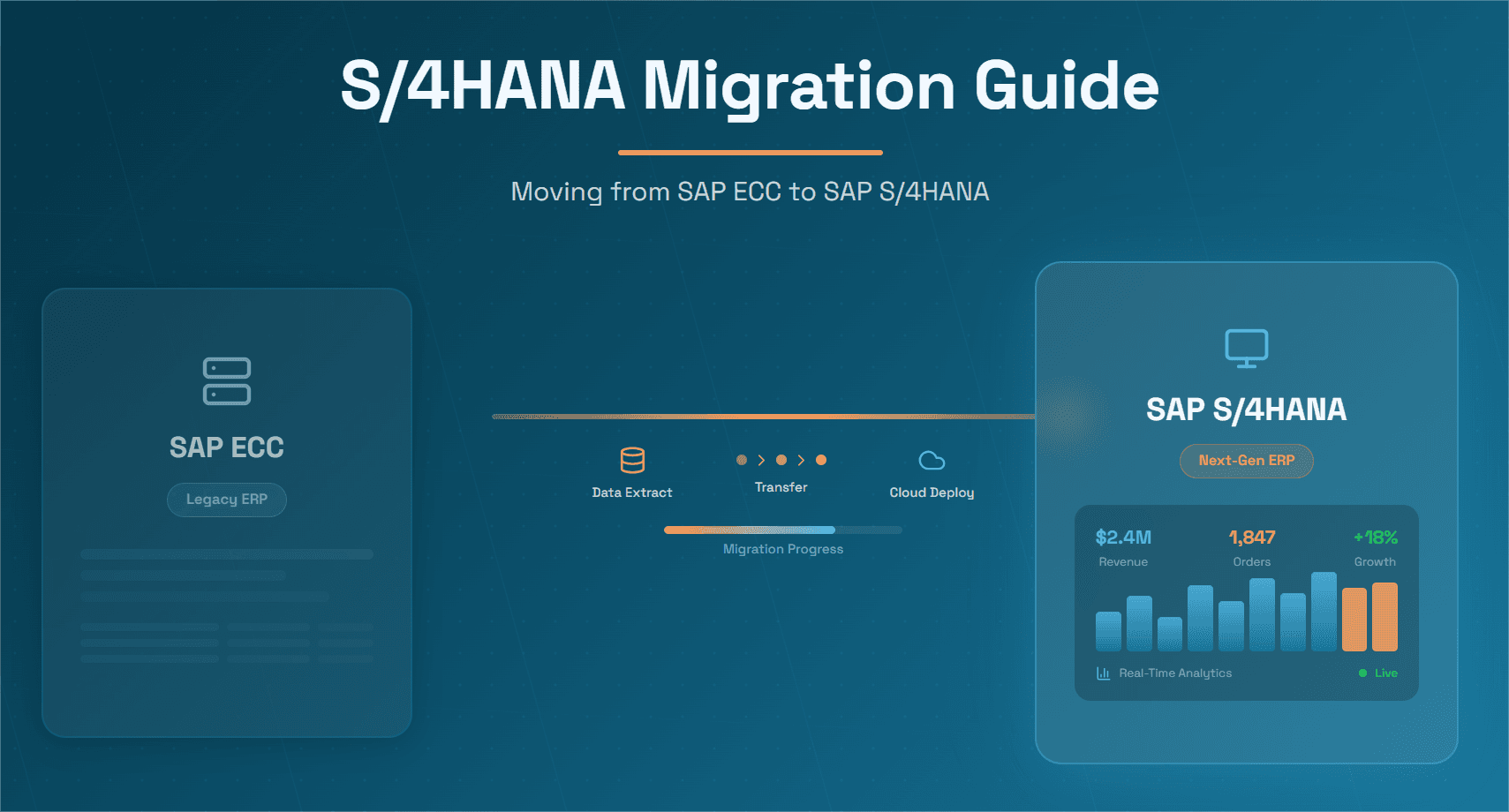
SAP ECC Is Being Retired: Here's Everything You Need to Know About S/4HANA Before 2027
What the end of SAP ECC support means for your business, how the transition to SAP S/4HANA works, and how finance teams can maximize ROI from their migration before the 2027 deadline.
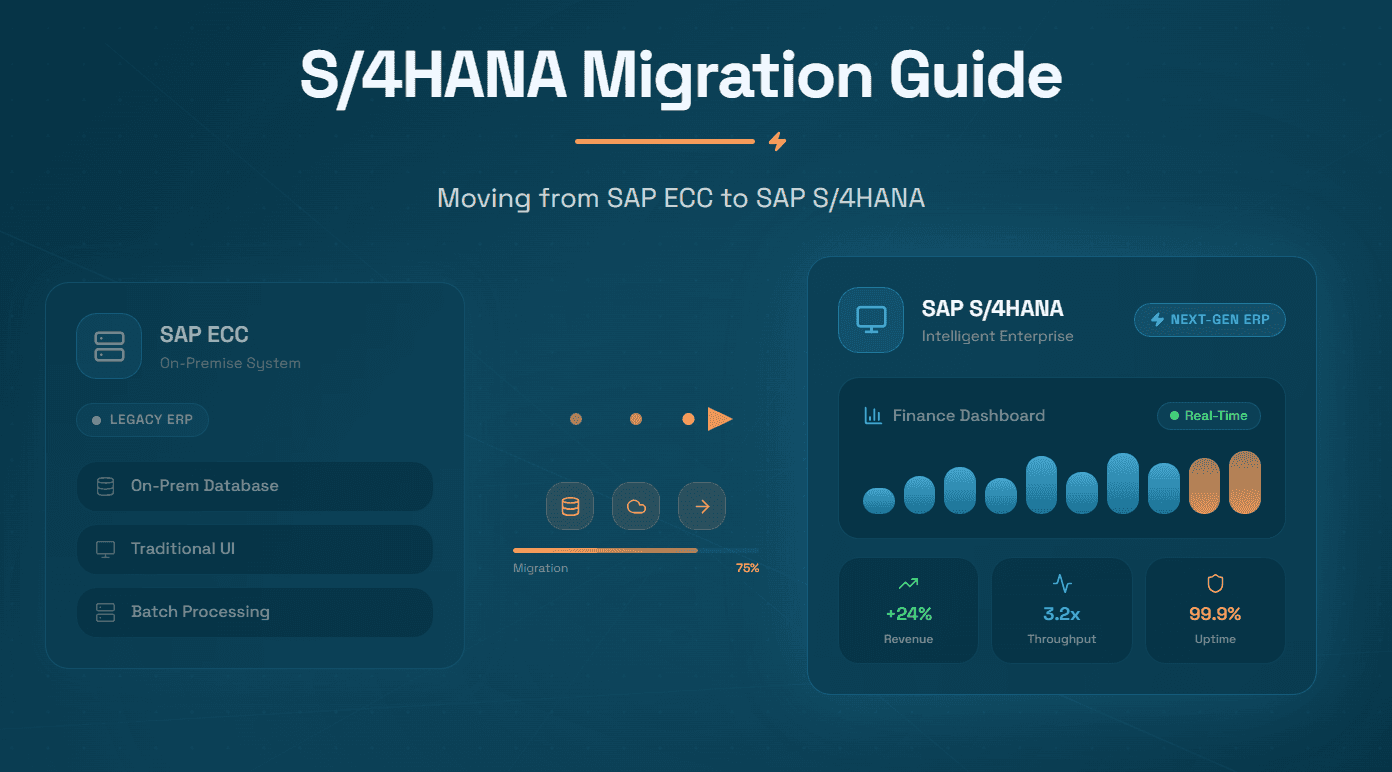
If you're running SAP today or evaluating it for the first time, you've almost certainly come across both "ECC" and "S/4HANA" and wondered what the difference actually is. The terminology can feel like alphabet soup, and most explanations either go too deep into technical architecture or stay so surface-level they don't help you make a real decision.
This guide cuts through the noise. We'll give a full breakdown of everything you need to know about SAP ECC and SAP S/4HANA, covering architecture, functionality, user experience, total cost, and migration implications. Whether you're a CFO weighing a platform upgrade, an IT director planning a roadmap, or a business leader trying to understand what SAP ECC vs S/4HANA actually means for your organization, this is the comparison you need.
What Is SAP ECC and S/4HANA? Starting With the Basics
Before diving into the differences, let's establish what each platform actually is.
SAP ECC (ERP Central Component) is SAP's previous-generation enterprise resource planning suite. It was released in the early 2000s as the successor to SAP R/3, and for nearly two decades it became the backbone of enterprise operations across thousands of companies worldwide. SAP ECC handles the core business functions you'd expect from an enterprise ERP: financial accounting (FI), controlling (CO), materials management (MM), sales and distribution (SD), production planning (PP), plant maintenance (PM), and human resources (HR), among others.
SAP S/4HANA is SAP's current-generation ERP platform, first released in 2015 and significantly evolved since. The defining characteristic of S/4HANA is that it was built from the ground up to run exclusively on SAP's own in-memory database engine, SAP HANA. This is not simply an upgrade to ECC, it is a fundamentally re-architected platform with a simplified data model, a redesigned user interface, and built-in intelligent capabilities that ECC was never designed to support.
Understanding the difference between SAP ECC and SAP S/4HANA starts with understanding the comparison between evolution and re-architecture.
SAP ECC vs S/4HANA: The Core Architectural Difference
The most fundamental difference between ECC and S/4HANA is where and how data is stored and processed.
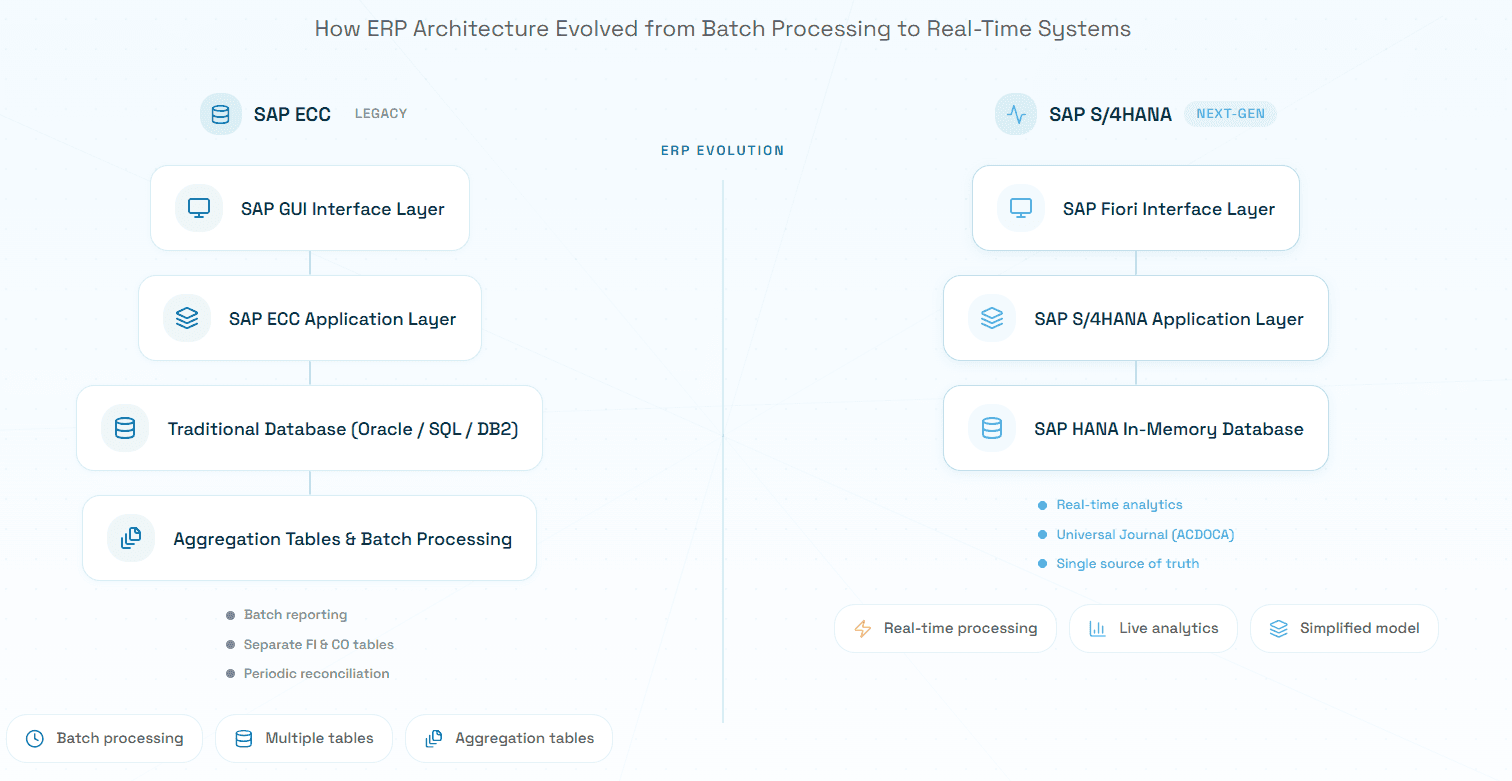
SAP ECC was designed to run on traditional relational databases like Oracle, Microsoft SQL Server, IBM DB2, or SAP's own MaxDB. These databases store data in rows, which works well for transactional processing but becomes a bottleneck when running complex analytical queries across large datasets. To work around this limitation, SAP ECC relied heavily on aggregation tables which were pre-summarized data tables that were updated periodically to enable faster reporting. This approach worked, but it introduced data redundancy, reconciliation requirements, and a fundamental lag between transaction and insight.
SAP S/4HANA eliminates all of that. By running exclusively on SAP HANA's in-memory columnar database, S/4HANA processes both transactions and analytics on the same live dataset simultaneously, in real time. There are no aggregation tables, no batch jobs required to update summary data, no overnight reconciliation runs. Every transaction is immediately visible in every report. This is what SAP means when it talks about the "digital core", a single source of truth that reflects your business as it actually is, right now.
The practical implication for finance teams is profound. In SAP ECC vs HANA, month-end close in ECC might involve waiting hours for batch jobs to complete before financial statements can be run. In S/4HANA, the same reports are available in seconds, at any point in the month, with no batch processing required.
SAP ECC vs S/4HANA: Data Model Simplification
One of the most significant and least discussed aspects of the SAP ECC vs S/4HANA difference is the dramatic simplification of the underlying data model, particularly in finance.
In SAP ECC, financial data is spread across dozens of separate tables. The FI (Financial Accounting) and CO (Controlling) modules maintain separate ledgers that must be periodically reconciled with each other. Accounts receivable, accounts payable, asset accounting, and the general ledger all store data in different structures. This fragmentation is a legacy of how ECC was built over decades incrementally, module by module.
SAP S/4HANA replaces this entire structure with a single universal journal, the ACDOCA table. Every financial posting, regardless of whether it originates in FI, CO, asset accounting, material ledger, or profitability analysis, writes to this single table. The result is that FI and CO are no longer separate modules that need reconciliation, they are unified. Period-end reconciliation between the general ledger and subledgers, which consumed significant time in ECC, is largely eliminated in S/4HANA.
This simplification also enables the Central Finance deployment option unique to S/4HANA, which allows organizations to consolidate financial data from multiple ERP systems (including non-SAP systems) into a single S/4HANA instance for real-time group-level reporting, something ECC was architecturally incapable of supporting.
S/4HANA vs ECC: User Experience and Interface
Anyone who has worked in SAP ECC will recognize the SAP GUI, the dense, form-heavy desktop interface that has remained largely unchanged since the 1990s. It is functional, familiar to millions of SAP users, and deeply unloved by nearly all of them. Navigating ECC requires transaction codes (T-codes), multiple menu layers, and significant training to use effectively.
SAP S/4HANA introduces SAP Fiori, a role-based, tile-driven user interface designed around how people actually work, rather than how the ERP is architected. Fiori apps are browser-native and mobile-responsive, meaning users can access S/4HANA from any device. Each user sees a personalized home screen showing only the apps relevant to their role, an AP clerk sees invoice processing and payment apps; a sales manager sees order pipeline and revenue analytics.
The difference between SAP ECC and SAP S/4HANA in terms of user experience is not cosmetic. It has real business impact: faster user adoption, lower training costs, reduced error rates from simplified workflows, and the ability to support a mobile and remote workforce without the VPN and Citrix infrastructure that ECC remote access typically requires.
SAP ECC vs SAP HANA: Reporting and Analytics
In the debate of SAP vs SAP HANA for reporting and analytics, there is no contest. This is where the architectural advantages of S/4HANA translate most directly into business value.
SAP ECC reporting has always been a pain point. Standard ECC reports are functional but limited. Most organizations running ECC end up building extensive custom reports using ABAP, installing SAP Business Warehouse (BW) as a separate analytics layer, or exporting data to Excel for any analysis beyond the most basic. Real-time operational reporting in ECC is constrained by the batch-processing architecture; you can only report on data that has been processed through the relevant batch jobs.
SAP S/4HANA provides real-time operational reporting natively, through embedded SAP Analytics Cloud and the SAP Fiori analytical apps that come standard with the platform. Because all data lives in the HANA in-memory database, queries that would have taken minutes or hours in ECC, profitability analysis by product line, real-time cash position, live inventory valuation, return in seconds. This fundamentally changes how finance and operations leaders interact with their data, shifting from backward-looking period reports to real-time decision support.
SAP ECC vs S/4HANA: Maintenance, Support, and the 2027 Deadline
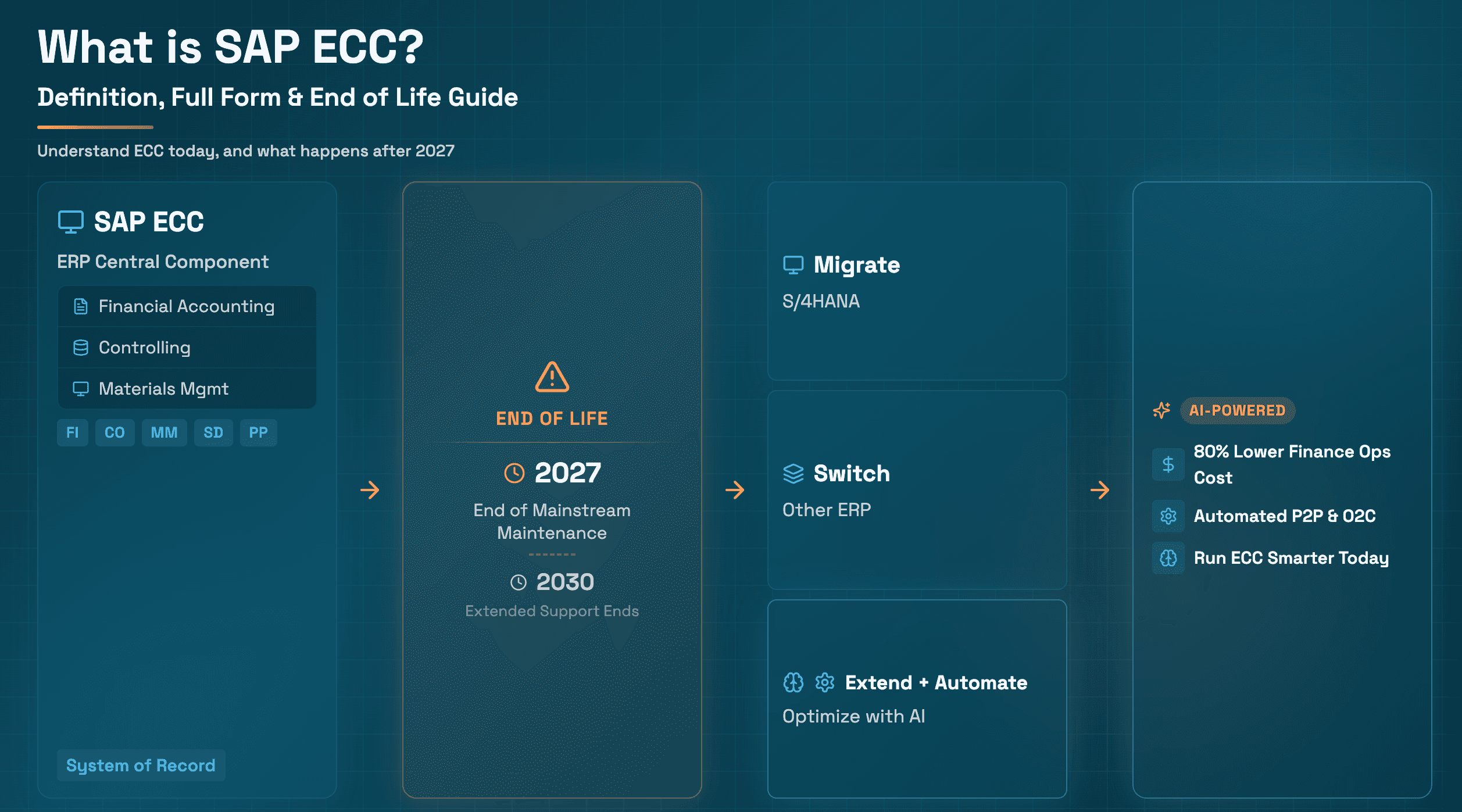
This is the consideration that is forcing the ECC to S/4HANA conversation for thousands of organizations right now. SAP has officially announced the end of mainstream maintenance for SAP ECC in 2027, with extended maintenance (at additional cost) available through 2030. After that date, SAP will no longer release patches, security updates, or legal/regulatory changes for ECC.
For any organization still running SAP ECC, this deadline makes the difference between SAP ECC and SAP S/4HANA not just a feature comparison but a business continuity issue. Running an unsupported ERP exposes your organization to security vulnerabilities, compliance gaps, and the risk of being stranded on a platform with no upgrade path.
The migration from SAP ECC vs S/4HANA is not trivial, it requires careful planning, data cleansing, custom code remediation, and change management. But with the 2027 deadline approaching, organizations that haven't started planning are already behind the curve.
What Changes and What Doesn't in S/4HANA
To summarize the key differences between SAP ECC and SAP S/4HANA practically:
What changes significantly: The underlying database (HANA in-memory replaces traditional RDBMS), the financial data model (ACDOCA universal journal replaces multiple separate ledgers), the user interface (SAP Fiori replaces SAP GUI for most transactions), real-time reporting capabilities, and the elimination of most aggregation tables and batch reconciliation processes.
What stays largely the same: The core business process coverage SAP S/4HANA supports all the same functional areas as ECC (FI, CO, MM, SD, PP, PM, HR). Your business processes don't have to change fundamentally, though most organizations use the migration as an opportunity to standardize and improve them.
What gets added: Intelligent automation capabilities, machine learning-based features (like payment term predictions and cash flow forecasting), embedded analytics, and integration with SAP's broader intelligent enterprise portfolio such as BTP, Ariba, SuccessFactors, and more.
Hyperbots + SAP S/4HANA and ECC: The AI Layer That Maximizes Your ERP Investment
Whether your organization is still running SAP ECC or has already completed the move to S/4HANA or is somewhere in between, there is one challenge that neither platform solves on its own: the labor-intensive, manual finance and accounting workflows that consume your team's time every single day.
Invoice processing, GL coding, vendor payments, accruals, collections, cash application, these workflows exist in every ERP environment, and they remain stubbornly manual in most finance teams regardless of whether the underlying platform is ECC or S/4HANA. That's precisely the problem Hyperbots was built to solve.
Hyperbots is a proprietary Agentic AI platform built exclusively for finance and accounting, with native integration connectors for both SAP S/4HANA (via SAP's BAPIs and proprietary APIs) and SAP ECC. The platform provides real-time, bidirectional read-and-write access to your SAP financial data such as invoices, POs, vendor masters, Chart of Accounts, GL entries and deploys in as little as 3–4 weeks with 99.8% accuracy in unstructured data extraction from day one.
Here is the concrete ROI Hyperbots delivers across both SAP environments:
Invoice Processing: The Invoice Processing Co-Pilot achieves up to 80% straight-through processing (STP) of invoices, cutting average processing time from 11 days to under one minute and recovering 80% of AP staff bandwidth. Duplicate payments, GL coding errors, and vendor disputes fall dramatically.
Payments Optimization: The Payments Co-Pilot analyzes payment terms, early pay discounts, penalty exposure, and cost of capital to optimize payment timing and method by reducing total cash outflow by up to 10%. For a company with $8M in annual payables, that's $800,000 in recovered cash flow.
Procurement Automation: The Procurement Co-Pilot auto-generates purchase requisitions and converts them to compliant purchase orders within your SAP environment, reducing PO creation time by 80% and PR creation time to just 5 minutes.
Month-End Close Acceleration: The Accruals Co-Pilot automates accrual identification, booking, and reversals, cutting accrual processing costs by 80% and reducing variance between accrued and actual costs to below 5%. Finance teams running S/4HANA's faster close cycle get even more from Hyperbots because the AI operates at the same real-time speed as the platform.
Collections and DSO: The Collections Co-Pilot autonomously manages dunning, follow-ups, dispute detection, and promise-to-pay tracking by reducing Days Sales Outstanding (DSO) by up to 40% and cutting cost to collect by 70%.
Cash Application: Automated remittance extraction, intelligent payment matching, and GL posting reduce reconciliation costs by 80% and bring unapplied cash below 10%.
Hyperbots was co-designed with CFOs across manufacturing, wholesale distribution, retail, and technology, the industries navigating the SAP ECC vs S/4HANA decision today. For organizations mid-migration, Hyperbots can bridge both environments simultaneously, ensuring finance operations don't skip a beat during the transition.
The Difference Between ECC and S/4HANA Is the Difference Between Yesterday and Tomorrow
The difference between ECC and S/4HANA is ultimately the difference between an ERP built for a world of batch processing and periodic reporting, and one built for a world of real-time data, intelligent automation, and anywhere-access. With the 2027 ECC maintenance deadline approaching, the question for most organizations is no longer whether to move to S/4HANA, it's when and how.
And once you're there or even while you're getting there, Hyperbots ensures that your finance team extracts maximum value from the investment, automating the workflows that neither ECC nor S/4HANA can fully eliminate on their own.
Ready to see how Hyperbots works with your SAP environment? The math is compelling: customers recover up to 80% of AP processing costs and reduce DSO by 40% within the first year. Book a free personalized demo today and see exactly what that looks like for your business.
Frequently Asked Questions (FAQs)
Q1. What is the main difference between SAP ECC and SAP S/4HANA?
The biggest difference between SAP ECC and SAP S/4HANA is the underlying architecture. ECC runs on traditional relational databases, while S/4HANA runs exclusively on the in-memory SAP HANA database. This enables real-time analytics, faster processing, and a simplified data model compared to ECC’s batch-processing architecture.
2. Why is SAP encouraging customers to move from ECC to S/4HANA?
SAP has announced that mainstream support for SAP ECC will end in 2027, with extended support available until 2030 at an additional cost. Migrating to SAP S/4HANA ensures continued vendor support, access to new innovations, and a modern ERP platform built for real-time operations.
3. Do businesses need to completely rebuild their processes when migrating to S/4HANA?
Not necessarily. While SAP S/4HANA introduces a simplified data model and modern interface like SAP Fiori, the core business modules (finance, procurement, sales, production, etc.) remain similar to those in SAP ECC. Many organizations choose to optimize or standardize processes during migration, but a complete redesign is not always required.
4. How long does it typically take to migrate from ECC to S/4HANA?
An SAP S/4HANA migration typically takes 9–18 months, depending on factors such as system complexity, data volume, integrations, and the migration approach (greenfield, brownfield, or selective data transition) used to move from SAP ECC.
5. How can AI improve finance operations in SAP ECC or S/4HANA?
Both SAP ECC and SAP S/4HANA are powerful systems of record, but many finance processes like invoice processing, collections, and accruals remain manual. AI automation platforms like Hyperbots integrate with SAP environments to automate these workflows, helping finance teams reduce processing time, improve accuracy, and unlock greater ROI from their ERP investment.