S/4HANA Migration: The Complete Guide to Moving from SAP ECC to SAP S/4HANA
Your Complete 2026 Guide to SAP S/4HANA Migration – Paths, Phases, Challenges, and Post-Migration ROI
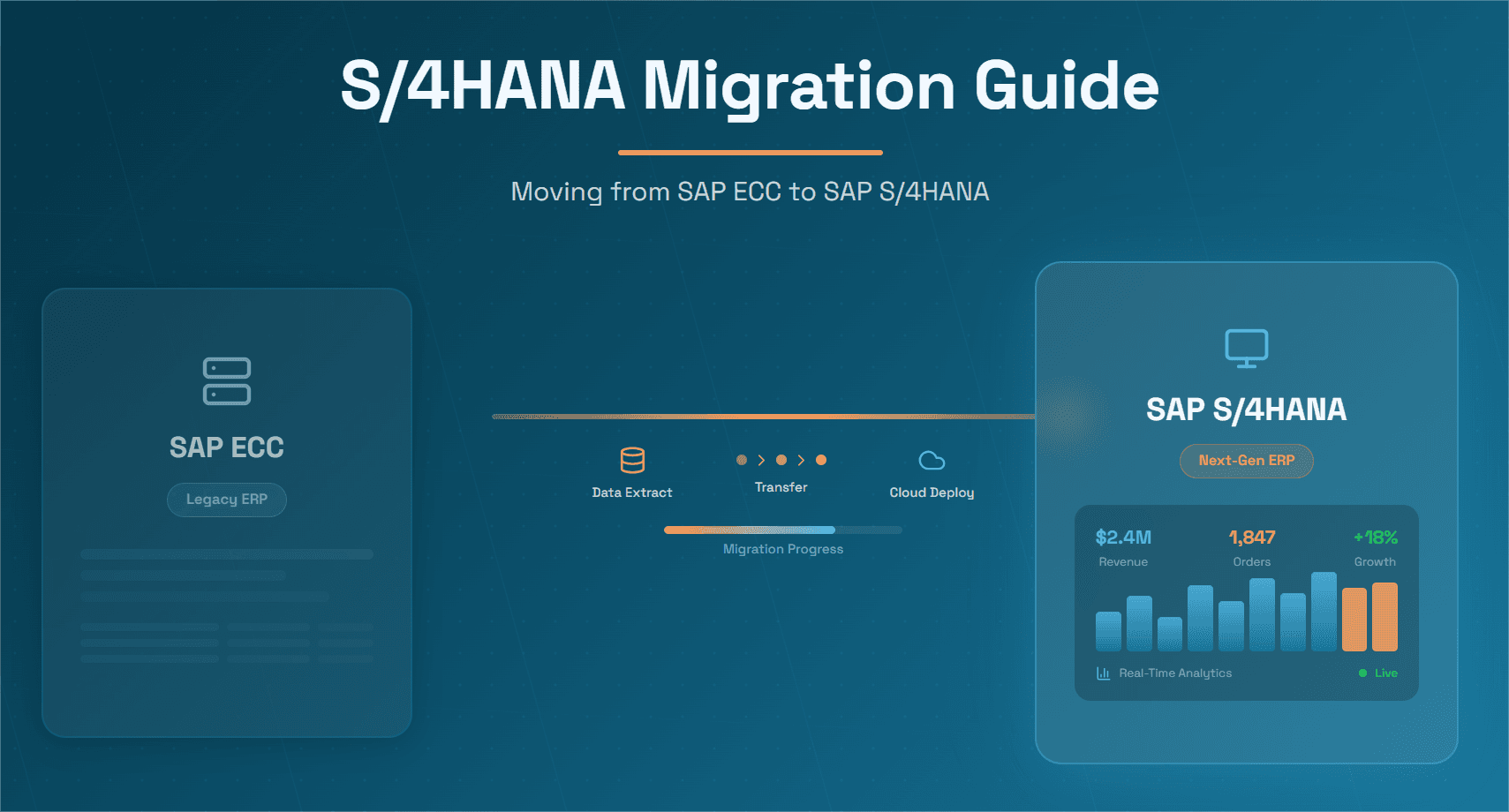
If your organization is running SAP ECC (ERP Central Component), you've likely already heard the term S4HANA migration come up in IT and finance conversations. And if you haven't started planning for it yet, the clock is ticking. SAP has set a firm deadline with mainstream maintenance for SAP ECC ending in 2027 and extended maintenance available through 2030 at additional cost. That means every SAP customer running ECC needs a clear plan for ECC to S4HANA migration sooner rather than later.
This guide breaks down everything you need to know: what the migration involves, which approach is right for your business, what to expect from SAP S/4HANA migration services, and how integrating an AI finance layer like Hyperbots with your new S/4HANA environment can dramatically accelerate your ROI post-migration.
What Is S/4HANA and Why Does Migration Matter?
SAP S/4HANA (SAP Business Suite 4 SAP HANA) is SAP's next-generation ERP platform, built natively on the SAP HANA in-memory database. It is SAP's flagship product and the strategic successor to SAP ECC, the ERP system that has powered the back offices of thousands of enterprises for the past two decades.
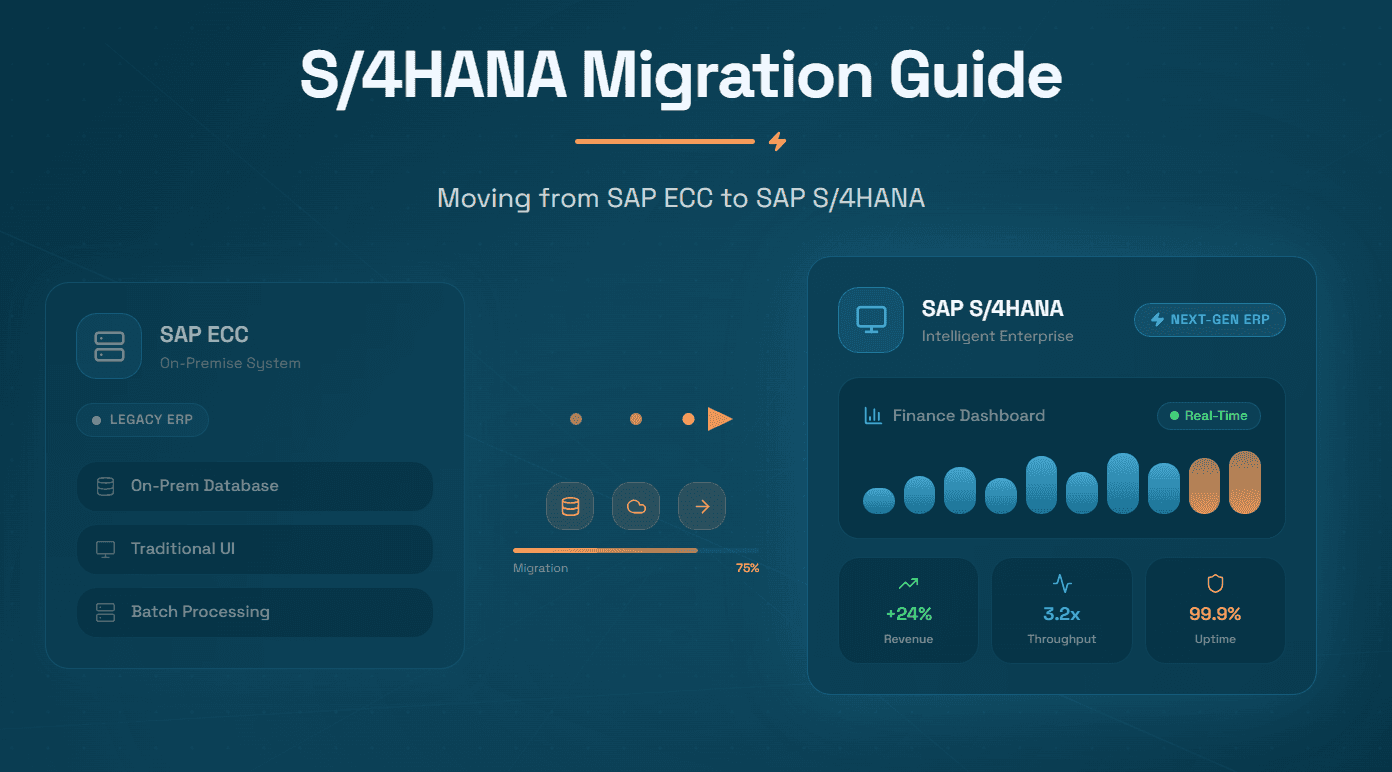
The core difference between ECC and S/4HANA comes down to architecture, speed, and intelligence. SAP ECC was built on a traditional relational database and designed for a world of batch processing and overnight reporting runs. SAP S/4HANA, by contrast, runs entirely on an in-memory columnar database (SAP HANA), enabling real-time analytics, sub-second query performance, and significantly simplified data models. Tasks that used to take hours like month-end close, MRP runs, financial consolidations, can now be completed in minutes or even seconds.
Beyond raw speed, S/4HANA brings a redesigned user experience through SAP Fiori, a role-based, browser-native interface that replaces the dated SAP GUI with intuitive apps accessible from any device. It also integrates natively with SAP's broader intelligent enterprise portfolio such as SAP Analytics Cloud, SAP Ariba, SAP SuccessFactors, and SAP BTP (Business Technology Platform), making S4HANA migration a gateway to a much wider ecosystem of digital capabilities.
ECC to S4HANA: Understanding the Three Migration Paths
When it comes to planning your ECC to S4HANA transition, there is no one-size-fits-all approach. When it comes to integrations, SAP and its certified SAP migration services partners offer three primary pathways, each suited to a different type of organization and level of transformation ambition.
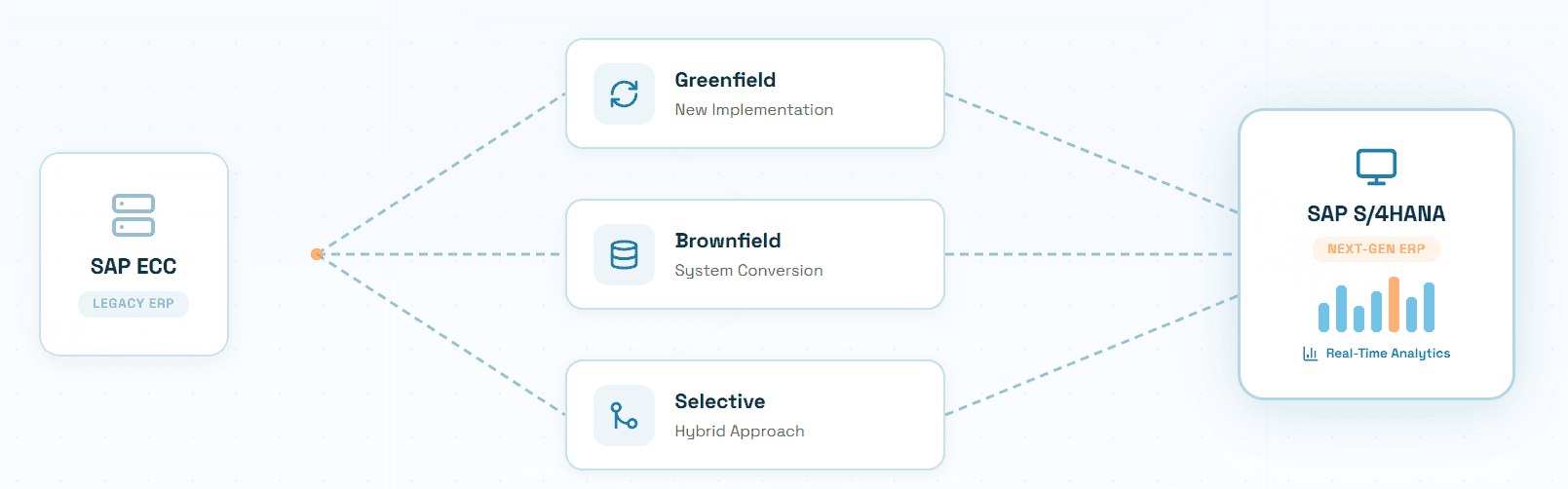
Greenfield Implementation (also called a new implementation) means starting fresh. Your organization essentially reimplements SAP from the ground up on S/4HANA, adopting SAP's best-practice processes (pre-configured via SAP Activate methodology) rather than carrying over years of customizations and legacy configurations. This approach takes longer and costs more upfront, but it gives you the cleanest possible foundation. It’s free of technical debt, redundant custom code, and process inefficiencies accumulated over decades. For companies using a migration as an opportunity to re-engineer their operations, Greenfield is often the right call.
Brownfield Migration (also called system conversion) is the most direct path from ECC to S4HANA. Your existing SAP ECC system including all historical data, configurations, customizations, and master data is converted to S/4HANA in place. This is typically faster and less disruptive than a Greenfield approach because you're not rebuilding processes from scratch. However, it also means you inherit whatever inefficiencies exist in your current system, and you'll still need to do significant work to clean up custom code and prepare for S/4HANA's simplified data model (particularly around finance, where the ACDOCA universal journal replaces multiple separate accounting tables).
Selective Data Transition (Hybrid Approach) is a middle path that has gained significant traction in recent years. It allows organizations to selectively migrate certain company codes, business units, or processes to S/4HANA while consolidating legacy data from older systems. This is particularly useful for organizations that have grown through acquisitions and are running multiple SAP instances that need to be harmonized during the migration.
Choosing the right path is one of the most important early decisions in any S/4HANA migration project, and it's an area where experienced SAP S/4HANA migration services partners add significant value.
Key Phases of a Successful S4HANA Migration
Regardless of which migration path you choose, a well-structured S4HANA migration project follows a series of clearly defined phases. Understanding these phases helps you set realistic timelines, allocate resources correctly, and avoid the most common pitfalls that derail ERP transformation projects.

Discovery and Assessment is where every migration should begin. This phase involves a thorough analysis of your current SAP ECC landscape by identifying custom code that needs to be adapted or retired, assessing data quality, mapping business processes, and defining the target S/4HANA architecture. SAP provides a tool called the SAP Readiness Check specifically for this purpose. Your SAP migration services partner will use this alongside custom assessments to produce a migration roadmap with realistic cost and timeline estimates.
Data Cleansing and Preparation is often underestimated but is critical to migration success. Years of ECC usage tend to accumulate duplicate vendor records, inconsistent master data, orphaned cost centers, and other data quality issues. Migrating dirty data to S/4HANA is one of the fastest ways to undermine the value of your new system. Investing in data governance and cleansing before go-live pays dividends for years afterward.
Custom Code Adaptation is a major workload in most Brownfield migrations. SAP ECC systems are almost universally customized through ABAP programs, user exits, BADIs, and third-party add-ons. S/4HANA's simplified data model and standard APIs mean many of these customizations need to be re-evaluated and rewritten. SAP's Custom Code Migration tools help identify which custom programs are affected and prioritize remediation efforts.
System Configuration and Testing involves building and configuring the S/4HANA environment, migrating or recreating process configurations, and running multiple rounds of testing such as unit testing, integration testing, user acceptance testing (UAT), and performance testing. This is also when training begins for end users who will work in SAP Fiori rather than the traditional SAP GUI.
Cutover and Go-Live is the most operationally intense phase. A detailed cutover plan — typically executed over a weekend or a holiday period to minimize business disruption — involves final data migration, system validation, and the formal switch from ECC to S/4HANA. A well-prepared cutover plan, rehearsed multiple times before the live event, is the difference between a smooth go-live and an operational crisis.
Hypercare and Stabilization follows immediately after go-live. During this period, your SAP S/4HANA migration services team is on standby to resolve issues quickly as users adapt to the new system. Hypercare typically runs for four to eight weeks before transitioning to steady-state support.
Common Challenges in ECC to S4HANA Migration
Even with careful planning, ECC to S4HANA migrations are complex undertakings. Some of the most common challenges organizations face include:
Scope creep is rampant in ERP projects. As migration teams dig into the current system, they frequently uncover additional customizations, interfaces, and processes that weren't in the original scope which drives up cost and timeline.
Data quality problems discovered mid-project can halt progress entirely. Organizations that treat data cleansing as a low-priority activity often pay a heavy price during the migration's final phases.
Change management is frequently cited as the number-one reason ERP migrations fail. Users who are not adequately trained, engaged, and prepared for the new system resist adoption thus negating the technical success of the migration.
Finance process disruption during the cutover period can be particularly painful. AP teams, treasury, and accounting operations need to continue functioning during the migration window, which requires careful coordination between the technical team and the business.
This is where having the right SAP S/4HANA migration services partner, one with deep functional expertise, not just technical skills makes all the difference.
Post-Migration ROI: Where Hyperbots Transforms Your S/4HANA Investment
Successfully completing your S4HANA migration is a significant achievement but it's only the beginning. The real question every CFO asks after go-live is: when does the investment start paying back?
SAP S/4HANA gives your organization a faster, smarter ERP platform. But like any ERP, it still relies on human effort for the high-volume, transactional work that drives your finance and accounting operations day to day. That's where Hyperbots comes in.
Hyperbots is a first-of-its-kind Agentic AI platform built exclusively for finance and accounting. It integrates natively with SAP S/4HANA through a dedicated connector that provides real-time, bidirectional read-and-write access to your S/4HANA financial data — including invoices, purchase orders, vendor master records, Chart of Accounts, GL entries, and more. The platform is pre-trained on millions of financial documents and achieves 99.8% accuracy in converting unstructured data to structured fields, deploying in as little as 3–4 weeks.
Here's the concrete ROI Hyperbots delivers for SAP S/4HANA users:
Accounts Payable Automation: Hyperbots' Invoice Processing Co-Pilot achieves up to 80% straight-through processing (STP) of invoices, cutting processing time from an industry average of 11 days to under one minute. For a finance team processing 5,000 invoices per month, this means staff bandwidth freed by 80% and a dramatic reduction in duplicate payments, GL coding errors, and late payment penalties.
Payments Optimization: The Payments Co-Pilot analyzes payment terms, early payment discounts, and cost of capital to optimize timing and payment method, reducing cash outflow by up to 10%. On a $10M annual payables spend, that's $1M in potential cash flow improvement.
Procurement Efficiency: The Procurement Co-Pilot auto-generates purchase requisitions and converts approved PRs into S/4HANA purchase orders automatically, reducing PO creation time by 80% and PR creation time to just 5 minutes.
Month-End Close Acceleration: The Accruals Co-Pilot automates accrual identification, booking, and reversals directly within S/4HANA, cutting accrual processing costs by 80% and reducing variance between accrued and actual costs to under 5%.
Collections and DSO Reduction: Hyperbots' Collections Co-Pilot reduces Days Sales Outstanding (DSO) by up to 40% and cuts the cost to collect by 70%, transforming cash inflow and AR aging performance.
Hyperbots was co-designed with CFOs across manufacturing, wholesale distribution, retail, and technology, the exact industries driving the largest waves of SAP S/4HANA migration today. Its unlimited-access licensing model means there are no per-seat costs limiting adoption across your finance organization.
Final Thoughts: S4HANA Migration Is a Once-in-a-Generation Opportunity
The ECC to S4HANA migration is not just an IT upgrade, it's a business transformation. Done right, it modernizes your technology foundation, streamlines operations, and positions your company to compete in an increasingly data-driven world.
But the organizations that will extract the most value from their S/4HANA migration are those that don't stop at go-live. By layering Hyperbots' Agentic AI on top of their new S/4HANA environment, finance teams can automate the manual workflows that ERP alone can't eliminate, turning their migration investment into measurable, ongoing ROI.
Whether you're just starting your SAP migration services evaluation or approaching go-live, now is the time to think about what comes next. Book a demo to see how layering Hyperbots Agentic AI on top of your SAP S/4HANA can automate the manual workflows that ERPs alone can’t eliminate.
Frequently Asked Questions (FAQs)
1. What is the deadline for migrating from SAP ECC to S/4HANA?
Mainstream maintenance for SAP ECC ends in 2027, with extended maintenance available until 2030 at an additional cost. After this period, organizations running ECC will no longer receive full support or updates, making migration to SAP S/4HANA a critical strategic priority.
2. What are the main approaches for ECC to S/4HANA migration?
There are three primary migration approaches to SAP S/4HANA:
Greenfield (New Implementation): Rebuilding the ERP system from scratch using best-practice processes.
Brownfield (System Conversion): Converting the existing SAP ECC system directly to S/4HANA while keeping current configurations and data.
Selective Data Transition: Migrating specific business units, data, or processes while restructuring the system.
Each approach offers different trade-offs in cost, timeline, and transformation depth.
3. How long does an S/4HANA migration typically take?
An SAP S/4HANA migration typically takes 9–18 months depending on system complexity, data volume, custom code, and the migration approach chosen. Large enterprises with multiple integrations or heavily customized SAP ECC environments may take longer.
4. What are the biggest challenges in ECC to S/4HANA migration?
Common challenges during migration include:
Cleaning and preparing legacy data
Adapting custom ABAP code to S/4HANA’s simplified data model
Managing integrations with third-party systems
Ensuring user adoption of the new SAP Fiori interface
Avoiding operational disruptions during cutover
Strong change management and experienced migration partners help mitigate these risks.
5. How can AI improve finance operations after migrating to S/4HANA?
While SAP S/4HANA provides a powerful system of record, many finance workflows remain manual. AI platforms like Hyperbots automate tasks such as invoice processing, payment optimization, accruals, collections, and cash application. This allows finance teams to reduce processing time, improve accuracy, and accelerate the ROI from their S/4HANA migration.