SAP Business One (SAP B1): The Complete Guide to the World's #1 ERP for Small and Mid-Sized Businesses
Your Complete 2026 Guide to SAP B1 – Features, Benefits, and How AI Is Transforming What It Can Do
If you've been searching for the right ERP solution for your growing company, chances are you've come across the term Business One more than once. But what exactly does it mean, what does it do, and why do hundreds of thousands of businesses worldwide rely on it to run their operations? This guide covers everything you need to know about SAP Business One and how pairing it with an AI finance platform like Hyperbots can take your ROI to the next level.
What Is Business One? Understanding What SAP B1 Means
Let's start with the basics. SAP Business One or commonly referred to as SAP B1, is an integrated enterprise resource planning (ERP) solution developed by SAP SE, one of the largest enterprise software companies in the world. So when people ask "what does SAP B1 mean?", the short answer is: it's SAP's dedicated ERP platform built specifically for small and medium-sized enterprises (SMEs).
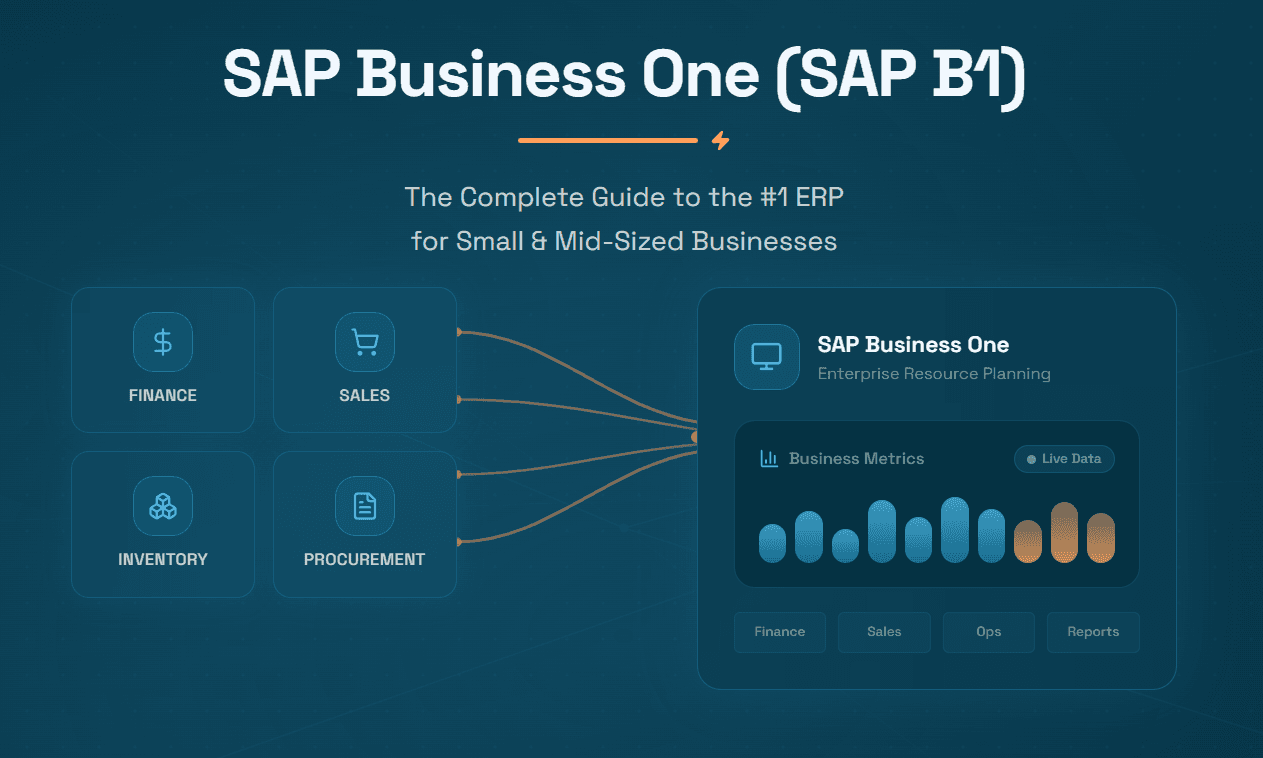
The "Business One" in the name reflects its promise, a single, unified platform that brings together every critical function of your business under one roof. From accounting and financials to sales, purchasing, inventory, production, and reporting, Business One ERP is designed to eliminate the silos that slow growing companies down.
Unlike SAP's enterprise-level products like SAP S/4HANA, which are built for large corporations, Business One software is scoped, priced, and structured to serve businesses with anywhere from 10 to a few hundred employees. It's approachable enough for a company just stepping into ERP for the first time, yet powerful enough to support complex multi-entity, multi-currency operations.
Core Modules of SAP Business One Software
One of the biggest reasons Business One ERP has become the go-to solution for SMEs globally is its comprehensive module coverage. Here's a breakdown of what the software handles:
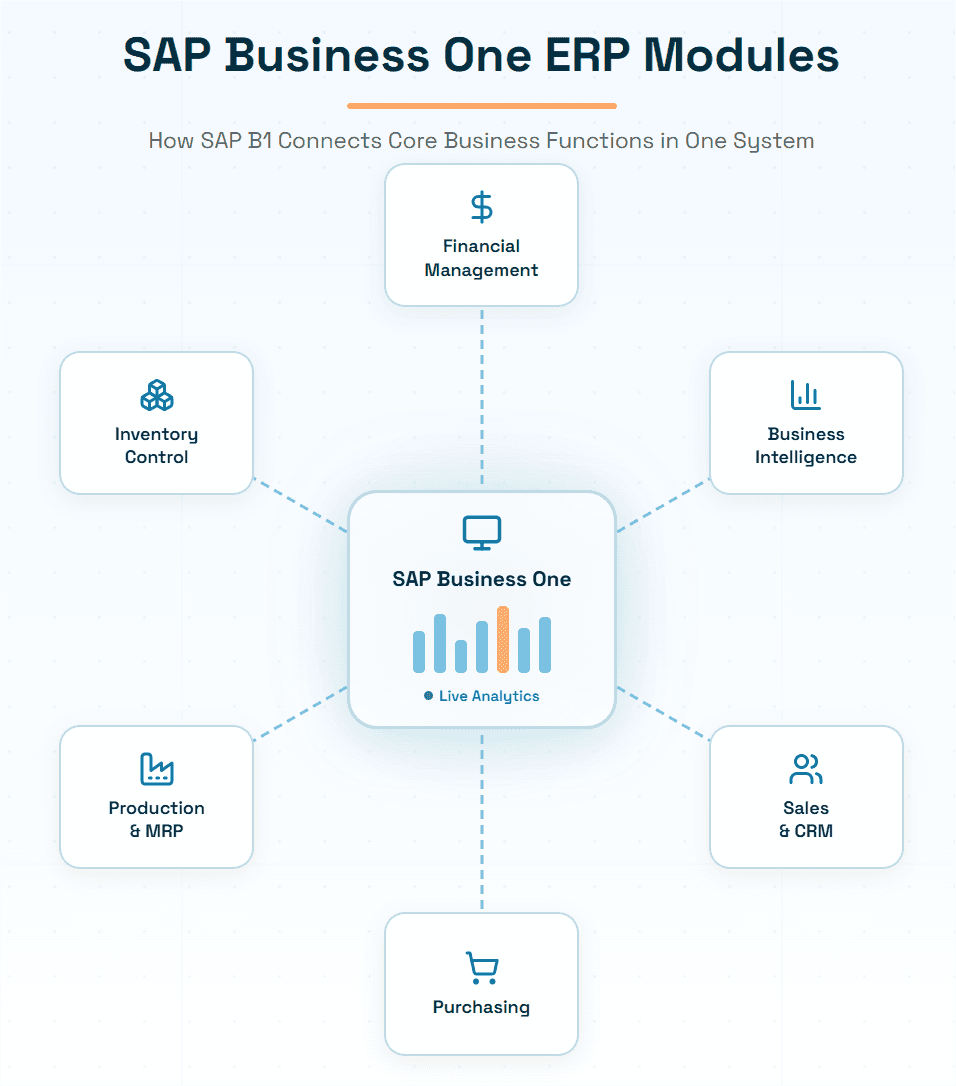
Financial Management is at the heart of SAP B1. It includes a robust general ledger, accounts payable (AP), accounts receivable (AR), bank reconciliation, budgeting, and multi-currency support. For CFOs and finance teams, this is where Business One software truly shines with real-time financial visibility across your entire organization.
Sales and Customer Management gives your sales team a complete view of the customer lifecycle from first contact and quotation through to order fulfillment and after-sales service. The CRM capabilities built into Business One allow teams to track interactions, manage opportunities, and forecast revenue without needing a separate CRM tool.
Purchasing and Inventory Control is critical for product-based businesses. Business One ERP handles purchase requisitions, purchase orders, goods receipts, vendor management, and inventory tracking in real time. With features like multiple warehouses and serial/batch number tracking, it gives operations teams granular control over stock.
Production and MRP (Material Requirements Planning) is particularly valuable for manufacturers using Business One software. It supports bill of materials (BOM), production orders, and capacity planning, helping production teams align supply with demand and reduce downtime.
Project Management and Service Management modules round out the platform, making Business One ERP versatile enough for service-based businesses, professional services firms, and project-driven industries like construction and consulting.
Business Intelligence and Reporting is one of the standout features of SAP B1. The system comes with a built-in analytics engine, drag-and-drop report designer, and integration with SAP Crystal Reports and SAP Analytics Cloud. Decision-makers can pull real-time dashboards and KPI snapshots to guide strategy.
Why Businesses Choose Business One ERP Over Alternatives
There are plenty of ERP options in the market for SMEs, from NetSuite and Microsoft Dynamics to Sage and QuickBooks. So why does Business One consistently rank among the top choices?
Scalability is a key differentiator. Business One software grows with your business. Whether you're a 20-person manufacturer or a 300-person distributor with multiple warehouses and international subsidiaries, SAP B1 can scale to fit. SAP's HANA-powered version of Business One also brings in-memory computing, enabling sub-second query performance on large datasets.
Global Reach and Localization matter for businesses operating across borders. SAP B1 supports over 40 country-specific localizations, handling local tax regimes, legal reporting requirements, and language preferences out of the box. This makes Business One ERP a natural choice for companies with international ambitions.
Industry-Specific Versions add another layer of value. SAP and its partner ecosystem have built vertical solutions on top of Business One software for industries including manufacturing, retail, wholesale distribution, professional services, food and beverage, and life sciences.
Trusted Ecosystem is a significant comfort factor. Because Business One is backed by SAP, a company with over 50 years in enterprise software with users benefitting from a vast global partner network, regular product updates, and long-term vendor stability. For CFOs and CIOs making a multi-year technology investment, this matters.
Deployment Flexibility allows companies to run Business One ERP on-premise, in the cloud (via SAP Business One Cloud or partner-hosted solutions), or in a hybrid model. This flexibility ensures businesses of different IT maturity levels can adopt and run the software on their own terms.
SAP B1 Means Real-Time Visibility for Decision-Makers
One of the most impactful things SAP B1 means for the companies using it is real-time business intelligence. In the traditional SME environment, finance and operations teams often work from disconnected spreadsheets, outdated reports, and siloed data systems. Business One eliminates this by centralizing all operational data into a single database.
Every transaction, whether it's a customer invoice, a vendor payment, a stock movement, or a production order, is recorded in real time and immediately reflected across all relevant modules. This means your CFO can see cash position, open payables, and receivables aging without waiting for a month-end report. Your operations manager can see inventory levels and pending purchase orders from the same system your finance team uses.
This level of integration is what separates a true Business One ERP from a simple accounting package. It's not just about tracking numbers, it's about giving every stakeholder in your business the data they need to make faster, smarter decisions.
Limitations of Business One Software And How AI Fills the Gap
Despite being a powerful platform, Business One software like any ERP is not without its limitations. Most ERP systems, including SAP B1, are fundamentally systems of record. They store and organize data well, but they rely heavily on human input, human judgment, and manual workflows to process that data.
In finance and accounting specifically, this means AP teams still spend hours manually keying in invoice data, matching POs, coding GL accounts, chasing approvals, and handling exceptions. Even with SAP B1's automation features, the day-to-day finance workload in most SMEs remains labor-intensive, error-prone, and slow.
This is precisely where integrating an AI-powered finance co-pilot becomes a game-changer for Business One users.
Hyperbots + SAP Business One: Unlocking the ROI of Agentic AI
Hyperbots is an Agentic AI platform built specifically for finance and accounting teams. Unlike generic automation tools, Hyperbots is designed from the ground up for F&A workflows, trained on millions of financial documents including invoices, purchase orders, contracts, and bank statements.
Hyperbots offers a native SAP B1 integration connector that provides real-time, bidirectional read-and-write access to your SAP Business One data including invoices, POs, vendor master records, Chart of Accounts, GL entries, and more. This means Hyperbots' AI co-pilots can act directly within your SAP B1 environment, automating the most time-consuming finance tasks without disrupting existing workflows.
Here's what the ROI looks like for SAP Business One users who integrate Hyperbots:
Invoice Processing: Hyperbots' Invoice Processing Co-Pilot achieves up to 80% straight-through processing (STP) of invoices, reducing processing time from an industry average of 11 days to under one minute. For finance teams processing hundreds or thousands of invoices monthly, this translates directly into staff cost savings of up to 80% and a dramatic reduction in duplicate payments and GL coding errors.
Accounts Payable and Payments: The Payments Co-Pilot analyzes payment terms, early payment discounts, late payment penalties, and cost of capital to optimize payment timing and method thus reducing cash outflow by up to 10%. For a business spending $5M annually with vendors, that's a potential $500K in cash flow improvement.
Procurement: The Procurement Co-Pilot auto-generates purchase requisitions and converts approved PRs into purchase orders within SAP B1, reducing PO creation and dispatch time by 80% and cutting PR creation time to just 5 minutes.
Accruals: Month-end close is one of the most stressful periods for any finance team. Hyperbots' Accruals Co-Pilot automates accrual identification, booking, and reversals to reduce accrual processing costs by up to 80% and driving variance between accrued and actual costs below 5%.
Collections: Hyperbots' Collections Co-Pilot reduces Days Sales Outstanding (DSO) by up to 40% and cuts the cost to collect by 70%, dramatically improving cash inflow and AR aging for Business One users.
Cash Application: Automated remittance extraction, intelligent payment matching, and GL posting within SAP B1 reduce reconciliation costs by 80% and bring unapplied cash percentages down to under 10%.
Hyperbots is designed by CFOs, for CFOs. The platform was co-created with finance leaders across industries including manufacturing, wholesale distribution, retail, and technology - the industries that rely on SAP Business One ERP most heavily. With 99.8% accuracy in unstructured data extraction and pre-built connectors that deploy in 2-4 weeks, Hyperbots gives SAP B1 users an AI layer that starts delivering ROI almost immediately.
Business One ERP Is the Foundation; AI Is the Multiplier
SAP Business One remains one of the most capable, well-supported, and widely deployed ERP platforms for small and mid-sized businesses in the world. If you're asking what SAP B1 means for your business, the answer is: centralized operations, real-time visibility, and a scalable foundation for growth.
But in today's competitive environment, having a good ERP is table stakes. The finance teams that will win are the ones that layer intelligent automation on top of their Business One software to automate the manual, error-prone workflows that still consume too much time and cost too much money.
That's what Hyperbots delivers. By combining the structural power of Business One ERP with the cognitive intelligence of Agentic AI, finance teams can finally close the loop between data and action much faster, cheaper, and with far greater accuracy than ever before.
Book a demo to see what Hyperbots can do for your SAP Business One environment
Frequently Asked Questions (FAQs)
1. What is SAP Business One used for?
SAP Business One is an integrated ERP platform designed for small and mid-sized businesses to manage core operations in a single system. It helps companies handle financial management, sales, purchasing, inventory, production, and reporting from one centralized platform, enabling real-time visibility across the organization.
2. What does SAP B1 mean?
SAP B1 is the commonly used abbreviation for SAP Business One. The name “Business One” reflects its goal of bringing all business processes into one unified system, eliminating data silos between finance, operations, sales, and inventory.
3. Is SAP Business One suitable for small and medium-sized businesses?
Yes. SAP Business One is specifically designed for SMEs, typically companies with 10 to several hundred employees. It offers enterprise-level functionality while remaining easier to implement and more affordable than large-enterprise ERP systems like SAP S/4HANA.
4. Can SAP Business One be deployed in the cloud?
Yes. Businesses can deploy SAP Business One in multiple ways, including on-premise installations, partner-hosted environments, or fully cloud-based deployments such as SAP Business One Cloud. This flexibility allows companies to choose the infrastructure that best fits their IT and scalability requirements.
5. How can AI improve finance operations in SAP Business One?
While SAP Business One provides a strong system of record, many finance workflows such as invoice processing, accruals, and collections still require manual work. AI-powered automation platforms like Hyperbots add an intelligent layer that can automate data extraction, approvals, reconciliations, and financial workflows, helping finance teams reduce processing time, improve accuracy, and increase operational efficiency.