Delaware Gross Receipts Tax for Businesses Expanding Into Delaware: What Triggers GRT, How to Register, and What to Set Up Before Your First Invoice
How modern invoice storage systems handle capture, compliance, and audit trails — so your finance team isn't scrambling when auditors ask.
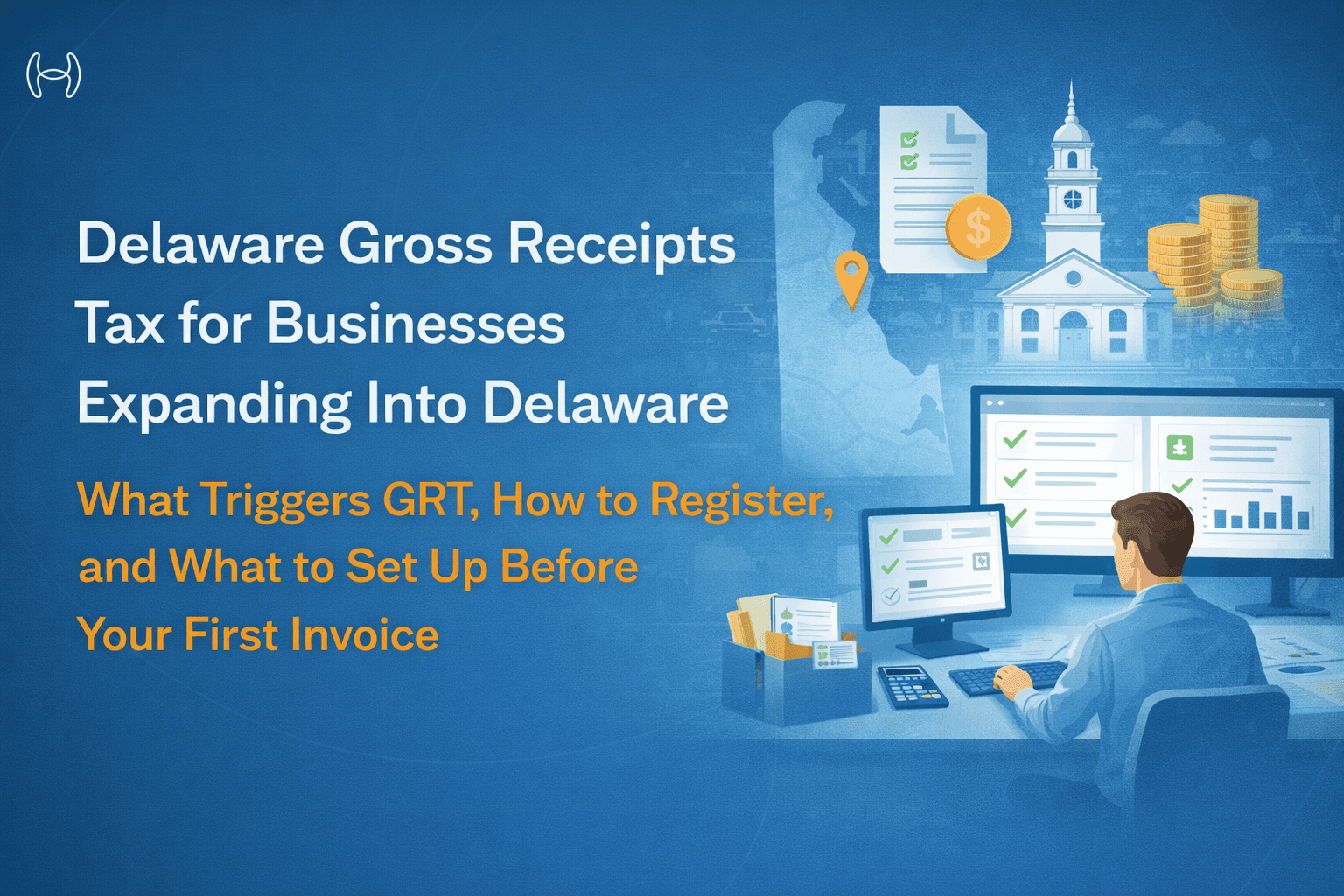
Expanding into Delaware comes with a tax obligation most finance teams are not expecting. This guide covers exactly what triggers gross receipts tax, how to register, and what your AP and finance systems need to have in place before the first transaction clears.
The Most Common Misconception About Delaware
Most businesses know Delaware as a place to incorporate. Over a million companies are registered in Delaware for legal and tax reasons that have nothing to do with operating there. The Delaware Court of Chancery, the predictable legal environment, and the absence of state corporate income tax on revenue earned outside Delaware make it attractive for incorporation.
But incorporation in Delaware is not the same as operating in Delaware. And operating in Delaware triggers a completely separate set of tax obligations that have nothing to do with why you incorporated there.
The most common mistake finance teams make when a company begins actual operations in Delaware is assuming that the incorporation relationship already covers everything. It does not. A business incorporated in Delaware but operating in another state owes nothing to Delaware beyond its franchise tax. A business that begins operating in Delaware, regardless of where it is incorporated, must register with the Delaware Division of Revenue, obtain a business license, and start filing gross receipts tax returns. The trigger is operations, not incorporation.
What Is Delaware's Gross Receipts Tax?
Delaware does not impose a state or local sales tax. Instead, it levies a gross receipts tax on the seller of goods or provider of services operating within the state. The GRT applies to total gross revenue from Delaware business activity, with no deductions for cost of goods sold, labor, interest, delivery costs, or any other business expense.
Rates range from 0.0945% to 1.9914% depending on the type of business activity, with petroleum products subject to a variable rate up to 2.4218%. Businesses conducting multiple types of activity must file a separate GRT return for each activity, at that activity's applicable rate.
Most businesses benefit from a monthly exclusion before the rate applies. Retailers and general service providers start with a $100,000 monthly exclusion, meaning only revenue above that threshold is taxable. Manufacturers may qualify for exclusions up to $1,250,000 per month. These exclusions mean many smaller operations expanding into Delaware will owe minimal or no GRT in early months, but the registration obligation still exists from the moment business activity begins.
For a practical perspective on how Delaware's GRT system works from a CFO's point of view, including how rates are tracked and how AI is changing compliance, see our interview on Delaware gross receipts tax compliance.
What Actually Triggers GRT Obligations
Understanding exactly what triggers GRT is the first thing finance teams need to establish when evaluating a Delaware expansion. The rules are clear but frequently misapplied.
Physical Presence
Any business with physical presence in Delaware has immediate GRT nexus. Physical presence includes owning or leasing property in Delaware, having employees working in Delaware, maintaining inventory in Delaware, or having any agent or representative conducting business on your behalf in the state. Physical presence triggers nexus from the first day of activity. There is no revenue threshold to cross first.
Revenue from Delaware Business Activity
Businesses without physical presence in Delaware may still trigger GRT obligations based on revenue generated from Delaware-sourced business activity. Unlike traditional sales tax economic nexus, Delaware has no transaction count requirement. A single large contract generating revenue from Delaware activity can establish nexus. Digital products and SaaS offerings sold to Delaware customers count toward Delaware-sourced revenue for this purpose, which catches many technology companies off guard when they begin targeting Delaware-based clients.
What Does Not Trigger GRT
Incorporation alone does not trigger GRT. Receiving payments from Delaware customers for goods or services delivered and consumed entirely outside Delaware does not trigger GRT. Employees who are Delaware residents but work exclusively outside the state do not create Delaware business nexus. Owning shares in a Delaware corporation does not create GRT obligations.
If you are genuinely uncertain whether your planned Delaware activity triggers nexus, the Delaware Division of Revenue provides a Nexus Questionnaire. Submitting it and receiving guidance in writing protects the business from retroactive assessments if the answer turns out to be yes.
How to Register: Step by Step
Registration in Delaware must happen before taxable business activity begins. It is not optional and it is not retroactive. The Division of Revenue expects businesses to register at the point business commences, not after the first filing period closes.
Step 1: Obtain a Federal Employer Identification Number
If the business does not already have a Federal Employer Identification Number from the IRS, obtain one before beginning Delaware registration. The FEIN is required to complete the state registration process.
Step 2: Register via the Delaware One Stop Portal
The primary registration method is the Delaware One Stop Business Registration and Licensing System at onestop.delaware.gov. This online portal allows businesses to register with the Delaware Division of Revenue, the Division of Unemployment Insurance, and the Division of Workers Compensation in a single process.
The registration requires completion of the Combined Registration Application, known as Form CRA. The CRA collects basic business information, entity type, business activity classification, and withholding agent registration if the business has Delaware employees. GRT accounts are automatically created based on the business activities declared in the CRA.
Alternatively, the CRA can be completed on paper and submitted by mail, or the Division of Revenue can be contacted directly to obtain the form.
Step 3: Obtain Your Delaware Business License
A Delaware business license is required for any person or entity conducting trade or business in Delaware, including entities located elsewhere that conduct business within the state. The license must be obtained at the time business commences, not after the first revenue is received.
The standard annual license fee is $75 for a first location, with $25 for each additional location. General retailers pay $90 for the first location and $40 for each additional site. The fee varies by business activity type, so confirming the correct fee for your specific classification before applying avoids having to amend the application. A separate license is required for each separate business activity. Licenses expire on December 31 each year and must be renewed annually. After the first year, businesses may optionally purchase a three-year license, though it is not discounted, as the fee is simply three times the annual rate.
Licenses are location-specific. If the expanding business will operate from multiple Delaware locations, each location requires its own license.
Step 4: Understand Your Filing Frequency
New businesses are automatically assigned quarterly GRT filing status. Businesses that grow to exceed specific revenue thresholds during twelve-month lookback periods defined in the Delaware Code will be moved to monthly filing. Monthly filers must submit returns and payments by the 20th day of the month following the reporting period. Quarterly filers must submit by the last day of the first month following the close of the quarter.
All GRT filing is mandatory online through the Delaware Taxpayer Portal at tax.delaware.gov since January 1, 2021. Paper filing is available only in limited circumstances as outlined in Technical Information Memorandum 2020-2. To register on the Taxpayer Portal, the business will need its FEIN and business license number.
Step 5: Set Up DBA Registration if Required
If the business will operate under a trade name rather than its legal entity name, DBA registration is required. As of February 2, 2026, DBA registration in Delaware has moved from county courts to the Division of Revenue, administered through the OneStop portal. Existing DBA holders are not required to re-register immediately but must hold a valid Delaware business license to complete any future re-registration through the new system.
What Finance Teams Need to Set Up Before the First Invoice
Registration is the legal step. Setting up the finance and AP function correctly is the operational step that most guides stop short of covering. Here is what needs to be in place before the first transaction clears.
Business Activity Classification in Your Chart of Accounts
Delaware's GRT rates differ by business activity. If the expanding entity conducts more than one type of activity, for example both retail sales and services, each activity must be tracked separately for GRT filing purposes. The chart of accounts for the Delaware entity or the Delaware cost center needs to be structured so that revenue by activity type is captured cleanly and can be extracted for each GRT return without manual reclassification. Getting this wrong at setup creates reconciliation work every filing period.
GRT Accrual Process
GRT is a cost of doing business in Delaware. It is not collected from customers and does not appear on invoices. Finance teams need to set up an accrual process that estimates the GRT liability for each period based on revenue generated, accrues it against the correct expense account, and reverses or settles it when the actual payment is made. For organizations expanding into Delaware mid-year, this accrual process should begin from the first month of Delaware activity, not from the first filing date.
Tax Validation Logic for Delaware Vendor Invoices
Once the business begins operating in Delaware, it will also begin receiving invoices from Delaware-based vendors. AP teams need to ensure their invoice validation rules treat Delaware vendor invoices with no sales tax line as correct, not as exceptions. Updating the tax validation configuration for the Delaware entity before the first invoice arrives avoids a backlog of false exceptions from day one.
Audit Trail Configuration
Delaware auditors can request documentation going back several years. The audit trail for all Delaware GRT-related transactions should be systematic from the start, covering revenue records by activity type, filing confirmations, payment receipts, and the basis for any exclusion claimed. Building this documentation discipline from day one is significantly easier than reconstructing it retroactively.
The Incorporation vs Operations Distinction: A Checklist
Because this is the most common source of confusion, here is a clear reference for what each status does and does not require:
Situation | GRT Registration Required | Business License Required | GRT Filing Required |
Incorporated in Delaware, no Delaware operations | No | No | No |
Incorporated elsewhere, operating in Delaware | Yes | Yes | Yes |
Incorporated in Delaware, operating in Delaware | Yes | Yes | Yes |
Remote business selling digital goods to Delaware customers | Depends on revenue from Delaware activity | Yes if nexus triggered | Yes if nexus triggered |
Employees who are Delaware residents, working outside Delaware | No | No | No |
Inventory stored in Delaware warehouse | Yes, physical nexus triggered | Yes | Yes |
Independent contractor working on your behalf in Delaware | Yes, agent creates nexus | Yes | Yes |
How AI Helps Finance Teams Set Up Delaware Compliance Correctly From Day One
The compliance setup described above creates a specific set of operational requirements: revenue tracking by activity type, GRT accrual calculations, invoice validation rules by jurisdiction, and audit-ready documentation from the first transaction. For expanding businesses setting up a Delaware entity or cost center alongside operations in other states, doing all of this manually is a significant source of error.
AI-powered tax verification handles the jurisdiction-specific logic automatically. Rather than configuring manual rules for each state in which the business operates, an AI-powered AP system applies the correct validation logic for Delaware vendor invoices, covering no-sales-tax validation, correct tax category by line item, and origin-to-destination address matching, from the moment Delaware vendors are onboarded.
For multi-state tax compliance, the system maintains separate tax logic per entity or location, so the Delaware operation's invoices are processed under Delaware rules while other entities continue under their own state rules without manual intervention to switch between them.
Automated accrual discovery identifies GRT liability accruals based on revenue data from the ERP, ensuring the period-end accrual for Delaware GRT is captured consistently rather than depending on a finance team member remembering to run the calculation each month.
The audit trail for every invoice processed, every tax category applied, and every exception handled is maintained automatically with timestamps and the identity of the person or system responsible, providing the documentation Delaware auditors require without any additional record-keeping effort from the finance team.
How Hyperbots Supports Delaware GRT Compliance for Expanding Businesses
When a business expands into Delaware and begins processing vendor invoices and managing its own GRT obligations simultaneously, the compliance workload multiplies quickly. Hyperbots addresses both sides of this from a single platform.
The Sales Tax Verification Co-Pilot is pre-trained on shipping origin and destination addresses and line-item tax categories. For Delaware vendor invoices, it correctly identifies the no-sales-tax jurisdiction and validates each line item against the applicable tax treatment without requiring manual configuration for each new vendor. For the business's own Delaware activity, it flags tax treatment discrepancies on outbound transactions before they create compliance exposure.
The Invoice Processing Co-Pilot extracts invoice data with 99.8% accuracy and processes each invoice in under one minute, handling the volume that comes with a new operating entity without adding AP headcount. Up to 80% of invoices move through the full cycle without any human touchpoint, with exceptions automatically flagged and routed for review.
For organizations with operations in Delaware and other states, multi-entity support allows separate configurations per entity. Delaware-specific tax logic, GRT accrual rules, and invoice validation settings apply to the Delaware entity without affecting the rules in place for other operating entities. A unified view across all entities gives finance leaders visibility into compliance status across the full organization from a single interface.
Implementation goes live within one month with no custom model training required. The co-pilots are pre-trained and ready to deploy from day one of Delaware operations.
FAQs
Does incorporating in Delaware mean I have to pay Delaware gross receipts tax?
No. Incorporation in Delaware does not trigger GRT. GRT applies to businesses that actually conduct operations, generate revenue, or have physical presence in Delaware. A business incorporated in Delaware but operating entirely in another state owes Delaware franchise tax but not GRT.
When exactly does the GRT registration obligation begin?
Registration must happen at the time business commences in Delaware, not after the first filing period closes. If you are unsure whether your planned activity triggers nexus, submit Delaware's Nexus Questionnaire to the Division of Revenue before beginning operations.
Do I need a separate business license for each type of business activity?
Yes. Delaware requires a separate business license for each separate business activity. If your expanding entity sells goods and also provides services, you need a license for each activity and must file a separate GRT return for each at the applicable rate.
Can a single large contract trigger Delaware GRT obligations for an out-of-state business?
Yes. Delaware has no transaction count threshold for economic nexus. A single large contract generating revenue from Delaware-sourced activity can establish nexus. This is different from most sales tax states where both a revenue threshold and a transaction count threshold must be met.
What happens if we start operating in Delaware without registering?
Operating without a business license exposes the business to penalties and back-tax assessments from the date operations began. The Division of Revenue can assess GRT, interest, and penalties retroactively. Late filing attracts a penalty of 5% per month plus 0.5% interest per month from the original due date. A separate failure-to-pay penalty of 1% per month applies on unpaid balances, capped at 25%.
How do we handle GRT for an entity that has some Delaware revenue and some non-Delaware revenue?
Only revenue from Delaware-sourced business activity is subject to GRT. Revenue from goods or services delivered and consumed outside Delaware is not subject to Delaware GRT. The chart of accounts and revenue tracking system for the expanding entity should be structured from the start to separate Delaware-sourced and non-Delaware-sourced revenue by activity type, so each GRT return can be prepared from clean data.
Hyperbots Sales Tax Verification and Invoice Processing Co-Pilots support Delaware GRT compliance from day one of operations, with pre-trained tax logic, line-item validation, and automatic audit trails. Go live in one month.
Request a demo.