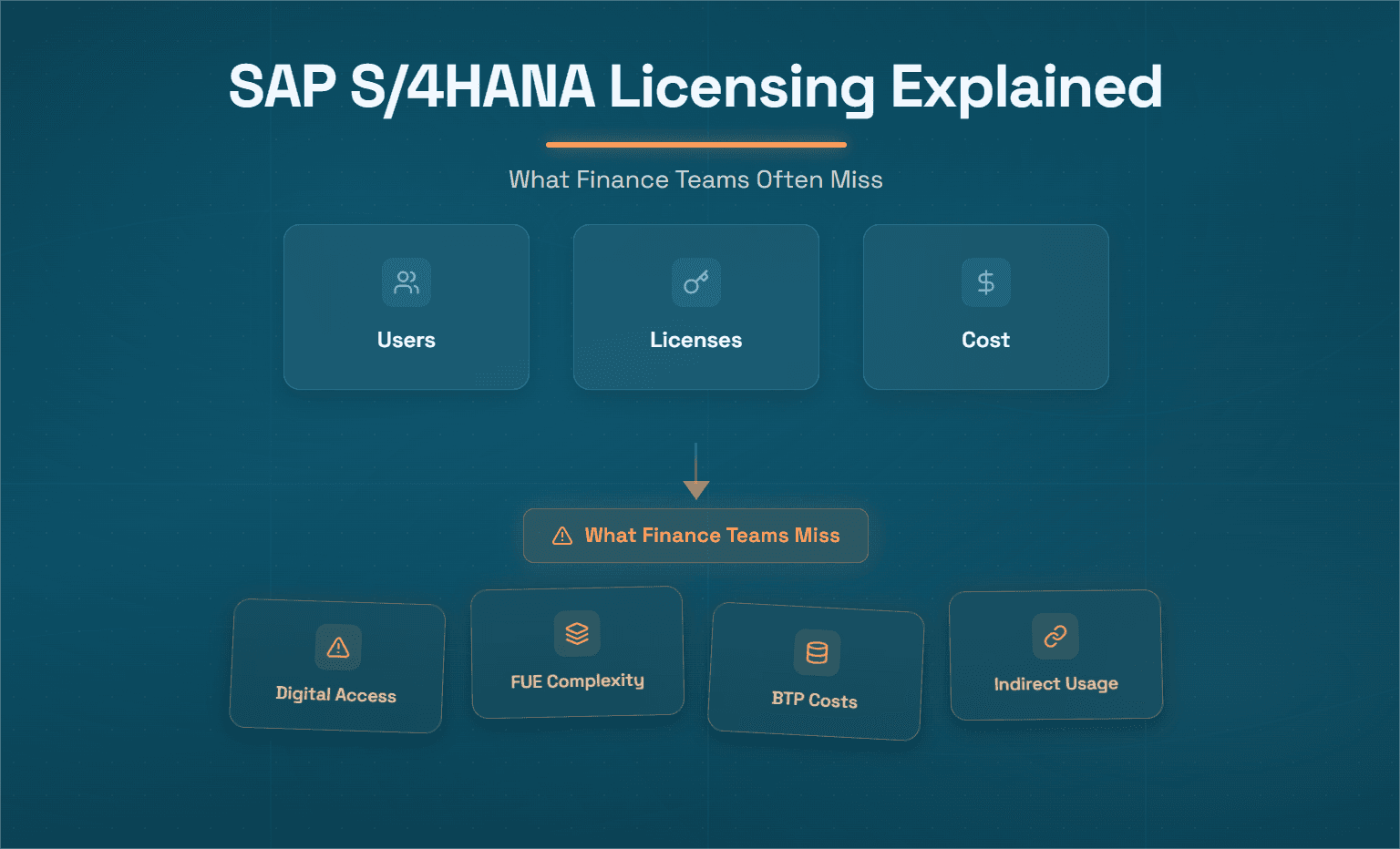
The True Cost of SAP S/4HANA: Beyond Licensing and Implementation
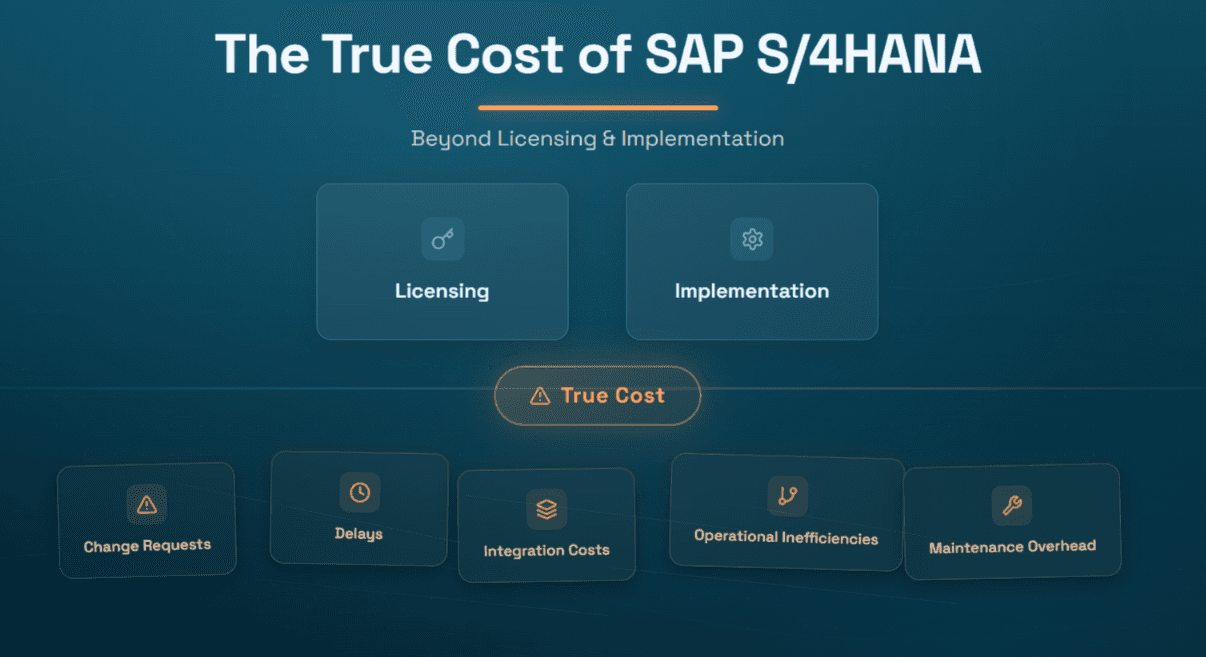
Ask any CFO who has been through an SAP S/4HANA implementation what it actually cost, and the answer is almost always the same: more than we planned. Sometimes significantly more.
In fact, many ERP projects exceed their budget by 20% to 50% due to factors no one warned you about. Many of the most expensive pitfalls are not technical, they are contractual, transformational, or governance-related, and they are often overlooked or subtly excluded by consulting partners focused on hitting a go-live date.
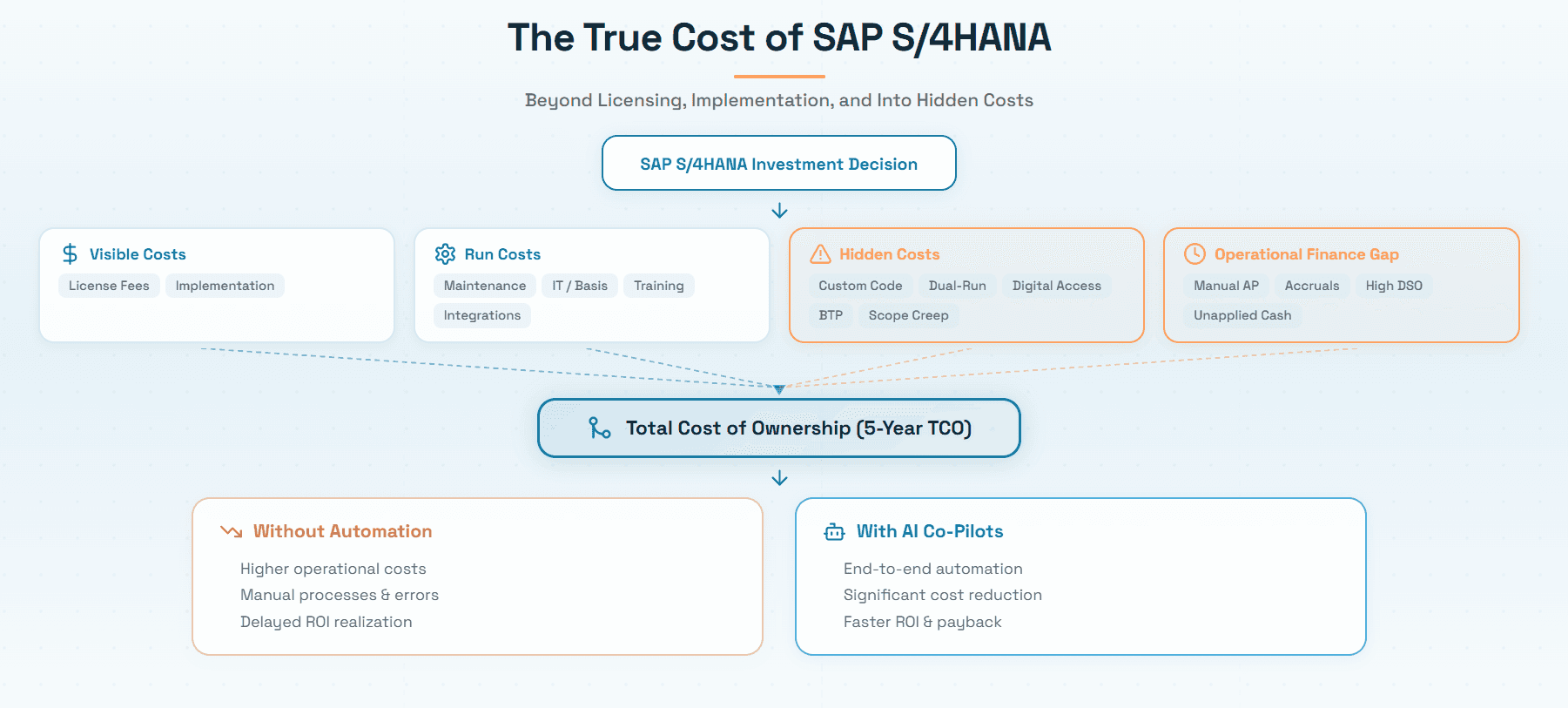
This is not a story about SAP being a bad investment. For organizations with the right size, complexity, and strategic ambition, SAP S/4HANA delivers genuine, long-term operational value. The problem is that the investment case is almost always built on the visible costs, license and initial implementation while the full cost structure extends far beyond those two line items into territory that most business cases never address.
SAP S/4HANA cost is not just "license price." Your five-year total cost of ownership is determined by what you lock down in the contract and how disciplined your governance is after go-live. And critically, what the investment case almost never includes, is the cost of the operational gaps that SAP S/4HANA creates when it goes live without an intelligent automation layer on top.
This guide maps the complete, honest cost landscape of SAP S/4HANA: the visible implementation cost, the ongoing run cost, the hidden costs that inflate TCO in years two through five, and most importantly, the operational cost that persists when finance teams are still processing invoices manually, calculating accruals in spreadsheets, and managing collections from aging reports after a system that was supposed to transform them has gone live.
The Visible Costs – What Most Business Cases Include
License and Subscription Costs
The license or subscription cost is the most visible component of SAP S/4HANA investment and the most variable.
For a 100-user deployment, SAP S/4HANA might cost $250,000 to $500,000 annually in license costs. Cloud-based deployments often start around $100,000, while on-premise setups can be higher due to additional hardware and maintenance expenses.
SAP S/4HANA Public Cloud costs $180 per user per month at list price. A typical three-year total cost of ownership for the Public Cloud edition ranges from $150,000 to $600,000 for mid-market companies, covering software subscription, implementation, training, and ongoing support. The subscription covers software licensing, hosting on the SAP hyperscaler cloud, automatic quarterly upgrades, standard SAP support, and access to SAP Learning Hub. Infrastructure costs, custom extensions via BTP, and implementation services are billed separately.
The critical word in that last sentence is "separately." The subscription covers what is explicitly included. Everything beyond it, BTP, implementation, integrations, training, change management is additional. For an accurate business case, the license is the starting point, not the total.
Initial Implementation Cost
SAP implementation cost must be assessed structurally rather than estimated as a single number. A full implementation includes solution design, process alignment, configuration, data migration, testing, training, and change enablement to ensure the system supports real business outcomes. Enterprise projects often range from high six figures to multi-million dollars when licensing, implementation services, data migration, and testing are included.
Partner implementation fees are typically 1–3× the annual subscription cost. For an organization with a $1.5M annual RISE subscription, that means implementation fees alone of $1.5M to $4.5M. For larger enterprise deployments, SI fees at tier-one firms (Deloitte, Accenture, IBM, Capgemini) regularly run $10M to $50M+.
SAP consulting services range from $100 to $300 per hour, depending on complexity and expertise. In a market where SAP implementation talent is increasingly scarce ahead of the 2027 ECC support deadline, this rate is climbing. Organizations that begin their S/4HANA journey later will pay more for the same implementation capacity than those who started earlier.
The Run Cost – What Business Cases Underestimate
The implementation cost is a one-time investment. The run cost is what the organization pays every year in perpetuity to operate, maintain, and evolve the SAP system. It is consistently the most underestimated component of five-year TCO.
Annual Maintenance and Support
For on-premise solutions, annual maintenance fees are generally 18–22% of the license cost. For an organization with $3M in on-premise SAP licenses, that is $540,000 to $660,000 per year, every year, for standard SAP maintenance. Premium support options (SAP Preferred Care, SAP Active Embedded) add additional cost on top.
For RISE/cloud subscriptions, support is bundled into the subscription but as noted above, the subscription rate escalates annually. SAP does not automatically waive or reduce maintenance fees during the dual-run period when both ECC and S/4HANA are operating simultaneously which means organizations pay full ECC maintenance costs and full S/4HANA subscription fees in parallel for the duration of the migration.You may be paying full annual maintenance fees (20–22%) on your old ECC licenses and paying new subscription fees for S/4HANA, a costly double-dip that can last 12 to 24 months.
Internal IT and SAP Basis Run Costs
On-premise and Private Cloud deployments require dedicated SAP Basis administrators, typically two to four for a complex landscape, at fully loaded costs of $100,000–$150,000 per year each. This personnel cost is a fixed run cost that appears nowhere in the SAP contract but shows up directly on the finance headcount budget.
For cloud deployments, the infrastructure management burden shifts to SAP but does not disappear entirely. Internal resources are still required for change management of quarterly updates, BTP monitoring, integration maintenance, and the ongoing optimization of SAP configurations as business requirements evolve.
Third-Party Integration Run Costs
Every third-party system connected to S/4HANA such as banking platforms, tax engines, EDI networks, AP automation tools, treasury management systems requires ongoing integration maintenance. SAP's quarterly update releases create periodic regression testing requirements across all connected systems. The integrating purchase order automation with ERP systems guide covers the architecture implications that drive these costs.
Organizations typically discover this run cost only after the first major SAP update breaks one or more of their third-party integrations. The fix requires SI involvement, testing cycles, and deployment effort, at day rates that are not in the original run cost budget.
Ongoing Training and User Support
As the system gets updated or new modules are added, additional training may be needed. This ongoing training represents a run cost that continues throughout the system's life.
SAP's quarterly update model for cloud deployments means new features, changed transaction paths, and modified workflows appear on a regular basis. Each update cycle creates a ripple effect of user confusion, help desk tickets, and retraining needs. In a 500-user finance organization, the annual cost of post-go-live training, user support, and adoption maintenance can easily reach $200,000–$400,000, cost that was never in the business case because the business case treated training as a one-time implementation activity.
For a deep analysis of why adoption costs are chronically underestimated, see why finance teams struggle to adopt SAP S/4HANA fully.
The Hidden Costs – What No One Tells Finance Leaders
SAP S/4HANA cost is shaped less by list rates and more by what you fail to lock down before the renewal clock starts. In large SAP deals, the "discount" is rarely the win. The win is preventing cost cliffs and non-separable bundles that silently raise your effective price every year.
Here are the seven hidden costs that consistently appear in SAP S/4HANA TCO and consistently appear after the business case has been approved.
Hidden Cost 1 – Custom Code Remediation
Your old SAP ECC system is riddled with custom ABAP code developed over decades. In an S/4HANA migration, a significant portion of this code will not work or will be made redundant by new SAP standard features. Your partner often quotes only the technical cleanup of necessary code. The true cost lies in the functional analysis and rewriting and redesign required to align that code with S/4HANA's simplified data model. Every line of unnecessary custom code carried over becomes a long-term maintenance liability.
This is not a small cost. Organizations with large ECC custom code landscapes frequently discover that custom code remediation alone adds 15–25% to the total implementation cost, appearing midway through the project when the budget is already committed.
Hidden Cost 2 – Dual-Run Period Costs
A typical S/4HANA transition takes 12 to 24 months. During this time, your company runs both the old SAP ECC system and the new S/4HANA project environment in parallel. You may be paying full annual maintenance fees (20–22%) on your old ECC licenses and paying the new subscription fees for S/4HANA, a costly double-dip. SAP does not automatically offer a fee holiday.
For an organization paying $500,000 per year in ECC maintenance and $1.5M per year in RISE subscription, the dual-run cost is $2M per year for the entire 12–24 month migration period - $2M to $4M in cost that the business case models as zero.
Hidden Cost 3 – Digital Access and Indirect Access Exposure
SAP introduced clearer rules for Indirect Access (Digital Access), but this remains one of the largest budget traps for non-compliant customers. This cost arises when external systems - like a third-party AP automation portal, supply chain tool, or manufacturing execution system - interact with S/4HANA data without a full named user license. If you fail to account for the volume of documents (sales orders, invoices, purchase orders) created by external systems, a future SAP audit could hit you with massive, unbudgeted true-up payments.
For organizations processing thousands of AP invoices per month through an automation tool that writes Finance Documents to SAP, the unaddressed Digital Access exposure can reach hundreds of thousands of dollars per year. Our companion blog on SAP S/4HANA licensing covers this in depth.
Hidden Cost 4 – SAP BTP Consumption Fees
SAP's AI and extensibility strategy increasingly runs through SAP Business Technology Platform. Key hidden costs of RISE include implementation and migration services (RISE does not include the consultants or effort to move you to S/4HANA), change management and training, and any add-ons beyond RISE's standard scope such as extra data storage, higher SLA tiers, premium features, and BTP consumption fees.
Every Joule AI interaction, every integration flow, every API call through BTP consumes credits that are typically not included in the base RISE subscription at the volumes organizations actually use. Organizations that assume SAP's native AI capabilities are "included" frequently discover BTP consumption overage charges that were nowhere in the original budget.
Hidden Cost 5 – Change Management and Productivity Dip Costs
Change management and training represent hidden costs of RISE with SAP because the cloud operating model requires new skills that most organizations do not have in-house.
But the most expensive change management cost is not the training budget, it is the finance productivity dip that follows every go-live. When invoice processing times double, month-end close extends by three to five days, and collections analysts are learning the new system rather than collecting cash, the cost is real and measurable but it appears nowhere in the SAP business case.
Hidden Cost 6 – Scope Creep and Change Request Fees
Implementation scope creep is the single most reliable predictor of budget overrun in SAP projects. Every undiscovered requirement that emerges during the Realize phase such as an integration that was not in scope, a reporting requirement that was not anticipated, a country-specific legal requirement that was not addressed in the design becomes a change request, billed at SI day rates.
Data migration remains one of the most underestimated cost drivers. Projects involving legacy SAP landscapes require careful data cleansing, validation, and transformation. This is especially true during ECC to S/4HANA migration, where data readiness directly affects timelines, risk, and overall implementation cost. Data migration scope creep, discovering data quality problems that require remediation, is one of the most consistent sources of unplanned SI cost in any SAP implementation.
Hidden Cost 7 – The Operational Finance Gap (The Most Expensive Hidden Cost)
This is the hidden cost that never appears on any SAP TCO analysis and consistently represents the largest gap between the investment case promise and the operational reality.
SAP S/4HANA is a system of record. When it goes live, it does not automatically process your invoices at 80% STP. It does not automatically calculate and book your accruals. It does not automatically prioritize your collections work list based on payment behavior signals. It does not automatically apply your incoming cash payments to open AR items with 99.8% accuracy.
Finance teams that go live on S/4HANA without an intelligent automation layer discover that they have a more expensive, more complex version of their previous manual process - running in a new interface. The operational cost of this gap, measured in FTE hours processing invoices, controller days spent on accruals, DSO that is five to eight days higher than it needs to be, unapplied cash accumulating on the balance sheet represents the largest single hidden cost in the S/4HANA investment.
Hyperbots AI Co-pilots are the solution to this hidden cost. They deploy on top of S/4HANA in three to five weeks, with no ABAP required, adding the autonomous intelligence layer that makes the SAP investment deliver the operational ROI it was always supposed to deliver.
The Finance Gap Cost – Quantifying What SAP Alone Doesn't Deliver
Let us put specific numbers on the operational finance gap, the cost that the S/4HANA business case treats as zero but that continues accumulating every month after go-live.
For a mid-market organization processing 5,000 invoices per month:
Manual AP processing cost: At an industry average of $10–$15 per invoice for manual processing, 5,000 invoices per month costs $50,000–$75,000 per month, or $600,000–$900,000 per year, in fully loaded AP processing cost. SAP S/4HANA without automation does not change this materially, it changes the interface, not the process.
Accruals manual labor cost: A controller spending four days per month-end close on accruals, at a fully loaded annual cost of $120,000, is spending $16,000 per month on accruals calculation alone; $192,000 per year on a process that Hyperbots' Accruals Co-pilot automates entirely.
DSO cost of manual collections: For an organization with $50M in annual revenue and 56-day median DSO (the industry average), a 5-day DSO reduction releases approximately $6.9M in working capital. At a cost of capital of 8%, that represents $550,000 per year in financial value. SAP's native collections management does not achieve this. Hyperbots Collections Co-pilot delivers 40% DSO reduction.
Unapplied cash cost: For an organization with $2M in average unapplied cash at any given time, at 8% cost of capital, the annual cost of that unapplied cash balance is $160,000. Hyperbots Cash Application Co-pilot reduces unapplied cash to less than 10% of its current level.
The combined operational finance gap for this mid-market organization exceeds $1.5M per year, every year, in measurable, quantifiable cost that is not in the S/4HANA business case. And this is not a cost that SAP releases will fix on their own.
Hyperbots AI Co-Pilots – Closing the Operational Finance Gap
Hyperbots has built the most comprehensive suite of agentic AI co-pilots for finance automation in SAP S/4HANA environments. Every co-pilot integrates through native SAP APIs, requires no ABAP, deploys in three to five weeks, and directly addresses the operational finance gap that inflates true S/4HANA cost.
Procure-to-Pay Co-Pilots
Invoice Processing Co-pilot Eliminates the largest single component of the AP operational cost gap. Achieves 80% straight-through processing, cutting invoice cycle time from 11 days to under one minute. Pre-trained on 35 million invoice fields with 99.8% extraction accuracy. See how XR Extreme Reach achieved 80% STP with zero manual touch-ups. Use the invoice processing ROI calculator to model your specific cost gap closure.
Vendor Management Co-pilot Eliminates the vendor onboarding cost gap. Vendor onboarding time drops 8x from nine days to under one day. Vendor data errors fall from ~6% to under 1%, reducing the downstream cost of mismatched payments and AP exceptions. Quantify your savings with the vendor management ROI calculator.
Procurement Co-pilot Closes the PR-to-PO efficiency gap, PR to PO in 4 hours versus the traditional three-day cycle. Automates PO creation and dispatch, with a self-learning GL recommender that eliminates coding errors that create AP exceptions downstream. Use the procurement ROI calculator for your scenario.
Accruals Co-pilot Eliminates the controller time cost of month-end accruals. Queries SAP at cut-off, calculates amounts using ML models, posts journal entries, and reverses automatically. Close compresses from days to hours, variance under 5%. The transforming accruals blog documents the production impact. Model your close savings with the accruals ROI calculator.
Payment Co-pilot Optimizes payment timing for early payment discount capture which is a direct, measurable offset to SAP implementation cost that most organizations leave on the table. Prevents duplicate payments and fraud, further reducing the hidden cost of AP errors. The payments ROI calculator models discount capture and error prevention value.
Sales Tax Verification Co-pilot Eliminates the tax leakage cost that accumulates from manual tax validation. One CFO cut $200K in annual tax leakage using Hyperbots which is a direct, documented offset to hidden S/4HANA operating cost.
Order-to-Cash Co-Pilots
Collections Co-pilot Closes the working capital cost gap from high DSO. Delivers 40% DSO reduction and 70% reduction in cost to collect, with 80% collections productivity improvement. For a $50M revenue organization, a 40% DSO reduction typically releases $5M–$8M in working capital. Model your specific savings with the collections ROI calculator.
Cash Application Co-pilot Closes the unapplied cash cost gap. Achieves 80%+ STP, reducing unapplied cash to less than 10% and cutting reconciliation costs by up to 80%. The cash application ROI calculator models your specific working capital improvement.
How Hyperbots Differentiates – The TCO Advantage
The critical question for any finance leader evaluating automation tools alongside an S/4HANA investment is: does this tool add to my TCO problem or reduce it?
Dimension | RPA Tools | Traditional AP Tools | SAP Native BTP | Hyperbots AI Co-pilots |
Adds to Digital Access exposure | Yes; creates SAP docs unsafely | Often; unclear licensing | No; within SAP | Addressed proactively |
Requires BTP licensing | No | No | Yes; adds to TCO | No; no BTP required |
Requires ABAP | No but fragile | Sometimes | Yes | Never |
Adds SI cost for deployment | 2–4 months SI fees | 2–3 months | 3–6 months BTP dev | None; direct deployment |
Breaks on SAP upgrades | 30–50% of the time | Sometimes | Within BTP | No; upgrade safe |
Invoice STP rate | 20–40% | 60–70% | 40–60% | 80%+ |
Deployment timeline | 2–4 months | 2–3 months | 3–6 months | 3–4 weeks |
Net effect on SAP TCO | Adds licensing + SI + maintenance risk | Adds licensing + integration | Adds BTP consumption | Reduces operational cost gap |
ROI payback period | 12–18 months | 9–15 months | 12–24 months | Within 60 days |
Hyperbots is the only finance automation option that reduces SAP TCO rather than adding to it because it addresses the operational finance gap that represents the true hidden cost of S/4HANA, without adding the licensing exposure, BTP consumption, or SI fees that other automation approaches carry.
Hyperbots Platform Capabilities – Transformational Impact on True SAP Cost
Self-Learning That Improves ROI Over Time Unlike SAP native automation that plateaus at its initial configuration quality, Hyperbots co-pilots improve continuously, reducing exception rates, improving GL coding accuracy, and increasing STP rates. The ROI case gets stronger every month, compounding the value of the initial investment rather than requiring expensive upgrades.
Unlimited User Licensing No per-seat cost means deploying Hyperbots across the entire finance function adds no incremental per-user cost. In an S/4HANA environment where every additional named user affects your FUE count, this is a structural cost advantage.
24/7 Autonomous Operation Finance processes execute continuously, not just during business hours. Zero overtime costs, zero batch processing delays, zero overnight backlogs. For global finance functions, this eliminates the operational cost premium of around-the-clock operations.
SOX-Ready Audit Trail – Reducing Audit Cost Every autonomous action is logged in a tamper-proof, timestamped audit trail meeting SOX, PCI-DSS, and FedRAMP standards. The AI automation and ease of audit relationship blog explains how this directly reduces external audit preparation cost, another hidden S/4HANA run cost that Hyperbots addresses.
ROI – What Hyperbots Delivers Against SAP's True Cost
Procure-to-Pay ROI
Tangible:
80% reduction in AP processing cost – most of the operational finance gap, addressed from day one
Invoice cycle time from 11 days to under one minute – measurable within 30 days of deployment
$200K+ annual tax leakage eliminated – direct offset to hidden S/4HANA run cost
Vendor onboarding 8x faster – reduces supplier management labor cost
Month-end close from days to hours – controller time redirected from accruals to analysis
Deployment in 3–4 weeks – ROI within 60 days, not 12 months
Intangible:
SAP business case gap closed – the investment delivers the promised operational ROI
Finance team shifts from SAP transaction processing to strategic analysis
Shadow system costs eliminated – Hyperbots makes SAP processes demonstrably better than spreadsheet workarounds
Audit preparation cost reduced through complete, explainable evidence for every SAP posting
Order-to-Cash ROI
Tangible:
40% DSO reduction – $5M–$8M working capital release for a $50M revenue organization
70% reduction in cost to collect – direct headcount efficiency improvement
80%+ STP on cash application – unapplied cash under 10%, $160K+ annual cost of capital saving
80% collections productivity improvement – human focus on strategic, high-value accounts
Intangible:
Real-time cash flow forecasting replaces static aging reports which improves treasury cost of capital
Revenue assurance strengthens so no AR items fall through the cracks
Customer satisfaction improves as accurate, AI-driven collections communications
Budget for What S/4HANA Actually Costs. Then Close the Gap.
SAP S/4HANA cost is not just license price. Your five-year total cost of ownership is determined by what you lock down in the contract and how disciplined your governance is after go-live. The organizations that manage S/4HANA cost effectively are those that go in with open eyes to understand the dual-run trap, the Digital Access exposure, the custom code remediation scope, and the BTP consumption creep and negotiate proactively against all of them.
But even the most disciplined SAP contract negotiation does not address the most consequential hidden cost: the operational finance gap that persists after go-live, when finance teams are still manually processing invoices, calculating accruals in spreadsheets, and managing collections from static aging reports in an ERP that was supposed to transform their operations.
Hyperbots AI Co-pilots close that gap. They deploy on S/4HANA in three to five weeks, with no ABAP, no BTP consumption, no SI fees, and no per-seat licensing constraints. They deliver measurable ROI within 60 days, reducing the operational finance cost that the S/4HANA business case never planned for.
Build your SAP business case with open eyes. Budget for the real implementation cost. Plan for the run cost. Address the hidden costs proactively. And close the operational finance gap with the AI automation layer that makes your S/4HANA investment deliver what it promised.
Frequently Asked Questions (FAQs)
Q1: What is the real total cost of SAP S/4HANA over five years?
Implementation, customization, training, and migration costs can easily double the initial license fees, especially for larger enterprises. A realistic five-year TCO for a mid-enterprise S/4HANA deployment (500 users) including license, implementation, data migration, custom code remediation, BTP consumption, ongoing support, training, and change management typically runs $15M–$45M. For global enterprises, $50M–$200M+ is common. The key variables are scope discipline during implementation and how well Digital Access and dual-run costs are managed in the contract.
Q2: What are the most commonly overlooked hidden costs in an S/4HANA implementation?
Hidden costs include consultant fees that can sometimes exceed software costs, data cleansing costs prior to migration, ongoing training as the system updates, integration costs for other software, Digital Access for indirect usage, and downtime costs. Annual maintenance fees of 18–22% of license cost are often underestimated. To this list add: custom code remediation, dual-run maintenance during the migration period, BTP consumption overages, scope creep from change requests, and most significantly, the operational finance gap created by deploying SAP without an automation layer.
Q3: How much does SAP S/4HANA implementation cost for a mid-market organization?
Mid-market enterprises often require broader functional coverage and moderate integration across systems. SAP S/4HANA implementation typically falls in the high six-figure to multi-million-dollar range. For a 200–500 user mid-market deployment: license/subscription $750K–$2M per year; implementation services $1.5M–$6M one-time; data migration $200K–$800K; ongoing support and Basis $300K–$600K per year. Five-year TCO: $8M–$25M. These figures do not include the operational finance gap which adds $1M–$3M per year in recoverable cost.
Q4: How do Hyperbots co-pilots affect SAP S/4HANA TCO?
Hyperbots adds a modest, flat-rate cost to S/4HANA TCO while delivering operational ROI that eliminates the largest single hidden cost in the investment: the operational finance gap. The typical payback period is 60 days. For a mid-market organization, the combined Hyperbots P2P and O2C co-pilot suite typically delivers $2M–$5M per year in measurable operational improvement against an annual Hyperbots cost that is a fraction of that figure. Use the ROI calculators to model your specific scenario.
Q5: What is the dual-run cost in an SAP S/4HANA migration?
A typical S/4HANA transition takes 12 to 24 months. During this time, your company runs both the old SAP ECC system and the new S/4HANA project environment in parallel. You may be paying full annual maintenance fees (20–22%) on your old ECC licenses and paying new subscription fees for S/4HANA. SAP does not automatically offer a fee holiday. The fix: negotiate Dual-Use Rights and a maintenance reduction explicitly in the S/4HANA contract before signing, with a clear end-date for ECC maintenance fees and a formal credit against legacy fees during the migration period.
Q6: Why does the operational finance gap persist even after SAP S/4HANA goes live?
Because SAP S/4HANA is a system of record, it stores and manages financial truth, but does not autonomously act on it. Invoices still need to be read, extracted, matched, and posted. Accruals still need to be calculated. Collections still need to be prioritized and executed. These processes are not automated by SAP S/4HANA alone. They require the intelligent automation layer that Hyperbots AI Co-pilots provide.