Does Oracle Own NetSuite? What It Means for ERP Buyers (2026)
Oracle acquired NetSuite in 2016 but kept it running as its own business unit. Here's what that means for the product and the people using it.

Introduction – Does Oracle Own NetSuite?
Yes, Oracle owns NetSuite. In July 2016, Oracle paid $9.3 billion to acquire it which was at the time, one of the largest cloud acquisitions on record. Nine years later, NetSuite is a $1 billion-per-quarter business serving more than 43,000 companies across 219 countries, and it operates as its own global business unit inside Oracle. If you're evaluating NetSuite or just trying to understand how the Oracle relationship works, this is what you need to know.
Background – NetSuite’s Evolution Before Oracle
Founded in 1998 as NetLedger by Evan Goldberg, with Larry Ellison (Oracle’s founder) as one of its major investors, NetSuite was a pioneer in Software as a Service (SaaS) ERP. Before Oracle acquired NetSuite, it had already become a dominant cloud ERP player, especially in sectors like professional services, wholesale distribution, retail, and technology.
The Acquisition Deal – Oracle and NetSuite Merge
Oracle’s acquisition of NetSuite was more than a financial transaction. It was strategic alignment. By acquiring NetSuite, Oracle reinforced its cloud ERP offerings, especially for small to mid-market businesses.
Deal Highlights:
Date Announced: July 28, 2016
Purchase Price: $9.3 billion
Objective: Cloud-first ERP expansion
How NetSuite Functions Under Oracle
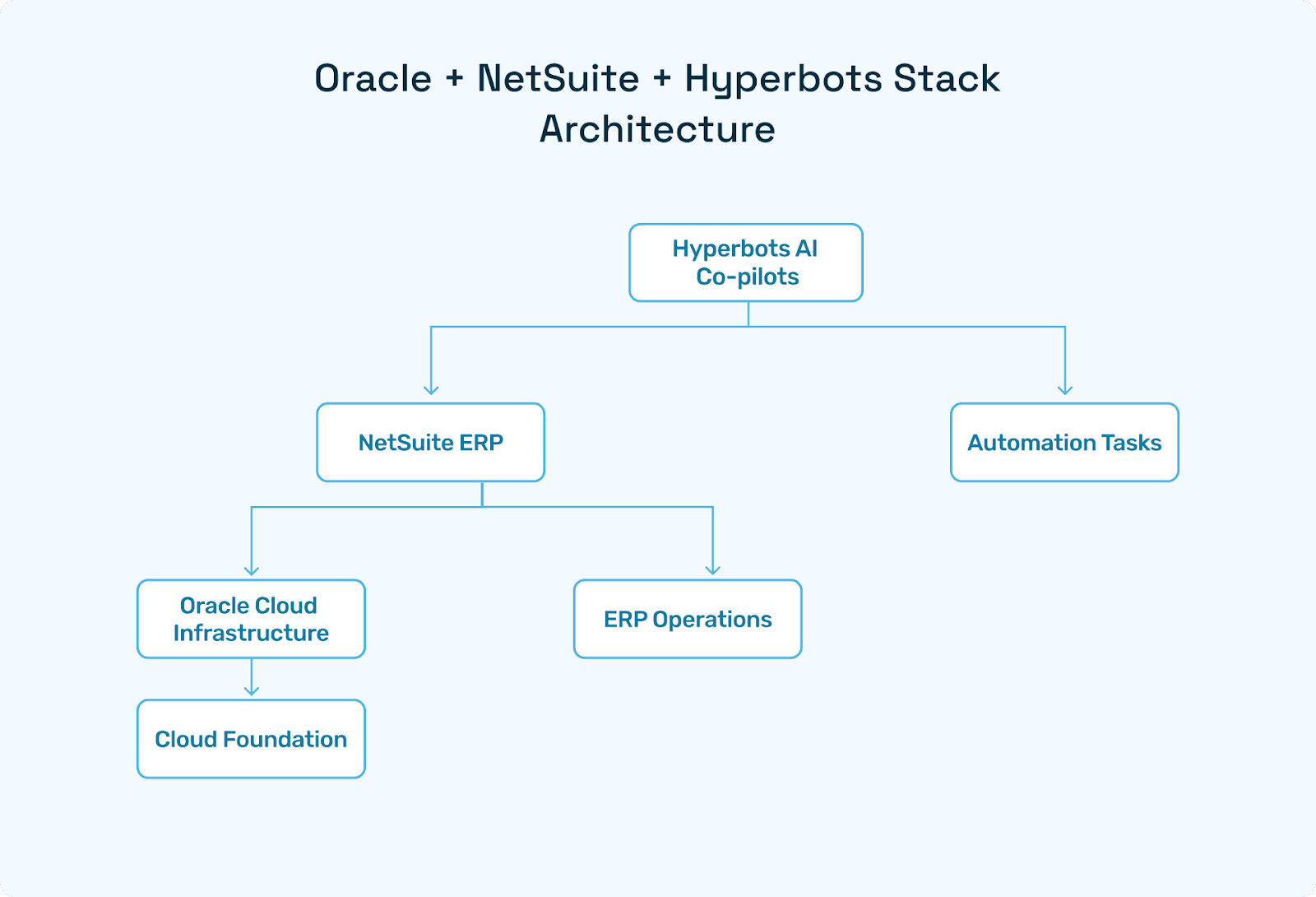
Although NetSuite is owned by Oracle, it operates as a separate Global Business Unit (GBU). This autonomy allows it to innovate independently while leveraging Oracle’s global infrastructure and R&D strength.
Key Synergies:
Shared Infrastructure: Oracle Cloud Infrastructure (OCI) powers NetSuite deployments globally.
Data Integration: Seamless integrations with Oracle’s database, analytics, and AI tools.
Innovation Velocity: Leveraging Oracle’s R&D while staying nimble.
What Changed After Oracle Acquired NetSuite?
The short answer: quite a lot, but NetSuite stayed NetSuite. Oracle kept it as a separate Global Business Unit rather than folding it into Oracle's broader ERP stack, which meant it kept its own product roadmap, its own branding, and its existing focus on small to mid-market companies. What changed was the resources behind it.
The most visible shift was infrastructure. NetSuite moved onto Oracle Cloud Infrastructure (OCI), which gave it access to data centers it couldn't have built independently. For users, this translated into faster performance, broader geographic availability, and enterprise-grade uptime: exactly the kind of backbone that small cloud vendors typically can't afford.
Product development also accelerated. Oracle's R&D budget is one of the largest in enterprise software, and NetSuite started shipping features at a faster pace after the acquisition. By 2024, Oracle had embedded AI across the NetSuite platform, with over 100 AI agents covering areas like financial exception management, demand forecasting, and invoice processing. NetSuite's SuiteAnalytics now includes more than 57 pre-built metrics out of the box.
The numbers tell the same story. NetSuite hit $1 billion in quarterly revenue for the first time in Q4 FY2025, up 18% year-over-year, according to Oracle's earnings release. It now serves more than 43,000 customers across 219 countries. In 2016, when Oracle bought it, NetSuite had around 30,000 customers. That growth didn't happen in spite of the acquisition. The capital and infrastructure Oracle brought in helped drive it.
One thing that didn't change: NetSuite is still not Oracle's enterprise ERP. Oracle Fusion Cloud ERP targets large enterprises, while NetSuite targets growing and mid-market businesses. The two products coexist in Oracle's portfolio rather than compete, which is why Oracle has kept investing in both. If you're a company with 50 to 1,000 employees evaluating cloud ERP, you're still in NetSuite's lane and Oracle's ownership hasn't changed that positioning.
What This Means for NetSuite Users
The ownership has benefited users of NetSuite in numerous ways:
More Features, Faster: Oracle’s investment accelerates product development.
Global Reach: Expanded data centers, more regional support.
Compliance: Improved support for data privacy, tax rules, and regulatory frameworks.
Hyperbots AI Co-Pilots: The Best Finance & Accounting Enhancements for Oracle NetSuite Users
Hyperbots has become the leading AI automation platform on top of Oracle NetSuite, with six advanced co-pilots purpose-built for ERP finance processes:
Invoice Processing Co-Pilot
Automates invoice capture, field extraction, validation, GL coding, approval routing, and posting, achieving 80%+ STP (straight-through processing). Outperforms traditional OCR with 99.8% accuracy using VLMs and LLMs in an MOE architecture.
Accruals Co-Pilot
Identifies, books, and reverses accruals. Speeds up closing, ensures compliance, and eliminates manual journal entries.
Payment Co-Pilot
Recommends payment timing, manages approval workflows, and supports multiple payment methods (ACH, wires, checks).
Procurement Co-Pilot
Creates AI-driven requisitions, accelerates approvals, and dispatches purchase orders automatically.
Sales Tax Verification Co-Pilot
Checks tax compliance across jurisdictions, detects over/underpayment, and ensures audit readiness.
Vendor Management Co-Pilot
Streamlines onboarding with document validation (e.g., W-9), offers a secure vendor portal, and identifies duplicate/high-cost vendors.
All co-pilots run on the Hyperbots Agentic AI platform, which includes:
Vision Language Models (VLMs)
Finance-aware Large Language Models (LLMs)
Mixture of Experts (MOE)
Intelligent Redaction and Document Reasoning
Why Hyperbots on NetSuite? Top Benefits
Built for Finance Teams: Specifically designed for accountants and AP teams.
Zero UI Disruption: Works with your existing NetSuite interface.
Fast Time to Value: Deploy in days, not months.
Pre-Built Connectors: Ready-to-integrate Oracle NetSuite connectors.
Industry Use Cases for NetSuite + Hyperbots
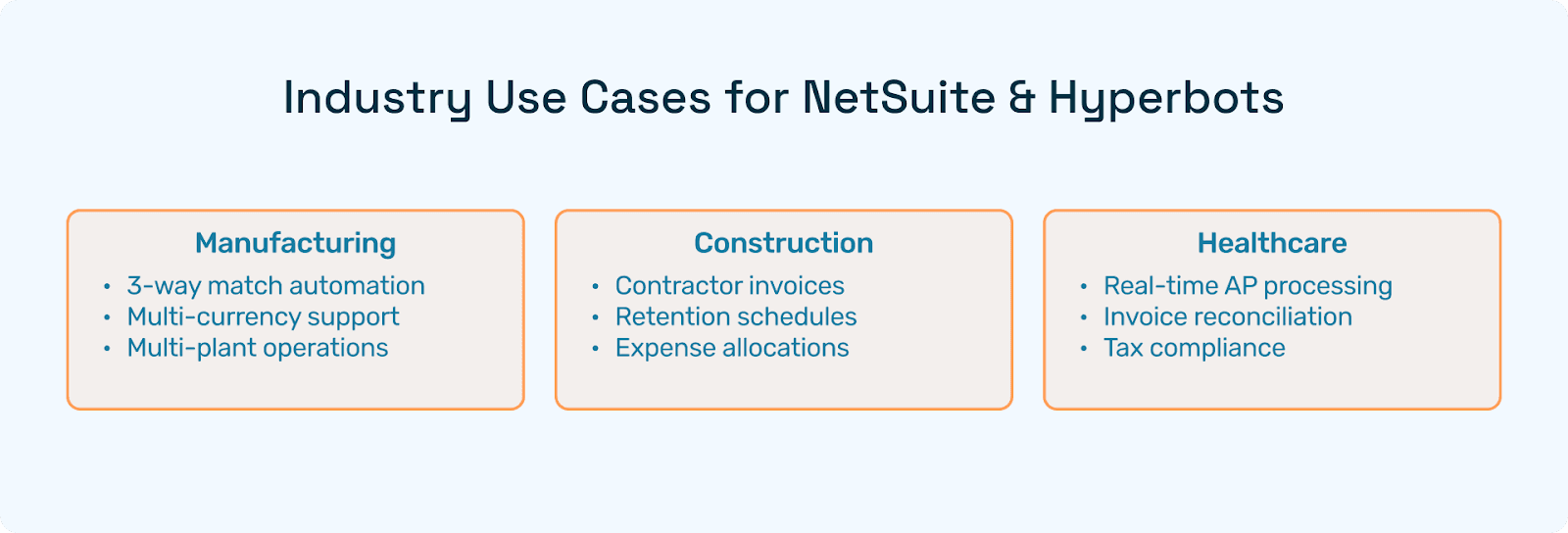
Healthcare
Hyperbots helps hospitals and clinics achieve real-time AP processing, invoice reconciliation, and tax compliance.
Construction
Manages contractor invoices, retention schedules, and expense allocations automatically.
Manufacturing
Automates 3-way match with delivery notes and POs. Supports multi-currency, multi-plant operations.
Oracle + NetSuite + Hyperbots Stack Architecture
Does Oracle Own NetSuite – Common Misconceptions
Despite the acquisition, NetSuite maintains its unique branding and product direction. It is not simply a rebranded Oracle ERP. Instead, it complements Oracle’s broader ERP ecosystem by targeting SMBs and mid-market firms.
Final Thoughts
So, does Oracle own NetSuite? Absolutely. But what’s more important is what this ownership enables, such as faster innovation, deeper integrations, and the ability for platforms like Hyperbots to build intelligent automation on top of NetSuite. With Hyperbots’ finance-aware AI agents, NetSuite becomes an even more powerful ERP for modern businesses. Oracle and NetSuite