ERP and Business Processes: Streamlining Operations for the Modern Enterprise
Empower your ERP with Hyperbots AI Co-pilots to unlock smarter, faster, and future-ready business operations.
ERP systems do one thing well: they connect the moving parts of a business and enforce how work gets done. Procurement, invoicing, inventory, financial close, tax reporting and all of it runs through the ERP. But most companies use only a fraction of what their ERP can actually do, relying on manual steps and spreadsheets to fill the gaps. This guide covers how ERP systems handle core business processes, where automation fits in, and what it looks like when an ERP is working the way it's supposed to.
Strategic Alignment - ERP and Business Processes
In today's hyper-competitive business landscape, organizations must constantly evolve and optimize their operations. One of the most powerful tools available is the Enterprise Resource Planning (ERP) system. But ERP isn’t just software; it’s the backbone of structured, automated, and intelligent business processes across an enterprise.
What Is ERP and How Does It Relate to Business Processes?
ERP and business processes are deeply interconnected. ERP software serves as a central hub for executing, monitoring, and optimizing key business operations such as procurement, invoicing, inventory, HR, finance, and compliance.
At its core, ERP is a unified system that connects departments and automates workflows. Meanwhile, business processes refer to the repeatable, structured activities that produce business outcomes. ERP systems support and enforce these processes through built-in logic, validations, and workflows.
How Do ERP Systems Streamline Business Processes?
1. Centralization of Data
ERP systems eliminate information silos by aggregating data across departments, offering a single source of truth.
2. Process Automation
Manual steps such as invoice processing, purchase order creation, and ledger postings can be automated within the ERP.
3. Standardized Workflows
ERP ensures consistency in execution through pre-defined templates, approval chains, and compliance checks.
4. Real-Time Reporting
Dashboards and analytics in ERP offer instant visibility into business performance, cash flows, procurement cycles, and more.
Common Business Processes Managed by ERP
Order-to-Cash (O2C)
Record-to-Report (R2R)
Hire-to-Retire (H2R)
Plan-to-Produce
Forecast-to-Plan
Tax Calculation and Reporting
Budgeting and Forecasting
ERP software modules are purpose-built to handle these end-to-end processes, ensuring alignment between operations and strategic goals.
How to Use ERP Software for Process Efficiency
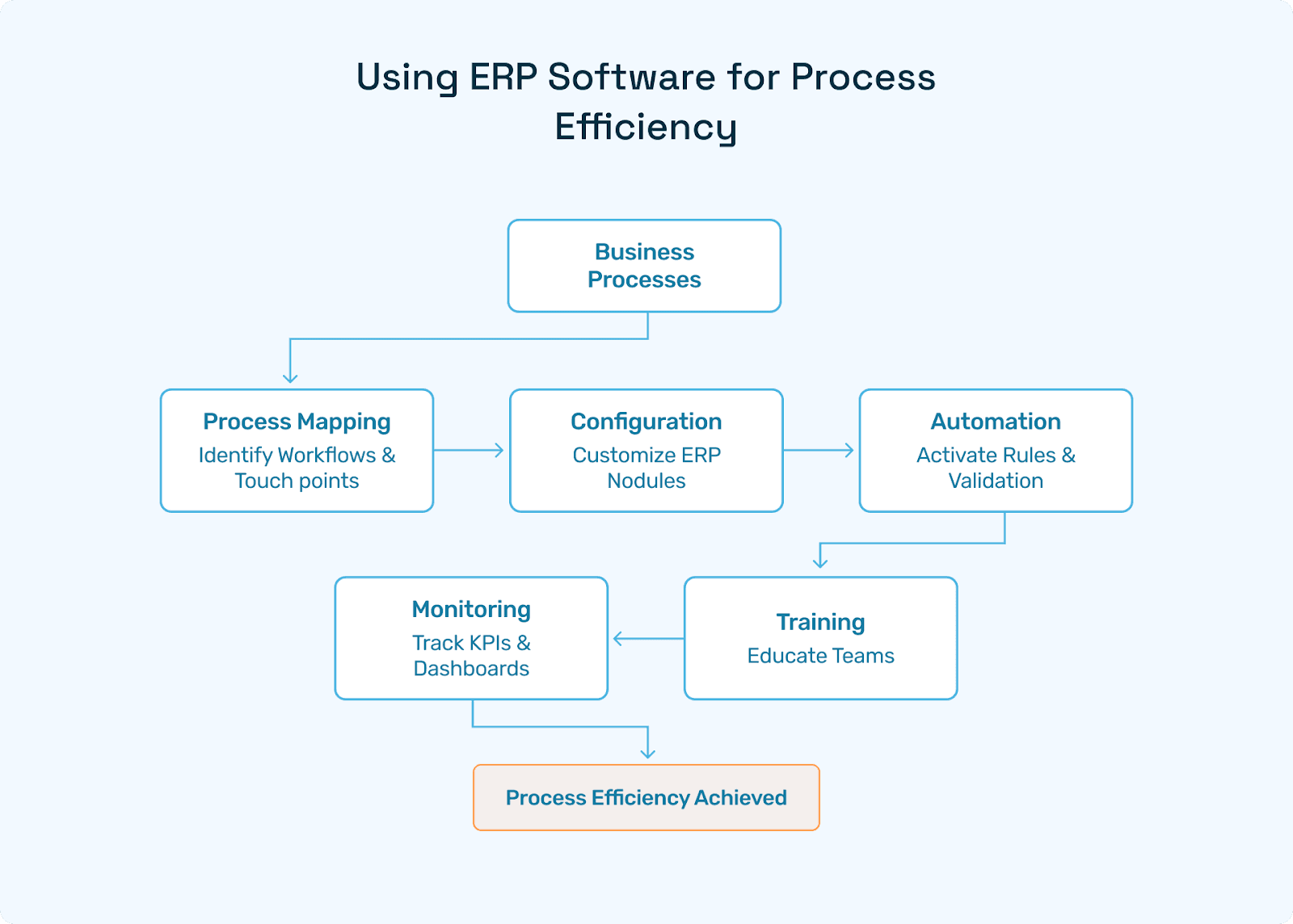
Understanding how to use ERP software starts with mapping business processes to ERP modules. This typically involves:
Process Mapping: Identify workflows and their touchpoints in the ERP.
Configuration: Customize ERP modules to reflect business policies.
Automation: Activate built-in rules, validations, and bots to reduce manual input.
Training: Educate teams on proper ERP use, change management, and governance.
Monitoring: Use dashboards and KPIs to track process health and compliance.
Key Benefits of Aligning ERP and Business Processes
1. Operational Efficiency
Processes are faster and less error-prone due to automation and standardization.
2. Visibility and Control
ERP provides real-time insight into every aspect of business operations.
3. Scalability
As companies grow, ERP-enabled processes scale without adding manual burden.
4. Risk Mitigation
ERP ensures regulatory compliance, audit trails, and approval checks.
Hyperbots AI Co-pilots: Automating ERP-Driven Business Workflows
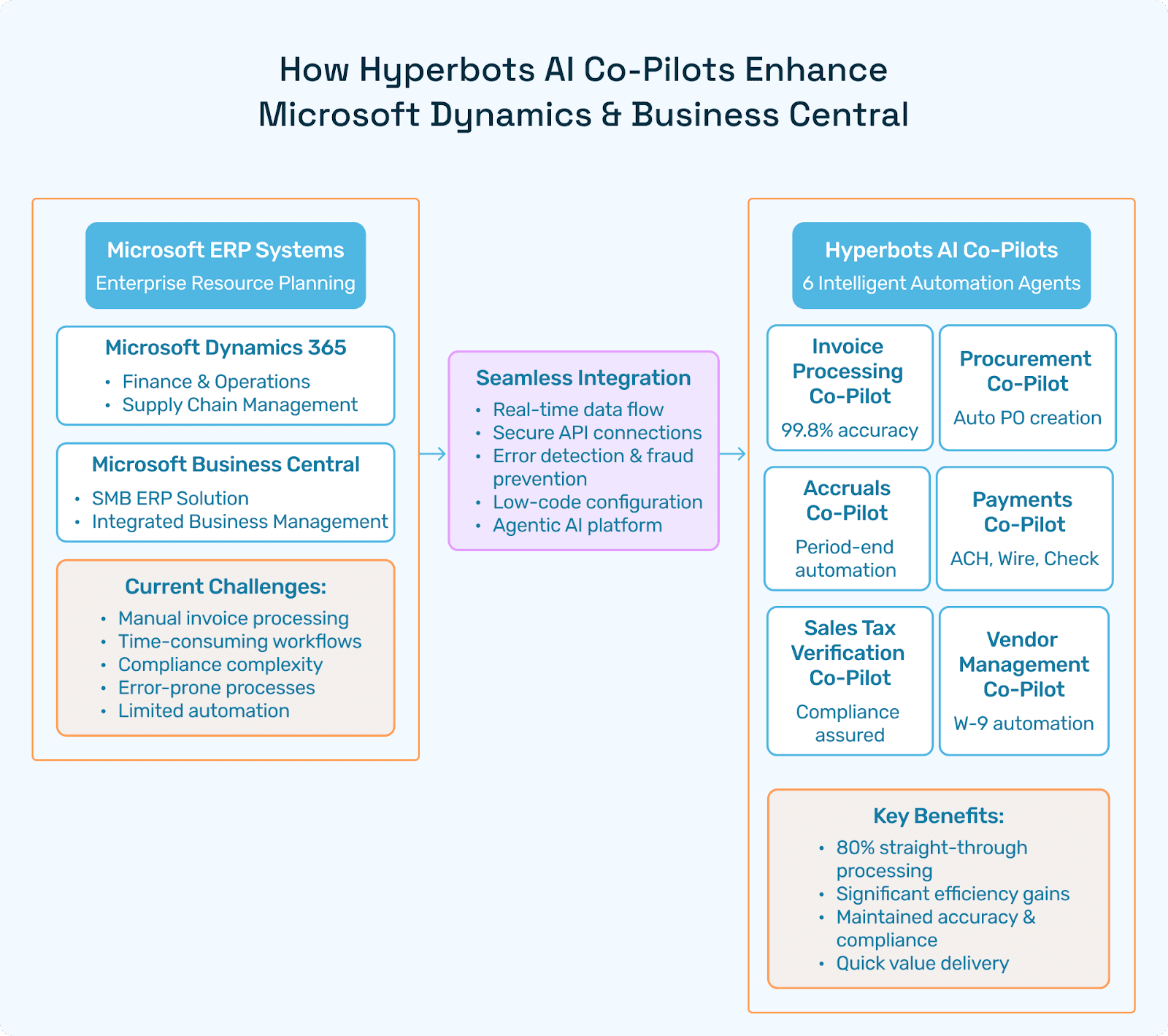
Hyperbots offers the most advanced AI-powered Co-pilots purpose-built for finance and accounting functions across ERP platforms like NetSuite, Oracle, and others. These AI agents supercharge traditional ERP systems by intelligently automating tasks, learning from historical data, and delivering 80%+ straight-through processing (STP).
Here’s how each Co-pilot enhances ERP and business processes:
Invoice Processing Co-pilot
Automates invoice capture, validation, GL coding, 3-way matching, and posting. Supports PDF, EDI, and scanned formats with 99.8% accuracy using proprietary VLM and LLM models.
Procurement Co-pilot
Auto-generates purchase requisitions from needs or templates, routes them for approvals, and dispatches POs to vendors, ensuring policy compliance and process speed.
Accruals Co-pilot
Identifies unrecorded expenses, automates month-end accruals, and manages reversals, improving financial close timelines and accuracy.
Payments Co-pilot
Schedules and automates secure vendor payments via ACH, wires, or checks with timing recommendations and fraud checks built in.
Sales Tax Verification Co-pilot
Validates line-level tax details based on geolocation, jurisdiction, and invoice context, ensuring compliance.
Vendor Management Co-pilot
Automates vendor onboarding (e.g., W-9 verification), document capture, and communication with a self-service vendor portal.
Each co-pilot sits on top of ERP systems and leverages Hyperbots’ Agentic AI architecture, which combines OCR, redaction, VLMs, LLMs, MOE, and reasoning capabilities.
Use Cases: Real-World Examples of Streamlining with ERP and Hyperbots
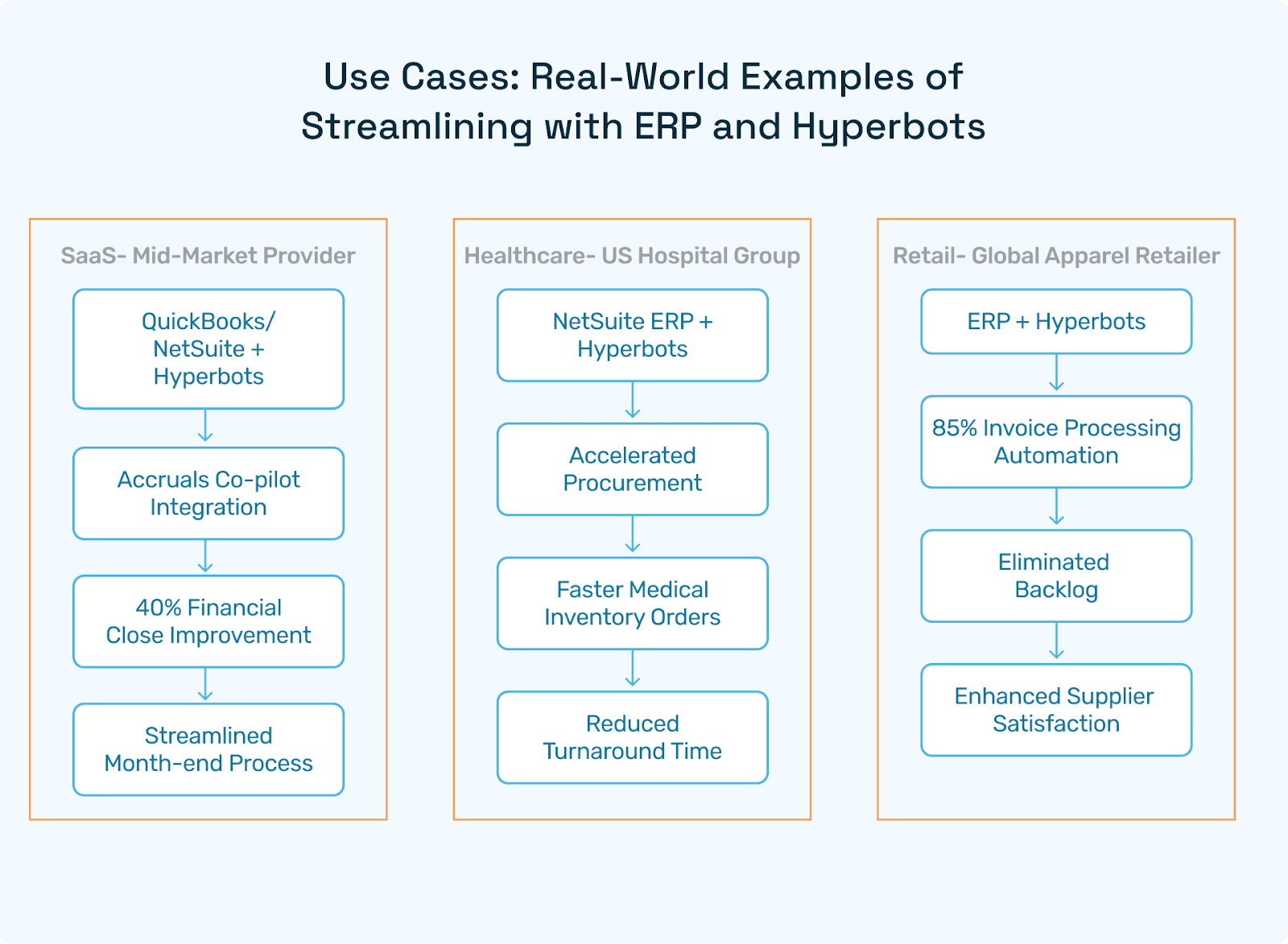
Retail
Using ERP and Hyperbots, a global apparel retailer automated 85% of their invoice processing, eliminating backlog and enhancing supplier satisfaction.
Healthcare
A US-based hospital group deployed Hyperbots to accelerate procurement in its NetSuite ERP, slashing turnaround time for medical inventory orders.
SaaS Company
A mid-market SaaS provider improved financial close by 40% using Hyperbots Accruals Co-pilot integrated into QuickBooks and NetSuite.
ERP Integration with Hyperbots: Architecture and Advantages
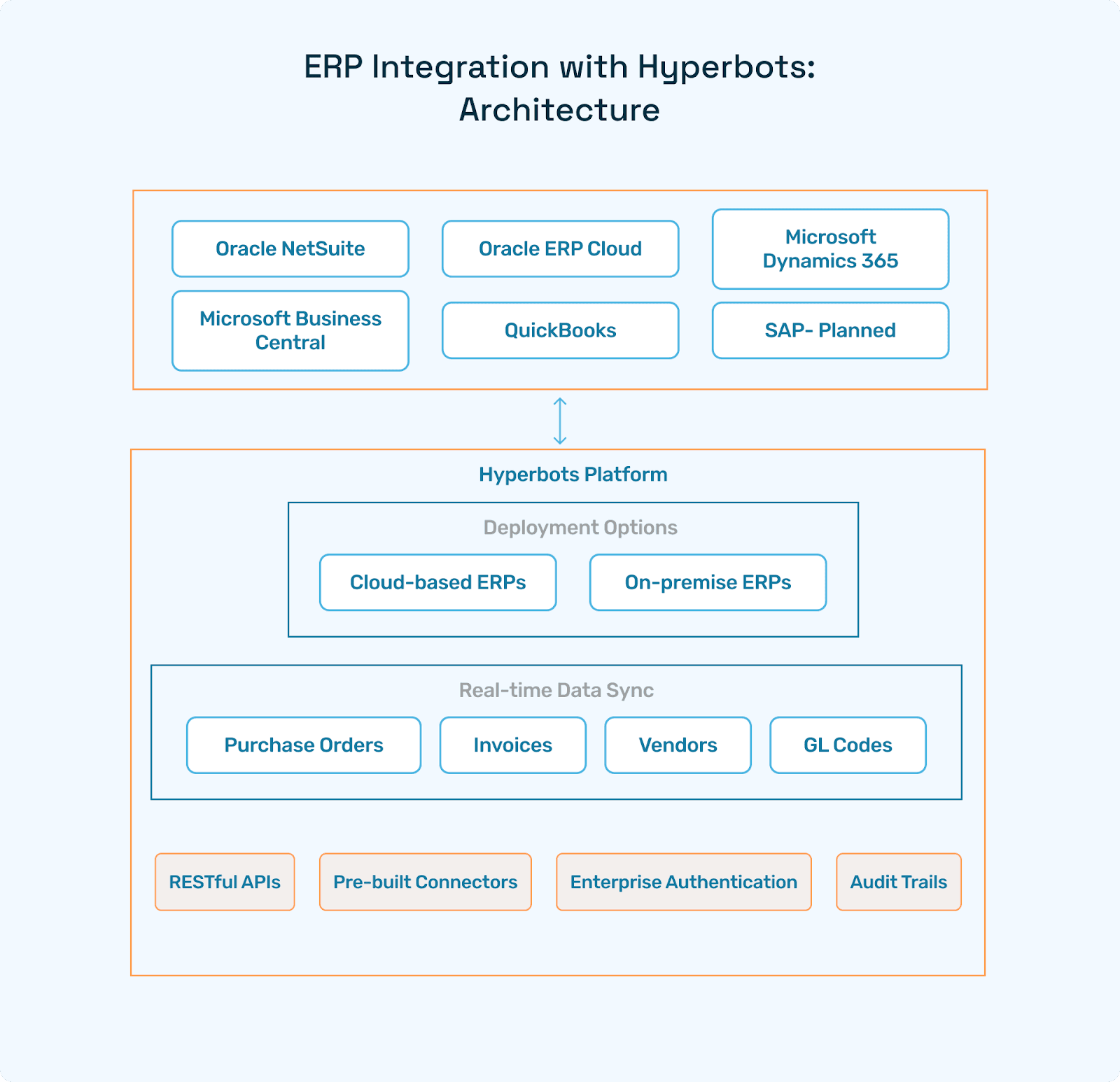
Hyperbots offers pre-built ERP connectors that enable real-time read/write of ERP data:
Oracle ERP Cloud
Microsoft Dynamics 365 / Business Central
QuickBooks Enterprise
SAP (planned)
Architecture Highlights:
Secure RESTful APIs
Real-time sync of POs, Invoices, Vendors, GL Codes
Supports on-premise and cloud-based ERPs
Scalable with enterprise-grade authentication and audit trails
This plug-and-play model reduces ERP implementation friction while enabling hyper-automation for finance.
Future of ERP and Business Processes with AI Agents
The next generation of cloud-based ERP systems will be agentic, adaptive, and data-driven. Businesses will increasingly look beyond core ERP to intelligent layers that:
Understand the invoice or PO context via reasoning
Detect anomalies and prevent fraud
Recommend actions for better cash flow
Automatically generate compliant records
Hyperbots leads this transformation with its agentic finance platform, enabling ERP systems to operate with near-zero manual intervention.
Frequently Asked Questions (FAQs)
Q1. How do ERP systems streamline business processes in finance?
ERP systems streamline finance-related processes by automating repetitive tasks such as invoice approvals, GL posting, accruals, payment scheduling, and tax validation. When enhanced with tools like Hyperbots Invoice Processing Co-pilot and Accruals Co-pilot, organizations can achieve straight-through processing (STP), reduce manual effort by over 80%, and speed up financial closures significantly.
Q2. What is the best way to use ERP software for process automation?
The most effective way to use ERP software is by combining its native capabilities with intelligent AI agents. For instance, automating requisition-to-PO workflows with the Hyperbots Procurement Co-pilot or managing payments with the Hyperbots Payments Co-pilot can drastically enhance your ERP’s value. Organizations should also leverage ERP dashboards, approval routing, and audit trails to gain full control and visibility.
Q3. Can ERP systems support both operational and compliance needs?
Yes. Modern ERP systems enforce policy controls, compliance rules, and audit trails out of the box. When extended with Hyperbots Sales Tax Verification Co-pilot, they can dynamically validate multi-jurisdictional tax laws and ensure accuracy at a line-item level, critical for audits and regulatory filings.
Q4. Are Hyperbots AI Co-pilots compatible with all ERP systems?
Hyperbots Co-pilots are built to work seamlessly with cloud-based and on-premise ERPs, including NetSuite, Oracle ERP Cloud, Microsoft Dynamics 365/Business Central, and QuickBooks. They integrate via secure APIs and are configurable for mid-market and large enterprise use cases alike.
Conclusion: ERP and Business Processes—Smarter Together with Hyperbots
Modern ERP systems offer immense potential, but when combined with intelligent automation, they transform into platforms for exponential productivity. Whether you’re exploring how ERP systems streamline business processes or learning how to use ERP software effectively, it’s clear that future-ready enterprises must augment ERP with AI.
Hyperbots AI Co-pilots stand at the forefront of this revolution, making ERP more intelligent, efficient, and finance-friendly than ever before.