Microsoft Dynamics or Business Central ERP: Features, Benefits, and AI Integration
Boost ROI and productivity with Hyperbots’ AI co-pilots for your Microsoft ERP ecosystem.
Introduction to Microsoft Dynamics & Business Central ERP
Microsoft offers a powerful suite of ERP systems under its Dynamics ERP system brand. These solutions serve diverse business needs, from global enterprises using Microsoft Dynamics 365 to growing companies opting for Microsoft Business Central, the modern evolution of Microsoft NAV.
Whether you're a small business scaling up or a global enterprise optimizing complex operations, Microsoft provides flexible, cloud-first ERP solutions for finance, supply chain, sales, and more.
Understanding the Microsoft ERP Ecosystem
Microsoft’s ERP offerings fall under the Dynamics umbrella, with the two flagship systems being:
Microsoft Dynamics 365 Finance & Operations (F&O), ideal for large enterprises.
Microsoft Dynamics 365 Business Central (BC), ideal for SMBs and mid-markets.
These platforms unify Enterprise Resource Planning (ERP) and Customer Relationship Management (CRM) capabilities, helping companies streamline operations, manage finances, and enhance customer experiences.
Key Features of Microsoft Business Central
Business Central, a cloud-based ERP system, is designed for fast-growing companies that need scalability, simplicity, and smart automation.
Financial Management
General Ledger, bank reconciliation, and budgeting
Fixed asset management
Financial reporting and analysis
Supply Chain Management
Inventory and warehouse control
Vendor management
Demand forecasting
Sales and Service
Quote-to-cash workflow
Contact and opportunity tracking
Integration with Microsoft 365 and Outlook
Project Management
Job costing
Time tracking
Resource allocation
Manufacturing and Assembly
Bill of Materials (BOM)
Production orders
Capacity planning
These features make Microsoft Business Central a preferred MS ERP system for mid-market businesses.
Microsoft Dynamics 365 ERP Modules Explained
For larger organizations, Microsoft Dynamics 365 offers individual ERP modules, including:
Finance – Accounting, fixed assets, financial reporting
Supply Chain Management – Logistics, inventory, production
Human Resources – Talent acquisition, payroll
Commerce – Retail, POS, e-commerce
Project Operations – Resource planning, billing, time tracking
This modular design allows enterprises to scale usage across departments and business units.
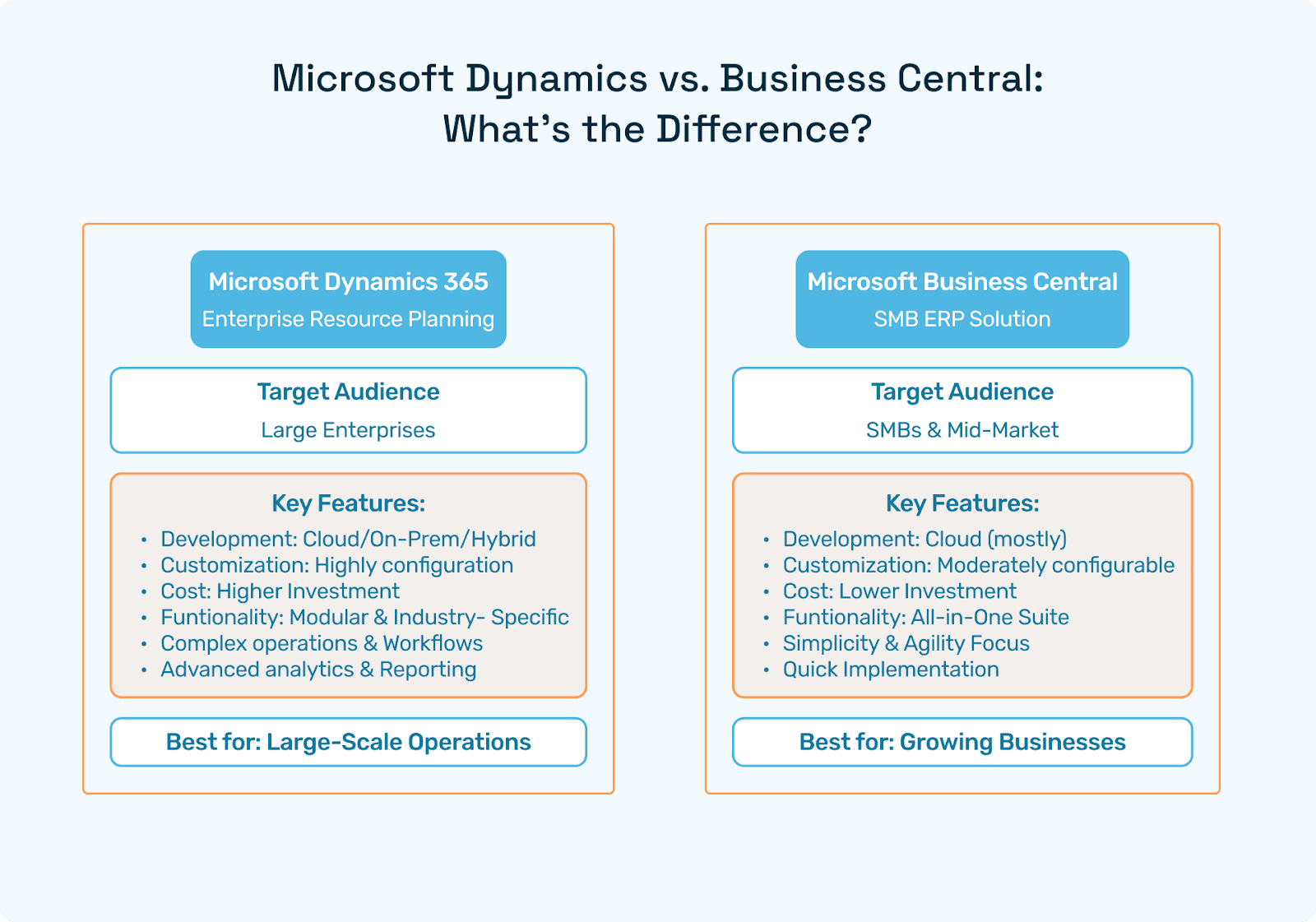
Microsoft Dynamics vs. Business Central: What’s the Difference?
Feature | Microsoft Dynamics 365 | Microsoft Business Central |
Target Audience | Large Enterprises | SMBs & Mid-Market |
Deployment | Cloud/On-Prem/Hybrid | Cloud (mostly) |
Customization | Highly Configurable | Moderately Configurable |
Cost | Higher | Lower |
Functionality | Modular & Industry-Specific | All-in-One Suite |
While Microsoft Dynamics ERP is built for large-scale operations, Microsoft Business Central offers simplicity and agility for growing businesses.
Benefits of Microsoft ERP for Mid-Market and Enterprise
End-to-end visibility across operations
Seamless Microsoft 365 and Power Platform integration
Scalable architecture for global expansion
Built-in AI insights for smarter decisions
Cloud-first, mobile-enabled interface
These benefits make Dynamic ERP solutions suitable for companies seeking modern, agile, and intelligent ERP.
Cloud vs. On-Premise Deployment: Dynamics ERP Flexibility
You can deploy Microsoft Dynamics ERP systems either:
Fully in the cloud (SaaS model)
On-premise in your data center
Or in a hybrid model
This flexibility supports a wide range of industry and compliance needs, especially for companies in finance, manufacturing, and healthcare.
Use Cases by Industry
Retail: Real-time inventory, omnichannel POS
Manufacturing: MRP, warehouse automation
Healthcare: Regulatory compliance, billing
Professional Services: Project accounting, time tracking
Construction: Job cost management
Why Companies Choose MSFT ERP Systems
Backed by Microsoft’s reliability and ecosystem
Deep integration with Outlook, Teams, and Excel
Built-in support for multiple currencies and languages
Frequent updates and AI enhancements
Many companies refer to this as their MSFT ERP transformation journey, powered by Microsoft’s trusted ecosystem.
How Hyperbots AI Co-Pilots Enhance Microsoft Dynamics & Business Central
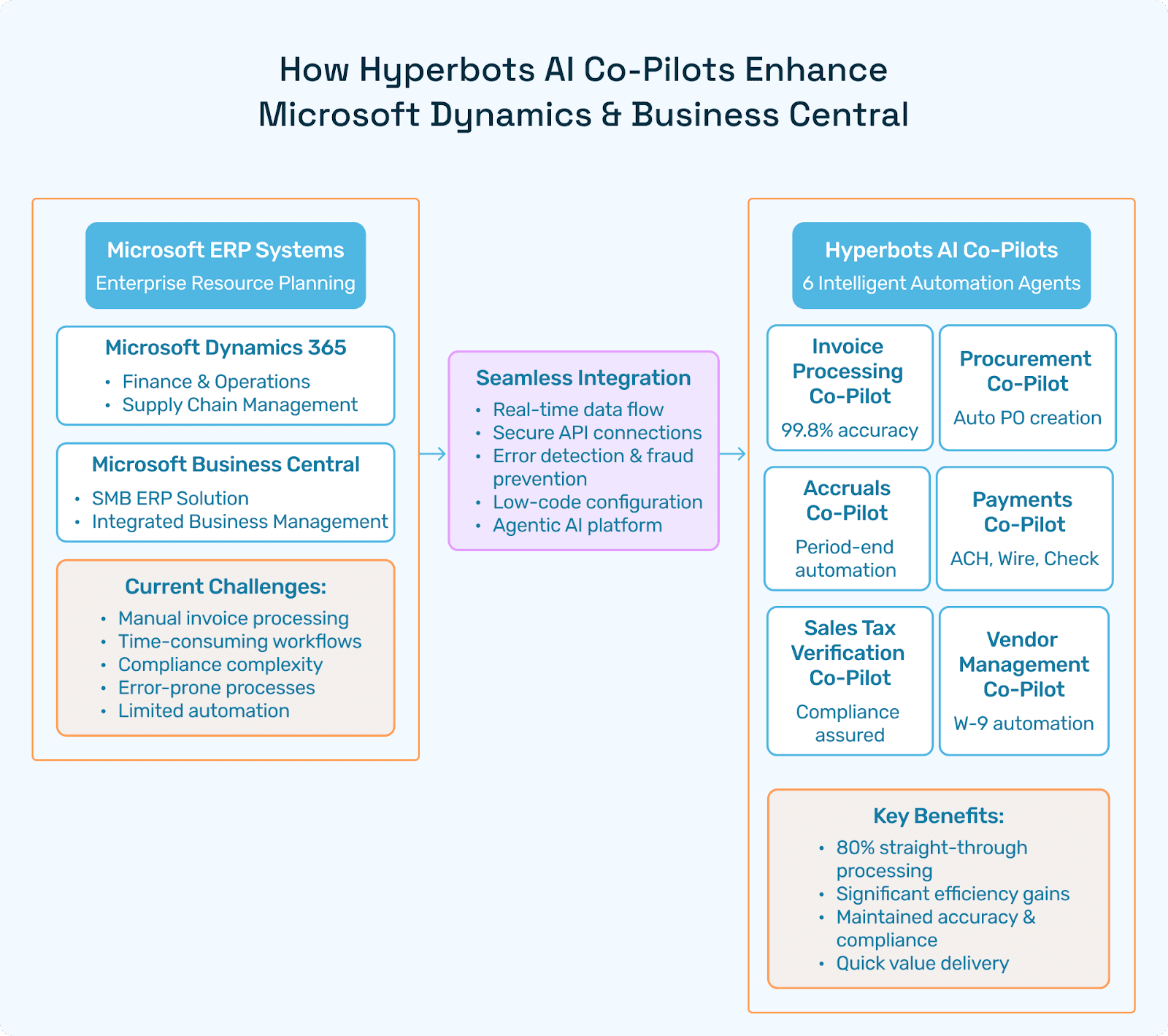
Hyperbots’ AI co-pilots supercharge Microsoft ERP systems by automating complex finance workflows. These AI agents seamlessly plug into both Microsoft Business Central and Microsoft Dynamics 365 platforms.
With Hyperbots, enterprises can unlock significant efficiency gains while maintaining accuracy and compliance.
Deep Dive into Hyperbots’ Six AI Co-Pilots
1. Invoice Processing Co-Pilot
Automates the full invoice lifecycle using advanced VLMs and LLMs. From PDF parsing to GL posting, it ensures 99.8% accuracy with 80% STP.
2. Procurement Co-Pilot
Creates purchase requisitions and POs automatically, accelerating workflows while enforcing procurement policies.
3. Accruals Co-Pilot
Performs accrual identification, booking, and reversals at period-end with full audit transparency.
4. Payments Co-Pilot
Suggests optimal timing for payments, manages approvals, and supports ACH, wires, and checks.
5. Sales Tax Verification Co-Pilot
Cross-verifies regional tax rates and regulations to ensure full compliance and reduce penalty risks.
6. Vendor Management Co-Pilot
Streamlines onboarding via automated W-9 verification and provides vendors with secure self-service portals.
Integrating Hyperbots with Microsoft ERP Systems
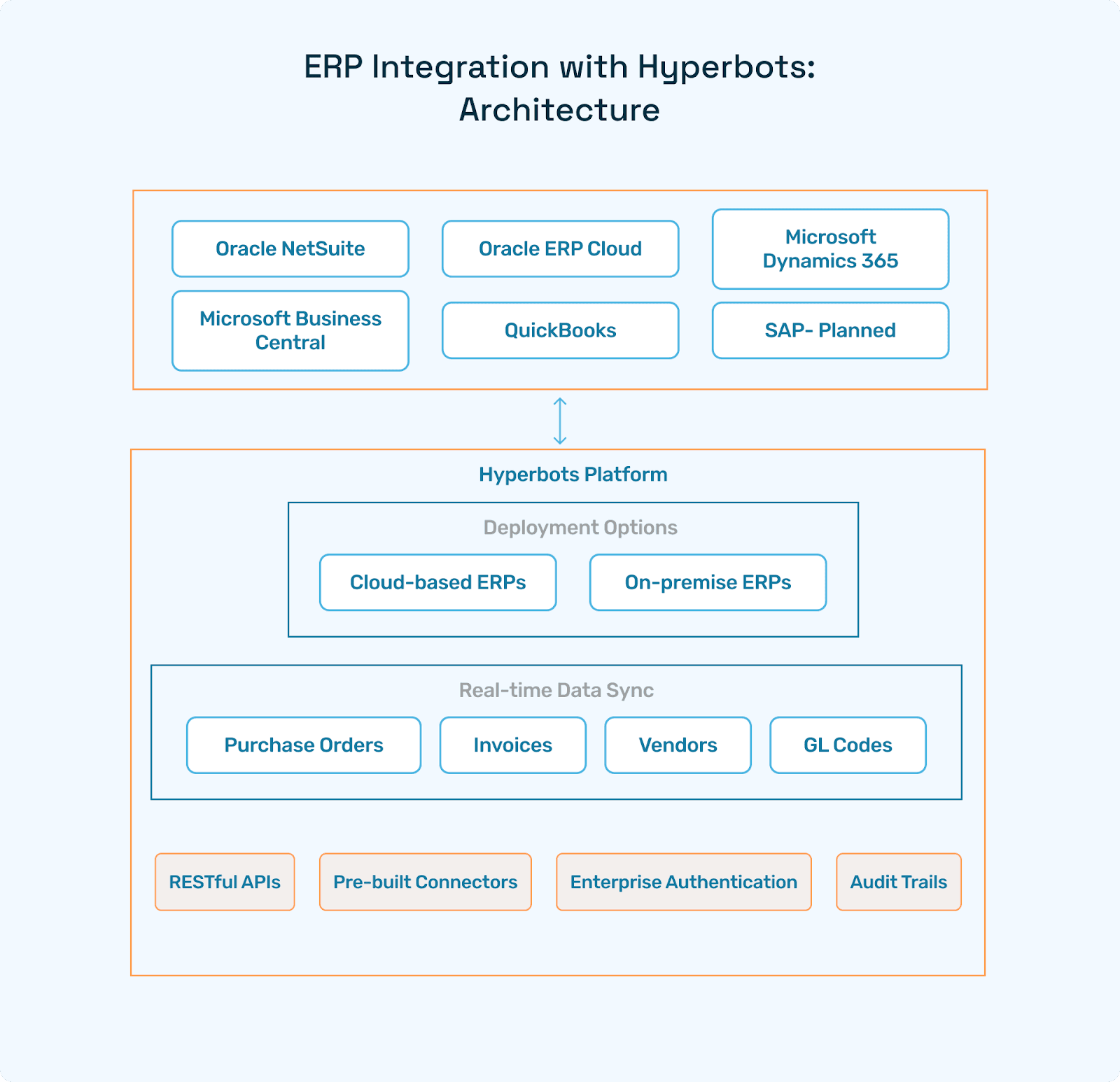
Hyperbots offers seamless real-time read/write integrations with Microsoft Dynamics and Business Central. The integration supports:
Secure data flow for invoices, vendors, and GL codes
Real-time error detection and fraud anomaly prevention
Low-code configuration using Hyperbots’ Agentic AI platform
This makes it easy for ERP consulting firms and Microsoft implementation partners to deliver value quickly.
Why Hyperbots is the Best AI Co-Pilot Suite for Microsoft ERP
Purpose-built for finance & accounting
Pre-trained on millions of finance documents
Uses Mixture-of-Experts models (MOE)
Agentic reasoning with summarization capabilities
Supports multi-language, multi-entity operations
Whether you're using Microsoft Dynamics 365 or Business Central, Hyperbots transforms your finance function into an AI-driven powerhouse.
Final Thoughts
Whether you're implementing Microsoft Business Central as your first ERP system or managing a global enterprise using Microsoft Dynamics 365, integrating Hyperbots’ AI co-pilots helps you accelerate ROI and productivity. From automating invoices and POs to intelligently managing accruals and payments, Hyperbots brings agentic intelligence to your Microsoft ERP ecosystem.