Financial ERP System: Streamlining Finance and Accounting in the Digital Era
Transform your ERP finance system with Hyperbots AI Co-pilots for smarter, faster, and ROI-driven operations.
Introduction to Financial ERP Systems
A financial ERP system is the heart of an enterprise's financial operations, integrating and automating core accounting, budgeting, planning, and reporting processes across departments. In today's digital economy, organizations demand real-time visibility, reduced manual effort, regulatory compliance, and error-free operations. That’s where ERP finance software shines.
What Is a Financial ERP System?
A financial ERP system (or ERP finance system) refers to Enterprise Resource Planning software that includes integrated financial management tools. It helps manage:
General Ledger (GL)
Accounts Payable (AP)
Accounts Receivable (AR)
Fixed Assets
Cash Flow
Bank Reconciliation
Tax Compliance
Financial Reporting and Analytics
Also known as ERP accounting packages, these platforms unify financial operations and provide a single source of truth, eliminating data silos.
ERP Comptable (French for “Accounting ERP”) is a popular term in multilingual regions, highlighting global demand.
Core Modules of an ERP Accounting System
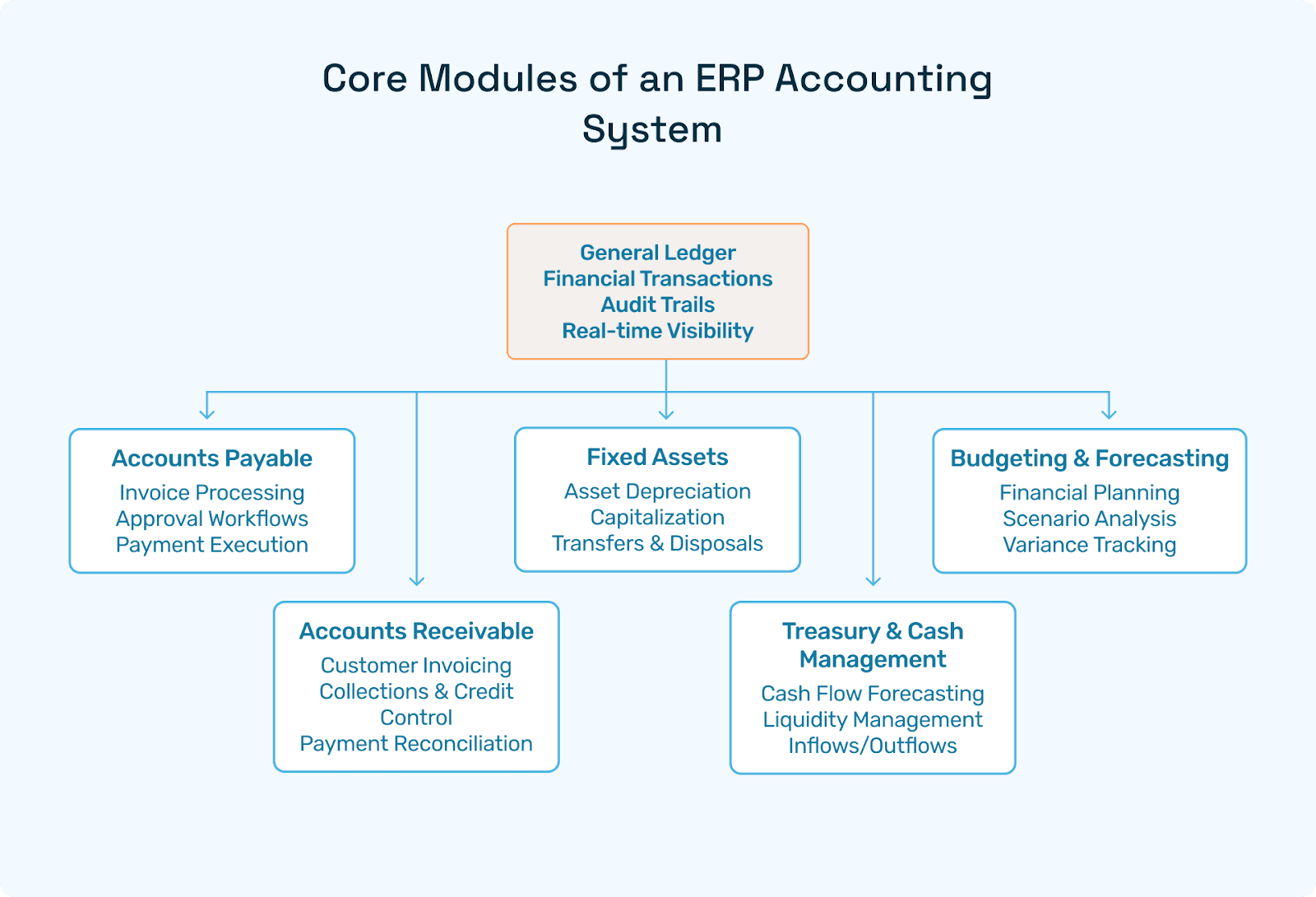
A powerful ERP accounting module includes the following key components:
1. General Ledger (GL)
Captures all financial transactions across business units, enabling complete audit trails and real-time financial visibility.
2. Accounts Payable (AP)
Automates supplier invoice processing, approval workflows, and payment execution.
3. Accounts Receivable (AR)
Manages customer invoicing, collections, credit control, and payment reconciliation.
4. Fixed Assets
Tracks asset depreciation, capitalization, transfers, and disposals.
5. Treasury and Cash Management
Enables forecasting and managing cash inflows/outflows to maintain liquidity.
6. Budgeting & Forecasting
Allows financial planning, what-if scenario analysis, and variance tracking.
ERP Financial Management System: Key Capabilities
A modern ERP financial management system helps organizations achieve:
Accurate and timely financial reporting
Multi-currency and multi-entity consolidation
Regulatory compliance (GAAP, IFRS, SOX)
Audit-readiness with traceability
Integration with operations for end-to-end process automation
Examples include MSFT ERP, NetSuite, Oracle ERP Cloud, Sage 300, and Microsoft Business Central.
Benefits of Using a Financial ERP System
Implementing ERP financial software brings transformative benefits:
Reduced manual effort through automation
Increased accuracy via standardized processes
Improved decision-making with real-time dashboards
Enhanced compliance and risk mitigation
Lower TCO by reducing redundant systems
ERP Implementation Strategy for Finance
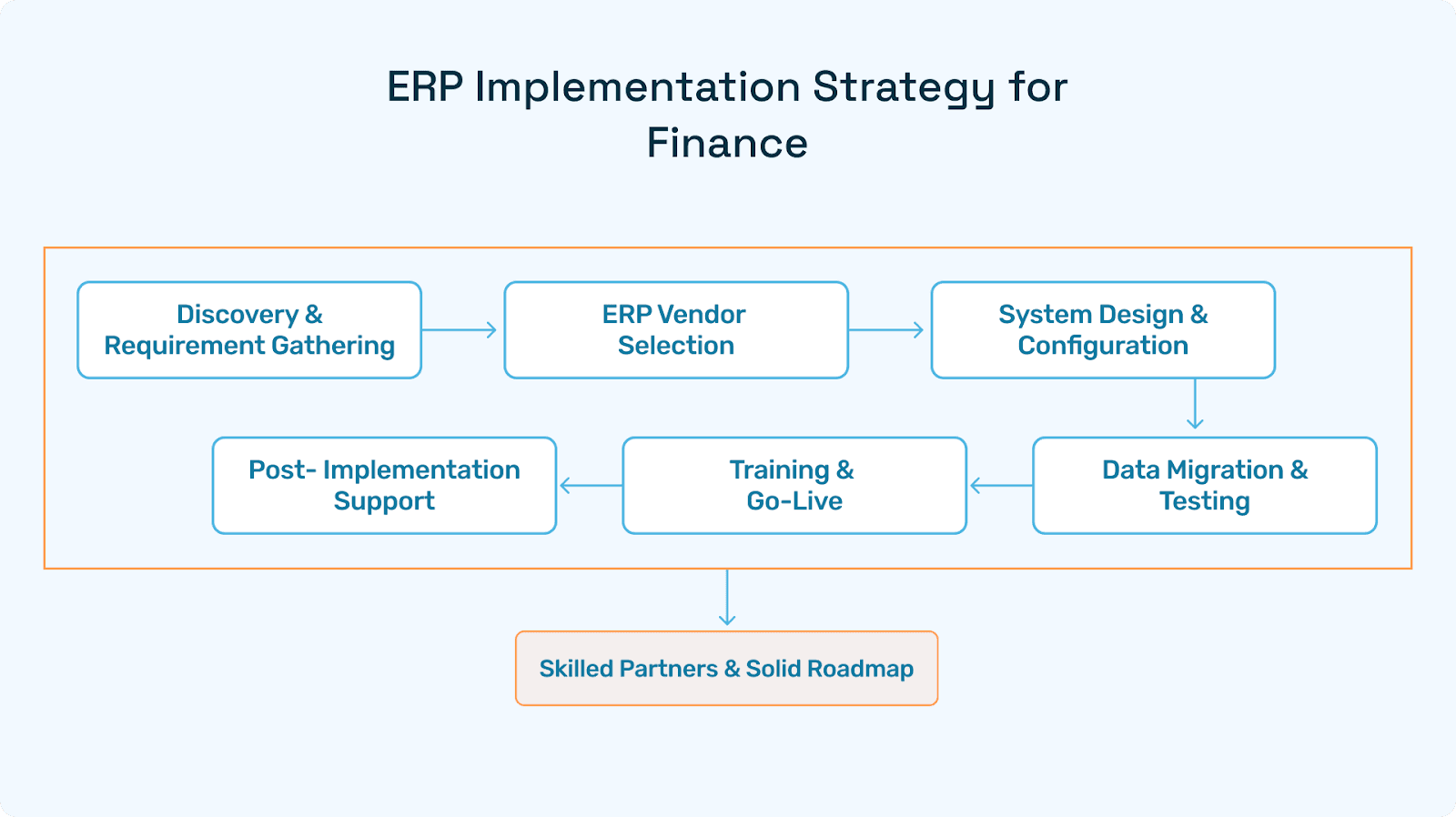
ERP implementation for finance follows a structured methodology, typically spanning these phases:
Discovery & Requirement Gathering
System Design & Configuration
Data Migration & Testing
Training & Go-live
Post-implementation Support
This end-to-end Enterprise Resource Planning (ERP) implementation requires skilled ERP partners transforming finance with AI and a solid roadmap.
How Hyperbots Enhances Financial ERP Systems
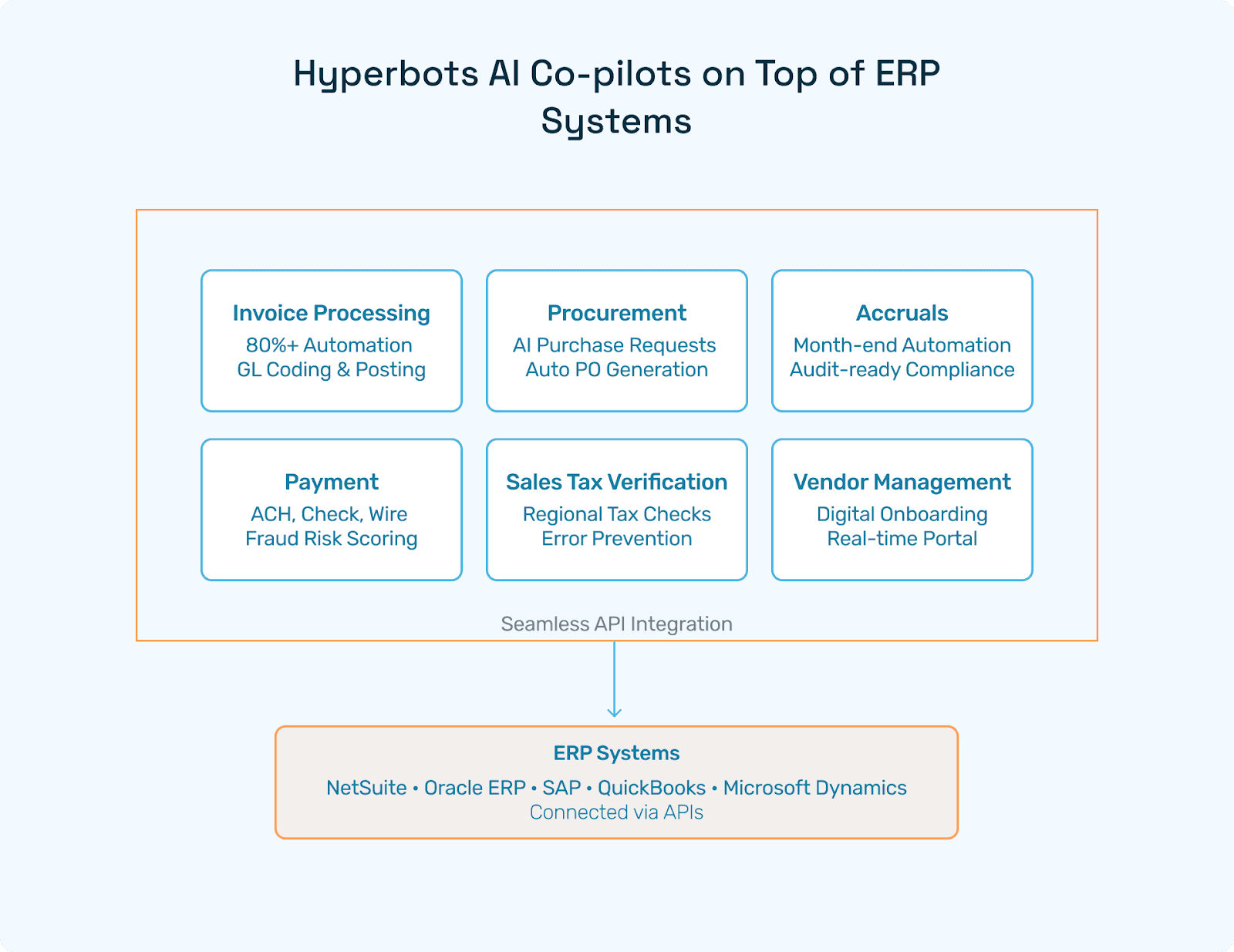
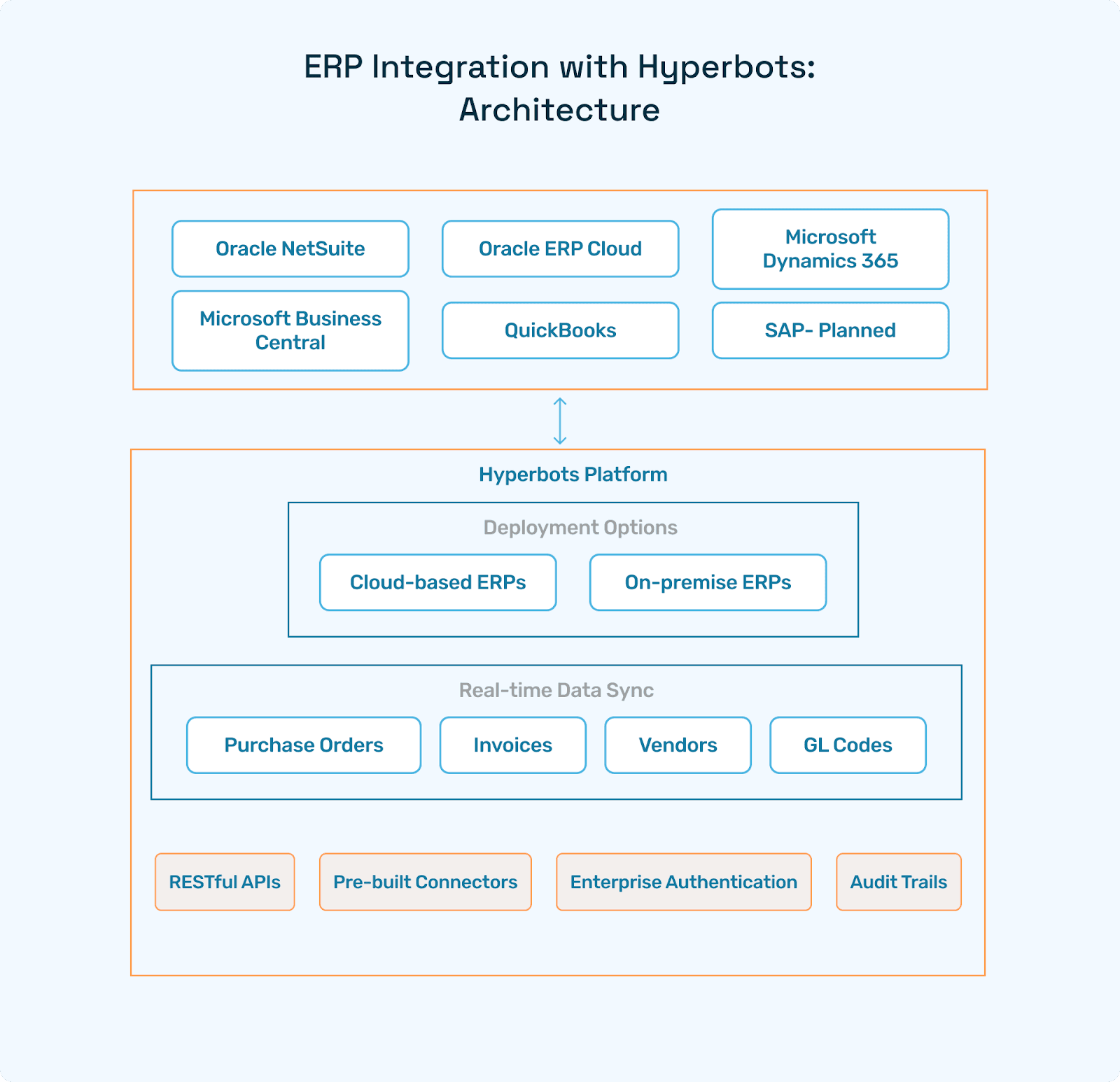
Hyperbots provides intelligent automation on top of financial ERPs like NetSuite, Oracle, Microsoft Dynamics, Sage 300, and others. Its AI Co-pilots are purpose-built to work with cloud ERP and on-premise ERP systems.
Hyperbots Co-pilot Suite Includes:
Invoice Processing Co-pilot – Delivers 80%+ straight-through processing using AI-driven discovery, validation, GL coding, and posting.
Procurement Co-pilot – Automates Purchase Requisition (PR) creation, PO generation, and vendor compliance.
Accruals Co-pilot – Auto-detects un-booked expenses, computes accruals, and reverses entries intelligently.
Payments Co-pilot – Recommends payment timing, executes multi-method payments, and ensures workflow control.
Sales Tax Verification Co-pilot – Verifies tax rates and jurisdictional accuracy using AI-led validation.
Vendor Management Co-pilot – Streamlines onboarding, document collection (e.g., W-9), and provides vendors with real-time visibility.
Industry Use Cases
Hyperbots Co-pilots are in use across:
Manufacturing – Automating GRN-match, vendor payments, and inventory cost accounting.
Healthcare – Enhancing compliance in vendor onboarding, GL coding for medical suppliers, and tax handling.
Construction – Managing subcontractor payments, lien waivers, and milestone-based accruals.
Retail & e-commerce – Syncing invoices with POs from global vendors and automating tax logic for multiple jurisdictions.
Hyperbots AI Co-pilots for Financial ERP Systems
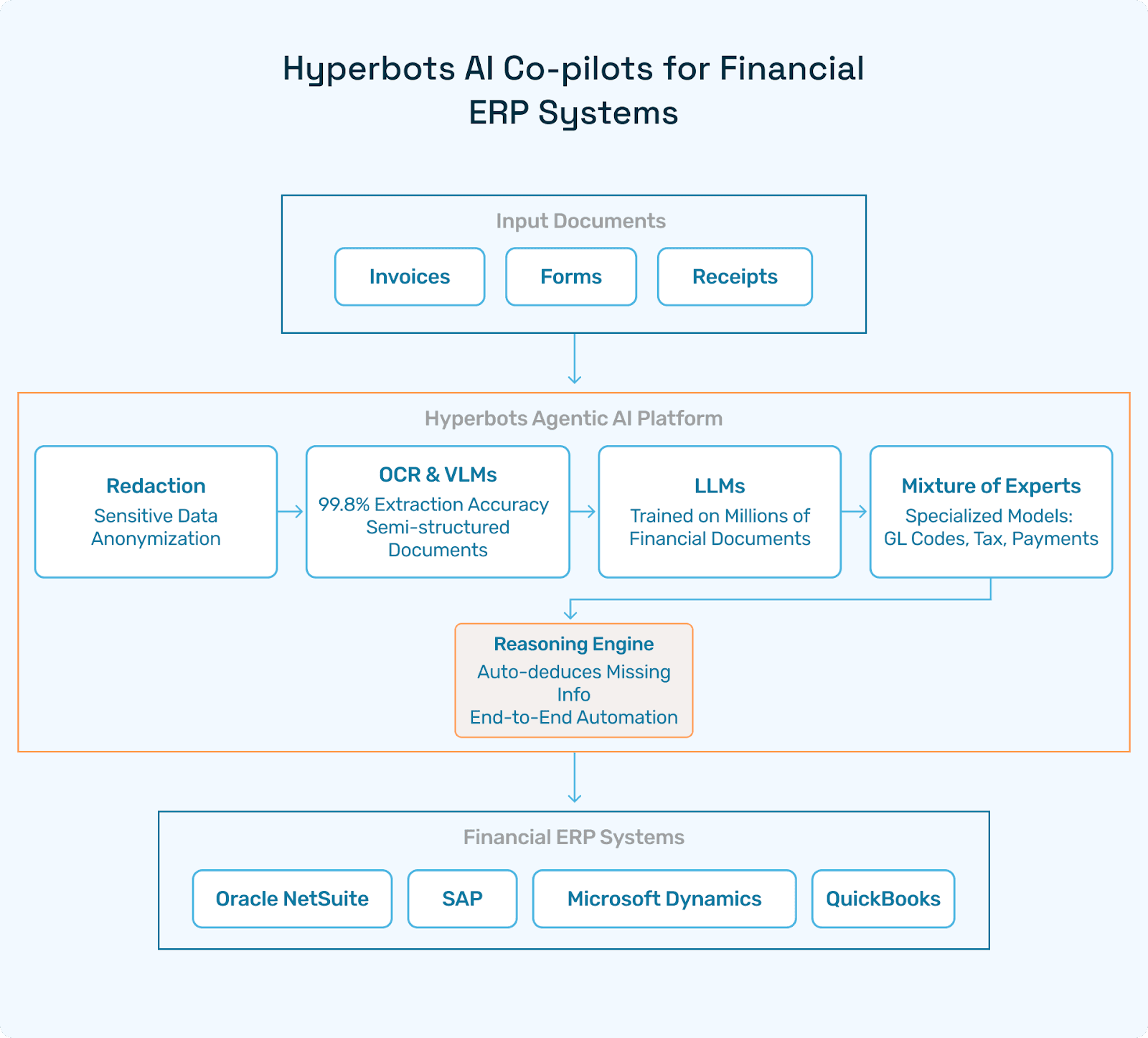
Each Co-pilot is backed by Hyperbots’ proprietary Agentic AI platform, which combines:
Redaction: All sensitive data anonymized using intelligent redaction engines.
OCR & VLMs: Vision-language models deliver 99.8% extraction accuracy for semi-structured invoices, forms, and receipts.
LLMs: Trained on millions of financial documents, enabling superior understanding of financial context.
Mixture of Experts (MoE): Multiple specialized models for GL codes, tax fields, and payment instructions.
Reasoning Engine: Automatically deduces missing information from context, enabling end-to-end automation.
This makes Hyperbots the best AI automation layer on top of any financial ERP system.
Hyperbots Agentic Platform Capabilities
The platform ensures:
ERP-grade security with redaction and permissioning
Plug-and-play integration with both cloud and on-premise ERPs
Continuous learning via enterprise-specific fine-tuning
Scalability to millions of transactions per month
Auditability and traceability across all decision-making steps
FAQs on Financial ERP Systems
Q1. What is an ERP financial management system?
It’s a software suite that manages core accounting, planning, and financial control functions across an organization.
Q2. How does Hyperbots improve financial ERP workflows?
By automating invoice processing, accruals, payments, tax verification, and vendor onboarding using AI-driven Co-pilots.
Q3. Is Hyperbots compatible with legacy ERPs?
Yes, Hyperbots integrates with on-premise ERPs using its proprietary connectors and secure agent architecture.
Q4. Can small and mid-size companies benefit from financial ERP systems?
Absolutely. Solutions like NetSuite, Business Central, and Hyperbots Co-pilots provide enterprise-grade capabilities with mid-market flexibility.
Conclusion
Choosing the right financial ERP system is a critical step toward operational efficiency, compliance, and financial control. But automation is key to unlocking its full value.
Hyperbots’ suite of AI Co-pilots for ERP financial systems transforms legacy workflows into intelligent, streamlined processes, delivering measurable ROI across industries.
Whether you’re on Oracle, NetSuite, Microsoft Dynamics, or any other ERP, Hyperbots empowers your finance team with intelligent agents that think, learn, and execute.
Ready to make your ERP finance system truly intelligent?
Get a demo of Hyperbots AI Co-pilots now.