ERP Automation: Modules & AI Co-pilots (2025 Guide)
ERP automation with Hyperbots means fewer exceptions, faster closes, and scalable, explainable workflows enterprises trust.
Executive Summary
CFOs, COOs, and CIOs are under pressure to do more with less: faster close, fewer errors, cleaner audits, and resilient supply chains, without ballooning headcount. ERP automation answers that pressure by removing manual friction from core processes (Procure-to-Pay, Order-to-Cash, Record-to-Report, Inventory/WMS, and Manufacturing) across the business modules in ERP. The best programs don’t just “integrate”; they establish machine-scale workflows that read documents, reason over transactions, apply policy, and post clean entries, end to end.
This practical guide shows how to architect and sequence ERP automation for enterprises. You’ll get a clear map of ERP system modules and the various ERP modules that matter, deep dives on manufacturing ERP modules (BOMs, routings, WOs, MRP/DRP, costing, quality), and a proven implementation blueprint. We detail where automation pays off first (invoice capture and matching, vendor onboarding, accruals, payments, tax verification), how to measure value (STP %, cycle time, DPO, discount capture, duplicate prevention), and how to harden controls (SoD, maker-checker, audit trails).
Finally, we show how Hyperbots sits as an AI layer on top of any ERP, cloud, or on-prem, to deliver finance-grade automation. With six purpose-built Co-pilots such as Invoice Processing, Procurement, Accruals, Payment, Sales Tax Verification, Vendor Management, Hyperbots turns intent into entries and exceptions into insights. Teams typically report high straight-through processing (STP), faster closes, and measurable cash benefits. If you’re evaluating ERP modules for the manufacturing industry or modernizing finance operations, this guide is your field manual.
What We Mean by ERP Automation
At its best, ERP automation means more than scripting or scheduled jobs. It’s the systematic removal of human re-keying and judgment calls that software can do repeatably:
Perception: Ingest unstructured content (PDF invoices, ASNs, statements) with vision models.
Reasoning: Apply business rules (tolerances, tax, freight allocation, landed cost), cross-check master and transaction data.
Action: Post clean entries, create/approve documents, and route edge cases with evidence.
Learning: Improve matches, thresholds, and suggestions over time from outcomes.
For ERP automation for enterprises, three constraints define success:
Data contracts between ERP system modules (IDs, statuses, approvals).
Policy engines that reflect real approval and tolerance logic.
Observability so Finance can trust what’s automated (and explain it to auditors).
Business Modules in ERP
The business modules in ERP, sometimes called the various ERP modules, underpin every automation decision. A pragmatic list:
Finance (Record-to-Report): GL, AP, AR, bank rec, fixed assets, tax, consolidation.
Procure-to-Pay (P2P): Requisitions, POs, receipts/service receipts, vendor bills, payments.
Order-to-Cash (O2C): Quotes/orders, delivery/ship, invoicing, collections.
Inventory & WMS: Receiving, putaway, bins, cycle counts, transfers, ASN/labels
Manufacturing: Items, BOMs, routings, work orders, MRP/DRP, costing, outside processing.
Quality (QMS): Inspections, NCR/CAPA, release/hold.
Projects/PSA: WBS, time/expense, billing (T&M/fixed/milestone), revenue recognition.
Maintenance (EAM/CMMS): PM schedules, work orders, spares.
CRM/CPQ: Pipeline, quoting, configuration rules.
Tax & Compliance: Indirect tax engines, electronic invoicing, document retention.
Analytics/BI: Operational and financial reporting, planning.
Automation amplifies the above, especially where documents meet decisions.
ERP System Modules: How They Interlock
A healthy automation program respects how ERP modules depend on one another:
AP ↔ P2P: Vendor bills must align with POs/service receipts and landed cost rules
AR ↔ O2C: Invoices must reflect shipment/completion facts, taxes, and contract terms.
Inventory/WMS ↔ Manufacturing: Issues/returns/completions must keep WIP and cost rolls honest.
Projects ↔ Finance: Time/expense and subcontract commitments drive billing and revenue.
Tax ↔ Everything: Jurisdiction, rate, exemptions—verified before posting.
Banking ↔ AP/AR: Payment runs and remittances; auto-reconciliation.
By codifying these interfaces and their approval semantics, you set a strong foundation for ERP automation for enterprises.
Manufacturing ERP Modules: From BOM to Close
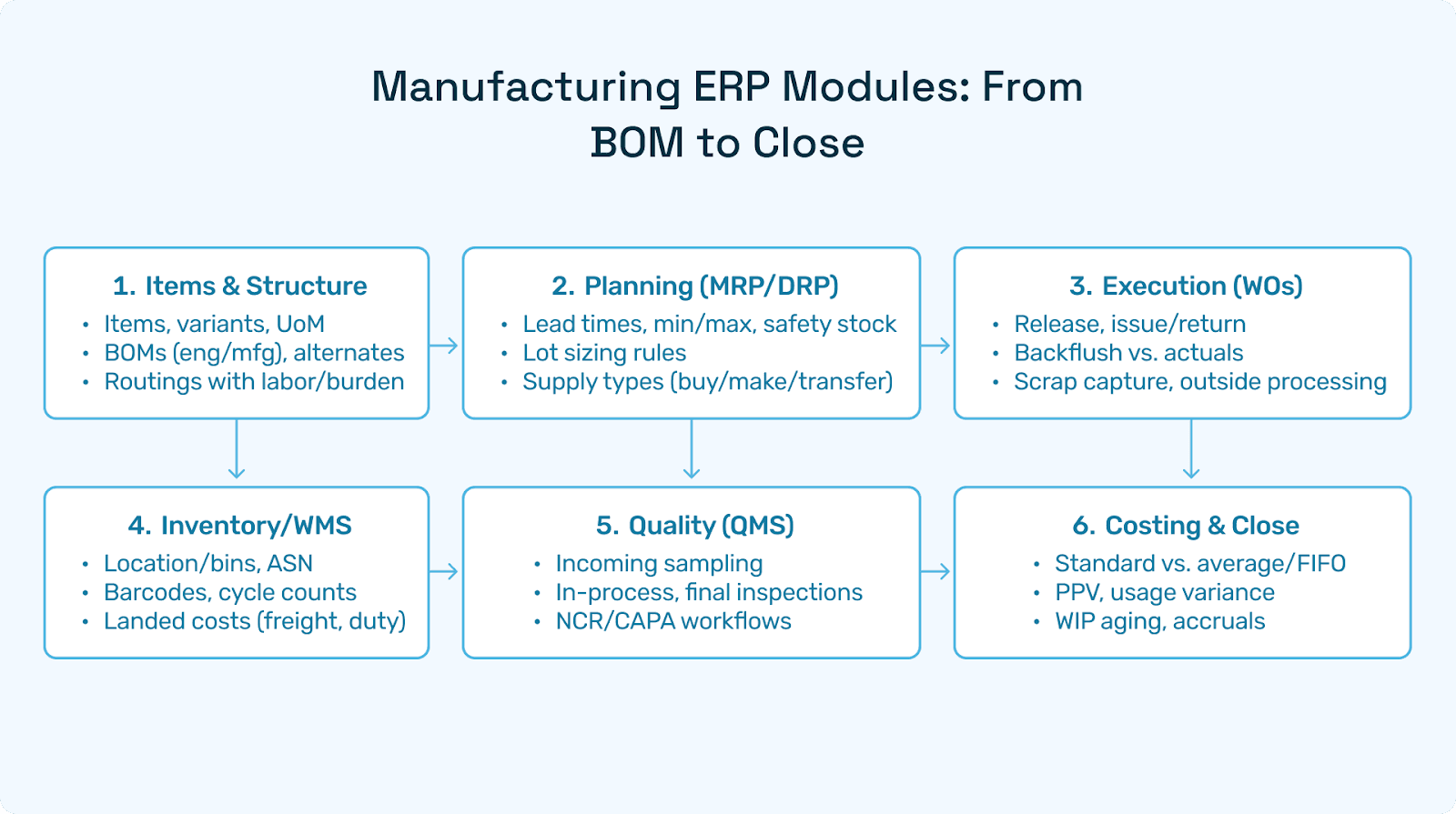
When people ask about ERP modules for the manufacturing industry, they’re usually after a working combo that covers planning, production, and cost integrity. The essential manufacturing ERP modules:
Items & Structures
Items, variants, UoM; BOMs (engineering/manufacturing), alternates; routings with labor/burden.
Planning (MRP/DRP)
Lead times, min/max, safety stock, lot sizing; supply types (buy/make/transfer).
Execution (WOs)
Release, issue/return, backflush vs. actuals, partial completions, scrap capture, outside processing.
Inventory/WMS
Locations/bins, ASN, barcodes, cycle counts; landed costs (freight, duty, tariffs).
Quality (QMS)
Incoming sampling, in-process, final inspections; holds/releases; NCR/CAPA workflows.
Costing & Close
Standard vs. average/FIFO; PPV, usage variance, outside processing variance; WIP aging; accruals for in-transit/unbilled services.
Automations here prevent manual leaks, especially around landed costs, outside processing, and three-way match edge cases.
Top Automation Plays (P2P, O2C, R2R)
Where ERP automation pays for itself first:
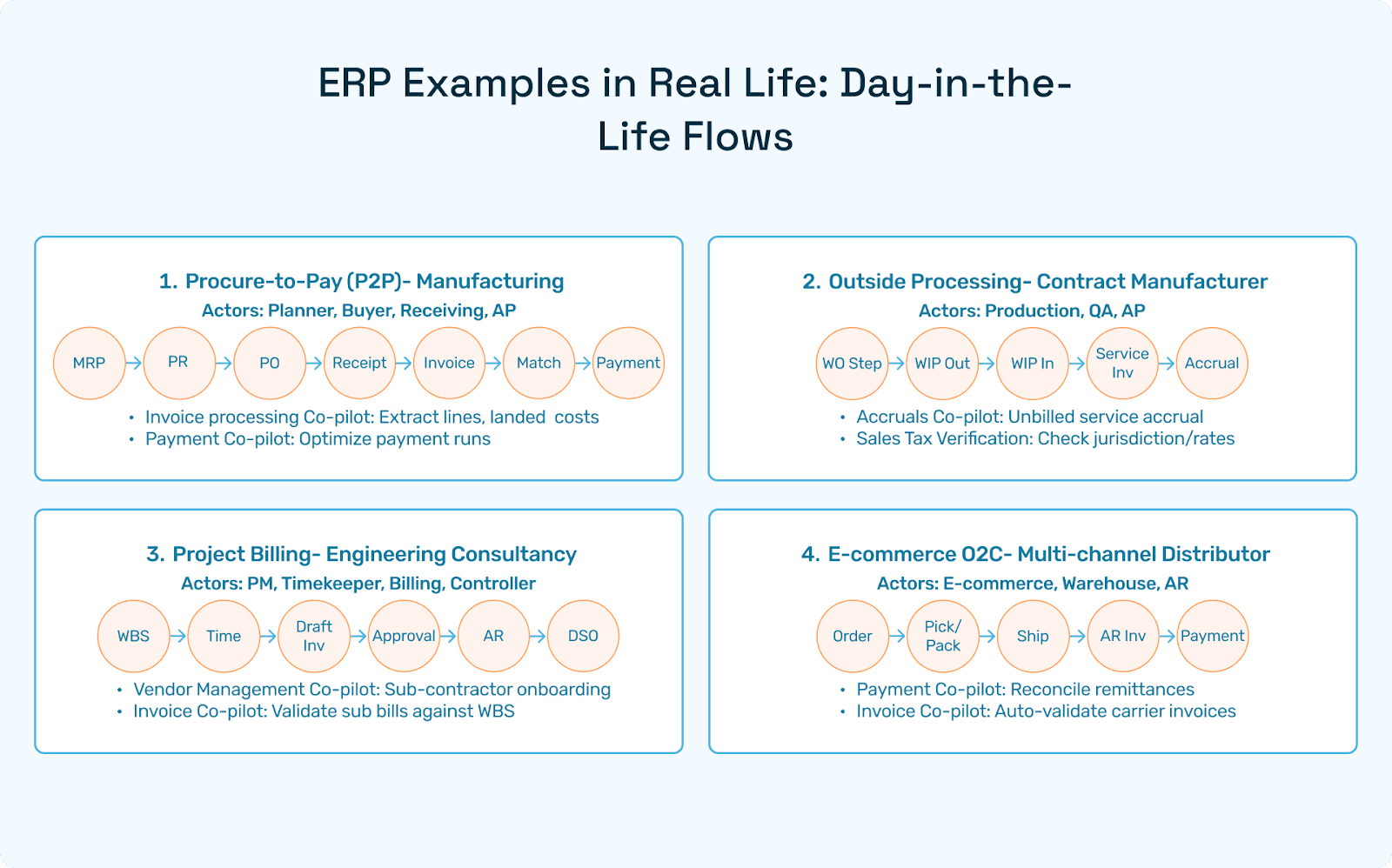
Procure-to-Pay (P2P)
Invoice capture & line-level extraction from PDFs/emails/portals.
2-/3-way match against PO/receipt/service operation with tolerances by vendor class.
Landed cost allocation to receipts by rule; use-tax suggestions when needed.
Accruals for unbilled services (outside processing, freight) and in-transit receipts.
Payment proposals optimized for terms/discounts/cash; bank validation; duplicate detection.
Order-to-Cash (O2C)
Order validation (credit, tax) and invoice generation off delivery/completion facts.
Cash application rules and auto-recon against remittance detail.
Dispute routing with supporting documents.
Record-to-Report (R2R)
Close checklists with evidence: WIP aging, unvouchered receipts, accruals, reconciliations.
Anomaly detection on GL postings and intercompany eliminations.
Audit pack generation - Te every entry to documents and approvals.
These plays rely on the business modules in ERP being cleanly defined and observable.
Hyperbots AI Co-pilots on Any ERP
Hyperbots is an AI layer designed to sit on top of your ERP and surrounding systems to automate the hardest finance steps, no rip-and-replace. The six Co-pilots are modular; begin with one and scale:
1) Invoice Processing Co-pilot —
Ingests vendor invoices from AP inbox/portals; extracts headers and line items (items, qty, price, tax, freight, incoterms).
Runs 2-/3-way match against POs, receipts, or service operations (great for outside processing).
Detects duplicates and suspicious patterns; posts clean vendor bills to ERP; routes only true exceptions.
2) Procurement Co-pilot —
Auto-creates PRs from MRP/DRP signals or min/max breaches; recommends suppliers and price breaks.
Drives policy-based approvals; writes POs (or subcontracts) to ERP; watches ASN/delivery adherence.
3) Accruals Co-pilot —
Suggests period-end accruals for unbilled services, in-transit receipts, and landed costs; auto-reverses with links to later bills.
4) Payment Co-pilot —
Builds payment proposals to maximize discounts and manage cash; validates vendor bank details; blocks duplicate/over-payments.
5) Sales Tax Verification Co-pilot —
Verifies jurisdiction and rates at the line level; flags anomalies before posting; preserves audit-ready evidence.
6) Vendor Management Co-pilot —
Onboards vendors with KYC, W-9/W-8, insurance; validates bank changes; keeps documents current; scores risk/performance.
Why this matters for manufacturers and enterprises
The Co-pilots understand ERP modules, manufacturing ERP modules, and routing/landed-cost contexts.
Teams see higher STP, fewer exceptions, faster approvals, and easier audits, exactly what ERP automation for enterprises promises but often fails to deliver without AI.
Hyperbots Platform Capabilities (for Automation)
Beyond individual Co-pilots, the platform complements ERP modules for the manufacturing industry and enterprise finance:
Finance-trained AI (HyperLM + MoE): Vision + layout + LLM ensemble tuned for invoices, POs, GRNs/ASNs, statements; strong on line-level reasoning.
Deep Connectors: Real-time read/write with major ERPs; Gmail/Outlook ingestion; bank rails; tax engines; shipping/3PL; EDI; portals.
Policy & Reasoning Engine: GL coding suggestions, tolerance rules by vendor class, maker-checker enforcement, approval nudges.
Security & SoD: Role-based access, bank-change validations, audit logs, redaction.
Scale & Reliability: Microservices (Java, Postgres, React), high-volume doc throughput, multi-entity & multi-currency.
Outcome-First Telemetry: Measures STP, cycle time, DPO, discount capture, duplicate prevention, and tax variance.
Put simply: Hyperbots is purpose-built to make ERP automation trustworthy, explainable, and scalable.
ROI: What Improves and How to Prove It
Leaders don’t buy automation, they buy outcomes. Typical, conservative ranges for a first year (scope-dependent):
Straight-Through Processing (STP): 60–90% of vendor bills processed with zero human touch after stabilization.
Invoice Cycle Time: 30–60% faster from receipt to post; faster GRN→bill match translates to earlier discount capture.
Duplicate/Over-Payment Prevention: Near-elimination through hash checks across vendor/date/amount/line patterns and bank validation.
Discount Capture: +0.5–2.0% of eligible spend via better timing and exception suppression.
Working Capital (DPO): +3–10 days through smarter payment proposals and fewer late-payment surprises.
Close Acceleration: 20–40% reduction in manual accrual work, with evidence-linked entries.
Audit Readiness: Automated, linked artifacts (PO, receipt, inspection, invoice, approval, payment) slash prep time.
Proving it: Baseline each KPI (e.g., STP %, invoice cycle time, duplicate rate, DPO, discount capture), run a 90-day pilot in one vendor/category cluster, then expand. Telemetry from Hyperbots provides before/after comparisons with drill-through evidence.
Implementation Blueprint & Timeline
A no-nonsense path to ERP automation for enterprises—works for single-site or multi-entity programs:
Phase 0 — Value & Scope (1 week)
Define target KPIs (STP%, invoice cycle time, duplicate rate, DPO, discount capture, WIP aging).
Select Release-1 scope: AP capture/match → Accruals → Payments → Sales Tax verification; optional vendor onboarding.
Pick 10–12 “day-in-the-life” scripts (e.g., 3-way match with landed cost, outside processing service bill, partial receipts).
Phase 1 — Design & Data (1 week)
Lock data contracts across ERP modules: document IDs, approval steps, tolerance policies.
Standardize masters (vendors with KYC/bank verified; items/UoM; locations/bins).
Landed-cost rules and tax treatments; maker-checker policies.
Phase 2 — Build & Integrate (4 weeks)
Connect AP inbox, banks, tax engine, shipping/3PL, portals; enable scanning/labels if WMS is in scope.
Configure Hyperbots Co-pilots; map exception queues and approver pathways.
Stand-up dashboards for STP, duplicates, and discount capture.
Phase 3 — Test & Train (1)
Unit → SIT → UAT using your scripts; include noisy PDFs, split shipments, currency/tax edge cases.
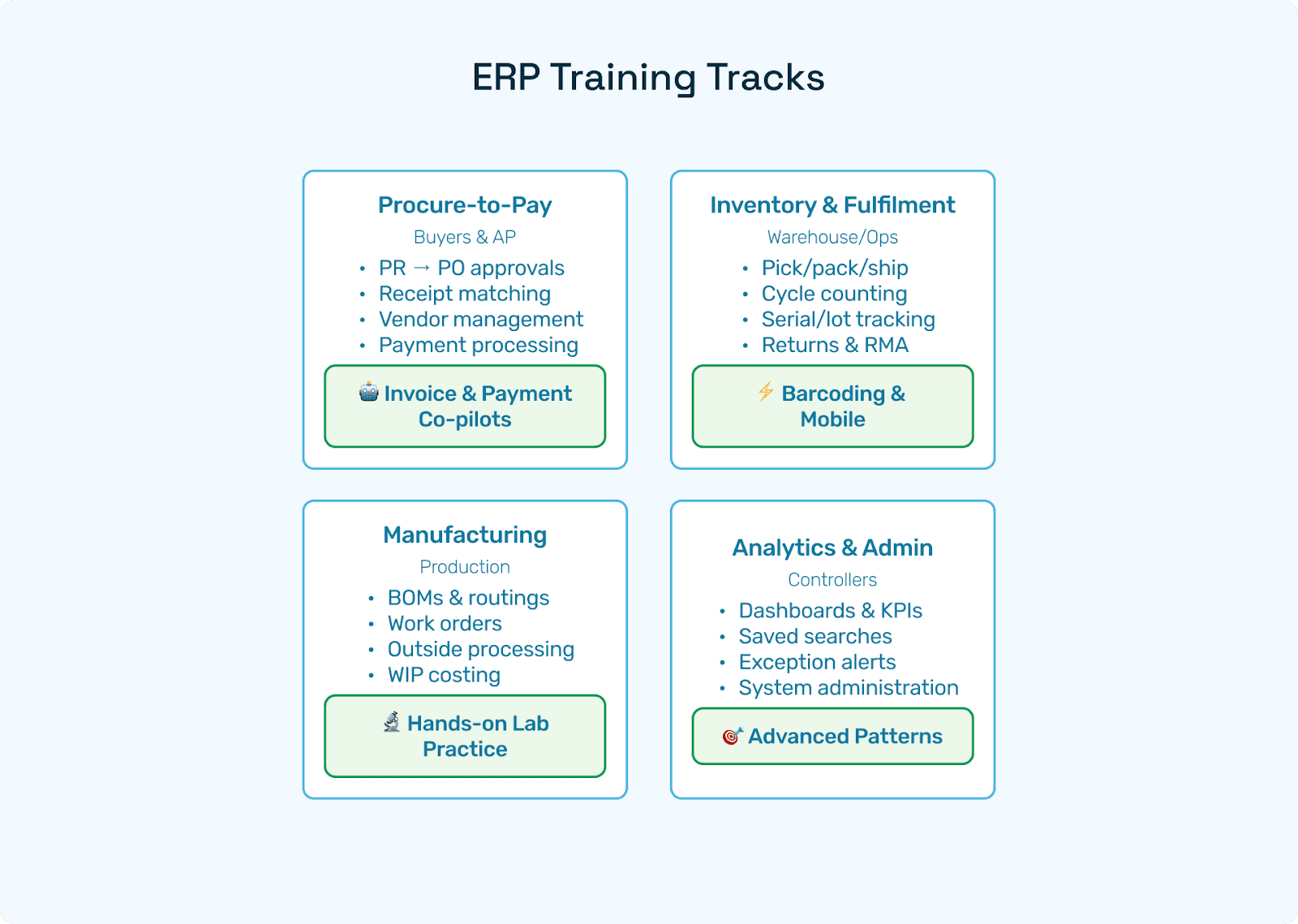
Role-based training (AP, buyers, planners, QA, approvers, controllers).
Trial cutover: Load vendors, price lists, tolerance rules; reconcile open POs/receipts.
Phase 4 — Cutover & Hypercare (2 weeks)
Freeze windows; final configs; go-live command center with daily KPI huddles.
Rapid fixes: tighten tolerances, tweak approvals, correct vendor data.
Plan Release-2 (e.g., O2C automations, project billing, cash application).
Typical timeline: 7-8 weeks for Release-1 in a focused P2P scope; expand in waves.
Data, Quality, and Controls
Automation is only as good as the data and policies behind it:
Masters: Vendors (terms, tax IDs, bank details verified), items (UoM, lead times), locations/bins, approval hierarchies.
Transactions: Open POs, receipts/service receipts, in-transit, unbilled services, open AP/AR, WIP balances.
Policies: Price/qty tolerances by vendor class, landed cost distribution, tax jurisdiction logic, and payment approval limits.
Validation: Trial loads and control totals; three-way reconciliations across Operations and Finance.
Quality: Inspection/CoC/COA capture for manufacturing; NCR/CAPA loop to Purchasing.
Hyperbots improves quality by validating vendor docs, catching mismatches before posting, and surfacing missing fields (terms, tax, bank) early.
KPIs and Dashboards That Matter
A balanced scorecard to prove ERP automation value:
Finance/AP
STP %, first-pass match %, invoice cycle time, duplicate rate, DPO, discount capture, landed cost variance, tax variance.
Operations/Inventory
WIP aging, days at CM/vendor, cycle count accuracy, traceability response time.
Manufacturing
OTD, first-pass yield, scrap/rework, outside processing variance, standard vs. actual cost.
Risk/Compliance
Vendor KYC completeness, bank change validations, audit findings closed, and exceptions aging.
All dashboards should support drill-through to evidence (PO, receipt, invoice, approval, payment).
Security, SoD, and Audit Readiness
Enterprise-grade ERP automation for enterprises is inseparable from controls:
SoD & Maker-Checker: Especially for vendor banking, journal postings, and payment approvals.
Immutable Audit Trails: Link each posting to its upstream artifacts.
PII/Financial Data Handling: Encryption at rest/in transit, role-based redaction.
Environment Hygiene: Dev/test/prod separation; migration approvals; versioned policies.
Resilience: Retries, idempotency keys, and dead-letter queues in integrations.
Hyperbots enforces maker-checker for bank changes, maintains audit logs, and keeps evidence chains intact.
FAQs
Q1. Is “ERP automation” just RPA or scripts?
A: No. True ERP automation combines perception (document understanding), reasoning (policy/tolerance logic), and action (posting/approvals) with learning and observability using Agentic AI
Q2. Where should we start?
A: AP capture and 2-/3-way match with landed-cost and tax verification delivers fast ROI. Then add accruals, payment proposals, and vendor onboarding.
Q3. Will this work if our ERP is older or on-prem?
A: Yes. Hyperbots connects via email ingestion and API/file interfaces. You can still automate the finance spine without a rip-and-replace.
Q4. What about ERP modules for manufacturing industry specifics?
A: Automate outside-processing service billing, landed-cost allocation, and inspection evidence capture; keep WIP and cost rolls clean.
Q5. How do we avoid “black-box AI”?
A: Insist on explainability: show the source documents, match logic, tolerance checks, and approval trails alongside every automated decision.
Q6. How long to see results?
A: Most teams see measurable improvements within a quarter for P2P scopes; full programs expand in waves across O2C and R2R.
Q7. Which KPIs prove success?
A: STP %, invoice cycle time, duplicate rate, DPO, discount capture, landed cost variance, tax variance, and WIP aging.