ERP Software Examples: Real-World Guide (2025)
Turn ERP examples into outcomes, cleaner closes, stronger cash, and scalable automation with Hyperbots.
Executive Summary
We start with vendor-neutral explanations, what are some examples of ERP, where each system tends to fit, and how to match the software to business model, size, and compliance needs. You’ll find curated crm and ERP software examples (popular pairings), ERP accounting software examples (what Finance actually uses day-to-day), and ERP examples in real life across manufacturing, distribution, professional services, and e-commerce. We also include SAP ERP system examples to illustrate how large enterprises model processes.
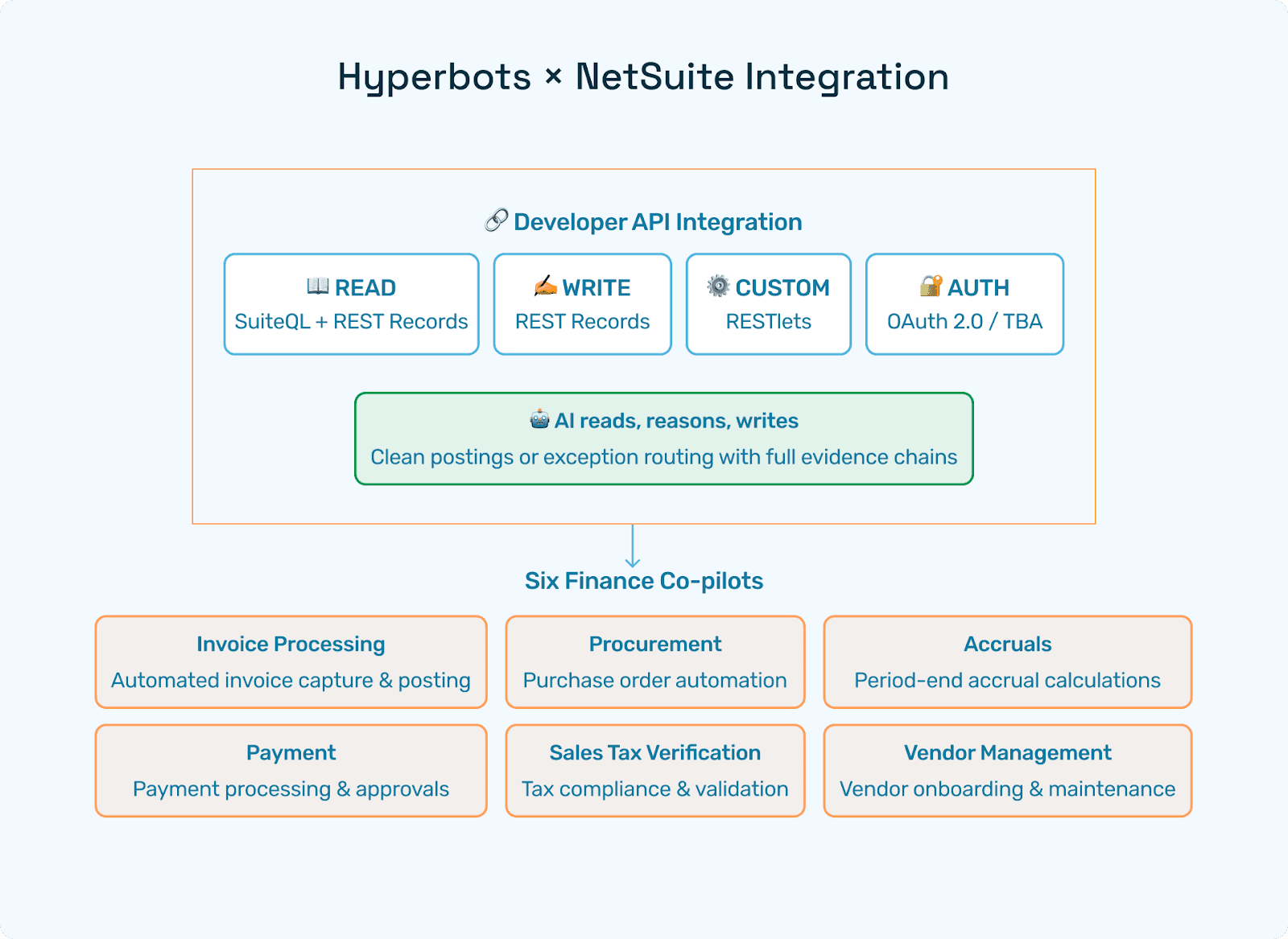
Then we overlay automation. Hyperbots provides six Finance-grade AI Co-pilots that sit on top of any ERP: Invoice Processing, Procurement, Accruals, Payment, Sales Tax Verification, and Vendor Management. This transforms back-office friction into explainable, policy-aware ERP automation. Throughout the guide, we show how Hyperbots accelerates Procure-to-Pay (P2P), Record-to-Report (R2R), and project accounting, making these ERP software examples in real life actually deliver measurable ROI.
Finally, we include a practical catalog of ERP system example company archetypes (small, mid-market, enterprise), ERP company names, and a library of ERP sample artifacts (templates and flows) to copy.
What Counts as an “ERP Software Example”?
People often ask, “What are some examples of ERP?” The honest answer: any system that is the operational and financial system of record, tying together modules for Finance (GL/AP/AR), Procurement, Inventory/WMS, Manufacturing (if relevant), Projects/PSA, and basic CRM/order management. So, ERP software examples are concrete, named platforms, and the real workflows they enable.
There are three kinds of examples worth studying:
Vendor Examples — Named systems (e.g., SAP S/4HANA, Oracle Fusion Cloud ERP, Microsoft Dynamics 365 Finance & Supply Chain, NetSuite, Infor CloudSuite Industrial/SyteLine, IFS Cloud, Epicor Kinetic, Sage Intacct/X3, Acumatica, Odoo, QAD, Plex, SYSPRO, Priority, Unit4). These are the erp company names you’ll hear most often.
Process Examples — Walkthroughs of P2P, O2C, R2R, and manufacturing flows. These become ERP system sample patterns you can copy.
AI Implementation Examples — Phased programs (4 weeks per wave) with data readiness, integrations, and controls. These ERP implementation examples prevent expensive surprises.
Because you asked for ERP software examples in real life, we’ll keep our focus squarely on how the platforms are used, not just what they’re called.
ERP Company Names: Market Map (2025)
Here’s a practical market map of companies that use ERP software and the platforms they often evaluate. This is not “best” or “ranked,” just a field guide:
Enterprise / Global (complex, multi-entity, regulated)
SAP S/4HANA — Enterprise backbone, deep manufacturing and finance controls; huge ecosystem.
Oracle Fusion Cloud ERP — Strong financials, procurement, project financial management; global scale.
Microsoft Dynamics 365 Finance & Supply Chain — Flexible, Azure-native, strong ISV ecosystem.
IFS Cloud — Asset- and project-centric industries (aerospace/defense, energy, service).
Upper Mid-Market / Subsidiaries
Oracle NetSuite — Cloud ERP popular with fast-growing companies; commerce/wholesale/manufacturing.
Infor CloudSuite Industrial (SyteLine) / CloudSuite Distribution — Manufacturing & distribution depth.
Epicor Kinetic — Discrete manufacturing, job shops; plant-friendly.
QAD — Automotive, F&B, life sciences manufacturing footprint.
Sage X3 / Sage Intacct — Distribution/manufacturing (X3), finance/PSA strength (Intacct).
Plex Smart Manufacturing Platform (Rockwell Automation) — Cloud MES/ERP blend for plants.
SYSPRO — Industrial SMB/mid-market focus; manufacturing/distribution.
SMB / Mid-Market (fast time-to-value)
Acumatica — Cloud ERP, distribution/manufacturing/construction editions; consumption-based pricing.
Odoo — Modular ERP/CRM/apps; open ecosystem; rapid deployment for SMBs.
Priority ERP, Unit4 (services), Deltek (PSA/ERP) — Industry-focused options.
CRM and ERP Software Examples (Popular Pairings)
Real organizations blend CRM + ERP. Here are credible crm and erp software examples used across industries:
Salesforce CRM ↔ NetSuite / Microsoft D365 / SAP — CRM for pipeline & quoting; ERP for order, inventory, fulfillment, billing.
Microsoft Dynamics 365 Sales ↔ Dynamics 365 Finance & Supply Chain — Single-stack convenience; native data model.
HubSpot CRM ↔ NetSuite / Acumatica / Odoo — SMB growth stacks; MAP + CRM + ERP
Zoho CRM ↔ Odoo / Acumatica — Cost-effective SMB pairing; APIs are straightforward.
SAP Sales Cloud ↔ S/4HANA — Enterprise pairing with deep CPQ and pricing options.
Tip: For companies that use ERP successfully with CRM, align masters (customers, items), price logic, tax, and approvals. Then tie documents: Quote → Order → Delivery → Invoice → Cash.
ERP Accounting Software Examples (What Finance Uses)
“ERP accounting software examples” aren’t separate tools—they’re the Finance modules inside ERP that make auditors happy:
General Ledger (GL) — Multi-entity, multi-currency, segment structure (entity, cost center, product, project).
Accounts Payable (AP) — Vendor bills, three-way match, tolerances, approvals, payment runs.
Accounts Receivable (AR) — Invoicing (O2C, project billing), dunning, cash application.
Fixed Assets — Capitalization, depreciation methods, asset tracking.
Tax — Sales/use/VAT, exemptions, electronic invoicing (where required).
Consolidation & Intercompany — Eliminations, FX translations, management vs. statutory books.
Close & Controls — Checklists, reconciliations, variance analysis, and audit evidence.
These appear in every major platform (SAP, Oracle, Microsoft, Infor, NetSuite, Epicor, Sage, Acumatica, etc.) and are the backbone of companies using ERP system deployments.
ERP System Examples by Company Size
One size doesn’t fit all. Here are archetypal ERP system examples matched to stage and complexity:
A) Small / Lower Mid-Market (single site, fast growth)
Typical stack: Acumatica / NetSuite / Odoo/QuickBooks + shipping/tax + bank feeds.
Why it works: Fast go-live, out-of-the-box WMS/MRP basics, app connectors.
Watchouts: Keep the core clean; add MES/QMS only when needed.
B) Mid-Market (multi-site, contract manufacturing, light compliance)
Typical stack: NetSuite / Infor CSI / Epicor Kinetic + MES/WMS + PLM + tax engine.
Why it works: Deeper manufacturing, better planning, scalable integrations.
Watchouts: Landed costs, outside processing, and inventory accuracy are make-or-break.
C) Upper Mid-Market & Enterprise (regulated, multi-entity)
Typical stack: SAP S/4HANA / Oracle Fusion / Microsoft D365 FSCM + PLM + QMS + EDI + data lake.
Why it works: Complex controls, global operations, strong partner ecosystem.
Watchouts: Over-customization and change management debt.
These patterns mirror what we see across companies that use Enterprise Resource Planning globally.
ERP Software Examples by Industry
Below are ERP software examples in real life by sector, with why leaders choose them. (You’ll see overlaps—that’s normal.)
Manufacturing (discrete, batch/process, job shop)
Examples: SAP S/4HANA, Oracle Fusion, Microsoft D365, Infor CloudSuite Industrial, QAD, Epicor Kinetic, Plex, SYSPRO, NetSuite, Acumatica, Odoo.
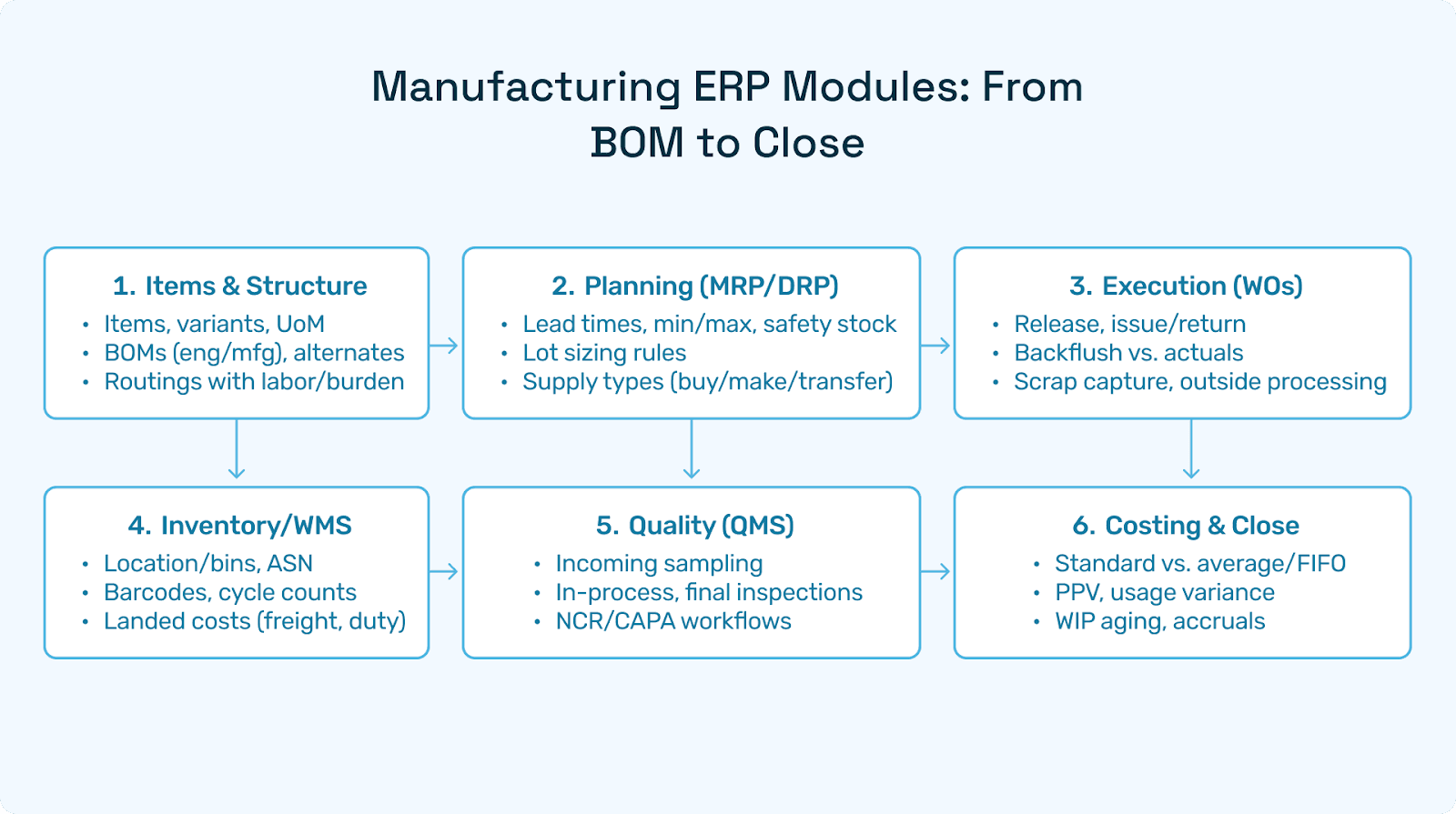
Why: BOMs/routings, MRP/DRP, WIP, costing, QMS, outside processing, serial/lot traceability.
Keyword fit: ERP modules for the manufacturing industry, manufacturing ERP modules.
Distribution & Wholesale
Examples: NetSuite, Acumatica, Infor CloudSuite Distribution, Microsoft D365, SAP S/4HANA (large), Sage X3, Odoo.
Why: Multi-warehouse WMS, ASN/labels, demand planning, EDI, landed costs.
Professional Services & Engineering
Examples: Microsoft D365 + PSA, Oracle Fusion + PPM, NetSuite + SRP, Unit4, Deltek, Sage Intacct + project modules.
Why: WBS, time/expense, utilization, complex billing (T&M/fixed/milestone), revenue recognition.
Food & Beverage / CPG
Examples: SAP, Oracle, Infor CloudSuite Food & Bev, QAD, Plex, SYSPRO, NetSuite.
Why: Recipe/formula management, FEFO, quality/COA, traceability, compliance.
Life Sciences & Regulated
Examples: SAP/Oracle/Microsoft + validated QMS; QAD; Infor (verticals).
Why: Validation packs, audit trails, CAPA/NCR, serialization, EDI.
E-commerce / DTC
Examples: NetSuite (SuiteCommerce), Acumatica + Shopify/BigCommerce, Odoo.
Why: Orders, fulfillment, returns, inventory, multi-channel integration.
These illustrate businesses that use ERP platforms for different reasons—fit wins over fame.
SAP ERP System Examples (S/4HANA & Business One)
Because you asked about SAP ERP system examples, here’s a concise, hands-on view:
S/4HANA Manufacturing & Finance (Enterprise)
Scenario: Global discrete manufacturer with outside processing.
Flow: MRP → Purchase requisitions → POs (materials + subcontracting) → Goods receipts & service entry sheets → Three-way match → Vendor bill → Payment proposal.
Finance touchpoints: Landed costs, tax determination, PPV, WIP close, and intercompany eliminations.
S/4HANA Order-to-Cash
Scenario: Make-to-order with configurable products.
Flow: Sales order (variant config) → Production order → Delivery → Billing → Cash app.
Finance touchpoints: Revenue recognition, FX, and credit management.
SAP Business One (SMB)
Scenario: Single-site manufacturer/distributor.
Flow: Item/BOM setup → Work orders → Issues/Completions → Delivery → AR invoice.
Finance touchpoints: Simple costing, bank feeds, taxes, basic consolidation (via add-ons).
These are practical ERP system examples you can adapt—regardless of vendor.
ERP Examples in Real Life: Day-in-the-Life Flows
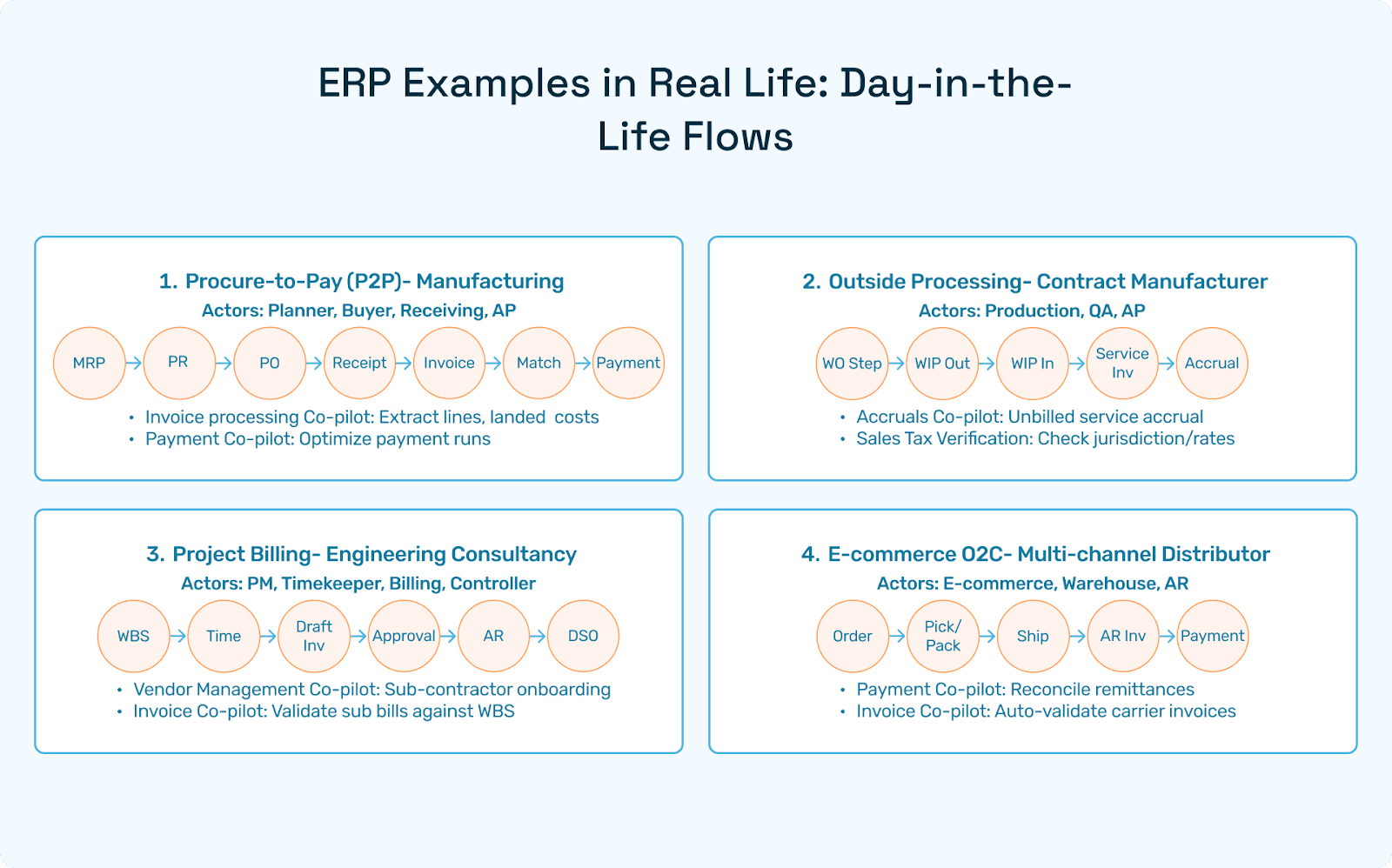
To fulfill the intent behind ERP examples in real life and ERP software examples in real life, here are cross-industry flows:
1) Procure-to-Pay (P2P) — Manufacturing
Actors: Planner, Buyer, Receiving, AP.
Steps: MRP drives PR → PO to supplier → ASN received → Goods receipt (with lot/serial) → Vendor invoice → Three-way match → Payment.
Automation: Invoice Processing Co-pilot extracts lines, allocates freight/duty as landed cost, and performs 2/3-way matching; Payment Co-pilot optimizes payment runs.
2) Outside Processing — Contract Manufacturer
Actors: Production, QA, AP.
Steps: Work order step outsourced → WIP shipped → WIP received → Service invoice from CM → Accrued if unbilled at close → Three-way match/service entry sheet.
Automation: Accruals Co-pilot suggests unbilled service accrual; Sales Tax Verification Co-pilot checks jurisdiction/rates.
3) Project Billing — Engineering Consultancy
Actors: PM, Timekeeper, Billing, Controller.
Steps: WBS setup → Timesheets/expense capture → Draft invoice (T&M/fixed/milestone) → Approval → AR → DSO tracking.
Automation: Vendor Management Co-pilot for sub-contractor onboarding; Invoice Co-pilot reads and validates sub-bills against WBS.
4) E-commerce O2C — Multi-channel Distributor
Actors: E-commerce, Warehouse, AR.
Steps: Order ingested → Pick/pack/ship → AR invoice → Payment reconciliation → Return/RMA loop.
Automation: Payment Co-pilot reconciles remittances; Invoice Co-pilot auto-validates carrier invoices (freight, surcharges).
Each scenario doubles as an ERP sample workflow your teams can use for UAT scripts.
ERP Implementation Examples (3 Proven Paths)
Because “companies that use ERP” succeed or fail on execution, here are proven AI ERP implementation examples with timelines and deliverables:
A) SMB (4 weeks)
Scope: AI agents for Invoice processing, payment processing, procurement, and vendor management
Hyperbots: Start with Invoice Processing for fast STP %, then add Payment.
B) Mid-Market Modernization (6 weeks)
Scope: AI agents for Invoice processing, payment processing, procurement, vendor management, and Accruals.
Key moves: Integration contracts (IDs/statuses/approvals); landed-cost policies; tolerance rules by vendor class.
Hyperbots: Layer Accruals and Sales Tax Verification; tighten duplicate detection.
C) Enterprise Wave Program (8-12 weeks)
Scope: AI agents for Invoice processing, payment processing, procurement, vendor management, and Accruals.
Hyperbots: All Co-pilots
These ERP system sample timelines keep risks contained and value flowing.
ERP Automation Sample Library: Templates You Can Copy
Use these ERP software sample artifacts as starting points:
P2P UAT Script (excerpt)
PO with price breaks and tolerances → partial receipt → landed cost allocation → invoice with mismatch → exception route → fix → match → payment proposal.
COA & Segments (example)
Entity-Dept-Product-Project structure; reserve ranges for intercompany and eliminations.
Vendor Onboarding Checklist
KYC, W-9/W-8, tax IDs, insurance, bank validation (maker-checker), approved terms.
Manufacturing Flow (light)
Items/BOMs/routings → WO release → issue/return → completion → inspection → cost close.
Close Checklist (monthly)
WIP aging, unvouchered receipts, accruals (freight/CM services), bank recs, FX reval, intercompany.
For automation-ready versions, pair the templates with the Hyperbots Co-pilots listed next.
Where Hyperbots Fit: AI Co-pilots on Any ERP
Hyperbots sits on top of your ERP to deliver deep automations across Finance—no rip-and-replace required. Six modular Co-pilots:
Invoice Processing Co-pilot —
Reads PDFs/emails/portals, extracts header & line-level details (items, qty, price, tax, freight).
Performs 2-/3-way match against POs/receipts or service operations; flags duplicates; posts clean bills.
Procurement Co-pilot —
Auto-creates PRs from MRP/min-max; recommends suppliers/price breaks; writes POs; tracks ASN compliance.
Accruals Co-pilot —
Suggests unbilled service and in-transit accruals; auto-reverses with evidence on bill posting.
Payment Co-pilot —
Builds payment proposals to capture discounts and manage cash; validates vendor bank details; blocks duplicates/over-pays.
Sales Tax Verification Co-pilot —
Verifies jurisdiction/rates at line level; flags anomalies before posting; preserves audit evidence.
Vendor Management Co-pilot —
Onboards vendors/subs (KYC, W-9/W-8, insurance); enforces maker-checker on bank changes; keeps docs current; scores risk/performance.
These are drop-in enhancers for the ERP system modules you already run.
Hyperbots Platform Capabilities & Deep Automations
Beyond the Co-pilots, the platform provides the scaffolding that makes companies that use ERP trust automation:
Finance-trained AI (HyperLM + MoE) — Vision + layout + LLM ensemble tuned for invoices, POs, GRNs/ASNs, statements; excels at line-level reasoning and anomaly detection.
Deep Connectors — Real-time read/write to major ERPs; Gmail/Outlook ingestion; bank rails; tax engines; shipping/3PL; EDI; supplier/customer portals.
Policy & Reasoning Engine — GL coding suggestions, tolerance logic by vendor class, approval nudges, maker-checker enforcement.
Security & SoD — Role-based access, bank-change validations, redaction, and immutable audit logs.
Scale & Reliability — Microservices (Java, Postgres, React), high-volume doc throughput, multi-entity & multi-currency.
Outcome Telemetry — STP %, first-pass match %, invoice cycle time, duplicate rate, DPO, discount capture, landed cost variance, tax variance.
This is how ERP automation for enterprises becomes explainable and auditable.
Hyperbots-Led ROI Improvements (What to Expect)
Every organization’s baseline differs, but these conservative ranges are common once the P2P spine is automated (first 90–180 days):
STP (Straight-Through Processing): 60–90% of vendor bills processed without human touch after stabilization.
Invoice Cycle Time: 30–60% faster from receipt to posting; unlocks early-pay discounts.
Duplicate/Over-payment Prevention: Near-elimination via cross-vendor/date/amount/line hashing + bank validation.
Discount Capture: +0.5–2.0% of eligible spend through timely, exception-free proposals.
Working Capital (DPO): +3–10 days by optimizing payment runs and eliminating late surprises.
Close Acceleration: 20–40% less manual accrual work, entries come pre-linked to evidence.
Audit Readiness: Automated evidence packs (PO → receipt → inspection → invoice → approval → payment).
These outcomes turn your ERP software examples from slide decks into bankable wins.
Security, SoD & Audit: Making Automation Explainable
To satisfy controllers and auditors across companies that use ERP:
Segregation of Duties (SoD): Separate creators/approvers; enforce maker-checker on vendor bank changes and payments.
Immutable Trails: Every posting links to upstream docs (PO, receipt, invoice, approval, payment).
Data Protection: Encryption in transit/at rest; role-based redaction for PII and bank data.
Environment Hygiene: Dev/test/prod separation; versioned policy changes; change approvals.
Resilience: Retries, idempotency keys, dead-letter queues; monitoring/alerts for integration health.
Hyperbots is designed to embed these controls without slowing the business.
FAQs: ERP Software Examples
Q1. What are some examples of ERP (named platforms)?
A: SAP S/4HANA, Oracle Fusion Cloud ERP, Microsoft Dynamics 365 Finance & Supply Chain, Oracle NetSuite, Infor CloudSuite Industrial, IFS Cloud, Epicor Kinetic, QAD, Plex, SYSPRO, Sage X3/Intacct, Acumatica, Odoo, Priority, Unit4. Those cover the majority of companies that use ERP today.
Q2. Which businesses use ERP the most?
A: Manufacturers, distributors, professional services/engineering, food & bev/CPG, life sciences, and multi-channel e-commerce. If you have inventory, production, or complex billing, you’ll find many businesses that use ERP in your peer group.
Q3. What’s a realistic ERP system example company setup for a mid-market manufacturer?
A: Core ERP with items/BOMs/routings, MRP/DRP, WMS with barcoding, QMS integration, tax engine, bank feeds, plus Hyperbots for AP capture/match, accruals, payments, tax checks, and vendor onboarding.
Q4. Can you give crm and ERP software examples for SMB?
A: HubSpot or Salesforce for CRM paired with NetSuite/Acumatica/Odoo for ERP is common. Align masters and tax, then integrate quotes → orders → invoices.
Q5. Where do ERP accounting software examples differ from plain accounting apps?
A: They’re native to ERP, so AP/AR/GL tie directly to inventory, WIP, POs, WOs, and projects—giving Finance end-to-end visibility and strong controls.
Q6. Are there ERP system examples specific to SAP?
A: Yes, see the S/4HANA and Business One flows above. They illustrate enterprise (S/4) vs. SMB (B1) approaches.
Q7. What is an ERP software sample we can test in UAT?
A: Try the P2P script in the Sample Library: price-break PO → partial receipt → landed cost allocation → invoice mismatch → exception → fix → match → payment. Hook Hyperbots Invoice + Accruals + Payment to see automation.
Q8. How do we keep automation from being a “black box”?
A: Demand explainability: show source docs, match logic, tolerances, approvals, and ledger impacts side-by-side. Hyperbots was built for this.
Final Takeaway
ERP software examples are only useful if they translate into repeatable flows you can copy. Use this guide as your blueprint: pick the ERP system examples that fit your size and industry, adopt CRM pairings that respect data contracts, and automate the finance spine with Hyperbots. That’s how companies that use ERP convert software into outcomes, cleaner closes, stronger cash, and fewer surprises.