Netsuite
NetSuite Developer API: 2026 Integration Playbook
A Field-Tested Playbook for NetSuite Integration Architects and Engineering Managers
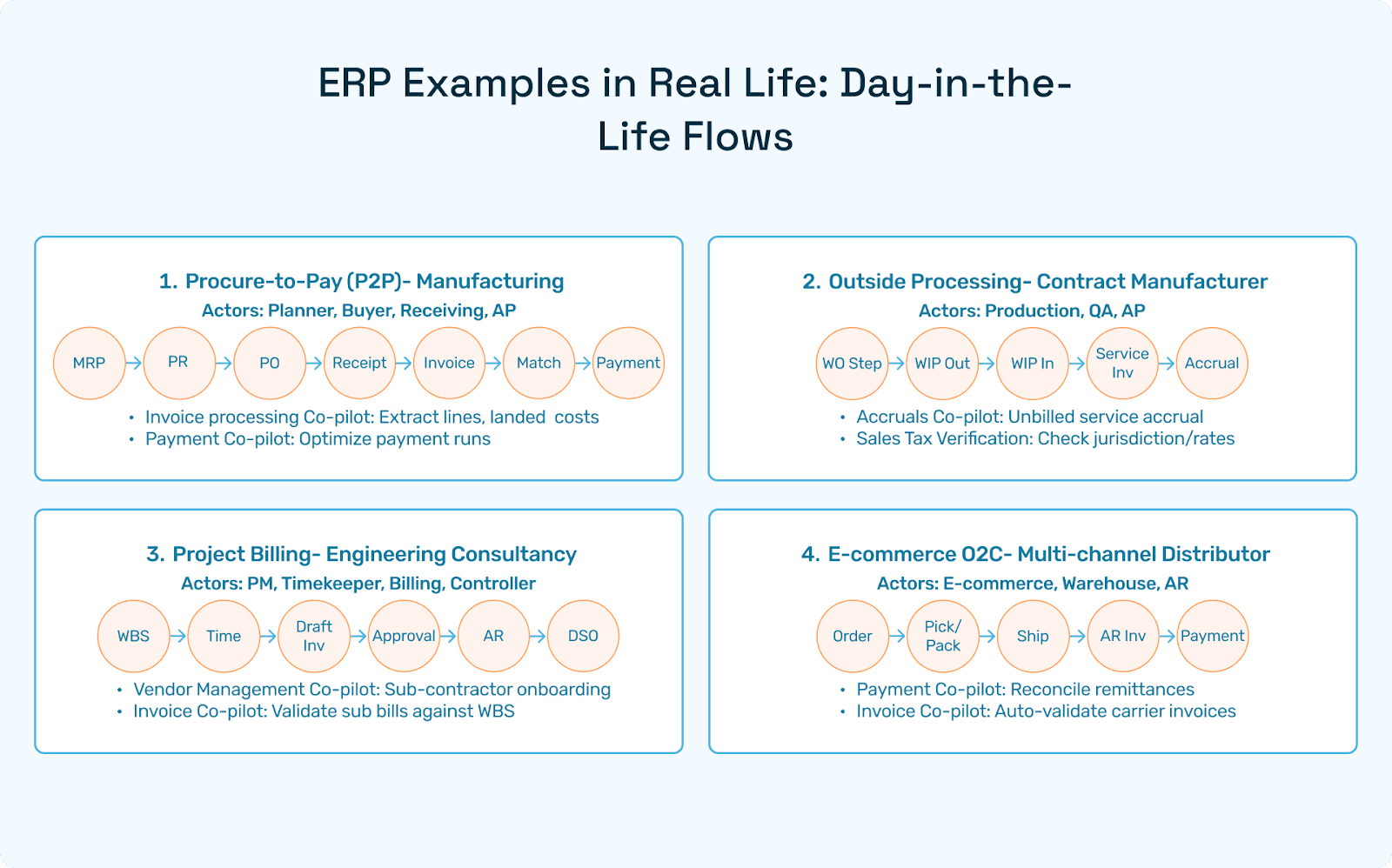
Executive Summary
If you are rolling out or scaling a NetSuite integration in 2026, you will run into four main developer surfaces: SuiteTalk REST Web Services, SuiteQL, RESTlets, and legacy SOAP. Oracle's official documentation is thorough but sprawling, and finding the right answers for your specific use case takes time that most engineering teams do not have.
This guide condenses that landscape into a field-tested playbook for architects and engineering managers. It covers where to use the native NetSuite REST API versus RESTlets, how the REST API Browser accelerates schema discovery, what you need to know about OAuth 2.0 and Token-Based Authentication, and how to harden your integration flows for production scale.
It also covers how Hyperbots, a finance-first layer of agentic AI, connects to NetSuite through these same developer surfaces to reduce manual work across Procure-to-Pay, Record-to-Report, and vendor risk workflows.
By the end, you will have a clear map of the NetSuite developer API landscape, a practical comparison of REST versus RESTlets versus SOAP with real integration tradeoffs, a ready-to-adapt integration matrix of common read and write touchpoints with polling and streaming frequencies drawn from live Hyperbots deployments, and starter patterns for auth, pagination, SuiteQL, and idempotency that you can take straight to your next stand-up.
API Surfaces at a Glance
NetSuite exposes multiple Netsuite integration api surfaces. The big four:
SuiteTalk REST Web Services (“REST Records”) — The modern, OpenAPI-based record API for CRUD on standard/custom records (Transactions, Vendors, Items, etc.). It comes with an official netsuite rest api documentation set and is discoverable with the NetSuite REST API Browser (OpenAPI 3.0 metadata). Oracle Docs+1
SuiteQL — SQL-92-style query language to query NetSuite data via REST (and other channels). Ideal for analytics, joins, and complex filters that exceed REST Records’ simple filtering. Oracle Docs+1
RESTlets (SuiteScript 2.x) — Custom REST endpoints you write in SuiteScript for bespoke operations (server-side logic, special validations, orchestration). Essential when you need non-standard workflows or bulk transforms in one call. Oracle Docs
SuiteTalk SOAP — Feature-rich, mature API (WSDL) used by many historical integrations. Still fully supported; useful when your ESB tooling prefers SOAP or when a record type hasn’t reached parity in REST. Oracle Docs+1
Use the netsuite rest api browser to inspect record schemas, supported fields, allowable operations, and response models before you write a line of code. It is the fastest path to “what’s actually supported in this account and release.” Oracle Docs
Authentication: OAuth 2.0 vs. TBA (and when to use which)
NetSuite supports OAuth 2.0 for REST Web Services and RESTlets; SOAP does not support OAuth 2.0. TBA (Token-Based Authentication) is also supported for RESTlets and web services. Most net-new builds standardize on OAuth 2.0 for modern security posture and vendor parity. Oracle Docs+2Oracle Docs+2
Practical guidance
OAuth 2.0 (Authorization Code / Client Credentials where appropriate): Use for first-party web apps, internal services, and vendor integrations that already support OAuth 2.0 key rotation and scopes. Oracle Docs
TBA: Useful for headless service accounts or where OAuth 2.0 client management is a poor fit. NetSuite lets admins create/assign tokens and manage permissions tightly. Oracle Docs
SOAP consumers**:** If you must use SOAP, stick with TBA or NLAuth; be aware SOAP doesn’t support OAuth 2.0. Oracle Docs
Records with the NetSuite REST API
The netsuite rest api (“REST Records”) exposes standard/custom record types with predictable URLs and query parameters. Devs prefer it for clean CRUD semantics, clearer error models, and first-party metadata.
Why it’s productive
OpenAPI 3.0 metadata powers the netsuite rest api browser, letting you see fields, types, sublists, and sample payloads for each record type. Oracle Docs
Consistent base URL:
https://<account>.suitetalk.api.netsuite.com/services/rest/record/v1/...(confirm realm in your account). Third-party connectors and docs reflect the same pattern. Tray.aiSubresources for linked data (e.g., line items) and externalId addressing. Tim Dietrich
Common operations (illustrative, confirm with the netsuite api documentation and API Browser):
GET /customer/123— fetch a Customer by internal IDGET /customer/eid:ACME-001— fetch by External ID (easier for idempotent upserts) Tim DietrichPOST /vendor/— create a vendorPATCH /vendor/789— partial updateGET /vendor/789/addressbook/1— read subresource (e.g., first address) Tim Dietrich
Queries with SuiteQL (and why you’ll love it)
SuiteQL is SQL-92-style querying within NetSuite. It’s perfect when REST filter params aren’t enough, when you need joins (e.g., Vendor ↔ Bills ↔ Payments), or when you’re consolidating analytics into a data lake.
Endpoint pattern:
POST /services/rest/query/v1/suiteqlwith a JSON body containing"q": "<SQL...>". Oracle’s docs show a canonical example and usage details. Oracle Docs+1Use cases: Finance analytics, exception buckets (duplicates, price variance), operational KPIs, near-real-time dashboards
Caveats: Respect result size and pagination; some teams still prefer saved searches for massive exports. NetSuite Professionals #general
Tip: Build normalized “views” by standardizing SuiteQL statements in code, or expose them through internal services. For discovery, developers commonly rely on tools and blog tutorials in addition to the Netsuite developer documentation. Tim Dietrich+1
RESTlets vs. REST Records: when do you need custom endpoints?
RESTlets are SuiteScript-powered endpoints—your safety valve when you need custom logic that the record API doesn’t offer (mass validations, orchestration, compound transforms in one roundtrip, specialized security). Oracle Docs
Choose RESTlets when
You must wrap multiple record operations into one atomic business step
You need domain logic (e.g., custom vendor onboarding checks) that can’t live client-side
You’re dealing with files in the File Cabinet, custom workflows, or third-party callbacks
Choose REST Records when
You can express the change as CRUD on a single record type or subresource
You want OpenAPI-discovered schemas and straightforward pagination
You want fewer moving parts and faster onboarding for engineers
SOAP (SuiteTalk) in 2026: still relevant?
Yes. While most greenfield projects prefer REST, SuiteTalk SOAP Web Services remains valuable—especially where your ESB stack is SOAP-centric, or certain record types/operations are better supported in SOAP for your account version. The official Netsuite developer documentation for SOAP (operations like add, update, search, initialize, attach) is still current. Oracle Docs
Performance, Pagination, Idempotency, and Errors
Modern NetSuite endpoints embrace the practices you’d expect:
Pagination: Most list endpoints support
limit&offset; handle follow-up URLs and re-auth correctly between pages. Community examples show typical pagination URLs and caveats. RedditIdempotency: The REST stack honors idempotency semantics for async operations; the API Browser and docs reference idempotency keys. system.netsuite.com
Filtering/Search: For heavy filters and joins, use SuiteQL rather than complex query params. Oracle’s docs include the REST query service Oracle Docs
Throughput: For very large extracts, evaluate SuiteAnalytics Connect or scheduled exports; some practitioners still find saved searches faster for million-row scenarios. NetSuite Professionals #general
Error hygiene
Normalize 4xx vs 5xx; surface NetSuite’s detailed error messages (validation, permission).
Log request IDs from response headers; link them to your observability stack for quick RCA.
Build a retry policy that respects idempotency and avoids double-posting vendor bills or payments.
Security & Governance by Design
Scopes & Roles: Create a dedicated integration role with least-privilege access (records, sublists, SuiteAnalytics).
Secrets: Store OAuth/TBA secrets in your vault (HashiCorp, AWS Secrets Manager).
Maker-Checker: For payments and vendor bank changes, enforce dual-control—either inside NetSuite workflows or via your integration layer (Hyperbots does this out-of-the-box).
Auditability: Persist request/response digests for write operations (Vendor Bill, Journal Entry, Vendor Payment).
PII & Redaction: If attachments (invoices) include sensitive data, redact pre-ingestion and retain hashes.
Hyperbots × NetSuite: Integration via Developer APIs
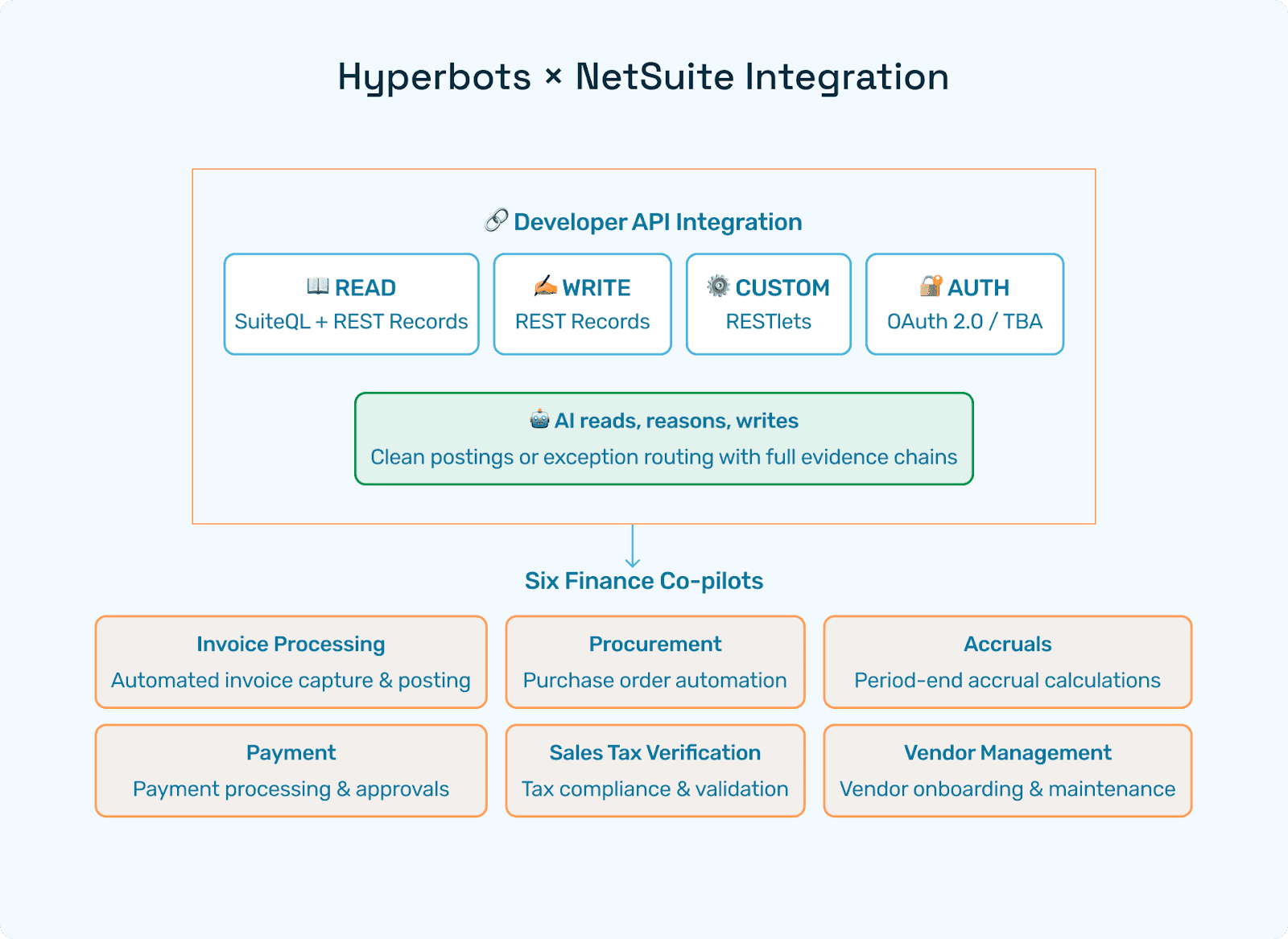
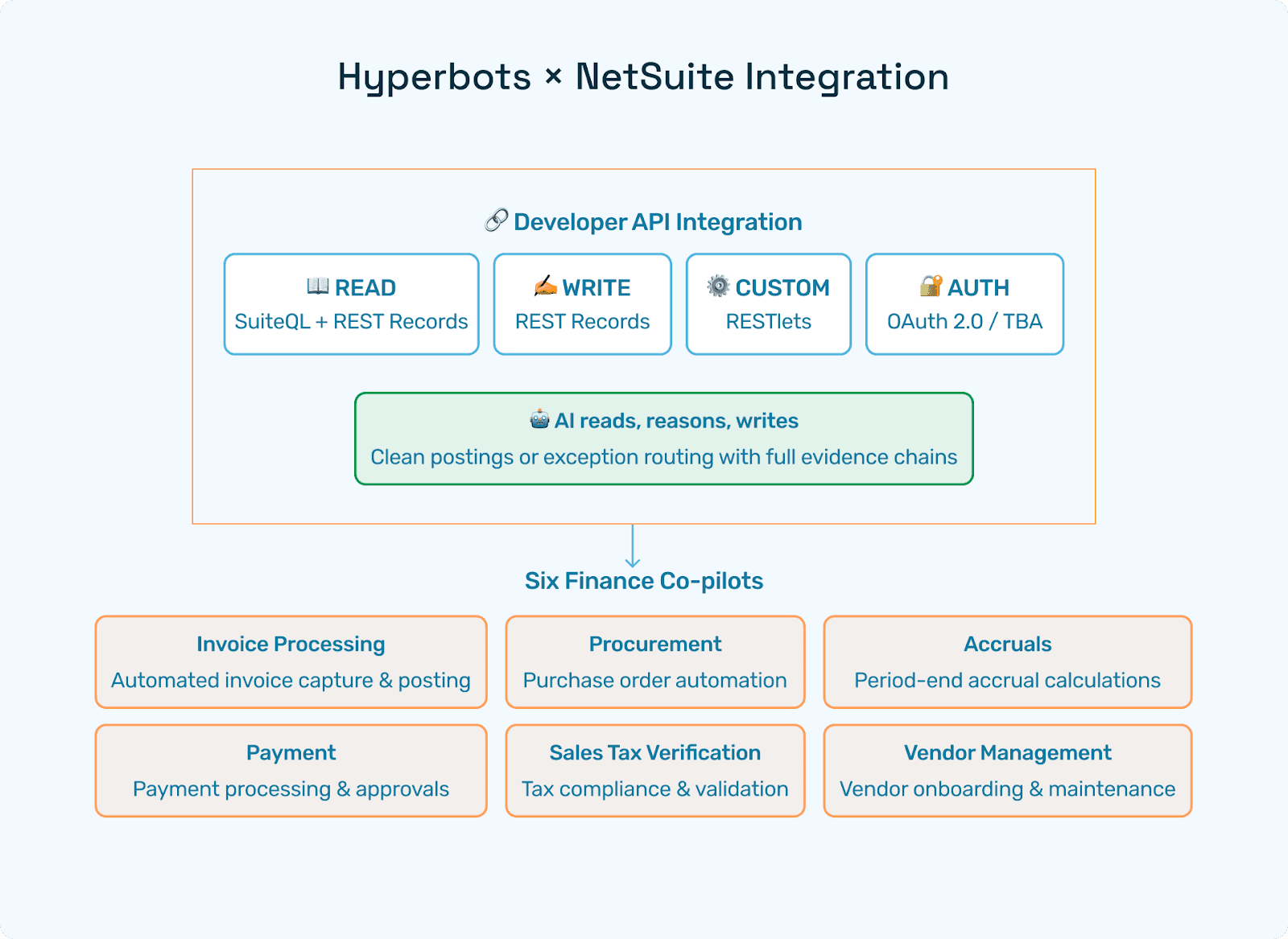
Hyperbots connects to NetSuite through the same netsuite developer api surfaces you use:
Read via SuiteQL (for analytics & exception queues) and REST Records (for targeted lookups)
Write via REST Records (Vendor Bills, Vendor Payments, Journal Entries, Vendor master updates)
Custom flows via RESTlets (e.g., mass vendor onboarding, bank-change approvals, or specialized posting)
Auth via OAuth 2.0 (preferred) or TBA, depending on your security model. Oracle Docs+1
Why it matters: Instead of teaching humans to key everything, Hyperbots’ agentic AI reads invoices, POs, receipts, and statements; reasons over your policies and tolerances; then writes clean postings or routes exceptions—with full evidence chains. Your team works on exceptions; STP goes up; close accelerates.
Six modular Finance Co-pilots (underline links to product pages):
Invoice Processing Co-pilot — Automates invoice capture, coding, and approvals with high accuracy and minimal manual intervention
Procurement Co-pilot — Manages purchase requests, approvals, and PO creation while enforcing policy and budget controls
Accruals Co-pilot — Handles accrual calculations and postings with real-time visibility and audit-ready logic
Payment Co-pilot — Streamlines payment execution with built-in validation, controls, and fraud checks
Sales Tax Verification Co-pilot — Ensures tax accuracy by validating calculations against applicable rules and jurisdictions
Vendor Management Co-pilot — Centralizes vendor onboarding, updates, and compliance with structured controls and visibility
Hyperbots ↔ NetSuite Integration Matrix (example)
You asked to include the table of read/write data points and frequencies from your Excel’s “integration” tab. I don’t have access to that prior upload in this chat, so here is a comprehensive example matrix that mirrors typical Hyperbots deployments on NetSuite. If you share the sheet again, we can swap in your exact rows/columns without changing the rest of this blog.
Domain | NetSuite object(s) | API surface | Direction | Typical frequency | Purpose |
Vendors |
| REST Records + SuiteQL | Read | Hourly + on-demand | Build vendor graph, bank validation, risk checks |
Vendors |
| REST Records / RESTlet | Write | Event-driven | Maker-checker bank updates, KYC docs |
POs |
| REST Records | Read | 5–15 min | Source of truth for 2/3-way match |
Receipts |
| REST Records | Read | 5–15 min | Receiving evidence for 3-way match |
Vendor Bills |
| REST Records | Write | Event-driven | Post clean matched bills with lines/tax/freight |
Credits |
| REST Records | Write | Event-driven | Post vendor credits linked to bills/POs |
Payments |
| REST Records | Write | Event-driven / daily | Propose/pay runs; discount capture; duplicate prevention |
Chart/Segmentation |
| SuiteQL | Read | Nightly | Coding suggestions, policy context |
Tax |
| SuiteQL | Read | Nightly + on-demand | Rate verification & variance checks |
Inventory |
| REST Records | Read | Nightly | Enrich price/qty context in match logic |
GL |
| REST Records | Write | Event-driven / month-end | Auto-accruals for unbilled receipts/services |
Statements | File Cabinet refs | RESTlet / SuiteScript | Read | Event-driven | Vendor statement capture & reconciliation |
Exceptions | (Derived via SuiteQL) | SuiteQL | Read | 5–15 min | Duplicate detection, price/qty/tax variance queues |
Audit | Request/response digests | Platform (external) | N/A | Continuous | Evidence chains with NetSuite internal IDs |
Notes:
Read cadences are tuned to license and throughput needs. Large exports = use SuiteQL + paging, or saved searches via scheduled jobs; write volume is governed by idempotency keys and guardrails. RESTlet paths handle corner cases that require compound, atomic operations.
Co-pilots: Where Hyperbots Delivers ROI on NetSuite
Hyperbots turns repetitive keystrokes into policy-aware decisions:
Invoice Processing — Extract + 2/3-way match + post or route.
Accruals — Generate period-end accruals for unbilled services/in-transit freight; auto-reversal with links.
Payments — Build proposals that capture terms discounts; validate bank data; block duplicates/over-pays.
Sales Tax Verification — Check jurisdictional rates by line; maintain clean audit trails.
Vendor Management — Onboard/KYC, automate bank change approvals (maker-checker), and monitor risk.
Teams routinely model 60–90% STP and major cycle-time cuts; many report ~80% labor reduction in AP workflows at scale (data quality and policy discipline apply).
Platform Capabilities: Why Hyperbots complements NetSuite
Finance-trained AI (HyperLM + MoE): Document vision + line-level reasoning for invoices, POs, receipts, statements
Deep connectors: Real-time read/write with NetSuite; Gmail/Outlook ingestion; bank rails; tax engines; 3PL/shipping; EDI; portals
Policy & controls: GL coding suggestions; per-vendor tolerances; maker-checker; approval nudges
Security & SoD: Role-based access; redaction; immutable audit logs
Scale: Microservices (Java, Postgres, React); multi-entity/currency; high-volume throughput
Outcome telemetry: STP %, first-pass match %, invoice cycle time, duplicate rate, DPO, discount capture, tax variance
Build Steps & Sample Snippets
Below are illustrative patterns to accelerate your build. Confirm details against the official Netsuite developer documentation and your account’s netsuite rest api browser.
1) OAuth 2.0 setup (high-level)
Create an Integration Record; capture client ID/secret
Configure redirect URIs; grant scopes for REST Web Services / RESTlets
Use Authorization Code flow for user-delegated apps; Client Credentials where supported for service-to-service (consult current docs)
NetSuite’s help center covers OAuth 2.0 setup, headers, and grant types. Oracle Docs+1
2) Query with SuiteQL (REST)
Endpoint: POST https://<account>.suitetalk.api.netsuite.com/services/rest/query/v1/suiteql Body:
{
"q": "SELECT id, tranid, total, entity FROM transaction WHERE type = 'VendBill' AND datecreated >= ADD_MONTHS(SYSDATE, -1)"
}
SuiteQL over REST is first-class and documented with working examples. Oracle Docs+1
3) Create a vendor bill (REST Records, sketch)
POST /services/rest/record/v1/vendorBillwith header/body per API Browser schemaProvide
entity,subsidiary,currency,approvalstatus, and populateditem/expensesublistsUse idempotency headers for retries on network blips (see API Browser notes). system.netsuite.com
4) Read subresources (lines, relations)
GET /record/v1/salesOrder/325/item/1to fetch the first line, or followlinks.hreffrom the record payload—handy for focused diffs. Tim Dietrich
5) Decide when to use RESTlets
If you must: compose multiple steps (e.g., create vendor → attach W-9 → set approval → log audit note) in a single atomic server-side operation. RESTlet script type and SDF config are fully documented. Oracle Docs+1
FAQs
Q1. Where do I find the official Netsuite api documentation?
Oracle’s help center: SuiteTalk REST Web Services, REST API Browser, SuiteQL, RESTlets, and SOAP references. Start with the REST API Browser to inspect record types in your account. Oracle Docs+2Oracle Docs+2
Q2. What’s the difference between Netsuite rest api and RESTlets?
REST is the native record API; RESTlets are SuiteScript endpoints you write for custom logic and multi-step orchestration. Oracle Docs
Q3. Is there a Netsuite rest api browser I can use?
Yes—the REST API Browser exposes OpenAPI 3.0 metadata: fields, types, operations, and response shapes. Oracle Docs
Q4. Do I use OAuth 2.0 or TBA?
Prefer OAuth 2.0 for modern REST integrations; TBA is still supported and useful for service accounts. SOAP doesn’t support OAuth 2.0. Oracle Docs
Q5. How do I run complex joins?
Use SuiteQL over REST (/query/v1/suiteql)—it’s SQL-92-style and built for analytics/joins. Oracle Docs
Q6. Where can I see Netsuite rest api documentation for record endpoints?
The SuiteTalk REST Web Services guide plus the in-account REST API Browser. Oracle Docs+1
Q7. Is SOAP dead?
No. SuiteTalk SOAP is supported and mature; use it when your ESB/workflow requires it. Oracle Docs
Q8. Can Hyperbots work without changing my NetSuite config?
Yes. Hyperbots reads/writes through supported APIs and respects your approvals/tolerances; it makes humans review exceptions, not retype data.
Final Takeaway
The quickest path from “Where do I start with the netsuite developer api?” to “We’re in production and saving money” is to pick the right surface for each job (REST Records for standard CRUD, SuiteQL for joins/analytics, RESTlets for orchestration, SOAP where required), build on OAuth 2.0/TBA best practices, and design for pagination, idempotency, and auditability. Then let Hyperbots do the heavy lifting: extracting and reasoning over documents, posting clean transactions, and routing exceptions with evidence. That’s how you turn Netsuite integration api choices into measurable outcomes—higher STP, a faster close, stronger controls—and a finance operation that runs itself most of the time.