ERP for Retail Industry - Complete 2026 Playbook for Choosing, Implementing, and Scaling Retail ERP Systems
Transform retail finance with Hyperbots AI Co-pilots, boost efficiency, accuracy, and compliance seamlessly.
Best ERP for Retail: Top Systems, Features, and AI Automation (2026)
Retail runs on margins that don't forgive mistakes. A mis-coded invoice, a late vendor payment, a freight accrual that slips through month-end, each one chips away at profitability that was already thin. Most retailers have an ERP handling the big picture: merchandising, inventory, store ops, procurement. What they don't have is clean, fast, autonomous finance running underneath it. That's the gap. This guide covers what makes the best ERP for retail, how the major platforms compare, and how Hyperbots AI Co-pilots close the finance execution gap that every retail ERP leaves behind that too without replacing the system you already run.
Why ERP for the Retail Industry Now
Retail is experiencing a significant industry reset:
Omnichannel is the default: Marketplaces, DTC web, social commerce, and physical retail stores must share one truth for price, inventory, and promotions.
Speed is survival: Customers expect real-time stock visibility, BOPIS, curbside, and 2-day delivery.
Margin pressure: Freight volatility, shrink, returns, and discounting demand smarter planning and tighter controls.
Regulatory complexity: Multi-state sales tax, privacy laws, and sustainability disclosures, all rising.
A modern ERP for the retail industry gives you a unified backbone including merchandising, inventory, order management, store ops, finance, and analytics, so you can move at the pace of your customer and still protect gross margin.
Retail ERP Fundamentals: What "Good" Looks Like
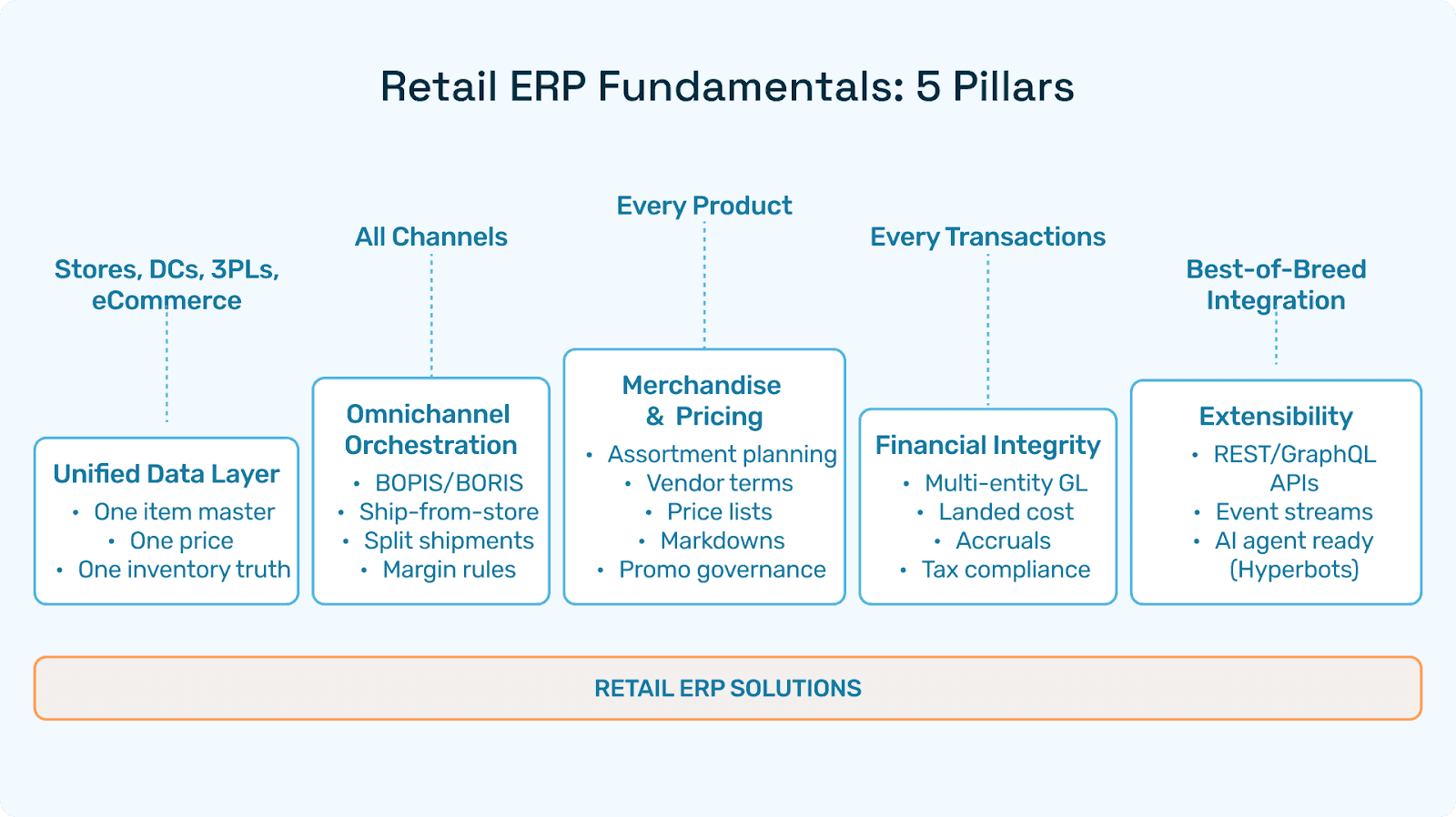
A credible retail management ERP should provide:
Unified Data Layer
One item master (style-color-size), one price, one promotion, one inventory truth across stores, DCs, 3PLs, and eCommerce.
Omnichannel Order Orchestration
Ship-from-store, BOPIS, BORIS, pre-orders, split shipments, substitutions, while respecting margin rules and SLAs.
Merchandising & Pricing Discipline
Assortment planning, vendor terms, cost breaks, price lists, markdown cadences, and promotion governance.
Financial Integrity
Multi-entity GL, landed cost, accruals, sales tax compliance, chargebacks, and reconciliations that actually reconcile.
Extensibility
Clean REST/GraphQL APIs and event streams to plug in best-of-breed POS, WMS, OMS, CRM, and AI agents like Hyperbots.
When those pillars are in place, retail ERP solutions become the fabric that supports every channel and every transaction.
Core Capabilities of Retail ERP Software
Capability | Why Retail Needs It | What "Great" Looks Like |
Merchandising | Plan assortments, manage attributes, and vendor terms | Hierarchies, attributes, vendor scorecards, and automatic cost breaks |
Pricing & Promotions | Compete without eroding margin | Rule-based pricing, location tiers, promo simulation & guardrails |
Inventory & WMS | Reduce stockouts & aged stock | Real-time ATP, bin/lot/serial, wave picking, cycle counting |
OMS / Order Orchestration | Omnichannel promises what customers must trust | Sourcing rules by margin/SLA, split shipments, substitutions |
POS & Store Ops | Fast, reliable checkout; store labor productivity | Offline-tolerant POS, mobile tasks, task scheduling, labor KPIs |
Procurement & Vendor Mgmt | Shorten replenishment cycles | Auto-PO from min/max & demand, vendor portals, ASN/EDI |
Finance (GL/AP/AR) | Protect cash & compliance | Landed-cost automation, STP invoices, accruals, bank recs |
Tax & Compliance | Multi-state, VAT/GST, eco fees | Real-time validation, nexus rules, audit trails |
Analytics & Planning | Decisions in hours, not weeks | Merchandise KPIs, store scorecards, cohort & RFM analytics |
These are table stakes for retail ERP systems, and where AI can deliver significant performance gains.
Popular ERPs in Retail: Who's Used Where (with strengths)
Below are widely adopted platforms retailers consider when evaluating the best retail ERP software and retail ERP solutions:
Oracle NetSuite (SuiteCommerce, WMS, SCM): Mid-market & high-growth brands; strong unified suite for ERP software for retail business.
Microsoft Dynamics 365
Business Central + LS Retail: SMB to mid-market retailers wanting tight POS-back-office integration.
Finance & Operations (Supply Chain): Upper mid-market/enterprise; deep supply chain.
SAP
S/4HANA Retail: Enterprise, global retailers; rich merchandising & localization.
SAP Business One: SMB retail/wholesale with extensions.
Infor CloudSuite Retail: Enterprise retail with micro-vertical depth.
Acumatica Retail-Commerce Edition: Usage-based pricing, cloud-native; growing mid-market presence.
Brightpearl by Sage: Commerce ops focused, ideal for DTC / multichannel.
Epicor (Prophet 21, Eagle): Specialty retail/wholesale, strong in hardlines.
Blue Yonder (WMS/SCM/Planning) & Manhattan (WMS/OMS): Often paired with ERP for best-of-breed logistics.
Selecting the best ERP for retail is about fit, including catalog complexity, channel mix, store count, fulfillment strategy, IT skills, and budget not just feature lists.
Architecture Patterns: Headless, Composable, and Unified Suites
Unified Suite
ERP provides merchandising, finance, inventory, and often OMS/WMS/POS in one vendor. Faster implementation, one data model, fewer integration points.
Composable Stack
ERP for financials + best-of-breed OMS, WMS, POS, pricing/promotions, and CDP, stitched together with iPaaS and event streaming. Maximizes capability, increases integration responsibility.
Headless Commerce
Storefront(s) powered by headless platforms; ERP and OMS drive availability, price, and order capture. Offers superior UX flexibility, requires disciplined API governance.
Most retailers combine these, e.g., NetSuite ERP + Manhattan WMS + headless Shopify + LS Retail POS, based on their operating advantages.
Finance & Back-Office in Retail ERP (And Where ERP Struggles)
Even the best ERP for retail business leaves gaps that cost time and margin:
Invoices everywhere: Freight, duty, vendor bills, chargebacks; often in PDFs and portals.
Accrual crunch: Freight/duty accruals and unbilled receipts flood the month-end.
Payments & discounts: Timing early-pay discounts vs. cash-flow needs.
Sales tax: Multistate rules and marketplace facilitator complexities.
Vendor onboarding: Chasing W-8/W-9, bank details, and duplicate vendors.
These pain points are precisely where Hyperbots' finance-native AI agents excel.
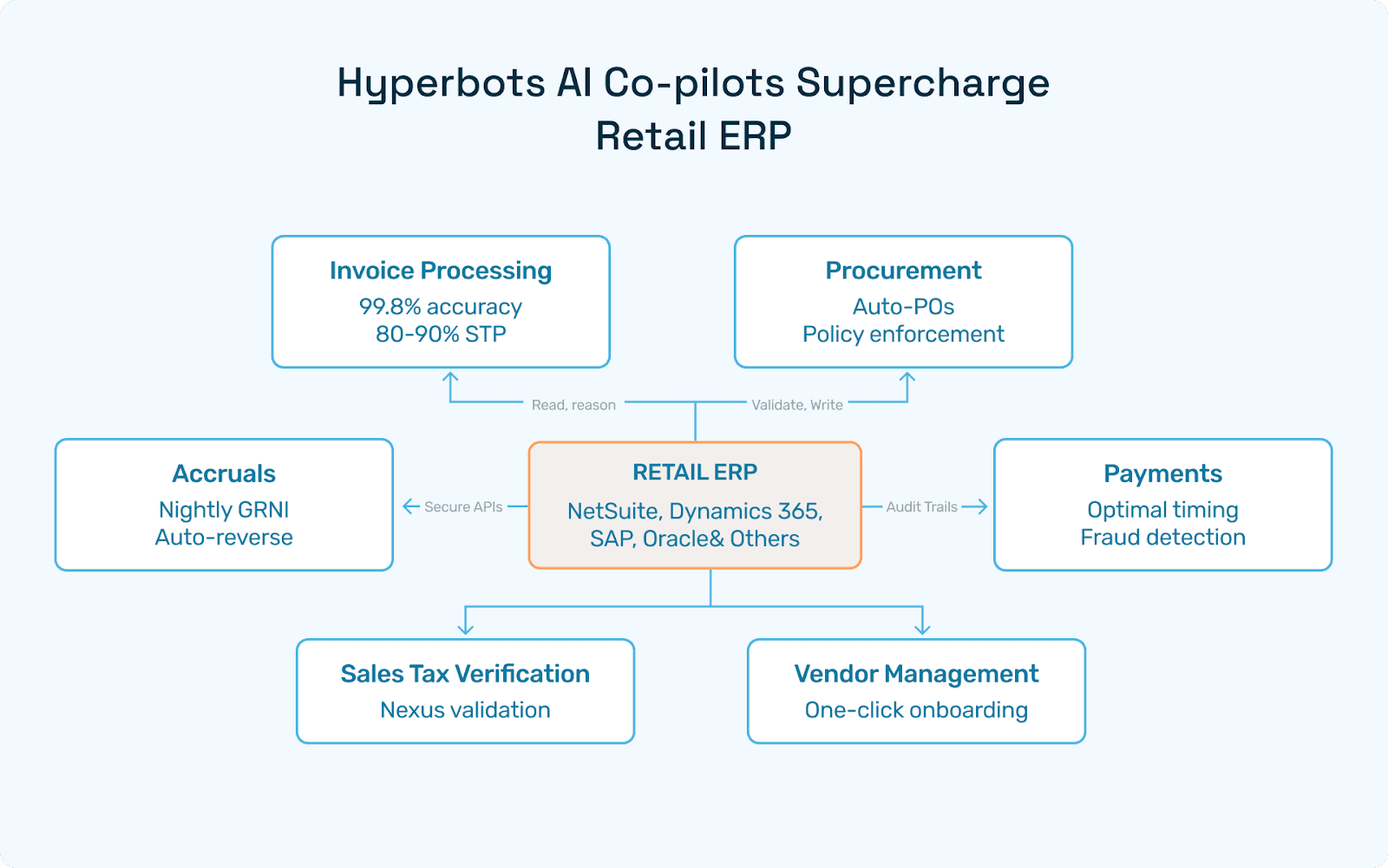
How Hyperbots AI Co-pilots Supercharge Retail ERP
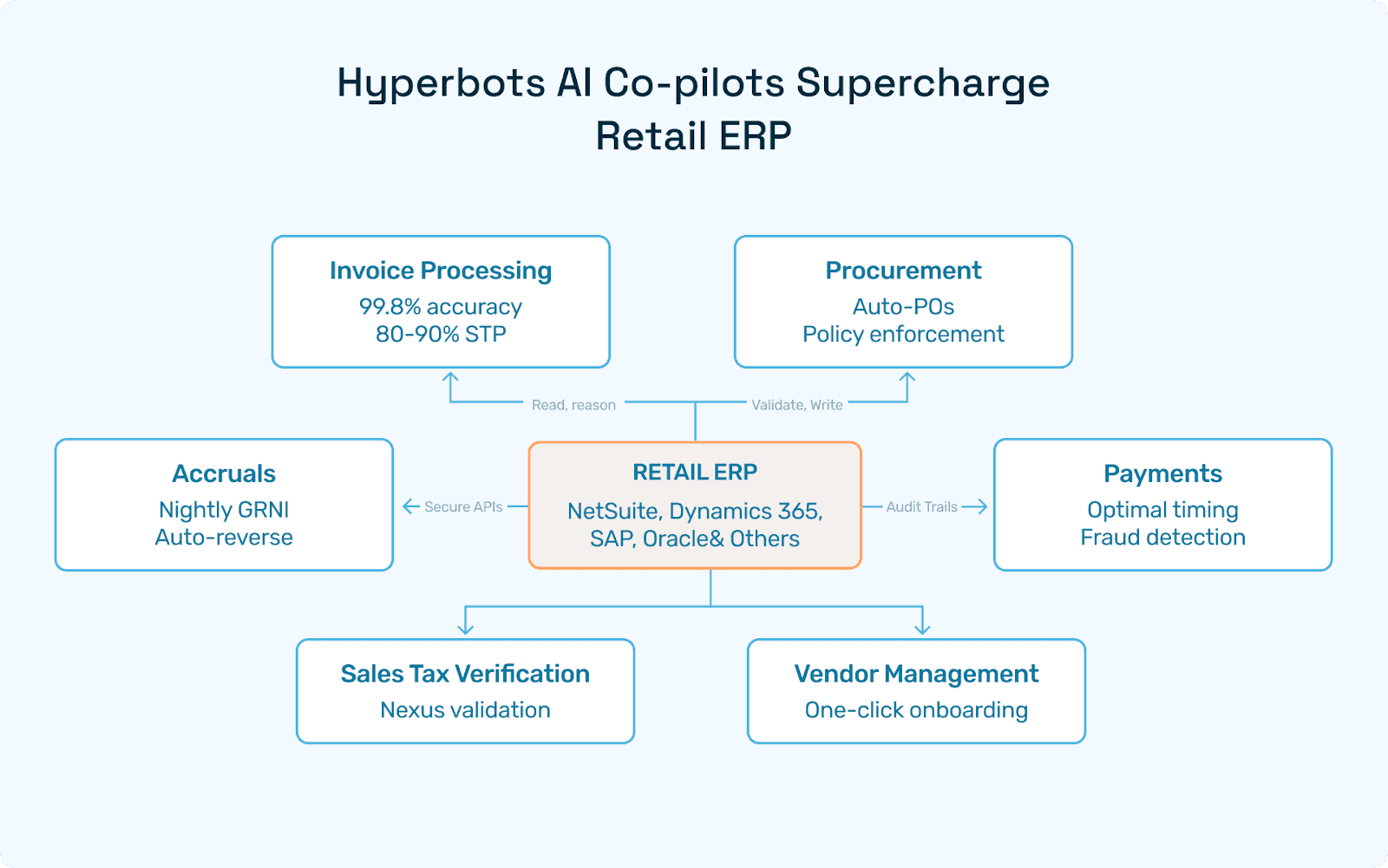
Hyperbots layers autonomous finance over any ERP system for retail business, using finance-trained AI agents that read, reason, validate, and write back to ERP, securely and with full audit trails. Deloitte reports that AI-infused ERP workflows cut processing time by 40%, and Hyperbots is built specifically to deliver that and more on top of your existing retail ERP stack.
99.8% extraction accuracy on invoices, freight bills, duty/tax docs, and credit memos.
GL coding with context (SKU, vendor terms, location), and 2/3-way match.
Achieves 80-90% straight-through processing (STP) on high-volume AP.
Auto-creates POs from demand thresholds and vendor lead times; policy enforcement.
Accelerates approvals; dispatches POs to vendors via email/portal/EDI.
Books freight, duty, and goods-received-not-invoiced (GRNI) accruals nightly; auto-reverses next period.
Eliminates end-of-month scramble; improves gross margin accuracy.
Optimizes when to pay; weighs early-pay discounts vs. cash-flow; multi-method support (ACH, check, wire).
Fraud detection and approval routing included.
Sales Tax Verification Co-pilot
Validates US state nexus, marketplace facilitator rules, and VAT/IOSS fields before posting.
Prevents tax mis-codes and penalties.
One-click onboarding; W-8/W-9 checks; duplicate detection; self-service vendor portal for POs, invoices, and payments.
What this means for retail ERP software: Faster AP cycles, accurate landed costs, cleaner audits, and fewer stockouts caused by invoice/PO errors.
Hyperbots Platform Capabilities (Why It Fits Retail)
Hyperbots' Agentic AI platform, designed for finance automation on top of ERP:
Redaction
All data anonymized; PII masked before model access to ensure security and no leakage.
OCR Enhanced by VLMs
Vision-Language Models excel at complex, multi-page invoices (containers, HTS codes, multi-line items). Accuracy ~99.8%.
Finance-aware LLMs
Trained on millions of finance samples; understand GL structures, cost components, discounts, allowances.
Mixture of Experts (MoE)
Specialists for invoice types (freight, duty, vendor), credit memos, tax lines, and exceptions.
Reasoning & Explainability
Automatic, human-readable rationales: why the line posted to 5200, Freight for DC-02 with location-specific taxes.
Connectors for On-Prem & Cloud
NetSuite, Oracle, Microsoft Dynamics 365, SAP, and others with real-time read/write via secure APIs.
These capabilities complement ERP software for the retail industry and retail management ERP stacks without risky custom code.
Hyperbots Implementation Roadmap
Align outcomes & KPIs (STP%, AP cost/invoice, invoice cycle time, close days, accrual variance, tax exceptions) and lock RACI.
Set up security (SSO/OAuth, least-privilege roles), redaction policies, and ERP sandbox access; gather ~300 recent invoices (incl. freight/duty).
Connect ingestion (email/SFTP/EDI/portal) and read-only ERP APIs; light up dashboards for throughput, confidence scores, and exceptions.
Run shadow mode for Invoice Processing Co-pilot, Accruals, and Sales Tax; target 99%+ field accuracy and 0.5% or less landed-cost accrual variance.
Define an exception taxonomy (low confidence, layout drift, policy breach) and hold a go/no-go review for write-back.
Launch a controlled write-back pilot (1 DC + 5-10 high-volume vendors) with 0.95 or higher confidence threshold and strict 2/3-way match.
Keep Payments in "prepare" mode first; enforce delegated approvals; attach reasoning logs to every posting for audit transparency.
Scale coverage to 60-80% of invoices; enable Payments execution (ACH/check/wire), Procurement auto-POs (within policy), and the Vendor portal for onboarding/status.
Tune confidence thresholds, mine exceptions, dedupe vendors, and publish monthly ROI dashboards; introduce supplier scorecards.
Day-90 targets: STP 80-90%; AP cost/invoice $1.5-$2.5; invoice cycle 1-3 days; close in 3-5 days; accrual variance 0.5% or less; near-zero material tax mis-codes.
Data, Governance & Controls for Multi-Channel Retail
Retail data changes constantly (attributes, sizes, substitutions, returns).
Enforce:
Single master for items, vendors, locations, and price lists.
Approval chains for price/promo changes with audit trail.
Tax & compliance checks pre-posting (by agent), not after.
Data contracts between ERP and best-of-breed apps via APIs (what, when, who owns the truth).
Exception review queues, because humans focus only on the 5-10% that matter.
Hyperbots' reasoning logs support internal controls, auditors, and real-time triage.
Advanced Use Cases: Omnichannel, Returns, and Trade Promotions
Omnichannel Orchestration
Margin-aware sourcing: ship from DC unless local store can fulfill within SLA with a higher margin. Auto-substitution rules: size-adjacent or color-adjacent within the same style when approved.
Returns & Reverse Logistics
Identify resale vs. refurbish vs. salvage; automate return reason codes; book provisions through Accruals Co-pilot.
Trade Promotions & Coop Funds
Track vendor allowances; tie to lift; validate accruals monthly with Invoice Processing Co-pilot and Accruals Co-pilot; reduce leakage.
Marketplace Compliance
Ensure proper tax handling for facilitator jurisdictions via Sales Tax Verification Co-pilot before settlement posting.
KPIs, Benchmarks & ROI Model
KPI | Pre-modernization | Post-ERP (baseline) | ERP + Hyperbots | Expected Lift |
Invoice cycle time | 10-14 days | 5-7 days | 1-3 days | 60-90% faster |
AP cost per invoice | $8-$12 | $4-$6 | $1.5-$2.5 | 60-80% lower |
Landed cost variance | 1-2% | 0.8-1.2% | 0.3-0.6% | 40-70% better |
Month-end close | 8-10 days | 6-7 days | 3-5 days | 30-50% faster |
Stockouts | 5-7% | 3-4% | 1-2% | 40-60% reduction |
Combined, these shifts typically yield 9-12-month payback and 4-8x three-year ROI. You can calculate your projected ROI here.
RFP Template: Feature Checklist for Retail ERP Solutions
Use this abbreviated checklist when evaluating retail ERP software and retail management ERP:
Merchandising & Pricing Hierarchies/attributes, vendor terms, markdown rules, promo simulator, price overrides with approval.
Inventory, WMS & OMS Real-time ATP, cycle counts, slotting, wave picking, sourcing rules by margin/SLA, backorder & substitution logic.
Finance & Tax Multi-entity GL, landed cost automation, accrual engine, tax validation, bank rec, strong audit trails.
POS & Store Ops Offline-tolerant, mobile tasks, labor scheduling, store KPIs; open APIs to ERP.
Extensibility REST/GraphQL, eventing/webhooks, iPaaS support, sandbox environments.
AI & Automation Support for agents (like Hyperbots): read/write APIs, field-level security, reasoning logs.
Risks, Pitfalls & How to Avoid Them
Over-customization: Brittle upgrades. Prefer configuration, platform workflows, and AI agents.
Dirty masters: Bad item and vendor data poison everything; cleanse first.
"Big-bang" go-live: Higher failure risk. Phase by region/channel.
Ignoring change management: Train store and DC leaders early; keep playbooks simple.
Underestimating finance: Landed cost, accruals, and tax determine true margin; automate them first.
FAQs
Q1. What's the difference between retail ERP software and a generic ERP? Retail ERP embeds merchandising, pricing/promo, store ops, OMS, and returns logic, with attributes such as style-color-size and channel-specific rules, beyond generic manufacturing or services ERP.
Q2. Which is the best ERP for retail? There's no single best answer. For mid-market, Oracle NetSuite is widely selected; Microsoft Dynamics 365 (BC + LS Retail) is strong for store-centric rollouts; SAP S/4HANA Retail and Infor CloudSuite Retail fit larger, global footprints. Assess fit by catalog complexity, channels, store count, and IT capacity.
Q3. Can we keep our favorite WMS/OMS/POS and still modernize ERP? Yes, many retailers adopt a composable approach: ERP for finance/merchandising with best-of-breed OMS/WMS/POS, integrated by APIs and events. Hyperbots work in either model.
Q4. How do Hyperbots AI Co-pilots connect? Via secure, read/write APIs to your ERP. Agents ingest documents (PDFs, EDI, images), extract with VLMs, reason with finance-trained LLMs, and write back postings with full audit logs. See how pre-trained co-pilots go live in days, not months.
Q5. What's a realistic timeline? ERP core: 12-24 weeks (scope dependent). Hyperbots: 4-8 weeks layered on top, often parallel to ERP rollout.
Conclusion & Next Steps
A modern ERP software for retail business is the backbone: one catalog, one price, one inventory truth. But the last mile of finance, including invoice capture, accruals, payments, tax, and vendor onboarding, is where time and money leak out of every retail operation. Hyperbots AI Co-pilots sit on top of any retail ERP software to drive 80-90% straight-through finance, cleaner landed costs, faster closures, and resilient controls.
Ready to see it live? Deploy Hyperbots on top of your current retail ERP systems (NetSuite, Dynamics 365, SAP, Oracle) and calculate what your AP operation could save before your next conversation with finance leadership.