ERP System Price Comparison 2026: Real Costs, Honest Tradeoffs, and What Buyers Actually Need to Know
A practical buyer’s guide to comparing ERP software pricing, implementation costs, and long-term operating expenses
Most ERP price guides are written for people learning how ERP pricing works. This one is written for people who are actually buying.
If you're trying to shortlist vendors, build a realistic budget, or pressure-test a vendor's quote, here's what you need to know upfront: the published software price is rarely the biggest number on your invoice. Implementation, integrations, and ongoing operational overhead consistently outrun the subscription fee. A $70/user/month platform can easily become your most expensive ERP. A $200/user/month platform with tight scope and strong out-of-the-box fit can deliver better value.
This guide gives you a comparison table, realistic pricing by company size, and the vendor-specific patterns that actually move total cost of ownership.
ERP System Price Comparison at a Glance (2026)
Use this table to shortlist. Prices are directional — final quotes depend on users, modules, contract term, and geography. All software prices are per user/month unless noted.
ERP System | Pricing Model | Published Starting Price | Typical Implementation Range | Best For | Deployment | Manufacturing Support | SMB / Enterprise |
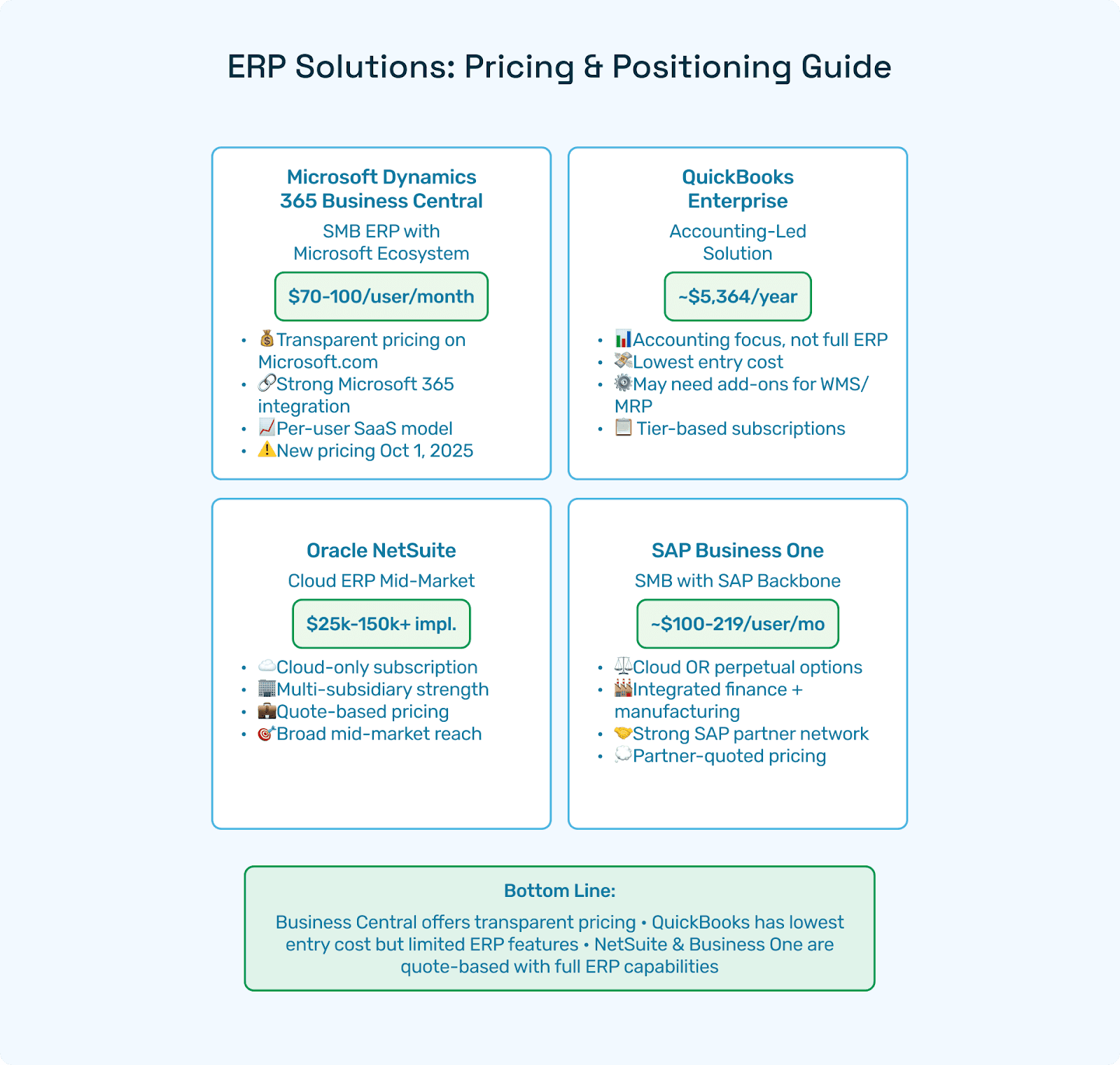
Per user | $70 (Essentials) / $100 (Premium) | $25K–$100K | SMBs on Microsoft stack | Cloud | Premium tier only | SMB | |
Per user | $210 | $150K–$500K+ | Mid-market to enterprise finance | Cloud | Via Supply Chain add-on | Enterprise | |
Base platform + per user + modules | ~$999/mo platform + $129–$199/user | $50K–$250K+ | Growth companies, IPO-track | Cloud | SuiteManufacturing module | Mid-market to enterprise | |
Resource/consumption-based (unlimited users) | ~$1K–$3K/mo depending on tier | $60K–$150K+ | Manufacturers, distributors wanting broad access | Cloud or private cloud | Strong — native editions | SMB to mid-market | |
Per user | ~$200+ (third-party estimates) | $200K–$2M+ | Large enterprises, complex supply chains | Cloud or on-prem | Best-in-class | Enterprise | |
Per user (cloud or perpetual) | ~$110–$219/user (cloud, partner estimates) | $30K–$100K | SMB manufacturers | Cloud or on-prem | Strong | SMB | |
Per user | ~$125+ (directory estimates) | $75K–$200K | Job shop / ETO manufacturers | Cloud | Native, deep | Mid-market manufacturer | |
Per user | ~$150+ (directory estimates) | $75K–$250K | Mixed-mode manufacturers | Cloud | Very deep | Mid-market to enterprise | |
Per user + modules | Quote only | $50K–$150K | Finance-heavy, multi-entity | Cloud | Limited | SMB to mid-market | |
Per app/module | Free (Community) to ~$35+/user (Enterprise) | $15K–$100K | Budget-conscious, flexible needs | Cloud or on-prem | Available | SMB | |
Per user or org tier | ~$500/user or $3K+/mo org (estimates) | $100K–$300K | Cloud-native manufacturers | Cloud | MES + ERP combined | Mid-market manufacturer | |
Subscription (quote) | Quote only | $250K–$1M+ | Asset-intensive, project-centric | Cloud | Strong | Mid-market to enterprise | |
Per user | ~$199+ (directory estimates) | $50K–$150K | Industrial SMBs | Cloud or on-prem | Solid | SMB |
Directory pricing estimates are directional signals only — not binding quotes. Always validate with a current vendor or certified partner quote.
Quick Answers for Common Buyer Searches
Cheapest ERP Systems for SMBs
Odoo is the most affordable entry point. The Community edition is open source (free software, you pay for hosting and implementation). Enterprise starts around $35/user/month. The catch: module sprawl is real, and customization hours add up fast. Budget realistically for implementation even if the license looks cheap.
Business Central Essentials at $70/user/month is the most predictable option for SMBs already on Microsoft 365. Implementation with an accelerator can land in the $25K–$60K range for a finance-first deployment.
SAP Business One partner estimates cluster around $110–$219/user/month (cloud). Solid for SMB manufacturers needing production and inventory depth without enterprise complexity.
Realistic Year 1 range for an SMB (10–30 users): $30K–$150K all-in, depending on scope and integration requirements.
Best ERP for Mid-Market Companies
The mid-market sweet spot — roughly $20M–$500M in revenue, 50–300 employees — is served best by:
NetSuite for companies with complex financials, multi-entity structures, or IPO ambitions. Strong out-of-the-box financial controls; manufacturing is secondary.
Acumatica for manufacturers and distributors who want unlimited user access and flexible deployment. Resource-based pricing avoids the per-seat penalty as you grow.
Dynamics 365 Business Central (scaling up) for companies deepening their Microsoft investment. Premium tier includes manufacturing.
Epicor Kinetic or Infor CSI for mid-market manufacturers where production is the core, not just a module.
Realistic Year 1 range for mid-market (50–150 users): $150K–$500K all-in.
Most Expensive ERP Platforms
SAP S/4HANA and Oracle ERP Cloud sit at the top. SAP implementations for global enterprises routinely run $1M–$5M+. Per-user costs frequently exceed $200/month fully loaded, and consultant rates for certified SAP specialists run $200–$400/hour.
Dynamics 365 Finance + Supply Chain can be surprisingly expensive in practice — Panorama Consulting's 2025 data found Dynamics 365 projects averaged ~$5.4M, the highest of any vendor they tracked, largely due to multi-wave implementations and heavy partner dependency.
IFS Cloud targets asset-intensive industries (aerospace, defense, energy) and field service; pricing is enterprise-grade and quote-only.
Best ERP Pricing for Manufacturers
Manufacturing ERP pricing scales faster than generic ERP because production modules — MRP, WMS, shop floor, quality, maintenance — add meaningful cost to both license and implementation.
Acumatica Manufacturing Edition: resource-based pricing, strong native manufacturing, broad user access without per-seat penalty. Good for 25–150 user shops.
Epicor Kinetic: natively built for discrete, job shop, and ETO manufacturing. Starts ~$125/user, implementation often $75K+.
Plex: cloud-native MES + ERP combined, strong for high-volume production environments. Org-level pricing starts ~$3K/month.
Infor CloudSuite Industrial: deep mixed-mode manufacturing capability. Per-user ~$150+, typically mid-market to enterprise scope.
SAP Business One: for SMB manufacturers who need solid production and inventory without S/4HANA complexity.
ERP Pricing by Company Size
Real-world budgeting scenarios. These are realistic planning ranges, not vendor quotes.
Scenario 1: Finance-First SMB (25 users)
Profile: Single entity, 25 finance + operations users, no manufacturing, basic inventory.
Cost Category | Estimated Range |
Software (annual) | $21K–$36K (Business Central Essentials or Sage Intacct) |
Implementation | $25K–$60K |
Integrations (bank feeds, tax engine) | $5K–$15K |
Year 1 Support / AMS | $5K–$15K |
Year 1 Total | $56K–$126K |
Core modules needed: financials, AR/AP, bank reconciliation, basic inventory, tax engine.
Scenario 2: Distributor (75 users)
Profile: $50M–$150M revenue, warehouse management, EDI, purchasing, multi-location.
Cost Category | Estimated Range |
Software (annual) | $65K–$135K (NetSuite or Acumatica) |
Implementation | $100K–$200K |
Integrations (EDI, 3PL, tax) | $20K–$50K |
Year 1 Support / AMS | $15K–$30K |
Year 1 Total | $200K–$415K |
Core modules needed: advanced inventory, WMS, purchasing, order management, EDI.
Scenario 3: Manufacturer (150 users)
Profile: $100M–$300M revenue, discrete or mixed-mode manufacturing, multi-site.
Cost Category | Estimated Range |
Software (annual) | $135K–$270K (Epicor, Infor CSI, Acumatica Manufacturing, or D365 Supply Chain) |
Implementation | $200K–$500K |
Integrations (MES, bank, tax, EDI, 3PL) | $50K–$150K |
Year 1 Support / AMS | $25K–$60K |
Year 1 Total | $410K–$980K |
Core modules needed: MRP/production scheduling, WMS, quality, purchasing, financials, costing.
Scenario 4: Multi-Entity Enterprise
Profile: 500+ users, multiple legal entities, global operations, regulated industry.
Cost Category | Estimated Range |
Software (annual) | $500K–$2M+ (SAP S/4HANA, Oracle ERP Cloud, or Dynamics 365 enterprise) |
Implementation | $1M–$5M+ |
Integrations + infrastructure | $200K–$1M |
Year 1 Support + internal IT | $150K–$500K |
Year 1 Total | $1.85M–$8.5M+ |
Core modules needed: global financials, multi-entity consolidation, supply chain planning, compliance/audit, BI/analytics.
The ERP Cost Most Buyers Underestimate
License cost is the number that gets quoted in sales decks. It's also usually the smallest number in your 5-year total cost of ownership.
Here's where budgets actually break:
Data migration is consistently the most underestimated project phase. Moving customer records, vendor master, item master, BOMs, open POs, historical GL balances, and on-hand lot/serial inventory from legacy systems takes longer and costs more than the discovery phase suggests. Clean data going in is the single highest-leverage thing you can do before an implementation starts. NetSuite's own documentation notes data migration can add 10–15% to total project cost even in straightforward migrations.
Integrations are underscoped in nearly every implementation. Tax engine, banking/ACH, 3PL/warehouse systems, EDI trading partners, e-commerce, CPQ, payroll — each is a project. Budget $5K–$50K per integration depending on complexity.
Change management and training are line items that get cut when budgets tighten. They're also the reason Panorama Consulting found that only 26% of employees actively use their ERP after implementation. Underinvestment here directly multiplies your ongoing support and rework costs.
Post-go-live optimization is rarely in scope but always necessary. The first 90 days after go-live generate a backlog of reports, dashboards, workflow adjustments, and edge cases that require consultant time. Budget a post-go-live support retainer.
Why ERP License Cost Is Usually Not the Biggest Expense
A useful benchmark: implementation typically costs 1–3x your annual software license for mid-market systems, and 2–5x for enterprise platforms.
That means a $60K annual NetSuite subscription can require a $60K–$180K implementation. A $300K annual Dynamics 365 Finance deployment can require $600K–$1.5M in professional services.
And software licensing, across all cost categories in a 5-year total cost of ownership, typically represents only 20–35% of total spend.
The rest goes to:
Professional services (configuration, testing, cutover)
Data migration and cleanup
Integration development and maintenance
Training (initial and ongoing)
Support and AMS retainer
Internal staff time (key users often commit 25–50% of their time during implementation)
Annual maintenance (16–22% of license value for on-premise perpetual licenses)
If a vendor or partner quotes you primarily on software price, ask them to build out a 3-year TCO model. The gap between quote and reality is where implementations fail.
Where ERP Implementations Typically Go Over Budget
Based on observed patterns across hundreds of mid-market and enterprise implementations:
Scope creep in phase 1: the list of "must have" requirements expands after contract signature. Features that weren't in the original scope get added mid-project. Fix by defining scope in writing before signing, with a clear change-order process for additions.
Data quality discovered late: garbage-in/garbage-out discovered in week 8 of a 16-week project. The cost to fix data mid-implementation is 2–3x the cost of fixing it before go-live. Run a data quality assessment before engaging an implementer.
Integration underscoping: initial proposal estimates one integration at $15K. By go-live, there are six. Integration costs grow non-linearly with complexity. Get a full integration inventory documented in the discovery phase.
Change management underinvestment: training budgets get cut when implementation timelines slip. This leads to low adoption, support queues, and manual workarounds that defeat the purpose of the ERP investment.
Customization addiction: every deviation from standard configuration adds cost: development time, testing time, upgrade risk, and maintenance burden. The more you customize, the harder (and more expensive) your next upgrade becomes.
Why Manufacturing ERP Pricing Escalates Faster
Manufacturing ERP isn't just adding a "manufacturing module" to accounting software. The production environment introduces a set of functional requirements that each add cost:
Bill of Materials management: engineering changes, revision control, multi-level BOMs
MRP/production scheduling: capacity planning, work orders, outside processing
Shop floor data collection: barcode scanning, labor tracking, machine downtime
Quality management: inspection plans, NCRs, CAPA, traceability
Costing: standard, actual, and average costing across jobs and lots
WMS depth: lot/serial tracking, directed put-away, 3PL integration
Each of these adds licensed module cost, implementation time, and integration surface area. A finance-only implementation for a 50-user company might land at $80K all-in. The same company with full manufacturing scope commonly lands at $200K–$350K.
Manufacturing-specific ERPs (Epicor, Infor CSI, Plex, SYSPRO) are often more expensive than generic ERPs, but they reduce the customization burden by shipping with production functionality built in. The tradeoff: less flexibility for non-manufacturing processes, and a smaller partner ecosystem.
Hidden Costs to Budget For
These items appear in nearly every ERP project but rarely show up in the initial proposal:
Hidden Cost | Typical Range |
Data cleanup / data governance pre-migration | $10K–$50K |
Integrations beyond the initial scope | $5K–$50K per integration |
Post-go-live optimization / bug fixes | $15K–$40K |
User training refresh (6–12 months post-go-live) | $5K–$20K |
Internal IT and project management time | 25–50% of key staff for 6–18 months |
Premium support tier (faster SLAs) | $10K–$50K/year |
Annual maintenance (on-prem perpetual) | 16–22% of license value |
Incremental user licenses as headcount grows | Ongoing |
ERP Pricing Models Compared
Understanding how each model behaves as your business grows:
Per-user subscription (NetSuite, Dynamics 365, Epicor, Infor, Sage Intacct): Costs scale linearly with headcount. Predictable. Can get expensive in manufacturing environments where many shop floor users need system access. Vendors typically offer "limited user" or ESS licenses at lower rates for read-only or light-use access.
Resource/consumption-based (Acumatica): You pay for computing resources, not seats. Unlimited users. Can be cost-effective for broad access environments (e.g., every shop floor worker gets an account without per-seat penalty). Cost can be less predictable if transaction volumes spike.
Per-app/module (Odoo): Pay for what you activate. Starts cheap. Grows as you add modules. The risk is activating modules incrementally without proper architecture planning, leading to technical debt.
Perpetual license + maintenance (on-prem SAP Business One, SYSPRO, legacy Epicor): Larger upfront cost, lower ongoing cost if kept long-term. Annual maintenance typically 16–22% of license value. Cloud migration path is an additional cost when the time comes.
What Buyers Should Evaluate Beyond ERP Pricing
After ERP selection comes the harder question: once your ERP is live, how efficiently does your finance function actually run?
ERP systems excel at being systems of record. They store transactions, enforce approval workflows, and generate financial reports. What they don't do well — and what most implementations leave unresolved — is the operational finance work that happens around the ERP:
Vendor invoices arrive in inconsistent formats, requiring manual review before they can be posted
AP teams manage exception queues manually when invoices don't match POs or receipts
Accruals are built from spreadsheets because the ERP doesn't automatically identify what to accrue
Month-end close requires reconciling transactions across multiple systems
Collections and cash application remain labor-intensive despite ERP automation features
Duplicate payments and overpayments slip through because ERP matching logic has limits
These aren't ERP product failures — they're the gap between what an ERP is designed to do and what day-to-day finance operations require. Most finance teams fill this gap with headcount, spreadsheets, and institutional knowledge.
Modern ERP buyers are increasingly evaluating this operational layer as part of their ERP investment, not as an afterthought. The question isn't just "how much does this ERP cost?" but "what does it cost to run finance operations on top of it?"
How Finance Automation Improves ERP ROI After Go-Live
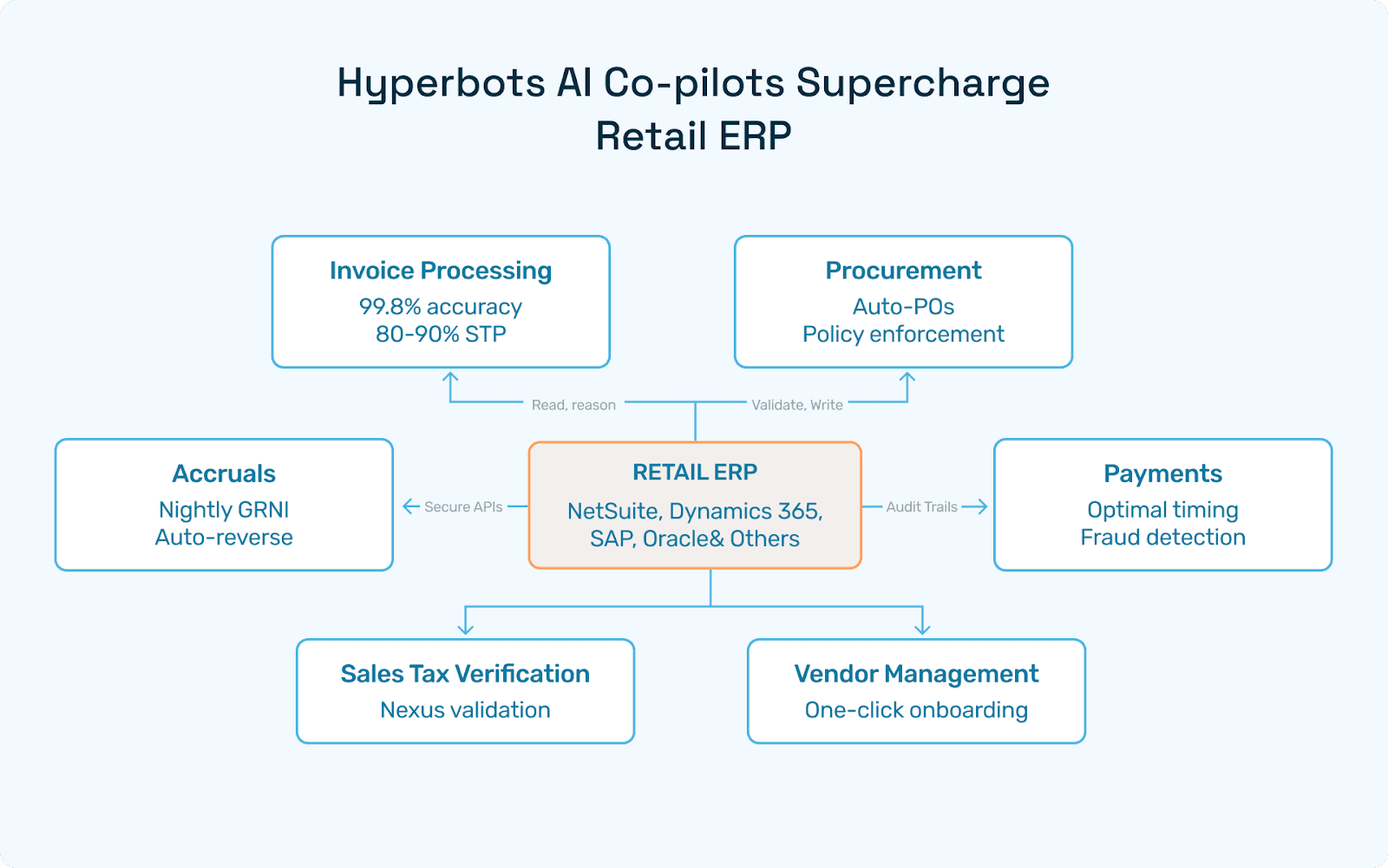
This is where Hyperbots fits. Hyperbots is a finance-grade AI platform that connects to your ERP — NetSuite, Dynamics 365, SAP, Epicor, Acumatica, Infor, Odoo, and others — and handles the operational finance workflows that live between your ERP and your finance team.
Six AI co-pilots, each focused on a specific finance workflow:
Invoice Processing Co-pilot — reads invoices in any format, reasons against PO/receipt data and tolerances, and posts or routes exceptions automatically. Targets 60–90% straight-through processing after stabilization.
Procurement Co-pilot — manages PO matching, receipt confirmation, and approval workflows across procurement touchpoints.
Accruals Co-pilot — identifies what to accrue based on open POs, receipts, and contracts; generates entries with linked evidence. Reduces manual accrual work by 20–40%.
Payment Co-pilot — optimizes payment proposals, validates bank details, prevents duplicate and overpayments, and improves working capital by 3–10 days DPO.
Sales Tax Verification Co-pilot — validates tax treatment before transactions are posted, preventing costly after-the-fact corrections.
Vendor Management Co-pilot — maintains vendor master data, flags anomalous changes, and manages onboarding and compliance workflows.
What this changes in your TCO model: If AP automation lifts straight-through processing from 30% to 80%, the reduction in manual exception handling directly offsets staff cost. Faster invoice cycle time improves discount capture. Duplicate prevention eliminates recoverable losses that most AP teams accept as a cost of doing business.
For CFOs evaluating ERP options, the question isn't just which ERP to buy — it's what operating model runs on top of it. Hyperbots answers the second question regardless of which ERP you choose for the first.
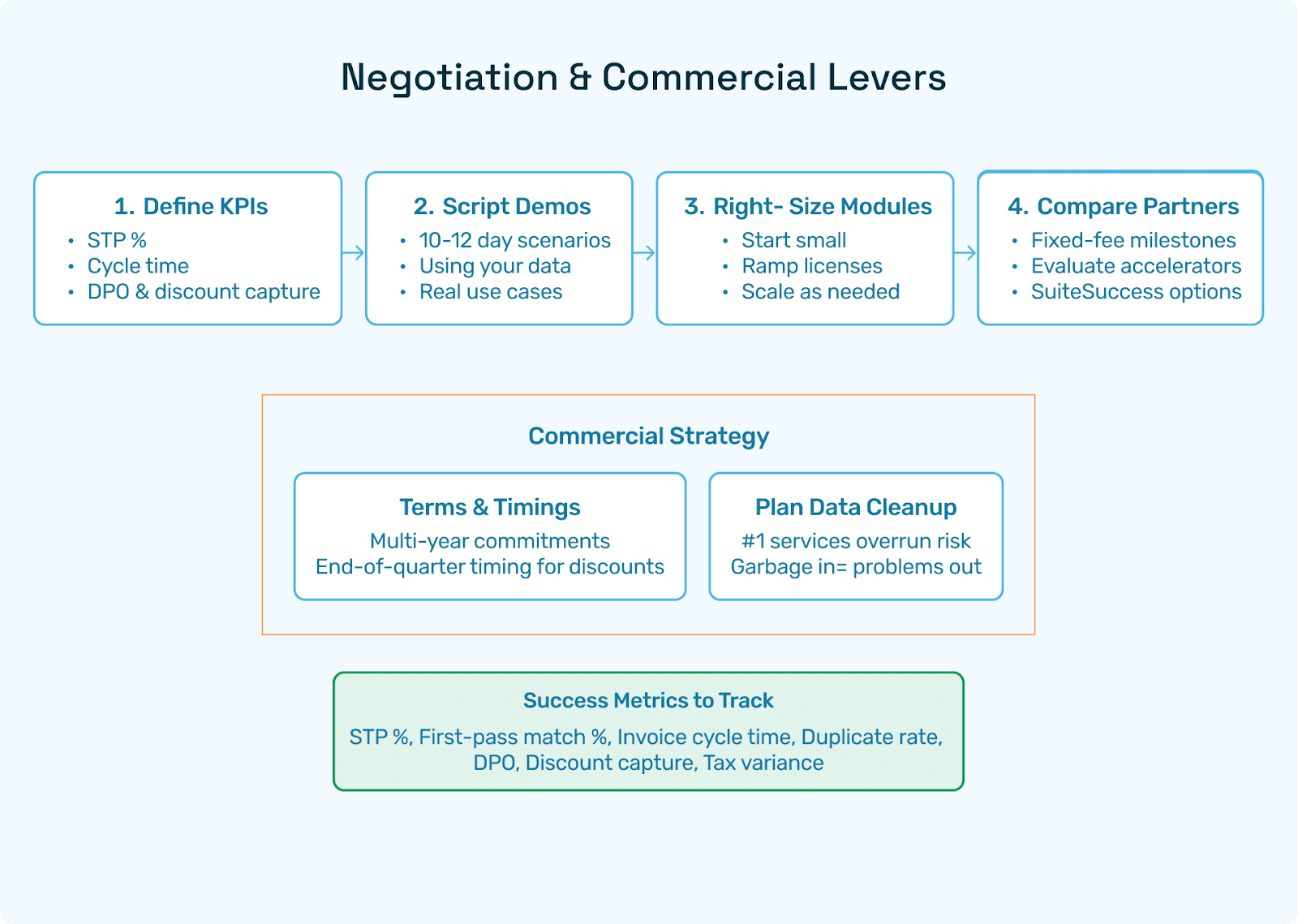
ERP Negotiation: Commercial Levers That Actually Work
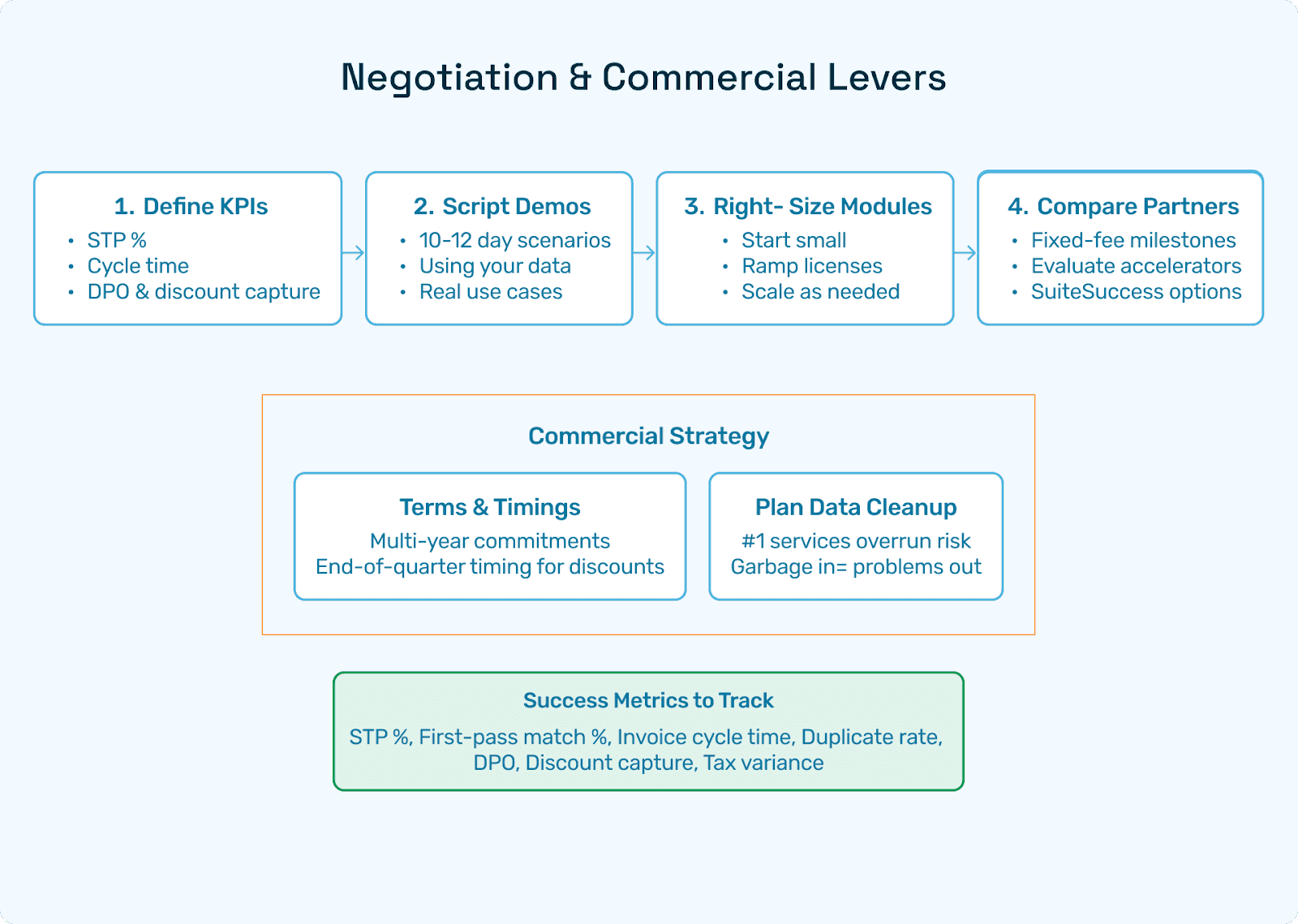
A few patterns that consistently improve deal terms:
Define scope before you sign. Every requirement that gets added after contract signature costs more than it would have in the initial scope. Invest in discovery before procurement.
Right-size modules. Don't buy WMS, manufacturing, or advanced planning modules you won't activate in the first 12–18 months. Subscription costs accumulate whether modules are in use or not. Ramp licenses as go-live milestones are reached.
Negotiate implementation model. Time-and-materials engagements transfer cost risk to you. For well-defined phases, standard module configuration - push for fixed-fee or capped-fee arrangements.
Use accelerators. NetSuite SuiteSuccess, SAP Activate, Acumatica industry editions — pre-built templates can cut implementation timelines by 20–40% and reduce partner fees proportionally.
Leverage timing. End-of-quarter and end-of-fiscal-year timing often unlocks discounts. Multi-year contract terms typically improve pricing.
Get 2–3 partner quotes. Implementation costs vary significantly by partner, even for the same ERP. The gap between the highest and lowest qualified partner bid is often 30–50%.
FAQ
Which ERP has the lowest implementation cost?
Odoo with a pre-configured implementation, or Business Central with a Microsoft-certified accelerator. Both can land under $50K for a finance-first SMB with limited customization. The risk: scope creep and customization add cost quickly.
Which ERP is best for manufacturing pricing?
Acumatica (resource-based, unlimited users, strong native manufacturing) and Epicor Kinetic (native job shop/ETO depth) offer the best value-to-capability ratio for mid-market manufacturers. SAP Business One is the leading SMB manufacturing option.
Which ERP is best for SMBs?
Business Central for Microsoft-stack companies. Odoo for budget-conscious teams willing to manage module complexity. SAP Business One for SMBs with serious manufacturing requirements.
What ERP has the best pricing transparency?
Microsoft and Odoo publish pricing pages. Everyone else — NetSuite, SAP, Epicor, Infor, IFS, Sage — is quote-based. Acumatica publishes its licensing model without specific pricing.
What is the average ERP implementation cost in 2026?
SMBs: $50K–$150K. Mid-market manufacturers and distributors: $150K–$500K. Enterprise: $750K–$5M+. The median implementation runs 1.5–2x the first-year software subscription.
What hidden ERP costs should companies expect?
Data migration overruns, integration scope expansion, post-go-live optimization, annual maintenance (on-prem), internal staff time, and support retainers. Budget 20–30% contingency on top of any implementation estimate.
What is the best ERP for a company going through rapid growth?
NetSuite is the most common choice for growth companies targeting an IPO or complex multi-entity consolidation. Strong financial controls, audit readiness, and a large partner ecosystem.
How does cloud vs. on-prem affect long-term cost?
Cloud bundles updates into the subscription — no additional maintenance fee, but you pay forever. On-prem perpetual licenses require 16–22% annual maintenance but have lower long-term cost if you keep the system 7+ years. Most new deployments are cloud; on-prem is largely a legacy or industry-specific choice.
Final Takeaway
ERP system price comparison is ultimately a 5-year TCO exercise, not a per-user rate comparison. The vendors who publish transparent pricing (Microsoft, Odoo) make shortlisting easier. The vendors who don't (NetSuite, SAP, Epicor, Infor) often deliver more value at their price points than the opacity suggests — you just need to scope carefully and validate with independent partner quotes.
The variables that move TCO more than any published rate: implementation scope, data quality, integration complexity, and how efficiently your finance operations run post-go-live.
Software licensing is 20–35% of your 5-year cost. Everything else is how well you planned the project, and how much manual work your finance team is still doing after the ERP is live.