ERP for the Food and Beverage Industry: The Complete Guide to Operations, Finance, and AI Automation
The Industry Where Getting It Wrong Has Consequences
Most industries can absorb a bad month. A delayed payment, a miscoded invoice, an inaccurate financial close. These are expensive, but they are recoverable.
Food and beverage is different. Here, operational and financial errors carry consequences that go beyond the balance sheet. A batch of product with a traced contamination needs to be recalled within hours, not days. An ingredient that passes its expiry date in the warehouse without being caught becomes a food safety incident. A supplier relationship damaged by consistently late payments becomes a supply security problem the moment that ingredient is hard to source.
The finance function sits inside all of this. Every purchase order, every goods receipt, every supplier invoice, every production batch, and every customer shipment generates financial data that has to be processed correctly, quickly, and with a complete audit trail. When the systems and processes handling that work are not built for the specific demands of food and beverage, the costs accumulate across quality, compliance, cash flow, and supplier trust simultaneously.
This blog is a complete guide to what ERP means in the food and beverage context, what it genuinely needs to do, where most implementations fall short, and how AI automation changes the economics and accuracy of F&B finance operations.
What Makes Food and Beverage Unlike Every Other Industry
Before covering what an F&B ERP needs to do, it is worth being specific about what makes this industry operationally distinct. The requirements are not just more complex versions of standard ERP needs. Several of them simply do not exist in other industries at all.
Every product has a biological clock. Raw materials expire. Finished goods have best-before dates. Work-in-progress has critical control points where the product can spoil or become unsafe. The entire supply chain, from the moment an ingredient arrives at goods receipt to the moment a finished product reaches the customer, operates under time pressure that has no equivalent in manufacturing non-perishable goods.
Traceability is a legal requirement, not a best practice. Under frameworks like the FDA's Food Safety Modernization Act (FSMA) in the US and equivalent legislation in the EU and UK, food businesses must be able to trace any product forward to customers and backward to raw material sources within hours of a recall being triggered. The ERP is the system that makes this possible. If it cannot track lot numbers end to end, the business cannot comply with its regulatory obligations.
Recipes are living documents with financial consequences. A recipe is not just a list of ingredients. It carries allergen declarations, nutritional data, approved substitute ingredients, and cost structures. When a commodity price moves, and in food and beverage commodity prices move constantly, the cost of every finished product that uses that ingredient changes. An ERP that cannot update standard costs in response to real ingredient pricing gives the finance team inaccurate margin data to make decisions with.
The procurement cycle runs on biology, not business logic. Fresh ingredients cannot be held in buffer stock the way industrial components can. Procurement needs to respond to production schedules with very short lead times. Ordering too early means waste. Ordering too late means the production line stops. The ERP needs to automate that balance, not leave it to a buyer's judgment and a spreadsheet.
Supplier relationships are supply security. In a market where ingredient availability is frequently constrained by weather, logistics disruption, or seasonal supply, the suppliers who prioritise your orders matter enormously. How you pay them, on time, at the agreed terms, with accurate remittance, directly affects whether you get priority access to ingredients when supply is tight. This is not a theoretical risk. It is a recurring operational reality in food and beverage.
What an F&B ERP Actually Needs to Handle
A general-purpose ERP can manage financial transactions across most industries. An ERP for food and beverage needs to do considerably more. Here are the capabilities that are non-negotiable:
Batch and Lot Traceability
Every production batch needs a unique identifier that is created at goods receipt and travels with the product through every stage: ingredients consumed, production run, quality checks, packaging, storage, and shipment. If a recall is triggered on a specific batch of raw material, the ERP needs to answer two questions immediately: which finished products were made using that lot, and which customers received them.
This is not a reporting feature. It is a data architecture requirement. The ERP's data model has to support bidirectional lot tracing natively. Systems that approximate this with custom fields or workarounds will fail under the pressure of a real recall scenario.
Expiry Date Management and FEFO
FEFO stands for First Expired, First Out. It means the inventory with the earliest expiry date must always be consumed or shipped first, regardless of where it sits in the warehouse. A general ERP defaults to FIFO, First In, First Out, which is the right logic for most industries. In food and beverage, it is the wrong logic and can result in expired stock being held while newer stock is consumed.
The ERP needs to enforce FEFO automatically at the picking stage, flag ingredients approaching their expiry date, quarantine stock that has expired, and prevent expired materials from being used in production or shipped to customers, without any reliance on warehouse staff to make the right call manually.
Recipe and Formulation Management
The production bill of materials in food and beverage is called a recipe or formulation. Managing it correctly means tracking approved substitutes, version-controlling recipe changes, maintaining allergen declarations at the ingredient level, and rolling up the cost of the finished product from actual ingredient costs rather than fixed standard prices.
When a recipe is changed, because an ingredient is unavailable, because a cost reduction has been identified, or because a product is being reformulated, the ERP needs to update the allergen declaration, flag the change for quality approval, and recalculate the product cost, all in one governed workflow.
Demand-Driven Procurement
The trigger for a purchase order in food and beverage should be production demand, not a weekly review. The ERP calculates what is needed based on the production schedule, checks current stock by lot and expiry status, accounts for in-transit orders already placed, and generates purchase requisitions for the shortfall automatically. This reduces both waste and stockouts, and removes the manual burden of procurement planning from a function that is better spent managing supplier relationships and exceptions.
Variable Pricing and Commodity Indexing
Many food and beverage ingredients are priced against commodity indices: wheat, dairy, oils, proteins. The price on a supplier invoice may differ from the price on the purchase order because the invoice reflects the commodity price at the time of delivery rather than the time of ordering. The ERP needs to handle these price variances intelligently by matching the invoice to the PO, calculating the variance, applying the correct accounting treatment, and flagging exceptions that exceed agreed tolerance bands.
Multi-Jurisdiction Tax Compliance
Food and beverage products have complex and inconsistent tax treatment across US states and international markets. Some food categories are exempt from sales tax. Others are taxable. The rules differ by state, by product type, and by channel. An ingredient purchased for manufacturing use may be taxed differently from the same ingredient purchased for resale. Applying a single global tax logic to all F&B purchases produces systematic compliance errors. The ERP needs to apply the correct tax treatment at the transaction level, based on the entity, the product, and the jurisdiction.
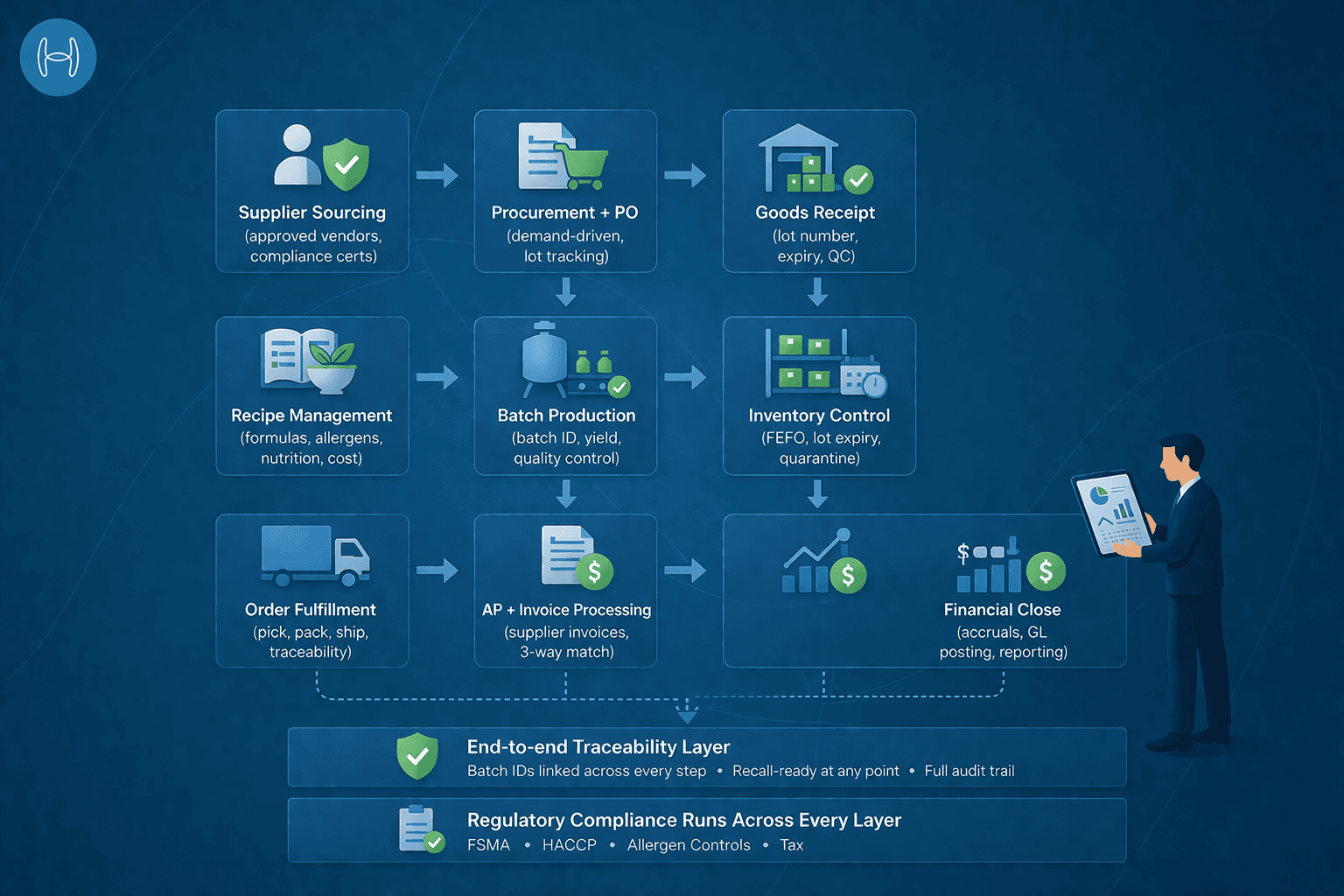
The F&B ERP Process Flow
Here is how a well-governed food and beverage ERP connects every core operational process, from supplier to customer, with traceability and compliance running underneath it all:
Where ERP Implementations Break Down in Food and Beverage
Even well-intentioned ERP projects in F&B produce systems that work adequately for basic transaction recording but leave significant operational and financial gaps. These are the failure points that appear most consistently:
Lot traceability works in the warehouse but not across the full supply chain. ERPs track inventory movements within their own modules, but when data is entered manually at goods receipt, a common scenario when a driver hands over paperwork and a warehouse operative types lot numbers into a screen, errors creep in. A single transposed digit in a lot number can make an entire production batch untraceable. This is not a technology failure. It is a process design failure that the ERP implementation did not address.
Standard costs are set once and rarely updated. The cost of a finished product in most ERP systems is calculated at implementation, adjusted occasionally, and used as the basis for all margin reporting in between. In a business where raw material costs are tied to commodity markets that move regularly, the standard cost becomes progressively less accurate as a reflection of reality. Finance teams know the margin data is wrong, but fixing it requires manual work that nobody has capacity for.
The AP function cannot keep pace with procurement volume. A food and beverage company can easily process a high volume of supplier invoices every week. Each invoice may have multiple line items, variable pricing, unit-of-measure conversions, and lot-specific pricing. Processing these manually, including data entry, PO matching, GL coding, approval routing, and posting, consumes enormous finance team capacity. The backlog builds. Early payment discounts are missed. Supplier relationships suffer from late and inaccurate payments.
Period-end accruals are guesswork. Goods received not invoiced, known as GRNI, is one of the most significant sources of financial inaccuracy in F&B finance. Deliveries arrive at the end of a period, the invoice arrives in the following period, and the finance team estimates the liability. In a business with hundreds of active purchase orders, those estimates are often materially wrong. The result is financial statements that do not accurately reflect the period's costs, and a close process that requires significant post-period adjustments.
Compliance documentation is disconnected from transactions. Certificates of analysis, supplier compliance declarations, allergen statements, and quality audit records typically live in separate systems: a shared drive, a quality management system, an email folder. When a regulator requests documentation for a specific lot, or when a customer requires evidence of compliance for a product they received, assembling that documentation is a manual emergency exercise rather than a straightforward system query.
The Numbers: Manual vs AI-Powered Finance in Food and Beverage
The table below shows what changes when AI-powered automation replaces manual and ERP-native-only finance in an F&B operation. The right column reflects verified Hyperbots performance data.
What Is Being Measured | Without Automation | With AI-Powered Automation |
Invoice extraction accuracy | Manual entry or basic OCR; significant errors on lot-coded, variable-price invoices | 99.8% accuracy |
Invoices processed without human involvement | Very few; most require manual touchpoints at multiple stages | Up to 80% straight-through processing |
Invoice processing cost | High, multiplied across active suppliers | 80% cost reduction |
Time from demand signal to approved purchase order | Days of manual coordination | Under 5 minutes |
PO creation and dispatch time | Slow and manual across multiple suppliers | 80% faster |
Accrued vs. actual cost variance at period end | Significant gap from manual GRNI estimates | Less than 5% variance |
Cash flow from more accurate accruals | Unpredictable; timing gaps create false liability signals | 10% improvement in cash flow |
Reconciliation processing cost | Manual, labour-intensive, performed entity by entity | 80% cost reduction |
Unapplied cash left unmatched | Large volumes create distorted cash position | 90% automatically matched |
Time to go live with AI automation layer | Several months for ERP-native configuration | Live within 1 month |
These are not projections. They are outcomes from Hyperbots deployments. In a high-volume F&B operation, the compounding effect is significant. The accuracy and cost impact shows up across every single transaction when invoice complexity is high and supplier volumes are large.
Why Generic Finance AI Falls Short in Food and Beverage
Not all AI automation tools are built the same way, and the difference matters acutely in food and beverage.
A general-purpose AI model trained on broad financial data will not reliably understand an F&B supplier invoice. It may misread catch-weight pricing. It may not recognise lot-specific line items as distinct from standard quantity-price lines. It may apply the wrong tax treatment to an ingredient purchase because it cannot distinguish between a taxable and an exempt food category in a specific state.
Hyperbots is pre-trained on millions of financial documents across industries, with specific depth in food and beverage, hospitality, and food processing. The Invoice Processing Co-Pilot is designed to recognise and understand industry-specific line item descriptions and terminology, the kind that appears on F&B supplier invoices but not in standard accounting training. This means it handles lot-coded invoices, catch-weight conversions, commodity-indexed pricing, and multi-line ingredient purchases accurately from day one, without requiring manual rule configuration for each new document type.
The platform's no-code framework means that when F&B-specific requirements change, a new supplier format, a new product category, a new tax jurisdiction, the finance team can update the configuration directly, without involving IT or raising a support request with the vendor.
How Hyperbots Changes Finance Operations for Food and Beverage Companies
Hyperbots is an agentic AI platform built specifically to sit on top of ERP systems and automate the finance and accounting processes that ERPs cannot handle intelligently on their own. For food and beverage companies, this means taking the high-volume, complexity-heavy AP and procurement workflows that currently consume finance team capacity and running them with industry-aware accuracy and a complete audit trail.
Invoice Processing
The Invoice Processing Co-Pilot reads supplier invoices in any format, including PDF, scanned document, EDI, and email attachment, at 99.8% accuracy. It handles the specific complexity of F&B supplier invoices: lot-coded line items, variable pricing tied to commodity indices, unit-of-measure conversions between how ingredients are ordered and how they are priced, freight and handling charges on the same document as ingredients, and tax lines that vary by product category and jurisdiction.
Up to 80% of invoices are processed end to end without any human involvement, captured, extracted, GL coded, matched against the purchase order and goods receipt, routed for approval, and posted to the ERP. The remaining invoices that require human attention are flagged clearly, with the specific reason surfaced so that the AP team can resolve them quickly rather than having to diagnose the issue from scratch.
For a finance team that currently processes invoices manually at high volume, this is not an incremental improvement. It is a structural change in how the AP function operates and what it costs to run.
Procurement Automation
The Procurement Co-Pilot ties directly to production schedules and demand signals, generating purchase requisitions automatically when stock levels or planned production require replenishment. Each requisition is checked against company purchasing policies and budget rules, routed to the correct approver, and converted to a purchase order that is dispatched to the supplier without manual intervention.
Purchase requests that previously took days to move through manual approval chains now take under 5 minutes. PO creation and dispatch time is reduced by 80%. In a perishable ingredients environment where a delay in a purchase order can disrupt a production run, the speed of this cycle has direct operational value that goes well beyond finance efficiency.
Accruals
The Accruals Co-Pilot solves the GRNI problem that causes financial reporting inaccuracy at every period end in F&B. It identifies goods received but not yet invoiced by reading actual goods receipt data from the ERP, calculates the accrual liability automatically, books the journal entry, and manages the reversal in the following period. The variance between what is accrued and what is actually invoiced is kept under 5%, with a 10% improvement in cash flow from more accurate and timely accrual recording.
Finance teams that currently spend the final days of every period reconciling GRNI estimates and making manual adjustments get that time back. For a deeper look at how accrual automation works in practice and what it means for the financial close, the analysis of live accrual automation is directly relevant.
Payments
The Payments Co-Pilot schedules and executes supplier payments via ACH, wire, or check. It includes timing recommendations that identify early payment discount opportunities, a significant value driver in F&B where supplier payment terms frequently offer discounts that are routinely missed because invoice processing backlogs delay approval. Fraud checks run on every payment request before execution, flagging changes to supplier bank details or unusual payment patterns for review.
Sales Tax Verification
The Sales Tax Verification Co-Pilot applies the correct tax treatment to each invoice based on the product category, the supplier's jurisdiction, and the entity receiving the goods. Food product tax rules vary considerably across US states: some categories are fully exempt, others are taxable, and the boundary between them is not always obvious. The co-pilot handles these distinctions automatically, applying industry-specific tax rules rather than a simplified global logic, and producing a complete audit trail of every tax decision for compliance documentation.
Vendor Management
The Vendor Management Co-Pilot handles the full supplier onboarding process: collecting and validating compliance documentation, verifying supplier identity, confirming banking details, and maintaining a deduplicated vendor master across all entities. It provides a self-service portal through which suppliers can submit invoices, check payment status, and update their own records without requiring any AP team involvement.
In food and beverage, where vendor compliance management carries regulatory weight, including approved supplier lists, certificates of analysis, organic certifications, and food safety audit records, having these records linked to vendor master data and maintained automatically is a compliance capability, not just an administrative convenience. The broader case for what supplier relationship management means for supply chain resilience is covered in the vendor management and supplier relations overview.
Collections and Cash Application
For F&B companies with significant receivables activity, selling to retailers, distributors, or foodservice operators, Hyperbots reduces collections costs by 70% and cuts Days Sales Outstanding by 40%. Ninety percent of incoming payments are matched automatically to the correct invoice, eliminating the unapplied cash problem that creates false signals in cash visibility reporting across entities.
Industry-Aware from Day One
What distinguishes Hyperbots from generic AP automation tools is not just the features. It is the depth of pre-training. The platform's AI models have been trained on millions of financial documents across food and beverage, hospitality, and agriculture and food processing, which means they understand the terminology, document structures, and line-item conventions that appear in real F&B supplier invoices without requiring manual configuration for each new supplier or document type.
The no-code framework means the finance team can adapt workflows, add custom fields, and update processing rules directly, without IT involvement and without raising a support ticket. In an industry where product ranges, supplier relationships, and regulatory requirements change regularly, this adaptability is operationally important.
All co-pilots go live within one month, connecting to the ERP through pre-built connectors that already understand the data structures of the ERP in use. There is no lengthy model training, no custom integration project, and no waiting period before the system starts processing. Hyperbots supports a wide range of industries with tailored capabilities, and food and beverage sits within an ecosystem designed for the full spectrum of finance complexity across sectors.
What to Look for When Choosing an ERP for Food and Beverage
Choosing an ERP for an F&B business is one of the most consequential decisions a finance and operations leadership team makes. These are the requirements that should be non-negotiable before signing:
Native lot traceability in the data model, not a workaround. Ask to see a recall simulation before committing. If the vendor cannot show you, from a specific lot of finished goods, which raw material lots were used in its production, and from a specific raw material lot, which finished goods it went into, the system cannot support your regulatory obligations.
FEFO enforcement that does not depend on people. Picking logic must enforce First Expired, First Out automatically across all warehouse locations, with automatic quarantine of stock approaching or past expiry.
Real-time recipe cost rollup from actual ingredient prices. Standard costs set at implementation and updated occasionally are not sufficient. The system needs to reflect current ingredient pricing in product cost calculations, so that the margin data the finance team works with is accurate.
Demand-driven procurement connected to production schedules. Purchase orders should be triggered automatically by production demand, not generated manually from periodic reports. In a perishable ingredients business, the difference between these two approaches is the difference between a lean operation and a wasteful one.
An AI layer that understands F&B document complexity. The finance automation tool sitting on top of the ERP needs to have been trained on food and beverage financial documents specifically, not just generic invoices. The vocabulary, the pricing structures, the lot references, and the tax treatment of F&B supplier invoices are industry-specific. A generic tool will produce generic accuracy, which is not sufficient for a business where invoice errors affect lot tracking, compliance, and supplier payments simultaneously.
Implementation in weeks, not months. Every month spent implementing is a month still running manual processes. A pre-trained AI with pre-built ERP connectors should be operational within a month of kickoff, without a custom development project.
For context on how F&B ERP requirements compare to those of other high-volume, margin-sensitive consumer industries, the complete retail ERP playbook covers many of the same structural pressures from a retail perspective.
The Bottom Line
Food and beverage is an industry that punishes operational and financial errors more severely than most. A mislabelled lot, a missed recall, a supplier paid late for months on end, an accrual estimate that is materially wrong: each of these carries consequences that reach beyond the finance department into quality, compliance, supply chain, and commercial relationships.
The ERP is the foundation that either controls these risks or contributes to them. A system built for F&B, configured correctly, and extended with an AI finance automation layer that understands the industry's specific document complexity, can turn what is currently a series of manual fire-fighting exercises into a governed, predictable, accurate operation.
The finance teams that manage F&B operations well are not working harder. They are working inside systems that handle the volume and the complexity automatically, so that every decision they make is based on data that is current, accurate, and traceable all the way back to the raw material.
Hyperbots' Invoice Processing, Procurement, Accruals, Payments, Sales Tax Verification, and Vendor Management Co-Pilots are industry-aware, pre-trained on F&B financial documents, and live on top of your existing ERP within one month. Request a demo.
FAQs
What is an ERP system in the food and beverage industry? An ERP system in food and beverage is the central software that manages purchasing, production, inventory, fulfilment, and finance in one connected platform. In F&B, it must also handle lot traceability, expiry date management, recipe cost management, and regulatory compliance as core capabilities. These are requirements that are absent or insufficient in general-purpose ERP systems.
Why is lot traceability so critical in food and beverage? Lot traceability is the mechanism by which a food recall is executed. When a contamination or safety issue is identified in a specific batch of raw material or finished product, the business must be able to identify every finished product made from that material and every customer who received it, within hours. Without bidirectional lot traceability in the ERP, this is not possible, which means the business cannot comply with food safety regulations and cannot protect its customers.
What is FEFO and why does it matter more than FIFO in food and beverage? FEFO stands for First Expired, First Out. It means the inventory with the earliest expiry date should always be consumed or dispatched first. Standard ERP systems use FIFO, First In, First Out, which does not account for expiry dates. In food and beverage, FIFO can result in newer stock being consumed while older stock expires unsold, creating waste and food safety risk. FEFO prevents this by directing warehouse picks to the earliest-expiry stock automatically.
What is GRNI and why does it cause problems at period end? GRNI stands for Goods Received Not Invoiced. It is the financial liability that exists when goods have been received into stock but the supplier has not yet sent an invoice. In high-volume F&B operations, GRNI balances can be significant. Estimating them accurately for period-end financial close is difficult when done manually, and errors in those estimates mean the financial statements do not accurately reflect the period's costs. AI-powered accruals automation resolves this by calculating GRNI from actual goods receipt data, keeping variance under 5%.
How does Hyperbots handle the complexity of food and beverage supplier invoices? Hyperbots' Invoice Processing Co-Pilot is pre-trained on millions of financial documents including food and beverage, hospitality, and agriculture and food processing. It is designed to recognise industry-specific line item terminology, handle lot-coded purchases, process variable pricing tied to commodity indices, manage unit-of-measure conversions, and apply the correct tax treatment by product category and jurisdiction, all from day one, without manual rule configuration.
How long does it take to go live with Hyperbots on top of an existing ERP? Hyperbots goes live within one month. Pre-built ERP connectors and pre-trained AI models mean there is no custom development, lengthy configuration project, or model training period required before the system begins processing.
What happens to the finance team when AI handles processing work? The AP team stops spending its time entering data, chasing approvals, reconciling mismatches, and managing backlogs. It focuses instead on exception handling, supplier relationship management, financial analysis, and the judgment-intensive work that actually requires human expertise. The processing volume is absorbed by the AI. The finance team's capacity goes to work that creates value.