AI in ERP: How Artificial Intelligence Is Transforming Every Business Process
What Is an ERP System, and Why Does It Matter?
Every business, no matter its size, runs on processes. Buying things, paying suppliers, managing staff, tracking inventory, closing the books at month end. For decades, companies have used software called an ERP system to manage all of these processes in one place.
ERP stands for Enterprise Resource Planning. Think of it as the central nervous system of a business. It connects every department, records every transaction, and keeps everything running on the same data. Without an ERP, every team uses its own spreadsheets and systems, and nobody ever has the full picture.
Businesses of every size, from fast-growing mid-market companies to large enterprises, rely on ERP systems to run their day-to-day operations.
But here is what most people do not say out loud: ERP systems are excellent at storing and organizing information. They are not particularly good at thinking.
That is where artificial intelligence comes in.
What Does AI Actually Mean in the Context of ERP?
Artificial intelligence, or AI, refers to software that can learn from data, recognize patterns, make decisions, and improve over time without being manually reprogrammed for every new situation.
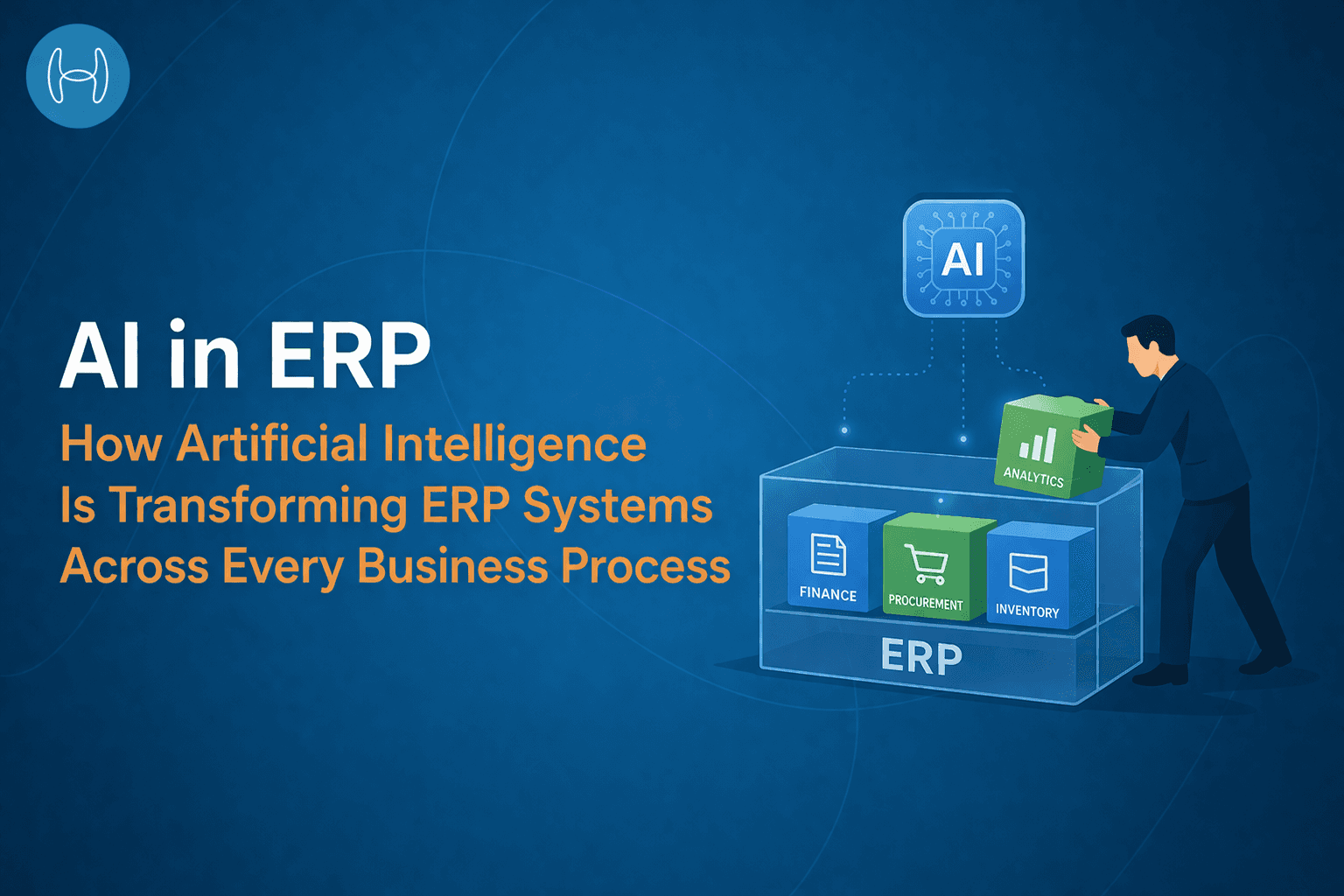
When people talk about AI in ERP, they are not talking about replacing the ERP system. They are talking about adding a layer of intelligence on top of it. The ERP continues to do what it does best: store data, enforce rules, and connect departments. The AI layer does what the ERP cannot: read an invoice and understand what it means, figure out which supplier is being referred to even if the name is slightly different, decide which approver should review a payment, or spot an unusual transaction before it becomes a problem.
There are several types of AI being applied in ERP environments today:
Machine learning learns from historical data to make predictions and recommendations. For example, it can look at thousands of past invoices and learn how each type of expense should be categorized, then apply that learning to new invoices automatically.
Natural language processing (NLP) allows AI to read and understand written documents, like invoices, purchase orders, and contracts, the way a human would.
Computer vision allows AI to extract data from scanned documents and images that traditional software cannot read.
Agentic AI is the most advanced form. Instead of just answering a single question or completing one task, an agentic AI system can take a sequence of actions, make decisions at each step, and complete an entire workflow from start to finish without needing a human to guide it through every stage.
Together, these technologies are changing what ERP systems are capable of across every business process.
Why ERP Systems Needed AI in the First Place
ERP systems have always been powerful, but they have a fundamental limitation. They do exactly what they are told. Every rule has to be written explicitly. Every exception has to be handled manually. Every new scenario requires someone to update the configuration.
In practice, this means that even companies with sophisticated ERP setups still have large amounts of manual work sitting around the edges of their systems. Someone has to enter invoice data. Someone has to decide how to code an unusual expense. Someone has to chase a supplier about a missing document. Someone has to review every exception and make a judgment call.
That manual work is expensive, slow, and error-prone. And it scales badly. As a business grows, the volume of transactions grows with it, but the ERP does not get any smarter. More transactions simply means more manual work.
AI solves this by giving ERP systems the ability to handle situations they have never seen before, learn from the decisions that humans make, and take over the judgment calls that previously required human intervention.
The result is not just faster processing. It is a qualitatively different kind of ERP, one that can adapt, improve, and manage complexity that would have been impossible to handle with rules and manual work alone.
How AI Is Changing Each Core ERP Business Process
The impact of AI is not limited to one area of the ERP. It is changing how businesses operate across every major process. Here is what that looks like in practice.
Finance and Accounts Payable
Accounts payable is one of the highest-volume, most repetitive processes in any business. Invoices arrive constantly, in different formats, from different suppliers, for different types of expenses. Each one needs to be read, checked against the purchase order, coded to the right expense category, routed to the right approver, and then posted to the financial system.
Traditionally, this process involved significant manual work at almost every step. AI changes that entirely.
AI-powered invoice processing reads invoices the same way a human would, regardless of format, layout, or language. It extracts the right data, matches the invoice to the corresponding purchase order and delivery confirmation, applies the correct expense category based on what it has learned from past invoices, and routes it to the right person for approval, all without a human touching it. When something genuinely needs human attention, it flags it clearly. Everything else moves through automatically.
The result is that the vast majority of invoices are processed end to end without any manual involvement. This is called straight-through processing. It reduces cost, speeds up payment cycles, and eliminates the errors that come from manual data entry.
AI also brings intelligence to fraud detection in AP. It can spot patterns that indicate a duplicate invoice, a supplier that has changed their bank details unexpectedly, or an invoice that does not match the contracted price. These are things that manual review processes routinely miss, simply because the volume is too high for humans to check every transaction carefully.
Procurement
Procurement is the process of requesting, approving, and ordering goods and services. In most businesses, this process is slow because it depends on people writing purchase requests, forwarding them for approval, waiting for responses, and then manually creating and sending purchase orders.
AI in procurement changes this by automating the entire sequence. A team member submits a request. The AI checks it against company policies and budget rules, routes it to the right approver, and when approved, generates and sends the purchase order automatically. The whole process that used to take days now takes minutes.
AI also adds intelligence that pure automation cannot provide. It can recommend which supplier to use based on past performance and current pricing. It can flag a purchase that is outside policy before it gets approved rather than after. It can recognize when a request matches a standing contract and apply the correct terms automatically.
Inventory and Supply Chain
AI helps businesses manage inventory more intelligently by predicting demand rather than just reacting to it. Traditional ERP inventory management is reactive: it tells you when stock is low. AI-powered inventory management is predictive: it tells you when stock is going to run low, based on historical demand patterns, seasonal trends, and current order data.
This means businesses can avoid both stockouts, where items run out and orders cannot be fulfilled, and overstocking, where too much capital is tied up in inventory that is not moving. Both are expensive problems that AI significantly reduces.
In supply chain management, AI can identify risks before they disrupt operations. If a supplier's delivery performance starts deteriorating, AI can flag it early. If a logistics route is disrupted, AI can recommend alternatives. These decisions used to require experienced supply chain managers checking reports manually. AI surfaces them proactively.
Financial Reporting and the Close Process
Closing the financial books at the end of each month or quarter is one of the most time-pressured processes in finance. It involves gathering data from across the business, making sure all expenses are recorded in the right period, reconciling accounts, and producing reports that accurately reflect the company's financial position.
AI accelerates this process in several important ways.
It automates accruals, which are the accounting entries that record expenses in the period they were incurred even if the invoice has not arrived yet. Getting accruals right requires looking at what was delivered, what is expected, and what is outstanding, and making estimates that are as accurate as possible. AI does this automatically across the entire business, reducing the variance between estimated and actual costs to under 5%.
It also automates account reconciliation, which is the process of checking that the balances in the financial system match the actual transactions that took place. Manual reconciliation is slow and often deferred until the close, creating bottlenecks. AI reconciles continuously, so the close is not starting from scratch each period.
HR and Workforce Management
HR processes like onboarding, payroll, and compliance reporting are also being transformed by AI inside ERP systems. AI can automate the administrative steps of onboarding a new employee, collecting and verifying documents, setting up payroll, and assigning the right access to systems.
In workforce management, AI can predict staffing needs based on operational data, helping managers plan schedules before gaps become problems. It can flag compliance issues before they become violations, and it can surface patterns in employee data that indicate risks like high turnover or performance issues in specific teams.
Tax and Compliance
Tax compliance is one of the most complex and highest-risk areas in business operations. Rules vary by jurisdiction, change regularly, and apply differently to different types of transactions. Getting it wrong creates financial penalties and audit exposure.
AI applies the correct tax rules to each transaction based on the entity, the location, the supplier, and the type of purchase. For businesses operating across multiple states or countries, this is not a trivial capability. The alternative is applying a simplified global logic that produces systematic errors, or maintaining manual rule tables that are always slightly out of date.
What the Shift From Rule-Based to AI-Driven ERP Looks Like
The best way to understand the change AI brings to ERP is to contrast two approaches side by side.
Process Area | Rule-Based ERP Approach | AI-Driven ERP Approach |
Invoice processing | Manual entry or basic OCR; exceptions handled by staff | AI reads any format, extracts data, codes and routes automatically; up to 80% processed without human touch |
Invoice accuracy | Dependent on manual entry; high error rate | 99.8% extraction accuracy |
Purchase requisition | Staff write and submit manually; takes days | Created automatically from templates or requests; done in under 5 minutes |
PO creation and dispatch | Manual drafting and sending | 80% faster; automated end to end |
Accruals at period end | Manual estimates; wide variance | Automated discovery and booking; less than 5% variance vs. actual |
Cash flow from accruals | Unpredictable; poor visibility | 10% improvement in cash flow accuracy |
Account reconciliation | Manual, done at period end | Continuous; 80% cost reduction |
Fraud and anomaly detection | Reactive; found after the fact | Proactive; flagged before payment |
Tax validation | Rule tables maintained manually | Applied automatically by jurisdiction and transaction type |
Unapplied cash matching | Large volumes left unmatched manually | 90% matched automatically |
Go-live time for AI layer | N/A | Live within 1 month |
These are not theoretical improvements. They are outcomes from actual deployments of AI on top of ERP systems.
What Hyperbots Does for AI-Powered ERP Operations
Hyperbots is an agentic AI platform built specifically to run on top of ERP systems and automate the finance and accounting processes that ERPs cannot handle intelligently on their own.
The platform uses a combination of computer vision, natural language processing, and agentic AI to read documents, understand their context, make decisions, and complete entire workflows without human intervention. It connects to the ERP through pre-built connectors that read and write data in real time, so every action the AI takes is immediately reflected in the financial records.
Invoice Processing. The Invoice Processing Co-Pilot reads invoices in any format, including PDFs, scanned documents, and EDI files, at 99.8% accuracy. Up to 80% of invoices are processed completely automatically, from capture through GL coding, three-way matching, approval routing, and ERP posting, without any human involvement. For finance teams processing hundreds or thousands of invoices a month, this changes the economics of AP entirely.
Procurement. The Procurement Co-Pilot automates the full process from purchase request to purchase order. Requests that previously took days to move through manual approvals are handled in under 5 minutes. PO creation and dispatch is 80% faster. Policy checks, budget validation, and supplier selection are all handled automatically, with the results posted directly to the ERP.
Accruals. The Accruals Co-Pilot identifies unrecorded expenses, books the correct accrual entries across all entities, and manages reversals automatically. The variance between estimated and actual costs stays under 5%, and cash flow improves by 10% from more accurate and timely accrual recording.
Payments. The Payments Co-Pilot schedules and executes vendor payments via ACH, wire, or check, with built-in timing recommendations that optimize for early payment discounts and fraud checks that flag suspicious payment requests before they are processed.
Sales Tax Verification. The Sales Tax Verification Co-Pilot applies the correct tax rules to every invoice based on the entity's location, the supplier's jurisdiction, and the type of purchase. For businesses operating across multiple states, this eliminates the systematic tax errors that manual rule tables produce.
Vendor Management. The Vendor Management Co-Pilot automates supplier onboarding, verifies identity documents, and manages ongoing communication through a self-service vendor portal, reducing the administrative burden on AP teams and improving data quality in the vendor master.
All of this goes live within one month. The co-pilots come pre-trained on finance and accounting processes, which means there is no lengthy model training or custom configuration required. They connect to the ERP, learn the specific policies of the business, and start processing from day one.
For a broader understanding of how ERP systems and business processes work together, and where AI fits in that picture, the ERP and business process guide covers the full landscape.
The Bigger Picture: What AI Changes About How ERP Is Used
The introduction of AI into ERP is not just a productivity improvement. It changes the role that ERP plays in a business and the role that finance teams play alongside it.
When ERP systems required large amounts of manual input and oversight, finance teams spent the majority of their time on processing work: entering data, correcting errors, chasing approvals, reconciling accounts. AI takes over that processing work. Finance teams shift toward higher-value activities: analyzing what the data means, identifying trends, advising on decisions, managing exceptions that genuinely require human judgment.
This is not about reducing headcount. It is about redirecting the capacity of skilled finance professionals toward work that actually requires their skills, while AI handles the volume and routine decision-making that was never a good use of their time in the first place.
For businesses exploring how to automate ERP modules and processes, the practical starting point is usually AP and procurement, where volumes are highest, errors are most costly, and the case for automation is clearest. From there, the same AI layer can be extended to accruals, payments, tax, and vendor management.
AI also makes ERP data significantly more reliable. When manual entry is the primary input method, data quality degrades over time. Vendor names become inconsistent, GL codes get applied incorrectly, and exceptions pile up unrectified. AI maintains consistency because it applies the same logic every time and flags deviations rather than ignoring them. The result is a financial system that finance leaders can actually trust, which is more valuable than any individual efficiency gain.
One area where AI's impact is particularly tangible is fraud and anomaly detection. In a manual AP process, a duplicate invoice or a fraudulent payment request might pass through undetected simply because the volume is too high for anyone to check every transaction. AI reviews every transaction, compares it against historical patterns, and flags anything that looks out of place, before the payment is made.
What to Look for When Evaluating AI for Your ERP
Not all AI tools that claim to integrate with ERP systems deliver the same quality of results. Here are the questions worth asking:
Is the AI pre-trained on finance and accounting data, or is it a general-purpose model? General-purpose AI models perform poorly on invoice processing, GL coding, and tax validation because they have not been trained on the specific patterns of financial documents. Pre-trained finance AI starts accurate from day one and improves further from actual usage data.
Does it connect to your ERP in real time, or does it rely on batch data exports? Batch exports mean the AI is always working with slightly out-of-date data. Real-time, two-way ERP connectivity means every decision the AI makes reflects the current state of the financial system.
Can it handle exceptions intelligently, or does it stop and ask for help whenever something falls outside the standard pattern? In any real AP environment, exceptions are common. An AI that cannot handle them autonomously is not reducing manual work as much as it appears to on a demo.
How long does it take to go live? Implementations that take six months or longer before delivering results are a meaningful risk. A pre-trained AI with pre-built ERP connectors should be operational within a month.
Does it explain its decisions? In a finance context, auditability matters. Every coding decision, every routing choice, every exception resolution should be logged with a clear record of why the AI made that decision. Finance teams and auditors need to be able to follow the trail.
The Bottom Line
ERP systems are not going away. They are the backbone of how businesses operate, and that will not change. What is changing is what those systems can do.
For most of the history of ERP, the system recorded what happened. Finance teams had to make sure the right things happened first. AI flips that dynamic. The intelligence layer makes the right things happen automatically. The ERP records the outcome.
The businesses that get the most value from AI in ERP are not the ones that replace their systems. They are the ones that add an intelligent layer on top of what they already have, let AI take over the volume and the routine decisions, and redeploy their finance teams toward the work that actually requires human judgment.
That transition is happening now. The technology is available, the implementations are fast, and the results are measurable from the first month of deployment.
Hyperbots' AI Co-Pilots connect to your ERP on day one, process invoices at 99.8% accuracy, automate procurement, accruals, payments, and vendor management, and go live within one month. Request a demo.
FAQs
What is AI in ERP? AI in ERP refers to adding an artificial intelligence layer on top of an ERP system to handle tasks that require judgment and pattern recognition, such as reading invoices, coding expenses, routing approvals, and detecting anomalies. The ERP remains the system of record. The AI layer makes each transaction smarter before it is recorded there.
Does AI replace ERP systems? No. AI works alongside ERP systems, not instead of them. The ERP stores data, enforces rules, and connects departments. The AI reads documents, makes decisions, and completes workflows that the ERP cannot handle on its own. Together they do far more than either can alone.
What is agentic AI and how is it different from regular automation? Regular automation follows fixed rules: if this, then that. Agentic AI can take a sequence of actions, make decisions at each step, handle situations it has not seen before, and complete an entire workflow from start to finish without needing a human to guide it. It behaves more like a skilled team member than a script.
Which ERP processes benefit most from AI? Finance and accounts payable, procurement, inventory management, financial close and accruals, tax compliance, and vendor management all see significant improvements. The highest-impact starting points are usually AP and procurement because of the volume of transactions and the high cost of manual errors.
How accurate is AI-powered invoice processing? Hyperbots delivers 99.8% invoice extraction accuracy. Up to 80% of invoices are processed end to end without any human involvement.
How long does it take to add AI to an existing ERP? With pre-trained AI and pre-built ERP connectors, implementation takes approximately one month. There is no custom model training or lengthy configuration required.
What happens to finance teams when AI takes over processing work? Finance teams shift from transaction processing toward analysis, exception management, and strategic decision support. The volume work is handled by AI. The judgment work stays with people.