
ERPs for Manufacturing Comparisons (2026 Guide)
Pair ERP with Hyperbots to reduce errors, accelerate finance, and scale manufacturing operations effectively.
Executive Summary
Manufacturers are operating on thinner margins and shorter lead times while juggling complex supply chains, regulatory pressures, and chronic labor shortages. Picking the best ERP for manufacturing is less about brand prestige and more about fit: the depth of manufacturing modules, ease of integrations, total cost of ownership (TCO), and speed to outcomes. This commercial buyer’s guide compares the top ERP systems for manufacturing across size tiers and industries—discrete, batch/process, and custom/ETO- and maps each to realistic scenarios you can use today.
You’ll find a head-to-head matrix of best manufacturing software systems, including SAP S/4HANA, Oracle Fusion Cloud ERP, Microsoft Dynamics 365 Finance & Supply Chain, Infor CloudSuite Industrial (SyteLine), IFS Cloud, Epicor Kinetic, QAD, Plex, SYSPRO, NetSuite, Acumatica, Sage X3, Odoo, and more. We evaluate manufacturing enterprise resource planning software feature depth (BOMs, routings, MRP/DRP, costing, quality), WMS and barcoding, outside processing, portals/EDI, tax and compliance, analytics, and extensibility. You’ll also get a clear definition of production ERP software vs. MES and how they intersect in real plants—so you don’t overbuy or underscope.
Because “software alone” doesn’t deliver outcomes, this guide shows where Agentic AI automation changes the math. Hyperbots provides six Finance-grade AI Co-pilots that run on top of your chosen ERP—automating invoice capture and matching, procurement, accruals, payments, sales-tax verification, and vendor management. For buyers evaluating enterprise resource planning for manufacturing industry options, the fastest ROI often comes from automating the finance spine first. With Hyperbots in the loop, ERP implementation in the manufacturing industry plans stabilize faster, exceptions shrink, and close cycles accelerate, without ripping and replacing your manufacturing ERP.
How to Evaluate Manufacturing ERPs
Before you shortlist the best ERP software for manufacturing, align the evaluation with how your plant runs today and how it needs to run in two years. Start by writing 10–12 “day-in-the-life” scripts that a vendor must execute live using your data. Example flows:
Outside processing step in routing; ship WIP to vendor; receive back; service invoice matched and posted with proper cost roll-ups.
Landed cost allocation (freight, duty, surcharges) distributed on receipts; correct inventory valuation and PPV/variance impact.
Serial/lot traceability from receipt → issue → operation → completion → shipment; instant recall lists.
Three-way match with tolerances by vendor class; true mismatch routed to the right approver with evidence.
Cycle count and corrections; variance postings; audit trails.
Tax validation (jurisdiction/rates) and electronic invoicing, where required.
Score each ERP on what actually drives outcomes:
Manufacturing depth: Items, BOMs, routings, WOs, MRP/DRP, scheduling/APS (even basic), backflush vs. actuals, scrap capture, ERP in production realities like downtime and partial completions.
Inventory/WMS: Multi-site, bins/locations, ASN/labels, barcoding, FEFO/expiration (process industries).
Quality/QMS: Sampling plans, NCR/CAPA, holds/releases, COA/traceability, compliance evidence.
Procure-to-Pay (P2P): PR/PO, vendor scorecards, three-way match, landed costs, ERP accounting software capabilities in AP/GL integration.
Order-to-Cash (O2C): Quotes/orders, ATP, pick/pack/ship, billing, returns/RMA.
Projects/ETO: WBS, time/labor capture, milestone billing (if applicable).
Extensibility: REST APIs, events/webhooks, low-code, marketplace; portals (suppliers/customers), EDI.
Cloud posture: Updates, environments, security/SoD, uptime SLAs, key to the best cloud ERP for manufacturing.
TCO & adoption: Licensing simplicity, partner ecosystem, training content, and admin overhead.
Fold in your SEO targets naturally: this is a comparison of ERP solutions for manufacturing, spanning manufacturing enterprise resource planning system options for SMB through enterprise.
Quick Compare: Top Manufacturing ERP Systems (Matrix)
Use this matrix as a directional guide to the top ERP systems for manufacturing. (“Depth” is relative to peers. All are modular and configurable.)
ERP (alphabetical) | Best Fit (size/model) | Cloud-First | Mfg Depth | WMS/Barcoding | Quality/QMS | Extensibility | Typical Uses |
Acumatica | SMB–mid; discrete, distro, construction | ✅ | High (for SMB) | High | Medium | High | Fast time-to-value, multi-edition |
Epicor Kinetic | Mid-market; discrete/job shop | ✅ (cloud) | High | High | Medium–High | Medium–High | Job shops, ETO/CTO |
MRPeasy | SMB; discrete, small-scale manufacturing | ✅ | Medium–High (for SMB) | Medium–High | Medium | Medium–High | Small manufacturers, private-label, make-to-order |
IFS Cloud | Upper mid-enterprise; asset/project | ✅ | High | High | High | High | Aerospace/defense, energy, service |
Infor CloudSuite Industrial (SyteLine) | Mid-market; discrete/process | ✅ | High | High | High (with Infor QMS) | High | Mixed-mode plants |
Microsoft D365 FSCM | Upper mid-enterprise | ✅ | High | High | High (ISVs) | Very High | Azure ecosystem, global |
NetSuite | SMB–upper mid; distro/light mfg | ✅ | Medium–High | High | Medium (ISVs) | High | Multi-subsidiary, e-commerce |
Odoo | SMB; modular | ✅/Hybrid | Medium | Medium | Medium (apps) | High | Budget-friendly modularity |
Oracle Fusion Cloud ERP | Enterprise/global | ✅ | High | High | High | High | Complex finance & procurement |
Plex (Rockwell) | Mid-market; plant-centric | ✅ | High | High | High | Medium–High | Cloud MES+ERP, strong plant floor |
QAD | Auto, F&B, life sciences | ✅ | High | High | High | Medium–High | Regulated manufacturing |
Sage X3 | Mid-market; distro/process | ✅ | Medium–High | High | Medium–High | Medium | Process & complex distro |
SAP S/4HANA Cloud | Enterprise/global | ✅ | Very High | High | Very High | High | Complex discrete/process |
SYSPRO | SMB–mid; industrial | ✅/Hybrid | Medium–High | High | Medium | Medium | Industrial SMBs with depth |
Deep Dives: Strengths, Trade-offs, Watch-outs
Below are practical notes to frame your “why/why not” when choosing the best ERP system for manufacturing for your context.
SAP S/4HANA Cloud (Public/Private)
Why: Enterprise-grade manufacturing enterprise resource planning system depth; strong finance, global tax, intercompany, and compliance. Mature discrete & process features, variant config, EWM, embedded analytics.
Trade-offs: Complexity; partner quality matters. Over-customization risk; strong program governance required.
Oracle Fusion Cloud ERP (with SCM/Manufacturing)
Why: Robust finance, procurement, project financials; solid manufacturing and planning with global scale.
Trade-offs: Ecosystem breadth varies by geography/vertical; expect a disciplined, multi-wave program.
MRPeasy
Why: MRPeasy is a good fit for small to mid-sized manufacturers needing core ERP functionality with built-in MRP, production planning, and inventory control. It supports BOMs, routings, work orders, and purchasing, making it suitable for discrete manufacturing and private-label or make-to-order businesses.
Trade-offs: Less suited for large enterprises or highly complex, multi-entity operations. Advanced features like deep APS or global compliance may require additional tools or integrations.
Microsoft Dynamics 365 Finance & Supply Chain
Why: Flexible, Azure-native; rich ISV ecosystem for WMS/QMS/APS. Tight CRM tie-ins (D365 Sales/Field Service).
Trade-offs: Integration/ISV selection drives outcomes; choose carefully and beware overlap.
Infor CloudSuite Industrial (SyteLine)
Why: Mixed-mode manufacturing strength (discrete + light process). MRP/APS depth; good with outside processing.
Trade-offs: Admin skill set matters; clarify CloudSuite component boundaries.
IFS Cloud
Why: Strong for asset- and project-centric industries (A&D, energy). Field service + manufacturing + projects in one.
Trade-offs: Fit shines in its sweet spots; ensure partner expertise in your vertical.
Epicor Kinetic
Why: Deep job-shop/ETO and plant-friendly flows; practical for ERP software for manufacturing company cases with custom builds.
Trade-offs: Plan governance to avoid customization creep; confirm cloud vs. on-prem feature parity.
QAD
Why: Automotive tier suppliers, F&B, life sciences—good global manufacturing compliance footprint.
Trade-offs: Fit is excellent where QAD is already prevalent; confirm partner bench locally.
Plex (by Rockwell Automation)
Why: Cloud-born plant focus; MES + ERP convergence; strong real-time production visibility.
Trade-offs: Ensure finance depth meets your consolidation/reporting needs or plan for adjunct tools.
SYSPRO
Why: Industrial SMBs; pragmatic manufacturing depth; straightforward WMS.
Trade-offs: Validate roadmap and cloud model for multi-site growth.
NetSuite
Why: Multi-subsidiary, e-commerce friendly; fast deployment; good distribution + light manufacturing.
Trade-offs: Advanced manufacturing features often need add-ons; vet WMS/QMS partners.
Acumatica
Why: SMB speed; distribution/manufacturing editions; consumption-based pricing can be attractive.
Trade-offs: ISV choices drive quality; structure customizations to remain upgrade-safe.
Sage X3
Why: Process manufacturing and complex distribution (lots/expiry/FEFO) with solid finance.
Trade-offs: Clarify cloud options and integration patterns early.
Odoo
Why: Modular, budget-friendly; rapid MVPs; growing manufacturing/WMS capabilities.
Trade-offs: Discipline needed for module sprawl; ensure governance and QA.
These deep dives will help you rank the top manufacturing software candidates and map them to your flows.
Best Cloud ERP for Manufacturing: When Cloud Wins
In 2025, cloud is the default for new deployments of enterprise resource planning for manufacturing unless you have air-gapped plants or regulatory constraints. Why cloud?
Evergreen updates: Security and feature cadence without heavy IT lift.
Connectivity: APIs/webhooks that make portals, EDI, tax, banks, and 3PL painless.
Global scale: Multi-entity/currency/time-zone resilience.
Observability: Telemetry across modules to drive continuous improvement.
Best cloud ERP for manufacturing short-list by scenario:
Enterprise (global, regulated): SAP S/4HANA Cloud, Oracle Fusion Cloud ERP, Microsoft D365 FSCM, IFS Cloud.
Upper mid-market mixed-mode: Infor CloudSuite Industrial, QAD, Epicor Kinetic, Plex.
SMB to upper mid, multi-subs & e-comm: NetSuite, Acumatica, Sage X3 (process), Odoo (modular).
Remember: “Best” is about the cleanest path to your outcomes, not the brand with the most features on paper.
Custom & ETO: ERP for Custom Manufacturing
For ERP for custom manufacturing and custom manufacturing ERP software, look for:
Quoting/estimating that becomes routings/BOMs; variant/config support.
Project/WBS linkage to items and WOs for cost visibility.
Outside processing is built into operations with service PO and accrual support.
Job costing and margin tracking per order/customer.
Document control (drawings, ECN/ECO) synced to item revisions.
Good fits: Epicor Kinetic, Infor CSI, Microsoft D365 with strong APS/ISV, IFS Cloud (project/asset focus), SYSPRO for industrial SMBs, Acumatica job shop scenarios, NetSuite with manufacturing add-ons, and Odoo for budget-constrained custom builders. These are proven ERP solutions for manufacturing industry patterns for ETO/CTO shops.
Production ERP Software vs. MES vs. APS
It’s easy to overload production ERP software with expectations better served by MES (execution) or APS (advanced scheduling).
ERP (system of record): Items/BOMs/routings, WOs, inventory, purchasing, AP/AR/GL, tax, costing, period close.
MES (shop-floor execution): Dispatch lists, machine states, OEE, SPC, e-signatures, batch records, genealogy.
APS (finite scheduling): Constraint-aware algorithms, setup/changeover optimization, what-if scenarios.
A modern production ERP system plus light MES and APS is usually enough for SMB/mid plants. For regulated/process industries (life sciences, chemicals, F&B), MES/QMS depth grows in importance. Choose integration patterns carefully (events/webhooks) so ERP in production remains fast and stable.
TCO: Licensing, Services, Devices, and Change
Budget for the whole picture of ERP solutions for manufacturing:
Licenses/subscriptions: Named vs. concurrent, module tiers, sandboxes.
Implementation services: Discovery, config, data migration, integrations, training, cutover.
Hardware & devices: Scanners, label printers, shop tablets, scales.
Add-ons: Tax engines, shipping/3PL, EDI, portals, MES/QMS.
Change management: SOPs, champions, office hours, training content.
Support model: Vendor premium support or partner retainer.
Automation layer (Hyperbots): Often self-funded via duplicate prevention, discount capture, and cycle-time cuts.
Contingency: 10–20% of services for surprises.
The best manufacturing software choice is the one that fits your TCO capacity while hitting KPI targets fastest.
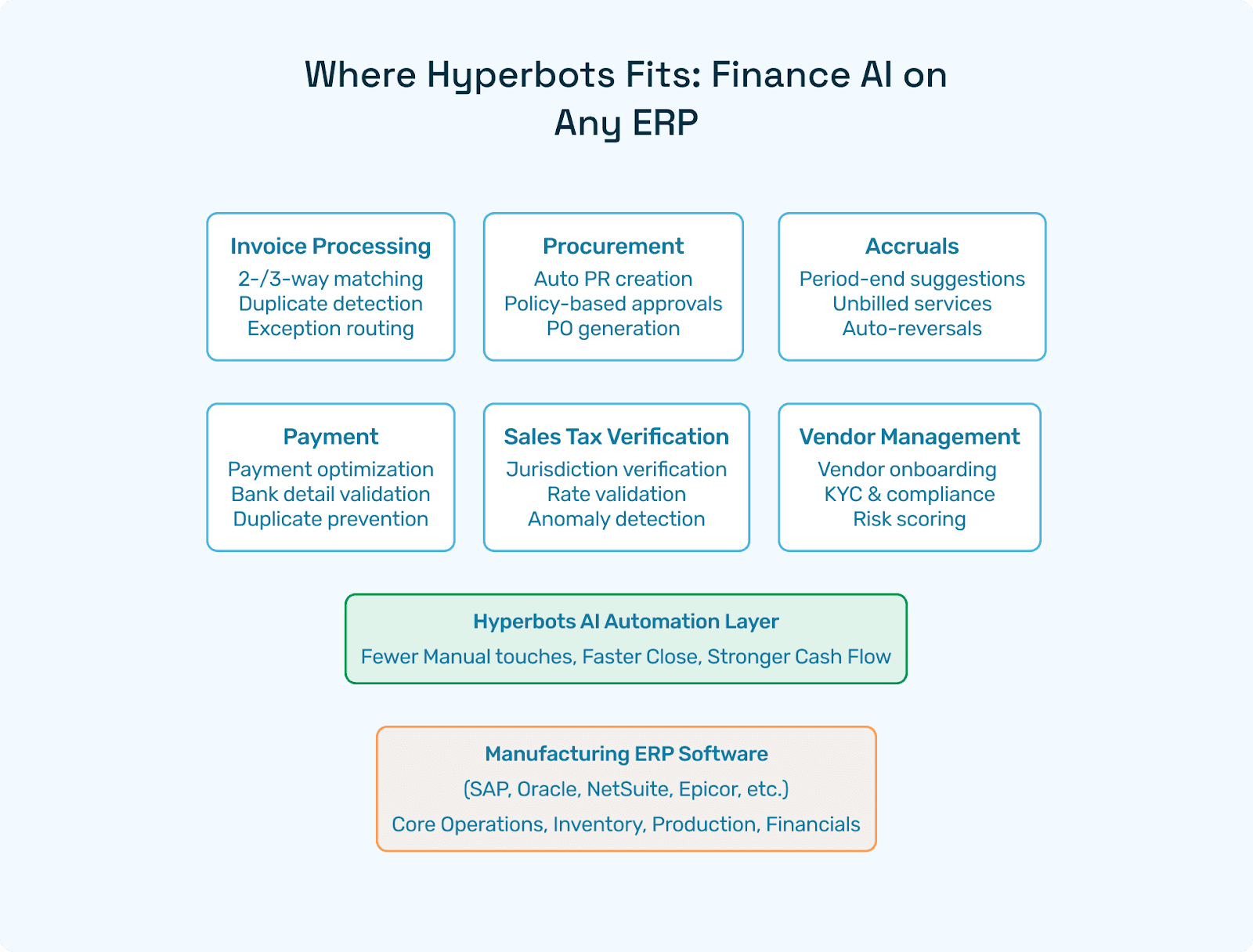
Where Hyperbots Fits: Finance AI on Any ERP
Hyperbots adds the missing automation layer on top of manufacturing ERP software so Finance and Operations move faster with fewer errors. Six modular Co-pilots—start with one, scale as you prove value:
Invoice Processing Co-pilot —
Ingests invoices from email/portals; extracts header & line-level details (items, quantities, price, tax, freight).
Performs 2-/3-way matches against POs/receipts or service operations (outside processing).
Detects duplicates; posts clean vendor bills; routes only true exceptions with evidence.
Procurement Co-pilot —
Auto-creates PRs from MRP/DRP signals or min/max breaches; recommends suppliers and price breaks.
Policy-based approvals; writes POs; monitors ASN/delivery adherence.
Accruals Co-pilot —
Suggests period-end accruals for unbilled services, in-transit receipts, and landed costs; auto-reverses with links to later bills.
Payment Co-pilot —
Optimizes payment proposals for terms/cash; validates vendor bank details; blocks duplicates/over-payments.
Sales Tax Verification Co-pilot —
Verifies jurisdiction and rates at the line level; flags anomalies before posting; preserves audit evidence.
Vendor Management Co-pilot —
Onboards vendors/subs (KYC, W-9/W-8, insurance); enforces maker-checker on bank changes; scores performance/risk; keeps documents current.
This overlay transforms enterprise resource planning for manufacturing into a system of results: fewer manual touches, faster close, stronger cash.
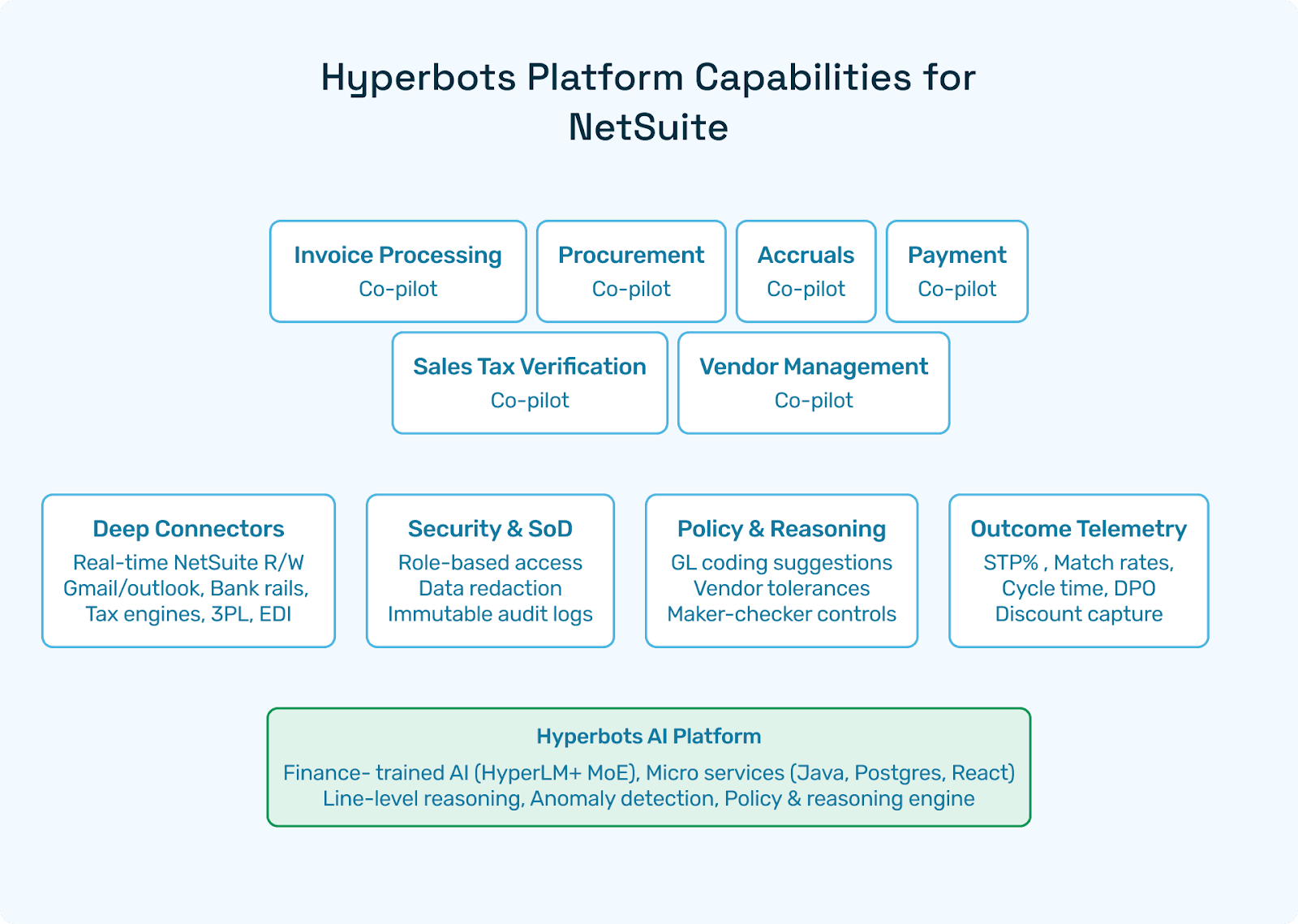
Hyperbots Platform Capabilities for Manufacturing
Beyond the Co-pilots, the platform complements any ERP system for manufacturing with durable capabilities:
Finance-trained AI (HyperLM + MoE): Vision + layout + LLM ensemble tuned for invoices, POs, GRNs/ASNs, statements; excels at line-level reasoning and anomaly detection.
Connectors: Real-time read/write to major ERPs; Gmail/Outlook ingestion; bank rails; tax engines; shipping/3PL; EDI; supplier/customer portals.
Policy & Reasoning: GL coding suggestions; tolerance rules by vendor class; maker-checker enforcement; approval nudges.
Security & SoD: Role-based access; bank-change validations; immutable audit logs; redaction.
Scale & Reliability: Microservices (Java, Postgres, React); high-volume document throughput; multi-entity and multi-currency.
Outcome Telemetry: STP %, first-pass match %, invoice cycle time, duplicate rate, DPO, discount capture, landed cost variance, tax variance.
For plants upgrading to the best ERP for the manufacturing industry, Hyperbots de-risks adoption by shrinking exception queues from day one.
Hyperbots-Led ROI Improvements
While baselines vary, conservative first-wave outcomes (90–180 days) for ERP software for manufacturing industry programs:
Straight-Through Processing (STP): 60–90% of vendor bills post with zero human touch after stabilization.
Invoice Cycle Time: 30–60% faster from receipt to posting; better discount capture.
Duplicate/Over-payment Prevention: Near-elimination via cross-vendor/date/amount/line hashing + bank validation.
Discount Capture: +0.5–2.0% of eligible spend through timely, exception-free proposals.
Working Capital (DPO): +3–10 days by optimizing payment runs and reducing fire drills.
Close Acceleration: 20–40% fewer manual accrual entries—each pre-linked to evidence.
Audit Readiness: Automated evidence packs: PO → receipt/inspection → invoice → approval → payment.
These gains turn your choice of best manufacturing software systems into tangible P&L and balance-sheet results.
FAQs
Q1. What’s the difference between “manufacturing ERP software” and “production ERP system”?
A: They’re often used interchangeably. “Production ERP” emphasizes shop-floor flows (WOs, issues/completions) within the broader manufacturing enterprise resource planning software that also covers finance, procurement, inventory, and quality.
Q2. Which is the best ERP for manufacturing—one-size answer?
A: No. The best ERP for manufacturing is the one that passes your day-in-the-life scripts with the lowest TCO and fastest time-to-value. Use our matrix to shortlist and your scripts to decide.
Q3. What are the top criteria to compare top manufacturing software options?
A: Manufacturing depth, WMS/barcoding, quality/QMS, outside processing, portals/EDI, tax, analytics, cloud posture, extensibility, and change management support.
Q4. We’re an ETO/job shop—what should we prioritize?
A: Estimating→BOM/route generation, project/WBS linkage, outside processing, job costing, document control (ECN/ECO), and role-based approvals. Consider Epicor Kinetic, Infor CSI, IFS Cloud, SYSPRO, Acumatica, or NetSuite with mfg add-ons.
Q5. Do we need MES if we have a strong ERP?
A: Maybe not at first. Many SMB/mid-market deployments start with ERP + light MES functions (dispatch, barcode capture) and add full MES later as the plant matures or compliance requires it.
Q6. What is the “best cloud ERP for manufacturing” in the enterprise?
A: Common enterprise choices: SAP S/4HANA Cloud, Oracle Fusion Cloud ERP, Microsoft D365 FSCM, IFS Cloud. For mid-market: Infor CSI, QAD, Epicor Kinetic, Plex. For SMB: NetSuite, Acumatica, Sage X3 (process), Odoo.
Q7. How does Hyperbots compare to built-in ERP automation?
A: ERPs post and report well but struggle with perception (reading messy invoices), nuanced policy reasoning, and exception triage. Hyperbots handles capture, line-level reasoning, matching, accruals, tax verification, payments, and vendor onboarding across systems—turning ERP solutions for manufacturing into explainable automations.
Q8. How long does a Hyperbots implementation take?
A: Single-site mid-market scope commonly lands in 4–10 weeks for Release-1.
Q9. Are there risks to avoid?
A: Over-customization, dirty masters, weak approvals/SoD, ignoring landed costs, skipping UAT scripts, and under-investing in change management.
Q10. What’s the difference between “best manufacturing software” and “best manufacturing software systems”?
A: The first often means a single platform; the second implies a stack (ERP + MES + QMS + APS + portals) integrated to behave as one system.
Final Takeaway
There’s no universal “winner” among top ERP systems for manufacturing. The winner for you is the platform that passes your scripts, respects your TCO, and scales with your growth, all while keeping your finance spine clean and auditable. Use this comparison to shortlist, then prove fit through day-in-the-life demos and rapid pilots. Finally, overlay Hyperbots’ Finance Co-pilots to transform your manufacturing ERP into a system of results: fewer exceptions, faster close, and measurable cash gains, no rip-and-replace required.