NetSuite ERP Pricing 2026: Real Costs, License Types, and What to Budget
A practical breakdown of NetSuite costs, licensing, implementation, and how to plan your ERP budget without surprises
"How much does NetSuite cost?" is a fair question that rarely gets a straight answer. Oracle does not publish a public price list. Every quote is negotiated, and the final number shifts based on your edition, user count, modules, and how well you push back at the table.
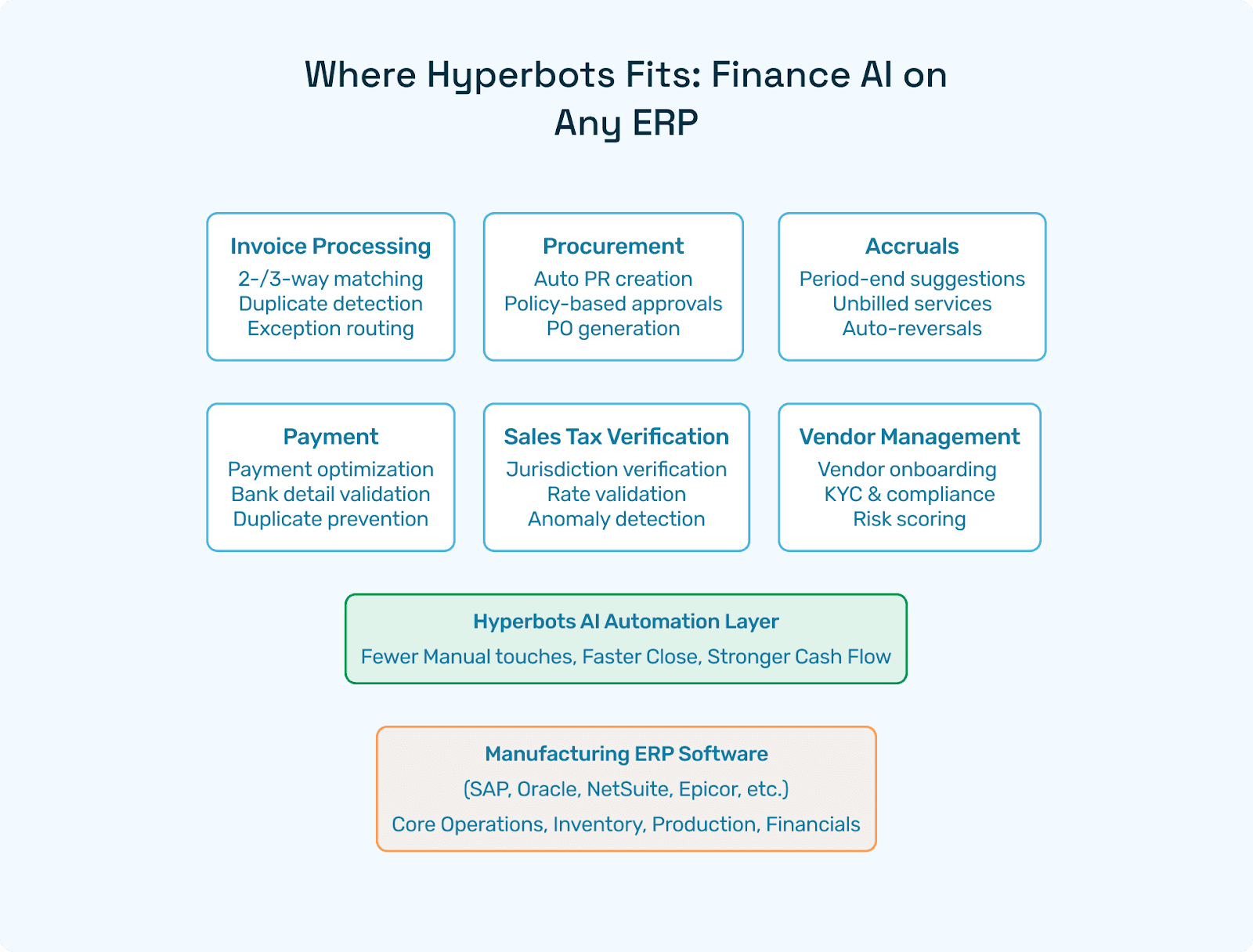
That said, you don't have to go in blind. This guide pulls together real 2026 pricing ranges from certified NetSuite partners, breaks down every cost bucket, and includes a section on NetSuite SuitePeople pricing that most blogs skip entirely. We also map where Hyperbots' Finance AI Co-pilots sit on top of NetSuite to cut down AP costs and help offset your subscription.
What Drives NetSuite Pricing in 2026
Before you look at any number, understand the four cost buckets that make up every NetSuite quote:
Software subscription (base platform + user licenses + modules)
NetSuite implementation cost (partner or Oracle Professional Services)
Integrations and customizations (tax engines, banks, 3PL, EDI, ecommerce)
Ongoing support and training (AMS, admin, refreshers)
Oracle prices by named user, not concurrent sessions. That distinction matters if you have 80 employees but only 20 who actually transact in NetSuite daily. You pay for names on the list, not simultaneous logins.
The six primary variables that move your quote are: edition (Starter, Mid-Market, Enterprise), user count and license type, modules selected, contract length, integration complexity, and data migration scope. Proteloinc's 2026 NetSuite pricing guide describes this clearly: implementation cost and technical scope are directly linked, so adding modules increases both your subscription fee and your services bill.
NetSuite License Cost: Base Platform Fees 2026
The base platform fee is a mandatory monthly charge for access to the core NetSuite tenant. It does not include add-on modules or users. In 2026, here is what partner guides show as directional ranges:
Edition | Best For | Base Fee (Monthly) |
Starter | Under 10 users, single entity | ~$999/month |
Mid-Market | 10+ users, multi-entity optional | $2,000 to $5,000/month |
Enterprise | Large, complex global operations | Fully negotiated, typically $5,000+/month |
According to Softype's March 2026 pricing breakdown, base platform fees range from about $999 to $5,000 per month depending on edition and support tier. The Starter edition covers core financials but caps user count. Once you need subsidiaries, multi-currency, or more users, Mid-Market is the entry point regardless of revenue size.
One thing worth knowing: Oracle's fiscal year ends January 31. Deals signed in December and January tend to get the most aggressive pricing as reps close out quotas. TechCloudPro's 2026 implementation guide notes that signing a 3-year contract typically yields a 15 to 25 percent discount over year-to-year, while 5-year terms can push savings to 30 percent or more.
NetSuite User License Pricing 2026
User licensing is where most buyers get surprised. NetSuite prices by named user, which means every person who logs in needs their own license, whether they use it once a day or once a month.
There are three main license types:
Full User License Full access to all modules you have licensed. This is what your finance team, operations staff, and procurement leads will use. BrokenRubik's April 2026 guide puts full user pricing at $129 to $199 per user per month, noting that Oracle raised the base full-user rate from $99 to $129, a roughly 30 percent increase that caught many existing customers off guard at renewal.
Employee Self-Service (ESS) / Employee Center License Covers limited actions only: time entry, expense submission, viewing payslips, and approvals. Softype's guide puts ESS at $10 to $25 per user per month. These are sold in packs, typically five ESS licenses for the equivalent of one full license. Important caveat: if you configure an ESS user with broader roles than intended, NetSuite reclassifies them as a full user and charges accordingly.
Vendor and Customer Portal Licenses Vendor access (letting suppliers view and print POs) is generally free. Customer portal access depends on configuration. Neither counts against your user cap.
A practical rule: do a role audit before you buy. Assign full licenses only to people who create, edit, or approve records daily. Everyone else can usually be an ESS user. BrokenRubik estimates the right license mix can cut user costs by 30 to 50 percent.
Module Pricing Breakdown 2026
Every NetSuite account includes core financials (GL, AP, AR), basic inventory, order management, basic CRM, and standard reporting. Everything beyond that is a separate module with its own fee.
Here are common modules and directional 2026 pricing ranges, drawn from Softype and BrokenRubik:
Module | What It Does | Approx. Monthly Cost |
Advanced Financials | Revenue recognition (ASC 606/IFRS 15), multi-book accounting | $500 to $1,500/month |
Advanced Inventory | Multi-location tracking, demand planning, lot/serial tracking | ~$500/month |
Warehouse Management (WMS) | Directed picking, bin management, mobile scanning | ~$1,000/month |
Manufacturing (Work Orders, MRP) | BOMs, routings, production scheduling | ~$600/month |
SuiteCommerce Standard | B2C or B2B ecommerce storefront | ~$2,500/month |
SuiteCommerce Advanced | Full custom ecommerce | ~$5,000/month |
Planning and Budgeting (NSPB) | FP&A, scenario modeling | ~$1,000/month |
OneWorld | Multi-subsidiary, multi-currency consolidation | ~$500 to $1,000/month per subsidiary |
SuitePeople (HR/HCM) | Payroll, benefits, performance management | See section below |
OpenAir (PSA) | Project management, resource allocation, job costing | ~$1,500 to $3,000/month |
BrokenRubik notes that industry-specific bundles are typically 10 to 20 percent cheaper than licensing the same modules separately. If your business fits a packaged vertical (wholesale distribution, manufacturing, software/SaaS), ask about industry editions before building a la carte.
NetSuite SuitePeople Pricing 2026
SuitePeople is NetSuite's human capital management (HCM) module. It sits inside the same NetSuite platform rather than connecting via integration, which means your payroll data, expense approvals, and headcount figures all live in the same system as your GL and AP.
What SuitePeople covers:
Core HR (org hierarchy, compensation, employee records)
Payroll processing and tax compliance (US, with global payroll via partners)
Benefits administration
Time and attendance tracking
Performance management and goal tracking
Employee and manager self-service portals
SuitePeople Pricing 2026
SuitePeople does not have a public list price. When added as a module on top of an existing NetSuite subscription, it is negotiated as part of the broader contract. Technology Evaluation Centers reports that on a standalone basis, SuitePeople starts at $5 per employee per month, with volume discounts for larger headcounts and reductions for multi-year contracts. Kimberlite Partners' 2026 guide puts the general HR module range at $5 to $20 per employee per month.
For a 100-person company, that works out to roughly $6,000 to $24,000 per year just for the HR module, before factoring in payroll processing fees or any SuitePeople-specific implementation work. BrokenRubik puts the SuitePeople range for a 100-employee company at $12,000 to $36,000 per year.
SuitePeople HR User License
SuitePeople adds a specific user type: the SuitePeople HR User. This license gives HR staff access to employee records, PTO management, and benefits workflows without giving them broader ERP access they don't need. According to Proteloinc's 2026 guide, this user type is typically evaluated when HR wants a stronger system of record but the organization doesn't want to provision full ERP access to every HR employee.
When SuitePeople is worth it:
If you are running payroll in a separate system like ADP or Gusto, and managing employee data in spreadsheets or a disconnected HRIS, SuitePeople eliminates the reconciliation work between HR and finance. The integration is native, not bolted on. That said, many mid-market companies find SuitePeople sufficient for core HR but still use a specialist payroll provider for complex multi-state or international payroll. It is worth asking your NetSuite partner how SuitePeople's payroll handles your specific state mix before committing.
NetSuite Implementation Cost 2026
The software subscription is predictable. Implementation is where budgets go sideways.
TechCloudPro's 2026 guide puts mid-market implementations (1 to 3 entities, moderate customization) at $80,000 to $175,000, taking 3 to 6 months. The full range across business sizes runs from $40,000 for a single-entity starter project to $1 million or more for a global multi-wave rollout.
Directional ranges by complexity:
Scope | Implementation Cost | Timeframe |
Small/SuiteSuccess accelerator | $25,000 to $60,000 | 2 to 4 months |
Mid-market multi-module | $60,000 to $150,000 | 3 to 6 months |
Global multi-entity, regulated | $150,000 to $500,000+ | 6 to 18 months |
What drives the number up:
Data quality. Dirty item masters, open POs with inconsistent data, and messy vendor records all add cleanup hours. This is consistently the biggest surprise for buyers who underestimate it.
Manufacturing and WMS. BOMs, routings, and warehouse workflows require substantially more configuration and testing than finance-only deployments.
OneWorld. Each additional subsidiary adds intercompany, consolidation, and currency work.
Integrations. Banks, tax engines, 3PLs, EDI, and ecommerce connectors each carry setup and testing cost.
Change management. Training by role, SOP documentation, and cutover support are often underscoped in initial proposals.
Techfino's April 2026 buyer guide makes the point clearly: for most businesses, implementation runs 1 to 2 times the annual license fee. Build that into your first-year budget, not your ongoing one.
NetSuite Pricing Calculator: DIY Framework
You won't get a quote from a calculator, but you can build a reasonable planning range before you talk to Oracle or a partner. Use this framework:
A. Annual Software Cost
Base_Edition_Monthly × 12
+ (Full_Users × $129-$199/month × 12)
+ (ESS_Users × $15-$25/month × 12)
+ (Module_1_Monthly + Module_2_Monthly + ...) × 12
B. One-Time Implementation Cost
Discovery + Configuration + Data_Migration
+ Integrations + Testing + Training + Cutover + PMO
C. Ongoing Annual Costs
Partner AMS (monthly retainer) × 12
+ Internal Admin (FTE or fractional)
+ Enhancements and new module rollouts
Sanity check questions before you plug in numbers:
How many users need full access versus limited/self-service?
Do you have multiple legal entities or subsidiaries?
Do you need WMS, manufacturing, or advanced revenue recognition?
How many integrations are required at go-live (tax, banks, 3PL, ecommerce)?
What is the quality of your current item, vendor, and customer master data?
Are you doing a phased rollout or a big-bang go-live?
Run your estimate against two or three partner calculators from certified NetSuite Solution Providers and triangulate. The delta between estimates usually tells you something about scope assumptions.
Scenario Budgets: SMB, Mid-Market, Enterprise
These are planning illustrations, not quotes. Use them to sanity-check your assumptions.
Scenario A: Small Distributor, Single Entity
Profile: 8 full users, 25 ESS users, one legal entity, basic inventory and purchasing, simple reporting.
Software: Starter edition base + users + Advanced Financials + basic inventory features. Directional annual software cost: $36,000 to $60,000 per year.
Implementation: SuiteSuccess-style accelerator, minimal integrations (tax engine and bank feed). One-time cost: $25,000 to $50,000.
Year 1 total: $60,000 to $110,000 including implementation.
Scenario B: Mid-Market Manufacturer, Two Sites
Profile: 20 full users, 60 ESS users, two locations, BOMs and routings, WMS, MRP, tax engine, bank integration, shipping/3PL connector.
Software: Mid-Market base + Manufacturing + Advanced Inventory or WMS + tax connector. Directional annual software cost: $80,000 to $150,000 per year.
Implementation: Data migration for items, BOMs, and routings is the heaviest lift. Integrations: banks, shipping, tax. Role-based training across warehouse, finance, and operations. One-time cost: $80,000 to $150,000.
Year 1 total: $160,000 to $300,000. TechCloudPro puts the typical mid-market 3-year TCO near $558,000 when you include licensing, implementation, training, and support across the contract.
Scenario C: Global Multi-Entity, Regulated
Profile: 60 to 200+ full users, multiple subsidiaries, OneWorld, revenue recognition, manufacturing, QMS integrations, intercompany eliminations, multi-currency consolidation.
Software: Mid-Market or Enterprise base + OneWorld + Finance add-ons + Manufacturing + Planning and Budgeting. Directional annual software cost: $150,000 to $500,000+.
Implementation: Multi-wave rollout, validation documentation for regulated industries, EDI, QMS or MES integration, data lake or warehouse connection. One-time cost: $200,000 to $1,000,000+.
Approach: Global template with phased subsidiary go-lives. Budget per subsidiary, not per module. This is where an experienced implementation partner matters more than anywhere else.
NetSuite for Small Business: What's Realistic
The honest answer is that NetSuite is not a fit for every small business. Companies under $5 million in revenue with a single entity, simple inventory, and standard accounting almost always find QuickBooks Online or Xero sufficient at a fraction of the cost. NetSuite's value proposition kicks in when you outgrow those tools: multi-location inventory, intercompany transactions, revenue recognition, or operational complexity that a general ledger tool cannot handle.
BrokenRubik's 2026 guide puts a realistic small business NetSuite deployment (5 to 25 users, single entity, core financials) at a base of $999 per month plus user licenses plus any modules, with implementation typically running $25,000 to $100,000 depending on complexity.
If you are primarily evaluating NetSuite as accounting software (GL, AP, AR, Fixed Assets), start with the Starter edition and Finance only. Add WMS or manufacturing later when you need it. Module creep at go-live is one of the most common ways small business implementations run over budget.
Negotiation Strategy: Getting the Best Oracle NetSuite Pricing
A few levers that consistently move the number:
1. Define your success KPIs before you go in. Know your STP target, invoice cycle time goal, and DPO. Vendors price more generously when they believe you will actually use the platform to its capacity and renew.
2. Stage your modules. Don't buy WMS, Manufacturing, or Revenue Recognition in year one if you won't go live on them. Ramp licensing as you actually adopt. Oracle allows this and it protects your budget.
3. Negotiate on term. A 24 to 36-month commitment typically unlocks meaningful discounts. A 5-year deal can push savings to 30 percent but reduces flexibility if your needs change.
4. Ask about annual price increase caps. BrokenRubik notes that without a cap, you should expect 5 to 8 percent annual increases at renewal. Negotiating a cap into a multi-year contract is one of the highest-value moves you can make at signing.
5. Time your deal. Oracle's fiscal year ends January 31. December and January deals get the most aggressive pricing. End of quarter (April, July, October) also creates rep motivation.
6. Compare partner quotes. NetSuite is sold through Solution Providers as well as Oracle Direct. Implementation partners often offer better service-to-price ratios than Oracle's own professional services team, and some offer fixed-fee milestones that reduce your cost risk.
7. Run multiple calculators. Use two or three certified partner pricing tools and note where they diverge. That delta usually points to scope assumptions you need to clarify.
8. Budget for data and change management. The most expensive surprises in every ERP implementation are dirty data and under-trained teams. Both extend timelines and add cost.
How Hyperbots Cuts NetSuite TCO with Agentic AI
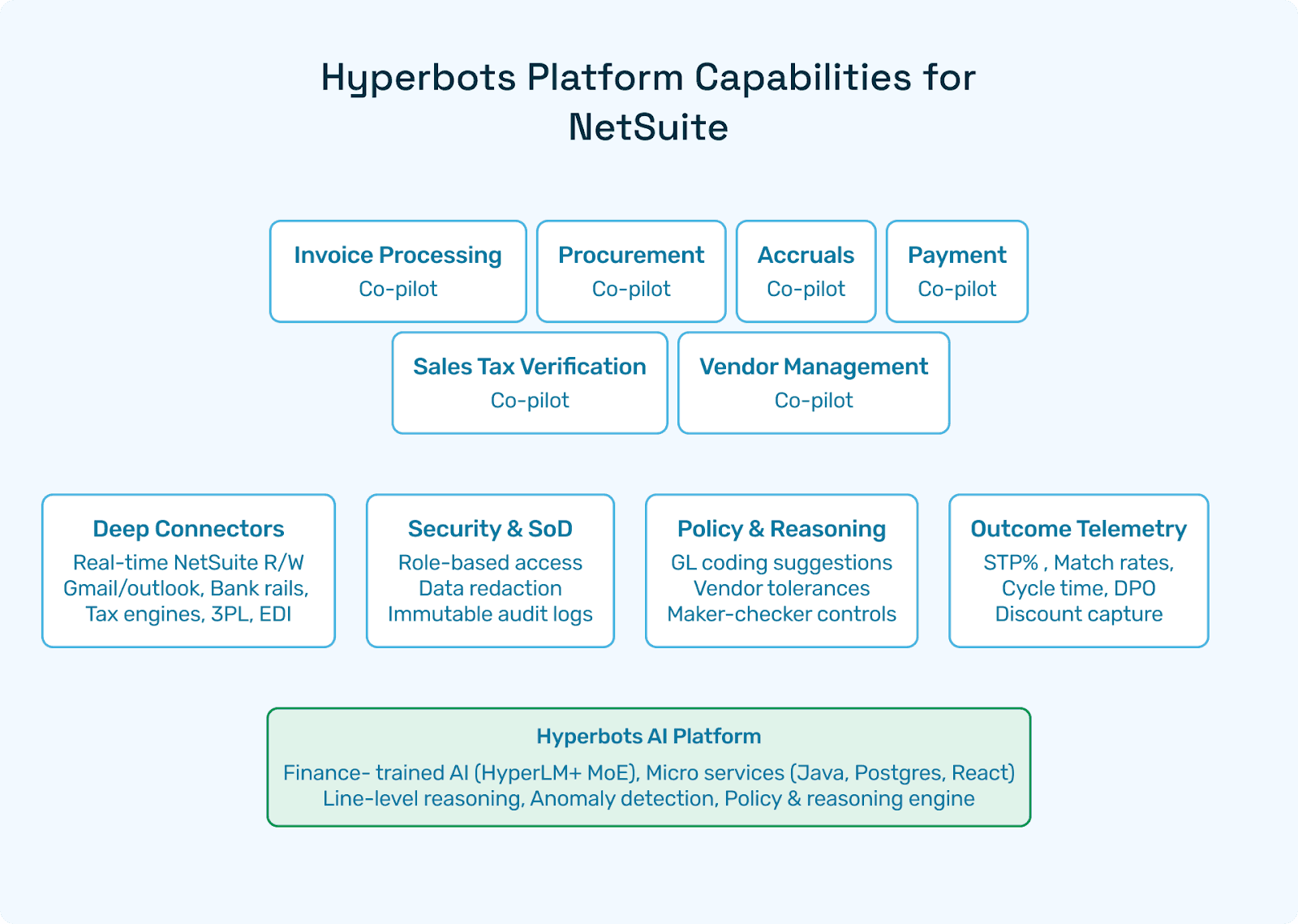
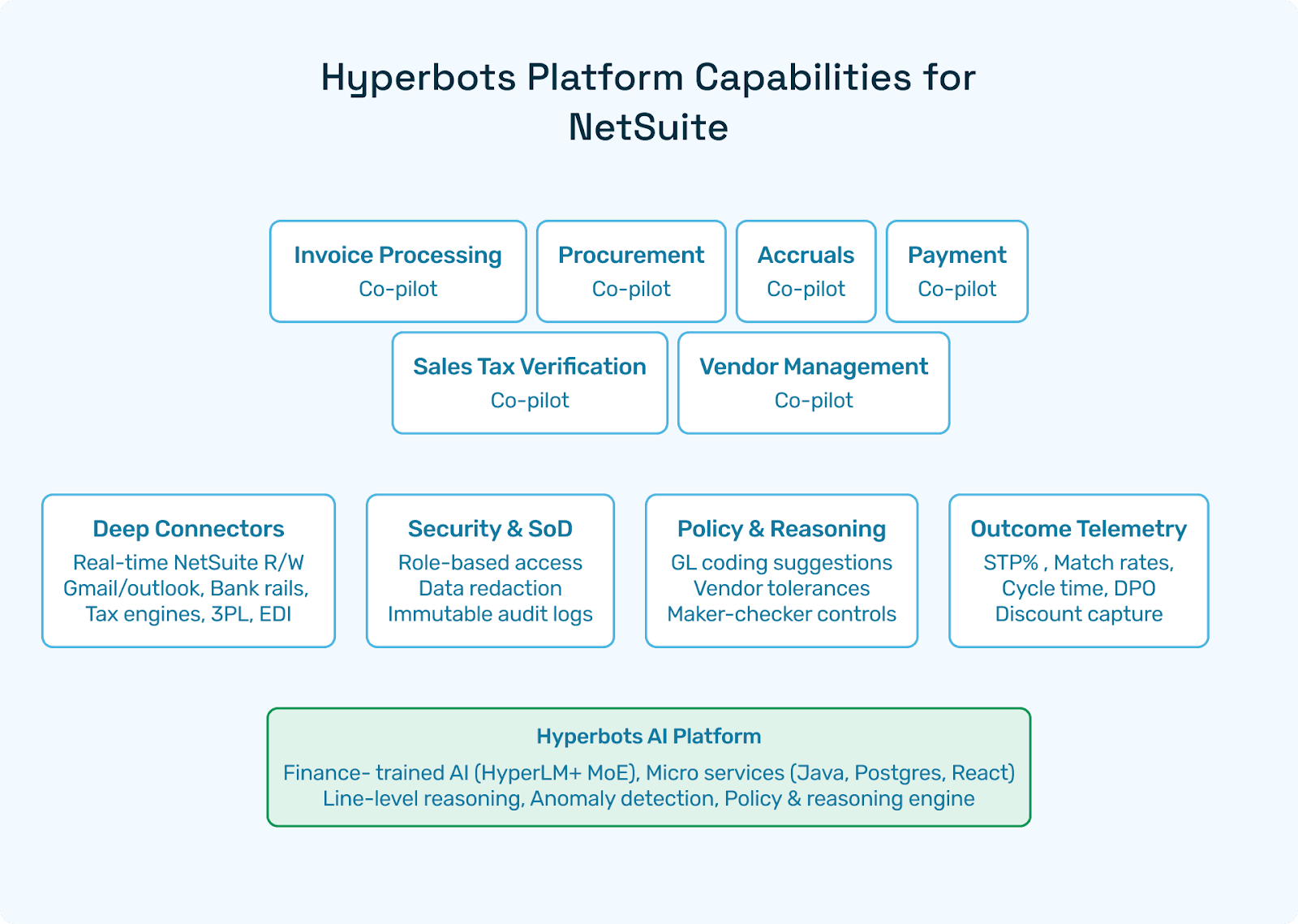
Once NetSuite is live, the next question is how much of your AP and finance operations still rely on manual work. That's where Hyperbots fits. Hyperbots is a finance-first AI layer built to run on top of NetSuite, automating AP and finance controls through agentic AI that reads documents, reasons over policies, and posts or routes exceptions without human intervention for standard transactions.
Eight AI Co-pilots for NetSuite
Invoice Processing Co-pilot — extracts, validates, matches, and posts invoices with GL coding and full audit trails
Procurement Co-pilot — generates requisitions, enforces purchasing policy, and creates purchase orders
Accruals Co-pilot — automates GRNI, landed cost, and month-end accrual entries with traceable logic
Payments Co-pilot — orchestrates ACH, wire, and check payments with approval workflows and fraud signals
Sales Tax Verification Co-pilot — validates tax at line and jurisdiction level before posting
Vendor Management Co-pilot — handles onboarding, W-9 validation, and duplicate vendor detection
Cash Application Co-pilot — matches incoming payments to invoices using remittance data and bank feeds, reducing manual reconciliation
Collections Co-pilot — prioritizes receivables, automates follow-ups, and improves cash recovery timing
Where Hyperbots Reduces NetSuite Operating Cost
Fewer services hours at go-live
Earlier exception detection during UAT surfaces data and configuration issues sooner, reducing rework cycles during implementation.
Lower AP headcount as volumes scale
Straight-through processing removes manual data entry for standard invoices, allowing the same team to handle higher volume without additional hires.
Improved cash position
Discount capture, duplicate payment prevention, and optimized payment timing directly improve DPO and working capital.
Faster month-end close
Automated accrual entries with supporting evidence reduce manual journal work and reconciliation effort, typically cutting close cycles by Up to 40 percent.
Reduced manual effort in AR and cash application
Automated matching of payments and structured collections workflows reduce time spent on reconciliation and follow-ups.
Audit readiness by default
Every transaction carries a traceable chain from PO to receipt to invoice to approval to payment, reducing audit preparation effort significantly.
Typical Outcomes After Stabilization
Across deployments, teams typically see:
Up to 80 percent straight-through processing for invoices
Up to 70 percent reduction in invoice cycle time
Significant reduction in manual cash application effort
Near-elimination of duplicate payments through validation controls
Actual results depend on data quality, transaction volume, and how tolerance policies are configured.
From Cost Line to Performance Lever
In practical terms, Hyperbots turns NetSuite from a fixed cost into a performance lever. As invoice processing, approvals, accruals, and collections become automated, the same ERP investment supports higher transaction volume at a lower marginal cost.
Finance teams shift from data entry to exception handling, decision-making, and control.
Platform Capabilities
Finance-trained AI designed to interpret accounting context such as payment terms, freight allocation, and multi-line invoice structures
Real-time read and write integration with NetSuite, along with email ingestion, banking rails, tax engines, 3PL, and EDI connectors
GL coding recommendations, per-vendor tolerance policies, and maker-checker controls for sensitive changes
Role-based access, data redaction, and immutable audit logs for compliance
Multi-entity and multi-currency support designed for complex finance environments
FAQs: NetSuite ERP Pricing 2026
Q1. How much does NetSuite cost in 2026? Most mid-market companies should budget $50,000 to $200,000 in year one (including implementation), then $50,000 to $150,000 per year in ongoing license fees. The base platform starts around $999 per month, full user licenses run $129 to $199 per month, and implementation typically runs 1 to 2 times your annual license fee. (BrokenRubik, 2026)
Q2. How much is NetSuite per month? Directionally, a small business deployment with 10 users and core financials might run $3,000 to $5,000 per month all-in on software. A mid-market company with 50 users, full ERP plus CRM plus ecommerce, typically runs $10,000 to $25,000 per month. (ERP Research, 2026)
Q3. What is the NetSuite subscription price range in 2026? Annual software costs (base platform plus users plus modules) range from about $25,000 for smaller, simpler deployments to $250,000 or more for larger enterprises. (Techfino, April 2026)
Q4. How much does NetSuite SuitePeople cost? SuitePeople is negotiated as part of your broader NetSuite contract. Standalone, it starts at approximately $5 per employee per month, with a typical range of $5 to $20 per employee per month depending on features and contract length. For a 100-employee company, expect $12,000 to $36,000 per year for the module. (TEC, 2026; BrokenRubik, 2026)
Q5. What drives NetSuite implementation cost? Data quality, manufacturing and WMS scope, OneWorld (multi-subsidiary), integration count, and change management. Most projects fall in the $25,000 to $150,000 range, with global or regulated programs running substantially higher. (TechCloudPro, 2026)
Q6. Is there an official Oracle NetSuite pricing page? Oracle's website explains pricing factors but does not list prices. Every quote goes through Oracle or a certified Solution Provider.
Q7. What modules are included in the base NetSuite license? Core GL, AP, AR, basic inventory, order management, basic CRM, and standard reporting are included in the base platform. Advanced capabilities (revenue recognition, WMS, manufacturing, SuiteCommerce, SuitePeople) are separate modules with their own fees.
Q8. Does Oracle NetSuite CRM pricing differ from ERP? CRM is typically bundled in the base platform or priced as a low-cost add-on. It rarely changes the quote significantly. Confirm in your specific proposal whether CRM is included or separate.
Q9. Can Hyperbots reduce AP operations costs significantly? Teams that achieve high straight-through processing rates with Hyperbots see substantial labor savings in AP. Exact ROI depends on invoice volume, data quality, and how well your tolerance policies are configured.
Q10. What is the difference between Oracle NetSuite pricing and NetSuite pricing? No difference. "Oracle NetSuite" is the vendor branding. It is the same product and the same quote.
Final Takeaway
The honest answer to "how much is NetSuite in 2026" is this: the software alone is knowable with two or three partner quotes. The implementation cost is where most budgets break, and it is almost always tied to data quality and scope creep, not the platform itself.
Lock your module list before you sign. Negotiate annual price increase caps into any multi-year deal. Stage licenses so you only pay for what you actually use at each phase. And if AP automation is in your roadmap, layering Hyperbots onto NetSuite P2P from day one gives you measurable savings that offset subscription cost while your team focuses on the work that actually requires human judgment.
NetSuite pricing changes with each contract cycle and varies by configuration, geography, and negotiation. Always validate any figures with a current quote from Oracle or a certified NetSuite Solution Provider. Pricing ranges in this guide are sourced from certified partner publications and reflect 2026 market data.