From Requisition to Purchase Order: End-To-End Procedure for Purchase Order Automation
Streamline requisitions to purchase orders with automation. Discover Hyperbots’ platform benefits, ROI, and proven best practices for finance teams.
Executive Summary
Procurement teams face pressure to cut costs, speed up cycles, and stay compliant, yet manual requisition and purchase order (PO) workflows create delays, errors, and poor visibility. Purchase order automation solves this by digitizing the entire PR-to-PO journey with AI-driven workflows, approval matrices, SLA-based routing, and mobile access. Hyperbots takes it further with real-time ERP integrations, intelligent automation, and audit-ready compliance. The result: faster cycle times, reduced maverick spending, stronger vendor relationships, and a future-ready procurement engine that enhances financial control and resilience.
Understanding the Purchase Requisition to Purchase Order Process
Definition & Importance
The purchase requisition to purchase order (PR-to-PO) process is a critical workflow within procurement and finance operations. It begins with generating an internal request (requisition) for goods or services, which must then be reviewed, validated, and formally converted into a purchase order (PO) that is dispatched to suppliers.
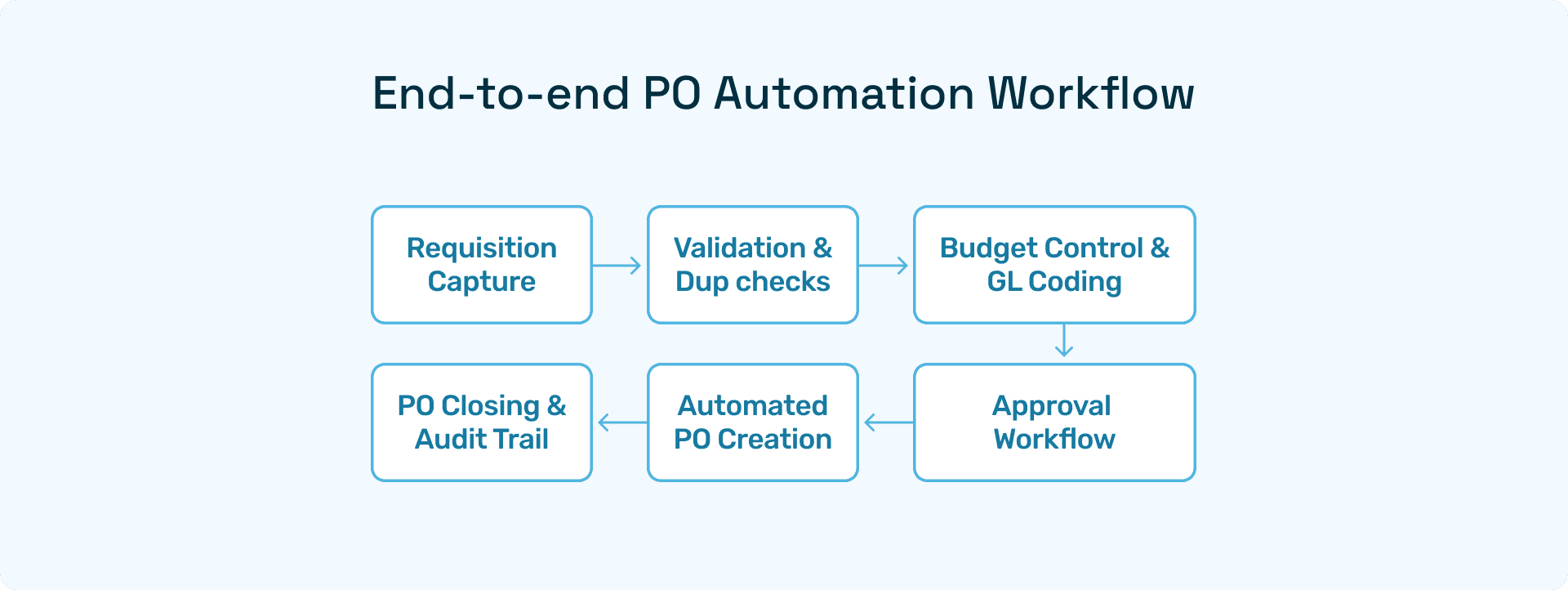
Key steps in this process include:
Initiating a purchase request with detailed requirements.
Validating budget, GL codes, and policy compliance to ensure financial control.
Approving the requisition through defined authority levels.
Creating and dispatching the purchase order to chosen vendors.
Recording and tracking the order across finance and procurement systems.
Automating these steps significantly improves accuracy, speeds up approvals, and reduces manual intervention. According to IBM’s research on Purchase Order Automation, organizations leveraging automation achieve higher efficiency, enforce compliance with audit-ready documentation, and enhance transparency across their supply chain—ultimately driving stronger cost control and operational agility.
Why Automate the Requisition and Purchase Order Process?
Challenges in Traditional Requisition and Purchase Order Processes
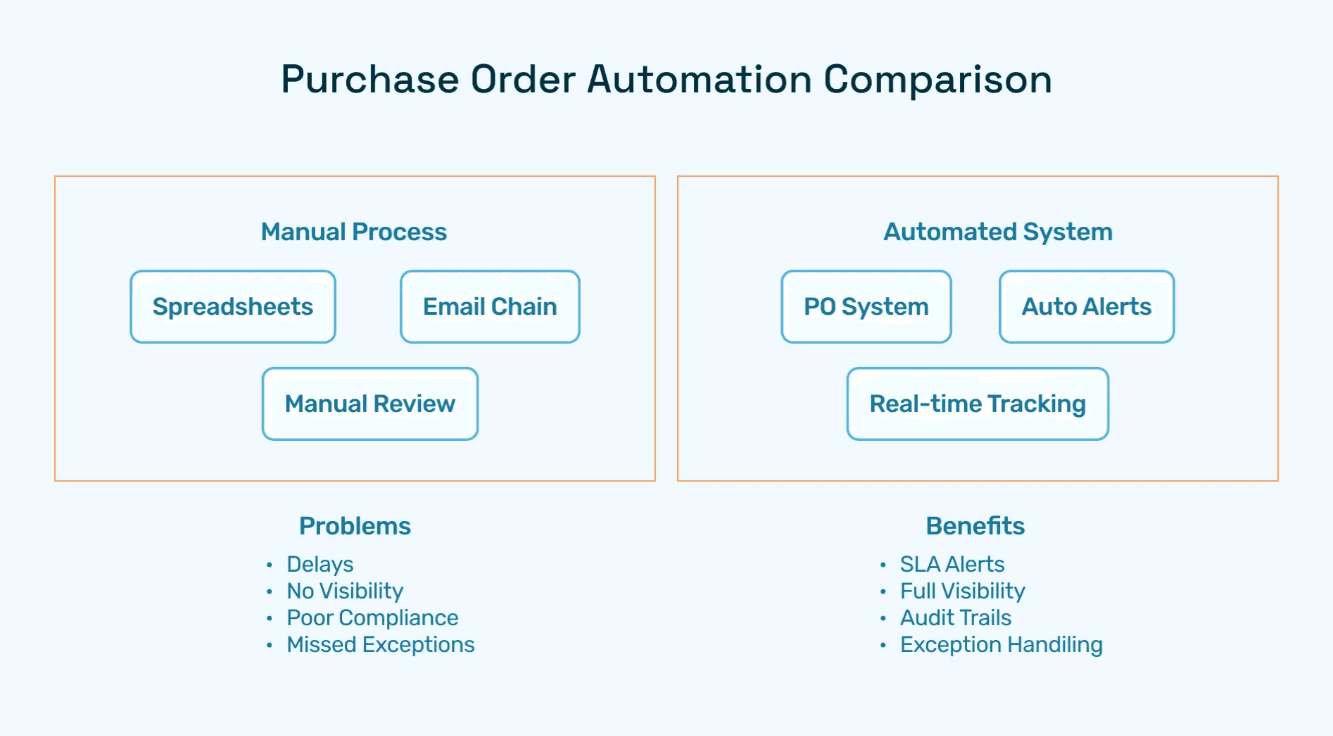
Traditional requisition and purchase order workflows often create bottlenecks that hinder procurement efficiency and financial control. Manual entry and paper-based approvals slow down cycle times, while errors in GL coding, budget allocation, and duplicate requisitions increase the risk of financial leakage.
Other common challenges include:
Lost audit trails and compliance gaps, making it difficult to meet regulatory requirements.
Fragmented data across departments, leading to poor visibility into spend and vendor performance.
Inconsistent approval matrices and delegation policies, resulting in delays and uncontrolled purchasing.
Research from Deloitte’s procurement operations and Accenture’s procurement studies confirms that reliance on manual workflows drives up administrative costs, prolongs vendor communication, and increases operational risk. Without automation, organizations struggle with inefficiency, reduced compliance, and limited scalability. Transitioning to purchase order automation eliminates these challenges by digitizing approvals, enforcing compliance, and providing real-time visibility across procurement.
Benefits of Automation
Automation revolutionizes procurement by not only cutting costs and saving time but also driving better compliance, accuracy, and strategic insights. Below are the key benefits, expanded with practical context:
70% Faster Approvals: Manual routing often causes delays when requests sit in email inboxes. With automation, purchase requisitions follow pre-defined approval matrices and SLA-based routing rules. Automatic reminders and escalations keep workflows moving, reducing turnaround times from days to hours. Faster approvals mean business units get the goods and services they need right on time, without compromising oversight.
80% Reduction in Manual Errors: Errors in vendor details, line items, or budgets are common in manual systems—and they create rework, delays, and supplier friction. Automation reduces these risks by validating data against vendor records, budgets, and contracts before approval. Built-in error checks ensure purchase orders are accurate, cutting mistakes by up to 80% and improving supplier trust.
Full Auditability and Compliance: Tracking paper trails or scattered emails makes audits stressful and time-consuming. Automated procurement systems solve this by maintaining digital audit logs of every requisition, approval, and purchase order—complete with timestamps and user actions. This ensures compliance with internal policies and external regulations, reduces fraud risks, and simplifies audit preparation dramatically.
Strategic Visibility Through Real-Time Dashboards: Procurement leaders need more than speed—they need visibility. Automation platforms provide real-time dashboards that show spend patterns, vendor performance, and approval bottlenecks. With this single source of truth, finance teams can forecast needs, negotiate better contracts, and optimize working capital. Decisions become data-driven, turning procurement into a strategic growth lever.
Step-by-Step End-To-End Purchase Order Automation Procedure
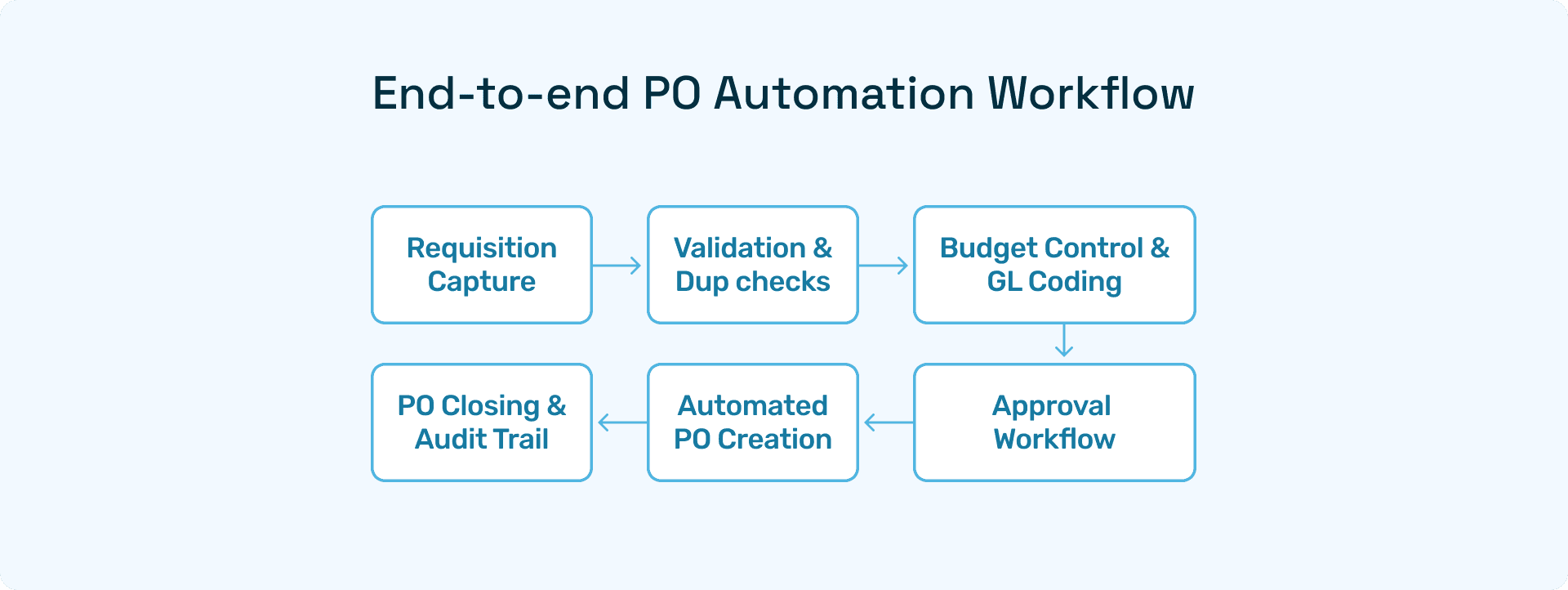
1. Purchase Request Initiation
Employee or department identifies the need
Enters data via procurement portal or ERP
AI extracts details from contracts, catalogs, and previous orders for accuracy and speed.
2. Validation & Budget Control
Hyperbots performs instant validations: budget, GL coding, compliance
Duplicates, policy exceptions flagged by pre-trained models
IBM and Gartner reiterate the importance of automated validation for controlling spend and reducing errors.
3. Approval Routing
Workflow engine maps approval matrices and delegates authority
Notifications and digital signatures managed by custom rules
4. Purchase Order Creation
Approved requisition auto-converts to PO.
GL coding and fields validated again.
Custom fields, vendor info pulled in via integrations.
5. PO Dispatch to Vendors
Electronic PO sent to vendor portals, emails, or via EDI
Vendor Management Co-Pilot coordinates onboarding, identity verification, and collaboration.
Deloitte confirms electronic PO dispatch reduces supplier friction and procurement turnaround time.
6. Order Tracking & Receiving
Status updates via vendor portals
Receipt confirmation triggers invoice workflows
7. Invoice Processing, Matching & Compliance
Invoice Processing Co-Pilot automates 2/3-way matching, validation, and audit trails
Vendor portal links invoices, receipts, payment status
8. Accruals, Payments & Bookkeeping
Accruals Co-Pilot automates period-end posting, reversals
Payments Co-Pilot manages ACH, check, or other payment types, fraud prevention, reconciliation
Full audit trails throughout the process
Migrating Successfully: Best Practice Roadmap
Migrating to a purchase order automation system can feel daunting, especially for organizations transitioning from manual or semi-automated workflows. However, with the right roadmap, businesses can not only mitigate risks but also unlock the full potential of automation. Below is a structured, best-practice approach to ensure your migration is smooth, efficient, and future-ready.
1. Audit Your Existing Process for Bottlenecks (Process Specific)
Before diving into automation, it’s critical to understand where your current process is breaking down. Are requisitions frequently delayed because of manual approvals? Are there repeated errors in GL coding or budget allocation?
Conducting a thorough process audit will highlight inefficiencies, compliance gaps, and redundancies. For example, many organizations discover duplicate requisitions or approvals stuck in email chains that add days to cycle times. By identifying these pain points early, you create a clear baseline against which automation success can be measured.
2. Use Integrated Platforms for Real-Time Visibility (Intelligence Elements)
One of the biggest challenges in traditional procurement is fragmented data spread across finance, procurement, and operations teams. Migrating successfully requires consolidating these silos into a single, integrated platform.
An integrated purchase order automation platform provides real-time dashboards showing the status of requisitions, approvals, vendor interactions, and payments. This visibility allows finance leaders to make faster, more accurate decisions. It also empowers procurement managers to track spend patterns and identify opportunities for cost savings. With Hyperbots’ intelligence dashboards, businesses gain a unified view of procurement, vendor performance, and compliance in one place.
3. Cleansing and Mapping Existing Data (Validation)
Data quality can make or break your migration. Legacy systems often contain incomplete vendor records, inconsistent GL codes, or mismatched tax information. If this data is migrated “as is,” the new system will inherit the same problems.
Best practice involves data cleansing—standardizing vendor names, validating tax IDs, consolidating duplicate supplier records, and aligning GL codes with current financial structures. Once cleaned, this data should be mapped carefully into the new automation system to ensure accuracy. Hyperbots’ validation modules, for instance, automate much of this process, reducing the manual workload on finance teams.
4. Automate Approvals with Flexible Workflows (Flexible Workflow)
Rigid, one-size-fits-all approval workflows are often the cause of procurement delays. Migrating to automation presents an opportunity to build flexible approval matrices that reflect real-world delegation of authority.
With Hyperbots, businesses can configure SLA-based routing, escalation triggers, and mobile approvals. For example, a low-value requisition under $500 might auto-route for instant approval, while a high-value requisition exceeding $50,000 may require multiple sign-offs. This flexibility ensures compliance without introducing unnecessary delays.
5. Centralize Vendor and Payment Management (Vendor Portal & Vendor Management)
Vendor relationships are at the heart of procurement. A successful migration should prioritize centralizing vendor data and payment workflows into a single portal.
Through Hyperbots’ Vendor Management Co-Pilot, suppliers can onboard themselves by submitting compliance documents, validating their identities, and updating payment details directly. The vendor portal also facilitates two-way communication, reducing email back-and-forth and providing suppliers with real-time visibility into order and payment status. This centralization improves vendor trust, reduces errors, and shortens onboarding times.
6. Escalate Issues for Fast Resolution (Notifications)
Even in the most automated systems, issues such as budget mismatches or missing vendor data may occur. What matters is how quickly they’re resolved.
Migrating successfully means implementing intelligent escalation protocols. Notifications should automatically alert the right stakeholders when an approval is overdue, when a requisition fails validation, or when a vendor requires urgent attention. With Hyperbots, notifications can be configured to escalate across channels—email, mobile apps, or even collaboration tools like Microsoft Teams—ensuring no bottleneck is left unresolved.
Hyperbots Platform Capabilities: Transformational Impact on Purchase Order Automation
The Hyperbots platform delivers next-generation purchase order automation designed to simplify complex procurement and finance workflows. Unlike traditional systems, it provides unlimited platform access, ensuring scalability without licensing constraints. Industry and category-specific configurations enable businesses to tailor procurement workflows to their unique operational needs while maintaining compliance.
Key capabilities include:
Real-time ERP integrations for seamless data synchronization across finance systems.
Human-in-the-loop augmentation, allowing procurement teams to intervene when needed without losing automation benefits.
Self-learning, AI-driven agentic workflows that adapt to evolving business rules and supplier dynamics.
Compliance modules addressing tax verification, audit requirements, and regulatory standards.
Multi-entity scalability, giving group finance leaders centralized control across subsidiaries and business units.
By combining AI, integration, and compliance-ready modules, Hyperbots empowers organizations to cut costs, accelerate procurement cycles, and strengthen governance.
Hyperbots AI Co-Pilots: Industry-Leading Differentiation
Hyperbots sets itself apart in purchase order automation with a powerful suite of AI Co-Pilots. Each Co-Pilot is designed to solve a specific challenge in procurement and finance, while working together to deliver a truly connected automation ecosystem.
Here’s how they make an impact:
Procurement Co-Pilot – Automates purchase requisition (PR) creation, validation, and approval workflows. Plus, it powers a vendor portal for easier supplier collaboration.
Invoice Processing Co-Pilot – Enables straight-through invoice processing with automated matching and audit trails, reducing errors and manual handling.
Vendor Management Co-Pilot – Simplifies supplier onboarding, ensures identity verification, and enhances collaboration with vendors.
Payments Co-Pilot – Provides smart recommendations for payment timing, processes transactions securely, and maintains audit-ready trails.
Sales Tax Verification Co-Pilot – Extracts and validates tax data automatically, ensuring compliance and accurate reporting.
Accruals Co-Pilot – Configures accrual policies, books entries automatically, and manages reversals for accurate period-end reporting.
Together, these Co-Pilots form a next-generation automation layer that improves accuracy, accelerates procurement cycles, and enforces compliance. With intelligence, adaptability, and end-to-end coverage all wrapped up in one, Hyperbots gives organizations the tools to cut costs, strengthen governance, and build resilience in financial operations.
Hyperbots vs. Other Procure-to-Pay Players
Feature/Capability | Hyperbots | Traditional Tools | Other AI Vendors |
Fully agentic AI workflows | ✓ | ✗ | Partial |
Deep ERP integration | ✓ | Partial | Partial |
End-to-end co-pilot suite | ✓ | ✗ | Partial |
No-code workflow editor | ✓ | ✗ | Partial |
Real-time intelligence | ✓ | ✗ | Partial |
Multi-entity scaling | ✓ | Partial | Partial |
Audit, tax, compliance | ✓ | ✗ | Varies |
ROI: 80% cost reduction | ✓ | Partial | Unproven |
Hyperbots-Led ROI Improvements in Purchase Order Automation
Adopting purchase order automation with Hyperbots delivers measurable ROI across multiple dimensions of procurement and finance operations. By replacing manual processes with intelligent, AI-driven workflows, organizations achieve significant improvements in speed, accuracy, compliance, and vendor relationships.
Implementing Hyperbots' Procurement copilot deliver significant ROI and transforms procurement operations by providing:
Over 80% reduction in PO creation & dispatch time
5 minute PR creation time
At least a 10% reduction in cash outflows
Accurate and timely automatic communication with vendors
100% automation of forms and other information verification
Granular and customized workflow for each process
Improved vendor relationships due to predictable approval timelines.
Hyperbots’ integrated platform ensures that these benefits scale across departments, projects, and business units, turning procurement into a high-value function rather than a bottleneck.
Industry Insights: Leading research from IBM and Deloitte confirms that organizations adopting purchase order automation consistently achieve faster processes, reduced costs, and improved compliance outcomes.
Tying It All Together: The Roadmap in Action
A successful migration isn’t just about technology; it’s about building confidence across teams. By auditing processes, ensuring clean data, and leveraging flexible workflows, businesses set a foundation for efficiency. Real-time visibility ensures leadership can monitor progress, while centralized vendor management and intelligent notifications keep operations flowing smoothly.
The end result is a future-ready procurement process: faster cycle times, reduced costs, stronger compliance, and happier vendors. Research from IBM consistently shows that companies following structured automation roadmaps achieve higher ROI, faster adoption, and stronger financial resilience compared to those that implement automation in piecemeal fashion.
Hyperbots’ end-to-end platform is designed around this roadmap—combining unlimited scalability, AI-driven Co-Pilots, and compliance-first architecture. For organizations ready to move beyond fragmented processes, this roadmap ensures migration is not only successful but also transformative.
Frequently Asked Questions (FAQs)
1. What is purchase order automation?
Purchase order automation is the process of digitizing and streamlining the journey from purchase requisition to approved purchase order. Instead of relying on spreadsheets, emails, or paper-based workflows, automation ensures requests are validated, approved, and dispatched to suppliers through an integrated, audit-ready system.
2. How does purchase order automation benefit finance teams?
Finance teams gain real-time visibility into spending, faster cycle times, and stronger compliance. Automated audit modules reduce risks of errors, enforce policy checks, and generate reliable audit trails—making period-end close and compliance reporting much simpler.
3. What is the requisition and purchase order process?
The process begins with creating a purchase requisition (PR) for goods or services. Once validated and approved, the requisition is converted into a purchase order (PO), which is then dispatched to suppliers. Hyperbots’ Procurement Co-Pilot automates each step, from PR creation to PO dispatch.
4. How does Hyperbots manage integration?
Hyperbots connects directly to ERP and finance systems through real-time integrations. Using REST APIs and pre-built connectors, it synchronizes requisitions, purchase orders, invoices, and payments without requiring heavy custom code.
5. What is three-way matching and why is it critical?
Three-way matching compares the purchase order, invoice, and goods receipt to ensure alignment before payment. This prevents overpayments, duplicate invoices, and compliance risks. Hyperbots’ Matching module automates this process with high accuracy.
6. How long does migration take?
Typical migration follows a phased approach: a pilot can be launched in a few weeks, while full go-live across entities usually happens within a few months.
7. Where does ROI show up?
ROI is visible in multiple areas: faster cycle times, reduced manual errors, lower administrative costs, stronger compliance, and improved vendor satisfaction. With Hyperbots’ Intelligence Elements, finance leaders can track savings and efficiency gains in real time.
Explore Next-Gen Purchase Order Automation
Hyperbots can future-proof your operations. Discover how end-to-end AI co-pilots move your procurement from slow legacy systems to unified, automated workflows. Request a custom demo from the experts at Hyperbots—see platform features, sector adaptors, integration flow, and real client use cases.