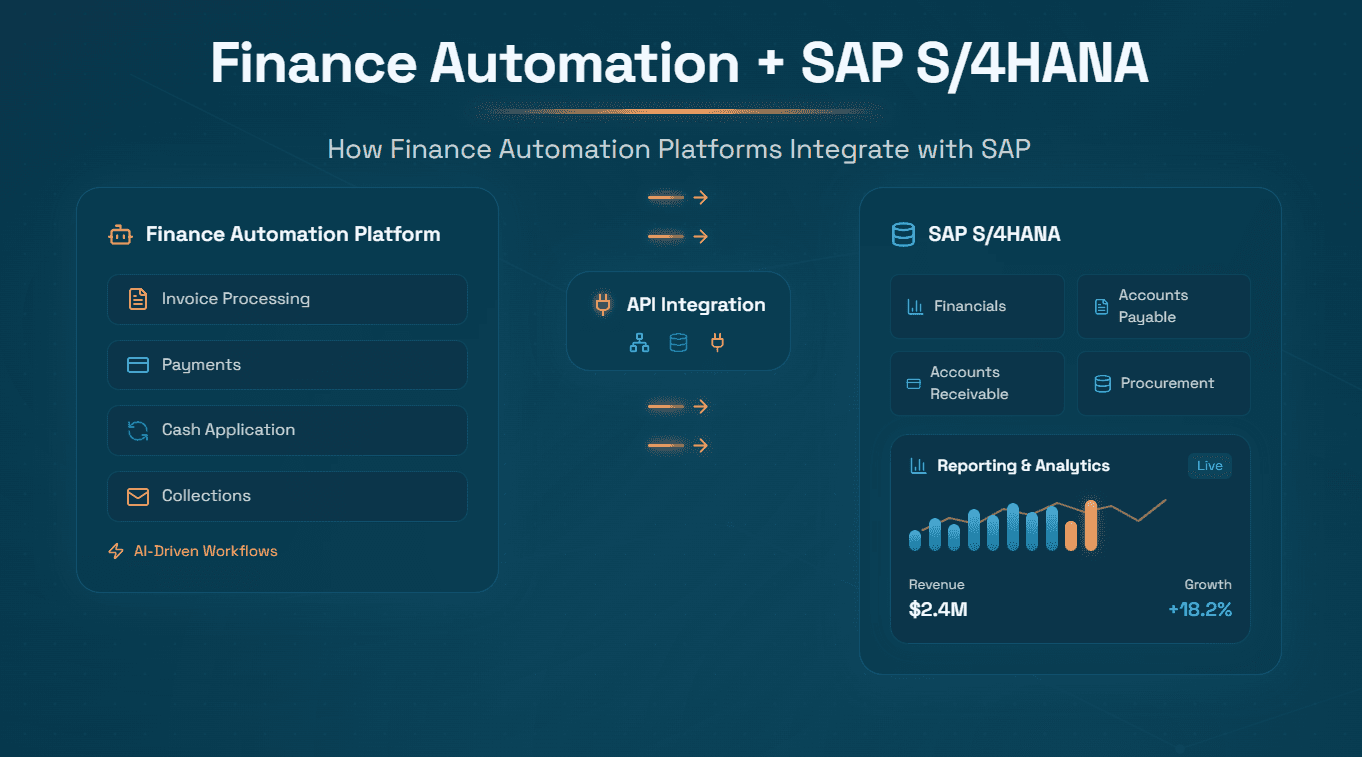
How Finance Automation Platforms Integrate with SAP S/4HANA
A practical look at how finance automation platforms connect with SAP S/4HANA to automate AP, payments, accruals, and collections while maintaining real-time financial data integrity.
SAP S/4HANA is the system of record for tens of thousands of enterprises worldwide. It holds the general ledger, manages purchase orders, stores vendor master data, tracks customer invoices, and runs the financial close. For most organizations, it is the single most important piece of enterprise software they own.
But here is the problem that every CFO, VP of Finance, and IT leader running SAP eventually runs into: S/4HANA is an exceptional system of record. It is not, on its own, a system of intelligent automation.
The invoice still has to be manually keyed or captured by a legacy OCR tool. The accruals still have to be calculated by the controller in a spreadsheet. The cash application team is still manually matching remittances to open invoices. The collections team is still working from a static AR aging report, making phone calls and sending emails by hand.
This is not a criticism of SAP. It is simply the reality of what ERP systems are designed to do: store and organize financial truth. The intelligence, the automation, the AI, the real-time decision-making comes from the layer of third-party tools and finance automation platforms that integrate with S/4HANA through its APIs.
In 2026, getting that integration right is one of the most consequential technical and strategic decisions a finance organization can make. This guide explains exactly how it works: the S/4HANA API landscape, the integration patterns that matter, what to look for in a third-party finance automation platform, and why Hyperbots has built the most capable, most deeply integrated AI co-pilot suite for SAP S/4HANA environments available today.
Understanding the SAP S/4HANA Integration Architecture
Before evaluating any third-party finance automation platform, it helps to understand how S/4HANA actually exposes its data and functionality to the outside world. The answer is: through a layered API architecture that has evolved significantly from the SAP ECC era.
The S/4HANA API Landscape
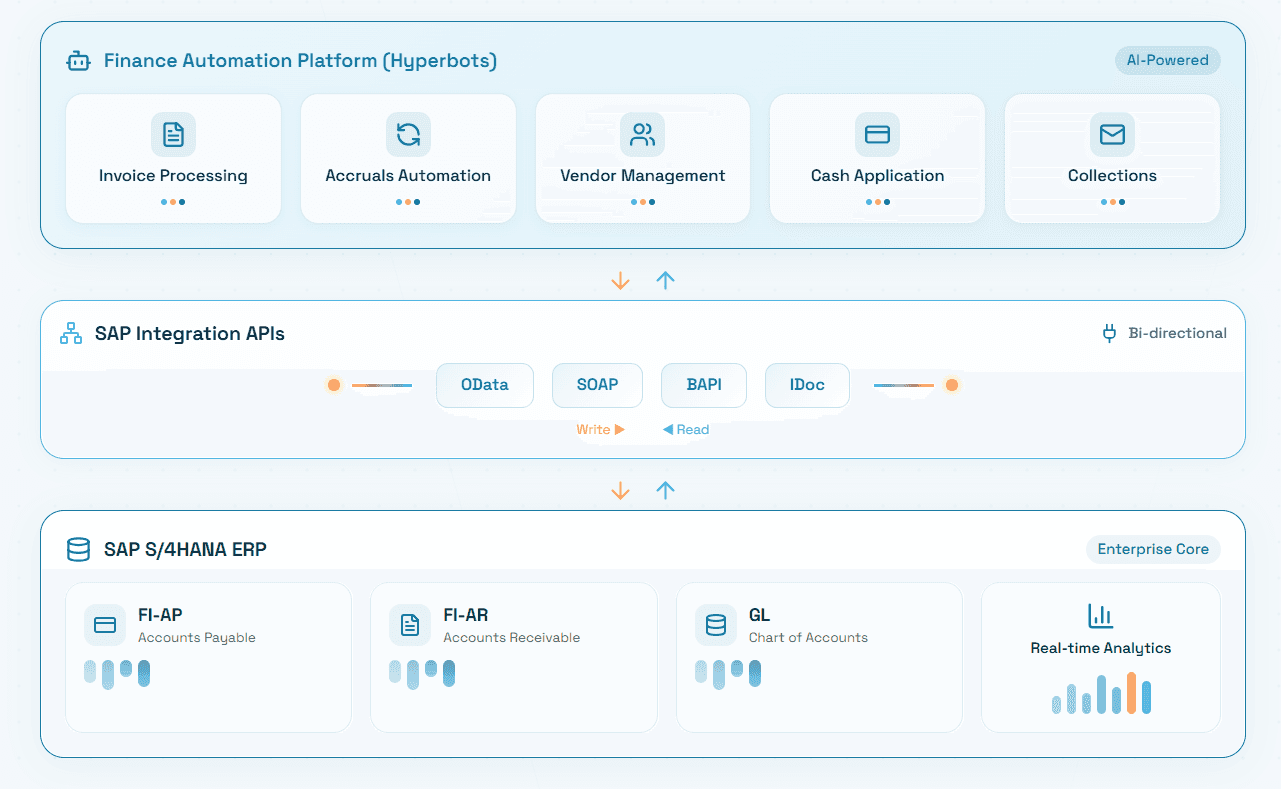
S/4HANA supports both REST and SOAP APIs, you are not forced to choose one or the other. The real question is when to use each. SAP implements REST through OData (Open Data Protocol), specifically OData V2 for most services and OData V4 for newer ones. OData provides a standardized way to create and consume RESTful APIs with consistent URL conventions and query options.
In practical terms, the S/4HANA API ecosystem consists of four main integration protocols, each suited to different use cases:
OData APIs (the modern standard) Most of the latest S/4HANA APIs are OData-based. Since it is a REST protocol, CRUD operations such as Create, Read, Update, Delete are supported via standard HTTP methods: POST, GET, PUT/PATCH, and DELETE. Because OData API can be regarded as a JSON-based REST service, it is easy to consume from both UI and server-side logic. For any finance automation platform connecting to S/4HANA in 2026, OData should be the primary integration protocol for real-time, bidirectional data exchange.
SOAP APIs (established and widely used) SOAP is a web service protocol that was popular in the 2000s and is still widely used today. It was once the core technology of SOA (Service-Oriented Architecture), and there are many SOAP-based APIs in S/4HANA. It requires an XML container called a SOAP Envelope in the HTTP body. Most of the APIs in the SAP API Business Hub are provided in OData or SOAP format.
BAPIs and IDocs (legacy but still relevant) BAPIs and IDocs are the legacy APIs that have long been used since the era of SAP R/3. IDocs were originally developed for EDI and are intended for asynchronous data communication. Many large enterprises running S/4HANA still have significant BAPI-based integrations in their landscape, particularly for procurement and financial posting scenarios. A robust third-party integration platform must be able to speak all of these protocols.
CDS Views (for data extraction) CDS views are consumable outside of the S/4HANA system using OData V2. When creating a CDS view, defining the scenario as "External API" creates an OData V2 service that can be consumed by third-party tools. This is particularly important for finance automation platforms that need to extract high-volume transactional data such as open invoices, AP aging, vendor records in real time without burdening the S/4HANA application layer.
The shift to API-first architecture means S/4HANA treats APIs as products, not afterthoughts. Every API gets proper documentation, versioning, and lifecycle management through the SAP API Business Hub. This is good news for third-party integrators: the integration surface is well-documented, stable, and expanding with every S/4HANA release.
What Finance Data Lives in SAP S/4HANA
To understand what an integration needs to do, it helps to be specific about the financial data objects that matter for automation. A finance automation platform integrating with S/4HANA needs read and write access across:
Financial postings: Journal entries, GL account balances, cost center assignments, profit center data
Accounts Payable: Vendor invoices (FI-AP), payment documents, open items, payment terms, dunning history
Accounts Receivable: Customer invoices (FI-AR), open items, payment receipts, credit limits, aging data
Purchase Orders: PO header and line data, goods receipts (GRNs), invoice verification status, three-way match data
Vendor Master: Vendor records, bank details, payment terms, tax classifications, W-9 / VAT registration data
Customer Master: Customer records, credit limits, payment behavior, contact information
Chart of Accounts: GL account structure, cost centers, profit centers, company codes, segments
Asset Accounting: Asset master data, depreciation runs, asset transactions
Tax Data: Tax codes, tax amounts, jurisdiction codes, withholding tax data
Hyperbots Co-Pilots deliver exhaustive ERP integration, providing full read-and-write access to expenses, Chart of Accounts (COA), vendor and item masters, assets, and liabilities to power end-to-end AI-driven automation. This is the comprehensive data access that genuine finance automation requires not just reading invoice headers, but writing back GL postings, updating vendor master records, and posting payment documents with full transactional integrity.
Why Most Finance Integrations with SAP S/4HANA Fall Short
Given that S/4HANA has a well-documented API layer, you might wonder why integration is still such a challenge. The answer lies not in the API availability, but in what happens after the data crosses the integration boundary.
The Read-Only Trap
Many finance automation tools connect to S/4HANA in read-only mode: they extract invoice data, display it in a nicer interface, and ask humans to take action. The human then goes back into SAP to post the result. This is not automation, it is a dressed-up manual process with an extra step.
True finance automation requires bidirectional integration: reading data from S/4HANA, processing it intelligently, and writing results back like journal entries posted, invoices approved, payments scheduled, accruals booked without human intervention. After Hyperbots posts a transaction to the ERP, it does not just assume everything worked. It actually reads the data back from the ERP to confirm the transaction landed correctly, with all the right values in all the right fields. If something did not match, it catches the error immediately and either retries automatically or alerts someone to investigate.
Custom Field Complexity
Any finance leader who has worked with a real SAP environment knows that production S/4HANA instances are nothing like the textbook demos. They have custom Z-fields on vendor records, custom GL account structures, company-specific approval hierarchies, and years of configuration decisions that make every implementation unique.
Hyperbots is specifically designed for complex SAP S/4HANA finance environments involving custom fields, multi-entity structures, and high transaction volumes. Most finance automation tools struggle here, they can handle standard SAP configurations but break down when they encounter the custom fields and unique data structures that real enterprise SAP instances contain. The ability to discover, map, and automate across custom fields is a critical differentiator.
The Upgrade Disruption Problem
SAP S/4HANA releases updates regularly, and every major upgrade carries the risk of breaking third-party integrations. Hyperbots requires no code changes during SAP upgrades or ECC migrations because its integration layer is built on standard, documented S/4HANA APIs rather than proprietary internal tables or undocumented interfaces. This upgrade safety is not a minor convenience, it is a significant risk mitigation for enterprises that cannot afford integration downtime during a system upgrade.
Batch vs. Real-Time Integration
Many older finance automation tools were built in an era when batch processing was the norm: extract data from SAP overnight, process it, push results back the next morning. In 2026, this architecture is inadequate. Real-time integration minimizes data staleness and ensures accuracy, laying the foundation for confident decision-making, while batch integration accumulates data over periods, often hours or days, before transferring to the target system. Inaccurate data integration can lead to incorrect financial reporting, compliance violations, delayed payments, strained vendor relationships, and finance teams spending hours hunting down discrepancies.
Integration Patterns That Matter for Finance Automation
When evaluating how a finance automation platform connects to S/4HANA, there are several specific integration patterns that determine whether you will get real automation or just a more expensive version of manual work.
Invoice Ingestion and GL Posting
The most foundational integration pattern for AP automation is the ability to read invoice data coming into the SAP environment, from email, EDI, vendor portals, and post validated, matched invoices directly to the FI-AP module without human intervention. This requires:
Reading vendor master data from SAP to validate supplier identity and payment terms
Reading PO data to perform 2-way or 3-way matching
Reading GRN data to confirm goods receipt
Writing the posted invoice document back to SAP with correct GL codes, cost center assignments, tax codes, and payment terms
Handling error responses from SAP and triggering exception workflows when posting fails
Accruals and Journal Entry Posting
Month-end accrual booking is one of the most time-consuming manual processes in SAP environments. A proper integration here requires the automation platform to query open PO and GRN data from S/4HANA, calculate the appropriate accrual amounts, post journal entries to the correct GL accounts, and then reverse those entries automatically when the actual invoice arrives, all through the standard SAP posting APIs.
Vendor Master Read and Write
Vendor onboarding automation requires bidirectional access to the SAP Business Partner (BP) object, the master data structure that underlies vendor records in S/4HANA. The platform needs to read existing vendor data to check for duplicates, write new vendor records with all required fields, update bank details after validation, and maintain the vendor master as supplier information changes over time.
AR and Collections Integration
For order-to-cash automation, the integration needs read access to the FI-AR module — open customer invoices, aging data, payment history, and dispute status — and write access to update collection notes, post payment applications, record promise-to-pay commitments, and trigger credit holds or releases.
Cash Application and Bank Statement Matching
Cash application automation requires the platform to ingest bank statements via bank file import or direct bank API and match incoming payments to open AR items in S/4HANA. This involves reading open item data from FI-AR, performing intelligent matching, and posting the clearing documents directly to SAP with the correct assignment.
How Hyperbots Integrates with SAP S/4HANA
Hyperbots has built one of the deepest, most complete SAP S/4HANA integration layers available in the finance automation market. Here is exactly how it works.
The Hyperbots SAP S/4HANA Connector
Hyperbots' SAP S/4HANA Connector leverages SAP's proprietary APIs and BAPIs to seamlessly integrate with core modules, enabling real-time read and write of invoices, POs, vendor records, GL codes, and asset data. This ensures precise alignment with SAP S/4HANA's data structures and workflows for optimized financial operations.
This is not a generic middleware connection. The connector is purpose-built for the financial data objects that matter for P2P and O2C automation: it knows the structure of SAP vendor master records, understands the GL posting logic of the FI-AP and FI-AR modules, and handles the specific data types, field lengths, and validation rules that SAP enforces.
Hyperbots Co-Pilots deliver real-time, bidirectional ERP data integration instantly syncing expenses, vendors, items, and COA details to keep every finance workflow seamless, accurate, and audit-ready.
No Code Changes Required, Ever
One of the most practically important aspects of the Hyperbots integration approach is that it requires no changes to the S/4HANA system itself. No ABAP development. No custom Z-tables. No transport requests. No basis team involvement. Hyperbots requires no code changes during SAP upgrades or ECC migrations — meaning your integration remains stable regardless of what SAP releases next. For IT teams already managing complex SAP landscapes, this is a meaningful reduction in integration maintenance burden.
Deployment Speed
For ERPs with pre-built connectors, integration can be completed in two to four weeks. Hyperbots delivers pre-built ERP integration connectors for SAP S/4HANA, ready for fast, code-free deployment. The Co-pilots are ready-to-deploy, no-code solutions with pre-trained AI agents and native ERP connectors, enabling rapid, customized setup without third-party integrations or development overhead.
Compare this to the reality of traditional finance automation implementations on SAP, which typically involve 12 to 24 weeks of integration work, ABAP development, basis team configuration, and quality assurance testing. Hyperbots compresses this to weeks, not months.
Multi-Entity and Multi-Instance SAP Support
Enterprise SAP landscapes are rarely simple. Most large organizations run multiple SAP company codes, multiple clients, and in some cases multiple SAP instances across geographies. Hyperbots natively supports multi-entity, multi-subsidiary, and multi-instance ERP environments with consolidated and entity-level visibility. This means a single Hyperbots deployment can automate AP and AR processes across your entire SAP landscape, not just one company code.
On-Premise and Cloud SAP, Both Supported
Hyperbots natively integrates with both on-premise ERP and cloud ERP platforms, enabling secure, high-speed data exchange and consistent finance automation across any deployment model. Whether you are running SAP on-premise, SAP S/4HANA Cloud, or a hybrid setup, the integration approach remains consistent. This matters enormously for enterprises mid-migration from SAP ECC to S/4HANA, Hyperbots works throughout the journey, not just at the destination.
Hyperbots AI Co-Pilots for SAP S/4HANA — The Complete Suite
Once the integration layer is in place, the Hyperbots AI Co-pilots automate every major finance process that runs through SAP S/4HANA. Here is the complete picture across Procure-to-Pay and Order-to-Cash.
Procure-to-Pay Co-Pilots
Invoice Processing Co-pilot The only solution on the market delivering true straight-through processing from email to GL posting in SAP. Achieves an 80% STP rate, dropping average invoice cycle time from 11 days to under one minute. Pre-trained on 35 million invoice fields with 99.8% extraction accuracy, it reads PO and GRN data directly from SAP to perform configurable 2-way and 3-way matching across 140+ fields and writes the validated invoice document straight back to FI-AP without human intervention.
Vendor Management Co-pilot Automates the full SAP vendor onboarding process: collecting supplier documents, verifying W-9s, checking for duplicates against the SAP Business Partner record, and creating clean vendor master records in SAP automatically. Reduces vendor onboarding time by 8x from an average of nine days to under one day — and cuts vendor data error rates from around 6% to under 1%.
Procurement Co-pilot Automates the full PR-to-PO lifecycle inside SAP. Auto-fills complex SAP procurement forms in as little as 5 minutes, converts approved PRs into SAP POs using company templates, and dispatches them to vendors with a self-learning GL recommender that improves GL coding accuracy over time. Works in closed-loop with the Invoice Processing Co-pilot to automate PO closure.
Accruals Co-pilot Queries SAP in real time at month-end cut-off to identify all uninvoiced POs and GRNs, calculates the correct accrual amounts, and posts journal entries directly to the SAP GL then reverses them automatically when the invoice arrives. A unique capability in the market: end-to-end accrual automation with near-zero human touch does not exist elsewhere. Compresses month-end close from days to hours.
Payment Co-pilot Manages the full payment run inside SAP: scheduling, approval routing, bank file generation, payment status tracking, and reconciliation. Validates vendor bank details against SAP master data before every payment, detects unusual payment patterns, and supports ACH, checks, and wire transfersp with a full audit trail written back to SAP. Optimizes payment timing to capture early payment discounts.
Sales Tax Verification Co-pilot Validates sales tax on every AP invoice processed through SAP, at both invoice and line-item level, before it is posted. Verifies shipping and vendor addresses against SAP master data for tax applicability, categorizes line items against jurisdiction-specific rules, and produces a timestamped audit trail for every decision. Continuously updates its tax database to reflect current U.S. state regulations.
Order-to-Cash Co-Pilots
Collections Co-pilot Reads open AR data, aging, and customer history directly from SAP FI-AR to dynamically prioritize the collector workload in real time. Automates 70% of collections activity without human chasing, achieving a 40% reduction in DSO and a 70% reduction in cost to collect. Writes collection notes, dispute status, and promise-to-pay commitments directly back to SAP so no manual logging required.
Cash Application Co-pilot Ingests bank statements, matches incoming payments to open SAP AR items using multiple signals simultaneously, and posts clearing documents directly to FI-AR. Achieves 80%+ straight-through processing on cash application, reducing unapplied cash to less than 10% and cutting reconciliation costs by up to 80%. Handles partial payments, deductions, short-pays, and missing remittance scenarios that rule-based tools cannot manage.
How Hyperbots Is Differentiated From Other SAP Finance Integrations
Every major finance automation vendor claims SAP integration. The differences in practice are significant.
Dimension | Legacy VIM / OpenText | RPA-Based Tools | iPaaS Middleware | Hyperbots AI Co-pilots |
|---|---|---|---|---|
Integration protocol | SAP-native (tight coupling) | Screen scraping / GUI | OData / REST | SAP APIs + BAPIs, purpose-built |
Requires ABAP development | Yes | No, but fragile | Sometimes | Never |
Real-time bidirectional | Partial | No — batch | Depends on config | Yes, always |
Handles custom SAP fields | Limited | No | Manual mapping | AI auto-discovers |
Upgrade safe | Partial | No — breaks frequently | Depends | Yes — no code changes |
AI decision-making | Rules-based | None | None | Agentic LLM-powered |
STP rate on invoices | 40–60% | 20–40% | N/A (plumbing only) | 80%+ |
Time to deploy | 12–24 weeks | 8–16 weeks | 4–12 weeks | 3–4 weeks |
Post-deployment learning | No | No | No | Continuous |
Multi-entity SAP support | Yes | Limited | Yes | Yes, native |
The most important distinction is the difference between integration as plumbing and integration as intelligence. Traditional tools, whether SAP-native VIM, RPA bots, or iPaaS middleware, move data between systems. Hyperbots moves data and makes decisions on it, autonomously, with 99.8% accuracy, and writes the results back to SAP with full auditability.
Hyperbots Platform Capabilities: Transformational Impact on SAP Environments
Beyond the individual co-pilots, the Hyperbots platform delivers several foundational capabilities that create compounding value in SAP environments specifically.
AI That Discovers SAP Custom Fields Automatically Hyperbots is specifically designed for SAP environments with multi-entity structures, custom fields, and high transaction volumes. It uses AI-driven discovery of custom fields and learns from historical patterns which means it adapts to your unique SAP configuration without manual field mapping or configuration work from your basis team.
SOX-Ready Audit Trail Hyperbots provides an immutable blockchain audit trail that meets SOX, PCI-DSS, and FedRAMP (low-impact) requirements. Every action, every AI decision, every ERP posting, every approval is logged with full context, timestamps, and data lineage. For SAP environments subject to external audit, this dramatically reduces audit preparation time and provides the kind of granular transaction evidence that auditors increasingly expect.
Real-Time ERP Integration Architecture Hyperbots uses REST/SOAP and event webhooks for real-time ERP integration, paired with a continuous learning loop via nightly micro-model retraining, and agentic AI orchestration that splits tasks among specialized bots. This architecture ensures that the automation layer is always working with current SAP data, not yesterday's batch extract.
24/7 Operation Hyperbots Co-pilots run 24/7 thus automating invoice workflows, monitoring tasks, and alerting humans only when needed. This ensures uninterrupted operations, faster turnaround, and continuous productivity across finance and procurement teams. In SAP environments with global operations spanning multiple time zones, this means AP and AR processes continue running around the clock without overnight backlogs building up.
Security and Compliance The Hyperbots Agentic AI platform ensures robust data security through redaction, encryption, customer-specific permissions, and compliance with ISO 27001, SOC 1 Type 2, and SOC 2 Type 2 standards. It also integrates with Okta, Microsoft Entra ID, Google Workspace, and OneLogin for seamless SSO, a standard requirement in enterprise SAP environments.
Self-Learning That Adapts to Your SAP Configuration Hyperbots Co-pilots use self-learning AI to adapt to company-specific workflows, improve accuracy over time, and continuously align with changing business rules, exceptions, and process variations thus driving smarter automation with every interaction. In SAP environments that evolve with each new release or business change, this continuous adaptation means the automation layer keeps pace without manual retraining.
ROI of Deploying Hyperbots on SAP S/4HANA
Procure-to-Pay ROI in SAP Environments
Tangible:
80% straight-through processing on AP invoices as the majority of SAP FI-AP postings happen with zero human touch
Invoice cycle time from 11 days to under one minute which is the most dramatic operational improvement in AP
99.8% GL coding accuracy on SAP postings thus eliminating reclassification journals and audit queries
Vendor onboarding time reduced 8x from nine days to under one day, with vendor data errors under 1%
Month-end close compressed from days to hours with accruals booked and reversed automatically in SAP GL
Sales tax compliance on every invoice with near-zero error rate, audit-ready documentation produced automatically
Deployment in 3–4 weeks versus 12–24 weeks for traditional SAP finance automation tools
Intangible:
SAP basis and IT teams freed from integration maintenance so no custom code to maintain through upgrades
Finance teams shift from SAP transaction processing to strategic analysis
Full audit trail across all SAP postings with internal audit and external auditors have complete, explainable evidence
Supplier relationships improved through faster, more accurate SAP-posted payments
Scalability without headcount as 3x invoice volume growth can be handled by the same Hyperbots deployment
Order-to-Cash ROI in SAP Environments
Tangible:
40% reduction in DSO: driven by AI that reads SAP AR data in real time and acts on it autonomously
70% reduction in cost to collect: 70% of collections activity automated without human chasing
80%+ STP on cash application: SAP AR clearing documents posted automatically, unapplied cash under 10%
80% reduction in reconciliation costs: bank-to-SAP matching at 99.8% accuracy
Collections team productivity up 80%: AI handles routine SAP AR follow-up, humans focus on high-value accounts
Intangible:
Real-time cash flow forecasting using live SAP AR data, not static aging reports
Customer satisfaction improves, fewer incorrect dunning notices, faster dispute resolution
Credit risk signals surfaced proactively from SAP payment behavior data
Revenue assurance strengthened as AI catches every open SAP AR item that would have fallen through the cracks
Evaluating Third-Party Finance Tools for SAP S/4HANA — A Checklist
If you are currently evaluating finance automation platforms for your SAP environment, use this checklist to assess integration quality:
Does the platform use standard SAP S/4HANA APIs (OData, BAPI), or does it rely on screen scraping or undocumented interfaces?
Is integration bidirectional? Does it write back to SAP, or only read?
Does it verify write-back success by reading data back from SAP after posting?
Does it require ABAP development or SAP basis team involvement to deploy?
Is it upgrade-safe? Will it break when SAP releases a new version?
Does it handle your SAP custom fields, company-specific GL structures, and multi-entity configuration?
Does it support both SAP on-premise and S/4HANA Cloud?
What is the deployment timeline, weeks or months?
What is the STP rate on AP invoices in production SAP environments (not demo environments)?
Does it produce a SOX-compliant audit trail for all SAP postings?
Does the AI learn from your specific SAP configuration over time?
Does it run 24/7, or does it require scheduled batch processing?
Conclusion: SAP S/4HANA Is the Foundation. Hyperbots Is What Makes It Intelligent.
SAP S/4HANA will remain the financial backbone of enterprise organizations for the foreseeable future. It is robust, deeply integrated into business processes, and trusted by finance teams worldwide to hold their financial truth.
But holding financial truth is different from acting on it intelligently. The gap between what SAP stores and what your finance team actually needs to do with that data autonomously, at scale, with 99.8% accuracy is exactly the gap that Hyperbots fills.
Through its purpose-built SAP S/4HANA Connector and its suite of eight AI co-pilots spanning the full P2P and O2C stack, Hyperbots transforms SAP from a passive system of record into an active, intelligent finance engine. Invoices are processed in under a minute. Accruals are booked and reversed automatically. 70% of collections happen without a human. Cash is applied at 80%+ STP. And all of it writes back to SAP with full auditability, with no ABAP development required, deployable in two to four weeks.
If your organization runs SAP S/4HANA and is serious about driving transformational ROI from its finance operations, the conversation about AI co-pilots is not a future-state discussion. It is available now, it deploys fast, and the ROI is measurable within 60 days.
Frequently Asked Questions (FAQs)
Q1: What APIs does SAP S/4HANA expose for third-party finance integrations? SAP S/4HANA exposes four main integration protocols: OData APIs (REST-based, the modern standard for real-time integrations), SOAP APIs (widely used for enterprise service bus scenarios), BAPIs via RFC (legacy but still prevalent in on-premise landscapes), and IDoc (asynchronous EDI-style messaging). The SAP API Business Hub documents all standard APIs with versioning and lifecycle management. For finance automation specifically, OData is the primary protocol for invoice, PO, vendor master, and AR data — with BAPIs still commonly used for financial document posting.
Q2: Does deploying Hyperbots require changes to our SAP system?
No. Hyperbots integrates with SAP S/4HANA through standard, documented APIs and BAPIs without requiring any ABAP development, custom Z-tables, or transport requests. Your SAP system remains exactly as it is. This also means Hyperbots is fully upgrade-safe so no code changes are needed when SAP releases updates or when you migrate from ECC to S/4HANA.
Q3: How long does it take to integrate Hyperbots with SAP S/4HANA?
For pre-built SAP S/4HANA connectors, integration is typically completed in two to four weeks. Full co-pilot deployment including AI training on your SAP data, workflow configuration, and user acceptance testing, is typically complete in three to five weeks. This compares to 12–24 weeks for traditional SAP finance automation implementations.
Q4: Can Hyperbots handle custom SAP fields and company-specific configurations?
Yes and this is one of Hyperbots' key differentiators. Its AI automatically discovers custom fields in your SAP environment and adapts to your specific GL structure, approval hierarchies, and business rules without manual configuration. This is specifically designed for the complex, real-world SAP environments that most finance automation tools struggle with.
Q5: Does Hyperbots work with both SAP on-premise and SAP S/4HANA Cloud?
Yes. Hyperbots natively integrates with both on-premise SAP and SAP S/4HANA Cloud editions, as well as SAP ECC and SAP Business One. The integration approach is consistent across deployment models, making it suitable for enterprises at any stage of their SAP cloud migration journey.
Q6: What SAP finance processes can Hyperbots automate?
Hyperbots covers the full finance operations stack on SAP: AP invoice processing and GL posting (FI-AP), vendor master management (Business Partner), procurement and PO management (MM), month-end accruals and journal entries (FI-GL), payment runs and bank reconciliation (FI-AP), sales tax verification, AR collections (FI-AR), and cash application (FI-AR clearing). This is end-to-end P2P and O2C automation, not point solutions.
Q7: How does Hyperbots ensure data accuracy when posting to SAP?
Hyperbots uses a read-back verification approach: after posting a document to SAP, it reads the posted record back from SAP to confirm the transaction landed correctly with all required fields populated accurately. If anything does not match, the platform catches the error immediately and either retries automatically or raises an exception for human review. This approach ensures SAP data integrity even in complex, high-volume environments.
Q8: Is Hyperbots compliant with SOX requirements for SAP environments?
Yes. Hyperbots produces an immutable, timestamped audit trail for every action taken with every AI decision, every SAP posting, every approval workflow step, every exception. This audit trail meets SOX, PCI-DSS, and FedRAMP (low-impact) requirements, and is available in full for internal and external auditors without any manual documentation effort.
Q9: What is the difference between Hyperbots and SAP's own automation tools like SAP Intelligent RPA?
SAP Intelligent RPA automates repetitive SAP GUI interactions, it essentially mimics what a human does by clicking through SAP screens. This is fragile (breaks when SAP UI changes), limited in intelligence (no machine learning), and does not handle complex scenarios like multi-format invoice processing or AI-driven collections prioritization. Hyperbots operates at the API level, uses agentic LLM-powered AI to make complex decisions, achieves 80%+ STP compared to 20–40% for RPA, and deploys in weeks rather than months.
Q10: Can Hyperbots connect to SAP and other ERPs simultaneously?
Yes. Many enterprises run multi-ERP environments, perhaps SAP S/4HANA for the parent company and NetSuite or Dynamics 365 for subsidiaries. Hyperbots connects to all of them simultaneously, providing unified finance automation and consolidated reporting across your entire ERP landscape.