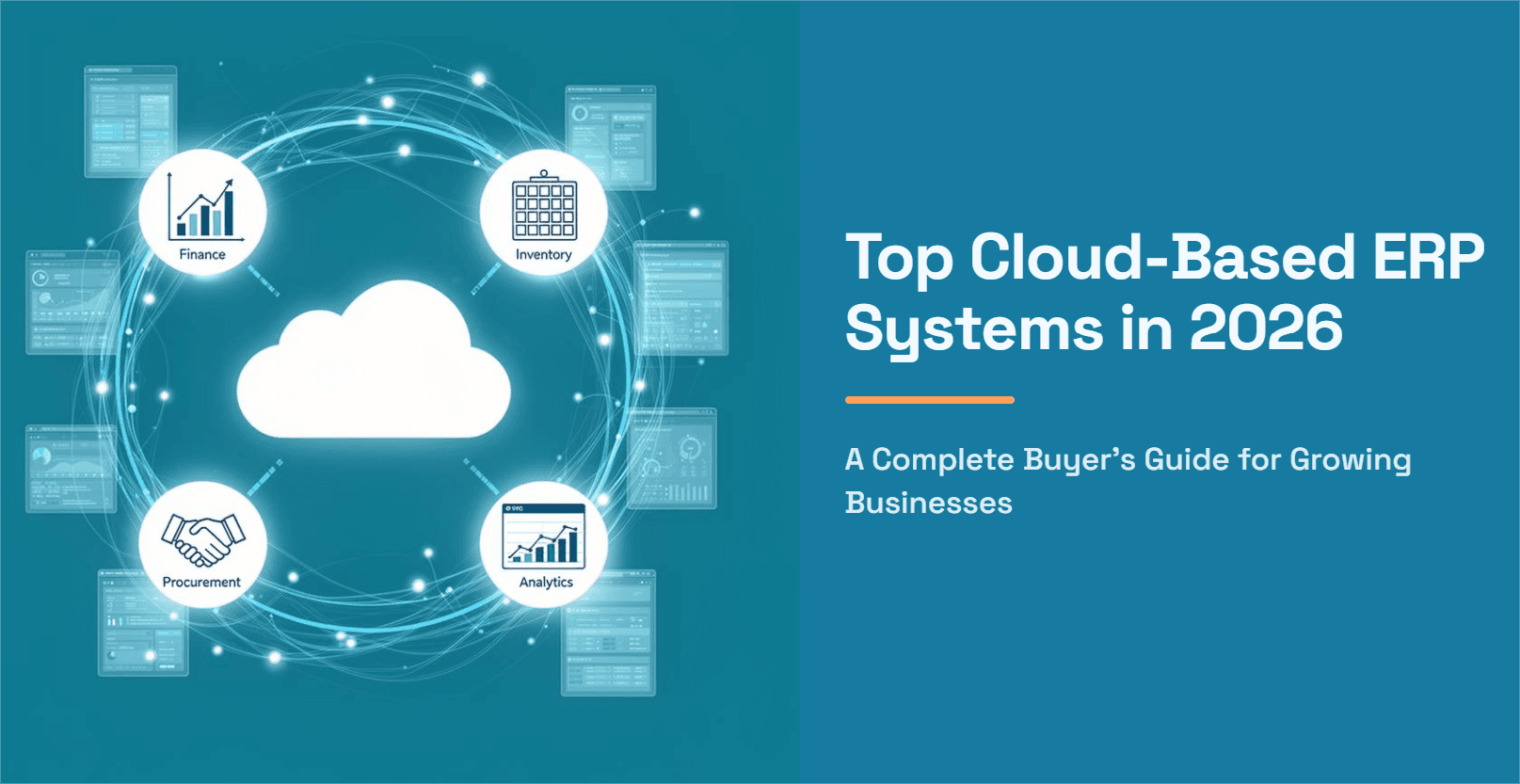
Top Cloud-Based ERP Systems in 2026: A Complete Buyer’s Guide for Growing Businesses
A No-Nonsense Comparison of Leading Cloud ERP Platforms — Features, Pricing Models, Deployment Options, and How to Choose the Right Fit for Where Your Business Is Headed
Choosing a cloud-based ERP system is one of the most consequential technology decisions a growing business will make. Get it right and you have a scalable, real-time operational backbone that grows with your business for years. Get it wrong and you're locked into a system that fights you at every turn, expensive to maintain, painful to customize, and slow to deliver the visibility your leadership team needs.
The good news: the cloud ERP solutions market in 2026 is mature, competitive, and genuinely excellent at the top end. The challenge is that there are dozens of credible options across different price points, deployment models, and industry fits and most vendor comparison content is written by the vendors themselves.
This guide is different. We'll break down what cloud-based ERP software actually is, what separates the best cloud ERP providers from the rest, how to evaluate your options, and which platforms stand out for which business profiles. We'll also show you how layering an AI finance co-pilot like Hyperbots on top of your cloud enterprise resource planning system can deliver ROI that the ERP alone simply cannot.
Cloud-Based ERP vs. On-Premise: Why Cloud Wins for Most Businesses
Before comparing specific cloud ERP solutions, it's worth anchoring on why cloud has become the dominant deployment model for cloud computing for enterprise resource planning.
Cloud ERP | On-Premise ERP |
|---|---|
Subscription Pricing | Large upfront CapEx |
3-9 month rollout | 12-18 month rollout |
Automatic Updates | Manual Upgrades |
Scales Instantly | Hardware Expansion Required |
Vendor-managed Security | Internal IT Responsibility |
Access anywhere | On-site access |
Lower total cost of ownership is the most immediate advantage. On-premise ERP requires significant upfront capital: server hardware, database licenses, implementation services, and dedicated IT staff to manage the environment. Cloud-based ERP software replaces most of that with a predictable monthly or annual subscription, shifting ERP investment from capital expenditure (CapEx) to operating expenditure (OpEx), a structure that is far more manageable for growing businesses.
Faster deployment is a consistent advantage of cloud-based ERP implementation over on-premise alternatives. Because the infrastructure is pre-built and the software is pre-configured around best-practice processes, cloud ERP applications can go live in weeks or months rather than the 12–18 month timelines common in large on-premise deployments.
Automatic updates ensure that cloud ERP software users always run on a current, supported, and secure version of the platform. On-premise upgrade cycles are notoriously painful, requiring dedicated IT projects, testing cycles, and planned downtime. Cloud eliminates this overhead entirely.
Scalability on demand means that adding users, expanding to new geographies, or activating new modules in a cloud-based ERP system is a configuration change, not an infrastructure project. For businesses growing rapidly or managing seasonal fluctuations, this elasticity is operationally critical.
Enterprise-grade security is another area where cloud outperforms most on-premise environments in practice. Leading cloud ERP providers invest hundreds of millions annually in security infrastructure, compliance certifications (SOC 2, ISO 27001, GDPR), threat monitoring, and disaster recovery, levels of investment that most SMEs and mid-market businesses cannot replicate on-premise.
Top Cloud-Based ERP Systems in 2026: A Practical Comparison
The cloud ERP software market has several clear leaders, each with a distinct profile, strength set, and ideal customer:
SAP S/4HANA Cloud is SAP's flagship cloud enterprise resource planning platform for enterprise and upper mid-market organizations.
Built natively on the SAP HANA in-memory database, it delivers real-time analytics, a simplified universal journal for finance, and deep integration across SAP's intelligent enterprise portfolio including SAP Ariba for procurement, SAP SuccessFactors for HR, and SAP Analytics Cloud for business intelligence.
The Public Edition offers rapid deployment via pre-configured best-practice processes; the Private Edition provides greater customization flexibility for complex organizations.
SAP S/4HANA Cloud is the natural destination for organizations currently running SAP ECC and planning their migration, as well as enterprises seeking the most comprehensive cloud ERP suite in the market.
SAP Business One Cloud is SAP's dedicated cloud-based ERP solution for small and medium-sized enterprises like companies with 10 to 250 employees.
It delivers the full ERP functional coverage of the SAP ecosystem (financials, sales, purchasing, inventory, production, reporting) in a cloud subscription model that eliminates the infrastructure overhead of on-premise deployment.
For SMEs wanting enterprise-grade capability without enterprise-scale complexity, SAP Business One Cloud is consistently one of the strongest options in its category.
Oracle NetSuite is one of the most established pure cloud-based ERP systems on the market and a genuine all-in-one ERP for mid-market and enterprise businesses.NetSuite is particularly strong for multi-entity and multi-subsidiary organizations.
Its OneWorld module handles consolidated reporting, intercompany transactions, multi-currency, and multi-tax across dozens of subsidiaries in real time, making it one of the most capable cloud enterprise resource planning solutions for organizations with complex legal structures or international operations.
For software and technology companies, NetSuite's native revenue recognition engine (aligned with ASC 606 and IFRS 15) and subscription billing ERP capabilities are industry-leading.
Product-based businesses benefit from its robust inventory, warehouse management, and demand planning modules.
NetSuite's SuiteERP architecture also supports deep customization through SuiteScript and SuiteFlow, allowing businesses to tailor workflows and cloud ERP applications without breaking the upgrade path, a critical consideration for fast-growing companies that need the platform to evolve with them.
Microsoft Dynamics 365 is the natural cloud-based ERP solution for organizations already embedded in the Microsoft ecosystem. It delivers a genuinely integrated cloud ERP suite spanning financials, supply chain, manufacturing, commerce, field service, and CRM, all within a single platform that connects natively with Microsoft 365, Teams, Power BI, and Azure AI.
Businesses can start with core financial management and activate additional cloud ERP applications such as supply chain, project operations, or commerce, as their needs evolve, without migrating to a new platform.
This makes it one of the most scalable cloud enterprise resource planning options for mid-market companies planning phased digital transformation.
Microsoft's Copilot integration brings generative AI directly into ERP workflows by automating invoice processing suggestions, cash flow forecasting, and demand planning recommendations within the familiar Microsoft interface users already know.
For organizations in manufacturing, retail, and professional services that are deeply invested in the Microsoft stack, Dynamics 365 offers the lowest integration friction and the broadest ecosystem of certified partners, industry accelerators, and third-party cloud ERP software extensions of any platform in its class.
Sage Intacct is the leading cloud-based ERP software for organizations where standard financial reporting falls short and multi-dimensional visibility is non-negotiable.
Built as a true cloud-based enterprise resource planning system from the ground up, Sage Intacct is purpose-built for industries where financial complexity, grant management, and project-level accounting drive day-to-day operations.
Rather than relying on a rigid chart of accounts, it allows finance teams to tag every transaction across multiple dimensions simultaneously such as department, location, project, fund, customer, and more and slice reporting across any combination without building separate ledgers or running manual consolidations.
This makes it one of the most powerful cloud ERP solutions for nonprofit organizations, healthcare systems, and professional services firms managing complex, multi-funded operations.
The platform is also the AICPA's preferred financial management solution, a significant trust signal for finance leaders in regulated or audit-intensive environments.
Its project accounting module handles revenue recognition, billing milestones, resource utilization, and budget-to-actual reporting at the project level, giving services businesses the granular financial control that general-purpose cloud enterprise software solutions typically cannot match.
For SaaS companies and subscription businesses, Sage Intacct's contract and revenue management capabilities handle multi-element arrangements and ASC 606 compliance natively.
Epicor is the specialist cloud-based ERP system for manufacturers and distributors that need deep operational functionality, not just financial management, from their cloud ERP software.
Where generalist platforms offer broad but shallow manufacturing coverage, Epicor delivers production planning, shop floor control, quality management, and supply chain execution capabilities that have been refined over decades of serving discrete and process manufacturers specifically.
Epicor's cloud ERP suite, delivered through Epicor Kinetic, is built around the manufacturing lifecycle: from engineering change orders and bill of materials management through production scheduling, work-in-progress tracking, and finished goods inventory.
Its Advanced MES (Manufacturing Execution System) integration gives plant managers real-time visibility into machine utilization, labor efficiency, and production variances directly within the cloud-based ERP application without relying on a separate standalone MES platform.
For distributors, Epicor's warehouse management, demand forecasting, and multi-location inventory capabilities make it one of the strongest cloud ERP solutions in the wholesale distribution vertical.
The platform also supports mixed-mode manufacturing environments, businesses that need to handle make-to-order, make-to-stock, and configure-to-order production within the same system.
Deltek is the definitive cloud-based ERP solution for project-driven businesses particularly those operating in government contracting, architecture, engineering, construction, and professional services.
While most cloud ERP providers treat project accounting as a module bolted onto a financial core, Deltek builds its entire platform around the project as the fundamental unit of business because for its target customers, the project is the business.
Deltek's flagship cloud enterprise resource planning products such as Costpoint for government contractors and Vantagepoint for professional services are purpose-built for industries where project profitability, resource utilization, and compliance with government cost accounting standards (DCAA, FAR, CAS) are existential business requirements.
Costpoint in particular is the dominant cloud-based ERP system in the U.S. federal contracting market, used by thousands of defense contractors, research firms, and government agencies.
For architecture and engineering firms, Deltek Vantagepoint combines project management, resource planning, CRM, and financial management into a single cloud ERP suite giving firm leaders real-time visibility into project margins, staff utilization, and pipeline health from a single dashboard.
How to Choose the Right Cloud-Based ERP for Your Business
With so many credible cloud ERP providers in the market, the selection process matters as much as the shortlist. A few principles that consistently separate successful ERP selections from expensive mistakes:
Start with your business requirements, not the vendor demos. Document your current process pain points, must-have functional requirements, integration dependencies, and growth plans before engaging vendors. This gives you an objective framework to evaluate options against rather than being swayed by whichever demo was most polished.
Evaluate total cost of ownership over five years, not just the Year 1 subscription. Cloud-based ERP implementation costs, training, integration development, and ongoing support fees can easily double the headline subscription figure. Build a realistic five-year TCO model for each shortlisted option.
Prioritize implementation partner quality. The best cloud ERP software delivers poor outcomes with the wrong implementation partner. Evaluate partner certifications, industry experience, reference customers in your vertical, and the quality of their post-go-live support model, not just their price.
Insist on a proof of concept. Before committing to any cloud-based enterprise resource planning software, run a structured proof of concept using your own data and business scenarios. This surfaces integration challenges, usability issues, and performance gaps that vendor demos never reveal.
Plan for the AI layer from day one. The most forward-thinking organizations evaluating cloud ERP solutions in 2026 are not just asking "what does this ERP do?" They are asking "what can this ERP do when AI is layered on top of it?" because that is where the step-change ROI comes from.
Hyperbots + Cloud-Based ERP: The AI Layer That Maximizes Your Investment
Selecting and implementing the right cloud-based ERP system is a significant achievement. But here is the reality every CFO confronts after go-live: even the best cloud ERP software still depends on significant human effort to run daily finance and accounting operations.
Invoices need to be processed and matched. Vendors need to be paid on time. Accruals need to be booked at month-end. Collections need to be chased. Cash needs to be applied. These workflows live inside every cloud-based ERP solution and in most finance teams, they remain labor-intensive, error-prone, and slow regardless of how good the underlying platform is.
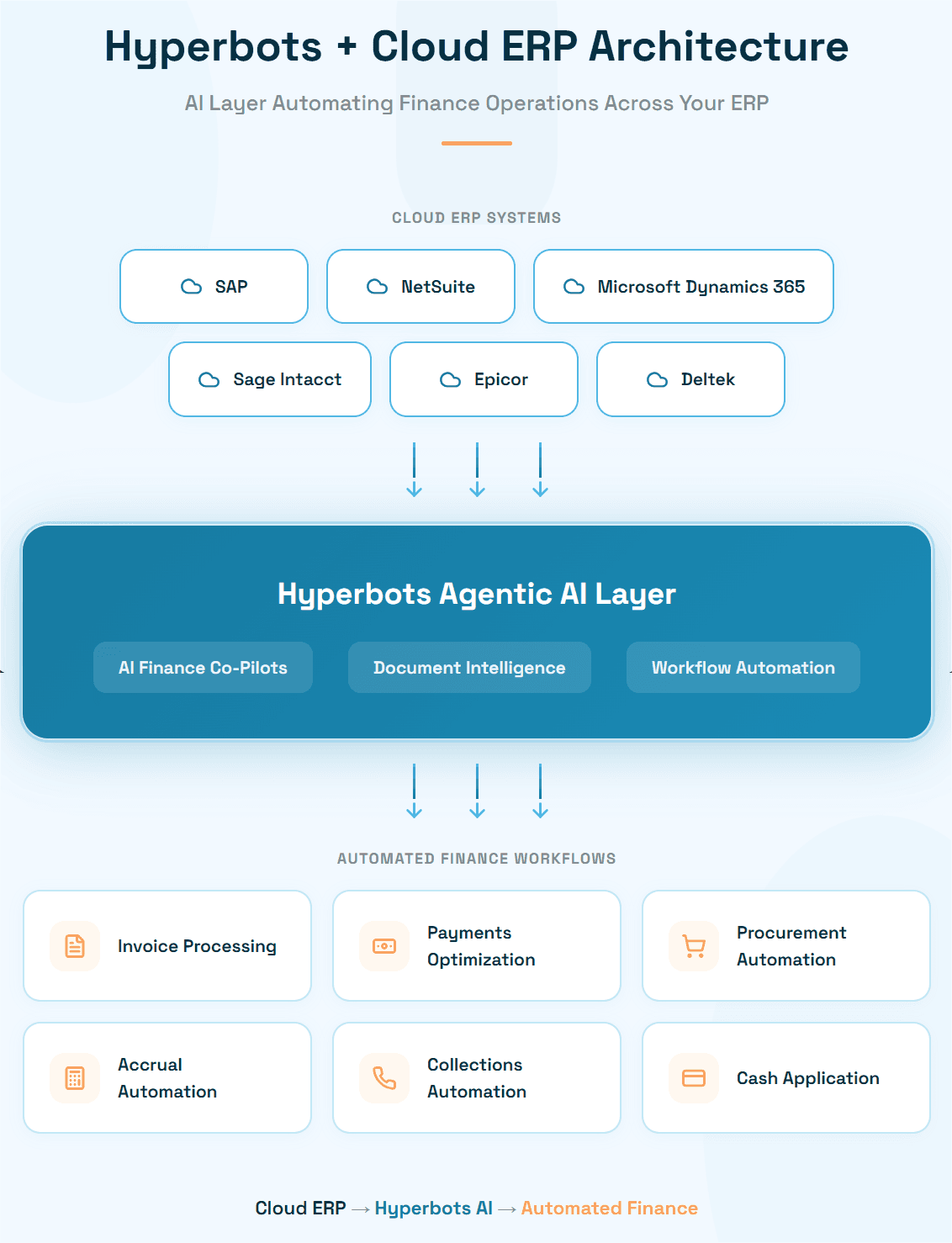
Hyperbots is a proprietary Agentic AI platform built exclusively for finance and accounting that integrates directly with your cloud ERP software to automate these workflows end-to-end. Unlike generic RPA tools or basic OCR solutions, Hyperbots deploys finance-trained AI agents that are pre-trained on millions of invoices, POs, contracts, and financial statements to handle complex F&A processes with minimal human intervention and maximum accuracy.
Hyperbots offers pre-built, bidirectional integration connectors for the leading cloud ERP providers including SAP S/4HANA, SAP Business One, Oracle NetSuite, Microsoft Dynamics 365 Business Central, Sage Intacct, Sage 300, QuickBooks, Epicor, Deltek Costpoint, and more. Deployment takes as little as 3–4 weeks, and the platform achieves 99.8% accuracy in extracting structured data from unstructured financial documents from day one.
The ROI for cloud-based ERP users who integrate Hyperbots is concrete, measurable, and begins almost immediately:
Invoice Processing: The Invoice Processing Co-Pilot achieves up to 80% straight-through processing (STP) of invoices thus cutting average processing time from an industry benchmark of 11 days to under one minute and freeing 80% of AP staff bandwidth. For a finance team processing 4,000 invoices per month, this is the equivalent of recovering multiple full-time employee capacities while simultaneously reducing duplicate payments, GL coding errors, and late payment penalties.
Payments and Cash Flow: The Payments Co-Pilot analyzes payment terms, early pay discount windows, late payment penalty exposure, and cost of capital to optimize payment timing and method by reducing total cash outflow by up to 10%. For a company with $7M in annual payables, that is $700,000 in improved working capital.
Procurement: The Procurement Co-Pilot auto-generates purchase requisitions and converts approved PRs into compliant purchase orders within your cloud ERP system automatically by reducing PO creation and dispatch time by 80% and PR creation time to just 5 minutes.
Month-End Close: The Accruals Co-Pilot automates accrual identification, booking, and reversal directly within your ERP by cutting accrual processing costs by 80% and reducing variance between accrued and actual costs to below 5%. Finance teams running cloud ERP's faster close cycle extract even more value when Hyperbots eliminates the remaining manual bottlenecks.
Collections: The Collections Co-Pilot autonomously manages dunning, follow-ups, dispute detection, and promise-to-pay tracking by reducing Days Sales Outstanding (DSO) by up to 40% and cutting the cost to collect by 70%. For cash-intensive businesses, this improvement transforms the entire financial profile of the organization.
Cash Application: Automated remittance extraction, intelligent payment matching, and GL posting reduce reconciliation costs by 80% and bring unapplied cash below 10% thus giving AR teams real-time clarity on exactly where every payment stands.
Hyperbots was co-designed with CFOs across manufacturing, wholesale distribution, retail, technology, and professional services, precisely the industries driving cloud-based ERP adoption at the fastest pace today. Its unlimited-access licensing model ensures no per-seat bottlenecks limit adoption across your finance organization.
Cloud-Based ERP Is the Platform But AI Is the Performance Multiplier
The cloud-based ERP market has never offered more capable, accessible, or well-supported options than it does in 2026. Whether your business is best served by SAP S/4HANA Cloud, SAP Business One, NetSuite, Dynamics 365, or another leading cloud ERP solution, the foundation you're building on is genuinely strong.
But foundation is all it is. The organizations that will pull furthest ahead are the ones that treat their cloud enterprise resource planning system as the starting point and layer Hyperbots' Agentic AI on top to automate the finance workflows that no ERP alone can eliminate.
The math is compelling: Hyperbots customers recover up to 80% of AP processing costs, reduce DSO by 40%, and improve cash outflow by 10% within the first year of deployment. Book a personalized demo and let a Hyperbots Financial Technology Consultant show you exactly what that return looks like for your specific cloud-based ERP environment.
Frequently Asked Questions (FAQs)
What is cloud-based ERP and how is it different from on-premise ERP?
A: Cloud-based ERP is an enterprise resource planning system hosted on remote servers and delivered over the internet, meaning the vendor manages all infrastructure, security, and updates on your behalf. Unlike on-premise ERP, which requires your organization to purchase, install, and maintain servers and software internally, cloud ERP is accessed through a browser from any device, anywhere. The key practical differences are cost structure (subscription vs. capital expenditure), deployment speed (weeks vs. months), scalability (configuration change vs. infrastructure project), and maintenance burden (automatic updates vs. dedicated IT projects).
Which cloud ERP system is best for small and mid-sized businesses?
A: The best cloud ERP for an SME depends on your industry, complexity, and growth trajectory. SAP Business One Cloud is consistently one of the strongest options for SMEs with 10–250 employees, offering full ERP functionality such as financials, sales, purchasing, inventory, and production, in a cloud subscription model purpose-built for smaller organizations. Microsoft Dynamics 365 is a strong alternative for SMEs already in the Microsoft ecosystem, while Oracle NetSuite suits multi-entity SMEs needing strong consolidation and revenue recognition. The right choice starts with your business requirements, not the vendor demo.
How long does a cloud-based ERP implementation take?
A: Cloud-based ERP implementation timelines vary significantly based on the platform, the complexity of your business processes, and the quality of your implementation partner. Simple deployments using pre-configured best-practice templates such as SAP S/4HANA Cloud Public Edition or SAP Business One Cloud can go live in as little as 8–16 weeks. Mid-complexity implementations for growing SMEs typically run 3–9 months.
What should I look for when comparing cloud ERP providers?
A: When comparing cloud ERP providers, evaluate six key dimensions: functional coverage across your core business processes (financials, procurement, inventory, manufacturing, HR), industry-specific capabilities in your vertical, total cost of ownership over five years rather than just the Year 1 subscription, implementation partner quality and certified expertise in your industry, integration architecture and API openness for connecting your broader technology stack, and the vendor's roadmap for AI and intelligent automation because the ERP platforms delivering the most value in the coming years will be those with the strongest AI layer built on top of core ERP functionality.
Can AI be integrated with cloud-based ERP systems to improve finance operations?
A: Yes and it is increasingly where the most significant ERP ROI comes from. Platforms like Hyperbots integrate directly with leading cloud ERP systems including SAP S/4HANA, SAP Business One, Oracle NetSuite, Microsoft Dynamics 365, and others to automate the finance and accounting workflows that ERP alone cannot eliminate: invoice processing, vendor payments, accruals, collections, and cash application. Hyperbots' Agentic AI achieves up to 80% straight-through processing of invoices, reduces Days Sales Outstanding by up to 40%, cuts the cost to collect by 70%, and reduces cash outflow by up to 10%, all within the existing cloud ERP environment, deploying in as little as 3–4 weeks.