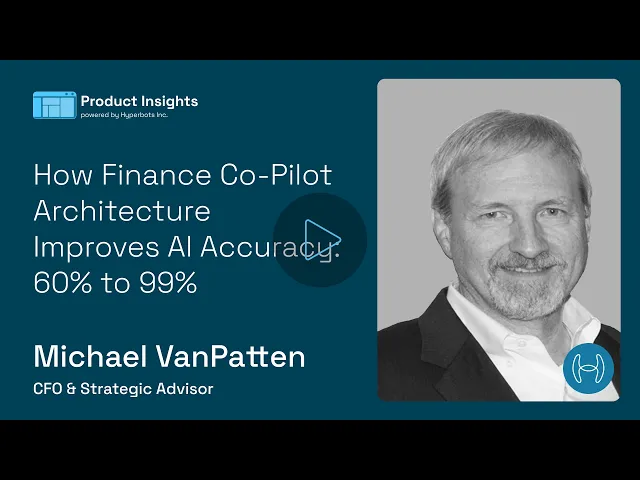
How Finance Co-Pilot Architecture Improves AI Accuracy: 60% to 99%
How process-specific finance copilots drive accuracy, automation, and ROI through intelligent, collaborative workflow
What Does "Process-Specific Copilot" Actually Mean?
Raghav: So, hello Michael. Our topic for discussion today is Hyperbots' process-specific C-Pilot architecture. I just wanted to understand from you, what it means when you talk about Hyperbots as process-specific co-pilots instead of one monolithic bot. What does that mean in practice?
Michael: Well, each copilot is a purpose-built micro product on an agentic AI platform. The Invoice Processing Co-Pilot is engineered for straight-through invoices. The Vendor Management Co-Pilot knows all the W9 rules, sanctions, and onboarding steps. The Payments Co-Pilot handles scheduling, approvals, and bank files. Each specialist does their piece and then hands it off to the next as needed.
How Deep Is the Domain-Specific Training?
Raghav: Amazing. So, how deep is the domain-specific training that is done for each of these Co-Pilots?
Michael: The Invoice Co-Pilot is pre-trained on millions of invoice forms, the Vendor Management Co-Pilot on identity documents, and the Payments Co-Pilot on receipts. So accuracy is greater than 98% on day one. Competing RPA tools started at about 50 to 60% accuracy.
Raghav: Yeah, I see that RPA typically operates at 50 to 60%. So it's very good to hear that these AI bots stand at 98%+. If every copilot is a specialist, then do you still share components to avoid redundancy?
Michael: Absolutely. Reusable agents. The GL Recommender sits in a library, so the invoice, accrual, and payment co-pilots can all call the same agent but feed it a different context.
Co-Pilots Collaborating in Real Life
Raghav: Can you share an example of these co-pilots collaborating in real life?
Michael: Sure. When an Invoice Co-Pilot extracts sales tax lines, it pings the Sales Tax Verification Co-Pilot for jurisdiction-specific rates. At payment time, the Payments Co-Pilot queries the Invoice Processing Co-Pilot to reconcile the voucher before releasing the funds. The handoff is all API-based.
How Does This Architecture Scale When Workflows Get Complex?
Raghav: OK, so I understand this, but how does this architecture scale when workflows get complex?
Michael: Sure. The Agentic AI platform orchestrates tasks across various co-pilots. For a new entry, we just enable the needed modules, and the specialists will auto-scale.
Where Generic Automation Suites Fall Short
Raghav: Competitively, where do generic automation suites fall apart when compared to Hyperbots agentic platform?
Michael: Sure. They offer one broad engine. Their bolt-on scripts for tax, GL, and vendor checks lead to poor accuracy and productivity gains. Hyperbots deliver deep process-specific logic out of the box. No separate tax engine is needed, no third-party GL mapper, and reusable agents mean less duplication.
Building Company-Specific Nuances Into Each Co-Pilot
Raghav: Amazing. So help me understand, how do you build company-specific nuances into these individual co-pilots?
Michael: Through no-code rules and datasets. We loaded our project codes into the Invoice Processing Co-Pilot and it learned them overnight. And for the Vendor Management Co-Pilot, we added a custom cyber risk field. No development sprint required.
Raghav: So what you're saying is you can add custom fields. Amazing.
Does Having Multiple Co-Pilots Complicate the User Experience?
Raghav: Just help me understand from a user experience standpoint, does having multiple co-pilots complicate the experience for the user?
Michael: Not at all. Users see a single portal. Which copilot runs behind the scenes is abstracted. A clerk just clicks an invoice card. The Invoice Co-Pilot and Sales Tax Co-Pilot coordinate transparently.
Raghav: So what you're saying is the coordination happens in the back end while the user only sees the UI. Amazing.
Can you give a tangible ROI example tied to this specific process design?
Michael: Yes. Vendor onboarding used to take up to four days. Vendor Management Co-Pilot Plus the Invoice Processing Co-Pilot reduces it to 15 minutes because identity validation and initial invoice readiness happen in one pass.
Raghav: That's a pretty strong ROI case.
How Do Co-Pilots Learn From Human Overrides?
Raghav: How do these co-pilots learn from human input across processes?
Michael: That's a good question. Overrides in any module flow back to the shared agents. So if AP corrects a GL code, the GL recommender updates, and the Accruals Co-Pilot benefits instantly just from a single learning loop.
What Differentiates Hyperbots' Approach to Reuse?
Raghav: Some vendors claim reuse. What differentiates Hyperbots' approach here?
Michael: A lot of competitors reuse code snippets. We reuse trained agents that carry their own model and metrics. They're plug-and-play across workflows, which keeps maintenance effort to a minimum.
Monitoring Performance Across Multiple Co-Pilots
Raghav: And last couple of questions on the performance metrics side. How do you monitor performance across so many co-pilots?
Michael: A unified dashboard shows agent latency, exception counts, and STP rates per process. If GL recommender accuracy drops, you'll see it across the invoice and accrual modules simultaneously.
The Competitive Edge, Summarized
Raghav: Got it. Could you summarize the competitive edge of these process-specific co-pilots?
Michael: Specialists beat generalists. High accuracy, fast deployment, and seamless collaboration are what Hyperbots delivers. While competitors juggle generic bots and integrations for most workflows, it translates to an 80% productivity gain and 99% accuracy end-to-end.
Raghav: That was amazing insight, Michael. I loved hearing your perspective. Thank you for taking out your time for this.
Michael: You're welcome. Have a great day.