
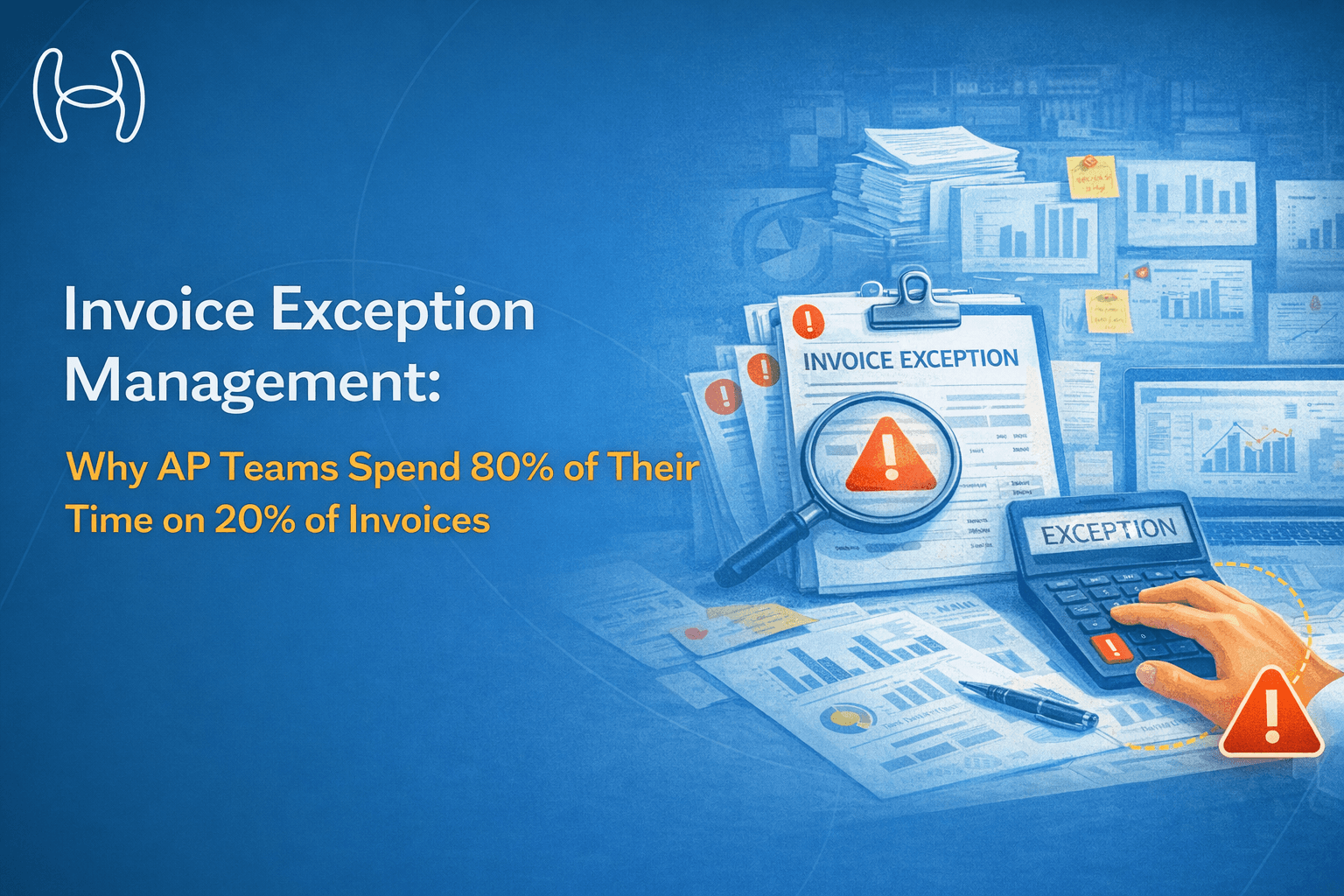
Invoice Exception Management: Why AP Teams Spend 80% of Their Time on 20% of Invoices
How AP teams can stop spending most of their time on a fraction of their invoices, and what a modern exception management framework actually looks like.
The 80/20 Problem Nobody Talks About in AP
Ask any AP manager where their team's time goes and the answer is almost always the same. The straightforward invoices, the clean PO matches, the routine vendor submissions that come in on time with the right information, those process themselves. They barely register. The problem is the other ones.
In most AP operations, 15 to 30% of invoices do not process cleanly. They arrive with missing PO numbers, quantities that do not match what was received, tax rates that contradict the contract, or layout variations that defeat standard extraction. They land in an exception queue. And from that point forward, someone has to touch them manually: investigate the discrepancy, chase the relevant stakeholder, make a judgment call, and push the invoice through.
That is not a minor inefficiency. In organizations processing thousands of invoices per month, the exception queue becomes the primary job of the AP team. The clean invoices move on their own. The exceptions consume the hours.
This guide breaks down what invoice exceptions actually are, why they form, what they cost, and what a modern exception management framework looks like in practice.
What Is Invoice Exception Management?
Invoice exception management is the process of identifying, categorizing, routing, investigating, and resolving invoices that fail to meet the criteria required for straight-through processing.
An exception is any deviation from what the system expects. It might be a data quality issue caught at extraction, a mismatch identified during validation, a policy violation flagged during approval routing, or a discrepancy surfaced during matching. What these situations share is that they cannot be resolved by the automated workflow alone. They require human judgment, additional information, or a correction before the invoice can move forward.
The way exceptions are handled directly determines AP performance. Organizations with poor exception management have long invoice cycle times, high cost per invoice, strained vendor relationships, and AP teams that feel perpetually overwhelmed. Organizations with structured exception management have faster closes, lower processing costs, and AP staff focused on work that actually requires their judgment.
The Six Most Common Invoice Exception Types
Not all exceptions are equal. Some are easy to resolve in seconds with the right information. Others require multi-party coordination and can sit in a queue for days. Understanding the categories is the first step toward managing them systematically.
1. Missing or Invalid PO Number
An invoice arrives without a purchase order reference, or with a PO number that does not exist in the ERP. Without a valid PO, the system cannot match the invoice to an approved spend commitment. This is one of the most frequent exception types, particularly for service invoices and non-PO spend categories.
2. Price Discrepancy
The unit price on the invoice does not match the price on the purchase order. This might be a vendor billing error, a contract rate that was updated without a PO amendment, or a currency conversion applied incorrectly. Even small per-unit discrepancies compound quickly at scale.
3. Quantity Mismatch
The quantity billed does not match what was recorded on the goods receipt note (GRN). A vendor may invoice for 500 units when only 450 were delivered, or bill for a full month of service when the engagement started mid-month. Without reconciliation, paying the invoiced quantity creates overpayment.
4. Duplicate Invoice
The same invoice has already been submitted and processed. Duplicates arise from vendor resubmissions, email forwarding errors, portal re-uploads, or ERP sync failures. Without systematic duplicate detection, the same liability gets paid twice.
5. Tax Discrepancy
The sales tax, VAT, or use tax applied on the invoice does not match what the system calculates based on jurisdiction rules, item classification, or vendor exemption status. Tax exceptions are particularly risky because they represent both an overpayment risk and a compliance exposure.
6. Coding and Approval Exceptions
The invoice cannot be automatically GL-coded because it falls outside the pattern the system recognizes, or it exceeds the approval threshold for automated routing and must be escalated to a senior approver. These exceptions slow down the approval cycle without necessarily indicating an error on the invoice itself.
What Invoice Exceptions Actually Cost
The financial and operational cost of exceptions is rarely measured directly, which is part of why it stays unresolved. When you add it up, the numbers are significant.
Exception Impact Area | Cost Driver |
Manual resolution time | Average 15–45 minutes per exception, depending on type |
Invoice processing cycle time | Industry average of 11 days; exceptions extend this significantly |
Late payment penalties | Invoices stuck in exception queues miss payment terms |
Missed early payment discounts | Exceptions prevent capturing 2/10 Net 30 and similar discount windows |
Vendor relationship strain | Repeated exception flags damage supplier trust and communication |
Duplicate payments | Each undetected duplicate is a direct cash loss |
Audit exposure | Exceptions resolved informally create documentation gaps |
When exceptions represent 15 to 30% of invoice volume, and each one requires meaningful manual intervention, the labor cost alone can account for the majority of total AP processing cost. This is the core reason Hyperbots focuses on reducing that manual burden: the Co-Pilot achieves 80% straight-through processing, which means 80% of invoices never enter the exception queue at all. The remaining exceptions reach human reviewers with pinpointed reasons already surfaced, so resolution time is a fraction of what it takes in a manual process.
Why Exception Queues Keep Growing
Understanding why exceptions accumulate is as important as knowing how to resolve them. The root causes fall into three categories.
Upstream Data Quality
The majority of invoice exceptions begin before the invoice even arrives in the AP system. Vendor master data that is incomplete or stale produces mismatches between vendor IDs on invoices and records in the ERP. PO data that was never updated after a contract amendment produces price discrepancies on every subsequent invoice. GRN data that updates on a batch delay produces quantity mismatches at the point of matching. Fixing exceptions downstream without addressing the upstream data problem is a cycle that never ends.
Process Design Gaps
Many AP workflows are designed around the assumption that invoices will be clean. There is no systematic approach for categorizing exceptions by type, no routing logic that sends a price discrepancy to procurement rather than AP, and no SLA that defines how long an exception can sit before escalation. When exceptions arrive, they go into a single queue and wait for whoever gets to them first. Understanding what prevents invoices from achieving straight-through processing reveals that most STP failures are predictable and addressable at the design level, not just the transaction level.
Technology Limitations
Legacy OCR-based extraction systems generate exceptions at high rates because they cannot reliably read non-standard invoice layouts, handwritten annotations, or multi-page documents with complex line structures. Every extraction error becomes a data quality exception. Every mismatch that the system cannot resolve automatically creates a queue item. AI-driven invoice and GRN matching addresses this directly by using reasoning-based models rather than template matching, dramatically reducing the volume of exceptions generated at the extraction and validation stages.
Where Existing Approaches Fall Short
Rule-Based Exception Routing
Many AP automation platforms handle exceptions by applying static rules: if the price variance exceeds a threshold, flag it; if the PO number is missing, reject it. These rules work for exceptions they were designed to catch. They fail on exceptions they were not. A vendor who changes their invoice template, a new cost center that was not in the original configuration, a partial delivery scenario that the rules do not account for: all of these produce exceptions that the system cannot classify or route correctly, and they go into a manual catch-all queue.
Human-Only Exception Teams
Some organizations respond to high exception volumes by adding AP staff whose sole job is working the exception queue. This scales linearly with volume. It does not get faster or more accurate over time. And it concentrates institutional knowledge in individuals, creating risk every time someone leaves the team.
Siloed Exception Visibility
Without centralized exception reporting, there is no way to know which vendors generate the most exceptions, which exception types take the longest to resolve, or which upstream process changes would reduce exception volume. The queue gets worked but never analyzed, so the same problems recur indefinitely.
How Hyperbots Handles Invoice Exception Management
Hyperbots' Invoice Processing Co-Pilot approaches exceptions differently from the ground up. The goal is not just to process exceptions faster. It is to prevent as many as possible from forming, and to give humans exactly what they need to resolve the ones that remain.
Prevention First: 99.8% Extraction Accuracy
The majority of exceptions in legacy AP systems originate at extraction. An OCR system that misreads a field creates a downstream mismatch. Hyperbots' multimodal extraction engine, combining large language models, vision language models, and layout models, achieves 99.8% accuracy across invoice fields regardless of format, language, or layout. Fewer extraction errors means fewer exceptions before the workflow even begins.
AI-Powered Duplicate Detection
Duplicate invoices are one of the highest-cost exception types because they represent direct cash leakage if they reach payment. Hyperbots' duplicate invoice detection runs across 100+ fields, identifying duplicates even when vendors resubmit with minor variations in invoice number, date, or amount formatting. This catches duplicates that rule-based systems miss entirely.
Intelligent Exception Classification and Routing
When an exception does occur, Hyperbots classifies it by type and surfaces the specific reason, in plain language, to the reviewer. A price discrepancy exception does not arrive as "mismatch" in a queue. It arrives with the PO line, the invoice line, the percentage variance, and the relevant contract terms alongside it. The flexible exception workflow routes each exception type to the right resolver based on business unit, category, cost center, and approval threshold, so price exceptions go to procurement and tax exceptions go to the tax team automatically.
Human-in-the-Loop Where It Counts
Hyperbots is designed so that automation handles everything it can handle with high confidence, and humans handle everything that genuinely requires judgment. The human-in-the-loop framework means reviewers see only the exceptions that need them, with full context already assembled. This is what makes the 80% STP figure meaningful in practice: the 20% of invoices that do reach human reviewers are handled efficiently because the Co-Pilot has already done the investigation.
Self-Learning to Reduce Recurrence
Every exception that a human resolves becomes training data for the Co-Pilot. If a reviewer consistently approves a 2% price variance for a specific vendor category, the system learns that tolerance and applies it automatically going forward. If a new invoice template from a vendor produces extraction errors, the system adapts after the first correction. Exception volumes decrease over time rather than staying flat.
For a broader view of how fraud-related exceptions are detected before they reach the queue, the guide on detecting anomalies and fraud through AI-based matching covers how Hyperbots surfaces vendor impersonation, price manipulation, and statistical anomalies before they become AP problems.
Manual vs. AI-Driven Exception Management: A Comparison
Capability | Manual Process | Hyperbots Invoice Co-Pilot |
Extraction accuracy | Variable; OCR errors create exceptions | 99.8% accuracy; fewer exceptions generated |
Duplicate detection | Manual spot checks, easy to miss | AI detection across 100+ fields |
Exception classification | One queue, no categorization | Automatic type identification and severity scoring |
Routing logic | Manual assignment or catch-all queue | Rules-based routing by type, business unit, threshold |
Reviewer context | Raw mismatch data only | Pinpointed reason with source documents alongside |
STP rate | Typically 40–60% | 80% straight-through |
Invoice processing time | Industry average 11 days | Under 1 minute for STP invoices |
Recurrence prevention | None; same exceptions repeat | Self-learning reduces exception volume over time |
Audit trail | Fragmented; resolution often undocumented | Complete trail for every exception and resolution |
The Business Impact
80% straight-through processing. When 80% of invoices never enter the exception queue, the AP team's capacity shifts entirely. Instead of working a queue, they are reviewing genuinely complex situations with the context they need to make fast, accurate decisions.
80% reduction in invoice processing cost. The manual effort of investigating, routing, chasing, and resolving exceptions is the primary driver of AP processing cost. Automating exception prevention and intelligent routing removes the majority of that cost.
Invoice processing time from 11 days to under 1 minute for straight-through invoices. For exceptions, resolution is faster because reviewers receive pre-investigated, context-rich queue items rather than raw mismatches.
99.8% extraction accuracy eliminates the single largest source of upstream exceptions before the workflow begins.
ROI and Implementation
Finance teams evaluating invoice exception management automation typically want to understand two things: the scale of the opportunity, and how quickly they can see results.
On ROI, the calculation is direct. If 20% of your invoice volume generates exceptions, and each exception takes an average of 20 minutes to resolve manually, a team processing 5,000 invoices per month is spending roughly 333 hours per month on exception work alone. An 80% STP rate reduces that to approximately 67 hours. The labor savings are immediate and measurable from the first close cycle.
On implementation, Hyperbots goes live in one month. The Invoice Processing Co-Pilot comes pre-trained on millions of financial documents and connects to major ERP platforms, including SAP, Oracle, NetSuite, Microsoft Dynamics, Sage, QuickBooks, and Deltek Costpoint, through native connectors. No custom middleware, no bespoke integration work, and no model training required before go-live.
FAQs
What is an invoice exception in accounts payable? An invoice exception is any invoice that cannot be processed automatically because it fails a validation rule, does not match an existing PO or GRN, contains a data quality issue, or requires human approval due to policy thresholds. Exceptions require manual investigation and resolution before the invoice can be posted and paid.
What are the most common causes of invoice exceptions? The most common causes are missing or invalid PO numbers, price discrepancies between the invoice and PO, quantity mismatches against the goods receipt, duplicate submissions, tax discrepancies, and GL coding failures. Most originate from upstream data quality issues or process gaps.
How does AI reduce invoice exception rates? AI reduces exceptions primarily through higher extraction accuracy, which eliminates data quality errors at the source, and through intelligent matching that resolves discrepancies automatically within configured tolerances. Self-learning models also reduce recurrence by applying learned tolerances and patterns from past resolutions.
What is human-in-the-loop exception management? Human-in-the-loop exception management is an approach where AI handles all exceptions it can resolve with high confidence automatically, and routes only the remaining exceptions to human reviewers, with full context assembled. Reviewers spend time on judgment, not investigation.
How long does it take to implement Hyperbots' Invoice Processing Co-Pilot? Hyperbots goes live in one month with no custom model training required. Pre-built ERP connectors and pre-trained AI models mean finance teams begin seeing STP improvements and exception queue reductions from their first processing cycle.
Hyperbots' Invoice Processing Co-Pilot achieves 80% straight-through processing and 99.8% extraction accuracy, reducing invoice exception volumes and resolution time from day one. Go live in one month. Request a demo.
Want to understand how finance teams maintain compliant and searchable invoice records? Our guide on digital invoice storage explains the systems, controls, and automation behind modern invoice archiving.