Multi-Entity AP Automation: How Mid-Market Finance Teams Can Manage Subsidiaries Without Losing Control
Let's Start With the Basics: What Is Accounts Payable?
Every business buys things. Office supplies, software subscriptions, raw materials, consulting services. When a supplier delivers something, they send an invoice asking to be paid.
Accounts payable, or AP, is the team and the process that handles those invoices. They receive the invoice, check that it is correct, get the right person to approve it, record it in the company's financial system, and then make the payment.
It sounds straightforward. But when a company grows and starts operating through multiple subsidiaries or legal entities, this process becomes significantly more complicated. That is what this blog is about.
What Is a Multi-Entity Business?
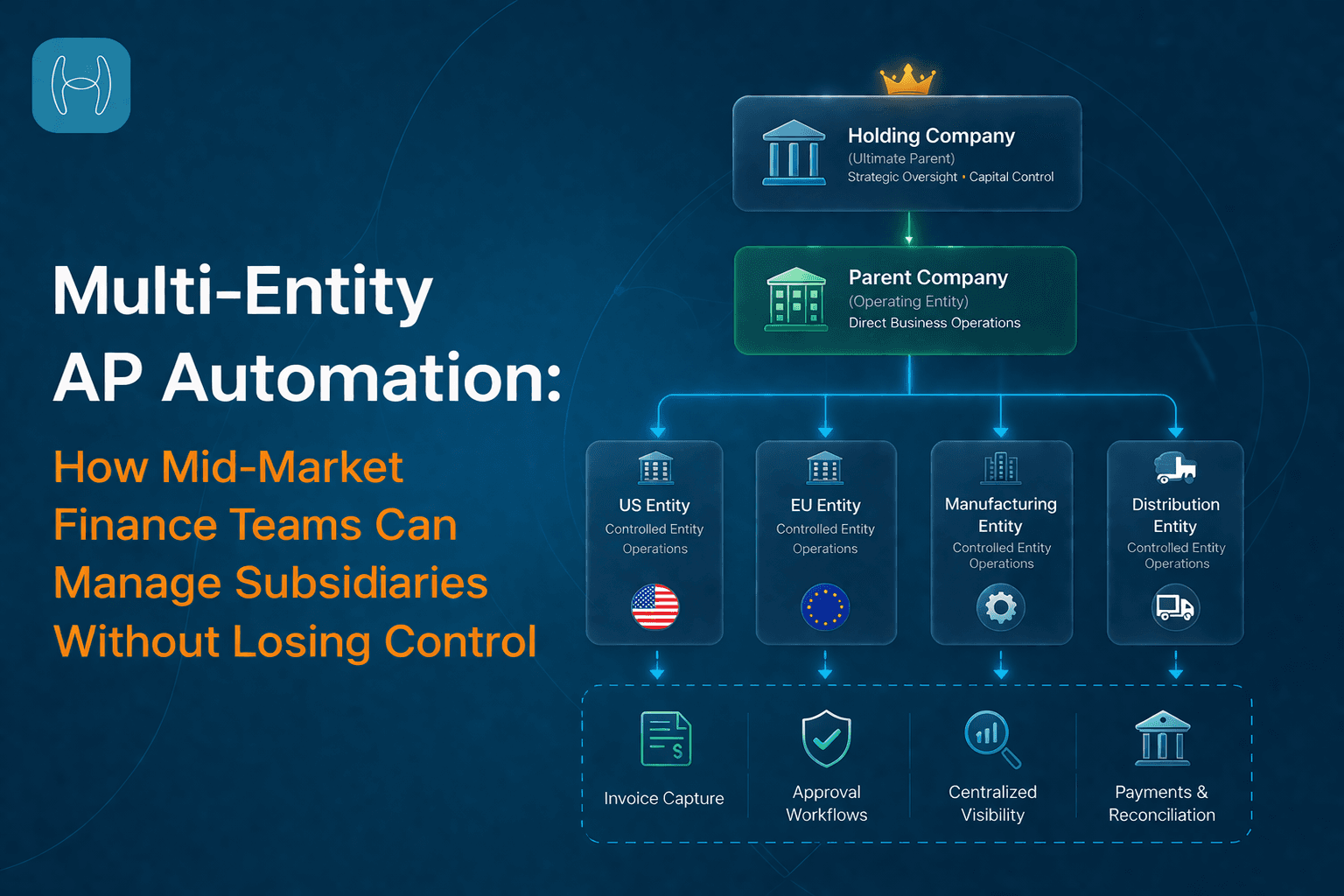
When a company expands, it often creates separate legal entities to manage different parts of the business. These might be subsidiaries in different countries, regional companies under a parent group, or separate legal structures for different business lines.
For example, a mid-market company might have:
A parent company registered in the US
A subsidiary handling European operations
A separate entity for manufacturing
Another entity for distribution
Each of these is its own legal company. Each has its own bank account, its own tax obligations, its own set of vendors, and its own financial records. But they are all ultimately part of the same group, and the group's leadership needs to see and control the finances across all of them.
Managing accounts payable across all these entities is what we call multi-entity AP.
Why Multi-Entity AP Is Much Harder Than It Sounds
When there is just one company, the AP process is manageable. You set up one system, train one team, and everyone follows the same rules.
The moment you add a second or third entity, several things break down at once.
The same supplier shows up differently in every system. Entity A has "Acme Corp" in its records. Entity B has "ACME Corporation." Entity C has "Acme Corp Ltd." They are all the same company, but the finance team has no automatic way to know that. This leads to duplicate payments, missed early payment discounts, and confusion over which payment terms apply.
Every entity has its own approval rules. In most companies, not everyone is allowed to approve every payment. A $5,000 invoice might need a department manager's approval. A $50,000 invoice might need the CFO. But those thresholds are often different from one entity to another. Keeping track of which rules apply where, and making sure they are actually followed, is an enormous manual burden.
Financial coding is different for every entity. Every company keeps a list of categories for recording its expenses. This is called a chart of accounts. An IT software invoice might be recorded under "Technology Expenses" in one entity and under "Software and Licences" in another. When these categories do not line up, the combined financial reports across all entities become unreliable.
Tax rules differ by location. Each entity may operate in a different state or country. Sales tax rates, the types of purchases that are taxable, and how taxes need to be reported all vary by jurisdiction. Applying the wrong tax logic to an invoice is not just an accounting error. It is a compliance risk that can lead to penalties.
Finance leadership cannot see the full picture. The CFO or Controller needs to know, right now, how much the entire group owes across all entities, which invoices are overdue, and what cash is going out next week. If each entity runs its own separate process with its own data sitting in its own system, pulling that combined view together requires hours of manual work.
Invoices between subsidiaries are especially tricky. Sometimes one entity within the group charges another for goods or services. When Entity A invoices Entity B, that transaction has to be recorded as a payable in Entity B and as a receivable in Entity A, and both entries must match perfectly. Getting this wrong distorts the group's combined financial statements and takes significant time to fix every period.
What ERP Systems Can and Cannot Do
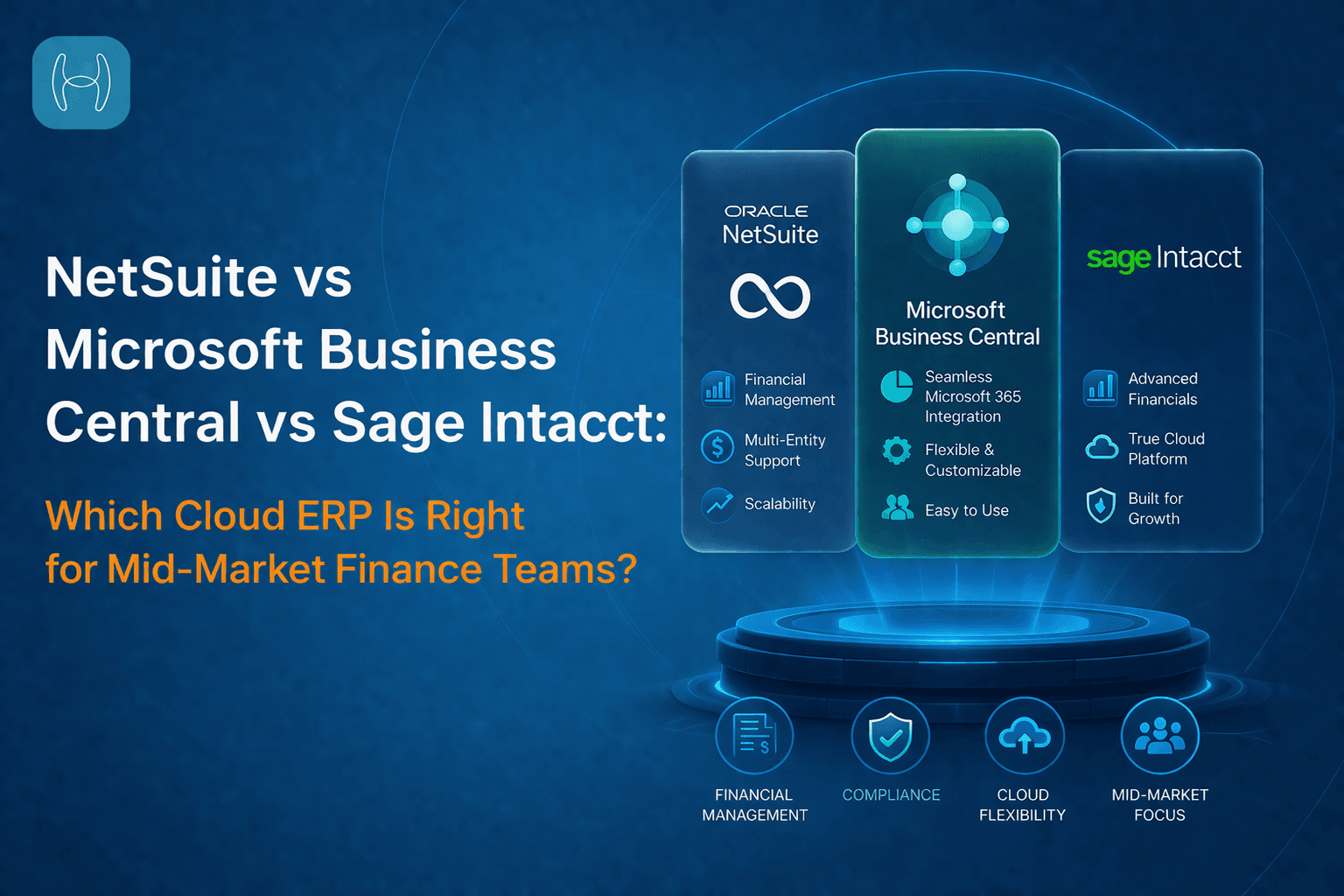
Most mid-market companies manage their finances using an ERP system. ERP stands for Enterprise Resource Planning. Think of it as the central software that records all of a company's financial transactions: what it bought, what it sold, what it owes, and what it owns. Common ERP systems include NetSuite, Microsoft Business Central, and Sage Intacct.
These systems can technically support multiple entities. But supporting multiple entities is not the same as managing the AP process across them intelligently. Here is where ERP systems typically fall short:
They do not automatically sort incoming invoices by entity. When invoices arrive by email, through supplier portals, or in various file formats, someone has to manually figure out which entity each invoice belongs to and enter it into the right place. This is slow and error-prone.
Their approval workflows are too rigid. ERP systems work with fixed rules: if the invoice is over a certain amount, send it to this person for approval. But in a multi-entity environment, the rules are different for every entity and they change regularly. Maintaining those rules manually in a rigid system is a constant overhead.
They keep vendor information separate for each entity. If three subsidiaries all work with the same supplier, the ERP treats them as three unrelated suppliers. There is no automatic way to know they are the same company, apply consistent payment terms, or prevent paying the same invoice twice across entities.
They do not give a real-time combined view. To see AP across all entities in most ERP systems, someone has to export data from each one, clean it up, and combine it manually. By the time the report is ready, it is already out of date.
The result is that finance teams end up using spreadsheets alongside their ERP to fill in the gaps. It works for a while. But as the business grows and more entities are added, it stops scaling and the finance team starts drowning in manual work.
The Numbers: What Changes With Automation
The table below compares what multi-entity AP looks like without automation versus what it looks like with AI-powered automation. The right column shows verified results from Hyperbots.
What We Are Measuring | Without Automation | With AI-Powered Automation |
How accurately invoice data is captured | Depends on manual entry or basic scanning; requires a lot of correction | 99.8% accuracy |
How many invoices are fully processed without anyone touching them | Very few; most require manual steps at some point | Up to 80% handled end-to-end automatically |
What it costs to process each invoice | High, and the cost multiplies across every entity | 80% cost reduction |
How long it takes to raise a purchase request | Days, as requests work through manual approvals | Under 5 minutes |
How long it takes to create and send a purchase order | Slow due to manual coordination across entities | 80% faster |
How close estimated costs are to actual costs at period end | Often significantly off because estimates are done manually | Less than 5% difference |
Impact on cash flow from more accurate accruals | Cash visibility is poor because accrual timing is inconsistent | 10% improvement in cash flow |
What it costs to reconcile accounts | Expensive and slow, done separately entity by entity | 80% cost reduction |
How much incoming cash goes unmatched to an invoice | Large amounts left unmatched, creating a distorted cash picture | 90% automatically matched |
How long it takes to go live | Several months to configure each entity separately in an ERP | Live within 1 month |
These are not estimates or benchmarks from the wider industry. They are actual results from Hyperbots deployments. And in a multi-entity environment, the savings grow with every subsidiary you add.
What AI Automation Does That Manual Processes Cannot
The reason rule-based tools and manual processes fail in multi-entity AP is straightforward. There are too many variables, and those variables change constantly. Every new entity brings new rules. Every policy update needs someone to maintain the system. Every unusual invoice needs a human to make a judgement call. AI handles this differently because it learns and adapts rather than just following fixed instructions.
Here is what that looks like in practice:
It reads each invoice and decides where it belongs. The system looks at the supplier name, the delivery address, the purchase order number, and other details and works out which entity should process it. This happens instantly, without anyone having to make that routing decision manually.
It codes each expense correctly for the right entity. Instead of someone looking up the correct expense category and typing it in by hand, the system learns how each entity categorises its spending from past invoices. It applies the right code automatically and only asks a human when it is genuinely unsure.
It sends invoices to the right approver without anyone telling it to. Each entity's approval rules are set up in the system once. After that, every invoice goes to the correct person based on the entity, the type of expense, and the invoice amount, with no manual routing needed.
It recognises the same supplier across different entities. When the system sees "Acme Corp," "ACME Corporation," and "Acme Corp Ltd" across three entities, it identifies them as the same company. This prevents duplicate payments and ensures consistent payment terms are applied across the group.
It applies the correct tax rules for each entity's location. A Texas entity gets Texas sales tax rules applied to its invoices. A New York entity gets New York rules. The system does not apply a single blanket tax logic to every invoice regardless of where the entity operates, which is one of the most common compliance errors in multi-entity AP.
It gives finance leadership a live view of everything at once. Because every entity's invoices run through the same system, there is no data to collect or combine manually. Finance leaders can see exactly what every entity owes, what is overdue, and what is coming up for payment, in real time.
It makes intercompany reconciliation far less painful. When one entity invoices another within the same group, the system recognises it as an internal transaction, records it correctly on both sides, and flags any mismatches immediately rather than letting them pile up until period end.
What Hyperbots Does for Multi-Entity Finance Teams
Hyperbots is built specifically for companies managing finance across multiple entities. Everything runs from one platform. Each entity has its own rules, its own expense categories, its own approval process, and its own tax configuration, but it is all managed centrally without running separate systems for each subsidiary.
Invoice Processing. The Invoice Processing Co-Pilot reads and captures invoice data at 99.8% accuracy. Up to 80% of invoices are processed completely automatically, from the moment they arrive all the way through to being recorded in the financial system, with no human involvement needed. When you multiply that across multiple entities processing hundreds or thousands of invoices a month, the reduction in manual work is significant.
Accruals. An accrual is an accounting entry that records an expense in the period it was incurred, even if the invoice from the supplier has not arrived yet. For example, if a service was delivered in March but the invoice comes in April, the expense still needs to appear in March's accounts. Getting accruals wrong across multiple entities leads to inaccurate financial reports and unpredictable cash flow. The Accruals Co-Pilot handles this automatically across all subsidiaries, keeping the gap between estimated and actual costs under 5% and improving cash flow by 10% through more accurate and timely accrual recording. For a detailed look at how accrual automation affects the financial close, the comparison of live invoice-driven accrual automation is worth reading.
Procurement. Procurement is the process of requesting, approving, and ordering goods or services before the invoice arrives. Think of it as everything that happens before the supplier sends their bill. Multi-entity procurement in Hyperbots applies each entity's own purchasing policies and budget limits automatically. A purchase request that used to take days to work through manual approvals now takes under 5 minutes. Creating and sending purchase orders is 80% faster. Each entity follows its own rules without needing a separate system.
Vendor Management. Managing suppliers across multiple entities is one of the most overlooked sources of inefficiency in multi-entity finance. Vendor management in Hyperbots handles supplier onboarding, verifies supplier identities to reduce fraud risk, and keeps vendor records consistent across all entities. Duplicate supplier records are identified and resolved automatically.
Collections and Cash Application. For entities that also send invoices and collect payments from their own customers, Hyperbots reduces the cost of chasing overdue payments by 70% and cuts the average time it takes to collect what is owed by 40%. Ninety percent of incoming payments are automatically matched to the correct invoice, eliminating the problem of cash sitting in the bank that the finance team cannot account for.
Going Live in One Month. Setting up multi-entity AP from scratch in an ERP system typically takes several months because each entity needs its own configuration and testing. Hyperbots comes with pre-built connectors for NetSuite, SAP, Microsoft Dynamics, Sage Intacct, and others, meaning the system already understands how these ERPs work. For companies using platforms with complex multi-entity financial structures like Sage Intacct, this removes a significant amount of setup work. The whole deployment goes live within one month.
Questions to Ask Before Choosing a Multi-Entity AP Platform
Not every platform that claims to support multiple entities actually handles the complexity well. These are the questions that reveal the difference:
Does it manage multiple entities inside one system, or does it run separate tools per entity and combine the data on top? Some platforms give every entity its own separate environment. That is not genuine multi-entity support. The right answer is one deployment where entity-specific rules are enforced independently within a single platform.
Does it come with pre-built connectors for the ERP systems you use? Building custom integrations takes time and they break down over time. Pre-built, tested connectors significantly reduce how long it takes to go live and reduce the risk of things going wrong after launch.
Can your finance team update settings themselves, without involving IT? New entities get added, approval thresholds change, and tax rules get updated. If every change requires a developer or a support request, the system becomes a bottleneck rather than a solution.
Does it produce a complete audit trail for every invoice, by entity? Auditors ask for the full history of every transaction at the entity level: when the invoice arrived, who approved it, how it was coded, and when it was paid. The system should generate this automatically, not require the finance team to piece it together from separate records.
The Bottom Line
Multi-entity AP does not fall apart all at once. It gets harder gradually, one extra hour of reconciliation at a time, one duplicate payment discovered too late, one financial close that runs longer than it should because the intercompany entries do not balance.
Finance teams that handle multiple entities well are not doing more manual work. They are using one automation layer that sits above their ERP systems and handles the entity-specific decisions automatically. The ERP records what happened. The automation layer makes sure the right things happen to each transaction before it gets there.
AI-powered multi-entity AP is not an experiment. It exists now, it deploys in weeks, and it removes the operational burden that multi-entity finance teams have been absorbing for years without a good alternative.
Hyperbots' Invoice Processing, Accruals, Procurement, and Vendor Management Co-Pilots run the full multi-entity AP process with entity-specific rules, combined visibility across all subsidiaries, 99.8% invoice accuracy, and go-live within one month. Request a demo.
FAQs
What is accounts payable? Accounts payable is the process of managing and paying invoices from suppliers. When a company buys goods or services, the supplier sends an invoice. The AP team checks it, gets it approved, records it in the financial system, and makes the payment.
What does multi-entity mean in finance? A multi-entity business is one that operates through more than one legal company. These might be subsidiaries in different countries, regional entities under a parent group, or separate legal companies for different business lines. Each entity has its own financial records, tax obligations, and bank account.
What is a chart of accounts? A chart of accounts is the list of categories a company uses to classify and record its expenses and income. Think of it as a filing system for money. Every transaction goes into a specific category so the company can track where money is going and produce accurate financial reports.
What is straight-through processing? Straight-through processing, or STP, means an invoice is received, checked, approved, recorded, and sent for payment without any human needing to manually step in at any point. An 80% STP rate means 80 out of every 100 invoices are handled completely automatically.
What are accruals and why do they matter? An accrual is a financial entry that records an expense in the period it was incurred, even if the supplier's invoice has not arrived yet. If a service was delivered in March but the invoice comes in April, the cost still needs to appear in March's accounts. In a multi-entity business, getting accruals wrong across entities leads to inaccurate financial reports and unpredictable cash flow.
What is multi-entity AP automation? It is a system that manages the entire AP process across all of a company's entities from one platform, applying the right rules for each entity automatically while giving finance leadership a single combined view of all invoices, approvals, and payments.
What results does Hyperbots deliver for multi-entity AP? Hyperbots delivers 99.8% invoice accuracy, up to 80% of invoices processed without human involvement, 80% lower invoice processing costs, and less than 5% variance between estimated and actual costs across entities.
How quickly can a team go live with Hyperbots? Hyperbots deploys within one month for multi-entity environments, using pre-built ERP connectors and pre-trained AI models that do not require lengthy setup or custom development.