NetSuite vs Microsoft Business Central vs Sage Intacct: Which Cloud ERP Is Right for Mid-Market Finance Teams?
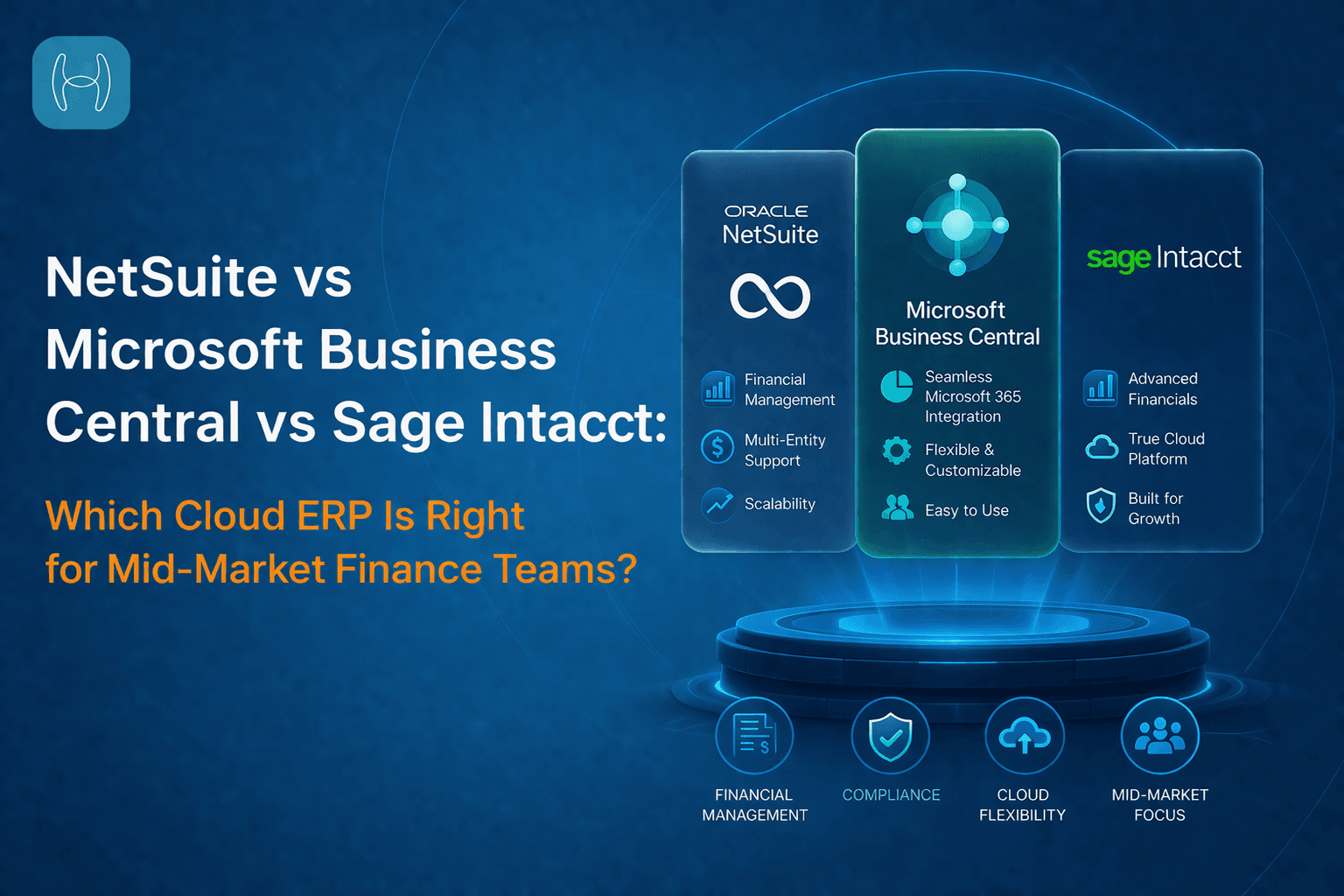
Three of the most evaluated cloud ERPs for mid-market organizations. One decision that shapes your finance operations for the next five to ten years. By the end of this guide you will know exactly what each platform is built for, which type of business each one suits, and how to make the right call for your organization without getting lost in vendor marketing.
What Is an ERP and Why Does the Type Matter?
An ERP, or Enterprise Resource Planning system, is the central software platform that manages a business's core financial and operational processes. At its most basic, an ERP replaces disconnected spreadsheets, accounting tools, and department-specific systems with a single source of truth for transactions, reporting, and controls.
What an ERP covers varies significantly by platform. Some ERPs are built to manage everything in one system: finance, inventory, procurement, sales, HR, and manufacturing all on a single database. Others are built to be excellent at one thing, typically financial management, and connect to specialized tools for everything else. Understanding which type of ERP a platform is, before you evaluate its features, is the most important first step in making the right choice.
There are three broad types of ERP that mid-market organizations typically evaluate:
All-in-one ERP: A single platform that manages finance and operations together. Finance, inventory, supply chain, CRM, and manufacturing all share the same data model. The advantage is unified data and fewer integrations to maintain. The trade-off is that the platform may be broader than the organization needs, and the cost reflects the full scope.
Ecosystem-anchored ERP: A platform built around an existing technology ecosystem, typically Microsoft. The financial and operational capabilities are solid, but the platform's real value is how tightly it connects to other tools the organization already uses, such as Teams, Excel, and Power BI. The advantage is fast adoption and familiar tooling. The trade-off is that advanced capabilities often require add-ons or extensions.
Finance-first ERP: A platform built to be the best financial management system available, with operational capabilities handled through integrations with specialized partners. The advantage is depth in accounting, reporting, and compliance. The trade-off is that the organization manages multiple systems for finance and operations.
The three platforms in this guide represent one of each type. NetSuite is the all-in-one ERP. Microsoft Business Central is the ecosystem-anchored ERP. Sage Intacct is the finance-first ERP. Understanding which type fits your organization's actual needs is what this guide helps you determine.
What This Guide Will Help You Decide
This is not a feature checklist. Every ERP vendor has a feature checklist, and they all look similar on paper.
This guide answers the question that actually matters: given your organization's size, operational complexity, existing technology stack, and finance team's priorities, which of these three platforms is the right foundation for the next five to ten years?
By the end, you will know which ERP fits your operational profile, where each platform genuinely falls short, and how an AI automation layer on top of your chosen ERP addresses the gaps that no ERP solves natively regardless of which one you pick.
Why This Comparison Matters for Mid-Market Finance Teams
Mid-market organizations face a specific ERP challenge. They have outgrown entry-level accounting software but do not need the complexity or cost of a full enterprise deployment. Oracle NetSuite, Microsoft Business Central, and Sage Intacct all target this segment. All three are genuine cloud-native SaaS solutions. All three serve thousands of mid-market finance teams. And all three make very different architectural bets about what a finance-led business actually needs.
Getting this decision wrong is expensive. ERP implementations take months. Data migrations are painful. Switching costs are high. Understanding exactly what each platform does well before you commit is not optional. It is the most important thing a CFO or finance leader can do before signing a contract.
The Three Platforms at a Glance
Oracle NetSuite: The All-in-One ERP
NetSuite was founded in 1998 as one of the earliest cloud ERP providers. Oracle acquired it in 2016 for $9.3 billion, recognizing its dominance in cloud ERP for mid-market and growing businesses. It now operates as a separate Global Business Unit within Oracle, maintaining its own product direction while benefiting from Oracle's infrastructure and R&D investment.
NetSuite's defining characteristic is breadth. It is a unified, all-in-one suite covering financials, inventory and order management, CRM, eCommerce, HR, manufacturing, and professional services automation, all within a single platform. The value proposition is that finance, operations, sales, and supply chain all run on the same data model without integration overhead between modules.
Best suited for: Growing businesses that want a single system for finance and operations, organizations with inventory or eCommerce complexity, multi-entity and multi-subsidiary organizations, businesses with international operations.
Microsoft Business Central: The Ecosystem-Anchored ERP
Microsoft Dynamics 365 Business Central is Microsoft's cloud ERP offering for small and mid-market businesses. Its defining characteristic is ecosystem integration. It connects natively with the tools mid-market organizations already use: Outlook, Excel, Teams, and Power BI. For organizations already deeply embedded in the Microsoft ecosystem, Business Central reduces training time and improves adoption significantly because the interface feels familiar.
Business Central covers core financials, supply chain, inventory, and project management. However, it is not a unified platform in the same way as NetSuite. Advanced reporting, CRM, and analytics often require additional licenses or partner-built extensions through the Microsoft AppSource marketplace. Customization requires AL programming experience and can involve meaningful implementation cost.
Best suited for: Microsoft-centric organizations that already use Teams, Outlook, and Power BI, businesses that want familiar tooling and fast user adoption, organizations with straightforward financial and supply chain needs.
Sage Intacct: The Finance-First ERP
Sage Intacct was founded in 1999 as a cloud-based financial management platform, acquired by The Sage Group in 2017 for $850 million. Unlike NetSuite and Business Central, Sage Intacct is not attempting to be a full ERP suite. It is deliberately finance-first, built to be the best financial management platform available for mid-market organizations, with broader ERP capabilities added through integrations with specialized partners.
Sage Intacct's defining characteristic is depth in financial reporting. Its dimensional accounting model allows finance teams to slice and tag transactions by any combination of department, location, project, fund, and custom dimension without needing to build new reports for each view. This makes it particularly strong for organizations where multi-dimensional financial visibility is the primary requirement. It is the dominant choice for nonprofits, SaaS companies, professional services firms, and financial services organizations.
Best suited for: Finance-first organizations that need deep accounting capabilities without full ERP complexity, nonprofits with fund accounting requirements, SaaS and subscription businesses with complex revenue recognition, professional services firms with project-based billing.
Head-to-Head Comparison
Dimension | NetSuite | Business Central | Sage Intacct |
Architecture | Unified all-in-one ERP suite | Modular, Microsoft ecosystem-first | Finance-first, best-of-breed integrations |
Financial management | Strong: multi-entity, multi-currency, revenue recognition | Strong for standard financials, limited advanced features natively | Excellent: dimensional reporting, project accounting, multi-entity |
Inventory and supply chain | Native, full-featured | Native, strong for mid-market | No native inventory, requires third-party integration |
CRM | Native module included | Requires additional license or integration | No native CRM, designed to integrate with external CRM |
eCommerce | Native integration | Limited natively, requires extensions | No native eCommerce |
HR and payroll | SuitePeople included | Basic HR, payroll via partners | Limited, via partner integrations |
Multi-entity and consolidation | Excellent: OneWorld for multi-subsidiary | Moderate, requires configuration | Strong: multi-entity consolidation a key strength |
International operations | Strong: multi-currency, multi-language, tax compliance | Moderate, better for single-country or limited international | Primarily US-centric, limited native global support |
Reporting and analytics | Strong: SuiteAnalytics built in | Power BI integration, strong for Microsoft users | Excellent: dimensional reporting is a key differentiator |
Customization | Extensive: SuiteCloud development platform | Moderate: AL programming, AppSource marketplace | Moderate: open APIs, Sage Intacct Marketplace |
Implementation speed | Moderate: SuiteSuccess methodology gives predictable timeline | Moderate to fast depending on configuration | Fast for finance-focused deployments, varies for complex setups |
User experience | Powerful but can feel complex for smaller teams | Familiar for Microsoft users, intuitive for many | Clean, finance-professional-oriented interface |
User satisfaction (G2 2025) | 3.9/5 stars on G2 | N/A | 4.2/5 stars on G2 |
Pricing model | Annual subscription for full suite | Per-user, per-month with module add-ons | Modular subscription, pay per module |
Starting price range | Around $2,000 per month for base suite | Competitive within Microsoft ecosystem | Custom quote, modular pricing varies |
Where Each Platform Wins and Where It Struggles
NetSuite: The All-in-One Advantage With a Complexity Trade-Off
NetSuite's core advantage is genuine breadth. A mid-market business that needs finance, inventory, CRM, and eCommerce to all talk to each other without middleware gets that natively in NetSuite. Multi-entity organizations with subsidiaries in multiple countries get OneWorld, which handles multi-entity consolidation, intercompany eliminations, and multi-currency reporting out of the box.
The trade-off is complexity and cost. NetSuite is not cheap, with the base suite typically starting around $2,000 per month and rising significantly with user count, modules, and multi-subsidiary requirements. Implementation is thorough but takes time. The interface is powerful but can feel overwhelming for finance teams that do not need every module. For organizations that only need financial management and are not running inventory or eCommerce, NetSuite may be more than they need.
Business Central: The Microsoft Ecosystem Play
Business Central wins when the organization is already a Microsoft shop. If the finance team lives in Excel, communicates in Teams, and reports in Power BI, Business Central slots in with minimal adoption friction. The licensing model is familiar, and Microsoft's support infrastructure is substantial.
The limitation is that Business Central is not a unified platform. CRM, advanced analytics, and industry-specific capabilities typically require AppSource extensions or partner-built solutions. This can create data silos between Business Central and the tools layered on top of it, which is precisely the problem ERP is supposed to solve. Multi-entity management and global consolidation capabilities are also more limited compared to NetSuite.
Sage Intacct: The Finance Team's Favorite With Operational Gaps
Sage Intacct consistently outscores both NetSuite and Business Central on user satisfaction metrics, and finance teams in particular tend to find it more intuitive and purpose-built for their work. The dimensional reporting model is genuinely flexible. Finance teams can analyze their data across any combination of dimensions without needing IT to build new reports.
The limitation is scope. Sage Intacct is not a full ERP. It does not have native inventory management, native CRM, or native eCommerce. Organizations that need these capabilities alongside financial management will be managing multiple systems and multiple integrations. For businesses that primarily need best-in-class financial management, this is often an acceptable trade-off. For businesses that need their finance and operations data on the same platform, it is a meaningful constraint.
Which ERP Is Right for Your Organization?
Your situation | Recommended platform |
Need finance, inventory, CRM, and eCommerce on one platform | NetSuite |
Multi-entity organization with international subsidiaries | NetSuite |
Already deeply embedded in Microsoft 365 and Teams | Business Central |
Simple financials, strong supply chain, familiar tooling | Business Central |
Finance-first, need best-in-class accounting and reporting | Sage Intacct |
Nonprofit with fund accounting requirements | Sage Intacct |
SaaS company with complex revenue recognition | Sage Intacct |
Professional services firm with project-based billing | Sage Intacct |
Need fast financial deployment, lower initial complexity | Sage Intacct |
What Existing Technology Falls Short On: The AI Automation Gap
All three platforms handle transactional finance well. Where they consistently fall short is in the layer of intelligence that sits on top of the transactions. Invoice processing still requires significant manual handling in all three. Purchase requisitions still involve manual data entry. Accruals are still calculated and booked manually at month-end. Vendor onboarding still relies on email and document requests.
This is not a criticism of any individual platform. ERP systems are designed to be systems of record, built to store, process, and report on financial data. They are not designed to be autonomous processing engines that work through the AP queue, validate invoices against contracts, recommend GL codes, and route exceptions without human touchpoints.
The gap between what a modern ERP records and what a modern finance team needs to do automatically is where ERP integration with AI automation platforms adds the most value. And critically, this gap exists regardless of which ERP the organization is running.
How AI Automation Fits on Top of All Three
The most important point for mid-market finance teams evaluating ERP is this: the right AI automation layer works regardless of which ERP you choose. You do not have to pick the ERP that has the best native automation. You pick the ERP that fits your operational model, and you add the automation layer on top.
This matters because it separates two decisions that are often incorrectly bundled together. The ERP decision is about data model, operational scope, and ecosystem. The automation decision is about how your finance team processes invoices, manages vendors, handles procurement automation, and closes the books. These are related but they are not the same decision.
How Hyperbots Works on NetSuite, Business Central, and Sage Intacct
The Hyperbots Procurement Co-Pilot and Invoice Processing Co-Pilot have pre-built native connectors for all three platforms. The same AI automation capabilities are available regardless of which ERP the organization has chosen. This means finance teams do not have to make a different automation decision based on their ERP choice.
On NetSuite: Hyperbots connects through Oracle NetSuite's native APIs with real-time bidirectional read and write access. The Invoice Processing Co-Pilot reads vendor master data, chart of accounts, and open POs directly from NetSuite and writes processed invoices, GL codes, and payment decisions back. The Procurement Co-Pilot auto-fills purchase requisitions from contracts and ERP data, runs budget checks against live NetSuite budget data, and dispatches approved POs directly to vendors or into NetSuite without manual intervention.
On Business Central: Hyperbots uses proprietary APIs to integrate with Business Central's financial data, including invoices, POs, vendor details, assets, liabilities, expenses, and revenues. Finance teams running on Business Central get the same invoice processing capabilities as NetSuite users: 99.8% extraction accuracy, up to 80% straight-through processing, and invoice processing in under one minute, without any change to their Business Central setup.
On Sage Intacct: The Hyperbots Sage Intacct connector provides real-time integration for invoices, purchase orders, vendor records, and GL entries. For finance-first organizations that chose Sage Intacct for its accounting depth, Hyperbots adds the operational automation layer that Sage Intacct's own tooling does not provide natively, covering autonomous invoice processing, vendor onboarding, procurement automation, and accruals management.
Across all three platforms, Hyperbots maintains comprehensive audit trails for every AI and human action, uses intelligent data redaction before processing, and connects through customer-specific permission layers. The platform is certified to ISO 27001, SOC 1 Type 2, and SOC 2 Type 2. Implementation goes live within one month with no custom model training required.
For multi-entity organizations that run more than one ERP across subsidiaries, Hyperbots supports multiple ERP instances simultaneously, providing a unified view across all entities through a single sign-on.
FAQs
Is NetSuite better than Business Central for mid-market companies?
It depends on the operational profile. NetSuite is stronger for organizations that need a unified platform spanning finance, inventory, CRM, and eCommerce. Business Central is stronger for organizations already embedded in the Microsoft ecosystem that want familiar tooling and fast user adoption. Neither is universally better. The right choice depends on what your business actually needs beyond finance.
Is Sage Intacct a full ERP system?
Sage Intacct is a best-in-class financial management platform rather than a full ERP suite. It does not have native inventory management, CRM, or eCommerce. It connects to specialized tools through its marketplace and APIs. For finance-first organizations, this is often an advantage. They get the best financial platform available without paying for ERP capabilities they do not need. For organizations that need their finance and operational data on the same platform, this is a meaningful limitation.
Which ERP has the best financial reporting?
Sage Intacct is widely regarded as having the strongest financial reporting for mid-market organizations, driven by its dimensional accounting model that allows transactions to be tagged and analyzed across multiple dimensions simultaneously. NetSuite's SuiteAnalytics is strong for organizations that need cross-functional reporting spanning finance, inventory, and operations. Business Central's reporting is best for organizations that are comfortable working within Power BI.
Can Hyperbots work with any of these ERPs?
Yes. Hyperbots has pre-built native connectors for Oracle NetSuite, Microsoft Business Central, and Sage Intacct. The same AI co-pilot capabilities covering invoice processing, procurement automation, vendor management, accruals, and tax verification are available on all three platforms. Finance teams do not need to choose their ERP based on which one has better native automation.
How long does it take to add Hyperbots to an existing ERP?
For ERPs with pre-built connectors, integration is typically complete within two to four weeks. Full go-live, including configuration of workflows, approval rules, and exception handling, happens within one month. No custom model training is required. The co-pilots are pre-trained on financial documents and ready to deploy from day one.
Which of these ERPs is easiest to implement?
Sage Intacct typically has the fastest implementation for finance-focused deployments because the scope is limited to financial management. NetSuite's Success methodology provides a more predictable implementation timeline than many ERP vendors but involves broader organizational change. Business Central's implementation speed depends heavily on the complexity of extensions and customizations required.
For context on Oracle's ownership of NetSuite and what it means for the platform's development roadmap and AI capabilities, see our guide to does Oracle own NetSuite.
Hyperbots AI co-pilots work on top of NetSuite, Business Central, and Sage Intacct through pre-built native connectors. The same invoice processing, procurement, vendor management, and accruals automation, regardless of which ERP you choose, with go-live in one month. Request a demo at hyperbots.com.