Why SAP S/4HANA Upgrades Cost More Than Planned
Uncovering the real reasons SAP S/4HANA upgrade projects exceed timelines and budgets.
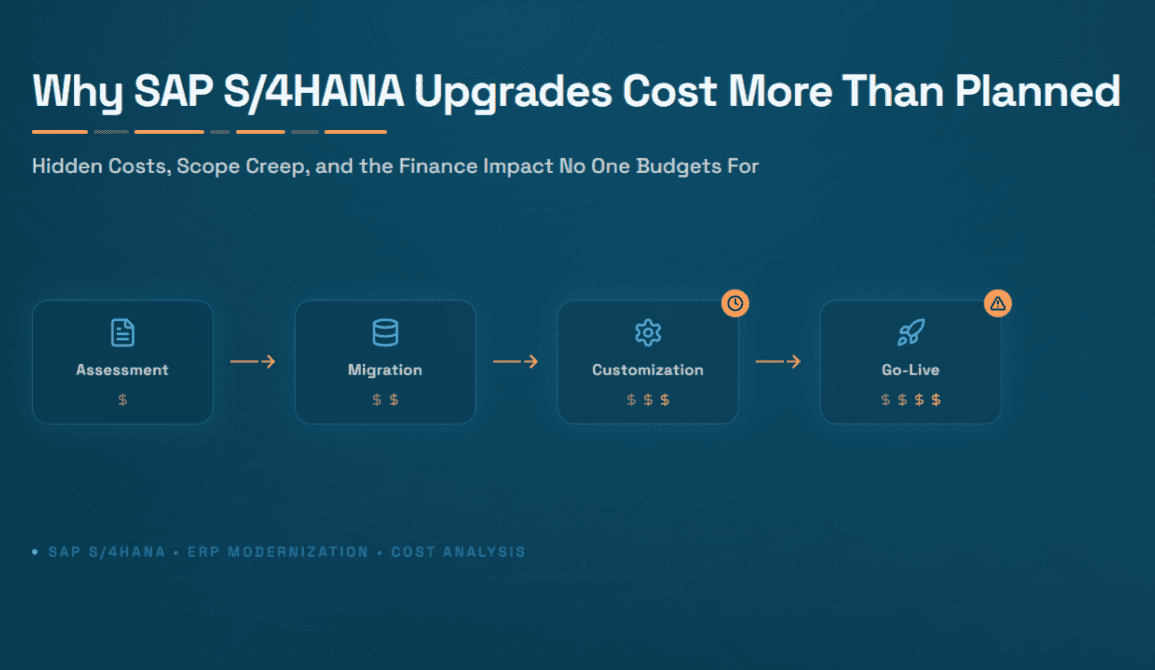
The business case was approved. The implementation partner was selected. The project plan was signed off. And then the bills started arriving.
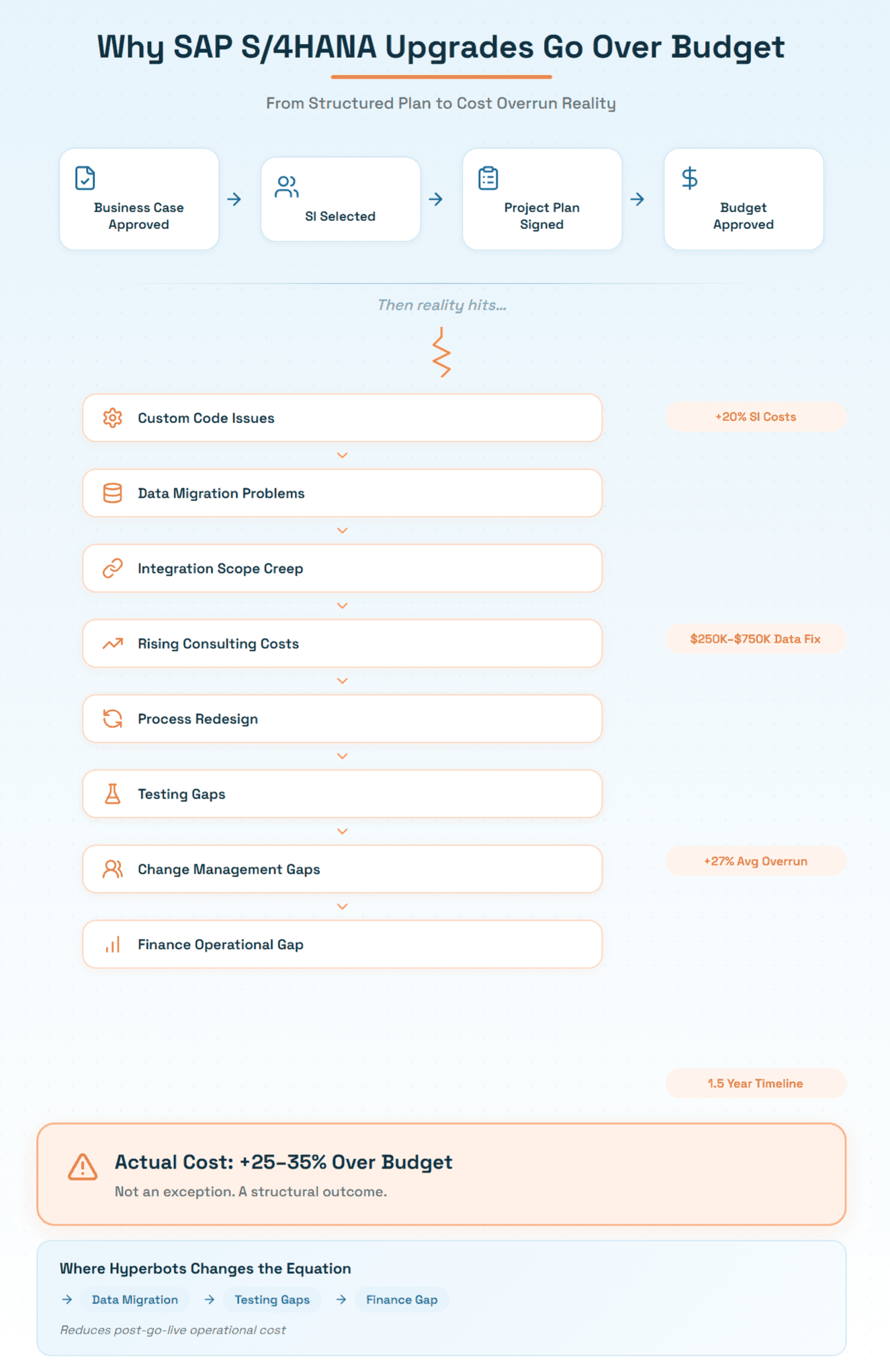
According to ASUG's 2024 SAP S/4HANA Journeys research, 49% of organizations already live on S/4HANA reported costs that exceeded their original budgets, up 17% from 2023. Only 23% of respondents said costs aligned with their expectations, down 13% from the prior year. Consulting fees were the primary culprit, increasing by 20% year-on-year.
A Horváth study from early 2025 found that more than 60% of companies experience deviations in budget, schedule, or result quality during S/4HANA migration. The average migration takes about 1.5 years, and 46% of respondents said the multi-step nature of migration, combined with existing business complexities, made the process more time-consuming and resource-intensive than anticipated.
These are not outlier experiences. They are the statistical norm. And the finance leader who understands why upgrade budgets reliably expand, before the contract is signed, is in a fundamentally different position from one who discovers each cost driver only when the invoice arrives.
This guide maps the eight specific drivers that push SAP S/4HANA migration expenses beyond their approved budgets, drawing on verified primary research from ASUG, Horváth, academic migration studies, and experienced implementation advisors. It also shows how deploying Hyperbots AI Co-pilots as part of the migration programme addresses the finance operational cost that never appears in the project budget but represents the largest long-term return on investment available to any S/4HANA programme. For the complete cost landscape, see our companion blog on the true cost of SAP S/4HANA.
The Upgrade Budget Problem Is Structural, Not Accidental
SAP S/4HANA is not a software upgrade. It is a business transformation that touches every finance, procurement, supply chain, and HR process in the organization , affecting data models, integration architectures, user experience, and process design simultaneously. Organizations that budget for an IT project systematically underfund what is actually a business transformation programme.
A realistic view of hidden as well as obvious expenses is essential. Whatever figure you have initially arrived at, you will probably need to add at least 25% more and possibly as much as 35% more in a large and complex programme.
That 25–35% contingency recommendation from experienced SAP programme advisors is the starting point for any honest upgrade budget. What follows are the eight specific drivers that fill that gap.
The Eight Drivers That Inflate SAP S/4HANA Migration Expenses
Driver 1 - Custom Code Remediation: The Silent Budget Killer
Custom code remediation was identified as the primary source of unanticipated complexity in SAP S/4HANA migrations, accounting for a significant proportion of budget overruns averaging 27% above initial projections.
Every organization that has run SAP ECC for more than a decade has accumulated custom ABAP code like Z-objects, custom reports, non-standard configurations, and workarounds built to address gaps in the original SAP implementation. In S/4HANA, SAP's Universal Journal and simplified data model have replaced or restructured many of the underlying tables that this custom code depends on. Code that worked perfectly in ECC either needs to be rewritten, restructured for BTP extensions, or decommissioned.
Implementation partners typically scope custom code remediation based on an initial assessment, often using SAP's Custom Code Migration Worklist tool. The problem is that the initial assessment identifies what needs to change, not how complex the change will be. A custom cost center report that references five deprecated ECC tables sounds like a two-day fix until someone opens the code and discovers it was built by a consultant who left the company eight years ago, is undocumented, and runs a critical month-end reconciliation process that nobody knew was connected to it.
The discovery that complex custom objects are more expensive to remediate than initially assessed is the most consistently documented source of mid-project change requests in SAP S/4HANA programmes. Every change request is billed at SI day rates and as the 2027 deadline approaches, those day rates are climbing.
For organizations currently evaluating how their AP automation tools interact with SAP custom code and whether those integrations will survive the migration, see how finance automation platforms integrate with SAP S/4HANA.
Driver 2 - Data Migration Complexity: The 7-9% Budget Trap
Data quality issues account for approximately 32% of migration delays and 27% of budget overruns. Organizations typically allocate just 7–9% of project budgets to data preparation despite its outsized impact on implementation outcomes. Organizations that increase their data quality investment experience dramatically better outcomes.
Data migration for S/4HANA is categorically more complex than ECC data migrations, because S/4HANA's simplified data model requires transforming legacy data structures, not simply moving them. Customer and vendor master records must be converted to SAP's Business Partner structure. FI-CO reconciliation gaps that existed in ECC must be resolved before migration. Historical transaction data must be validated for completeness and consistency against S/4HANA's Universal Journal structure.
Data integrity issues presented additional challenges, with 73% of organizations reporting quality issues requiring substantial remediation efforts, with average remediation costs of $250,000–$750,000 depending on data volume and complexity.
The 7–9% budget allocation for data preparation is structurally insufficient. Organizations that discover significant data quality issues, duplicate vendor records, orphaned cost center assignments, GL accounts with inconsistent transaction history, typically face three choices: remediate the data before migration (expensive and slow), migrate dirty data and clean it post-go-live (expensive and operationally disruptive), or reduce migration scope (compromising the business case).
None of these options are in the original budget. They all add to migration expenses.
The clean vendor master that Hyperbots' Vendor Management Co-pilot maintains, with automated duplicate detection, identity verification, and error rates under 1%, is one of the most practical pre-migration data quality investments available. Deploying it before the S/4HANA migration means the vendor master arrives at migration in clean, validated condition rather than requiring $250,000+ in remediation.
Driver 3 - Integration Scope Creep: The Third-Party Surprise
Every non-SAP system connected to your ECC environment needs to be reconnected and often rebuilt for S/4HANA. Banking platforms, EDI networks, AP automation tools, tax engines, treasury management systems, expense management platforms, and HR systems all have integration points with SAP that need to be assessed, updated, and tested.
The need to make a clean core migration makes this transition particularly challenging, with managing customizations, third-party applications, and data hygiene high on the list of technical challenges.
The integration scope problem has two components. First, integration inventory is almost always incomplete at project start. Organizations that believe they have ten SAP integrations typically discover fifteen to twenty during the Explore phase. Second, even known integrations frequently require more work than estimated because they were built by different vendors over different time periods using different connection approaches, and SAP's clean core model requires moving custom integration logic to BTP or standard APIs.
The move to SAP S/4HANA is likely to highlight costs that may be missed or underestimated in budget evaluations. Having an understanding of those less-seen project costs when calculating your financials will give your budgeting a much firmer foundation.
Every integration that was not in scope when the project budget was approved becomes a change request when it is discovered. And in a busy delivery phase with a fixed go-live date, change requests are approved under pressure - often without the rigour that would normally apply to a formal scope addition.
For the complete picture of integrating purchase order automation with ERP systems - specifically how to build integration architecture that survives the migration and subsequent SAP updates - our integration guide covers every connection pattern.
Driver 4 - Consulting Fee Escalation: The Market Rate Trap
Consulting fees are the main source of unexpected costs in SAP S/4HANA upgrades, increasing by 20% since 2023. Implementation services through partners and system integrators represented the greatest costs to go live on SAP S/4HANA.
The SAP consulting market in 2026 is operating under significant demand pressure. Resources vital to enacting SAP S/4HANA migration projects, such as consultants and migration partners, are expected to become more in-demand as more SAP customers reach the go-live stage simultaneously.
Organizations that approved upgrade budgets based on 2023 SI day rates are discovering in 2025–2026 that those rates have increased materially. A consulting engagement budgeted at $150/hour that now prices at $185/hour adds 23% to the SI cost line before a single line of code has changed. For a programme with $5M in SI fees, that is $1.15M in unbudgeted migration expenses from market rate escalation alone.
The situation is likely to worsen before it improves. Demand for S/4HANA talent is expected to be three times the available supply by 2027. Organizations that start projects later will pay more for the same quality of resource - or accept lower-quality resources at the original price.
Driver 5 - Business Process Change: The Scope Expansion Nobody Planned
The top barriers to S/4HANA migration remain business process change (49%), customizations (44%), and organizational resistance (37%), according to Precisely and ASUG's November 2025 research.
Business process change is not only a barrier - it is a budget driver. When organizations conduct fit-to-standard workshops during the Explore phase and discover that their current ECC processes cannot simply be replicated in S/4HANA without redesign, the response is either to accept the SAP standard process (requiring change management and training investment) or to build a custom extension (requiring development investment). Both add to migration expenses.
The most expensive version of this driver occurs when organizations discover during the Realize phase , after the design has been approved and configuration has started - that a process assumption made in the Prepare phase was wrong. Rework in the Realize phase is among the most expensive work in any SAP project because it requires reconfiguring what has already been built, retesting what has already been tested, and often re-running fit-to-standard workshops that were supposed to be complete.
Almost 60% of companies that have completed their S/4HANA transformation ended up exceeding their planned schedule, according to a Horváth survey of 200 executives. S/4HANA migrations vary in quality and budget driven largely by project scope expanding and weak project management.
The SAP implementation phases guide covers how to structure the Explore phase to surface process change requirements before Realize begins - the single most effective way to prevent scope-driven budget overruns.
Driver 6 - Testing Scope and Quality Failures
Business disruption during implementation exceeded planned tolerances for 68% of organizations, resulting in productivity losses averaging $157,000 per day during critical cutover periods.
Testing scope is one of the most consistently underfunded areas of SAP S/4HANA upgrade budgets. Finance validation testing , aP matching, GL coding regression, accruals cycle simulation, AR dunning configuration, bank integration testing - requires significant time, business resource involvement, and multiple test cycles to do properly. When testing timelines are compressed to protect the go-live date, defects are promoted to production.
Every post-go-live defect costs significantly more to fix than it would have cost to prevent. The defect needs to be investigated (SI time), root-caused (configuration or development work), fixed (configuration or development work), tested (SI and business time), and deployed (another change management cycle). For a complex matching configuration defect that affects every invoice above a certain value threshold, the cumulative cost can easily exceed the cost of the additional testing cycle that would have caught it.
The cost of poor testing in SAP S/4HANA programmes falls almost entirely on finance operations , AP teams manually processing invoices while defects are fixed, controllers investigating GL variances, collections analysts working from unreliable AR data. For the detailed analysis of this cost, see why finance teams bear the cost of poor SAP S/4HANA testing.
Driver 7 - Change Management and Training Under-Investment
Precisely's November 2025 research found that organizational resistance was identified as a top-three barrier to S/4HANA migration by 37% of respondents and this is the barrier whose cost is most consistently excluded from upgrade budgets.
Change management in SAP S/4HANA programmes is typically funded at 5–10% of total project cost. For a $10M programme, that is $500,000–$1M for change management, training, communications, and organizational readiness. For a transformation that touches every finance, procurement, HR, and supply chain process across a multi-entity organization, this is usually insufficient.
The budget consequence shows up post-go-live, when the under-invested change programme produces a finance function that is technically on S/4HANA but operationally still running the ECC-era processes in a new interface. Shadow systems persist, manual workarounds multiply, and the productivity gains that justified the upgrade budget are not realized.
Allow typically around 10% for what will inevitably be increases in the scope of the programme, and a final contingency of 5–10% to tackle overruns in delivery and time.
Driver 8 - The Finance Operational Gap: The Cost That Follows You Past Go-Live
This is the budget driver that never appears in the SAP project budget - but represents the largest ongoing cost of an under-resourced S/4HANA upgrade. It is the operational gap between what the new SAP system provides and what the finance function actually needs to operate efficiently.
When S/4HANA goes live without an intelligent automation layer on top, finance teams discover that they have moved from ECC to a more powerful system that still requires significant manual intervention for high-volume processes. Invoices still need to be matched and posted. Accruals still need to be calculated and booked. Collections still need to be prioritized and executed. Cash still needs to be applied from messy bank remittances.
The finance productivity dip that follows every go-live, when these processes are being performed manually in a new interface by users who are simultaneously learning the system, costs real money every day. Productivity losses averaged $157,000 per day during critical cutover periods for organizations that experienced business disruption exceeding planned tolerances.
This daily operational cost continues beyond cutover, at a lower intensity, for as long as finance processes remain manual. For a mid-market organization, the accumulated operational cost of running finance manually for 12–18 months post-go-live frequently exceeds the original upgrade budget.
Hyperbots AI Co-pilots are the specific solution to this driver. Deployed in parallel with the SAP build during the Realize phase, they go live simultaneously with S/4HANA, absorbing the operational cost of the finance gap from day one of production. For the complete analysis of this dynamic, see why SAP S/4HANA alone cannot deliver autonomous finance.
How to Build an Honest SAP S/4HANA Upgrade Budget
Given the eight drivers above, here is the framework for an upgrade budget that will not be ambushed:
Start with the SI's base estimate – then stress-test it. Understand how the SI has scoped custom code remediation (number of objects versus complexity of objects), data migration (volume versus quality), and integration (identified interfaces versus total interface inventory). Ask specifically what is in scope and what assumptions have been made about complexity.
Add 25–35% contingency explicitly. Whatever figure you have initially come to, you will probably need to add at least 25% more and possibly as much as 35% in a large and complex programme. This is not pessimism, it is calibration to the historical evidence.
Budget for data quality remediation separately. The $250,000–$750,000 range for data quality remediation should appear as a distinct budget line, not as a contingency. If the data quality turns out to be better than expected, the contingency remains available for other overruns.
Include the dual-run cost explicitly. Organizations that will be running ECC and S/4HANA in parallel for 12–24 months should include the full cost of both maintenance fees in the budget - not model this as zero.
Include Hyperbots as a project line item. The ROI case for Hyperbots AI Co-pilots is strongest when it is included in the S/4HANA business case from the start because the operational finance gap it closes is the largest single item of unplanned migration expense. Deploying it as a post-go-live afterthought means 12–18 months of that gap cost is already sunk. Planning it from the Prepare phase means those costs never materialize.
For more on how to structure an ERP implementation budget that reflects real-world cost drivers, our implementation guide covers the complete planning framework.
Hyperbots AI Co-Pilots – Protecting the Finance ROI of Your S/4HANA Upgrade
Hyperbots directly addresses the most consequential of the eight budget overrun drivers, the finance operational gap by deploying purpose-built agentic AI co-pilots that go live simultaneously with S/4HANA. Here is the complete suite:
Procure-to-Pay Co-Pilots
Invoice Processing Co-pilot Eliminates the manual AP processing cost that constitutes the largest component of the post-go-live finance gap. Achieves 80% straight-through processing, reducing invoice cycle time from 11 days to under one minute. Pre-trained on 35 million invoice fields with 99.8% accuracy. Deployable in two to three weeks - live on day one of S/4HANA production. See how XR Extreme Reach achieved 80% STP with zero manual touch-ups in a real production deployment.
Vendor Management Co-pilot Resolves Driver 2 proactively by maintaining a clean SAP vendor master before the migration. Automates vendor onboarding with AI-driven verification, reducing onboarding time 8x, from nine days to under one day and vendor data errors to under 1%. Clean vendor master data at migration = lower data migration remediation cost. The vendor management ROI calculator models the pre-migration value.
Procurement Co-pilot Automates the full PR-to-PO lifecycle in SAP MM (PR to PO in 4 hours versus the traditional three-day cycle). A self-learning GL recommender prevents the GL coding errors that create finance exceptions and testing defects downstream. The procurement ROI calculator quantifies your specific savings.
Accruals Co-pilot Addresses the most anxiety-inducing post-go-live finance gap: the first month-end close on the new S/4HANA system. The Accruals Co-pilot automates the complete accruals lifecycle such as discovery, calculation, posting, and reversal. Close compresses from days to hours, variance under 5%. The transforming accruals blog documents production outcomes. Use the accruals ROI calculator to model your specific close improvement.
Payment Co-pilot Manages the complete SAP payment run like scheduling, approval routing, bank file generation, fraud detection, and reconciliation. Protects against the payment errors that post-go-live finance gaps create, when manual processes substitute for properly configured SAP automation. The payments ROI calculator models discount capture and error prevention value.
Sales Tax Verification Co-pilot Eliminates the tax leakage that accumulates during the post-go-live period when tax configuration has not been fully validated. One CFO cut $200K in annual tax leakage using Hyperbots , a direct, documented offset to upgrade-related operational cost.
Order-to-Cash Co-Pilots
Collections Co-pilot Closes the working capital cost gap that the post-go-live productivity dip creates in AR. Delivers 40% DSO reduction, 70% reduction in cost to collect, and 80% collections productivity improvement from day one of live operation. Model your specific DSO improvement with the collections ROI calculator.
Cash Application Co-pilot Achieves 80%+ STP on cash application, directly offsetting the working capital cost of high unapplied cash balances that post-go-live bank integration gaps create. Model your savings with the cash application ROI calculator.
How Hyperbots Differentiates - The Upgrade Budget Perspective
Dimension | Native SAP Automation (BTP) | RPA Tools | Traditional AP/AR Tools | Hyperbots AI Co-pilots |
Adds to upgrade budget via BTP fees | Yes | No | No | No - no BTP required |
Adds to SI scope via ABAP dev | Yes | No | Sometimes | Never |
Breaks on S/4HANA upgrade releases | Within BTP | 30–50% breakage | Sometimes | Never - upgrade safe |
Deployable in parallel with SAP build | Partially | No | No | Yes - full parallel deployment |
Addresses finance operational gap | Partially | No | Partially | Fully - P2P + O2C |
ROI payback period | 12–24 months | 12–18 months | 9–15 months | Within 60 days |
Net effect on upgrade programme budget | Increases (BTP + SI) | Neutral or increases | Neutral | Reduces operational gap cost |
The decisive differentiator for organisations managing S/4HANA upgrade budgets is the last row. Every other automation option either adds to migration expenses (BTP fees, SI development) or makes no meaningful contribution to the post-go-live operational finance gap. Hyperbots reduces that gap, converting it from an unbudgeted ongoing cost into a realized ROI that more than offsets the Hyperbots investment.
Hyperbots Platform Capabilities – Transformational Impact on SAP Upgrade Economics
Ready-to-Deploy Pre-Trained Models No model training phase, no ABAP development, no BTP configuration - Hyperbots co-pilots deploy in three to five weeks using finance-specific models pre-trained on tens of millions of transactions. This speed-to-value is critical in the context of upgrade budget management: the operational finance gap costs money every day it exists. Three to five weeks to live means 60 days to measurable ROI.
Self-Learning That Compounds Value Over Time Unlike tools that plateau at initial configuration quality, Hyperbots co-pilots improve continuously, reducing exception rates, improving GL coding accuracy, and increasing STP rates. This compounding improvement means the ROI case strengthens with every month of operation, making the Hyperbots investment return more valuable as the S/4HANA programme matures.
Unlimited User Licensing No per-seat cost means deploying across the entire finance function adds no incremental cost. This contrasts directly with SAP's FUE model where every additional finance user affects subscription cost, making Hyperbots a structurally better economic choice for the automation layer as organizations right-size their SAP user populations post-migration.
SOX-Ready Audit Trail Every autonomous action is logged in a tamper-proof, timestamped audit trail meeting SOX, PCI-DSS, and FedRAMP standards. This directly reduces the post-go-live audit cost that incomplete testing creates, providing the complete, explainable evidence trail that external auditors require, without requiring the manual documentation effort that finance teams would otherwise spend.
ROI - What Hyperbots Delivers Against S/4HANA Upgrade Budget Overruns
Procure-to-Pay ROI
Tangible:
80% reduction in AP processing cost – the operational finance gap, addressed from day one of S/4HANA production
Invoice cycle time from 11 days to under one minute – measurable within the first 30 days
$200K+ annual tax leakage eliminated – direct offset to upgrade-related operational cost
Vendor onboarding 8x faster – clean data for migration, faster supplier enablement post-go-live
Month-end close from days to hours – the highest-anxiety post-go-live finance process, handled
Deployment in 3–4 weeks – ROI before the SI team has even left the programme
Intangible:
Upgrade programme confidence increases – finance leaders know the operational gap is covered on day one
Finance team change fatigue decreases – the new process is demonstrably better, not just different
Shadow system persistence decreases – Hyperbots makes SAP processes better than the workarounds they replace
SAP upgrade business case strengthens – operational ROI is realized from go-live, not deferred to a future phase
Order-to-Cash ROI
Tangible:
40% DSO reduction – working capital released immediately post-go-live
70% reduction in cost to collect , AR operational gap addressed without post-go-live re-implementation
80%+ STP on cash application – bank integration gaps handled by AI matching, not manual reconciliation
80% collections productivity improvement – collector time freed from routine follow-up
Intangible:
Customer relationships protected through the go-live transition, no incorrect dunning from configuration gaps
Real-time cash flow forecasting from live SAP AR data, replacing static aging reports
Revenue assurance from day one, no AR items fall through the cracks during the learning curve period
Budget for the Real Upgrade. Then Protect It with AI.
The organizations that protect themselves do three things differently. They build in the 25–35% contingency that the evidence demands. They invest in data quality preparation before the migration rather than remediating during it. And they deploy Hyperbots AI Co-pilots in parallel with the SAP build so that the operational finance gap, the most expensive and most consistently ignored of the eight overrun drivers, is closed from the first day of production rather than accumulated as ongoing cost for 12–18 months post-go-live.
The upgrade budget should reflect the real cost of transformation. The post-go-live operations should reflect the real capability of an AI-powered finance function. Hyperbots delivers both in three to five weeks, with no ABAP, no BTP fees, and measurable ROI before the SI team has left the programme.
Frequently Asked Questions (FAQs)
Q1: How much do SAP S/4HANA upgrades actually cost compared to the original budget?
49% of organizations already live on S/4HANA reported costs that exceeded their original budgets, up 17% from 2023, with consulting fees as the primary culprit. 82% of S/4HANA projects reported cost overruns averaging 27% above initial projections. A realistic view suggests adding at least 25% more and possibly as much as 35% to whatever initial figure has been developed. The conclusion is clear: the most reliable number in a SAP S/4HANA upgrade budget is the one that includes explicit contingency for all eight overrun drivers described in this guide.
Q2: What is the biggest driver of SAP S/4HANA migration expense overruns?
Consulting fees are the main source of unexpected costs, increasing by 20% since 2023, with implementation services through partners and system integrators representing the greatest costs to go live on SAP S/4HANA. Beyond SI fees, custom code remediation and data migration complexity are the most consistently underestimated technical cost drivers. Data quality issues account for approximately 32% of migration delays and 27% of budget overruns.
Q3: How long does an SAP S/4HANA upgrade typically take versus what was planned?
The average migration takes about 1.5 years, and 46% of respondents said the multi-step nature of migration, combined with existing business complexities, made the process more time-consuming and resource-intensive than anticipated. Almost 60% of companies that have completed their S/4HANA transformation exceeded their planned schedule. For planning purposes, add 30% to the implementation partner's baseline timeline estimate to arrive at a realistic go-live projection.
Q4: How does custom code affect upgrade budget?
Custom code remediation is a systemic source of mid-project budget expansion in SAP S/4HANA programmes. SAP's clean core model requires moving customizations to BTP extensions or standard APIs. The initial assessment identifies what needs to change; the actual cost is determined by how complex those changes are which can only be fully assessed once developers open the code. Budget for custom code remediation as a range, not a point estimate, and include a specific contingency for complex objects that are more expensive to remediate than assessed.
Q5: Can Hyperbots be deployed during the SAP build to protect the upgrade budget?
Yes and this is the most effective way to use Hyperbots in the context of an S/4HANA upgrade programme. Deploying Hyperbots co-pilots against the sandbox S/4HANA environment during the Realize phase means they are configured, tested, and validated as part of the standard UAT cycle. Finance teams go live on day one with both S/4HANA and autonomous AP/AR automation active simultaneously thus eliminating the post-go-live operational finance gap from the first day of production. This approach converts what would otherwise be 12–18 months of operational gap cost into immediate ROI.
Q6: How does Hyperbots affect the Digital Access licensing cost in an S/4HANA upgrade?
Hyperbots co-pilots that create Finance Documents or Purchase Orders in SAP trigger Digital Access licensing, a category of upgrade budget that is frequently not addressed in the original project budget. Organizations deploying Hyperbots should address Digital Access coverage explicitly in their S/4HANA contract negotiation, ensuring document volumes are sufficient for the monthly automation throughput. For organizations on RISE with SAP, typical third-party integrations are bundled into the subscription, confirming with SAP that Hyperbots' expected document creation volumes are within fair use. For the complete Digital Access analysis, see understanding SAP S/4HANA licensing: what finance teams miss.
Q7: What is the best way to protect an SAP S/4HANA upgrade budget from the eight overrun drivers?
The most effective upgrade budget protection strategy combines three elements: a realistic contingency (25–35% above the SI base estimate), a pre-project data quality investment that reduces the largest single source of technical overruns, and a parallel Hyperbots deployment that eliminates the post-go-live operational finance gap before it accumulates cost. Organizations that treat these three elements as discretionary additions to the budget consistently outperform those that treat them as post-project enhancements.