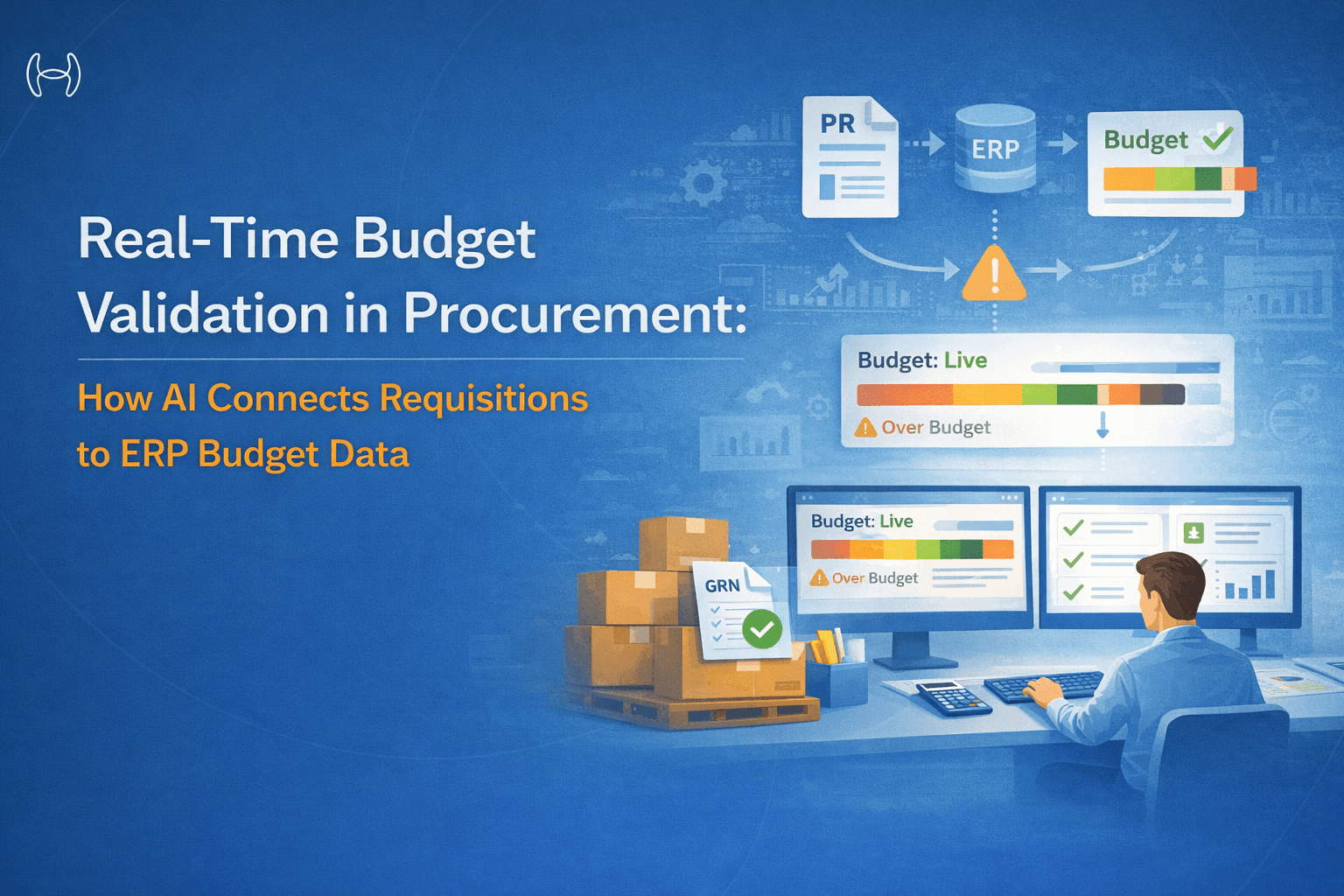
Invoice Audit Preparation: How Finance Teams Can Cut Audit Prep Time and Retrieve Any Invoice Fast
How finance teams can retrieve any invoice instantly and stay audit-ready without the scramble
The Audit Notice Arrives. What Happens Next?
A notification lands - external auditors are coming in three weeks, or the IRS has issued a document request, or internal audit has flagged the AP function for review. For most finance teams, what follows is not a calm, systematic process. It is a scramble.
Someone opens a shared drive with thousands of folders organised by year and vendor. Someone else starts pulling ERP reports and cross-referencing them against scanned PDFs. Emails go out to department heads asking them to dig up approval confirmations from eight months ago. A controller begins rebuilding the approval chain for a handful of transactions that were processed manually because the system was down that quarter.
This is invoice audit preparation for the majority of AP teams - not a process, but a recovery effort. And it costs far more than it should, both in time and in risk.
This guide explains what auditors actually look for, why manual invoice retrieval fails under audit conditions, what compliance standards require from an AP audit trail, and what a properly designed system looks like when an audit notice is not a crisis.
What Auditors Actually Ask For
Understanding invoice audit preparation starts with understanding what auditors - whether external financial auditors, IRS examiners, or SOX compliance reviewers - are actually requesting. The list is more specific than most AP teams expect.
Original invoice documents. Auditors want the source document as received - not a retyped entry in the ERP, not a summary report, but the actual invoice PDF or image that was processed. They want to verify that what was entered into the accounting system matches what the vendor sent.
The complete approval chain. For every material transaction, auditors need to see who approved the invoice, at what level of authority, when the approval was given, and whether it was given before or after payment was made. A payment that went out before the invoice was approved is a finding. An approval that cannot be traced to a named individual is a finding.
Three-way match documentation. For PO-based invoices, auditors expect to see the purchase order, the goods receipt note, and the vendor invoice - and evidence that all three were reconciled before payment. For a detailed breakdown of how this works in practice, see our guide on three-way matching for finance teams.
GL coding rationale. Auditors sampling expense accounts will ask why a specific cost was coded to a specific account. If the GL code was assigned by a person who is no longer with the organisation and there is no documented basis for the coding decision, that is a gap.
Exception handling records. Invoices that were processed outside the normal workflow - emergency approvals, overrides, manual journal entries - receive heightened scrutiny. Auditors want to see that exceptions were documented, authorised at the right level, and not systemic.
Timestamp evidence. When did the invoice arrive? When was it entered into the system? When was it approved? When was it paid? The sequence and timing of these events matters for period-end cut-off testing, fraud assessment, and segregation of duties review.
What SOX and IRS Standards Actually Require
Finance teams often treat "audit-ready" as a vague aspiration rather than a specific standard. But both SOX compliance for public companies and IRS record retention requirements set clear expectations.
SOX Requirements for AP Teams
Under the Sarbanes-Oxley Act, Section 404 requires that management assess and report on the effectiveness of internal controls over financial reporting. For AP teams, this translates into several specific obligations:
Segregation of duties. The person who approves an invoice must be different from the person who processes the payment. The audit trail must make this separation demonstrable - not just claimed in policy, but visible in the record of who did what and when.
Complete and accurate record-keeping. Every transaction that affects the financial statements must have supporting documentation that is complete, accurate, and retrievable. Gaps in documentation are internal control weaknesses. Systemic gaps are material weaknesses.
Timely recording. Transactions must be recorded in the period they occur. Cut-off errors that affect reported financials, whether intentional or not, are SOX issues.
Immutable records. For SOX purposes, the audit trail itself must be protected from alteration. A log that can be edited after the fact provides no assurance. Auditors look specifically for evidence that records are tamper-evident and cannot be retroactively changed.
IRS Record Retention Requirements
For tax purposes, the IRS generally requires businesses to retain records that support items on a tax return for a minimum of three years from the date the return was filed, with longer periods applying in specific circumstances - six years if income was underreported by more than 25%, and indefinitely in cases of fraud or failure to file.
For AP teams, this means every invoice that supports a deduction - expenses, cost of goods sold, capital expenditures - must be retrievable and legible for at least three years, and potentially up to seven years or beyond in audit situations. The IRS accepts electronic records provided they are accurate, accessible, and reproducible in a readable format.
Why Manual Invoice Retrieval Fails Under Audit Conditions
The standard manual approach to digital invoice storage (scanning to a shared drive, filing by vendor or date, backing up to a server) creates predictable and serious problems when an audit arrives.
Failure Mode | Why It Happens | Audit Consequence |
Invoice not found | Inconsistent filing conventions, staff turnover, renamed folders | Auditor treats missing document as missing transaction - potential finding |
Incomplete document | Only the first page scanned, attachments missing, cover email not saved | Cannot verify vendor details, line items, or delivery terms |
No approval record | Approval given verbally or by email that was deleted | Segregation of duties cannot be demonstrated |
Broken match trail | PO in one system, GRN in another, invoice in a shared drive - no link between them | Three-way match cannot be reconstructed |
Altered records | ERP entry corrected without documenting the original | Raises fraud suspicion regardless of intent |
Slow retrieval | Up to 9 minutes per transaction on average; longer for complex searches | Auditor frustration, extended fieldwork, higher audit fees |
Inconsistent GL coding | Coded differently for the same expense type by different team members | Raises questions about accuracy of financial statements |
Each of these failure modes is avoidable. But avoiding them requires a system that was designed for retrievability from the moment an invoice enters the AP workflow - not a scramble to reconstruct records after an audit request arrives.
What the Invoice Audit Preparation Process Should Look Like
A finance team that is genuinely prepared for an audit can respond to any document request in a predictable, systematic way. Here is what that process looks like at each stage:
Audit Request Received
│
▼
┌──────────────────────────────────┐
│ Identify Scope │
│ • Date range │
│ • Vendor or transaction type │
│ • GL accounts or cost centers │
└─────────────┬────────────────────┘
│
▼
┌──────────────────────────────────┐
│ Retrieve Source Documents │
│ • Original invoice image/PDF │
│ • Associated PO and GRN │
│ • Approval chain with timestamps │
└─────────────┬────────────────────┘
│
▼
┌──────────────────────────────────┐
│ Produce Audit Trail Evidence │
│ • Who processed each step │
│ • Human vs AI action log │
│ • Timestamps per action │
│ • Exception handling record │
└─────────────┬────────────────────┘
│
▼
┌──────────────────────────────────┐
│ Verify GL Coding Rationale │
│ • Account assignment basis │
│ • Override documentation │
│ • Period-end cut-off alignment │
└─────────────┬────────────────────┘
│
▼
┌──────────────────────────────────┐
│ Package and Deliver to Auditor │
│ • Complete, linked document set │
│ • Immutable - no post-retrieval │
│ modification possible │
└──────────────────────────────────┘
The difference between teams that handle audits smoothly and teams that struggle is almost entirely in how well steps two and three are built into daily operations rather than assembled retrospectively.
Where Existing AP Systems Fall Short
Most AP teams are running on a combination of an ERP, a document scanning solution, and a shared drive or basic document management system. Each of these handles part of the audit preparation requirement - but none of them handles all of it, and the gaps between systems are where audit risk accumulates.
ERP systems store the transaction record - the journal entry, the payment, the vendor master data - but they do not always store the original invoice image with the transaction. Document management systems store the images but lack the workflow context - who approved what, when, and why. Approval emails live in personal inboxes and are regularly deleted or lost when staff leave. Exception documentation exists in spreadsheet comments or informal notes that are not linked to the transaction record.
When an auditor asks for the complete record of a single invoice - the original document, the three-way match, the approval chain, the GL coding basis, and the payment confirmation - assembling all of that from multiple disconnected systems can take an hour per transaction. For a sample of fifty transactions, that is fifty hours of retrieval work before any analysis even begins.
Beyond the time cost, the fragmentation creates risk. Any gap in the record - a missing approval, an undocumented override, an original document that cannot be located - becomes an audit finding. And findings have consequences: remediation costs, management letter comments, internal control weaknesses disclosed to the board, and in SOX environments, potential material weakness determinations. For a broader look at how AI automation improves audit ease, the relationship between the two runs deeper than most AP teams realise.
How Hyperbots Transforms Invoice Audit Preparation
This is where the Invoice Processing Co-Pilot directly addresses what disconnected AP systems cannot. Rather than assembling audit evidence retrospectively from multiple sources, Hyperbots builds a complete, immutable, and instantly retrievable audit record at the moment each invoice is processed.
Comprehensive Action Logging Across 140+ Fields
Every action taken during invoice processing is logged automatically - extraction, validation, matching, GL coding, exception handling, approval, and ERP posting. The log captures over 140 fields per invoice, including line-item data, payment terms, tax components, and matching decisions. This is not a summary log; it is a complete record of every decision made and every data point involved at each step.
Human and AI Actions Differentiated
One of the most important features of a SOX-ready audit trail is the ability to demonstrate who - or what - took each action. Hyperbots' audit log explicitly differentiates between actions taken by the AI system and actions taken by a human user, with the approver name, timestamp, comments, and any matching discrepancies recorded for every human touchpoint. This makes segregation of duties demonstrable at the transaction level, not just at the policy level.
Timestamps for Every Step
Each action in the audit trail carries a precise timestamp, creating a complete chronological record from invoice receipt through ERP posting. For cut-off testing, fraud assessment, and segregation of duties review, the sequence and timing of events is as important as the events themselves. Hyperbots' timestamped trail makes this evidence immediately available without reconstruction.
Immutable Hash Logs - SOX-Ready from Day One
Hyperbots maintains an immutable audit log for every invoice processed. The record cannot be altered after the fact. This is the specific requirement that manual systems and basic document management tools consistently fail to meet - and it is the feature that allows auditors to rely on the record rather than question it. Hyperbots is SOC 2 Type II, ISO 27001, HIPAA, and SOX-ready, meaning the platform's security and compliance architecture meets the standards that external auditors and regulatory examiners apply.
Instant Retrieval Across the Full Document Set
Because Hyperbots links the original invoice document, the associated PO and GRN, the matching record, the approval chain, and the GL posting into a single connected transaction record, retrieval is a search, not an investigation. Any invoice, any transaction, any approval - retrievable from a single interface without navigating multiple systems or chasing down email archives.
For AP teams, this transforms audit preparation from a multi-day effort into a structured, fast, and repeatable process. The difference is not just speed - it is confidence. When every document is where it should be, complete, linked, and immutable, the audit becomes a verification exercise rather than a liability. For teams still managing documents manually, our guide on accounts payable document management covers the full framework.
Manual vs. AI-Powered Invoice Audit Preparation: A Comparison
Audit Requirement | Manual / Traditional AP | Hyperbots Invoice Processing Co-Pilot |
Original invoice document | Stored in shared drive - may be incomplete or misfiled | Captured at ingestion, linked to full transaction record |
Approval chain evidence | Approval emails - may be deleted, unlinked to transaction | Named approver, timestamp, and comments logged per invoice |
Human vs AI action distinction | Not differentiated - all entries look the same | Explicitly differentiated in every audit log entry |
Three-way match documentation | Reconstructed from three separate systems | Linked automatically - PO, GRN, and invoice in one record |
GL coding rationale | Relies on staff memory or informal notes | AI recommendation basis logged with every coding decision |
Exception handling record | Ad hoc - email or spreadsheet | Systematic - logged with authorisation level and reason |
Immutability | Not guaranteed - ERP entries can be edited | Immutable hash log - tamper-evident by design |
Compliance certifications | Varies by infrastructure | SOC 2 Type II, ISO 27001, HIPAA, SOX-ready |
Retrieval time per transaction | Up to 9 minutes on average; longer for complex searches | Instant - single interface, all linked documents |
Audit prep timeline | Days to weeks for a sample request | Hours or less - evidence pre-assembled daily |
The Business Case: What AP Teams Actually Gain
The ROI from investing in proper invoice audit preparation infrastructure is not difficult to calculate. It shows up in three places:
Reduced audit preparation time. When every invoice has a complete, linked, and retrievable record from the moment it was processed, responding to a document sample request is a search, not a reconstruction project. Teams that previously spent days on audit preparation can respond to the same scope in hours.
Fewer audit findings. The most common AP audit findings - missing documents, undocumented approvals, broken match trails, altered records - are systemic failures of process, not isolated mistakes. A system that builds a complete, immutable record at the transaction level eliminates the root cause of these findings rather than managing their consequences.
Lower ongoing compliance cost. SOX Section 404 testing, external audit fieldwork, and internal audit reviews all consume finance team time. The more complete and accessible the underlying records, the shorter the fieldwork cycles and the lower the audit fees. For organisations with significant external audit engagements, even a modest reduction in fieldwork time translates to meaningful cost savings.
On implementation, Hyperbots goes live in one month. The co-pilot is pre-trained on finance-specific data and connects natively to major ERP platforms without custom middleware or bespoke integration development. From the first invoice processed after go-live, every transaction builds the kind of audit-ready record that turns the next audit notice from a crisis into a routine request.
FAQs
What do auditors typically request during an AP audit? Auditors typically request original invoice documents, approval chain evidence with timestamps, three-way match documentation linking PO, GRN, and invoice, GL coding rationale, exception handling records, and evidence of segregation of duties. The completeness and retrievability of these records determines how smoothly the audit proceeds.
How long should invoice records be retained? For IRS purposes, the general minimum is three years from the date the relevant tax return was filed, with longer retention periods applying in specific circumstances. SOX requires records supporting internal control assessments to be retained for seven years. Best practice for AP teams is to retain all invoice records, including the full audit trail, for a minimum of seven years.
What makes an audit trail SOX-compliant? A SOX-compliant audit trail must be complete, accurate, timely, and immutable. It must show who took each action, when they took it, what data was involved, and that the record cannot be altered after the fact. It must also demonstrate segregation of duties - that the approver and the processor were different individuals.
Why is three-way match documentation important for auditors? Three-way matching - reconciling the purchase order, goods receipt, and vendor invoice before payment - is a primary control against duplicate payments, fraudulent invoices, and payment for goods or services not received. Auditors specifically test whether three-way match was performed and documented before payment was released.
How does Hyperbots support audit preparation specifically? Hyperbots' Invoice Processing Co-Pilot builds a complete, immutable audit record at the time of processing - logging every action across 140+ fields, differentiating human and AI actions, timestamping each step, and linking the original document, match record, approval chain, and GL posting into a single retrievable transaction record. The platform is SOC 2 Type II, ISO 27001, HIPAA, and SOX-ready.
Hyperbots' Invoice Processing Co-Pilot builds an immutable, SOX-ready audit trail for every invoice - automatically, from day one. 99.8% extraction accuracy. 80% straight-through processing. Request a demo.