Three-Way Matching: The Complete Guide for Mid-Market Finance Teams
How Mid-Market Finance Teams Validate PO, Invoice, and GRN
When an invoice arrives and no one can confirm whether the goods actually showed up, or whether the price matches what procurement agreed to, your AP team is flying blind.
Three-way matching is the control mechanism that prevents that. For mid-market finance teams processing thousands of invoices a month, it is also one of the most time-consuming and error-prone steps in the entire accounts payable cycle.
This guide explains what three-way matching is, how it works, where manual processes consistently break down, and how AI-powered automation is resolving those failures at scale.
What Is Three-Way Matching?
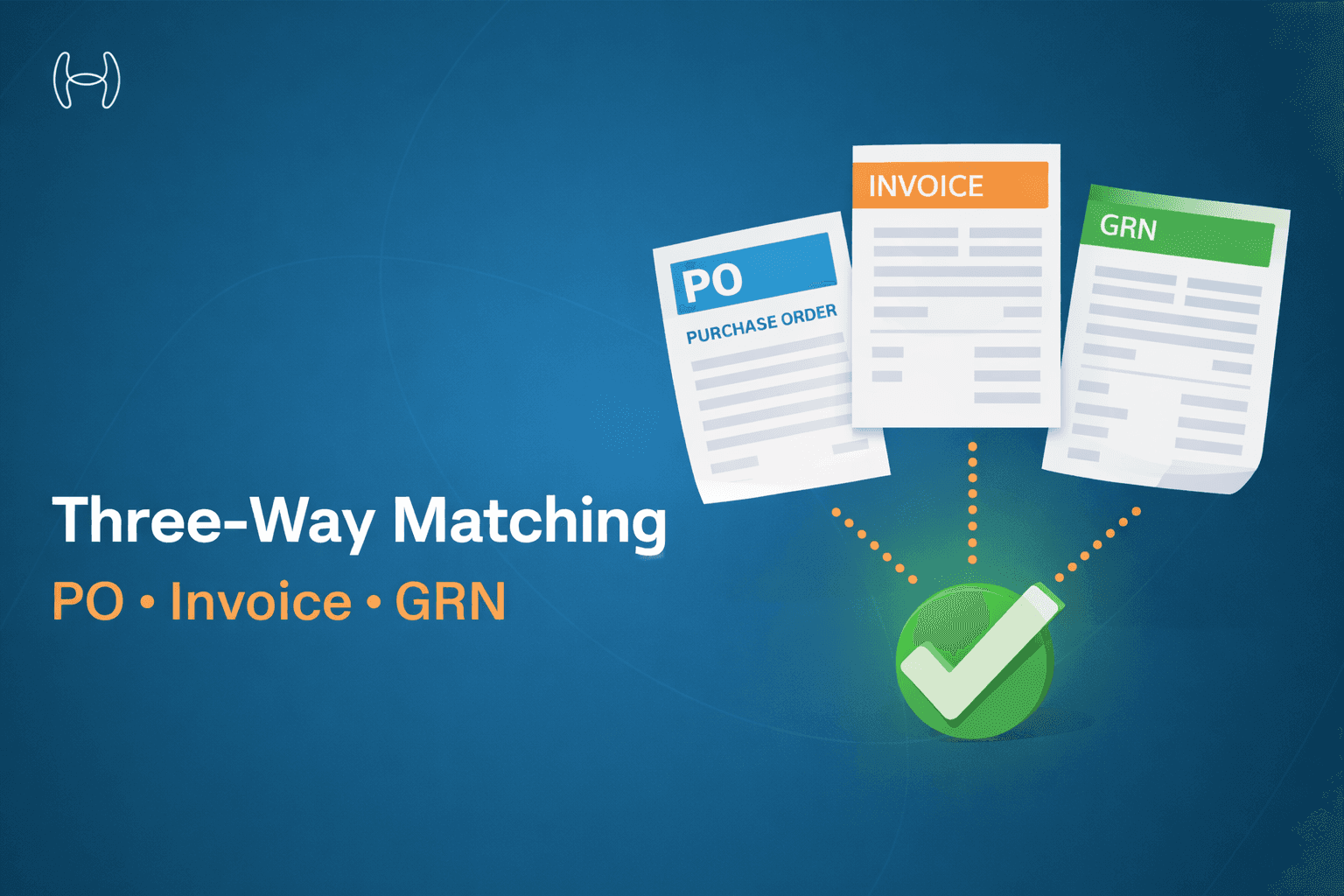
Three-way matching is an accounts payable verification process that cross-checks three documents before releasing payment to a vendor:
Purchase Order (PO): what was ordered, at what price, from which vendor
Vendor Invoice: what the vendor is billing for
Goods Receipt Note (GRN): confirmation that the goods or services were actually received
All three must align on quantity, unit price, item description, and total amount. If they do, the invoice moves forward for payment. If they do not, it becomes an exception that requires investigation before any money leaves the business.
This differs from two-way matching, which only checks the invoice against the PO without confirming delivery, and four-way matching, which adds a quality inspection record. For most mid-market companies dealing with physical goods or services with defined deliverables, three-way matching is the appropriate standard.
The Three-Way Matching Process: Step by Step
Step | Action | Documents Involved |
1 | Invoice received from vendor | Vendor Invoice |
2 | System retrieves the linked Purchase Order | PO + Invoice |
3 | System pulls the Goods Receipt Note | GRN + Invoice + PO |
4 | Price, quantity, and terms compared across all three | All three |
5 | Tolerance rules applied (e.g. ±2% price variance allowed) | All three |
6 | Matched invoices approved; discrepancies flagged as exceptions | Depends on outcome |
7 | Approved invoices posted to ERP; exceptions routed for resolution | ERP / AP team |
The matching engine compares line items, not just header totals. A PO for 100 units at $50 each needs to match an invoice for 100 units at $50 each, backed by a GRN confirming 100 units were received. A shortfall of even 5 units, or a vendor billing $52 per unit, should trigger an exception before payment is released.
Process Flow: How Three-Way Matching Works
THREE-WAY MATCHING PROCESS FLOW
STEP 1 Vendor Invoice Arrives Via email, EDI, or supplier portal
▼
STEP 2 Retrieve Purchase Order from ERP Price, quantity, PO number, vendor
▼
STEP 3 Retrieve Goods Receipt Note Confirm delivery quantity and condition
▼
STEP 4 Apply Tolerance Rules Configurable rules e.g. ±2% price variance
▼
OUTCOME
✓ MATCH | ✗ EXCEPTION |
Auto-approved, ERP posted, payment released | Routed to AP reviewer with full context assembled |
Why Manual Three-Way Matching Fails Mid-Market Teams
The concept is simple. The manual execution is not, especially at volume.
Volume Crushes Productivity
A mid-market company processing even 5,000 invoices a month is asking its AP team to retrieve, open, compare, and validate thousands of document triplets. Industry benchmarks put the cost of processing a single invoice manually at $12.88, a figure that directly reflects the labor involved in matching and validation.
Data Lives in Disconnected Systems
The PO lives in procurement or the ERP. The GRN is logged by a warehouse team in an operations system. The invoice arrives by email or EDI. In most mid-market environments, these three systems do not automatically communicate with each other. An AP clerk has to open multiple tabs, manually retrieve records, and compare them line by line. That is where errors compound.
Format Inconsistency Causes Constant Failures
Vendors do not follow a standard invoice layout. One vendor sends a PDF with line items. Another sends a single-line invoice with a lump total. A third uses a completely different item description from what appears on the PO, even though it refers to the same product. Manual matching requires human judgment on every one of these cases.
Minor Discrepancies Pile Up Into a Backlog
In manual environments, small variances such as a $2 price difference, a rounding error, or a unit-of-measure mismatch all land in an exception queue. Finance teams routinely spend more time chasing the cause of a minor variance than the variance itself is worth. That queue becomes a bottleneck that slows every invoice sitting behind it.
Approval Chains Stall Payments Further
Once an exception is flagged, it needs to reach the right person: procurement, the budget owner, or the vendor. In manual workflows this typically happens via email chains that can sit unread for days. Every day an invoice waits is a day closer to a late payment penalty and a day further from capturing an early payment discount.
The Real Cost of Getting It Wrong
Matching failures carry measurable financial consequences beyond the time cost.
Failure Type | Typical Impact |
Approximately 0.3% of total AP spend in manual environments | |
Overpayments from price mismatches | Often undetected for 30 to 90 days |
Late payment penalties | 1 to 2% of invoice value per month |
Missed early-pay discounts | Only around 25% captured in manual AP |
Audit preparation for exceptions | 3 to 5 FTE-days per audit cycle |
For a company with $50 million in annual AP spend, a 0.3% duplicate payment rate represents $150,000 in preventable losses, before counting the cost of recovering those payments.
Where Legacy Technology Falls Short
For the past decade, most mid-market teams have relied on OCR (Optical Character Recognition) tools to extract invoice data and attempt automated matching. OCR was a genuine improvement over pure manual entry. It reduced keystrokes and sped up data capture.
But OCR has a fundamental limitation: it reads characters without understanding context.
The moment a vendor changes their invoice template, extraction breaks. Fields shift, column headers change, and the tool outputs incorrect values that either fail matching or, worse, pass through silently with wrong data. Template maintenance for OCR tools becomes a full-time job as the vendor base grows.
OCR also cannot handle judgment calls that make matching genuinely complex: recognizing that "Consulting Svcs Feb" and "Professional Services, February" refer to the same PO line item, or that a GRN logged 98 units when the invoice says 100 because 2 were rejected on inspection and a credit note is pending.
The result is that OCR-based AP teams typically achieve 60 to 70% straight-through processing on their simplest invoices and still manually manage the rest. The genuinely difficult part of the problem remains unsolved.
How AI Solves Three-Way Matching
AI-native matching engines take a fundamentally different approach. Rather than reading characters off a template, they understand the semantic content of an invoice: what each field means, how it relates to other fields, and how it maps to ERP records regardless of format.
Layout-Independent Extraction
An AI model trained on finance documents reads a vendor invoice the way an experienced AP clerk would, understanding that the number next to "Qty," "Units," and "Pcs" all represent the same field, regardless of what the vendor calls it.
Intelligent Tolerance Management
Not every discrepancy is a real problem. AI matching applies configurable tolerance rules and only escalates genuine exceptions. Minor rounding differences are resolved automatically without human involvement.
Cross-System Data Retrieval
AI agents pull PO data from the ERP and GRN data from the warehouse system without manual intervention, assembling the complete three-document set automatically before comparison begins.
Intelligent Exception Triage
When a real exception is found, AI does not just flag it. It categorizes it. A price discrepancy routes differently from a quantity shortfall, which routes differently from a suspected duplicate. The right person receives the exception with all context already assembled, so resolution takes minutes rather than days.
How Hyperbots Handles Three-Way Matching
The Hyperbots Invoice Processing Co-Pilot is purpose-built for the matching problems that OCR tools and rule-based automation cannot reliably solve. It handles the complete three-way matching workflow from invoice ingestion through GRN retrieval, line-item comparison, exception triage, and GL posting as a single automated process.
Accuracy That Matching Can Actually Depend On
The foundation of reliable matching is accurate data capture. Hyperbots combine multiple vision-language models and large language models with a chain-of-thought reasoning approach, pre-trained on 35 million invoice fields. This delivers 99.8% accuracy in invoice data extraction, which means the data entering the matching engine is correct from the start. The most common source of false exceptions in OCR environments, extraction errors, is eliminated before matching even begins.
80% Straight-Through Processing
With accurate extraction and intelligent tolerance management, the Co-Pilot delivers 80% straight-through processing. Eight out of every ten invoices are matched, approved, and posted to the ERP without any human touch, reducing invoice processing time from an industry average of 11 days to under one minute. The AP team's attention is reserved for the 20% that genuinely require judgment, not wasted on rounding errors and format variations.
140-Field Matching Configurability
Hyperbots supports configurable matching across 140 or more invoice fields, including line items, payment terms, dates, addresses, and tax amounts. Teams can set custom rules, tolerances, and severity levels to match against POs, GRNs, or both, aligned with their specific company policies.
Flexible Matching Strategy
Not every invoice needs the same level of scrutiny. The Co-Pilot supports 3-way, 2-way, or no-match strategies per vendor or invoice category. High-trust vendors with a clean track record can be set to 2-way matching. New vendors or high-value invoices can require full 3-way matching. This keeps straight-through processing rates high without compromising control where it matters most.
Intelligent Exception Routing
For invoices that do not match cleanly, the platform categorizes the exception type and routes it to the right resolver with all relevant documents already assembled and a clear explanation of the discrepancy. This eliminates the back-and-forth email chains that make exception resolution so slow in manual environments.
Immutable Audit Trail
Every matching decision, whether automated or human-resolved, is logged with a timestamp, a data record, and the reasoning behind it. Audit preparation that previously consumed 3 to 5 days can be completed in under an hour.
ERP-Native Integration
Hyperbots connects directly to NetSuite, SAP Business One, Microsoft Dynamics, Sage, QuickBooks, and others, pulling PO and GRN data natively. There is no manual export, no middleware configuration, and no data reconciliation between systems.
ROI: What the Numbers Look Like
For a mid-market finance team processing 10,000 invoices per month:
Metric | Manual or OCR | Hyperbots AI |
Cost per invoice | $12.88 | At least 70% reduction |
Straight-through processing rate | 50 to 65% | 80% |
Invoice extraction accuracy | 85 to 92% | 99.8% |
Duplicate payment rate | Approximately 0.3% of spend | Approximately 0.03% of spend |
Invoice processing time | Up to 11 days | Under 1 minute |
Audit preparation time | 3 to 5 days | Under 1 hour |
At 10,000 invoices per month, reducing cost per invoice from $12.88 to approximately 70% lower which generates thousands of dollars in monthly savings, which can be well over a million annually on processing cost alone. Duplicate payment prevention and early-pay discount capture add meaningfully on top of that. Hyperbots goes live in under one month, with pre-trained AI models that require no template building and ERP connectors ready to deploy out of the box.
Common Questions from Mid-Market Finance Teams
What if the GRN has not been logged yet when the invoice arrives? The platform holds the invoice in a pending state and automatically re-checks when the GRN is recorded. AP teams get a live dashboard showing invoices awaiting GRN confirmation so they can follow up with the receiving team directly.
Can it handle partial deliveries? Yes. If 80 of 100 ordered units were received, the system can approve payment for the 80 confirmed units and flag the remainder, either as a pending second delivery or for partial payment resolution.
What about vendors who format invoices inconsistently? Hyperbots builds a vendor-specific data profile over time. After processing a vendor's invoices, the AI recognizes their formatting patterns and applies the correct field mappings automatically, without any manual reconfiguration.
Conclusion
Three-way matching exists because the risk of paying the wrong amount, for the wrong goods, to the wrong vendor is real, frequent, and expensive. For mid-market finance teams, the challenge is not understanding why it matters. It is doing it fast enough and accurately enough at volume without burying the AP team in exception queues.
Manual matching and legacy OCR tools both fail at scale. AI-native platforms like Hyperbots resolve the extraction, tolerance, and exception-routing problems that have kept straight-through processing rates low and costs per invoice high.
The result is 80% of invoices matched and paid without human touch, at 99.8% accuracy, with a complete audit trail, live in under a month.
Explore the ROI or Schedule a Demo to see what this looks like for your team.