What Triggers Arizona TPT Nexus
Understanding Physical and Economic Nexus for Arizona TPT
What Triggers Arizona TPT Nexus: Physical Presence, Economic Thresholds, and What Remote Sellers Get Wrong
Here is a situation that happens more often than you would think.
A company has been selling into Arizona for two years. They know Arizona has a Transaction Privilege Tax. They have a rough idea of the rates. What they have never actually answered is the most basic question of all: do we even have an obligation to collect this tax?
Then an audit request arrives. And suddenly that unanswered question becomes very expensive.
That first question, the one that should come before anything else, is the nexus question. This blog breaks it down in plain language: what nexus means in Arizona, what triggers it, what changed at the end of 2024, and what mistakes businesses keep making that they really do not have to.
Start Here: What Does "Nexus" Actually Mean?
Nexus is just a legal way of saying your business has enough of a connection to Arizona that the state can require you to collect and pay tax there.
If you run a bakery in Phoenix, the answer is obvious. You are doing business in Arizona. But what if you are a company based in Ohio, selling software subscriptions to Arizona customers entirely online, with no office or staff in the state? Do you owe Arizona TPT?
That depends on the nexus, and in Arizona, the answer is not always what you expect.
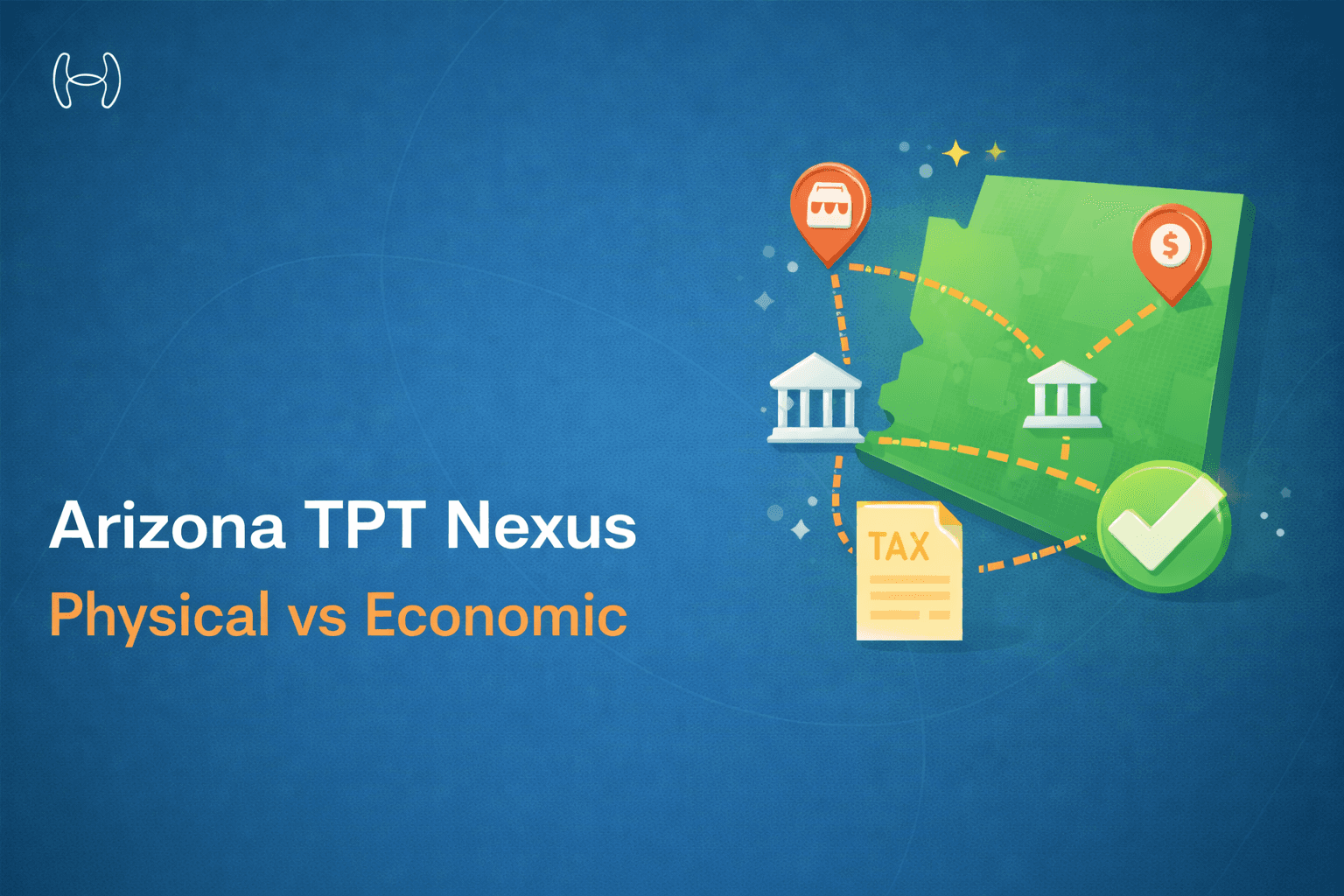
Arizona establishes nexus in two ways:
Physical nexus: your business has an actual presence in the state
Economic nexus: you sell enough into the state even without a physical footprint
They work differently, carry different rules, and you can trigger one without the other.
Quick note on how Arizona TPT works
Most states charge a sales tax that the buyer pays at checkout, and the seller collects it on the state's behalf. Arizona does it differently. The Transaction Privilege Tax, or TPT, is a tax on the business. You owe it for the privilege of doing business in the state. Most businesses pass the cost to customers, but if something goes wrong, wrong rate, wrong classification, missed filing, the liability is yours, not the customer's.
Physical Nexus: If You Have a Presence There, You Owe the Tax
Physical nexus is straightforward. If your business has a physical footprint in Arizona, you have nexus from day one. No threshold to cross, no grace period. The obligation is immediate.
Here is what counts:
You own or rent space in Arizona. An office, warehouse, retail location, or even a co-working desk used regularly by your staff. If you are paying for physical space in the state, that is nexus.
You store inventory there. This one catches a lot of e-commerce businesses off guard. If you use Amazon's FBA programme and Amazon stores your products in an Arizona fulfilment centre, you have physical nexus, even if your business is based in another state entirely. Your inventory is physically in Arizona, and that is enough. Check your Inventory Event Detail Report in Amazon Seller Central to see if this applies.
You have employees or remote workers in Arizona. This includes people working from home. But not every remote employee triggers nexus. According to Arizona's December 2024 ruling TPR 24-1, it depends on what the employee does. Someone in sales, marketing, or a customer-facing role creates nexus because their work directly builds the company's market in the state. A back-office employee, say a remote bookkeeper or data entry person, is much less likely to trigger it. Function matters more than job title.
You send reps or contractors into the state regularly. Sales reps, agents, or contractors meeting clients or attending trade shows in Arizona can create nexus if the activity is regular and non-transitory. A one-time visit is unlikely to trigger it. A pattern of visits throughout the year probably does.
You operate vehicles or equipment in Arizona. Delivery trucks, service vehicles, or assets that regularly operate in the state all count.
Once the physical nexus is established, the obligation covers all applicable TPT categories, not just retail sales. And it starts immediately.
Economic Nexus: The $100,000 Threshold
Economic nexus is for businesses with no physical presence in Arizona. You are selling in from outside the state, with no employees, no warehouse, no one on the ground.
The rule is simple: if your retail sales into Arizona exceed $100,000 in a calendar year, you have an economic nexus threshold obligation. You must register for TPT and start collecting it.
How the $100,000 threshold works
Situation | What Happens |
Sales exceed $100,000 in the current year | Register and collect TPT within 30 days |
Sales exceeded $100,000 last year | Already obligated this year, even if sales are lower |
Sales through Amazon, Etsy, eBay (marketplace) | Marketplace collects; usually does not count toward your threshold |
Direct website sales of $50,000 + marketplace sales of $70,000 | Direct sales count; you may have crossed the threshold |
Registration timeline: Once you cross $100,000, you must register and begin collecting by the first day of the month starting at least 30 days after crossing. Cross on February 15, start collecting April 1.
Trailing nexus: the detail most people miss. Arizona looks at both the current calendar year and the previous one. If you crossed $100,000 last year, you are obligated for all of this year, even if your sales this year are tracking much lower. Nexus carries forward for the entire following calendar year.
Marketplace sales work differently. If you sell through Amazon, Etsy, or another marketplace facilitator, they collect and remit TPT on your behalf. Those sales are handled separately and typically do not count toward your personal $100,000 threshold. Your direct sales, through your own website or invoicing, are what drive your calculation.
The SaaS Question: What Changed in December 2024
If your business sells software, subscriptions, or services into Arizona, there is a specific ruling you need to know about.
In December 2024, the Arizona Department of Revenue issued TPR 24-1. It clarified that economic nexus only applies to the retail classification of TPT, not to other classifications like personal property rental.
Why does that matter? Because Arizona classifies SaaS, cloud software subscriptions, as personal property rental, not retail.
SaaS and TPT nexus: two scenarios
Scenario | Physical Presence? | Revenue Type | Nexus? |
$300,000 SaaS revenue, no AZ presence | No | Personal property rental | No economic nexus |
$300,000 SaaS revenue + remote sales employee in Tempe | Yes | All classifications | Full physical nexus; everything taxable |
$150,000 perpetual software licences, no AZ presence | No | Retail | Economic nexus triggered |
$80,000 SaaS + $30,000 perpetual licences, no AZ presence | No | Mixed | No nexus; retail sales below $100,000 |
The bottom line: for technology and service companies, physical presence is often the dividing line between having a tax obligation in Arizona and not having one at all. A single remote employee in a sales role can change everything.
The Mistakes Remote Sellers Keep Making
Here are the errors that come up most often, all avoidable:
Assuming FBA does not create nexus. It does. Amazon moves inventory between fulfilment centres based on demand. Your nexus footprint can change without you making any active decision. Check your fulfilment reports regularly.
Not tracking where remote employees live. One customer service hire in Scottsdale creates Arizona nexus for the whole business, depending on their role. Many companies do not cross-reference employee addresses against their nexus position until an audit forces the issue.
Treating nexus as a one-time check. Nexus is not static. A new hire, inventory in a new fulfilment centre, a strong sales quarter, any of these can change your position. Review it at least annually, and whenever something in your business changes.
Mixing up marketplace and direct sales. These channels have different rules. Track them separately. Your direct sales drive your personal economic nexus calculation; your marketplace sales do not.
Underestimating the back liability. Arizona can assess tax retroactively. If you should have been collecting TPT two years ago and were not, you owe that tax now, even though you never collected it from customers. Penalties run up to 25% of tax due, plus interest from the original due date. The number compounds quickly.
Once You Have Nexus: What Happens Next
Register through Arizona's AZTaxes.gov portal. The state fee is $12, plus local jurisdiction fees depending on where you are doing business.
Then you need to apply the right rate for every sale. Arizona uses destination-based sourcing, meaning you collect TPT based on where the customer receives the product, not where you are located. With over 90 local taxing jurisdictions each carrying their own rate on top of the state base, the rate changes with every delivery address.
Arizona TPT rate structure at a glance
Component | Rate |
Arizona state base rate | 5.6% |
County rate (example: Maricopa) | 0.7% |
City rate (example: Phoenix) | 2.3% |
Combined rate (Phoenix example) | 8.6% |
Low end (some rural areas) | ~5.6% |
High end (some city jurisdictions) | Up to 11.2% |
Rates vary by city and change periodically. Always look up the current combined rate for the specific delivery address; never use a state average.
Filing frequency based on estimated annual tax liability
Annual Liability | Filing Frequency | Statutory Due Date |
Under $500 | Annual | 20th of the month following the period |
$500 to $2,000 | Quarterly | 20th of the month following the period |
Over $2,000 | Monthly | 20th of the month following the period |
Electronic filers receive a grace period through the last business day of that month. Paper filers must be received by the second-to-last business day.
How AI Is Changing the Way Businesses Handle TPT Compliance
Once you know your nexus position, the real work begins. Rates change across 90-plus jurisdictions. Classifications have to be applied correctly at the transaction level. Filings go out on different schedules. Every decision needs to be documented. And Arizona is usually just one of several states a finance team is managing at the same time.
Doing all of this manually is not realistic at scale, and that is where AI has started to make a genuine difference.
The most useful thing AI does in tax compliance is not the strategy work. It is the repetitive, detail-heavy, error-prone work that happens at the transaction level. Reading each invoice, identifying what type of transaction it is, looking up the correct rate for that delivery address, and checking whether the tax applied matches what should have been applied.
A human doing this across hundreds of invoices a month will miss things, not because they are careless, but because the volume is high and the rules are granular. AI handles that volume consistently, applies the same logic to every transaction, and surfaces the ones that do not add up.
AI also benefits from sales and use tax dictionaries, standardized libraries of tax categories and classifications that ensure every transaction is evaluated against the same rules, regardless of how the invoice describes the item. This is what makes consistent classification possible at scale.
AI also solves the audit trail problem. Arizona does not just want you to pay the right amount of tax; it wants you to show your work. AI systems log each validation decision with the rule applied, the rate used, and the source data. When an auditor requests documentation, that record is already there.
One thing worth saying clearly: AI does not replace your tax advisor. The nexus analysis itself, deciding whether your business activities create an obligation in Arizona, requires human judgment. What AI handles is the execution layer that comes after that decision is made.
As Jon Naseath put it in the Arizona Sales and Use Tax Compliance interview, AI can assist with automated rate updates, geolocation for rate applications, monitoring changes, and minimizing errors. The strategy is yours. The execution is where AI earns its place.
Hyperbots' Sales Tax Verification Co-Pilot
For businesses managing Arizona TPT and multi-state compliance, Hyperbots built the Sales Tax Verification Co-Pilot to handle the transaction-level work that creates the most risk and takes the most time.
Here is what it does:
Classification at the line-item level. It reads every invoice line and applies the correct tax category classification for each item. A SaaS subscription is classified as personal property rental. A perpetual software licence is classified as retail. A professional service is evaluated against the applicable rules. Classification is not assumed; it is derived from what the transaction actually is.
Rate lookup by delivery address. Once the classification is confirmed, the co-pilot looks up the correct combined rate for the delivery address, the state base rate plus the applicable local jurisdiction rate. For a business with customers across Phoenix, Tempe, Scottsdale, and Tucson, that means four different combined rates applied correctly to each transaction rather than estimated once and used for everything.
Mismatch detection. It compares the tax charged on the invoice against what should have been charged. Any mismatch gets flagged: a vendor charging the wrong rate, a jurisdiction update that has not been reflected, or a transaction classified incorrectly.
Audit-ready documentation. Every check is logged with the rule applied, the rate used, and the underlying transaction data. When Arizona's Department of Revenue requests documentation, the record is already structured and timestamped, not a folder of spreadsheets assembled the night before an audit.
Rate monitoring. The co-pilot tracks rate changes across Arizona's 90-plus jurisdictions and updates accordingly, so the team is not manually checking municipal websites to find out whether a local infrastructure surcharge has changed.
The result is not that the finance team stops thinking about compliance. It is that they stop doing the parts that do not require thinking, and have time for the decisions that do.
The Takeaway
Arizona TPT nexus is not one question. It is several:
Do you have physical presence in the state?
Is that presence non-transitory?
Are you a remote seller above the $100,000 retail sales threshold?
Are you selling SaaS or services that fall outside the economic nexus rules entirely?
Each question has a different answer depending on how your business operates. Getting one wrong, even accidentally, can mean owing back taxes, penalties, and interest on money you never collected.
The right approach is simple: review your nexus position regularly, separate your revenue by TPT classification, track your direct and marketplace sales independently, and do not assume that because nothing has changed on your end, nothing has changed in your nexus status.
For a broader understanding of how Arizona's TPT system works, how rates are structured across jurisdictions, why Arizona is different from other states, and what day-to-day compliance looks like, see the Arizona Sales and Use Tax Compliance guide.
Know Exactly Where Your Arizona TPT Exposure Sits
Hyperbots' Sales Tax Verification Co-Pilot validates tax classifications, checks rates by jurisdiction, and flags mismatches at the invoice level, so your Arizona compliance is built on accurate data, not manual estimates.