Payment Terms Explained: How Net 30, Net 60, and Early Pay Discounts Affect Your Cash Flow
How Payment Terms Shape Cash Flow and Early Pay Discounts

Every invoice that arrives in your AP queue carries a hidden clock. The payment terms printed on that invoice determine when you owe money, whether you can save money by paying sooner, and what it will cost you if you pay late.
For mid-market finance teams, payment terms are not just administrative detail. They are a cash flow management lever that directly affects working capital, vendor relationships, and the bottom line. Yet in most organizations, payment terms are processed passively: invoices are paid when they are approved, on whatever schedule the AP team runs, with no systematic effort to optimize the timing.
This guide explains what payment terms mean, how the most common structures work, what early pay discounts are actually worth, where manual processes leave money on the table, and how AI-powered automation changes the equation.
What Are Payment Terms?
Payment terms are the agreed conditions between a buyer and a seller that define when payment for goods or services is due. They appear on invoices, purchase orders, and vendor contracts, and they govern the financial relationship between the two parties.
The most common format is a net days structure: Net 30 means the full invoice amount is due within 30 days of the invoice date. Net 60 means 60 days. Net 90 means 90 days.
Early pay discount terms add an incentive layer on top of this. The notation 2/10 Net 30 means the buyer can take a 2% discount if they pay within 10 days; otherwise the full amount is due by day 30. This is one of the most widely used discount structures in B2B commerce.
Here is a reference table of the most common payment term structures:
Term | What It Means | Typical Use |
Net 30 | Payment due 30 days from invoice date | Most common standard term in B2B trade |
Net 60 | Payment due 60 days from invoice date | Common in manufacturing and wholesale |
Net 90 | Payment due 90 days from invoice date | Typical in large enterprise or seasonal industries |
2/10 Net 30 | 2% discount if paid within 10 days; full amount due by day 30 | One of the most common early pay discount structures |
1/10 Net 60 | 1% discount if paid within 10 days; full amount due by day 60 | Common in longer-cycle procurement environments |
Due on Receipt | Payment expected immediately upon invoice receipt | Used for smaller vendors or first-time transactions |
End of Month (EOM) | Payment due at the end of the month in which the invoice was received | Common in retail and recurring service billing |
How Payment Terms Directly Affect Your Cash Flow
Payment terms affect cash flow in two directions simultaneously, and most finance teams only manage one of them well.
The Outflow Side: When You Pay Matters
If your vendor offers Net 30 and you pay on day 5, you have given away 25 days of free use of that cash with no benefit unless you captured a discount. If you pay on day 31, you may have triggered a late payment penalty. The optimal payment date for most standard terms is as close to the due date as possible without going over, unless an early pay discount makes paying sooner the better financial decision.
In a manual AP environment, this calculation rarely happens. Invoices are approved when they are approved, and payments are batched on a fixed schedule, typically once or twice a week. The timing of actual payment is determined by process convenience, not financial logic.
The Discount Side: The Value That Goes Uncaptured
Early pay discounts are more valuable than most finance teams realize. A 2% discount for paying 20 days early (the typical window in a 2/10 Net 30 structure) translates to an annualized return of approximately 36%, which is significantly higher than the return on most short-term cash alternatives. Even a 1% discount for paying 50 days early on a Net 60 structure represents an annualized yield of around 7%.
The table below shows what these discounts are worth at different spend levels:
Annual AP Spend | Discount Term | Annual Saving if Captured | Capture Rate |
$500,000 | 2/10 Net 30 | $10,000 | 2.0% |
$1,000,000 | 2/10 Net 30 | $20,000 | 2.0% |
$5,000,000 | 2/10 Net 30 | $100,000 | 2.0% |
$1,000,000 | 1/10 Net 60 | $10,000 | 1.0% |
$5,000,000 | 1/10 Net 60 | $50,000 | 1.0% |
For a company with $5 million in annual AP spend under 2/10 Net 30 terms, the available discount pool is $100,000 per year. The question is not whether the discount is worth pursuing. The question is whether the AP process is fast enough to capture it.
Why Manual AP Processes Miss Most of the Value
The math on early pay discounts is compelling. The reason most organizations capture only around 25% of available discounts is not a lack of awareness. It is a process problem.
Invoice Processing Is Too Slow
The industry average for processing an invoice manually is 11 days from receipt to approval. On a 2/10 Net 30 term, that leaves only a 2-day window to release payment and still capture the discount. In practice, that window is almost always missed. Payment runs on fixed schedules make it worse: if the payment run happens to fall outside the discount window, the opportunity is gone regardless of how fast the invoice was approved.
Terms Are Not Systematically Tracked
In manual environments, payment terms are typically keyed into the ERP during vendor setup and rarely revisited. When a vendor changes their terms on an individual invoice, that change is easy to miss. Discount windows are not monitored automatically, and no one is alerted when a discount is about to expire.
Approval Bottlenecks Burn the Window
Even when an invoice is processed quickly, a single approval delay can eliminate the discount window entirely. If an invoice sits in an approver's inbox for three days during a busy period, a 10-day discount window becomes a 7-day window. The approval workflow is one of the most common points of failure in early pay discount capture.
No Visibility Into the Full Terms Portfolio
Most mid-market finance teams do not have a consolidated view of all the payment terms across their vendor portfolio, which discounts are available, which are expiring this week, and which vendors have inconsistent terms across invoices versus contracts. Without that visibility, optimizing payment timing is impossible.
The Other Side of the Equation: Late Payment Penalties
While missed discounts represent unrealized upside, late payment penalties represent a direct cost. Most vendor contracts include a late payment clause, typically ranging from 1% to 2% of the invoice value per month. On a $50,000 invoice with a 1.5% monthly penalty, paying 30 days late costs $750. Paying 60 days late costs $1,500.
In manual AP environments, late payments are often a consequence of the same approval delays and process bottlenecks that cause missed discounts. The invoice stalls somewhere in the workflow, the due date passes, and the penalty is incurred before anyone realizes the invoice was outstanding.
The compounding effect is significant. An organization missing discounts and incurring penalties on even a small proportion of its invoice volume can be losing several percentage points of AP spend annually to payment timing failures alone.
What Existing Technology Gets Wrong
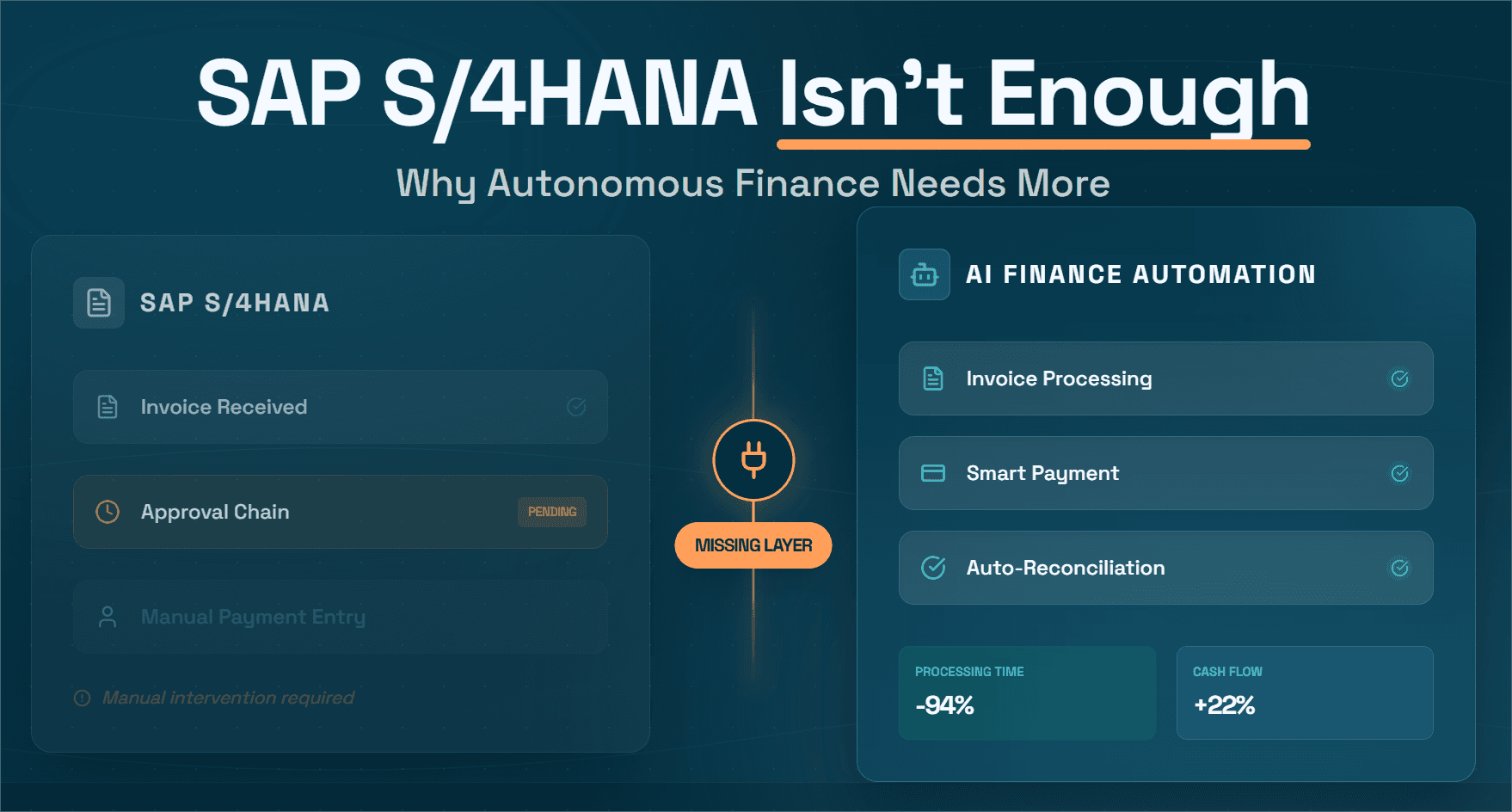
Most ERP systems store payment terms but do not actively use them to drive payment timing decisions. They record the due date and generate an aging report, but they do not alert the AP team when a discount window is about to close, calculate whether early payment is financially justified given the current cash position, or automatically schedule payments to optimize between discount capture and cash preservation.
Basic AP automation tools improve invoice processing speed but typically stop short of payment timing intelligence. They can get an invoice approved faster, which helps, but they do not connect invoice approval to the financial analysis required to decide when to pay.
The gap is in the decision layer: the system needs to know the discount amount, the payment due date, the cost of capital, the current cash position, and the vendor relationship value, and then recommend the optimal payment date accordingly. No rule-based system can do this well because the variables change with every invoice.
How Hyperbots Turns Payment Terms Into a Cash Flow Advantage
Most finance teams know they are missing discounts. The problem is their process cannot move fast enough to catch them. Hyperbots fixes that.
The Payments Co-Pilot analyses the payment terms on every approved invoice, the discount window, the due date, the cost of capital, the vendor relationship and tells your team exactly when to pay. Not based on when the payment run happens to fall. Based on what the numbers actually say.
If paying early generates a return that beats the cost of holding that cash, the system recommends early payment. If it does not, it holds to day 29. That decision happens for every invoice, automatically, without anyone having to think about it.
On the penalty side, approaching due dates are monitored continuously. Invoices at risk are flagged before the deadline passes, not discovered on the next vendor statement.
The outcome is up to 10% savings on cash outflow. On $20 million of annual AP spend, that is up to $2 million returned to the business from smarter payment timing alone. Every payment decision, timing, method, approval, disbursement is logged in a full audit trail that takes seconds to pull, not days to reconstruct.
Hyperbots go live in under one month, built on pre-trained models trained on bank statements and payment data. No templates to build, no custom development required.
ROI: Manual AP vs Hyperbots on Payment Terms
For a mid-market finance team managing $10 million in annual AP spend:
Capability | Manual AP | Hyperbots Payments Co-Pilot |
Discount capture rate | Approximately 25% | Up to 90%+ |
Payment timing decisions | Fixed weekly or bi-monthly runs | AI-optimized per invoice |
Cash flow savings on payments | Minimal, reactive | Up to 10% reduction in cash outflow |
Late payment penalty exposure | High cause of approval delays common | Minimized as AI flags penalty risk |
Vendor payment visibility | Email queries, manual tracking | Real-time vendor portal |
Reconciliation effort | Manual, days to complete | Automated, same-day |
Audit readiness | Manual trail assembly | Immutable log, instant retrieval |
The financial impact of optimizing payment terms goes well beyond the discount savings. Penalty avoidance, reduced reconciliation cost, and the staff time freed from manual payment tracking all contribute to the return. Hyperbots goes live in under one month, with pre-trained AI models built on bank statements and payment data, and native ERP connectors that require no custom development.
Process Flow: AI-Optimized Payment Timing
STEP 1: Invoice Approved and Ready for Payment Matched and validated by AP team or AI
STEP 2: Payment Terms Identified Net days, discount window, penalty clause extracted from invoice
STEP 3: AI Analyses Timing Options Discount value vs. cost of capital vs. cash position vs. vendor relationship
STEP 4: Optimal Payment Date Recommended Pay early to capture discount, or hold to day 29 to preserve cash
STEP 5: Payment Approved and Scheduled ACH, wire, check, or card which is routed as per vendor preference
EARLY PAY: DISCOUNT CAPTURED Supplier paid within discount window. Saving is booked automatically.
STANDARD PAY: CASH PRESERVED Payment held to day 29. Cash stays in the business longer.
Common Questions from Mid-Market Finance Teams
What if we do not have enough cash to capture every available discount?
The Co-Pilot accounts for cash position in its timing recommendations. If capturing every discount would strain liquidity below a defined threshold, it prioritizes the highest-value discount opportunities first and defers others to standard payment dates. The goal is optimal cash deployment, not blanket early payment.
How does the system handle vendors with inconsistent terms across invoices?
The platform reads payment terms directly from each invoice rather than relying solely on the vendor master in the ERP. When invoice terms differ from the master record, the discrepancy is flagged for review so that the right terms are applied to each payment decision.
Can it handle multi-currency payments and international vendors?
Yes. The Co-Pilot supports multi-entity operations and integrates with multiple ERP instances, which accommodates multi-currency environments and cross-border payment workflows. Wire transfers and other international payment methods are supported alongside ACH and check processing.
Conclusion
Payment terms are one of the most underleveraged variables in mid-market finance. The difference between paying on day 5 and day 9 of a 10-day discount window, or between paying on day 29 and day 32 of a Net 30 term, can represent tens or hundreds of thousands of dollars annually for a typical mid-market organization.
Manual AP processes are structurally unable to optimize this. Fixed payment runs, slow approvals, and the absence of real-time discount monitoring mean that most organizations capture only around 25% of available early pay discounts and regularly incur penalties that should be avoidable.
Hyperbots resolves this by treating payment timing as an active financial decision, analysed and optimized for every invoice, and acted on automatically within a payment approval workflow that maintains control without adding friction. The result is up to 10% savings on cash outflow, stronger vendor relationships, and a reconciliation process that no longer consumes finance team bandwidth at month end.
Explore the ROI or Schedule a Demo to see what this looks like for your team.