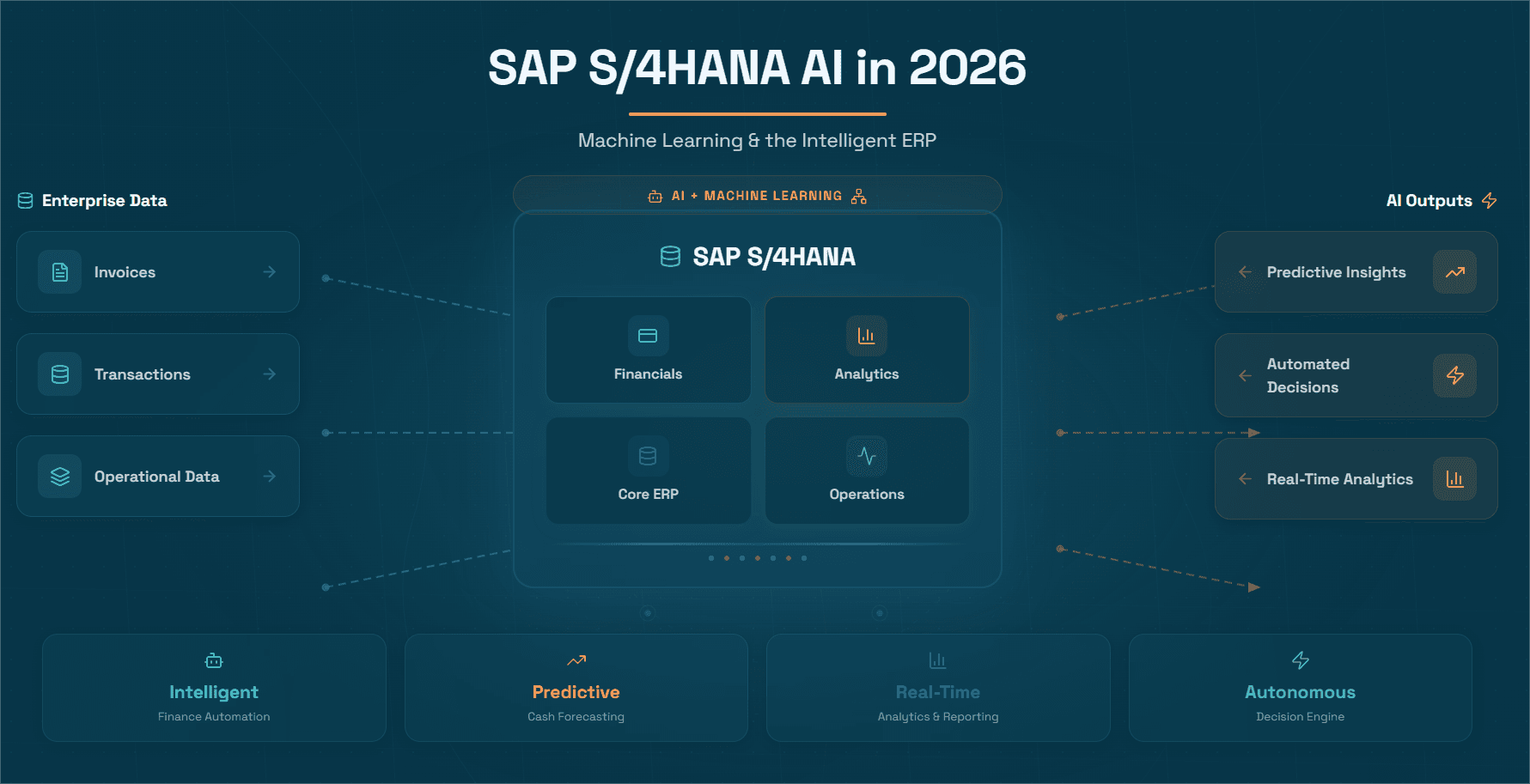
Why SAP S/4HANA Alone Cannot Deliver Autonomous Finance — And What Complements It
Why modern ERP stops short of full finance automation—and how an AI layer bridges the gap to truly autonomous operations.
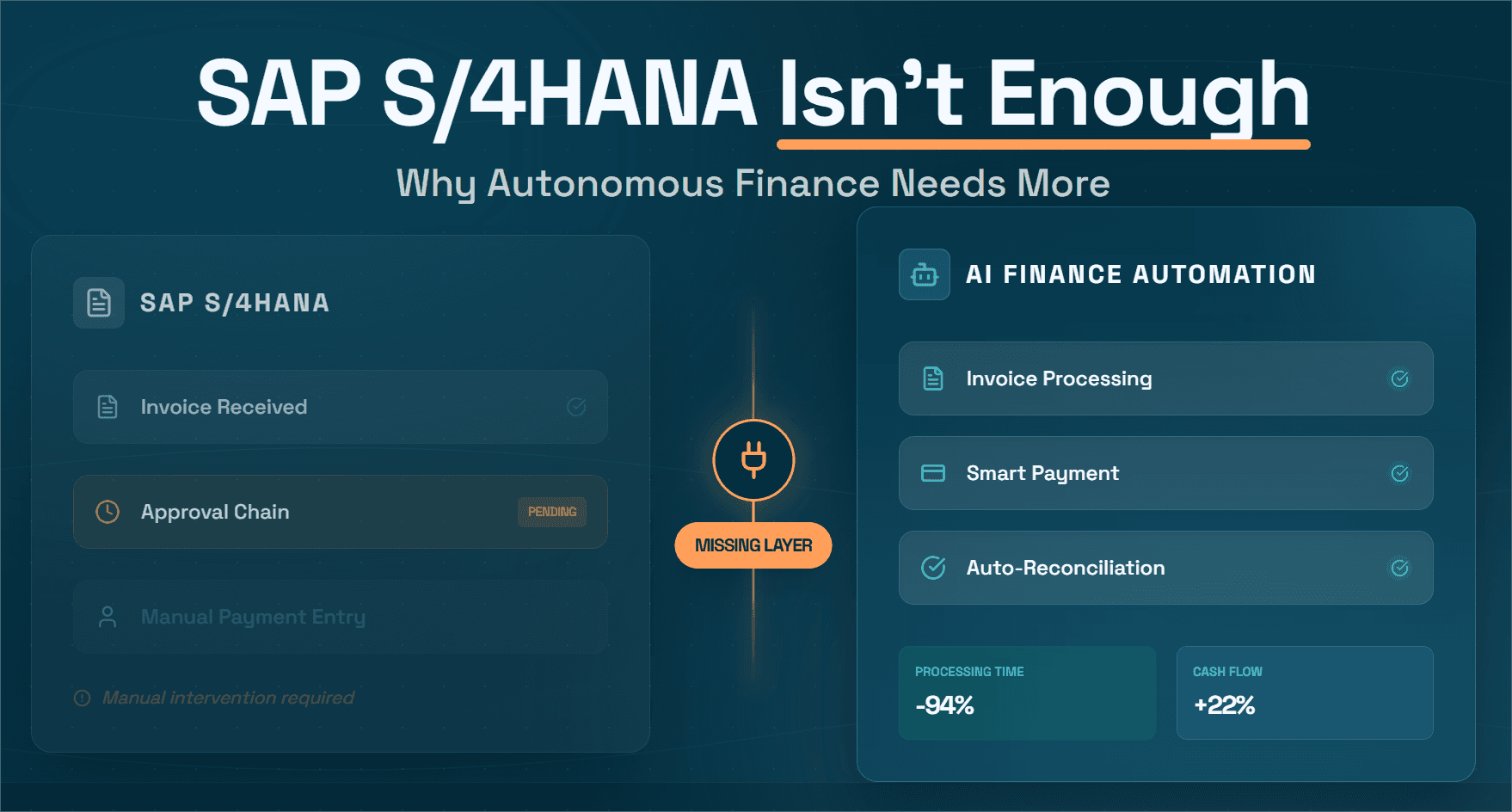
SAP S/4HANA is arguably the most powerful enterprise resource planning platform ever built. Its Universal Journal consolidates financial and management accounting in a single table. Its real-time HANA database delivers analytics 1,800 times faster than its predecessors. Its embedded AI through SAP Joule, SAP Document AI, and SAP Build Process Automation has added genuine intelligence to core transactional processes. The 2025 release of SAP S/4HANA shifts the accounting and financial close agenda from procedural efficiency to governed automation, with a continued focus on precision, audit compliance, and integration flexibility.
And yet, in finance departments worldwide that run S/4HANA, the same manual processes persist. Controllers still spend days calculating accruals at month end. AP teams still manually key invoices or manage exceptions from imperfect OCR tools. Collections teams still work from static aging reports, deciding who to call based on how overdue an invoice is rather than how likely it is to be collected. Cash application analysts still manually match bank remittances to open AR items, one payment at a time.
The gap between what SAP S/4HANA promises and what most organizations actually experience is not a product failure. It is an architecture gap, the difference between a system that manages financial truth and a system that acts on it autonomously. Autonomous finance refers to an environment where processes and activities are partly governed and majority-operated by self-learning software agents that optimize front-, middle-, and back-office operations. SAP S/4HANA provides the foundation for this environment. It does not, on its own, deliver it.
This blog explains exactly where that gap exists, why it persists even in well-implemented S/4HANA environments, and how Hyperbots' purpose-built agentic AI co-pilots close the gap to deliver genuine autonomous finance across procure-to-pay and order-to-cash.
Defining Autonomous Finance: What Does It Actually Mean?
The term autonomous finance has become widely used, but its meaning is often imprecise. A rigorous definition is the starting point for evaluating whether any system, including S/4HANA, delivers it.
An autonomous finance function is not just automated, it’s capable of delivering augmented real-time and predictive insights, effortless compliance, and greater flexibility in financial strategy. Within an autonomous finance environment, finance teams can deliver valuable insights to decision makers, find innovative ways to use analytic resources, and connect business problems to the data to help inform better decisions.
Autonomous finance refers to the integration of advanced technologies and AI-driven processes that allow financial operations to function with minimal manual intervention. It extends beyond automation by incorporating predictive analytics, real-time decision-making, and continuous learning. Traditional finance functions relied heavily on manual processes and rule-based automation. Autonomous finance represents the next-generation finance function where AI models, intelligent systems, and advanced tools handle complex tasks such as financial close, AR and AP processing with continuous close, accelerated month-end close, straight-through processing, and automated reconciliation to streamline financial operations.
The Gartner picture is equally unambiguous about trajectory. Gartner predicts that a third of enterprise applications will have embedded agentic AI by 2030, making 15% of day-to-day work decisions autonomously. As soon as 2028, Gartner is predicting 70% of finance functions will be using AI analysis with connected device data for real-time decision making on operational costs and cash flow management. Gartner projects that by 2030, more than 80% of finance functions will embed AI-driven autonomy in core processes.
Three capabilities define an autonomous finance function:
1. Self-execution: Processes complete end to end without requiring human initiation at each step, not just rule-based scripts, but AI agents that handle exceptions, adapt to variability, and learn from outcomes.
2. Continuous learning: The system improves with every transaction, every approval, every exception without manual retraining.
3. Explainable, auditable decisions: Every autonomous action is traceable to its inputs and logic, meeting the compliance standards that financial operations require.
Unlike RPA, which requires explicit inputs and produces predetermined outputs, and generative AI which responds to user-based prompts, agentic AI will be able to make decisions, solve problems, and act autonomously thus combining action, knowledge, and experience to perform tasks in digital finance environments such as ERPs, financial planning systems, and databases.
SAP S/4HANA delivers pieces of this picture. It does not deliver the whole.
What SAP S/4HANA Does Brilliantly and Where It Stops
To be clear about the gap, it is first necessary to be clear about what SAP S/4HANA does exceptionally well.
SAP S/4HANA's Genuine Strengths
Central to SAP S/4HANA Finance's unique value proposition are the process and reporting improvements available through SAP HANA. The Universal Journal consolidates FI, CO, AA, and ML data in a single table to eliminate reconciliation between financial and management accounting and enables real-time drill-through from the balance sheet to individual transactions. Analytics and reporting capabilities are 1,800 times faster than SAP ERP.
The January 2025 Cloud Public Edition introduced embedded generative AI through SAP Joule, enhanced integration with SAP Business Technology Platform, and deeper analytics within the financial core. SAP S/4HANA 2025 brings AI-driven insights in finance, supply chain, and production planning with integrated SAP Build Process Automation for streamlining repetitive tasks, predictive accounting, real-time profitability insights, and unified journal views.
The 2025 release introduces AI-assisted journal upload that accelerates manual journal processing with validations, mass editing, and workflow approvals, plus an enhanced consolidation monitor with multi-period processing through a modern Fiori interface.
This is genuine progress. SAP S/4HANA in 2026 is meaningfully more intelligent than it was in 2020. But there is a structural limitation that no SAP release will resolve.
The Structural Gap: Why S/4HANA Is a System of Record, Not a System of Autonomous Action
SAP S/4HANA Finance's main technical and architectural advantages, its unified financial database and integrated transactional, analytics, and planning applications, are also its biggest constraint when it comes to autonomous action, because they require organizations to make major changes in how they manage their finances.
The architectural reality is this: SAP S/4HANA is designed to be the authoritative source of financial truth for an enterprise. It is built to store, organize, and report on financial data with exceptional speed and accuracy. It is not designed to be the autonomous decision-making layer that acts on that data independently, handles unstructured inputs from the outside world (vendor emails, PDF invoices, messy bank remittances), and continuously learns from every action to improve its own performance.
While the features provided by SAP S/4HANA give organizations a good head start when it comes to AI, they are more tailored for general use. To tackle issues like late payments, disputes, cash application, and customer experience, it helps to have AI-enhanced automation software that is purpose-built for these specific AR workflows.
Implementing SAP S/4HANA introduces challenges related to data migration, integration complexity, and organizational change. Technical constraints also persist, particularly where process logic spans external portals, supplier systems, or non-SAP applications that require orchestration outside the clean core.
This is not a criticism of SAP. It is a recognition of what SAP is for and what requires a complementary layer to complete the picture.
The Six Autonomous Finance Gaps in SAP S/4HANA
Let us be specific. Here are the six concrete areas where SAP S/4HANA, even in its most current and fully implemented form, falls short of delivering autonomous finance.
Gap 1: Unstructured Document Intelligence
Autonomous AP and AR require the ability to process financial documents in any format such as PDF invoices, email remittances, scanned receipts, handwritten delivery notes with near-perfect accuracy, without human intervention.
SAP Document AI and SAP Joule have made progress here, but the production reality is sobering. High-accuracy remittance-to-invoice matching, greater than 90% accuracy, and handling of strict rules or manual processing for complex scenarios remain areas where SAP's general-purpose AI capabilities fall short of what purpose-built solutions achieve.
Autonomous AP requires 80%+ straight-through processing across the full diversity of supplier document formats: multi-page PDFs, line-item-heavy invoices, documents in multiple languages, invoices from suppliers who do not follow any consistent format. SAP's native document intelligence does not consistently deliver this because it is not a specialized document AI system; it is an ERP with document AI features.
Gap 2: Agentic AP and AR Workflows
Cloud ERP providers are redefining mature intelligent process automation solutions to handle everything from autonomous transaction processing to AI-driven accounts receivable collections that predict payment behavior and optimize working capital, freeing finance teams to focus on strategic priorities instead of routine tasks. This is the direction of travel SAP itself acknowledges. But the actual delivery of agentic AP and AR workflows with agents that execute complete end-to-end processes without human initiation, is not something SAP S/4HANA provides natively today.
The gap is most visible in the autonomous AP workflow: a complete agent that reads an invoice email, extracts all fields with 99.8% accuracy, queries the SAP purchase order and goods receipt data, performs 3-way matching across 140+ fields, routes exceptions intelligently, posts approved invoices directly to SAP FI-AP, verifies the posting, and schedules payment at the optimal time, all without a human touch. SAP provides the plumbing for this. It does not provide the autonomous agent.
Gap 3: Continuous Self-Learning at Process Level
Although AI agents can learn on their own, they learn faster and more accurately when humans provide feedback, update the agents' memory in a structured way, and correct mistakes as they happen. This also helps prevent AI agents from adopting incorrect processes.
SAP S/4HANA's embedded ML capabilities are primarily trained on SAP's general data models and released through the standard product update cycle. They do not continuously learn from your specific organization's transaction patterns, your suppliers' unique invoice formats, your customers' payment behavior, or your team's approval decisions. Autonomous finance requires exactly this kind of continuous, organization-specific learning and it requires it to happen automatically, not through manual model retraining.
Gap 4: Predictive Collections Intelligence
SAP S/4HANA's Collections Management module provides worklists, dunning integration, and promise-to-pay tracking which are solid foundational capabilities. What it does not provide however, is AI that continuously reprioritizes the collections workload based on behavioral payment signals: which customer is likely to pay this week, which is at risk of default, which invoice should be escalated now versus in three days, and which dunning communication is most likely to elicit payment from this specific customer segment.
Agentic AI goes further than traditional automation as it introduces goal-driven collaboration where systems can autonomously decompose goals, break them into subtasks, execute actions across systems, and learn from feedback. This is what genuine autonomous collections looks like. It is categorically different from the rules-based worklist prioritization that SAP Collections Management provides.
Gap 5: Intelligent Cash Application
Cash application is one of the most consistently unsolved autonomous finance problems in SAP environments. SAP's standard clearing functionality handles clean, well-matched payments reliably. The 30–40% of incoming payments that arrive with incomplete remittance, partial amounts, deductions, or references to internal PO numbers rather than SAP invoice numbers require intelligent, AI-driven matching logic that SAP does not provide natively.
The consequence is persistent unapplied cash balances that distort the AR aging report, generate false-positive collections activity on invoices that have already been paid, and consume analyst time in manual research, the opposite of autonomous AP and AR.
Gap 6: Month-End Accruals Automation
SAP S/4HANA 2025 introduces accruals management and periodic valuations with automated expense recognition and foreign-currency revaluations at period end. This is a meaningful improvement. But the specific problem that consumes controllers' time at month end like identifying every uninvoiced PO and service receipt at cut-off, calculating the correct accrual amount for each, posting journal entries to the correct GL accounts, and reversing them automatically when the actual invoice arrives, is not something SAP handles autonomously. Automating this fully requires a specialized co-pilot that queries SAP data, applies ML-based amount estimation, posts journals, and manages the reversal lifecycle automatically.
The Agentic AI Architecture That Closes the Gaps
Most finance leaders are familiar with AI copilots assistants that respond to prompts or summarize information. Agentic AI goes further: it introduces goal-driven collaboration where intelligent digital agents analyze data, generate text, reason, plan, and act on behalf of the enterprise.
Agentic AI combines three basic capabilities to perform tasks in digital finance environments: action (executing transactions, routing approvals, posting documents), knowledge (understanding financial data structures, business rules, and process context), and experience (learning from each transaction to improve performance over time).
This is the architecture of Hyperbots AI Co-pilots. Not a chatbot. Not an RPA bot dressed up with an AI label. Purpose-built agentic AI co-pilots that operate on financial process goals like process this invoice, collect this receivable, apply this payment, close this month and execute them end to end, autonomously, with 99.8% accuracy, writing every result back to SAP with a full, auditable trail.
According to Gartner, analysts recommend that finance teams select cloud ERP finance applications with independently validated ML, GenAI, and agentic AI capabilities, specifically those that deliver automation, conversational analytics, and autonomous operations aligned with strategic business outcomes. Hyperbots is precisely this: an independently deployable agentic AI layer that integrates with SAP S/4HANA through native APIs, extends it with the autonomous capabilities it lacks, and delivers measurable ROI within 60 days.
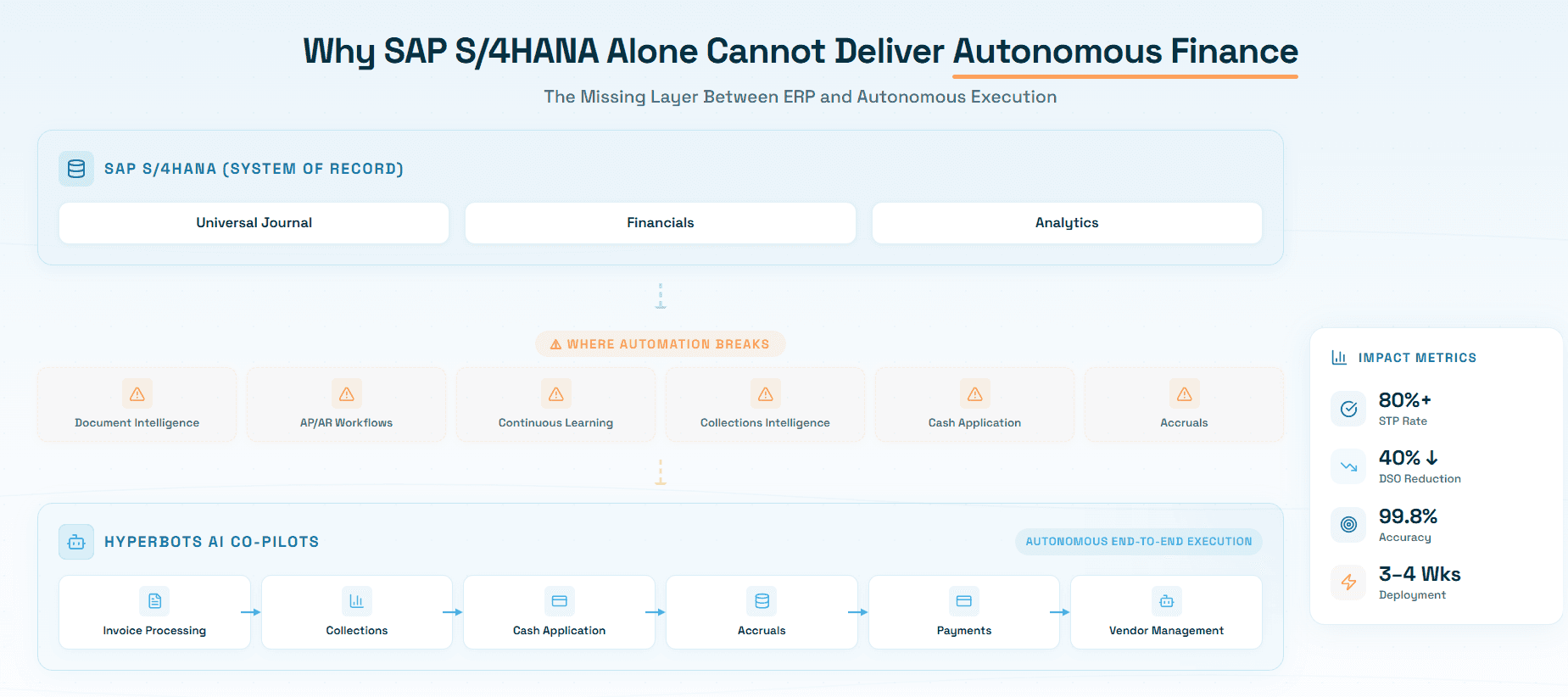
Hyperbots AI Co-Pilots: Closing Every Autonomous Finance Gap
Autonomous AP: The Procure-to-Pay Suite
Invoice Processing Co-pilot Closes Gap 1 and Gap 2 simultaneously. The only solution delivering true straight-through processing from email to SAP GL posting, with zero human intervention. Pre-trained on 35 million invoice fields, it achieves 99.8% extraction accuracy across every document format like PDF, EDI, email, portal. Performs 2-way and 3-way matching across 140+ fields against SAP PO and GRN data. Achieves 80% STP rate, reducing cycle time from 11 days to under one minute. Posts verified invoices directly to SAP FI-AP. Every decision is logged in a tamper-proof audit trail. And most importantly, it continuously learns from every invoice processed, improving accuracy and matching rates over time without manual retraining.
Vendor Management Co-pilot Delivers autonomous vendor onboarding: document collection, W-9 verification, SAP Business Partner duplicate checking, and clean ERP record creation — all without human intervention. Reduces onboarding time 8x, from nine days to under one day. Vendor data error rates drop from ~6% to under 1%. A self-service supplier portal provides real-time PO, invoice, and payment visibility, reducing inbound supplier queries.
Procurement Co-pilot Automates the full PR-to-PO lifecycle in SAP MM. Auto-fills complex procurement forms in five minutes, converts approved PRs to POs using company templates, and dispatches to vendors without human intervention. A self-learning GL recommender continuously improves coding accuracy based on historical approval patterns, a direct application of the continuous learning capability that SAP Build Process Automation does not provide.
Accruals Co-pilot Closes Gap 6 entirely. Queries SAP at month-end cut-off for all uninvoiced POs and GRNs, applies ML-based amount estimation, posts journal entries to the correct SAP GL accounts, and reverses them automatically when actual invoices arrive. Close compresses from days to hours, variance to actual consistently under 5%. This capability of fully automated, near-zero-touch accruals, does not exist anywhere else in the SAP ecosystem.
Payment Co-pilot Autonomous payment run management: scheduling, approval routing, bank file generation, fraud detection, and bank-to-SAP reconciliation. Validates vendor bank details before every payment. Optimizes payment timing for early discount capture. Detects unusual patterns in real time and alerts before payments are released.
Sales Tax Verification Co-pilot Validates sales tax compliance on every AP invoice at line-item level before SAP posting. Covers all U.S. states, continuously updates its tax database, and produces a timestamped audit trail for every decision which is integrated natively within the Invoice Processing workflow.
Autonomous AR: The Order-to-Cash Suite
Collections Co-pilot Closes Gaps 3 and 4. Reads live SAP FI-AR data and autonomously orchestrates the entire collections lifecycle. 70% of collections happen automatically without human chasing. AI continuously reprioritizes the collections workload based on behavioral payment signals, not static aging buckets. Forecasts cash inflows by customer, week, and month using behavioral prediction. Detects dispute signals before due dates and routes them automatically. Achieves 40% DSO reduction and 70% reduction in cost to collect, with 80% collections productivity improvement. All outcomes written back to SAP FI-AR in real time.
Cash Application Co-pilot Closes Gap 5. Achieves 80%+ straight-through processing on cash application, reducing unapplied cash to less than 10% and cutting reconciliation costs by up to 80%. Uses multiple matching signals such as invoice numbers, PO references, amounts, dates, customer behavior, historical patterns simultaneously to handle partial payments, deductions, short-pays, and missing remittance that SAP's standard clearing cannot manage. Pre-trained to 99.8% accuracy. SAP AR clearing documents posted automatically.
How Hyperbots Differentiates: the Autonomous Finance Benchmark
According to a January 2025 Gartner poll of 3,412 webinar attendees, only 19% of organizations had made significant investments in agentic AI, with 31% taking a wait-and-see approach or remaining unsure of how to proceed. Deloitte's 2025 Emerging Technology Trends study finds that while 30% of organizations are exploring agentic options and 38% are piloting solutions, only 11% are actively using these systems in production and 42% are still developing their agentic strategy roadmap, with 35% having no formal strategy at all. Gartner also warns that over 40% of agentic AI projects will be canceled by the end of 2027, due to escalating costs, unclear business value, or inadequate risk controls.
The message is unambiguous: most organizations are not ready to build agentic AI in-house, and many who try will fail. The viable path to production-scale autonomous finance is to partner with a purpose-built solution that is already trained, already integrated with SAP, and already proven in production, which is exactly what Hyperbots delivers.
Dimension | SAP Joule / Build PA | RPA (UiPath, AA) | Point Solutions | Hyperbots AI Co-pilots |
Autonomous end-to-end P2P | No; workflow only | No; scripts only | Partial | Yes; full lifecycle |
Autonomous end-to-end O2C | No | No | Partial | Yes; full lifecycle |
Unstructured document AI | General purpose | No | Yes, limited formats | 99.8% across all formats |
Agentic architecture | Emerging | No | Partial | Purpose-built agentic AI |
Continuous self-learning | No | No | Partial | Yes, every transaction |
Real-time bidirectional SAP | Native but limited | Batch only | Partial | Always, with write-back verification |
Handles SAP custom fields | Manual config | No | Manual | AI auto-discovers |
Invoice STP rate | 40–60% | 20–40% | 60–80% | 80%+ |
Cash application STP | 40–60% | 20–40% | 60–75% | 80%+ |
Accruals automation | Partial | No | No | Full lifecycle, unique capability |
Deployment timeline | 3–6 months | 2–4 months | 2–3 months | 3–4 weeks |
No-code, no ABAP | Requires BTP dev | No but fragile | Often requires config | Yes, always |
SOX immutable audit trail | Basic | Minimal | Basic | Full-context, tamper-proof |
The decisive differentiator is completeness. Every other tool in this comparison automates part of the autonomous finance picture. Hyperbots automates the complete picture, end-to-end P2P and end-to-end O2C, on a single agentic AI platform, integrated with SAP through native connectors, in three to five weeks, without changing a single line of ABAP.
Hyperbots Platform Capabilities: Transformational Impact
Agentic Architecture — Goals, Not Scripts Hyperbots co-pilots operate on business outcomes. When instructed to "process incoming invoices," the co-pilot does not execute a predetermined script, it reads the email, understands the document, queries SAP for matching PO and GRN data, resolves ambiguities using trained intelligence, handles exceptions, posts the result, and verifies the write-back thus, adapting to variability at every step.
Continuous Learning Loop Every transaction processed makes Hyperbots smarter. GL coding accuracy improves as the system learns approval patterns. Invoice matching rates improve as the system learns supplier document formats. Collections prioritization sharpens as the system learns customer payment behavior. This is Gap 3, continuous self-learning, solved at the process level.
SOX-Ready Immutable Audit Trail Agentic AI's ability to solve complex finance problems autonomously requires governance guardrails and without human oversight, AI agent actions can be opaque, hard to audit, and difficult to hold to account. Hyperbots addresses this directly: every autonomous action is logged in an immutable, timestamped audit trail meeting SOX, PCI-DSS, and FedRAMP standards. Every AI decision is explainable, every SAP posting is verifiable, every exception is documented.
Configurable Human-in-the-Loop Above a confidence threshold, actions are autonomous. Below it, the co-pilot surfaces the item for human review with full context and an AI recommendation. This configurable human-in-the-loop design gives finance leaders the control they need without sacrificing automation rates.
Real-Time Bidirectional SAP Integration Hyperbots connects through native SAP APIs and BAPIs, no ABAP, no custom tables. After every SAP posting, it reads the record back to verify correctness. No code changes through SAP upgrades. Deployable in two to four weeks.
Enterprise Security and Compliance ISO 27001, SOC 1 Type 2, SOC 2 Type 2 certified. Integrates with Okta, Microsoft Entra ID, Google Workspace, and OneLogin for SSO. Field-level redaction and customer-specific permissions throughout.
24/7 Autonomous Operation The autonomous finance function does not observe business hours. Hyperbots co-pilots run continuously, processing invoices overnight, applying cash on weekends, running collections follow-ups across time zones, with zero batch processing windows and zero overnight backlogs.
ROI — The Autonomous Finance Dividend
Procure-to-Pay ROI
Tangible:
80% straight-through processing on AP invoices so the majority of SAP FI-AP postings happen autonomously from day one
Invoice cycle time from 11 days to under one minute, the single most dramatic operational improvement in AP
99.8% GL coding accuracy thus eliminating reclassification journals and audit queries
Vendor onboarding 8x faster from nine days to under one day with vendor data errors under 1%
Month-end close from days to hours as accruals are booked and reversed automatically with variance under 5%
Near-zero sales tax errors with every invoice validated at line-item level and audit-ready documentation produced automatically
Deployment in 3–4 weeks with autonomous AP live within one quarter of project start
Intangible:
Finance teams shift from SAP transaction processing to strategic analysis which is exactly the talent redeployment that autonomous finance is designed to enable
SAP data quality improves as automated posting means cleaner, more current records
Supplier relationships strengthen with faster, more accurate payments with real-time visibility
Audit preparation time dramatically reduced as there’s a complete, explainable evidence for every SAP posting
Scalability without headcount: 3x volume growth absorbed without adding AP staff
Order-to-Cash ROI
Tangible:
40% reduction in DSO: AI-driven collections acting on live SAP AR data around the clock
70% reduction in cost to collect: 70% of AR activity automated without human chasing
80%+ STP on cash application: unapplied cash under 10%, reconciliation costs down 80%
80% collections team productivity improvement: human effort focused on strategic accounts
50% faster dispute resolution: early detection, automatic routing, cross-functional coordination through AI
Intangible:
Real-time cash flow forecasting — behavioral prediction models replace static SAP aging reports
Customer satisfaction improves — accurate communications, faster dispute resolution
Revenue assurance strengthens — every SAP AR item tracked and acted on
Working capital optimization: faster collections + optimized payment timing = stronger cash position
Frequently Asked Questions (FAQs)
Q1: What is autonomous finance and how does it differ from ERP automation?
Autonomous finance refers to an environment where processes and activities are partly governed and majority-operated by self-learning software agents that optimize front-, middle-, and back-office operations, not just automated, but capable of delivering augmented real-time and predictive insights, effortless compliance, and greater flexibility in financial strategy. ERP automation, including what SAP S/4HANA provides natively, automates specific, structured process steps through rules and workflows. Autonomous finance goes further: AI agents that handle unstructured inputs, make complex decisions across exception scenarios, learn from outcomes, and execute complete end-to-end workflows without human initiation.
Q2: Does SAP S/4HANA provide agentic AI capabilities?
SAP S/4HANA has introduced embedded generative AI through SAP Joule and enhanced integration with SAP Build Process Automation. These are meaningful capabilities for general ERP interaction and structured workflow automation. However, purpose-built agentic AI for specific finance processes, autonomous invoice processing at 80% STP, AI-driven collections prioritization, intelligent cash application, requires a specialized co-pilot layer. While SAP's AI features give a good head start, they are more tailored for general use to tackle issues like late payments, disputes, and cash application specifically, purpose-built AI-enhanced automation software is needed.
Q3: What does agentic AI mean in the context of AP and AR automation?
Agentic AI combines action, knowledge, and experience to perform tasks autonomously unlike RPA, which requires explicit inputs and produces predetermined outputs, or generative AI, which responds to user prompts. Agentic AI will make decisions, solve problems, and act autonomously. In autonomous AP and AR, this means an agent that reads an invoice email, extracts data, queries SAP for matching POs, handles exceptions, posts to SAP, and schedules payment — all without a human touch. Or an agent that reads SAP AR aging data, prioritizes collections actions, sends personalized dunning communications, detects dispute signals before invoices are overdue, and writes all outcomes back to SAP automatically.
Q4: Why does Hyperbots deploy in 3–4 weeks when SAP automation projects take months?
Because Hyperbots is pre-built and pre-trained. The co-pilots arrive with finance-specific AI models already trained on tens of millions of transactions with no model training phase, no ABAP development, no BTP configuration by your IT team. Integration with SAP uses pre-built API connectors. Workflow configuration is no-code. The result is a deployment that goes from kickoff to live in three to five weeks versus the three to six months typically required for native SAP automation builds on BTP.
Q5: How does Hyperbots handle the human-in-the-loop requirement for autonomous finance?
Gartner describes agentic AI interaction models where agents function with different levels of human involvement, human-in-the-loop versus human-out-of-the-loop. For finance functions, AI should automate data-driven tasks while keeping people in charge of interpretation, judgment, and accountability. Hyperbots implements this through configurable confidence thresholds: above the threshold, actions are autonomous; below it, the co-pilot surfaces the item for human review with full context and an AI recommendation. Finance leaders control exactly where the automation boundary sits.
Q6: What happens to the finance team in an autonomous finance environment?
AI agents will handle tasks autonomously, altering finance processes, vendor relationships, talent needs, and organizational structures. AI will automate many tasks, requiring finance professionals to adapt to new roles as co-workers and coordinators of AI agents. In practice, this means AP analysts who used to key invoices now manage exception queues and supplier relationships. Collections analysts who used to chase routine overdue invoices now focus on strategic account relationships and dispute resolution. Controllers who used to calculate accruals manually now review AI-generated accrual recommendations and focus on financial analysis. The function does not shrink, it elevates.
Q7: Is Hyperbots compliant with SOX and other financial audit requirements?
Yes. Every action taken by every Hyperbots co-pilot is logged in a tamper-proof, timestamped audit trail meeting SOX, PCI-DSS, and FedRAMP standards. Every AI decision includes full data lineage like what inputs were used, what logic was applied, what action was taken. This explainability is essential for autonomous finance: the next generation of CFO technologies will move from assisting to acting, enabling autonomous financial decision-making that remains fully explainable and controllable. Hyperbots delivers both autonomy and explainability.
Q8: When should a CFO start deploying autonomous AP and AR capabilities on top of SAP?
57% of finance teams are already implementing or planning to implement agentic AI. Although agentic AI is still in its early stages of development, CFOs should start preparing now to lay a foundation for future deployments and competitive advantage. The competitive reality is that organizations deploying autonomous AP and AR today are building compounding advantages: lower costs per invoice, faster cash conversion cycles, and finance teams focused on strategic work rather than manual processing. Every quarter of delay is a quarter of compounding advantage ceded to organizations that have already made the move.
SAP S/4HANA Is the Foundation But Autonomous Finance Requires More.
Cloud ERP providers are redefining intelligent process automation to handle autonomous transaction processing and AI-driven AR collections that predict payment behavior and optimize working capital, freeing finance teams to focus on strategic priorities. But realizing these benefits requires CFOs to navigate vendor hype, organizational change, and the evolving economics of AI in the enterprise.
SAP S/4HANA is an exceptional foundation for this future. Its Universal Journal, real-time HANA analytics, embedded AI, and clean-core architecture provide the data infrastructure that autonomous finance requires. What it does not provide and what no ERP vendor, by architectural design, will ever provide as a core product, is the purpose-built agentic intelligence layer that processes unstructured financial documents with 99.8% accuracy, autonomously orchestrates collections across thousands of customer accounts, applies cash from messy bank remittances without human matching, and closes the month without a controller spending days on accrual calculations.
According to the Gartner press release published August 27, 2025, a third of enterprise applications will embed agentic AI by 2030, making 15% of day-to-day work decisions autonomously and as soon as 2028, 70% of finance functions will use AI analysis for real-time decision making on operational costs and cash flow management. The organizations building that capability today by deploying Hyperbots AI Co-pilots on top of their SAP S/4HANA investment are not waiting for 2028. They are already operating with 80% invoice STP, 40% lower DSO, and month-end close measured in hours rather than days.
The autonomous finance function is not a vision statement. It is a deployment decision. And it starts by recognizing that SAP S/4HANA is the best system of record in the world and that the agentic AI layer that makes it autonomous is already available, already integrated, and deployable in weeks.