SAP S/4HANA AI: Machine Learning and the Intelligent ERP in 2026
How AI and machine learning are transforming SAP S/4HANA into a predictive, self-optimizing ERP for modern finance and operations.
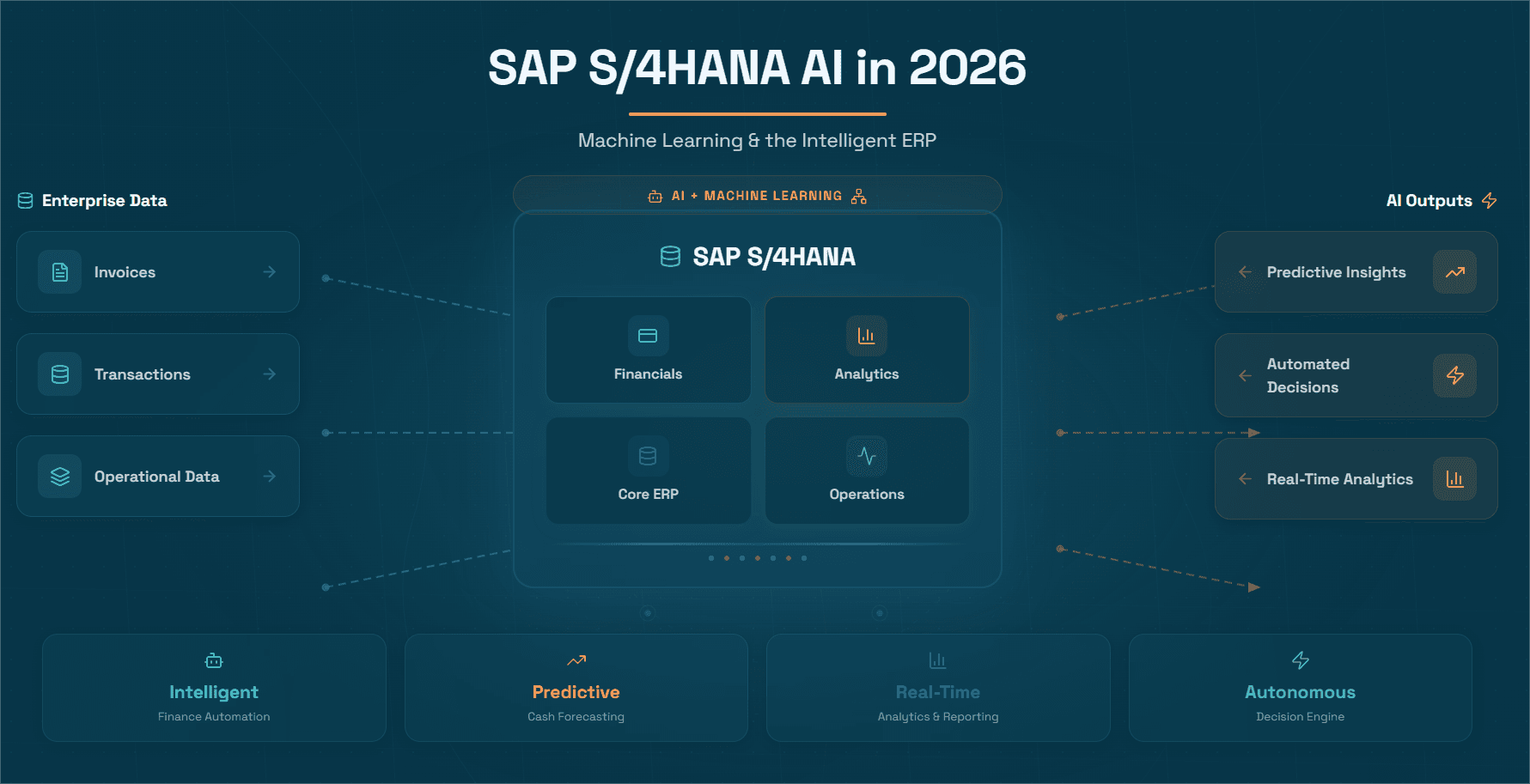
Enterprise resource planning has always been about organizing complexity. SAP started that mission in 1972, giving organizations a single system to manage finance, procurement, manufacturing, and logistics. SAP S/4HANA, launched in 2015 and continuously evolving ever since, represents the most significant architectural leap in the company's history: real-time analytics, an in-memory HANA database, and now, the deepest AI integration SAP has ever shipped.
The integration of AI, ML, and Joule in SAP S/4HANA represents a decisive shift from traditional ERP systems to intelligent enterprise platforms. With Joule acting as the intuitive interface and AI and machine learning driving predictions and automation, organizations gain a competitive edge in efficiency, decision-making, and innovation. This combination doesn't just enhance operations, it reshapes how businesses plan, execute, and evolve.
The ambition is real, and the progress is genuine. The 350 AI features, including Joule Agents, along with over 2,400 Joule skills, are already delivering unparalleled value to customers, built on the AI Foundation in SAP Business Technology Platform. At SAP Connect 2025, the company unveiled 14 new Joule Agents spanning finance, HR, procurement, supply chain, and industry-specific scenarios, each agent essentially a subject-matter expert.
But there is a gap between the headline ambition and the operational reality, particularly in finance. AI in SAP finance has advanced dramatically. It has not yet delivered the truly autonomous financial operations that CFOs and finance leaders need: invoices processed without human touch, collections running on behavioral AI, cash applied automatically from messy remittances, and accruals booked and reversed without a controller spending four days on a spreadsheet.
This guide maps the complete AI in SAP finance landscape, what machine learning and intelligent ERP capabilities SAP S/4HANA provides natively, where the gaps remain, and how Hyperbots AI Co-pilots provide the purpose-built agentic layer that closes them.
What SAP Means by "Intelligent ERP" — The Official Architecture
SAP's vision for the intelligent ERP is not a marketing language. It is a specific architectural commitment that has been executed through every S/4HANA release since 2023.
SAP S/4HANA is SAP's next-generation ERP suite that runs on the HANA in-memory database, enabling real-time analytics and transaction processing. Traditionally, ERP systems managed data and workflows but lacked predictive intelligence. Over the years, SAP has continuously enhanced S/4HANA with automation, embedded analytics, and industry-specific innovations. The integration of AI, ML, and Joule is the natural evolution of ERP, transforming it into a self-learning, autonomous system capable of making recommendations, predicting risks, and executing tasks without constant human intervention.
The intelligent ERP architecture rests on four pillars:
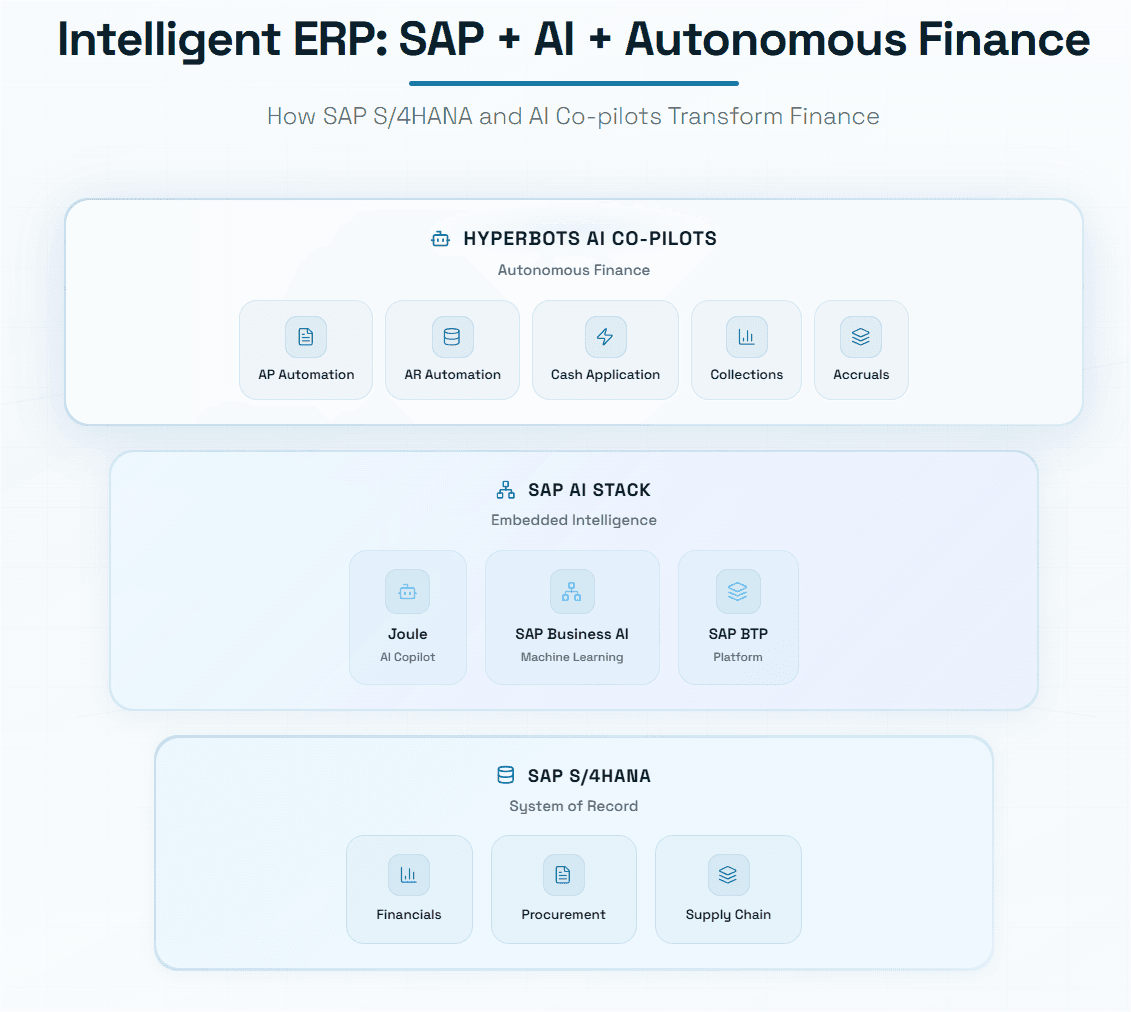
SAP Joule – the AI Copilot Layer SAP Joule is SAP's digital AI assistant designed to work seamlessly across SAP's ecosystem, including SAP S/4HANA, SuccessFactors, Ariba, and more. Unlike traditional reporting tools, Joule utilizes natural language processing (NLP), allowing users to interact with SAP systems conversationally.
Joule understands business rules, adapts to user behavior, and surfaces recommendations in real time. This supports faster, more confident decisions especially in cross-functional ERP environments where latency kills momentum. Joule is integrated into core SAP analytics and apps, enriched by the SAP Graph, and governed through LeanIX.
SAP Business – AI the Machine Learning Foundation SAP Business AI is the umbrella brand for all AI capabilities embedded in SAP applications. SAP's generative AI hub includes the latest frontier models from Mistral, OpenAI, Gemini, and Anthropic thus allowing customers to implement the model that best suits their specific use cases. This multi-model architecture means SAP is not locked into a single AI vendor but can deploy the best available model for each specific finance or operations use case.
SAP Business Technology Platform (BTP) – the AI Development Layer BTP is where SAP's AI Foundation lives, the platform through which Joule agents are built, deployed, and managed. In Q4 2024, SAP released Joule Studio in SAP Build, providing a low-code/no-code environment for businesses to create, deploy, monitor, and manage custom Joule skills. This allows organizations to extend standard Joule capabilities with company-specific AI workflows, though it requires BTP licensing and developer resource investment.
SAP Business Data Cloud – the Intelligence Data Layer The SAP Snowflake partnership enables zero-copy data sharing across Snowflake and SAP Business Data Cloud, allowing customers to integrate their existing Snowflake instances with SAP BDC for seamless, real-time access to combined, semantically rich SAP and non-SAP data. This data architecture is essential for machine learning in intelligent ERP because AI is only as good as the data it can access.
AI in SAP Finance — What Machine Learning Delivers Today
AI-Assisted Financial Insights and the Virtual Analyst
Features like AI-Assisted Financial Insights, also known as the "Virtual Analyst", provide real-time explanations of financial data, uncovering dependencies and suggesting actionable insights to improve decision-making. Finance teams can ask Joule questions in natural language like "Why did our margin in EMEA decline last quarter?" and receive contextual, data-grounded responses without building a new report or engaging the BI team.
Joule allows users to perform CRUD operations and manage financial documents via natural language, imagine asking: "Post a vendor invoice of $5,000 to account X with due date Y." This conversational interface dramatically reduces the training burden on finance users and makes SAP more accessible to occasional users who do not know the specific transaction codes for every operation.
Allocation Run Analysis
Business analysts and cost accountants now gain immediate clarity into their financial data with a new Joule feature for allocation run results. This capability allows them to efficiently view amounts allocated across diverse objects including cost centers, profitability objects, or profit centers and quickly navigate to detailed run reports for in-depth review. This streamlined access results in an up to 70% decrease in time spent on allocation result analysis and up to 40% faster resolution of allocation issues.
For management accountants who previously spent hours reconciling cost allocations across company codes, this is a genuinely meaningful improvement. The machine learning capability here is not just answering questions, it is surfacing anomalies and highlighting allocations that look unusual compared to historical patterns.
AI-Assisted Journal Upload
The 2025 release of SAP S/4HANA introduced AI-assisted journal upload that accelerates manual journal processing with validations, mass editing, and workflow approvals. Finance teams can upload journals with AI validation running in parallel, catching coding errors, duplicate entries, and policy violations before they hit the GL, rather than after the period has closed.
Accruals Management and Period-End Automation
The Q4 2025 SAP Business AI release introduced a dedicated Accounting Accruals Agent. In finance, a Cash Management Agent can reason over daily bank statements and automate reconciliations, potentially saving up to 70% of the time finance teams spend on manual cash positioning tasks. These are meaningful SAP-native automation capabilities — though as we discuss later, they address only portions of the full accruals and cash management challenge that finance teams face.
Master Data Intelligence
Sales managers, procurement specialists, and other business users utilizing SAP Master Data Governance on SAP S/4HANA Cloud Private Edition can now streamline master data tasks with Joule. This capability enables them to interact with Master Data Governance functions using natural language processing seamlessly searching, displaying, submitting new business partners, and modifying existing ones, resulting in a reduction of up to 85% in effort for managing master data and a decrease of up to 10% in annual operating income loss due to delayed or incorrect updates.
The machine learning dimension here is significant: Joule learns from master data governance patterns to proactively identify records that need updating rather than waiting for a user to notice an error.
AI-Assisted Tax Configuration
AI-Assisted Configuration for US Tax Jurisdictions automates complex tax setups, reducing errors and accelerating processes, a vital tool for multinational companies. For organizations operating across multiple US states with different tax rules, this embedded machine learning capability reduces the configuration burden significantly.
Predictive Procurement and Purchase Requisitions
SAP plans AI-assisted creation of purchase requisitions where Joule helps generate them without navigating complex user interfaces. Input can be given in natural language for example, a request like "I need ten laptops for the sales team" is automatically recognized, correctly mapped, and created as a structured purchase requisition in the system. This reduces manual effort and minimizes free-text entries that would otherwise need time-consuming review and assignment. In the long term, even voice-driven input is planned.
Where AI in SAP Finance Still Falls Short
The progress above is genuine. The gap is also genuine. Understanding both honestly is essential for finance leaders who need to make real investment decisions about AI in SAP finance.
The Adoption Gap Is Wider Than SAP's Roadmap Suggests
Six out of ten companies that are transitioning to S/4HANA and could implement Joule without significant additional resource expenditure consider themselves "not agile, efficient, and flexible enough" to manage coupling SAP's flagship cloud ERP with its AI copilot offering. According to the survey of 200 companies worldwide with annual turnover of €200 million, even without extensive AI add-ons, system migration often proves more challenging than initially anticipated with nearly half of all companies (46%) stating they would subsequently allocate more time and a larger budget.
The practical implication: organizations that are excited about SAP's AI roadmap often cannot execute on it because their S/4HANA implementations are consuming every available resource and budget. The AI in SAP finance vision and the operational reality of SAP migration are frequently in tension.
Joule Has Specific Deployment Constraints
Joule is not supported on on-premise S/4HANA. SAP has confirmed it is not on the current roadmap for classic on-premise systems. Joule arrived as part of the Public Cloud starting around Q3 2024. For Private Cloud, Joule is available but requires setup and configuration, it is not automatically active. You must enable it via SAP BTP and Joule Studio, with technical prerequisites including ensuring the UI5 version in your system meets or exceeds the minimum required for Joule integration.
This means a significant proportion of the SAP S/4HANA base, particularly on-premise and Private Cloud customers, cannot access Joule's AI capabilities without additional technical investment. For organizations mid-migration or running on-premise SAP, AI in SAP finance is not a switch they can flip.
SAP's AI Is General Purpose — Finance Needs Specialist Intelligence
SAP's current roadmap clearly shows that artificial intelligence is deeply embedded in the SAP strategy. For users of SAP solutions, especially SAP S/4HANA, AI will gradually become a core part of daily work. The word "gradually" is key. SAP's AI covers dozens of use cases across finance, HR, procurement, supply chain, and beyond. It is necessarily general-purpose, designed for the full breadth of SAP's customer base.
Finance automation, specifically autonomous AP and AR, requires specialist intelligence: models trained on tens of millions of invoice fields, collections agents trained on customer payment behavior patterns, cash application models trained on messy real-world bank remittances. This depth of finance-specific training is not what SAP Business AI provides. SAP provides the intelligent ERP platform. The specialist finance AI layer requires a dedicated co-pilot.
Machine Learning in SAP Does Not Self-Learn from Your Data
SAP's embedded machine learning models are trained on SAP's aggregate datasets and updated through the standard product release cycle. They do not continuously learn from your organization's specific transaction patterns, your supplier invoice formats, your customers' payment behavior, your team's GL coding decisions. Genuine intelligent ERP for finance requires exactly this kind of continuous, organization-specific learning, not periodic model updates from SAP's product team.
The Specialist AI Layer — Where Hyperbots Completes the Intelligent ERP Picture
SAP is doubling down on its AI-first promise with Joule Everywhere, a major 2025 update that embeds generative AI agents across the entire SAP ecosystem. Joule has evolved into an agentic AI network, capable of reasoning across systems, initiating action, and collaborating with users in natural language.
This is the right architectural direction. And it creates the context in which Hyperbots AI Co-pilots deliver their greatest value: as the specialist agentic finance layer that integrates with SAP S/4HANA, extends its AI capabilities into the high-volume, high-judgment finance processes that SAP's general-purpose AI cannot fully address, and delivers production-grade autonomous finance within weeks of deployment.
The shift from process automation to decision co-piloting means enterprises can move beyond workflow automation and into intelligent co-piloting, Joule understands business rules, adapts to user behavior, and surfaces recommendations in real time. Hyperbots takes this further: it does not just surface recommendations, it acts on them autonomously, posting invoices to SAP, routing collections follow-ups, applying cash to open AR items, booking accruals to the GL, and verifying every write-back without human intervention.
Hyperbots AI Co-Pilots — Specialist AI in SAP Finance, End to End
Procure-to-Pay — Intelligent AP Automation
Where SAP Joule can help users submit invoices via natural language, Hyperbots goes further: it autonomously captures, classifies, extracts, validates, matches, and posts invoices with no human initiation required at any step. Pre-trained on 35 million invoice fields with 99.8% extraction accuracy across PDF, EDI, email, and portal, it performs 2-way and 3-way matching across 140+ fields against SAP PO and GRN data and posts directly to SAP FI-AP.
The machine learning dimension: the Co-pilot continuously learns from every invoice processed thus improving supplier-specific extraction rules, GL coding accuracy, and exception handling without manual retraining. The result is 80% straight-through processing and cycle time from 11 days to under one minute. This is AI in SAP finance at production scale, not a roadmap feature, but a live capability deployable in two to three weeks.
SAP Joule's master data capabilities reduce effort for managing Business Partner records. Hyperbots automates the entire vendor onboarding lifecycle: document collection, W-9 verification, duplicate checking against the SAP vendor master, and clean ERP record creation, all autonomously. Onboarding time drops 8x, from nine days to under one day. Vendor data error rates fall from ~6% to under 1%.
Where SAP plans natural language purchase requisition creation through Joule, Hyperbots already automates the complete PR-to-PO lifecycle end to end in SAP MM, auto-filling procurement forms in five minutes, converting approved PRs to POs using company templates, and dispatching to vendors automatically. A self-learning GL recommender continuously improves coding accuracy based on historical approval patterns which is exactly the kind of organization-specific machine learning that SAP's general-purpose AI does not provide.
SAP's Q4 2025 Accounting Accruals Agent is a meaningful step forward. Hyperbots goes further: it queries SAP at month-end cut-off for all uninvoiced POs and GRNs, calculates accrual amounts using ML models trained on your historical patterns, posts journal entries to the correct SAP GL accounts, and reverses them automatically when actual invoices arrive. Close compresses from days to hours, with variance to actual consistently under 5%. This end-to-end, near-zero-touch accruals capability is unique in the intelligent ERP market, there is no equivalent elsewhere in the SAP ecosystem.
Manages the complete SAP payment run autonomously: scheduling, approval routing, bank file generation, fraud detection, and bank-to-SAP reconciliation. Machine learning optimizes payment timing to capture early payment discounts while maintaining cash flow targets. Validates vendor bank details before every payment. Detects unusual payment patterns in real time.
Where SAP provides AI-assisted configuration for US tax jurisdictions, Hyperbots validates sales tax compliance on every AP invoice at line-item level before SAP posting in production, on every transaction. Covers all U.S. states, continuously updates its tax database, and produces a timestamped audit trail for every classification decision. Natively integrated within the Invoice Processing workflow so tax verification adds zero additional process steps.
Order-to-Cash — Intelligent AR Automation
SAP's Cash Management Agent can reason over daily bank statements and automate reconciliations. The Hyperbots Collections Co-pilot does something categorically different: it reads live SAP FI-AR data and autonomously orchestrates the entire collections lifecycle such as dynamic prioritization, dunning, dispute detection, promise-to-pay management, and ERP write-back. 70% of collections happen automatically without human chasing, delivering 40% DSO reduction and 70% reduction in cost to collect. The machine learning engine continuously reprioritizes the collector workload based on behavioral payment signals thus predicting which customer will pay, which is at risk, and which invoice should be escalated now versus in three days. This is AI in SAP finance applied to the full AR lifecycle, not just a single reconciliation task.
Achieves 80%+ straight-through processing on cash application, compared to SAP's standard clearing which handles only clean, well-matched payments. The machine learning architecture uses multiple matching signals simultaneously like invoice numbers, PO references, amounts, dates, customer behavior, and historical patterns, handling the full complexity of real-world cash application: partial payments, deductions, short-pays, missing remittance. Reduces unapplied cash to less than 10% and cuts reconciliation costs by up to 80%. SAP AR clearing documents posted automatically at 99.8% accuracy.
Hyperbots vs. SAP Native AI — Where Specialist Intelligence Wins
Dimension | SAP Joule / Business AI | Hyperbots AI Co-pilots |
AI architecture | Generative AI + rules + ML | Agentic LLM-powered specialist AI |
Finance process coverage | Cross-functional, general purpose | End-to-end P2P and O2C specialist |
Invoice STP rate | 40–60% | 80%+ |
Cash application STP | 40–60% | 80%+ |
Continuous self-learning | No — periodic SAP updates | Yes — every transaction |
Available on-premise SAP | Not supported | Yes — ECC and S/4HANA both |
Requires BTP setup | Yes for Joule | No — pre-built API connectors |
Deployment timeline | 3–6 months | 3–4 weeks |
Handles SAP custom fields | Manual configuration | AI auto-discovers |
Accruals full automation | Partial — Accruals Agent | Full lifecycle, unique capability |
SOX audit trail | Basic | Immutable, full-context |
Self-learning from org data | No | Yes — continuously |
Autonomous ERP write-back | Limited | Always, with verification loop |
The relationship is complementary, not competitive. SAP Joule makes the S/4HANA interface more intelligent and accessible. Hyperbots makes the financial processes that run through S/4HANA autonomous. Organizations that deploy both get the full intelligent ERP picture: an accessible, AI-assisted interface for the humans who interact with SAP, and an autonomous AI layer that handles the high-volume financial workflows without human initiation.
Hyperbots Platform Capabilities: Transformational Impact in Intelligent ERP Environments
Finance-Specialist Machine Learning: Where SAP's machine learning models are trained across the full breadth of SAP's product portfolio, every Hyperbots model is trained specifically on finance data: invoice fields, supplier document formats, customer payment behavior, GL coding patterns, and bank remittance structures. This specialist training is the reason Hyperbots achieves 99.8% extraction accuracy and 80%+ STP, performance that general-purpose AI in SAP finance consistently falls short of.
Continuous Organizational Learning: Every transaction processed by Hyperbots improves its models for your organization specifically. GL coding accuracy improves as the system learns your approval patterns. Matching rates improve as it learns your supplier formats. Collections prioritization sharpens as it learns your customer payment behavior. This is machine learning applied at the process level, not periodic model updates from SAP's product team.
Real-Time Bidirectional SAP Integration: Hyperbots connects to SAP S/4HANA through native APIs and BAPIs which read financial data in real time and write back verified results. After every posting, Hyperbots reads the SAP record back to confirm correctness. No ABAP. No custom tables. No code changes through SAP upgrades. Deployable on both SAP on-premise and S/4HANA Cloud, including environments where Joule is not yet available.
SOX-Ready Explainable AI: Every AI decision made by every Hyperbots co-pilot is logged in an immutable, timestamped audit trail, what inputs were used, what logic was applied, what confidence score was assigned, what action was taken. This explainability is essential for AI in SAP finance: autonomous actions need to be as auditable as manual ones. The audit trail meets SOX, PCI-DSS, and FedRAMP standards.
Configurable Human-in-the-Loop: Finance leaders set confidence thresholds for each co-pilot. Above the threshold, actions are autonomous. Below it, the co-pilot surfaces the item for human review with full context and a recommendation. This configurable design means automation rates can be tuned to the risk tolerance of each organization, each process, and each transaction type.
24/7 Operation – Intelligence That Does Not Sleep: SAP S/4HANA Cloud already includes powerful embedded AI features that drive business process automation and enable faster, data-driven decision-making. Hyperbots extends this with 24/7 autonomous operation, processing invoices overnight, applying cash on weekends, running collections follow-ups across time zones with zero batch processing windows and zero overnight backlogs.
Works Across the SAP Migration Journey Hyperbots supports both SAP ECC and S/4HANA which means organizations mid-migration can deploy co-pilots on their current ECC system today, realize immediate ROI during the migration period, and carry the same deployment to S/4HANA at go-live.
ROI — What AI in SAP Finance Delivers with Hyperbots
Procure-to-Pay ROI
Tangible:
80% straight-through processing on AP invoices, the majority of SAP FI-AP postings happen autonomously from day one, regardless of Joule availability in your S/4HANA environment
Invoice cycle time from 11 days to under one minute, the most dramatic operational improvement in AP that AI in SAP finance delivers
99.8% GL coding accuracy on SAP postings, machine learning applied to your specific chart of accounts, eliminating reclassification journals
Vendor onboarding 8x faster from nine days to under one day, vendor data errors reduced to under 1%
Month-end close from days to hours as accruals are booked and reversed automatically in SAP GL with variance to actual under 5%
Near-zero sales tax errors as every AP invoice validated at line-item level before SAP posting, with full audit documentation
Deployment in 3-4 weeks with intelligent ERP finance automation live within one quarter, regardless of S/4HANA migration status
Intangible:
Finance teams shift from SAP transaction processing to strategic analysis, the talent redeployment that intelligent ERP was always supposed to enable
SAP data quality improves continuously, automated posting means cleaner, more current records for analytics and reporting
Supplier relationships strengthen through faster, more accurate payments with real-time portal visibility
Policy-driven AI creates compounding productivity improvement over time as models learn from every interaction
Order-to-Cash ROI
Tangible:
40% reduction in DSO — AI-driven collections acting on live SAP AR data continuously, not in batch
70% reduction in cost to collect — 70% of AR activity automated, AI handles routine follow-up
80%+ STP on cash application — unapplied cash under 10%, reconciliation costs down 80%
80% collections team productivity improvement — human focus on strategic, high-value accounts
50% faster dispute resolution — early AI detection, automatic routing, cross-functional coordination
Intangible:
Real-time cash flow forecasting from live SAP AR behavioral data — replacing static aging reports
Customer satisfaction improves — accurate, AI-driven communications, faster dispute resolution
Revenue assurance strengthens — every open SAP AR item tracked and acted on
Credit risk visibility improves — delinquency signals surfaced before they become write-offs
Intelligent ERP Requires Both SAP's Platform and Specialist Finance AI
As enterprises prepare for the future, adopting SAP S/4HANA enhanced with AI and Joule is no longer optional, it is essential for staying ahead in a data-driven world. That assessment is correct. SAP's investment in AI in SAP finance, through Joule, SAP Business AI, BTP, and the expanding library of Joule Agents, is building the most comprehensive intelligent ERP platform in the enterprise market.
But the intelligent ERP vision is complete only when the financial processes that run through it are also autonomous. While fully self-managing ERP systems might still be a long way off, we can expect steady improvements that make S/4HANA more intelligent and adaptable. Finance leaders cannot wait for "steady improvements" to resolve invoice processing backlogs, DSO problems, and month-end close pain that exist today.
Hyperbots is the specialist AI layer that makes intelligent ERP a financial operations reality today, not on the next SAP release roadmap. It deploys on top of your existing SAP S/4HANA or ECC environment in three to five weeks. It requires no ABAP, no BTP setup, and no change to your SAP configuration. And it delivers the autonomous finance outcomes that SAP's general-purpose machine learning cannot: 80% invoice STP, 40% DSO reduction, month-end close in hours, cash application at 80%+ STP, all writing back to SAP with full explainability and a tamper-proof audit trail.
The intelligent ERP is SAP S/4HANA plus Hyperbots. Together, they deliver what neither delivers alone: a financial management platform that is not just intelligent but truly autonomous.
Frequently Asked Questions (FAQs)
Q1: What is SAP Joule and how does it deliver AI in SAP finance?
SAP Joule is SAP's digital AI assistant designed to work seamlessly across SAP's ecosystem. It utilizes natural language processing, allowing users to interact with SAP systems conversationally. In finance specifically, Joule provides conversational access to financial data, AI-assisted journal uploads, allocation run analysis, and, through dedicated Joule Agents, cash management automation and accruals support. It represents the intelligent interface layer of SAP S/4HANA, making the ERP more accessible and analytically capable without requiring deep SAP expertise for every query.
Q2: What machine learning capabilities does SAP S/4HANA have natively?
AI-powered features now available in S/4HANA include AI-Assisted Financial Insights (the Virtual Analyst), AI-Assisted Configuration for US Tax Jurisdictions, AI-Assisted Error Resolution, and Predictive Maintenance. The Q4 2025 release extended this with an Accounting Accruals Agent and Cash Management Agent. These capabilities cover a broad range of use cases but at a general-purpose level that does not match the specialist accuracy required for high-volume, autonomous financial processes like invoice STP, cash application, and behavioral collections.
Q3: Does SAP Joule work on on-premise SAP S/4HANA?
Joule is not supported on on-premises S/4HANA. SAP has confirmed it is not on the current roadmap for classic on-premise systems. For Private Cloud, Joule is available but not automatic, it requires UI compliance and setup via BTP. For Public Cloud starting from release 2408, Joule is supported with proper entitlement. Organizations running on-premise SAP cannot access Joule's AI capabilities without migrating to a cloud deployment. Hyperbots, by contrast, supports both on-premise SAP ECC and all S/4HANA editions.
Q4: How does Hyperbots complement rather than compete with SAP Joule?
SAP Joule makes the S/4HANA interface more intelligent: users can query financial data in natural language, get contextual recommendations, and execute routine SAP tasks without knowing transaction codes. Hyperbots makes financial processes autonomous: it processes invoices without human initiation, applies cash without human matching, and orchestrates collections without human follow-up. The two capabilities are complementary, Joule improves how humans interact with SAP; Hyperbots reduces how often humans need to interact with SAP at all for routine financial processes.
Q5: Why does Hyperbots achieve higher STP rates than SAP native AI for invoices?
Because Hyperbots is a specialist system. Its extraction models are pre-trained on 35 million invoice fields specifically, not on generic SAP data. Its matching logic covers 140+ invoice fields with configurable 2-way and 3-way matching rules. Its exception handling uses LLM-powered reasoning to resolve ambiguous matches rather than defaulting to a human queue. SAP Document AI is a generalist document processing tool applied to a broad range of document types. Specialist training on finance documents produces specialist accuracy and that is the difference between 40–60% STP and 80%+ STP in production.
Q6: Can Hyperbots be deployed before an organization finishes its S/4HANA migration?
Yes and this is one of Hyperbots' most practically important advantages. Hyperbots supports both SAP ECC and all S/4HANA editions. Organizations can deploy invoice processing, vendor management, and collections co-pilots on their current ECC system today, realizing immediate ROI during the migration period and carry the same deployment to S/4HANA at go-live without re-implementation.
Q7: How does Hyperbots' machine learning differ from SAP's embedded ML?
SAP's machine learning models are trained on SAP's aggregate datasets and updated through the standard product release cycle. Hyperbots co-pilots learn continuously from your organization's specific data: your supplier invoice formats, your customers' payment patterns, your team's GL coding decisions, your approval workflow outcomes. This continuous, organization-specific learning is why Hyperbots' accuracy and automation rates improve over time and why they can exceed the performance of SAP's general-purpose ML from the very first week of deployment.
Q8: Is Hyperbots compliant with SAP's clean core principles?
Yes. Hyperbots integrates with SAP through standard, documented APIs and BAPIs, not through custom ABAP code, Z-tables, or undocumented interfaces. This means Hyperbots is fully aligned with SAP's clean core strategy: it adds specialist AI capabilities on top of S/4HANA without modifying the SAP system itself. When SAP releases updates, Hyperbots continues working without code changes, fully upgrade-safe and fully clean-core compliant.