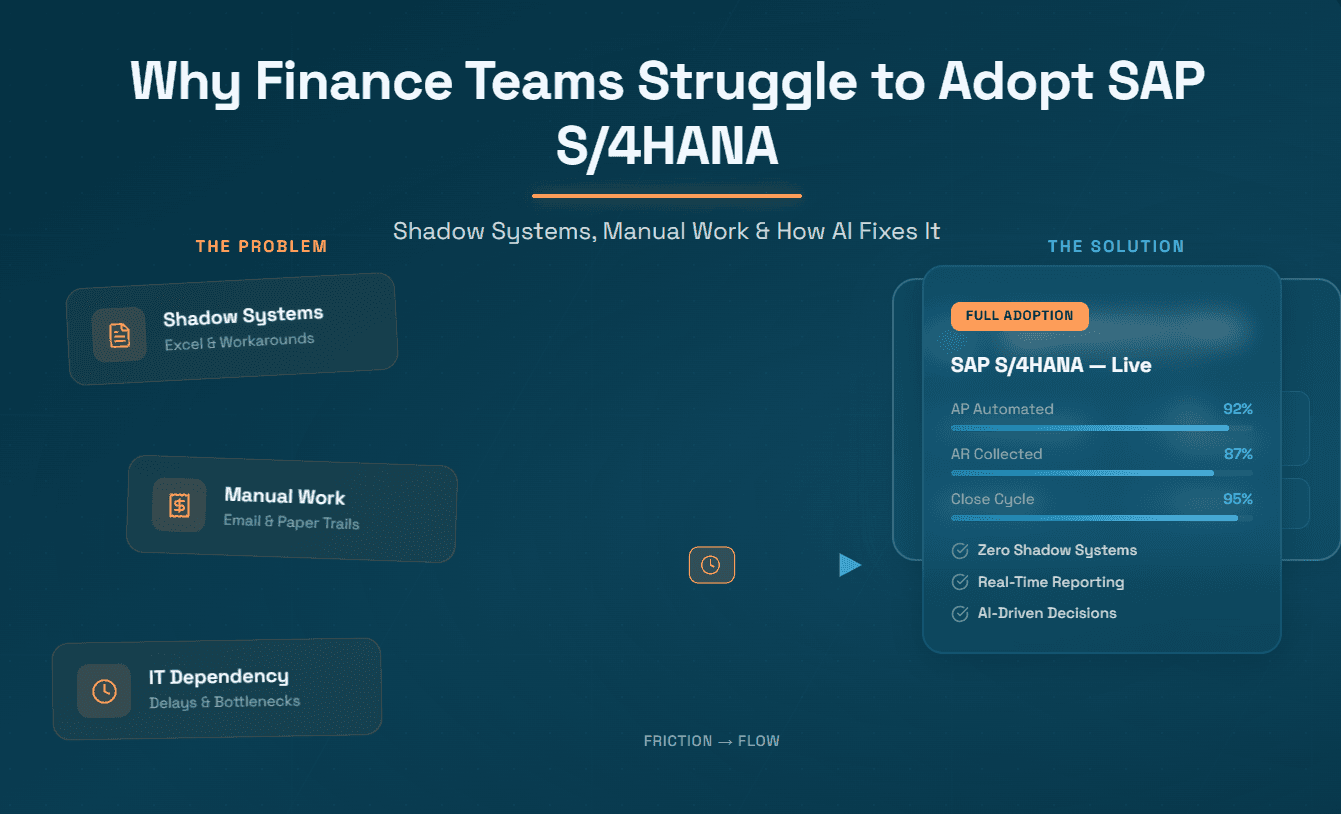
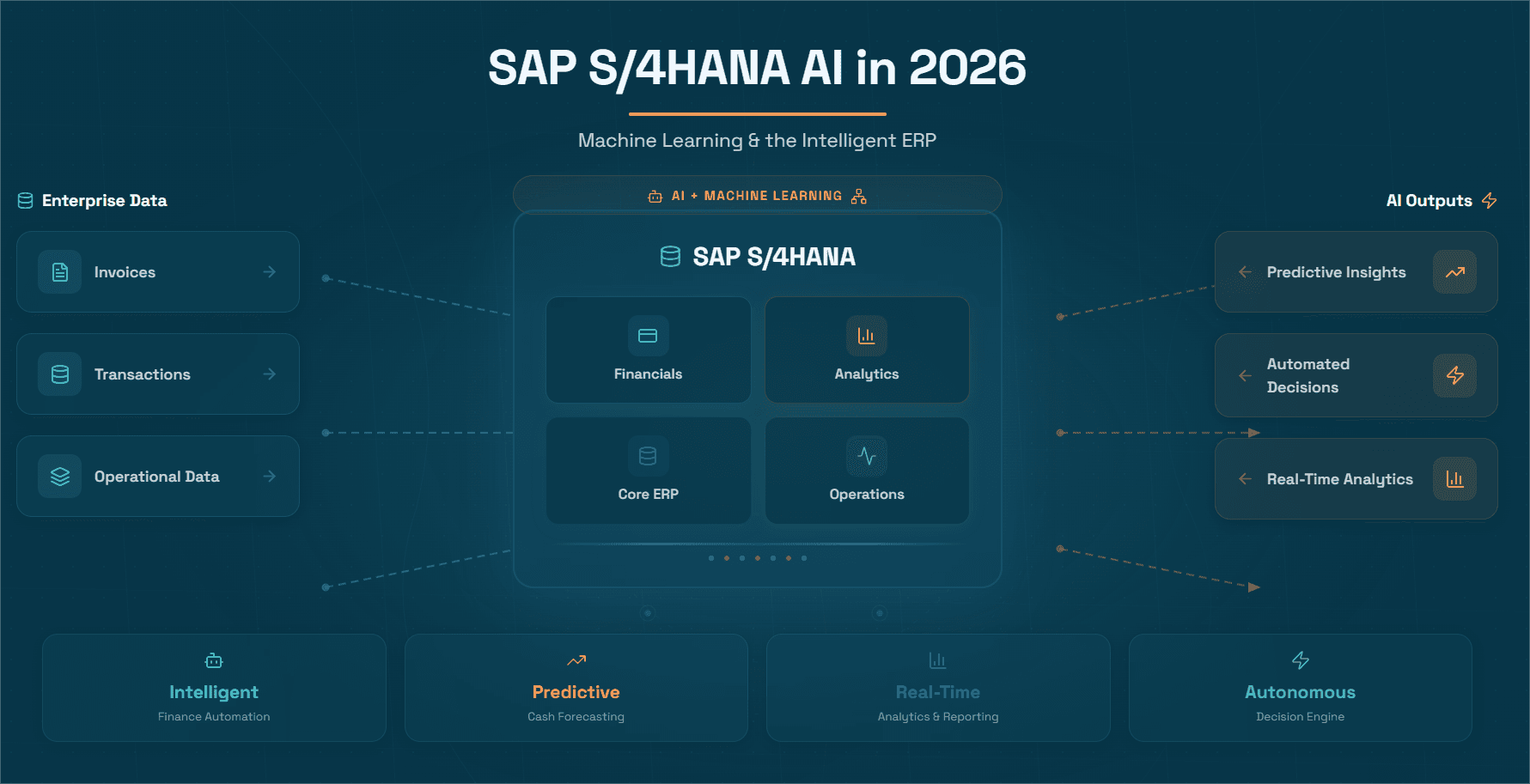
Why Finance Teams Bear the Cost of Poor SAP S/4HANA Testing
How gaps in SAP S/4HANA testing—from UAT to regression—create costly downstream risks for finance teams.
The SAP go-live date is circled in red on the project calendar. Months of configuration, data migration work, and integration development have led to this moment. The steering committee is satisfied. The project manager has declared readiness. The business is exciting.
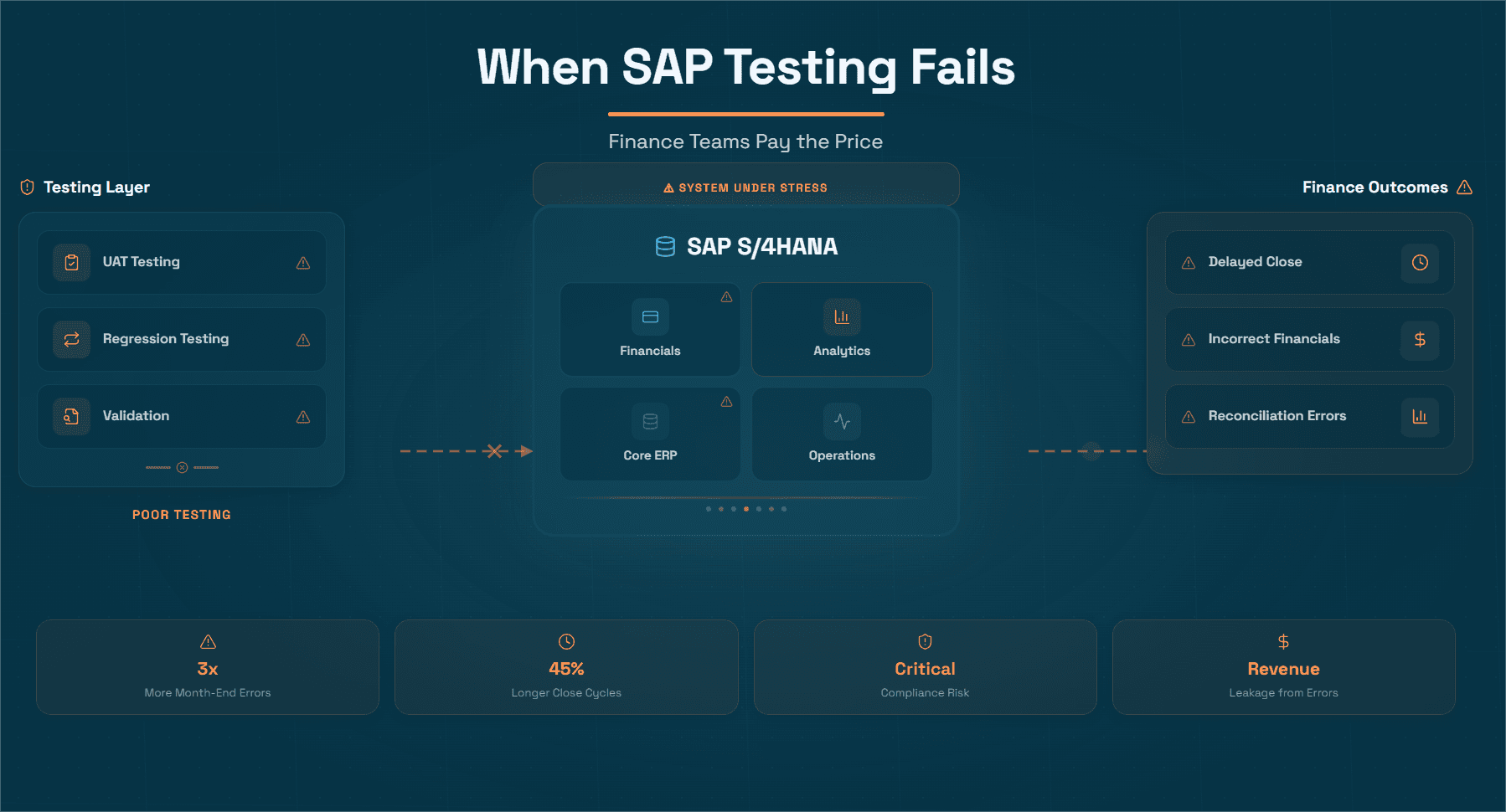
Then, three days after go-live, the AP team cannot post invoices. The 3-way matching logic is throwing errors on every PO line with more than five items. The GL coding on every auto-posted journal entry from the third-party procurement system is mapping to the wrong cost center. The month-end accrual run produces results that the controller cannot reconcile to the prior period. And the collections team discovers that the dunning configuration is sending letters to customers whose accounts are current.
None of these defects appeared in testing. Or more precisely: none of these defects were caught in testing because the testing was inadequate, rushed, or finance-business-users were not meaningfully involved.
According to a Horvath survey of 200 executives cited by CIO.com, almost 60% of companies that have completed their S/4HANA transformation ended up exceeding their planned schedule, with quality and budget driven largely by project scope expanding and weak project management.
According to Qualitest Group, 60% of S/4HANA migration organizations face quality issues and almost always run over budget thus, making these transformations the largest, most complex, and most expensive ever undertaken.
As Andagon's SAP testing specialists summarize, a central reason for difficulties in S/4HANA migrations is insufficient or delayed testing as documentation remains incomplete, testing is mostly manual, and clear quality criteria are often lacking, directly causing business operations to be unexpectedly disrupted and the accuracy of financial reporting to suffer.
The cost of poor testing is never borne by the testing team. It is borne by finance. Controllers scrambling to close a broken GL. AP teams manually process invoices that the system cannot handle. Collections analysts working from AR aging data they cannot trust. Month-end close taking twice as long because the accruals automation is not working as configured.
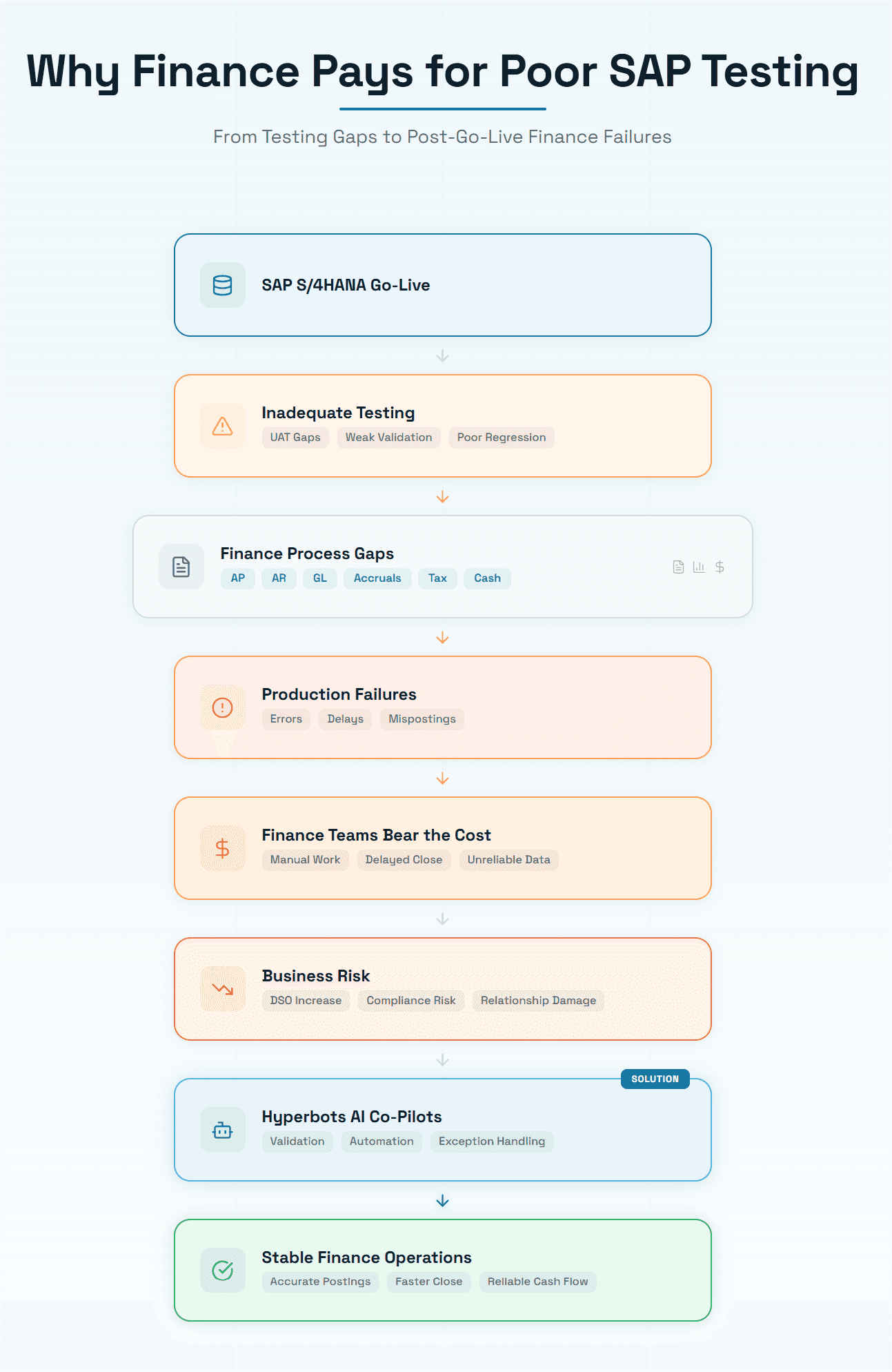
This blog explains exactly how and why finance teams end up paying for inadequate SAP UAT testing, finance validation gaps, and regression testing failures and how deploying Hyperbots AI Co-pilots as the intelligent automation layer on top of SAP transforms the risk profile of every finance process from the moment the system goes live.
Why SAP S/4HANA Testing Is Different and Harder Than Most Teams Expect
The Scope Is Vastly Larger Than Legacy ERP Testing
SAP is a mission-critical ERP system used by over 440,000 organizations worldwide to manage core business functions. From finance to supply chain and human capital, SAP integrates processes across departments and geographies. Given this scale, even a minor failure can cause major disruption.
The migration from SAP ECC to S/4HANA is not a simple upgrade. When you move from SAP ECC to S/4HANA, you're switching to an entirely different way SAP handles data. The simplified data model removed thousands of duplicate tables. Your custom code that relied on old tables needs updates, and testing must verify that business processes work correctly without data loss.
This means that finance validation testing in an S/4HANA migration is not just re-running the existing ECC test scripts with new transaction codes. It is validating an entirely new data architecture, the Universal Journal (ACDOCA) that replaces multiple separate tables, the new asset accounting model, the simplified profit center accounting, and the reimagined credit management framework. Every finance process has changed at some level, and every changed process needs to be validated against real-world financial scenarios.
Manual testing accounts for between 25% and 30% of total SAP project costs, and many organizations still rely on it which is time-consuming and error-prone. For S/4HANA upgrades, a comprehensive testing approach must span multiple layers: unit testing of custom code, integration testing across modules, regression testing of existing functionality, performance testing for scalability, user acceptance testing for business validation, and security and compliance testing.
Quality Takes a Hit When Migration Volume Peaks
The move to SAP S/4HANA is inevitable as the 2027 deadline approaches. The more conversion projects there are, the more demand for the workforce which means more cost and less quality. Quality takes a toll during the testing phase, which is the phase that decides the success or failure of an S/4HANA conversion project.
This is the painful paradox of the 2026 SAP migration wave: the urgency of the 2027 ECC support deadline is compressing timelines precisely when more rigorous testing is needed. Organizations starting migrations now face constrained testing windows, limited availability of SAP testing specialists, and business stakeholders who are asked to conduct UAT testing while simultaneously managing their day jobs.
Initiating testing too late in the lifecycle, over-relying on manual validation, neglecting integration scenarios, weak business involvement in UAT, and lack of ownership for test data, these are the gaps that create avoidable production disruptions and long-term instability. And they are gaps that disproportionately affect finance, because finance processes are the most interdependent, most data-sensitive, and most compliance-critical workflows in the entire SAP landscape.
The Six Finance Validation Gaps That Cost the Most
Gap 1: AP Invoice Processing Validation
The accounts payable invoice processing workflow is the highest-volume, most-customized financial process in most SAP environments. It involves dozens of configuration decisions: which document types trigger 3-way matching, what tolerance thresholds allow posting without exception, how duplicate invoice detection is configured, which GL accounts receive which cost center assignments from which vendor categories.
An unverified finance update could delay financial closes or misstate tax liabilities. Excluding business users from UAT means critical workflow misalignments may go unnoticed without user involvement. UAT should reflect real scenarios, compliance, and user expectations.
The failure mode in AP validation is almost always the same: test scripts are written around clean, standard invoices that match perfectly to POs. The 20% of invoices that are non-PO, the invoices from vendors whose document format is unusual, the credit memos, the partial deliveries, these are never included in the UAT test library. They are discovered in production, by the AP team, on day three of go-live.
The downstream cost: AP team manually processing backlogged invoices while defects are investigated and fixed. Payments delayed. Supplier relationships strained. Early payment discount windows missed. Controllers unable to close the period because the AP subledger has unposted items.
Gap 2: GL Coding and Cost Center Assignment Regression
Every SAP S/4HANA migration involves changes to the chart of accounts, cost center structure, profit center hierarchy, or all three. Regression testing in this area means validating that every automated posting, from AP invoices, from SD billing documents, from payroll, from asset depreciation, still lands on the correct GL account and cost center in the new system.
The data model change means reports and custom programs accessing deprecated tables may produce inaccurate results. Regression testing must verify through reconciliation that new CDS views produce the same output as the legacy table reads they replace.
In finance terms, this is the difference between management accounts that are reliable and management accounts that need three days of manual adjustment before they can be distributed to budget holders. Organizations that do not run adequate GL regression testing frequently discover material mispostings in the first month-end close after go-live at exactly the moment when the close is already under maximum stress.
The downstream cost: Controllers spending days investigating GL variances. Management accounts delayed. Budget reporting is unreliable. Potential restatement risk if the mispostings are material.
Gap 3: Accruals and Period-End Close Validation
The month-end accruals process involves some of the most complex logic in the SAP finance configuration: which open POs trigger GRNI accruals, what calculation method is used for SRNI (Services Received Not Invoiced), how recurring accruals for SaaS and rent are configured, and how the reversal documents are created in the subsequent period.
UAT testing in SAP must simulate real business conditions, not ideal scenarios. Transaction response time, batch job execution efficiency, and peak workload behavior all need to be tested. In high-volume enterprises, performance defects translate directly into operational disruption.
Period-end close validation is almost universally under-tested because it requires running a complete simulated month-end cycle in the test environment including all batch jobs, all automated postings, and all accrual runs, against a dataset that resembles the real financial position at period end. This takes time and requires finance expertise. When testing timelines are compressed, close simulation is typically the first thing cut.
The downstream cost: Accruals posted with incorrect amounts or to wrong accounts. Close cycle extending by two to four days while the controller manually investigates. Variance to actual in double-digit percentages that require explanation to the audit committee.
Gap 4: Accounts Receivable and Collections Configuration
Excluding business users from UAT means critical workflow misalignments in AR may go unnoticed. A well-defined SAP testing strategy is essential to safeguard critical business processes across the SAP ecosystem.
AR configuration in SAP S/4HANA involves credit management rules, dunning configuration, customer payment terms, and the collections management worklist logic. Each element has multiple configuration points that interact with each other and none of them are visible until they either work correctly or produce a dunning letter to a customer who has already paid.
The most common AR validation failure is dunning, specifically the failure to configure dunning exclusions correctly. Invoices in dispute, invoices with open credit memos, invoices from customers who have submitted promises to pay: all of these should be excluded from dunning runs. When they are not, the collections team spends its first weeks post-go-live managing the relationship fallout from incorrect dunning letters rather than actually collecting cash.
The downstream cost: Customer relationships damaged by incorrect communications. DSO increases because the collections team is reactive rather than proactive. Finance leadership distracted by customer complaints that should never have occurred.
Gap 5: Cash Application and Bank Statement Integration
Cash application validation requires testing the integration between SAP and the bank like how bank statement data is imported, how the clearing logic maps incoming payments to open AR items, and how exceptions (unmatched payments, partial payments, deductions) are handled.
BTP integrations must be validated under load, including error handling. Migration testing requires validating data quality before migration, verifying completeness after, and reconciling financials.
Bank integration testing is almost always compressed because it requires coordination with external parties such as the bank, the treasury management system and setting up a realistic test environment for bank statement processing is technically complex. The result is that go-live happens with a bank integration that has been tested with a handful of clean, matched transactions but has never been tested with the volume, format diversity, and exception scenarios of a real production environment.
The downstream cost: Unapplied cash accumulating from day one. AR aging report showing invoices as outstanding when they have already been paid. Collections team chasing payments that are sitting in an unapplied cash account. Month-end reconciliation consuming days instead of hours.
Gap 6: Sales Tax and Compliance Validation
Tax configuration validation is one of the most technically specialized areas of SAP finance testing and one of the most frequently under-resourced. Sales tax in SAP involves tax codes, tax procedures, jurisdiction codes, and condition records that interact with every AP and AR posting.
Inaccurate configurations or untested code can cause real-time process failures, reporting discrepancies, or even regulatory violations. AI-Assisted Configuration for US Tax Jurisdictions automates complex tax setups, reducing errors.
When tax configuration is not adequately validated in UAT, the failure mode is insidious: invoices post with incorrect tax amounts. The error is not immediately visible in the transaction, it appears only when a tax return is filed, when an auditor reviews accounts, or when a vendor queries a payment that short-pays their invoice by the amount of the tax error.
The downstream cost: Tax compliance exposure, underpayment penalties, overpayments that erode margin, and the cost of retrospective correction across potentially thousands of incorrectly posted transactions.
The Real Cost Formula: What Poor Finance Validation Delivers
The costs of poor SAP testing are both direct and indirect. The direct costs are visible and quantifiable:
According to SOAIS's October 2025 ERP Testing ROI Report, SAP S/4HANA-specific results are documented in production: Shiseido achieved an 85% reduction in testing time, a 99% reduction in defect risk, and a 98% reduction in test scope by combining impact analysis with automated regression testing across their global S/4HANA rollout. Break-even on ERP test automation investment is typically reached in 7–14 months, with annual savings in the range of $450K–$900K in large ERP programmes. According to Forrester's Total Economic Impact research cited by ContextQA, enterprise test automation programmes document 4.5x ROI over three years with an average payback period of 13 months and platforms with self-healing capabilities deliver 85% lower maintenance costs over time. According to VirtuosoQA's enterprise analysis, enterprises implementing comprehensive automated testing strategies achieve average cost reductions of 78–93% while improving release velocity by 40–75% and reducing production defects by 50–80%.
The indirect costs are often larger but harder to attribute. When finance processes break post-go-live, the immediate response is always manual workaround: AP teams reverting to spreadsheets, controllers manually calculating accruals, cash application teams manually matching every payment. These workarounds persist for weeks or months, consuming finance FTE time at exactly the moment when the team should be realizing the productivity benefits of the new SAP system.
In large ERP transformations, the financial and operational impact multiplies due to complex integrations and data dependencies. Research from IDC indicates that enterprises experience significant operational disruption during ERP transitions when testing maturity is low, leading to delays, revenue leakage, and compliance exposure. Testing is not a technical checkpoint, it is business risk management. A weak testing strategy puts the entire transformation at risk.
The formula for the true cost of poor finance validation is:
Direct remediation cost (defect fix, configuration change, retesting, deployment) + Business disruption cost (manual workaround FTE time, delayed payments, missed early payment discounts) + Working capital cost (DSO increase from AR defects, unapplied cash from bank integration failures) + Compliance risk cost (tax errors, audit exposure, SoD violations from access control misconfigurations) + Relationship cost (supplier and customer trust damaged by incorrect communications and delayed payments).
For a mid-market organization processing 5,000 invoices per month, a two-week AP processing breakdown post-go-live costs considerably more than the additional testing investment that would have prevented it.
Building a Finance-Centric UAT Testing Strategy for SAP S/4HANA
The answer to poor finance validation is not simply "do more testing." It is "do the right testing, with the right people, at the right time."
The Shift-Left Principle – Start Finance Validation in Explore
We recommend introducing the shift-left testing principle in the early phase to avoid late-stage surprises like broken integrations, failed data migration, or untested workflows. A successful migration validates every ecosystem component, from functional workflows to integration points and user experience.
For finance specifically, this means involving finance business users in the fit-to-standard workshops during the Explore phase, not just as observers, but as active validators. When the AP team is in the room when invoice matching configuration is discussed, they can identify immediately if the proposed tolerance logic will not work with their actual supplier base. When the controller is present for the accruals design session, they can flag the SRNI scenarios that the standard configuration does not handle.
What Effective UAT Testing for Finance Actually Requires
UAT for SAP S/4HANA involves engaging a diverse group of end users to test the system, including training users before conducting UAT so they are familiar with the system's features, gathering feedback on usability, functionality, and performance, and resolving any issues identified promptly before go-live.
UAT testing in SAP must simulate real business conditions, not ideal scenarios. For finance, this means:
Test real documents, not clean demo data. Use actual supplier invoices from your top 50 suppliers, including the ones with unusual formats, split deliveries, and non-PO charges. Use actual customer accounts for dunning testing, including accounts with disputes, credits, and mixed payment histories.
Test exception scenarios, not just happy paths. An AP invoice that matches perfectly to a PO is a trivial test case. An AP invoice with a price variance, a quantity discrepancy, and a missing GRN is the test case that reveals whether your matching configuration is actually correct.
Test the full month-end close cycle. Run a complete simulated close in the QA environment, all batch jobs, all accrual runs, all automated postings, against a realistic financial dataset. Reconcile the output to the expected result. If the numbers do not tie, find out why before go-live, not after.
Test integrations under realistic load. BTP integrations must be validated under load, including error handling. A bank statement import that processes 10 transactions correctly in testing but fails when presented with a 500-transaction end-of-month statement is a defect that will only appear in production.
Regression Testing – The Ongoing Finance Obligation
Regression testing ensures that we haven't broken any process and keeps our SAP running flawlessly. Best practices include automating tests, prioritizing critical areas and key processes, and maintaining an updated suite that reflects system changes.
For finance teams, regression testing is not just a go-live concern, it is an ongoing obligation. Every SAP quarterly update, every BTP enhancement, every third-party integration change is a potential regression event for finance processes. The organization that invests in a regression test library for its core finance workflows, AP, AR, GL, close, can validate every change in hours rather than days, and can go live with updates confidently rather than with fingers crossed.
For automation, target high-ROI areas like regression suites, smoke tests, and UAT. Integrate automated test suites into CI/CD pipelines using Jenkins or Azure DevOps to ensure continuous feedback.
How Hyperbots AI Co-Pilots Change the Risk Equation
Here is the strategic insight that most organizations miss when they think about SAP testing and finance validation: the best defense against the cost of testing gaps is not just better testing, it is a smarter automation layer that catches errors, validates results, and handles exceptions that configuration alone cannot prevent.
Hyperbots AI Co-pilots provide exactly this. By deploying purpose-built AI automation on top of SAP S/4HANA, organizations add an intelligent layer that validates every SAP posting, handles exceptions that fall outside the configured matching rules, and provides a real-time audit trail that makes post-go-live defects visible immediately rather than three weeks after the fact.
Critically, Hyperbots co-pilots also support the testing process itself. Because they integrate with SAP through standard APIs, they can be configured and tested in parallel with the core SAP build during the Realize phase, using sandbox SAP data, allowing the finance team to validate not just the SAP configuration but the full end-to-end automated workflow including the Hyperbots layer. This parallel validation approach is the closest thing to a guaranteed go-live safety net that SAP finance automation offers.
Hyperbots AI Co-Pilots – Finance Automation Built for SAP Environments
Procure-to-Pay – Closing the AP Validation Gap
Even when UAT testing misses edge cases in the AP matching configuration, the Hyperbots Invoice Processing Co-pilot catches them in production. Because it applies AI-driven matching logic on top of SAP's standard 3-way match, using 140+ fields with configurable tolerance rules and continuous learning, it handles the exception scenarios that SAP configuration alone cannot. Pre-trained on 35 million invoice fields with 99.8% extraction accuracy, it achieves 80% straight-through processing and reduces cycle time from 11 days to under one minute. Every posting is verified by reading the SAP record back, catching errors before they propagate.
Vendor master data quality is one of the most common sources of post-go-live defects such as incorrect bank details, missing tax classifications, duplicate records created during data migration. The Vendor Management Co-pilot automates vendor onboarding with AI-driven verification, reducing vendor data error rates from ~6% to under 1% and cutting onboarding time 8x, from nine days to under one day. Clean vendor master from day one means fewer matching failures and fewer payment errors in production.
Automates the full PR-to-PO lifecycle in SAP MM such as auto-filling forms in five minutes, converting PRs to POs automatically, and dispatching to vendors without human intervention. A self-learning GL recommender continuously improves coding accuracy based on historical patterns, providing a dynamic safety net against the GL misposting errors that regression testing failures allow through.
The single biggest close validation risk in any SAP S/4HANA go-live is the accruals run. The Accruals Co-pilot queries SAP at month-end cut-off for all uninvoiced POs and GRNs, calculates amounts using ML models trained on your historical patterns, posts journal entries to the correct GL accounts, and reverses them automatically. Close compresses from days to hours, variance to actual under 5%. Even when period-end testing was compressed, the Co-pilot handles the scenarios that were not tested, autonomously, accurately, and with a full audit trail.
Manages the complete SAP payment run such as scheduling, approval routing, bank file generation, fraud detection, and bank-to-SAP reconciliation. Validates vendor bank details before every payment, detecting the bank detail errors that inadequate vendor master testing allows through. Pre-trained on bank statements and checks, delivering high accuracy from day one.
Sales Tax Verification Co-pilot
Validates sales tax compliance on every AP invoice at line-item level before SAP posting, covering all U.S. states, continuously updating its tax database. Even when tax configuration UAT testing was insufficient, the Co-pilot catches tax errors on every live transaction before they become compliance exposure. Produces a timestamped audit trail for every classification decision.
Order-to-Cash – Closing the AR Validation Gap
Even when dunning configuration was not fully tested in UAT, the Collections Co-pilot orchestrates the collections lifecycle intelligently with AI-driven exclusions for disputed invoices, real-time promise-to-pay tracking, and behavioral prioritization that overrides static aging-bucket logic. 70% of collections happen automatically, with 40% DSO reduction and 70% reduction in cost to collect. The AI catches the configuration gaps that testing missed, producing better collection outcomes than even a perfectly configured SAP dunning run would produce.
Achieves 80%+ straight-through processing on cash application, reducing unapplied cash to less than 10%. When bank integration testing was compressed and the real-world complexity of incoming payments was not fully validated, the Cash Application Co-pilot handles partial payments, deductions, short-pays, and missing remittance that SAP's standard clearing cannot manage, posting SAP AR clearing documents automatically at 99.8% accuracy.
How Hyperbots Differentiates From Other SAP Finance Automation Tools
Dimension | SAP Native (FI/AP/AR) | RPA Tools | Traditional Finance Tools | Hyperbots AI Co-pilots |
Catches post-testing configuration gaps | No | No | No | Yes; AI handles exceptions SAP config misses |
Real-time bidirectional SAP integration | Native | Batch only | Partial | Always, with write-back verification |
Handles SAP custom fields | Manual config | No | Manual | AI auto-discovers |
Continuous self-learning | No | No | No | Yes; every transaction |
Invoice STP rate | 40–60% | 20–40% | 60–70% | 80%+ |
Cash application STP | 40–60% | 20–40% | 60–75% | 80%+ |
Accruals full automation | Partial | No | No | Full lifecycle, unique |
Deployment timeline | 3–6 months | 2–4 months | 2–3 months | 3–4 weeks |
SOX audit trail | Basic | Minimal | Basic | Immutable, full-context |
Upgrade safe | Within BTP | Breaks frequently | Depends | Yes; no code changes |
Parallel testing during SAP build | Yes | Partially | No | Yes; full parallel validation |
The critical differentiator in the context of testing is the last row. Hyperbots can be configured, tested, and validated in parallel with the SAP build, meaning that when go-live happens, both the SAP configuration and the Hyperbots automation layer have been tested against real financial scenarios together. This dramatically reduces the risk that post-go-live defects emerge from the interaction between SAP and the automation layer, because that interaction has been validated end to end before production.
Hyperbots Platform Capabilities – Transformational Impact on Testing Risk
AI-Driven Exception Handling as a Testing Safety Net No UAT testing programme, however rigorous, catches every exception scenario. Hyperbots AI Co-pilots handle exceptions autonomously using LLM-powered reasoning, making intelligent decisions on scenarios that were not in the test library. This converts untested exception scenarios from production defects into handled edge cases.
Write-Back Verification Loop After every posting to SAP, Hyperbots reads the record back to verify it landed correctly. This real-time verification catches posting errors, incorrect GL codes, wrong cost center assignments, missing mandatory fields at the moment they occur, not during the month-end reconciliation three weeks later.
SOX-Ready Immutable Audit Trail Every action is logged in a tamper-proof audit trail meeting SOX, PCI-DSS, and FedRAMP standards. When post-go-live defects are investigated, the complete decision trail is available immediately like what data was used, what decision was made, what posting was created, what the SAP verification confirmed. This audit capability dramatically reduces the investigation time for post-go-live finance issues.
No ABAP, Upgrade Safe Because Hyperbots integrates through standard SAP APIs rather than custom code, there is no additional regression testing burden when SAP releases updates. The integration continues working through every SAP release, and the co-pilots self-adapt to changes in your SAP data without requiring configuration updates or regression test reruns.
Parallel Deployment With SAP Build Hyperbots deploys in three to five weeks and can be configured against a sandbox SAP environment in parallel with the Realize phase. Finance teams can validate the complete end-to-end automated workflow, from invoice arrival through SAP GL posting during UAT, not just the SAP configuration in isolation.
ROI – What Hyperbots Delivers When Testing Gaps Are Inevitable
Procure-to-Pay ROI
Tangible:
80% straight-through processing on AP invoices – handling the exceptions that UAT testing missed with AI intelligence, not manual workaround
Invoice cycle time from 11 days to under one minute – even when go-live AP configuration has gaps, the Co-pilot keeps the process running
99.8% invoice extraction accuracy – continuous learning catches the coding errors that regression testing did not prevent
Vendor onboarding 8x faster – clean SAP vendor master from day one reduces matching failures
Month-end close from days to hours – accruals automated even when period-end close testing was compressed
Near-zero sales tax errors – every invoice validated at line-item level regardless of tax configuration testing gaps
Deployment in 3–4 weeks – can go live simultaneously with SAP, providing immediate protection
Intangible:
Finance team confidence in go-live increases – knowing the AI layer handles exceptions SAP alone cannot
Post-go-live hypercare period shortened – fewer defects to investigate and resolve
Audit readiness from day one – complete, explainable evidence for every SAP posting
SAP data quality improves continuously – clean automated postings mean reliable management accounts immediately
Order-to-Cash ROI
Tangible:
40% reduction in DSO – AI collections intelligence overrides dunning configuration gaps
70% reduction in cost to collect – 70% of AR follow-up automated despite UAT validation gaps in collections configuration
80%+ STP on cash application – bank integration gaps handled with AI-powered matching
80% reduction in reconciliation costs – bank-to-SAP matching at 99.8% accuracy
Collections productivity up 80% – AI covers the scenarios the SAP configuration could not
Intangible:
Customer relationships protected – AI-driven dunning exclusion prevents incorrect communications
Revenue assurance from day one – every open SAP AR item tracked and acted on
Working capital optimized immediately – cash applied accurately from the first day of production
Better Testing Matters. Smarter Automation Matters More.
Quality takes a toll during the testing phase, which is the phase that decides the success or failure of an S/4HANA conversion project. That observation is correct and it should motivate every finance leader involved in an SAP implementation to invest more in UAT testing, finance validation, and regression testing than the project timeline currently allocates.
But no testing programme is perfect. Weak business involvement in UAT, lack of ownership for test data, and over-reliance on manual validation create avoidable production disruptions. Even organizations that run rigorous, business-led, scenario-based UAT will find edge cases in production that testing missed because real-world financial data is more varied, more complex, and more unpredictable than any test dataset.
The organizations that manage this reality most effectively are the ones that combine rigorous testing with an intelligent automation layer that handles what testing missed. Hyperbots AI Co-pilots provide exactly that layer, a purpose-built finance AI that catches AP exceptions SAP configuration cannot prevent, applies cash that SAP clearing cannot match, books accruals that controllers would otherwise calculate manually, and validates every SAP posting with a real-time write-back verification loop.
Deploy it in parallel with your SAP build during the Realize phase. Validate it alongside your UAT. Go live with both simultaneously. And stop making your finance team pay for the testing gaps that are almost inevitable in every SAP S/4HANA implementation.
Frequently Asked Questions (FAQs)
Q1: Why do finance teams bear the cost of poor SAP testing rather than the IT team?
Because the consequences of testing failures land in finance operations, not in IT systems. When AP matching configuration fails, it is the AP team that processes invoices manually. When dunning configuration sends incorrect letters, it is the collections team that manages the relationship fallout. When accruals automation produces incorrect journal entries, it is the controller who spends days investigating and correcting. IT fixes the configuration; finance absorbs the operational and financial cost in the interim.
Q2: What is finance validation testing in the context of SAP S/4HANA?
Finance validation testing is the systematic verification that SAP S/4HANA's finance configuration such as GL coding rules, AP matching logic, AR dunning configuration, accruals automation, bank integration, tax codes, produces correct outputs against real-world financial scenarios. It is distinct from technical testing in that it requires finance business users, not just IT testers, to validate that the system behaves correctly for the actual transactions the organization processes. UAT should reflect real scenarios, compliance, and user expectations, critical workflow misalignments may go unnoticed without user involvement.
Q3: What are the highest-risk areas for UAT testing in SAP S/4HANA finance?
The six highest-risk areas for finance UAT testing are: AP invoice matching configuration (especially edge cases and exceptions), GL coding and cost center assignment regression, accruals and period-end close validation, AR dunning and collections configuration, cash application and bank integration, and sales tax and compliance configuration. Each carries both operational disruption risk and compliance risk if not adequately validated before go-live.
Q4: What is regression testing and why does finance need it for SAP?
Regression testing ensures that updates don't break existing functions and keeps SAP running flawlessly. Best practices include automating tests, prioritizing critical areas, and maintaining an updated suite that reflects system changes. For finance specifically, regression testing is critical because every SAP quarterly update, every BTP change, and every third-party integration update is a potential regression event for core finance processes. A regression test library covering AP, AR, GL, and close processes allows finance teams to validate every change quickly and confidently.
Q5: How can deploying Hyperbots AI Co-pilots reduce the cost of testing gaps?
Hyperbots co-pilots provide an intelligent exception-handling layer on top of SAP configuration. Where UAT testing missed an edge case in the matching logic, the Hyperbots Invoice Processing Co-pilot handles it with AI reasoning. Where bank integration testing was compressed, the Cash Application Co-pilot applies cash from complex remittances that SAP's standard clearing cannot manage. Where period-end testing was insufficient, the Accruals Co-pilot books and reverses accruals correctly. The co-pilots effectively convert untested exception scenarios from production defects into handled edge cases thus reducing the operational cost of inevitable testing gaps.
Q6: Can Hyperbots be tested in parallel with the SAP S/4HANA build during the Realize phase?
Yes and this is one of the most important reasons to plan Hyperbots deployment as part of the SAP implementation programme rather than as a post-go-live addition. Because Hyperbots integrates via standard SAP APIs and requires no ABAP development, it can be configured and tested against the QA SAP environment in parallel with the core system build. Finance teams can run end-to-end UAT scenarios such as invoice arriving by email through Hyperbots processing through to SAP GL posting, during the standard UAT phase, validating the complete automated workflow before go-live.
Q7: What does Hyperbots' write-back verification do that SAP testing cannot?
In SAP testing, a successful test confirms that the SAP configuration produces the expected output. Hyperbots' write-back verification goes further: after every posting in production, it reads the SAP record back to confirm that the transaction landed with all the correct field values. If anything does not match like a wrong GL code, missing cost center, incorrect tax amount, the system catches the error immediately and either retries or raises an exception. This real-time verification in production catches the configuration errors that testing missed, at the moment they occur rather than weeks later.