Why Finance Teams Struggle to Adopt SAP S/4HANA Fully
Breaking down the hidden barriers—from process gaps to user resistance—that prevent full SAP S/4HANA adoption in finance.
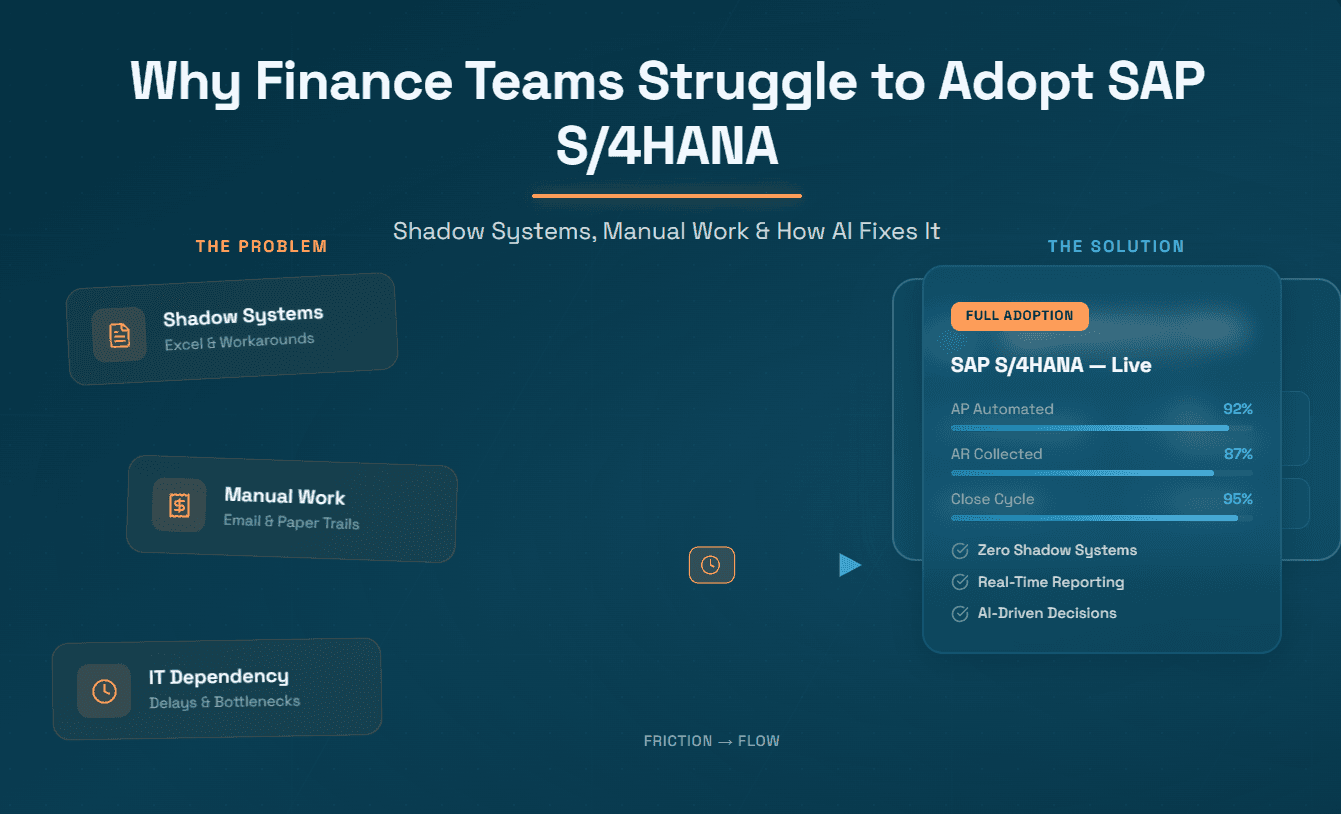
The go-live date passed. The champagne was opened. The steering committee declared success. And three months later, the finance team is still running their AP accruals in Excel, still managing collections in a spreadsheet they built during the ECC era, and still maintaining a shadow database of vendor information because the SAP vendor master "takes too long to update."
According to ASUG's 2024 SAP S/4HANA Journeys: Voice of the ASUG Member research published in December 2024, 49% of respondents already live on S/4HANA indicated costs exceeded their original budgets, up 17% from 2023. Costs aligned with expectations for only 23% of respondents, down 13% from the prior year. Consulting fees were cited as the main source of unexpected costs, increasing 20% since 2023. More accurate forecasting and resource distribution were cited as the most common unmet needs. Budget overruns are a symptom. The root cause is almost always the same: the system went live, but the finance team did not fully adopt it.
Full SAP S/4HANA adoption in finance is not a technical event. It is a behavioural, organizational, and process event. The SAP system can be perfectly configured, the data migration can be flawless, the integrations can all be green and yet finance teams can still work around it, under it, and beside it, returning to the familiar comfort of spreadsheets, email chains, and unofficial databases that predate the entire implementation program.
According to insightsoftware's 2024 Finance Team Trends Report, only 26% of SAP-driven finance teams have fully moved to a cloud environment, and 76% of SAP-based finance teams report feeling over-reliant on IT. Separately, according to a LeanIX survey reported by CIO.com, 66% of CIOs identify aligning IT, business, and project teams as the biggest hurdle to S/4HANA migration success.
This blog maps the specific reasons finance teams fail to fully adopt SAP S/4HANA, the adoption challenges, shadow systems, and training gaps that persist long after go-live and shows how Hyperbots AI Co-pilots resolve the underlying causes, making S/4HANA genuinely usable and genuinely transformative for the finance function.
The Adoption Gap: What Full SAP S/4HANA Adoption Actually Means
Full adoption of SAP S/4HANA in finance means one specific thing: finance teams consistently use SAP as the primary system for every financial process, not as the system of record that gets updated after the real work has been done somewhere else.
In practice, partial adoption is almost universal. Finance teams use SAP for the processes that are easy, familiar, or enforced by controls and they work around it for the processes that are slow, complex, or don't produce the outputs they need quickly enough. The result is a hybrid operating model that combines the cost of maintaining SAP with the cost of maintaining the shadow systems that substitute for it.
According to NetSuite's compilation of 60 critical ERP statistics, among organizations that performed an ROI analysis prior to implementing their ERP projects and had been live for more than a year, 83% said the projects met their ROI expectations. Separately, 49% of organizations experience data migration challenges during ERP implementations, and 74% of ERP projects experience difficulties in managing system integrations, according to Gitnux's ERP Implementation Failure Statistics report. The inverse of the ROI finding is equally true: organizations that under-invest in change management, training, and process validation are systematically less likely to realize the ROI they projected because finance teams that cannot use the system confidently will not use it fully.
Based on historic SAP and Gartner data, less than a third, around 28%, of the original 35,000 ECC customers were live on S/4HANA at the end of 2023. Despite predicted acceleration, the model reveals that only just over half, 57% to be specific, of ECC customers will have finished their transformations when mainstream maintenance ends in 2027. Even among those who are live, "live" and "fully adopted" are very different things.
Seven Adoption Challenges That Keep Finance Teams Stuck
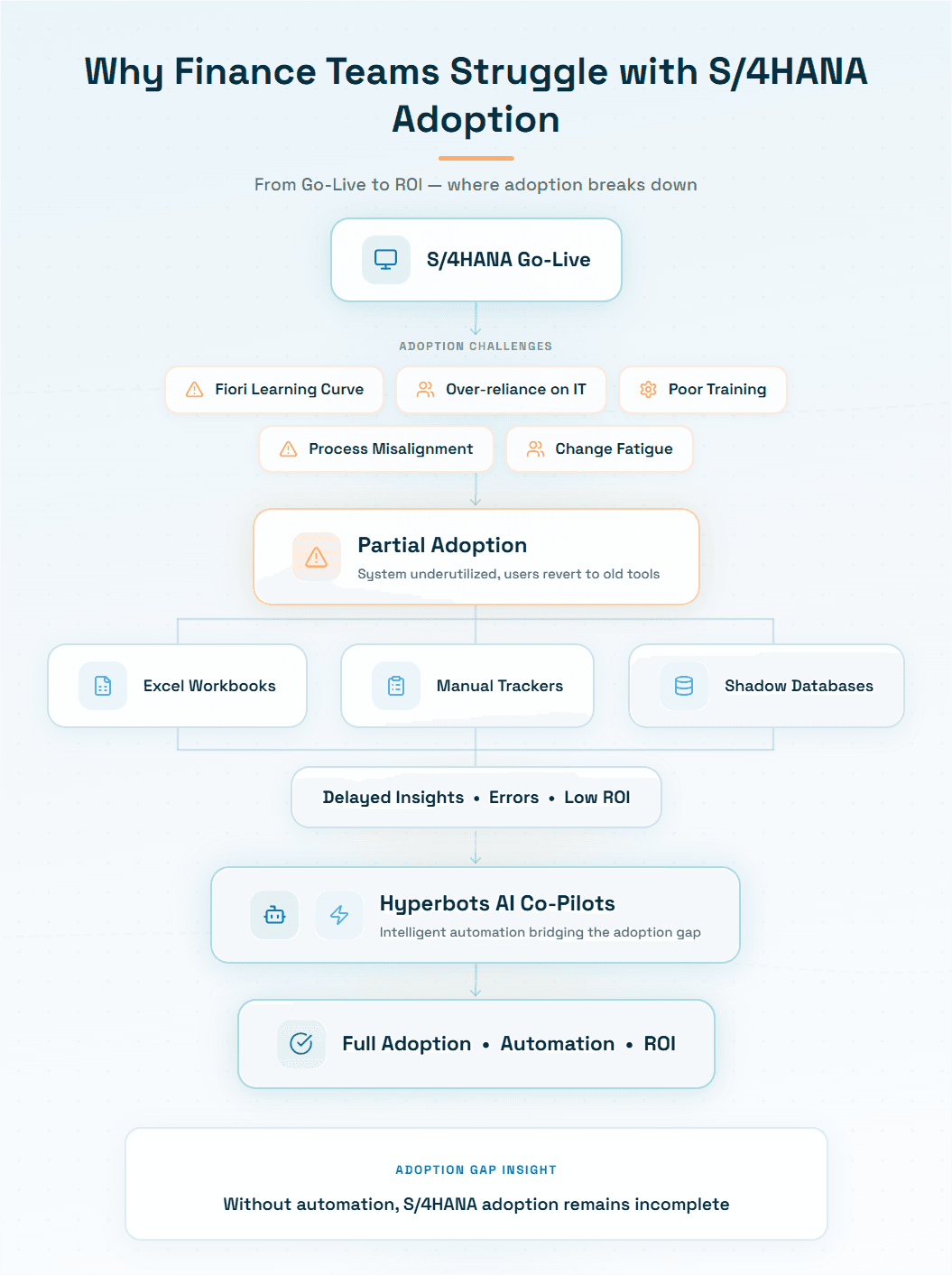
Challenge 1: The SAP Fiori Learning Curve Is Steeper Than Expected
SAP S/4HANA's user interface, SAP Fiori, is a fundamental departure from the SAP GUI that finance teams have used for 10 to 20 years. The transaction codes, the navigation paths, the report layouts, everything has changed. For finance users who have built their entire workflow around knowing that FB60 posts a vendor invoice or F-28 clears an open item, Fiori's tile-based interface and app-centric navigation feels foreign and slower until proficiency is established.
SAP-powered finance teams need a platform that addresses the skills gaps that prevent them from fully utilizing S/4HANA's advanced features. Building in-house IT expertise is essential but time-consuming. The training gap created by the Fiori transition is not just about learning new screens, it is about rebuilding the muscle memory that makes an experienced SAP user fast, confident, and able to handle exceptions without calling IT.
Training that covers "how to navigate Fiori" is not enough. Finance users need role-based, scenario-based training that walks through their specific job tasks in the new system and they need time to practice before go-live, not a one-day workshop three weeks before the cutover date.
The adoption consequence: Finance users who are not confident in Fiori default to asking IT for reports that they could pull themselves, reverting to legacy workarounds for processes that feel unfamiliar, and maintaining shadow spreadsheets rather than learning the SAP transaction that replaces them.
Challenge 2: Over-Reliance on IT for Reporting and Analytics
76% of SAP-based finance teams reported feeling over-reliant on IT. When finance teams are faced with analytical requests, they turn to IT teams or consultants with technical expertise to run custom reports. This leaves finance over-reliant on IT. IT teams navigate an organization's critical infrastructure on a daily basis, so requests from finance often move to the bottom of the pile, thus causing delayed insights and roadblocks to effective decision-making.
In ECC, finance teams often had established relationships with ABAP developers who built custom Z-reports to meet their specific reporting needs. In S/4HANA, the reporting landscape is fundamentally different, embedded analytics, CDS views, SAP Analytics Cloud and the skills to navigate it are not automatically carried over from ECC knowledge.
The result is a finance function that has moved to a more powerful analytics platform but cannot access its power without IT intermediation. The management accounts still take three days to produce. The variance analysis still requires an IT ticket. The ad-hoc query that should take five minutes still takes five days.
The adoption consequence: Finance teams stop trying to use SAP's analytics capabilities and maintain their own reporting infrastructure, typically Excel-based, outside the system. The SAP data becomes the data of last resort rather than the primary analytical layer. Shadow reporting systems multiply.
Challenge 3: Shadow Systems That Predate the Implementation
Thousands of journal lines otherwise calculated in spreadsheets are processed automatically in SAP S/4HANA's 2026 release in line with SAP data structures, SAP business data validation rules, and SAP Business AI principles. That this is a noteworthy SAP 2026 release feature speaks to the scale of the shadow systems problem: even in 2026, thousands of journal lines are still being calculated outside SAP and entered manually.
Shadow systems in finance SAP environments typically fall into three categories:
Calculation shadows: Spreadsheets that replicate calculations SAP could perform natively such as accruals workbooks, depreciation schedules, intercompany reconciliation models, management reporting bridges from IFRS to local GAAP. These exist because finance teams either do not know SAP performs these calculations, do not trust SAP's output, or have built the spreadsheet over years and find it more flexible than the SAP equivalent.
Tracking shadows: Unofficial databases that track information the finance team needs but cannot access easily from SAP, collections status trackers, vendor contact databases, invoice dispute logs maintained in shared drives. These exist because the SAP collections management or dispute management module was either not implemented, not configured to the team's needs, or not trained well enough for users to adopt it.
Workaround shadows: Systems that perform a step SAP is supposed to perform but where the SAP configuration produced unreliable results. The AP team's manual matching spreadsheet exists because the 3-way matching configuration produces too many false exceptions. The treasury team's payment reconciliation tracker exists because the bank integration produced errors in the first month and no one has fully trusted it since.
The adoption consequence: Shadow systems do not disappear after go-live, they calcify. Every month a shadow system is maintained, it becomes harder to eliminate: more institutional knowledge is embedded in it, more people depend on it, and more the official SAP record diverges from the shadow record that the team actually trusts.
Challenge 4: Training That Does Not Match the Real Job
A Deloitte study on digital transformation highlights the need for ongoing training and upskilling of employees to fully leverage new ERP capabilities. This is particularly critical when adopting sophisticated systems like SAP S/4HANA, where user expertise is key to maximizing benefits.
Most SAP S/4HANA training programs suffer from the same fundamental design flaw: they are built around the system's capabilities, not around the finance user's job. Training covers "how to use transaction X" rather than "how to complete your end-to-end job task Y using transactions X, Z, and the analytics app W."
The training gap is compounded by timing. Training delivered weeks before go-live, with no opportunity to practice in a sandbox environment before the go-live date, produces a finance team that understands the training at the time but has forgotten the specifics by the time they need to use the system in anger. Organizations investing in ongoing training are 40% more likely to meet their ROI expectations from ERP systems. One-and-done training delivery is not ongoing training, it’s a checkbox.
The adoption consequence: Finance users who received training but cannot remember or apply it in production revert to the processes they know. The training investment produces compliance at go-live and regression within 90 days.
Challenge 5: Process Redesign That Was Never Truly Adopted
SAP S/4HANA implementations are supposed to redesign finance processes to fit the SAP standard, adopting best practices that are embedded in the system rather than replicating ECC-era processes in the new platform. In practice, the fit-to-standard principle is frequently compromised under project timeline pressure, resulting in S/4HANA configured to replicate the old process rather than improve it.
Adoption no longer means installing new functionality, it means aligning with the release's structure. Each process must match SAP's standardized scope. Enterprises that approach adoption as alignment, not customization, will see fewer transport conflicts and cleaner upgrade cycles.
When the process design has not changed, finance users have no reason to change their behaviour. They use SAP as a more expensive, more complex version of the system they had before because that is exactly what it has been configured to be. The full adoption challenge here is not a training problem or a technical problem. It is a process design problem that was not solved during implementation.
The adoption consequence: Finance teams adopt the new system's transactions but not its capabilities. They use SAP to do what they used to do, not what SAP enables them to do. The transformational ROI of S/4HANA is not realized.
Challenge 6: Change Fatigue and Resistance in the Finance Team
According to a LeanIX survey of 100 enterprise architects and IT practitioners, reported by both CIO.com and ARN Network, approximately 66% of respondents identified aligning business, project, and IT teams as the biggest hurdle to completing SAP S/4HANA migration. The original LeanIX survey press release is also available directly at leanix.net. The alignment challenge is not just organizational politics, it is also the emotional reality of asking experienced finance professionals to substantially change how they work, often while simultaneously being asked to absorb higher workloads during the migration period.
S/4HANA migrations ask a lot of finance teams. They are expected to support the project (providing requirements, reviewing design, participating in UAT) while maintaining their day jobs, learning a new system, and coping with the inevitable post-go-live disruption. The result is change fatigue, a state where finance users comply with new system requirements minimally and revert to familiar behaviours whenever they can.
The adoption consequence: Post-go-live adoption rates look acceptable in the first month when monitoring is active and support teams are present. They decline in months two through six as monitoring decreases and the pressure to get through the month-end close supersedes the discipline of using the correct SAP process.
Challenge 7: The Gap Between What SAP Provides and What Finance Needs
99% of SAP-based finance teams use both SAP and non-ERP data sources for a holistic view of their finances. That statistic is remarkable, virtually every SAP finance team operates on a hybrid data model that spans SAP and outside-SAP sources. This is not a technology failure. It is a recognition that SAP S/4HANA, however capable as a system of record and analytics platform, does not autonomously process the financial transactions that the finance team needs processed.
Invoices still need to be extracted, matched, and posted. Cash still needs to be applied to open AR items. Accruals still need to be calculated and booked. Collections workflows still need to be managed. SAP provides the framework for all of these activities but it does not autonomously execute them. The finance team that adopts SAP fully still has a full workload; they are just doing that workload inside SAP rather than outside it.
The adoption consequence: Finance teams who adopt SAP fully but do not automate their high-volume transactional processes discover that "full SAP adoption" means spending more time in SAP doing the same manual work they did before, just in a different interface. The transformational ROI never materializes because the underlying process has not been automated.
This is exactly the gap that Hyperbots AI Co-pilots are designed to close and why the combination of SAP S/4HANA and Hyperbots produces a genuinely different outcome than SAP alone.
How Shadow Systems Survive and Multiply After SAP Go-Live
Shadow systems do not appear after go-live. They persist from before it and they survive because nobody takes explicit ownership of eliminating them.
The most common shadow system survival patterns in SAP finance environments are:
The "temporary" workaround that becomes permanent. During UAT, a configuration issue produces incorrect output for a specific scenario. The implementation team creates a manual workaround for go-live and marks it as "to be resolved in hypercare." Hypercare ends, the team moves on to the next project, and the manual workaround becomes the permanent process. The finance team that inherited the workaround has no knowledge of the original configuration issue, they just know "this is how we do it."
The shadow that exists because the SAP module was descoped. Not every S/4HANA implementation deploys every relevant finance module. Dispute management, collections management, and the cash application clearing logic are frequently descoped to reduce implementation cost or timeline. Finance teams that needed those capabilities build their own in Excel, SharePoint, or a ticketing system and maintain them indefinitely.
The report that IT never rebuilt. When migrating from ECC to S/4HANA, custom ABAP reports that provided management with critical financial information need to be rebuilt in the new environment either in CDS views, Fiori analytics, or SAP Analytics Cloud. When this rebuild is not prioritized, finance teams maintain Excel downloads from ECC-era report formats and update them manually after every SAP period close. In SAP S/4HANA Cloud Private Edition's 2026 release, thousands of journal lines otherwise calculated in spreadsheets can now be processed automatically in line with SAP data structures and SAP Business AI principles, indicating that the spreadsheet problem is so pervasive that SAP itself is building features specifically to address it.
The trust deficit from the first month-end close. If the first month-end close post-go-live produces numbers that cannot be reconciled, the finance team's trust in SAP is damaged and the shadow systems that provide comfort re-emerge. A controller who cannot reconcile the SAP-produced trial balance to the prior period will not run the board pack from SAP data. They will build their own model, populate it from SAP extracts, and adjust for what they know to be wrong. That model becomes the real management reporting infrastructure, and SAP becomes the system that feeds it raw data.
Addressing shadow systems requires more than training, it requires an honest audit of why each shadow system exists, followed by either fixing the SAP configuration gap that created it or deploying a purpose-built automation tool that addresses the underlying need more effectively than both SAP alone and the shadow system it replaced.
How Hyperbots AI Co-Pilots Drive SAP S/4HANA Full Adoption
Hyperbots AI Co-pilots address the adoption challenge from a different angle than change management programs or training investments: they eliminate the most common reasons finance teams work around SAP rather than through it.
When the invoice matching process is so accurate and so fast that manual workarounds produce slower, worse outcomes than the automated process, the AP team adopts the automated process. When the accruals co-pilot produces a month-end close in hours with variance under 5%, the controller stops running their accruals workbook. When the collections co-pilot handles 70% of follow-up automatically and produces better DSO outcomes than the manual tracker, the collections team abandons the tracker.
This is adoption driven by demonstrable outcome superiority, the most durable form of adoption there is.
Procure-to-Pay — Eliminating P2P Shadow Systems
Eliminates the most common AP shadow system: the manual matching spreadsheet that exists because SAP's matching configuration produces too many exceptions for the AP team to trust. Pre-trained on 35 million invoice fields with 99.8% extraction accuracy, it achieves 80% straight-through processing, reducing invoice cycle time from 11 days to under one minute. When 80% of invoices flow through to SAP FI-AP without human touch, the shadow matching process becomes redundant. Finance teams adopt SAP fully because SAP with Hyperbots is demonstrably better.
Eliminates the shadow vendor database that finance teams maintain because SAP vendor master updates "take too long." Vendor onboarding time drops 8x, from nine days to under one day. Vendor data error rates fall from ~6% to under 1%. When the SAP vendor master is accurate, current, and fast to update, the shadow database has no reason to exist. Teams adopt the SAP system fully because it is now reliable.
Eliminates the PR tracking spreadsheet that procurement teams maintain because SAP PR-to-PO conversion "loses visibility." Auto-fills complex procurement forms in five minutes, converts approved PRs to POs automatically using company templates, and provides real-time status visibility through the vendor portal. When SAP is the most visible, fastest path from requisition to purchase order, the shadow tracking system is abandoned.
Eliminates the most deeply embedded shadow system in finance: the accruals workbook that controllers have maintained through multiple system changes and would sooner retire than trust SAP to replace. The Accruals Co-pilot queries SAP at month-end cut-off for all uninvoiced POs and GRNs, calculates amounts using ML models trained on historical patterns, posts journal entries to the correct SAP GL accounts, and reverses them automatically. Close compresses from days to hours, with variance to actual consistently under 5%. When the Co-pilot outperforms the spreadsheet on accuracy and speed, the workbook adoption is complete.
Eliminates the payment reconciliation tracker that treasury teams maintain because the SAP bank integration produced early errors they never fully trusted. Manages the complete payment run such as scheduling, approval routing, bank file generation, fraud detection, and bank-to-SAP reconciliation with pre-trained accuracy on bank statements and checks. When reconciliation is automated and verified, the shadow tracker is redundant.
Eliminates the manual tax validation checklist that AP teams maintain because SAP tax configuration was never fully trusted after go-live. Validates sales tax on every AP invoice at line-item level before SAP posting, covering all U.S. states, continuously updating its database, and producing a timestamped audit trail. When tax validation is automated and reliable, the manual checklist becomes unnecessary.
Order-to-Cash — Eliminating O2C Shadow Systems
Eliminates the collections tracker that AR teams maintain because SAP Collections Management "doesn't show what we need to see." Reads live SAP FI-AR data and autonomously orchestrates the entire collections lifecycle with dynamic prioritization, AI-driven dunning, dispute detection, promise-to-pay management, and ERP write-back. 70% of collections happen automatically. When the SAP-based collections process is more effective than the spreadsheet it replaced, delivering 40% DSO reduction and 70% reduction in cost to collect, full adoption follows naturally.
Eliminates the manual remittance matching process that AR teams maintain because SAP's standard clearing cannot handle complex real-world payment data. Achieves 80%+ straight-through processing, reducing unapplied cash to less than 10% and cutting reconciliation costs by up to 80%. When cash application is faster, more accurate, and less manual than any shadow system the AR team has built, adoption of the SAP process is complete.
How Hyperbots Differentiates From Other SAP Adoption Tools
Dimension | Change Management programs | SAP Training Investments | Point AR/AP Tools | Hyperbots AI Co-pilots |
Addresses root cause of shadow systems | Partially | No | Partially | Yes; makes SAP demonstrably better |
Eliminates accruals workbooks | No | No | No | Yes; full automation |
Eliminates AP matching trackers | No | No | Partially | Yes; 80% STP |
Eliminates collections spreadsheets | No | No | Partially | Yes; 70% automated |
Real-time bidirectional SAP | N/A | N/A | Partial | Always, with verification |
Self-learning improvement | No | No | No | Yes; every transaction |
Deployment timeline | 3–6 months | 2–4 months | 2–3 months | 3–4 weeks |
Drives adoption through outcome superiority | Sometimes | No | Partially | Yes; consistently |
SOX audit trail | N/A | N/A | Basic | Immutable, full-context |
Works on ECC and S/4HANA | N/A | N/A | Partial | Yes; both |
The decisive differentiator is outcome superiority. Change management and training ask finance teams to adopt SAP because they are supposed to. Hyperbots gives finance teams a reason to adopt SAP because it is genuinely better, faster, more accurate, and less effort than any shadow system they have built.
Hyperbots Platform Capabilities — Transformational Impact on SAP Adoption
Making Finance Adoption Self-Reinforcing The more finance teams use Hyperbots co-pilots on top of SAP, the better the co-pilots become through continuous learning from every transaction, every approval, every exception. This creates a self-reinforcing adoption dynamic: the more the team uses the system, the better it performs; the better it performs, the more the team adopts it. Shadow systems do not have this property, they get worse over time as they diverge from the SAP truth.
No-Code Configuration That Finance Can Own In SAP S/4HANA 2025, most functions are activated, not custom built. SAP delivers predefined scopes that you can enable, extend, or deactivate. Hyperbots extends this principle: workflow configuration is no-code, meaning finance teams can modify thresholds, approval rules, and exception handling without IT involvement. This directly addresses the over-reliance on IT that drives shadow system creation — when finance can configure their own automation, they are more likely to use it.
Real-Time SAP Data Visibility That Replaces Reporting Shadows Every Hyperbots co-pilot provides real-time KPI dashboards on invoice STP rate, accrual variance, DSO trend, cash application hit rate, collections productivity that give finance leaders live operational visibility without IT-intermediated reports. When finance can see their key metrics in real time from the SAP-connected Hyperbots platform, the Excel reporting shadow loses its primary purpose.
SOX-Ready Audit Trail That Eliminates Control Shadows Finance teams sometimes maintain shadow systems specifically for audit and control purposes because they do not trust SAP's audit trail to be complete or accessible. Hyperbots provides an immutable, tamper-proof audit trail meeting SOX, PCI-DSS, and FedRAMP standards for every action across all co-pilots. When the audit trail is complete and accessible, the control shadow is redundant.
24/7 Operation That Eliminates After-Hours Manual Processes Finance shadow processes frequently exist because SAP-based processes only run during business hours. Hyperbots co-pilots run continuously, processing invoices overnight, applying cash on weekends, running collections follow-ups across time zones. When the automated SAP process operates 24/7, the manual shadow that substitutes for overnight processing becomes unnecessary.
ROI — What Hyperbots Delivers When Adoption Barriers Are Removed
Procure-to-Pay ROI
Tangible:
80% straight-through processing on AP invoices — shadow matching spreadsheets eliminated because the SAP process is demonstrably better
Invoice cycle time from 11 days to under one minute — the single most visible P2P adoption metric
99.8% GL coding accuracy — reclassification journals eliminated, management accounts reliable from day one
Vendor onboarding 8x faster — shadow vendor databases eliminated because the SAP vendor master is now accurate and fast
Month-end close from days to hours — accruals workbooks eliminated because the Co-pilot outperforms them on accuracy and speed
Near-zero sales tax errors — tax validation checklists eliminated through automated line-item validation
Deployment in 3–4 weeks — faster than any change management program
Intangible:
Finance team confidence in SAP increases because SAP with Hyperbots produces better outcomes than their shadow systems
IT over-reliance decreases as finance can configure their automation and access their analytics without IT intermediation
Shadow systems shrink because the underlying need is met by a system that is better than the shadow
Audit readiness improves from day one with complete, explainable evidence for every SAP posting
Order-to-Cash ROI
Tangible:
40% reduction in DSO — collections spreadsheets eliminated because the AI collections process is more effective
70% reduction in cost to collect — 70% of AR follow-up automated, manual shadow processes redundant
80%+ STP on cash application — manual remittance matching eliminated, unapplied cash under 10%
80% reduction in reconciliation costs — bank-to-SAP matching at 99.8% accuracy
Collections team productivity up 80% — AI handles routine follow-up, humans focus on strategic accounts
Intangible:
AR team adopts SAP Collections Management fully because Hyperbots makes it work better than their spreadsheet
Real-time cash flow forecasting replaces static Excel models maintained outside SAP
Customer satisfaction improves with accurate communications, faster dispute resolution
Revenue assurance strengthens as every open SAP AR item tracked and acted on
Full Adoption Requires a System That Is Worth Adopting Fully
The finance teams that struggle most with SAP S/4HANA adoption are not resistant to technology. They are rational actors making rational decisions: they use the system or process that produces the best outcome for the least effort. When SAP, without intelligent automation, requires more manual work than the shadow systems it is supposed to replace, rational finance professionals keep the shadow systems.
According to insightsoftware's 2024 Finance Team Trends Report which is based on survey responses from more than 500 finance professionals in Europe and North America, only 26% of SAP-driven finance teams have fully moved to a cloud environment, with 62% operating in a hybrid setting. The same research found that 76% of SAP-based finance teams reported feeling over-reliant on IT. These statistics describe a finance function that has moved to a more capable platform without realizing its capabilities because training, change management, and configuration alone cannot close the gap between what SAP provides and what the finance team needs from it.
Hyperbots AI Co-pilots close that gap. They make SAP demonstrably better than any shadow system by being faster, more accurate, more autonomous, and more reliable. They eliminate the root causes of shadow systems rather than the symptoms. And they deploy in three to five weeks, on top of SAP S/4HANA or ECC, without changing a line of ABAP.
Full SAP adoption does not come from mandating that finance teams stop using their spreadsheets. It comes from giving them an AI-powered SAP process that is so clearly superior to their spreadsheets that abandoning them becomes the easy, obvious choice.
Frequently Asked Questions (FAQs)
Q1: Why do finance teams maintain shadow systems even after a successful SAP S/4HANA go-live?
Shadow systems persist after go-live for three main reasons. First, the SAP configuration does not fully meet the finance team's needs, typically because finance validation testing was insufficient or because SAP modules were descoped during implementation. Second, the finance team was not trained well enough to use SAP capabilities that would replace their shadow processes. Third, SAP alone does not autonomously execute the high-volume transactional processes such as accruals, matching, cash application, collections tracking. When SAP requires more manual effort than the shadow system, rational finance professionals keep the shadow system. Hyperbots addresses the third cause directly thus, making SAP more capable than any shadow system by adding autonomous AI execution on top of the ERP framework.
Q2: What is the most common training gap in SAP S/4HANA finance implementations?
The most consistent training gap is the difference between "how to use the system" and "how to complete your job in the system." Finance users who receive feature-based training “here is how transaction X works, but not scenario-based training, here is how you complete your end-to-end AP close process using the system” cannot apply their training in production. Organizations investing in ongoing training are 40% more likely to meet their ROI expectations from ERP systems. A one-day workshop before go-live does not qualify as ongoing training. Role-based, scenario-based training delivered with sufficient time to practice in a sandbox, followed by structured support in the first 60 days of production, is what produces durable adoption.
Q3: How does Hyperbots drive SAP adoption without adding more training burden?
Hyperbots drives adoption through outcome superiority rather than training compliance. Finance teams do not adopt Hyperbots-powered SAP processes because they were told to, they adopt them because the automated process is faster, more accurate, and less effortful than any manual alternative they have built. The Invoice Processing Co-pilot processes invoices in under a minute with 99.8% accuracy. No manual matching process can compete. The Accruals Co-pilot closes the month-end accruals in hours with variance under 5%. No spreadsheet can match that reliability. When the system is demonstrably better, adoption follows without coercion.
Q4: What should organizations do about shadow systems that have been running for years?
The right approach is a structured shadow system audit, not a mandate to stop using them. For each shadow system, identify: why it was created (configuration gap, training gap, or missing SAP module), what it provides that SAP does not, and whether the gap is best addressed by fixing the SAP configuration, deploying a purpose-built tool like Hyperbots, or accepting that the shadow system is legitimately better for a specific edge case. Most shadow systems in finance can be eliminated by deploying the right Hyperbots co-pilot because they typically exist to perform calculations, tracking, or matching that SAP provides the data for but does not autonomously execute.
Q5: Can Hyperbots be deployed on ECC to support adoption before S/4HANA go-live? Yes. Hyperbots supports both SAP ECC and all S/4HANA editions. Deploying Hyperbots on ECC before the S/4HANA migration allows finance teams to begin adopting AI-automated processes, eliminating shadow systems and building confidence in system-driven automation, before the ERP migration adds change fatigue. When S/4HANA go-live arrives, the finance team has already adopted AI-automated workflows. The migration becomes a platform upgrade rather than a complete process redesign, and adoption of the new system is dramatically smoother.
Q6: What happens to the finance team's workload when shadow systems are eliminated?
Eliminating shadow systems does not reduce the finance team's work, it redirects it. Controllers who no longer spend four days on accruals calculations spend that time on analytical work that SAP's embedded analytics make possible but that manual process burden previously prevented. Collections analysts who no longer manage a collections spreadsheet spend that time on strategic account relationships. AP analysts who no longer manually match invoices spend that time on supplier management and exception investigation. The workload shifts from transactional to analytical which is exactly the talent redeployment that SAP S/4HANA was always supposed to enable.