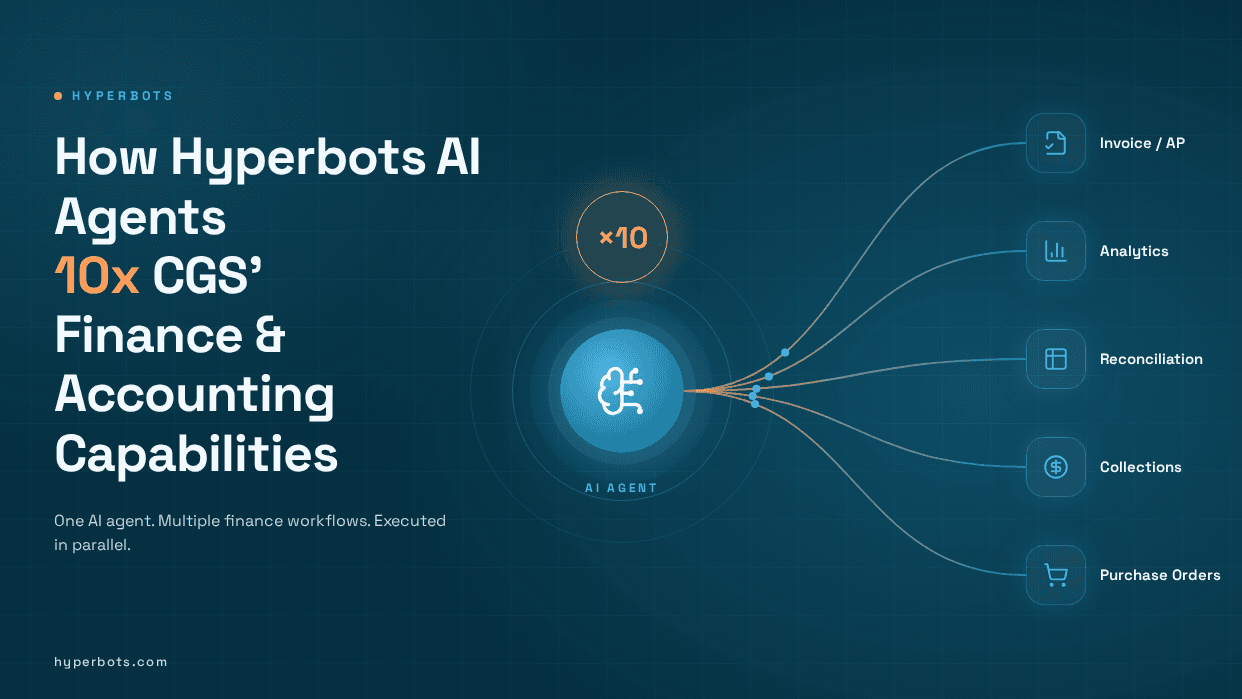
How Hyperbots AI Agents 10x CGS' Finance & Accounting Capabilities
How Hyperbots AI agents can amplify finance productivity across CGS BlueCherry operations while helping teams spend less time on manual processes and more time on higher-value financial work.
Finance teams supporting fashion, apparel, footwear, and consumer lifestyle businesses are under a particular kind of pressure. Product cycles keep getting shorter, wholesale and retail channels keep multiplying, and supplier networks keep spreading across geographies yet the finance function is still expected to close the books faster, manage cash more precisely, and do it all without a proportional increase in headcount.
For many of these companies, BlueCherry® by CGS is the operational backbone: an ERP and supply chain platform built specifically for fashion, apparel, footwear, and consumer goods businesses, covering everything from product development and sourcing to inventory, order management, and financials. It's a foundation used by hundreds of brands managing billions of dollars in annual retail sales. But even the best system of record cannot, on its own, keep pace with the sheer transaction volume and document complexity that fashion finance teams deal with every day.
This blog is a practical look at why finance in fashion is uniquely complex, how agentic AI differs from the automation finance teams already know, and where an AI-agent layer can realistically add value on top of a BlueCherry-powered finance stack without replacing the system, the software, or the people who run it.
Why Finance in Fashion Is More Complex Than It Looks
To someone outside the industry, fashion finance might look like standard accounts payable, accounts receivable, and month-end close. In practice, the complexity compounds in ways that are specific to how apparel, footwear, and consumer lifestyle brands operate.
Long, capital-intensive production cycles. Brands often have to commit cash for fabric, manufacturing deposits, and production months before a single unit sells. Finance teams describe this as a working-capital trap: a spring collection launching at market months from now still requires fabric minimums and manufacturing deposits paid today, while the company is simultaneously waiting on payment for last season's goods, as one accounting firm specializing in fashion has documented. Getting the timing of that cash outlay wrong is one of the more common causes of liquidity strain in the industry.
Seasonality and demand volatility. Fashion sales follow pronounced seasonal cycles, and overproduction is a real and costly risk - industry estimates suggest billions of dollars' worth of unsold inventory piles up globally each year because production commitments were made before real demand was known, according to analysis from Clear.co. Finance teams have to plan and report around that volatility, not just react to it after the fact.
Multi-channel, multi-entity operations. Most apparel and footwear brands sell through several channels at once - direct wholesale, department stores, e-commerce, and their own retail doors - often across multiple legal entities and currencies. Each channel can carry different payment terms, different invoicing formats, and different reconciliation requirements, multiplying the number of financial touchpoints a controller has to manage.
Retailer deductions and chargebacks. Selling through major retail partners introduces a layer of complexity that's specific to consumer goods and apparel: retailers routinely deduct amounts from vendor payments for compliance issues, shipping errors, shortages, or promotional allowances. Industry estimates put these deductions anywhere from a low single-digit to mid-teens percentage of gross sales depending on the retailer relationship, based on data cited by trade-spend accounting specialists. Reconciling which deductions are valid and which should be disputed is a recurring, document-heavy job for AR teams.
Supplier networks and factor relationships. Apparel and footwear supply chains typically span dozens or hundreds of manufacturing partners, often supported by factoring or asset-based lending arrangements to bridge the gap between production spend and retail payment, as financing specialists at firms like eCapital have described. Vendor onboarding, invoice matching, and payment execution all have to happen at scale and with accuracy, because errors ripple into supplier relationships and factor covenants alike.
It's worth being precise here: these are characteristics of the fashion, apparel, and consumer lifestyle industry generally, based on publicly available industry and financing research not claims specific to any individual CGS BlueCherry customer's finance operation. But they are exactly the kind of structural complexity that a platform like BlueCherry is built to manage at the system-of-record level, and exactly the kind of repetitive, document-heavy, judgment-adjacent work that an AI-agent layer is designed to sit on top of.
From Finance Automation to Agentic AI
Finance teams have lived through several waves of automation, and it's easy to assume "AI in finance" just means the next incremental step. It's worth being precise about what's actually different.
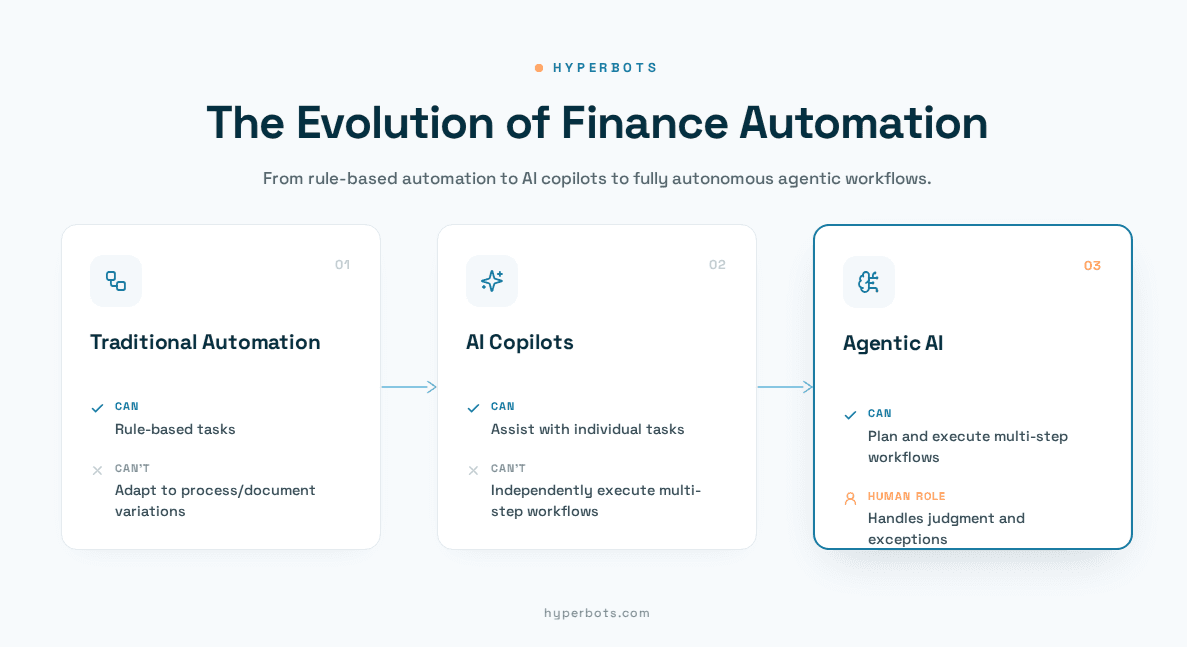
Traditional automation follows fixed rules: if a field matches a pattern, do X. It's fast and reliable for narrow, well-defined tasks, but it breaks the moment a document or process deviates from the template it was built for.
Generative AI: the generation of tools most finance professionals have used over the past few years which respond to a specific prompt or request. They can summarize a document or draft a report, but they wait for a human to direct every step.
Agentic AI is different in kind, not just degree. As McKinsey's finance research describes it, agentic AI is an emerging class of AI that can independently pursue goals, make decisions, and take action with limited human input, and in finance it can orchestrate time-consuming, multi-step workflows such as the accounting close rather than just accelerating a single step within it, per McKinsey's analysis of AI in finance functions. Deloitte frames the core distinction similarly: agentic systems possess genuine agency or the ability to take initiative toward a defined outcome and are built to plan, act, and adapt with little or no step-by-step supervision, according to Deloitte's research on agentic AI in financial services.
In practice, that means an agent can move through a connected sequence like this:
Invoice received → key fields validated → purchase order and receipt data checked → mismatches or exceptions identified → the exception routed for the right person's approval → the clean transaction prepared for posting → anything still unresolved escalated with context, not just a flag.
A rules engine can do the first step. A copilot can help with the third. An agentic AI system is designed to carry the whole chain, handling everything that fits a pattern it has learned and handing off, with context, only what genuinely needs a human decision. That human-in-the-loop structure from autonomy for the routine to the escalation for the judgment calls, is the design principle that responsible finance-AI deployments are converging on, as both the McKinsey and Deloitte research emphasize.
Where AI Agents Can Amplify CGS Finance Operations
Hyperbots publicly documents a purpose-built CGS BlueCherry Connector that supports financial and supply-chain data such as invoices, purchase orders, vendor records, and inventory transactions. The connector is positioned for fashion, apparel, consumer goods, and similar businesses running on BlueCherry. Hyperbots also publicly cites a customer example involving 20,000+ invoices across 200+ factories using CGS BlueCherry and Microsoft Business Central, where its agents were associated with a 70% reduction in vendor-management overhead, a reduction in invoice-processing time from 10 days to 1 day, and 90% accelerated inventory updates.
1. Accounts Payable & Invoice Processing
Invoice processing is one of the most repetitive, high-volume jobs in finance, and the scale of fashion supply chains can make that workload particularly demanding. Hyperbots' Invoice Processing Co-Pilot uses AI agents for invoice discovery, field extraction, validation, matching, GL coding, and posting. Hyperbots reports 80% straight-through processing (STP) and invoice processing times of less than one minute, compared with an industry average of 11 days cited on its product page. Its extraction models are also reported at 99.8% accuracy.
For a BlueCherry environment, the potential productivity gain is not simply faster data entry. The bigger opportunity is to let agents handle routine invoices while finance professionals focus on exceptions, approvals, and controls. That becomes particularly relevant at the scale illustrated by Hyperbots' BlueCherry customer example: 20,000+ invoices across 200+ factories, with reported invoice-processing time falling from 10 days to 1 day.
2. Procure-to-Pay
Procurement in apparel can involve numerous suppliers, purchasing requirements, approvals, and downstream finance processes. Rather than treating requisition creation, approval, PO generation, and dispatch as isolated tasks, an agentic approach can connect these steps into a more continuous workflow.
Hyperbots' Procurement Co-Pilot is designed to automate PR creation, approvals, PO generation, vendor communication, posting, and PO closure. Hyperbots reports that the Co-Pilot can reduce PR creation time to 5 minutes and automate 80% of PO creation and dispatch time.
For finance teams, the value is less about removing procurement controls and more about reducing the administrative work around them. AI can populate forms, apply configured policies, route approvals, and prepare POs while keeping human review where the organization requires it.
3. Accounts Receivable & Collections
Collections becomes increasingly operationally intensive as finance teams manage aging balances, payment commitments, disputes, and customer follow-ups across large account portfolios. In fashion and consumer businesses, deductions and customer-specific payment behavior can add another layer of complexity.
Hyperbots' Collections Co-Pilot uses AI agents for prioritization, dunning, follow-ups, dispute detection, promise-to-pay management, and ERP updates. Hyperbots reports up to 80% improvement in collections productivity, alongside a potential 40% reduction in DSO and 70% reduction in cost to collect. The practical implication is that collectors can spend less time deciding whom to chase and manually sending routine reminders, and more time resolving disputes, managing important customer relationships, and deciding how to handle accounts that require judgment.
4. Cash Application
Matching incoming payments to open invoices can be deceptively difficult when remittance information is incomplete, payments are partial, or deductions are bundled into a single transaction. That creates work for AR teams and can leave cash sitting unapplied even after it has reached the bank.
Hyperbots' Cash Application Co-Pilot automates remittance and bank-statement extraction, payment matching, exception handling, GL coding, and ERP posting. It reports 80%+straight-through processing, less than 10% unapplied cash, and up to 80% lower reconciliation costs. The platform also cites 99.8% accuracy for its document-reconciliation agents.
For finance teams, this shifts cash application from a largely manual matching exercise toward an exception-management process: the agent handles routine matches while accountants investigate short payments, deductions, unidentified cash, and other cases that genuinely need human judgment.
5. Reconciliation
Reconciliation is another area where the economics of AI are less about replacing accounting judgment and more about reducing repetitive comparison work.
Hyperbots' Payments Co-Pilot can track check status, match checks to invoices, and flag anomalies such as mismatched amounts, duplicate checks, or unknown bank-statement entries.
The broader Hyperbots cash-application offering reports up to 80% lower reconciliation costs, while its reconciliation agents are reported at 99.8% accuracy for processing financial documents.
For an accounting team, the goal is straightforward: automate the matches that can be confidently resolved and bring the discrepancies that require investigation to an accountant's attention faster.
6. Finance Data & Natural-Language Queries
Automation can reduce transaction-processing work, but finance leaders also lose time simply finding and interpreting information. This is where HyperLM / Vera, which powers Vera, takes a different approach. Hyperbots describes Vera as an AI workspace for CFOs that enables conversational interaction with financial information. Instead of beginning every analysis by locating reports and manually combining information, a finance professional could use natural-language questions such as:
● Which customers currently have the largest overdue balances?
● Which invoices are stuck in an approval queue?
● What changed in AP aging compared with last month?
● Which entities have the highest outstanding receivables this quarter?
These are illustrative examples rather than guarantees of functionality in every deployment. The value of a finance-specific AI workspace is ultimately determined by the financial data it can securely access, the systems it is connected to, and the controls established for the specific organization.
Taken together, these capabilities illustrate what "10x" finance productivity can mean in practice.
It is not necessarily about making one employee do ten people's jobs. It is about moving finance teams away from repetitive transaction handling, manual matching, routine follow-ups, and data gathering and toward a model where AI agents handle a larger share of the operational workload while finance professionals focus their time on exceptions, controls, analysis, and decisions.
AI Agents Don't Replace Finance Teams: They Change Where Finance Spends Its Time
It's tempting to frame AI agents as a headcount story. That framing misses the point. The work that AI agents are built to absorb, high-volume, pattern-based, repetitive tasks, is precisely the work that burns out skilled accountants and pulls them away from what actually requires a finance professional's judgment: interpreting a material exception, deciding how to handle a disputed chargeback, assessing a supplier's credit risk, forecasting cash under a new set of assumptions, or explaining a variance to the CFO.
Judgment, controls ownership, and accountability for material decisions stay with people. Materiality thresholds, exception escalation, policy interpretation, risk assessment, forecasting assumptions, and every supplier or customer relationship decision remain human responsibility, the AI agent's job is to make sure the right exceptions reach the right person, with enough context to decide quickly, rather than burying that person in routine transactions first.
This is what "human-in-the-loop finance" actually looks like in practice: not a human rubber-stamping every AI action, but a human focused entirely on the subset of decisions that genuinely require judgment, while the system handles the volume around them.
Why an AI Layer Can Complement Existing Finance Systems
A common misconception about AI adoption in finance is that it requires ripping out existing systems. It doesn't, and for most companies, it shouldn't.
The clearest way to think about the architecture is a simple division of labor: ERP and finance systems remain the system of record, the authoritative source of truth for transactions, balances, and the chart of accounts. AI agents operate as a workflow and intelligence layer on top of that system of record, reading data, executing multi-step processes, and writing validated results back, without displacing the ledger itself.
Hyperbots documents this architecture explicitly through its published ERP connector list, which includes a dedicated CGS BlueCherry connector alongside connectors for NetSuite, SAP, Sage, Microsoft Dynamics, and QuickBooks, described as supporting real-time, bidirectional read-and-write integration for invoices, purchase orders, vendor and item masters, and general ledger data. To be clear about what is and isn't established here: this confirms Hyperbots offers a BlueCherry-specific integration capability. It does not mean any specific CGS customer is currently running Hyperbots, and Hyperbots is an independent, third-party AI vendor not a CGS or BlueCherry product, feature, or division.
The Future of Finance in Fashion Is Agentic
Fashion finance is genuinely harder than it looks from the outside: long production cycles, seasonal demand swings, multi-channel and multi-entity operations, retailer deductions, and sprawling supplier networks all compound the ordinary complexity of running a finance function. A platform like BlueCherry gives fashion and apparel businesses the system of record they need to manage that complexity. Agentic AI is emerging as the layer that can help finance teams keep pace with the volume and speed that complexity generates without displacing the system, the software, or the professionals who run finance day to day.
None of this happens automatically or without oversight. The companies getting real value from agentic AI in finance are the ones that start with a measurable use case, keep humans firmly in control of judgment and exceptions, and expand deliberately as they build trust in the system. That's not a revolutionary story, it's a practical one, and it's exactly the kind of steady, incremental progress finance teams can build on.
If your finance team is exploring where agentic AI could remove manual work, accelerate procure-to-pay or order-to-cash processes, or increase finance capacity without proportional headcount growth, it's worth seeing where a platform like Hyperbots could fit into your existing BlueCherry environment. Request a demo to explore which workflows have the most potential for your team.
Frequently Asked Questions
Q1. What is agentic AI in finance?
Agentic AI in finance refers to AI systems that can independently pursue a defined goal, plan the steps to reach it, and execute across connected systems with limited step-by-step human direction. Unlike a chatbot or copilot that responds to a single prompt, an agentic system can carry a multi-step workflow, like invoice processing or cash application, from start to finish, escalating only the parts that require human judgment.
Q2. How are AI agents different from traditional finance automation?
Traditional automation follows fixed rules and breaks when a document or process deviates from its template. AI copilots respond to individual prompts but wait for direction at every step. Agentic AI can reason across a workflow, adapt to variation, and execute multiple connected steps autonomously, handing off to a human only when genuine judgment is needed.
Q3. How can AI agents help fashion finance teams?
Fashion finance teams manage high transaction volumes, seasonal cash flow swings, multi-channel sales, and retailer deductions. AI agents can reduce manual effort in invoice processing, procurement, collections, cash application, and reconciliation - all the repetitive, document-heavy tasks that consume disproportionate time in apparel and footwear finance operations.
Q4. What finance processes can Hyperbots automate?
Based on Hyperbots' published platform, its AI co-pilots cover invoice processing, procurement, payments, sales tax verification, vendor management, accruals, collections, and cash application, with a purpose-built connector for CGS BlueCherry environments. Specific capabilities and configurations should be confirmed directly with Hyperbots for your environment.
Q5. Can AI agents work with existing ERP systems?
Yes, the intent of an AI-agent layer is to complement, not replace, the ERP. Hyperbots documents pre-built connectors for BlueCherry, NetSuite, SAP, Sage, Microsoft Dynamics, QuickBooks, and other systems, positioned as reading from and writing back to the existing system of record rather than operating as a parallel process.
Q6. How can AI improve accounts payable?
AI agents can extract and validate invoice data, match invoices to purchase orders and receipts, recommend GL coding, and route only genuine exceptions for human approval, reducing the manual touches required on routine, compliant invoices while keeping accountants focused on discrepancies that need judgment.
Q7. How can AI improve collections and accounts receivable?
AI agents can prioritize which accounts need attention, manage follow-up cadences, detect disputes, and track promises to pay, reducing the manual, repetitive chasing that collections work typically involves while leaving decisions about individual customer relationships and credit terms with finance staff.
Q8. How can AI help with reconciliation?
Reconciliation is largely a matching-and-comparison task, which is well suited to AI agents that can hold two data sets in context at once. Agents can match routine transactions automatically and flag genuine anomalies, mismatched amounts, duplicates, unexplained variances, for human review, reducing the volume of manual line-by-line matching.
Q9. What role does human oversight play in AI-powered finance?
Human oversight remains central. Finance professionals retain responsibility for materiality judgments, controls, policy interpretation, risk assessment, forecasting assumptions, and relationship decisions. Well-designed agentic systems are built around clear approval thresholds and escalation points, so AI handles volume while people handle judgment.
10. How can CGS/BlueCherry finance teams evaluate AI-agent opportunities?
Start by identifying the highest-volume, most repetitive manual often invoice processing, cash application, or reconciliation and define measurable success criteria before piloting. Confirm integration compatibility with your BlueCherry environment, set clear human approval points, and expand only after the first use case demonstrates measurable results.