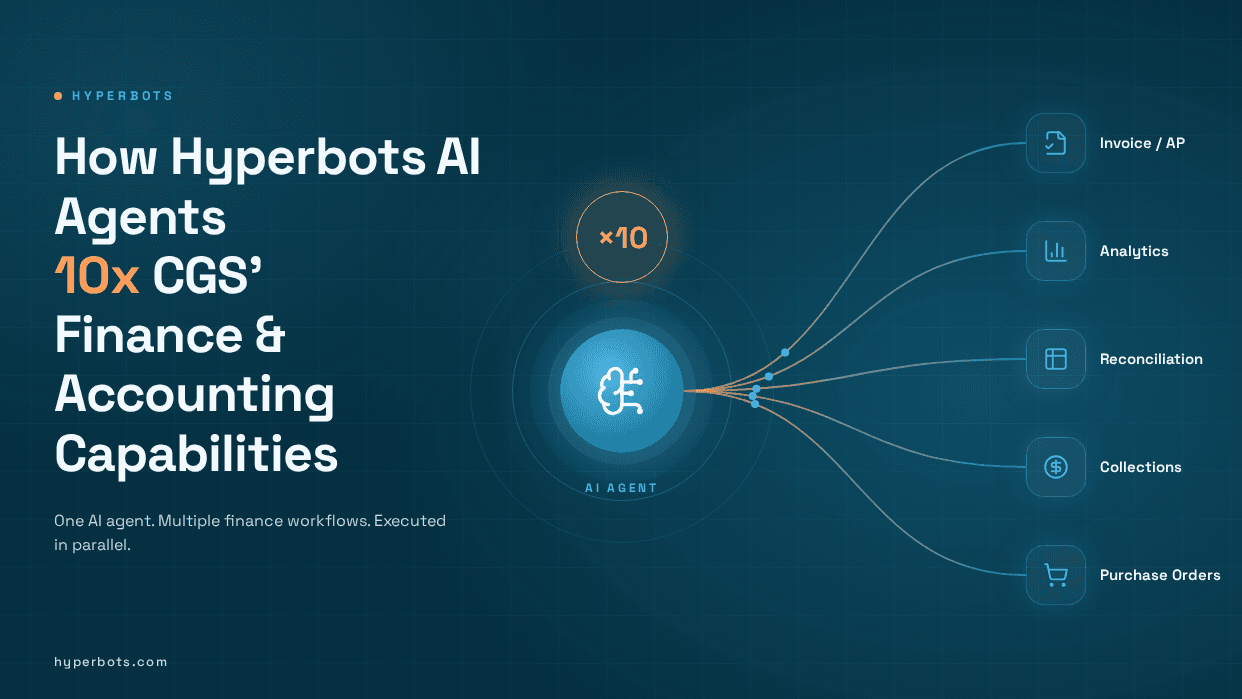

How Is Agentic AI Changing Finance & Accounting Operations on CGS?
A practical guide for finance leaders on how agentic AI is reshaping finance and accounting operations for fashion, apparel, footwear, and consumer goods businesses using CGS BlueCherry.
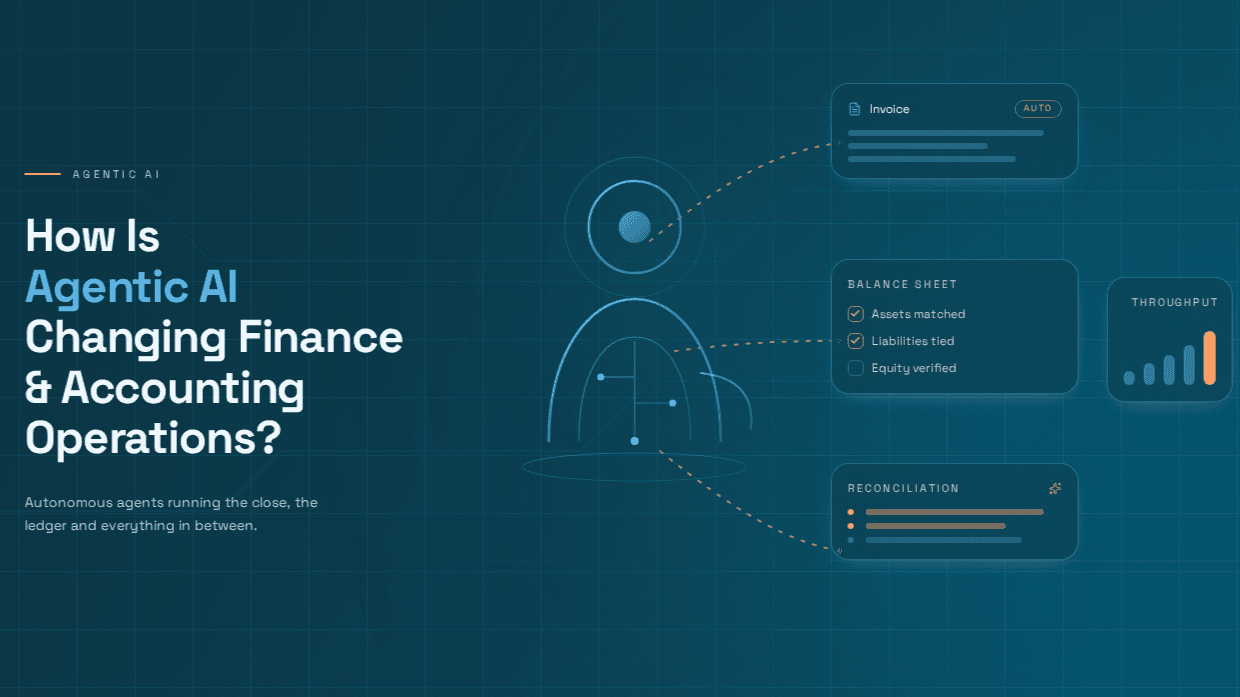
Finance teams running on industry-specific ERP systems like CGS BlueCherry are no strangers to volume. High invoice counts, multiple purchase orders per style or season, supplier and customer follow-ups, cash application, month-end reconciliations, and a steady stream of ad hoc reporting requests are simply part of the job especially for fashion, apparel, footwear, and consumer goods companies managing complex, multi-entity supply chains.
Traditional automation has chipped away at some of this manual load. Optical character recognition can read an invoice. Workflow tools can route an approval. But in most finance organizations, a person still has to move information from one step to the next: pulling data from one screen, checking it against another, deciding what to do with an exception, and updating a third system to close the loop.
That pattern is starting to change. The next phase of finance automation isn't simply about automating more individual tasks, it's about connecting those tasks into workflows that can execute, monitor themselves, respond to what they find, and escalate only what genuinely needs a person's judgment. This is generally referred to as agentic AI, and it's becoming increasingly relevant for finance teams operating on CGS BlueCherry. AI adoption is moving into this next phase quickly: PwC’s AI Agent Survey found that 79% of executives say AI agents are already being adopted in their companies, while 34% report their use in accounting and finance.
What Is Agentic AI in Finance?
It helps to place agentic AI on a spectrum of how finance work actually gets done:
Manual work: a person performs every step: opening the invoice, checking the PO, keying in the entry, following up by email.
Traditional automation: a system performs predefined, repetitive steps, such as OCR-based data capture or a fixed approval routing rule, but can't adapt when something doesn't fit the pattern.
Generative AI: a system can understand or generate information (drafting an email, summarizing a document) but typically waits for a person to direct the next step.
AI copilots: AI assists a person within their existing workflow, offering suggestions or filling in fields, but the person remains the one executing the process.
Agentic AI: AI can carry out multiple connected steps toward a defined objective, check whether the outcome is correct, respond to conditions it encounters along the way, and escalate exceptions to a human when needed.
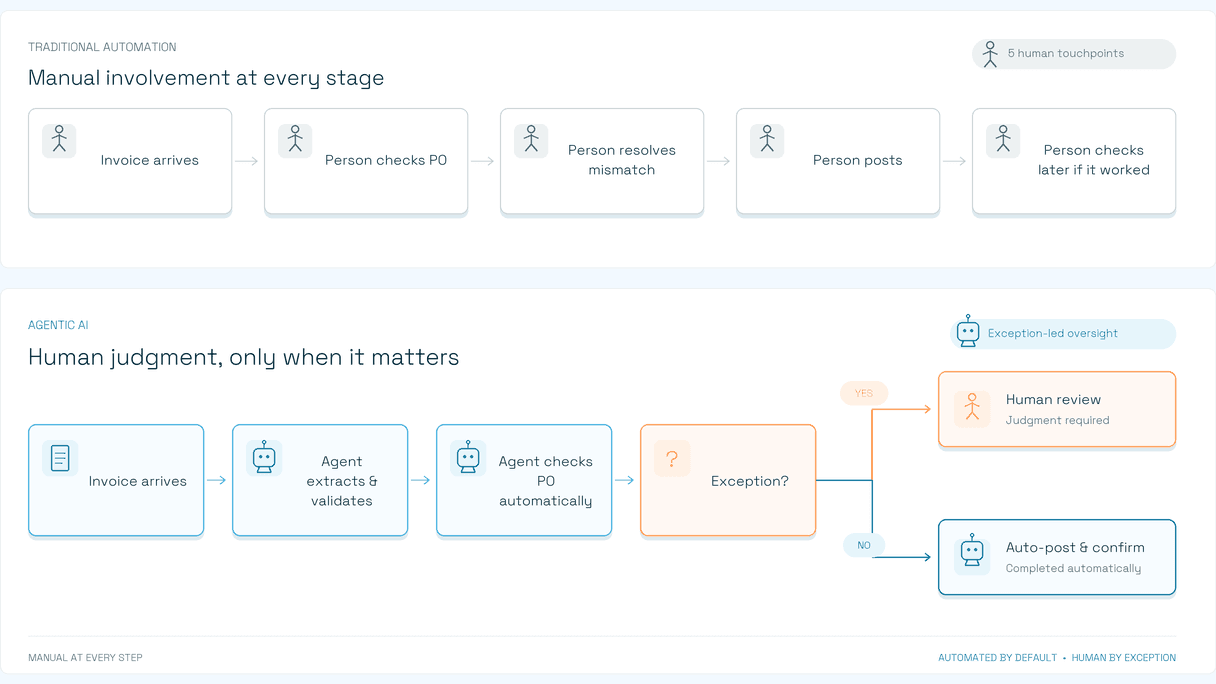
A simple finance example illustrates the difference. In a traditional process, an invoice arrives, a person extracts the relevant fields, checks them against a purchase order, resolves any mismatch, and posts the transaction. In an agentic process, an agent extracts the invoice data, validates it, checks the PO automatically, identifies a discrepancy if one exists, routes only that discrepancy to a person for a decision, and then confirms and posts once the exception is resolved.
For finance leaders, the practical significance isn't the technology itself, it's what it frees people to do. Fewer routine transactions require manual handling, which means more finance capacity is available for analysis, forecasting, and the judgment calls that genuinely need a human.
Why Agentic AI Is Particularly Relevant to Finance on CGS BlueCherry
Fashion, apparel, footwear, and consumer goods businesses tend to share operating characteristics that make interconnected finance workflows especially valuable though not every BlueCherry customer will exhibit all of them: large, often global supplier ecosystems; high invoice volumes tied to seasonal production cycles; purchase-order-heavy procurement spanning styles, colors, and sizes; seasonal working-capital pressure; multi-channel customer relationships across wholesale, retail, and e-commerce; retailer deductions and chargebacks that complicate collections and cash application; and reconciliation workloads spanning multiple entities and currencies.
The underlying pattern is straightforward: the more interconnected a finance workflow is, invoice to PO to GL to payment, or order to invoice to collections to cash application the greater the potential value of managing that workflow as a whole rather than automating its individual pieces in isolation.
This shift is already taking shape among BlueCherry users. In 2025, CGS announced that home-fashion company EnVogue International was using BlueCherry’s open API architecture to integrate finance-focused AI from Hyperbots into its supply-chain environment, applying AI agents to vendor management, invoicing, and reporting. EnVogue CEO Manoj Chirania described the initiative as a way to combine BlueCherry’s real-time visibility with advanced automation to modernize finance operations.
The Biggest Change: From Task Automation to Workflow Ownership
This is arguably the most important shift agentic AI introduces. Traditional automation tools might individually automate invoice extraction, PO creation, payment matching, or collections emails. But the finance process itself is not a single task, it's a sequence of connected steps, and automating each step separately still leaves a person responsible for stitching them together.
Traditional approach: an invoice arrives; an AP employee reviews it, checks it against the PO, resolves any mismatch manually, posts it, and later checks whether it was posted correctly.
Agentic approach: an invoice arrives; an agent extracts and validates the data, checks the relevant purchasing information, determines whether the invoice meets configured conditions for straight-through processing, posts routine transactions automatically, monitors whether posting succeeded, and escalates only the exceptions that require a decision.
Hyperbots' Invoice Processing Co-Pilot illustrates this pattern: rather than simply extracting invoice fields, it carries the transaction through validation, matching, GL coding, and posting as one connected sequence, surfacing exceptions for review rather than leaving them for someone to discover later. The underlying message is that agentic AI changes what gets automated from individual actions to the movement of work through an entire process.
How Agentic AI Changes Different Finance Operations
AP: From Processing Invoices to Managing Exceptions
The traditional AP job is largely data entry and chasing approvals. An agentic approach shifts the emphasis toward exception management: the system handles routine, well-formed invoices end to end, and people spend their time on the invoices that genuinely need judgment such as unusual coding, disputed pricing, or missing documentation.
As one reference point, Hyperbots reports 99.8% invoice field extraction accuracy, 80%-plus straight-through processing on qualifying invoices, and invoice-to-ERP posting in under a minute for straight-through transactions. These are Hyperbots-reported figures from its own deployments, not guaranteed outcomes for every implementation, and results will vary based on invoice complexity, data quality, and configuration.
P2P: From Moving Documents to Coordinating the Workflow
Procure-to-pay involves requisitions, approvals, purchase orders, supporting documents, and ERP updates typically touched by several people across several systems. An agentic layer can connect these steps: generating a purchase requisition, routing it for approval, converting it into a compliant PO, and dispatching it to the vendor, with the ERP kept in sync throughout.
Hyperbots cites examples of purchase requisition creation dropping to around five minutes and roughly 80% of PO creation and dispatch being handled automatically once approved again, reported outcomes from specific deployments rather than universal figures.
AR & Collections: From Chasing Accounts to Prioritizing Action
Collections work is inherently prioritization-heavy: which accounts to chase first, which follow-ups matter most, which disputes need escalation. Agentic systems can monitor aging balances, prioritize accounts based on configured criteria, initiate routine follow-ups, track promises to pay, and flag disputes for a human collector rather than leaving prioritization entirely to manual judgment.
Hyperbots reports collections productivity improvements of up to 80% and DSO reductions of up to 40% in some deployments through its Collections Co-Pilot. These figures should be read as illustrative of what's achievable under favorable conditions, not as a guaranteed result.
Cash Application & Reconciliation: From Matching Everything to Managing Exceptions
Cash application is a natural fit for the shift from full manual matching to automated matching of routine, clean transactions, remittances, straightforward payments, while ambiguous or unmatched items are surfaced for a finance professional to resolve. Hyperbots reports 80%-plus straight-through cash application and unapplied cash held under roughly 10% in some deployments via its Cash Application Co-Pilot.
Finance Intelligence: From Finding Reports to Asking Questions
A newer layer of agentic finance tooling lets finance professionals query financial data conversationally rather than building a report from scratch, asking, for example, about AP aging by vendor, which customers are overdue, or cash position by entity. Hyperbots' Vera, powered by its HyperLM model, is built around this kind of natural-language interface for CFOs and finance teams. The specific questions a system can answer will depend on what data it's connected to and how it's configured, these are illustrative use cases rather than guaranteed capabilities out of the box.
What Happens When AI Understands the BlueCherry Environment?
CGS BlueCherry is purpose-built for fashion, apparel, footwear, and consumer goods companies, which means finance data inside it, POs tied to styles and factories, vendor records, item masters, department codes, has industry-specific structure that a generic finance tool may not natively understand. Hyperbots' CGS BlueCherry Connector is built specifically for this environment, supporting real-time synchronization of invoices, purchase orders, vendor records, items, departments, PO attachments, and invoice statuses between the two systems, seven categories of finance-relevant data in total, covering the information AP and controllership teams actually work with day to day.
It's also worth understanding, at a practical level, how the two systems actually talk to each other, because it affects how quickly an integration can go live. BlueCherry doesn't expose all of its data the same way: some of it comes through a standard API, PO print documents move through a file-transfer pipeline, and certain finance records sit in BlueCherry's own staging and posting structure before they're finalized. A connector that only understands the standard API misses the rest. Hyperbots' connector was built to work with all of these paths rather than just one, which is a meaningful reason integrations with BlueCherry clients tend to go live in days rather than the months a more generic connector might require.
A few finance implications are worth translating out of technical language:
System integration means less duplicate work. When invoice, PO, vendor, and item data flow bidirectionally between the AI layer and BlueCherry across all seven data categories, staff don't re-key the same information twice.
Validation against BlueCherry's own records means stronger controls. Checking an invoice against live PO and vendor data, rather than a static rule set, reduces the risk of posting errors or duplicate payments. In practice, this includes checking whether an invoice number has already been recorded before writing it, so the same invoice can't be posted twice.
Status feedback means better operational visibility. Knowing whether a transaction actually posted in BlueCherry, not just that an automation "ran," gives teams clearer line of sight into where work stands, and each status update can be traced back to the original source document.
Exception handling with read-back verification and retries means fewer manual intervention tickets. Hyperbots' broader ERP integration approach verifies postings and applies retries on failures before routing genuine exceptions to a person. As one example, if an invoice can't be located in BlueCherry after it was supposed to be written because it was removed upstream, say the connector detects the gap and automatically re-attempts the write rather than generating a support ticket for someone to chase down.
Configuration-driven, company-specific field mapping means stronger auditability. Because the integration adapts to a company's specific BlueCherry setup rather than a generic template, the resulting transaction trail is more traceable.
Throughout, BlueCherry remains the system of record. The role of an agentic AI layer is to move data and decisions faster within and around it, not to replace it, an important distinction for finance leaders evaluating these tools. CGS and Hyperbots have publicly discussed this kind of collaboration in the context of BlueCherry's open API architecture, which is designed to let ERP customers plug in finance-focused AI capabilities without replacing the core system.
Agentic AI Can Be Self-Monitoring, Not Just Automated
One of the more meaningful distinctions between conventional automation and agentic AI is what happens after an action is taken. A conventional automation typically follows a "do, then stop" pattern: a step executes, and if something downstream fails silently, nobody finds out until someone notices later, often during a reconciliation or an audit. Gartner's guidance for CFOs reinforces why this distinction matters: finance AI agents should be deployed with review, traceability, and control mechanisms in place before organizations scale them into higher-impact workflows. A more agentic workflow follows a "do, check, detect, respond, confirm or escalate" pattern. For example, after writing a transaction into an ERP, the system can check whether the expected record actually exists, and if it doesn't, attempt to re-trigger the action or flag it for a person rather than assuming success.
On BlueCherry, this looks concrete rather than abstract: after an invoice is written, the connector checks BlueCherry's own records to confirm the invoice actually made it through, first as a staged entry, then as a posted transaction and classifies each one as in progress, posted, or failed. If it's missing entirely, the system re-attempts the write on its own before anyone has to notice the gap.
This built-in verification is a meaningful step toward workflows that manage themselves, though it's worth being clear that this one capability doesn't make an entire platform autonomous. It's one mechanism among several that, together, reduce the number of things a finance team has to catch manually.
How Finance Leaders Should Evaluate Agentic AI
Rather than evaluating vendors on feature lists alone, finance leaders considering agentic AI, on BlueCherry or any ERP, should ask:
Does it work with our existing ERP as the system of record, rather than trying to replace it?
Can it execute genuinely multi-step workflows, not just individual tasks?
Can it recognize exceptions and route them appropriately rather than forcing every case down the same path?
What happens when an automated action fails: does the system detect and respond, or does it fail silently?
Are there clear, configurable points where human approval is required?
Is every action traceable for audit purposes?
How is financial data protected, and what security certifications does the vendor hold?
Can performance be measured against a defined baseline?
Can the system scale across multiple entities, currencies, and transaction volumes?
Can the organization start with a single workflow say, invoice processing and expand from there, rather than requiring a full rip-and-replace rollout?
The Future of Finance Operations on CGS
The framing that will likely define the next several years of finance operations isn't ERP versus AI, it's ERP as the system of record, AI agents as a workflow and intelligence layer operating around it, and people as the decision-makers who retain final accountability.
For finance teams on CGS BlueCherry, this suggests a gradual shift in what the role of "finance operations" actually means: less time spent as transaction processors, more time spent as exception managers, analysts, controllers, and business partners to the rest of the organization.
Hyperbots' documented BlueCherry integration is one practical, currently available example of what this emerging model looks like but it's the underlying shift in how finance work gets structured, not any single vendor, that finance leaders should be paying attention to.
If your team is exploring where agentic AI could reduce manual work, tighten exception management, or free up capacity within your existing CGS BlueCherry environment, it's worth mapping your highest-volume, most repetitive workflows first and evaluating from there. You can request a demo with Hyperbots to see how one such approach works in practice, or explore Vera for a look at conversational finance intelligence.
Frequently Asked Questions
Q1. What is agentic AI in finance?
Agentic AI refers to AI systems that can execute multiple connected steps toward a defined objective, rather than performing a single predefined task, while monitoring outcomes and escalating exceptions to a human. In finance, this typically means an AI agent can extract, validate, match, post, and confirm a transaction across a workflow, not just complete one isolated step like data extraction.
Q2. How is agentic AI different from traditional finance automation?
Traditional automation executes fixed, repetitive steps and generally can't adapt when something falls outside its rules. Agentic AI can coordinate multiple steps, check its own outcomes, respond to what it finds, and hand off only genuine exceptions to a person - shifting automation from the task level to the workflow level.
Q3. How can agentic AI work with CGS BlueCherry?
Agentic AI platforms can integrate with BlueCherry through APIs, synchronizing invoices, purchase orders, vendor records, items, departments, and attachments bidirectionally. A well-built integration also needs to work the way BlueCherry itself operates, combining standard API calls, file transfer for PO documents, and BlueCherry's own staging and posting structure, rather than treating everything as one generic connection. BlueCherry remains the system of record; the AI layer handles execution, validation, and monitoring around it, rather than replacing the ERP itself.
Q4. How can AI agents improve finance operations in fashion and apparel companies?
Fashion and apparel finance often involves high invoice volumes, PO-heavy procurement across factories, and complex reconciliation. Agentic workflows can automate routine invoice and PO processing, prioritize collections activity, and flag exceptions, freeing finance staff to focus on judgment-heavy work like vendor negotiations, deductions disputes, and cash forecasting.
Q5. Can agentic AI automate accounts payable?
Agentic AI can automate a significant share of routine AP work, including invoice extraction, validation, PO matching, GL coding, and posting for well-formed invoices. Exceptions, mismatches, unusual coding, missing documentation, are typically routed to a person rather than fully automated, since these usually require judgment.
Q6. Can AI agents help with collections and accounts receivable?
Yes. Agentic systems can monitor aging balances, prioritize which accounts to pursue, initiate routine follow-up communications, track promises to pay, and flag disputes for human review. This shifts collections work from manually chasing every account toward prioritized, exception-based effort.
Q7. Does agentic AI replace accountants and finance professionals?
No. Agentic AI is best understood as handling execution, monitoring, and routine exception triage, while accounting judgment, materiality assessment, policy decisions, risk management, and relationship management remain with finance professionals. The goal is to shift human time toward higher-value work, not to remove humans from the process.
Q8. How should CFOs evaluate agentic AI tools?
CFOs should assess whether a tool works alongside the existing ERP as system of record, can execute multi-step workflows (not just single tasks), handles failures and exceptions transparently, offers clear human approval points, provides full auditability, meets data security standards, and can start with a single workflow before scaling further.
Q9. What is the role of the ERP when finance becomes agentic?
The ERP, BlueCherry, in this context, continues to serve as the authoritative system of record for financial and operational data. Agentic AI operates as a workflow and intelligence layer that reads from and writes back to the ERP, rather than replacing its core record-keeping and control functions.