Why Hyperbots’ Finance-Specific Agentic AI Outperforms Generic AI Platforms
A conversation with Juan Maes, COO at Viewpoint.ai, on why purpose-built finance AI delivers better accuracy, stronger governance, and faster ROI than generic AI platforms.
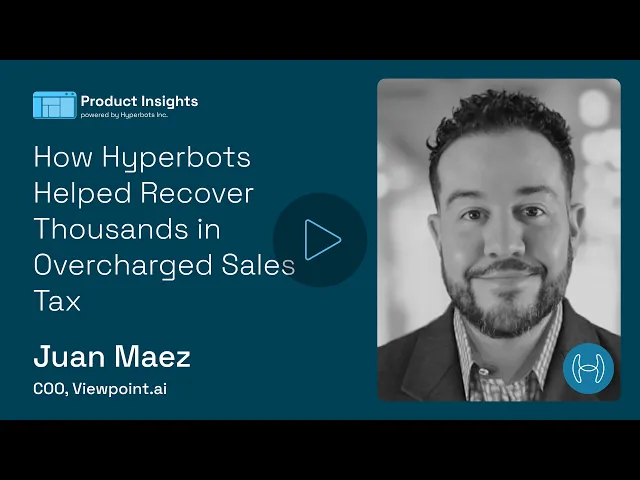
A conversation with Juan Maez, COO at Viewpoint.ai, hosted by Srishti Rajvir, Digital Transformation Consultant at Hyperbots
Most AI vendors sell horizontal, one-size-fits-all tools. Hyperbots doesn't. In this conversation with Juan Maes, a finance and operations leader with over two decades of experience at Intel, Google, Microsoft, and high-growth startups — breaks down why purpose-built, finance-specific agentic AI outperforms generic AI layers bolted onto an ERP, and what that means for CFOs, controllers, and AP teams trying to close books faster with fewer errors.
What Makes Hyperbots Different From Generic AI Platforms?
Srishti: Many vendors sell horizontal AI. What makes the Hyperbots platform finance-specific instead of generic?
Juan: Everyone assumes AI is everywhere — it isn't, at least not usefully. What I like about Hyperbots is that it's purpose-built for finance and accounting. It's trained on real accounting policies, like ASC 842, and behaves like an advisor or a CPA, not like a general-purpose LLM. If you work in finance, that's the difference: it takes the mundane work off your plate and gives you control while doing it.
How Accurate Is Hyperbots' Data Extraction, and How Is It Measured?
Srishti: You quote 99.8% extraction accuracy. How is that measured?
Juan: I look at it through invoices — Hyperbots has processed a huge volume across industries, from a single invoice to a thousand at once, and the accuracy holds. That's because it pulls in the layout, the models, and the expertise together — I call them "finance superheroes," available any time. Your team becomes the validator rather than the extractor, and most of what they're checking is already pulled straight from the ERP. When you're at 98-99% confidence, that's a meaningful number, not a rounded-up marketing stat.
This level of accuracy comes from Hyperbots' multi-modal mixture-of-experts approach, which combines multiple models for reasoning rather than relying on a single generic model — a key reason the platform performs differently from general-purpose tools.
What Does Higher Accuracy Actually Mean for the Bottom Line?
Srishti: Accuracy stats are great, but what does that translate to financially?
Juan: Every five points of accuracy you gain removes that many manual reviews. Moving from 70% to 99% accuracy can be the equivalent of two fewer people needed, depending on the size of your books. It also makes close easier and accruals less painful. Fewer errors simply means fewer headaches.
How Does Hyperbots Handle Unstructured Data?
Srishti: How does the platform synthesize unstructured data?
Juan: Data only matters once it becomes information. Hyperbots pulls in your chart of accounts, master lists, and open POs, then overlays everything so it actually makes sense — even something like vendor mapping is handled without extra manual work. I'm a finance person, not an accountant by trade, and it still feels effortless.
Traditional OCR dumps text and works reasonably well on structured data, but struggles with unstructured input. Hyperbots applies a finance-specific contextual layer on top of generic AI, so it can interpret unstructured documents the way a finance professional would — not just transcribe them.
What's the Value of Pre-Trained Finance Agents on Day One?
Srishti: Can you talk about the value of pre-trained agents from day one?
Juan: The appeal is plug-and-play — you feed in invoices and the system can consume all of them from day one. I'd actually describe it less as "pre-trained" and more as "pre-trained with expertise." The agents already know what they're screening for, which is what makes onboarding feel fast.
How Does Inference-Time Learning Work for Company-Specific Nuance?
Srishti: Some tasks, like coding entries, still need company-specific nuance. How does inference-time learning work?
Juan: Once a team learns to work with the platform, it becomes a real-time feedback loop — similar to an auto-ML pipeline giving you corrections minute by minute. GL corrections happen automatically, but you still review them, and confidence builds quickly because the accuracy consistently lands near 99%, which is higher than manual accuracy tends to be.
Is That Learning Confined to a Single Tenant?
Srishti: Is that learning confined to your own tenant or environment?
Juan: Data stays secure and tailored to the individual login — Hyperbots configures around personas, so what a controller sees and needs is different from what an AP analyst sees. You get your own integration layer and configuration, but the underlying business logic remains consistent across the platform.
Where Do Competing "AI-Enabled" Platforms Fall Short?
Srishti: Competitors claim to have similar AI. Where do they actually fall short?
Juan: Most systems have some kind of AI layer, but it isn't built end-to-end by accountants and finance people the way Hyperbots is — from data extraction and validation to coding and forecasting. Bolting AI onto multiple disconnected products is difficult to manage. An end-to-end platform built specifically by finance and accounting professionals can realistically drive at least 80% productivity gains — built, as I'd put it, by CFOs, for CFOs.
How Quickly Can a New Finance Process Go Live?
Srishti: How quickly could a company roll out a new finance process, like cash outflow forecasting?
Juan: It depends on company size. At a smaller SaaS company like PagerDuty, where I worked previously, teams need something affordable and fast to plug in — and that's exactly the model Hyperbots supports: connect to what matters, get forecasting running, and start seeing cash flow predictions quickly. Enterprises benefit too, since the simplicity cuts through what's normally a long buying and implementation cycle.
How Does an AI-Driven Platform Stay Explainable for Auditors?
Srishti: Human auditors need transparency. How does an AI-dense platform stay explainable?
Juan: I see AI as a force multiplier, not a replacement — but only when it's well-orchestrated and controlled by experts. The "why" behind every decision matters. Every agent in Hyperbots can explain its reasoning, which you can then question — that's part of a CFO's responsibility. That explainability is what lets auditors, regardless of which ones a company uses, follow and trust the output.
Does a Finance-Only Focus Limit Expansion Into Other Domains?
Srishti: Does the finance-only focus limit expansion into other areas?
Juan: Not at all. Having led finance transformation teams — including managing 75 people on machine learning and automation at Microsoft — I'd argue finance and accounting are the best functions to automate, precisely because they involve so many repetitive tasks. Hyperbots made a deliberate choice to focus there, covering everything from spend analytics to procure-to-pay to quarterly reporting. That focus is a strength, not a limitation — no other platform covers that full scope as intentionally.
How Does Higher Accuracy Change the Role of Finance Staff?
Srishti: How has the platform's accuracy changed staff roles?
Juan: This isn't disruption — it's evolution. The ROI is positive without requiring workforce reduction; instead, AP teams shift into more analytical roles, owning dashboards and driving effectiveness rather than manually chasing approvals or signatories. That time savings can be worth the equivalent of $200-300K depending on location and team size, and it's really about redeploying people toward higher-value work, not replacing them.
What Are the Risks of an AI-Native Stack vs. Rules-Based Engines?
Srishti: Are there risks with an AI-native stack compared to proven rules engines?
Juan: There are always risks — data availability chief among them. Hyperbots keeps data protected rather than exposed the way a general tool like ChatGPT might be. Human oversight still matters: financial processes are methodical, and as long as the rules are clearly set, AI handling that repetitive work tends to outperform manual processing, with less risk from human error rather than more.
Why Choose Hyperbots Over a Household-Name ERP Add-On?
Srishti: As a final takeaway — why Hyperbots over a household-name ERP add-on?
Juan: I think of it as a finance digital assistant. For day-to-day questions, you can trust the system directly; for strategic decisions, teams will still turn to their people, and that's expected. What stands out is the onboarding: Hyperbots lets you stay on your current system and process while it works alongside it, so you only go live once you're confident. That makes the transition close to risk-free.
The Bottom Line for CFOs
For a CFO operating under budget pressure, having accurate, auditable, finance-specific data in one platform — rather than a generic AI layer bolted onto an ERP — is the difference that matters. As Juan put it, companies of every size often need this kind of platform more than they realize, because inefficiency in finance operations quietly costs money long before anyone notices it. The goal isn't just automation — it's maximizing cash flow visibility and giving finance teams the tools to grow into new capabilities over time.
Interested in seeing how Hyperbots' agentic AI platform can support your finance and accounting workflows? Explore Hyperbots' finance AI co-pilots to learn more.